Introduction
Background
Emergency medical services (EMS) systems are an integral component of the US healthcare system, and are particularly important for the care of older patients. In 2006, 18.4 million patients were transported to the emergency department by EMS, approximately 15%, and the majority were triaged as urgent or emergent on arrival.Reference Pitts, Niska and Xu1 Of this total, 6.2 million transports were for patients ≥≥65 years of age, and 36.1% of older emergency department patients were transported by ambulance. Older patients utilize EMS at a rate of 167/1,000 population per year, and EMS transport needs are expected to grow as the population ages.Reference Shah, Bazarian and Lerner2 Based on population projections,3 at current utilization rates, EMS transports for elderly patients would number 9.2 million by 2020, 12.9 million by 2035, and 14.8 million by 2050.
In the US, EMS systems are a heterogeneous mix of public and private organizations, some hospital-based, some coupled with fire services, and some private and stand-alone.
All EMS systems rely almost exclusively on petroleum-based fuels to provide their services. This is a potential operational constraint, in that there currently is no alternative fuel source available at a large scale in the event of a supply shortage or significant price increases.
Petroleum supply limitations may be acute or chronic. As a result of storms, political conditions, and supply chain issues, acute shortages have occurred during the oil embargo of the 1970s and sporadically since. The Strategic Petroleum Reserves, sufficient for one month of domestic consumption,4 would provide raw materials but not refined fuels in the event of supply disruption. Longer-term supplies are determined by other factors, namely geologic availability, exploration, and oil field management. Concerns over long-term scarcity have emerged, with expert consensus holding that global production will peak in the next few decades.Reference Hirsch, Bezdek and Wendling5 Experts project that prices will climb steadily as production declines. If the supply contraction is abrupt there is potential for significant disruption in a range of activities including medical transport.Reference Frumkin, Hess and Vindigni6
Petroleum use by EMS also is a concern from the perspective of greenhouse gas emissions, as fuel use is a large proportion of direct EMS emissions.Reference Blanchard and Brown7 There are several compelling reasons for reducing emissions from the health sector,Reference Jackson and Naumoff Shields8,9 not least the health impacts of climate change.Reference Frumkin, Hess and Luber10 Vehicle emissions are a primary target for reductions of emissions. In the case of EMS, decreasing emissions through improved fuel efficiency also could significantly reduce operational costs.
Importance
Little work has been done to evaluate the vulnerability of EMS to fuel supply shortages and price increases, to model and prepare for such events, or to explore alternative fuel options. A flurry of such activity occurred after the fuel shocks of the 1970s,Reference Bailey11 and there have been scattered efforts to diversify energy sources for EMS activitiesReference Hawkins12,Reference Williamson, Knapp and Hubbard13 and to minimize costs associated with fueling EMS activities.Reference Phebus14 Studies note the impacts of fuel supply interruptions on hospital activities, medical services, and medical transport,Reference Babar and Rinker15–Reference Taylor17 but rarely discuss contingency plans or health sector preparedness for chronic supply shortfalls. Neither is there literature on EMS fuel use, though determining baseline use is an important first step to evaluating vulnerability.
The goal of this investigation was to begin filling this knowledge gap by establishing a baseline for fuel consumption, including total fuel used, fuel costs, mileage, and fuel use normalized to call and patient transport volume, in a large, dynamically deployed, ground ambulance EMS program.
Methods
Design
This study was a retrospective review of the dispatch calls, patient transports, ambulance miles traveled, and fuel used in a large EMS system from January 2007 through September 2008. Data included ambulance unit-hours, number of calls, responses, and patient transports. Only vehicles used for patient transport were included. The study was exempted from review by the Institutional Review Board (IRB).
Setting
This study was performed in a hospital-based, dynamically-deployed, ground EMS system with 35 diesel ambulances, all advanced life support (ALS)-equipped, that serves a metropolitan area with >5 million residents, services six area hospitals, and handles approximately 160,000 service calls and 120,000 transports annually. Its coverage area includes 132 square miles (212 square kilometers). The number of ambulances deployed depends on demand forecasts based on historical records. The system’s annual budget currently averages approximately US$140 million.
Protocol
Fuel purchasing and maintenance records were reviewed retrospectively. All ambulances in the EMS provider’s fleet were eligible for inclusion. Cases were excluded from analysis in the detailed mileage calculations if there were missing data that precluded calculation.
Measurements
Drivers entered odometer values into an information system when fueling. The fuel vendor tracked fuel use. Data on call volume, unit-hours, and patient transports were collected by the EMS organization, and manually abstracted from their continually updated operations database.
Data Processing
Data were collected by the principal investigator and a research assistant and descriptive statistics were calculated using SPSS 17 (SPSS, Inc., Chicago, IL).
Results
During the study period, the ambulance fleet operated for 277,849 unit-hours and traveled 1,902,710 miles. Detailed mileage data were available for 66,527 unit-hours, 23.9% of the sample, secondary to lost records and a change of fuel vendors. Out of 201 vehicle-months of data 36 (17.9%) were excluded secondary to poor data quality. There were 168,407 calls and responses and 118,263 transports during the study period. Fuel for EMS activities was readily available with the exception of September 2008, when hurricanes interrupted the fuel supply for 10 days and ambulances had to travel further than usual to refuel. Overall, mean mileage (with 95% confidence interval) was 6.89 (6.71, 7.08) miles per gallon (mpg) with a range of 3.7 to 15.0. An average of 11.5 (10.4, 12.6) miles were travelled per call, and 16.2 (14.8, 17.6) miles per transport; 2.7 (2.4, 2.9) gallons of fuel were used per transport, for a total of approximately 320,000 gallons of fuel consumed during the study period. The EMS organization paid >US$1.1 million for fuel during this time.
Discussion
This is the first published estimate of fuel use and mileage in an EMS system, though doubtless many EMS programs could generate a similar estimate with data at hand. The study’s main strength is the large amount of data used to generate the outcome estimate. Its main limitations derive from the need to exclude some data from the detailed analysis, the inability to evaluate factors such as idling behavior that may affect mileage and fuel usage, and the specificity of the findings to one particular EMS system. Each of these limitations is discussed briefly below.
Regarding data exclusion, certain drivers habitually failed to enter correct mileage. They may also have driven differently, affecting mileage estimates, though it is impossible to determine the direction of any bias. Regardless, its magnitude was likely small given that the outcome is an average.
Regarding the inability to evaluate factors that may affect mileage and fuel use, there are several related issues. Mileage is a useful, but potentially problematic outcome for a dynamically deployed EMS system, as several factors other than transport distances can affect fuel consumption, including travel from post to post, from post to base, for refueling, and for maintenance. Driver behavior and the propensity for dynamically deployed vehicles to idle while at post (in order to maintain climate control in their vehicles, for instance) also affect mileage estimates. These issues likely introduced a systematic bias that resulted in mileage underestimation. It is difficult to assess the magnitude of this bias without a comparison of this (or another dynamically deployed) system with one using static deployment. Absolute fuel usage normalized to patient transports, however, is not subject to the same bias and should be a fair estimation of fuel use in this system.
Regarding generalizability, these findings may not be generalizable to systems with substantially different design parameters, service areas, and other characteristics. Systems using static deployment may have higher mileage as they are less likely to idle at post, though they may have larger absolute fuel usage secondary to longer travel distances, while mileage may be higher in those covering larger areas or transporting at higher average speeds. Conversely, systems that rely on fire-based paramedics to stabilize patients in the field and on a separate ambulance service for patient transport are likely to expend more fuel per patient transport. Despite these threats to validity, the findings present a point of departure for considering issues of fuel efficiency, and petroleum dependence in EMS, and serve as a baseline against which future fuel consumption can be measured in this particular system.
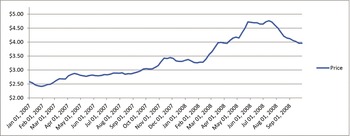
As it happened, there was a significant rise in the price of diesel fuel during the study period (Figure 1), resulting in significant cost increases related to fuel that were mirrored across the country. While prices dropped during the recession, they are likely to continue putting significant cost pressures on EMS organizations going forward. In this EMS system and others like it, the findings can facilitate scenario-based contingency planning, and help evaluate interventions to reduce petroleum dependence and exposure to rising petroleum prices. There are three intervention categories that that should be considered for evaluation: (1) decreasing transport needs through improved triage and telemedicine; (2) increasing fuel efficiency with different vehicles and deployment strategies; and (3) increasing reliance on other fuels including electric vehicles (including hybrids), biodiesel, and natural gas.
National weekly average diesel prices during the study period (Weekly prices for diesel and other fuels are collected by the US Energy Information Administration and are publicly available at http://tonto.eia.doe.gov/dnav/pet/pet_pri_gnd_dcus_nus_w.htm. Accessed 30 April 2010.)

There is scant literature on these topics, though strategies for decreasing transport needs are perhaps the best studied. The literature includes several papers recognizing the potential for better matching high acuity patients with constrained EMS resources.Reference Gellerstedt, Bang and Herlitz18 Evidence to date demonstrates that there are ways to identify low-acuity patients reliably,Reference Hinchey, Myers and Zalkin19 but also urges caution given potential sources of bias such as EMS providers’ tendency to underestimate patient acuity.Reference Knapp, Tsuchitani and Sheele20 Telemedicine, which allows for patient evaluation and treatment in situ, also might reduce transport demand. It has been shown to be effective at managing many medical conditions,Reference Schlachta-Fairchild21 and to provide care that better matches the needs of patients and their families.Reference McConnochie22 While transport-related fuel use and other costs have not been assessed, telemedicine would be expected to reduce EMS petroleum use, particularly in populations that use EMS frequently.
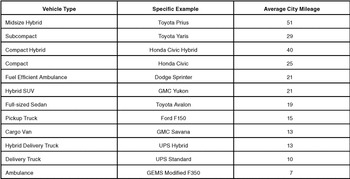
As for more fuel-efficient vehicles, there are reports of significant cost savings with fuel efficient ambulances such as the Dodge Sprinter,Reference Meaux23 (see Table 1) but there are no published estimates of their impacts on EMS operations in the medical literature. Papers evaluating the role of motorcycles in EMS have identified decreased response timesReference Lin, Chang and Shyu24 and added value particularly in life-threatening situations and for calls in which there was an uncertain need for an ambulance.Reference Soares-Oliveira, Egipto and Costa25 With proper training, safety does not appear to be a significant concern.Reference Kiefe and Oliveira26 There are fewer reports of EMS organizations using “green” ambulances that increase fuel efficiency,Reference Hawkins12 and/or ambulance modification to run on alternative fuels,Reference Williamson, Knapp and Hubbard13,Reference Harkness27 but no systematic studies of impacts of such modifications on mission critical outcomes, costs, and fleet performance over time.
Mileage spectrum for various vehicles (Data for all vehicles from Model Year 2010 Fuel Economy Guide produced by the US Department of Energy and the Environmental Protection Agency,28 with the exceptions of the mileage for the Dodge Sprinter, which is from Dodge,29 and for the UPS vehicles, which was reported in a separate US Department of Energy report.Reference Lammert30)

As cost pressures grow and technological innovation allows for more fuel efficiency, a wider range of alternative fuels, and better computer-assisted triage, such innovations are likely to be adopted by more EMS organizations. Future research should be devoted to evaluating the impacts of these interventions on fuel use, costs, transport times, and other mission-critical outcomes.
Conclusions
This study addresses a literature gap regarding fuel use in a large, hospital-based, dynamically deployed, ground EMS system. In this system, patient transport fundamentally is petroleum dependent, ambulances used approximately 2.7 gallons of diesel fuel per transport, and ambulance mileage averages approximately 6.8 miles per gallon of diesel fuel. Patient transport distances averaged 16.6 miles. Options to reduce operational dependence on petroleum-based fuels include strategies to reduce transport demand, strategies to improve fuel efficiency, and switching to alternative fuels and energy sources for patient transport.
Abbreviations:
EMS = emergency medical services
ALS = advanced life support