Introduction
The leading objective of this article is to examine the Chinese attempt, starting in 1988, to implement a big society project. This case study examines the reasons for the introduction of this policy, as an accompaniment to the economic restructuring begun under the Chinese leader Deng Xiao-Ping; its impact on ‘social welfare’ (which, in China, means mainly the care of older people) in the form of the ‘socialisation of social welfare’; and the reasons for its recent demise, as the role of the state in social welfare is being reinstated. Although there are striking parallels between this Chinese case study and the project launched by David Cameron in the UK following the formation of the Conservative led Coalition Government in 2010, not least in their common neo-liberal aims to reduce the scope of state welfare and boost that of the market, their comparison is not a purpose of this article. However, the conclusion contains some reflections on the possible lessons from China's experiment for the UK Coalition Government's project.
‘Small government, big society’
Although ‘small government, big society’ (xiao zhengfu da shehui) has never been publicly proclaimed as a slogan by China's top leaders, as David Cameron has done in the UK, this term has been so frequently used since the launch of economic reform that its status as an objective of the high level leadership for some two decades cannot be doubted. Thus its currency can be easily tracked in the discourses of government bodies, academia and the media.
‘Small government, big society’ is often used to describe the preferred consequence of the constant reforms in government administration which have accompanied the fundamental economic changes in China. Both are functions of the Communist Party of China's (CPC) acceptance of neo-liberal prescriptions concerning the importance of the market and the need to reduce the role of the state in welfare (Chan et al., Reference Chan, Ngok and Phillips2008). Economic reform centred on the decentralisation of power to local units, such as state enterprises or rural collectives (Eleventh CPC Central Committee, 1978). Seen as the most important means to achieve this end, the market mechanisms were introduced and the establishment of the ‘socialist market economy’ was set by the CPC as the ultimate goal of the economic restructuring (Jiang, Reference Jiang1992).
Due to the fundamental changes in China's economic base, the original mechanisms of totalitarian control in work and life (Shaw, Reference Shaw1996) were considered to be impeding the establishment of the socialist market economy. The incompatibility between the economic and political systems prompted the initiation of political reforms. Bureaucratism was identified by Deng Xiao-ping as one of the primary barriers to socialist modernisation. As he argued:
Our leaders at different levels have been involved in many affairs in which they should neither intervene, nor can they do well and nor even can they handle . . . With proper regulations, these affairs should have been done better by decentralising to enterprises, public institutions and social organisations. (1980: 328)
Consequently, with socialism and the dictatorship of the CPC, political reform in his mind was related to such measures as promoting younger leaders, streamlining the administrative structure and decentralising government power (Deng, Reference Deng1987).
Later Deng Xiao-ping's determination to fight against bureaucratism was institutionalised in the Thirteenth CPC National Congress in 1987. The transformation of government functions was confirmed as key in the forthcoming reform of government bodies (Zhao, Reference Zhao1987). According to ‘the demands of the economic reform and the separation of national enterprises from government administration’, the contents of the restructuring of government bodies in 1988 all aimed at:
improving the unreasonable structure of departments and the low efficiency of administration by transforming functions, decentralising power, restructuring departments, reducing staff, minimising government administration in enterprise management, and strengthening macro-control capability. (Song, Reference Song1988)
Also, social organisations were expected to take up some of the functions of administrative departments. As the then General Secretary of the CPC, Zhao Zi-yang, (Reference Zhao1987: 39) proposed, ‘The effects of mass organisations and autonomous mass organisations at grass-root levels should be fully utilised, so that the people can carry out their affairs by themselves in accordance with the law.’
The notion of ‘small government, big society’ was born along with this political reform process. This slogan was first proposed by a government researcher, Liao Xun (Reference Liao1988), in his academic papers in 1986. These works immediately attracted the attention of the central government as their analyses and policy implications fitted neatly the purposes of the political reform. Liao Xun was soon appointed to the preparatory committee for the establishment of Hainan Province and mainly responsible for designing the government bodies. Therefore, it was not surprising to find that Hainan was chosen by the State Council as the pilot province to fully implement the political reform in 1988, the aim of which was to achieve ‘small government, big society’.
Upon the establishment of the province, Hainan should stick to the separation of the party from the government as well as from enterprises, to the simplification of administrative structure and to the initiation of more economic entities . . . in order to achieve ‘small government, big society’. (State Council, 1988)
Subsequently, great efforts were made more or less continuously by the CPC, over two decades, to promote ‘small government, big society’. This can be demonstrated by the similarity between the contents of the later political reforms and those in 1988. For example, it was emphasised by each of the reforms in 1993, 1998 and 2003 that, given the separation between enterprises and government, the functions of government should shift to regulation and macro-control. Also, in order to increase efficiency, the State Council instructed regional and local governments to streamline administrative departments, reduce redundant staff and leave more autonomy for social organisations (Luo, Reference Luo1993, Reference Luo1998; Wang, Reference Wang2003).
In summary, fundamental changes to China's economic base, especially the introduction of market mechanisms, have forced the CPC to relax its previous totalitarian control. This includes decentralising some of its power to enterprises and social organisations, transforming government functions in regulation, and increasing its administrative efficiency. All of these measures in the various political reforms were intended to achieve a state−society relationship called ‘small government, big society’. The following section discusses how this rhetoric has influenced social welfare (especially in terms of the old-age care) in post-reform China.
The socialisation of social welfare
As constructed in the Chinese context, the concept of ‘social welfare’ (shehui fuli) differs considerably from analogous provision in the western welfare states (Leung and Nann, Reference Leung and Nann1995; Leung, Reference Leung, Walker and Wong2005; Chan et al., Reference Chan, Ngok and Phillips2008). Despite considerable variation in coverage and levels, before the economic reform most of the urban population were provided with comprehensive welfare programs by the danwei system (Bian, Reference Bian1994; Walder, Reference Walder1986; Walker and Wong, Reference Walker and Wong1996). The non-employment-related social welfare, delivered by the Civil Affairs authorities, was narrowly defined as ‘residual’ (buque xing), only offering assistance to the most disadvantaged elderly, disabled and orphaned who were neither covered by danwei nor supported by their family (Wong, Reference Wong1998; Dou, Reference Dou2007). However, after the economic reforms the restructuring of the social welfare system followed the prescriptions of the ‘small government, big society’ initiative. Danwei welfare provided by state enterprises was quickly labelled as a ‘public burden’, because it was thought to prevent state enterprises from competing in the market (Walker and Wong, Reference Walker and Wong2009). Consequently, as former Minister of Civil Affairs Cui Nai-fu (1982–1993) pointed out, ‘Along with further reform of large- and medium-scale enterprises and the transition of their operational systems, some of the services previously carried out by enterprises would have to be transferred to society’ (1992: 137).
Facing the prospect of these welfare responsibilities released by danwei, the Civil Affairs authorities decided to promote the initiative of the ‘socialisation of social welfare’ (shehui fuli shehuihua). Unlike direct provision, as under danwei, ‘socialisation’ refers to ‘push the society and the people to carry out their affairs by themselves with the advocacy, regulation and subsidy of the government’ (Ministry of Civil Affairs, Reference Affairs1991: 129). Later, the detailed contents of the ‘socialisation of social welfare’ were specified by the next Minister, Duoji Cairang (1993–2003), (Reference Duoji1998).
Firstly, the range of recipients should be expanded from the narrowly defined targets to the whole of the respective group in society. For example, rather than those without family members, all frail older people could be admitted to state nursing homes providing they could afford the fees. Secondly, various sources of fund raising, such as welfare lotteries and donations, could be used to support public funds for social welfare. Furthermore, private investors were warmly welcomed to initiate businesses in the elder care field. Thirdly, community organisations were encouraged to undertake responsibility for the provision of care and support. Fourthly, volunteers were expected to be fully mobilised to support service delivery. In essence, the role of the state in social welfare should be restricted to regulation instead of provision.
The campaign for the ‘socialisation of social welfare’ was still a major one in the early 2000s. It was clearly instructed by a decisive official document that argued that social welfare should be ‘based on family support, supported by community and supplemented by social welfare institutions’. Meanwhile, the role of state provision was further constrained because it was also stated that ‘state-owned social welfare institutions should be the demonstrations while other ownerships of social welfare institutions should be the backbone’ (Office of the State Council, 2000).
In terms of the regulatory role of the state and the heavy dependence on private channels (Wong, Reference Wong1994), it can be argued that the ‘socialisation of social welfare’ has been deeply affected by the rationale of ‘small government, big society’. For example, in a very similar vein to the discourses about the reform of state enterprises, it was also argued that the government was too involved in the administration of welfare institutions and social organisations such that its functions were both indiscriminate and over-extended.
‘Small government and big society’ is coming into formation because of the reform of government bodies. Regarding the administration of social welfare, the government should change their functions by separating away enterprises, public institutions and social organisations in accordance to the requirement of the socialist market economy . . . Only by doing this can the long-term problems of over-sized government body, over-lapping functions, over staffing, indistinctive governmental relationship with enterprises or public institutions, and serious bureaucrat practices be fundamentally corrected. (Duoji, Reference Duoji1998: 6)
Consequently, one of the two main solutions for reducing the functions of government in social welfare (e.g. the Civil Affairs authorities) was to emphasise regulation instead of provision – a classic choice in social policy, along with funding, with a direct parallel in the UK in the 1980s (McCarthy, Reference McCarthy1989). As Duoji Cairang (Reference Duoji1998: 7) argued, ‘According to “small government, big society”, the functions of government should turn to macro-control by regulations and pass the role of managing welfare institutions from Civil Affairs to social organisations.’ Furthermore, he insisted that the role of the government should be strengthened by ‘initiating, organising and leading social forces, designing policies and plans, providing guidance and supervision rather than undertaking everything as before’ (Duoji, Reference Duoji and Cairang2002a: 687).
The other solution was to lay the primary responsibility of social welfare provision on to ‘society’. This can be illustrated by the statements of Cui Nai-fu and Duoji Cairang.
As it will be heading towards the direction of ‘small government and big society’, many services which were conducted by the government should be carried out by society. Some of them will be delivered by the means of commercialisation and a considerable amount of them will be organised according to the socialisation. (Cui, Reference Cui and Affairs1992: 137)
The establishment of the socialist market economy requires the government to transform its functions and requires enterprises to transform their operations, which is in accordance to ‘small government and big society’ . . . Therefore, it is urgent to develop the socialisation of urban services. (Duoji, Reference Duoji and Cairang1994a: 57).
The social functions separated from enterprises will be undertaken by community . . . so that ‘small government and big society’ can gradually come into being. (Duoji, Reference Duoji and Cairang1999: 450)
Promoting the socialisation of Civil Affairs . . . is the effective means and the right direction of developing civil affairs in the socialist market economy. It is also the basic requirement of adapting to ‘small government, big society’. (Duoji, Reference Duoji and Cairang2002b: 665)
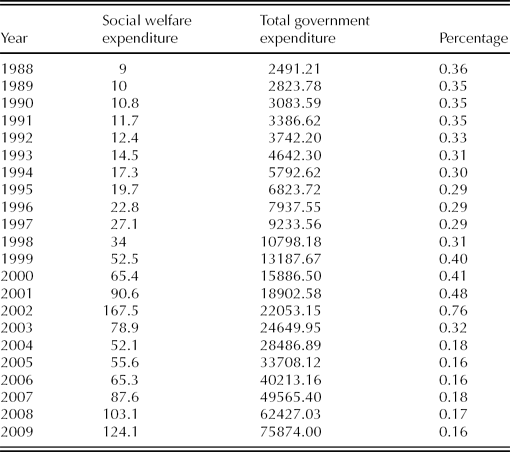
Of critical importance is the fact that the transformation of government functions and the ‘socialisation of social welfare’ were combined with a substantial reduction in public spending on social welfare as a proportion of total spending. Thus the state's commitment to social welfare was steadily residualised between 1988 and 2009. Despite increased allocations, it can be seen from Table 1 that the proportion of government expenditure devoted to social welfare dropped by over 50 per cent. This severe financial constraint added to the pressure on the Civil Affairs authorities to embrace the big society project. As early as 1985, it was advocated that the work of Civil Affairs should be shifted from ‘only emphasizing social profits and ignoring economic profits’ to ‘emphasizing both social profits and economic profits’ as well as ‘not only in relation to spending but also with regard to earning money’. Regarding the practice of social welfare reform, state-owned welfare institutions were expected to actively enrol self-financing customers, so that they could realise benefits without asking for a state investment. Also, to subsidise their expenditures, welfare institutions were required to develop new programs aimed at ‘gaining quick returns by small investments’ (Ministry of Civil Affairs, Reference Affairs1985: 59–60). In short, as Cui Nai-fu (Reference Cui and Affairs1988: 100) summarised, the experience of ‘relying on social forces to run social welfare at multi levels and through multi channels’ was ‘to do more things with less money and to do things without money’.
Spending on social welfare as a proportion of total government expenditure 1988–2009 (100 million yuan)

Source: Ministry of Civil Affairs (2010).
The heavy pressure behind the search for alternative resources for Civil Affairs was maintained throughout the 1990s. Duoji Cairang (Reference Duoji and Civil Affairs1994b: 190) stressed that ‘the problem of the state finance disproportional to the needs of Civil Affairs in the temporary future should be fully considered’. Accordingly, ‘the economy of Civil Affairs should be actively developed and the economic power serving Civil Affairs targets should be strengthened steadily’. For example, ‘all kinds of Civil Affairs institutions should strive to make revenues and subsidise welfare provisions by running businesses’. Similarly, having admitted to the limited financial support coming from the state, former Deputy Minister Fan Bao-jun (Reference Fan and Affairs1997) insisted that the focus should be placed on broadening the sources of revenue by the socialisation of Civil Affairs.
In summary, the authorities of Civil Affairs promoted the ‘socialisation of social welfare’ in direct response to the rhetoric of ‘small government, big society’. This policy was aimed at expanding the scope of social welfare by means of non-state funding and provision. Similar to the reform of state enterprises, the government's function in social welfare was expected to transform from provision to regulation. At the same time, ‘society’ (the family, the market and social organisations) was assumed to be the ideal alternative to undertake the welfare services released by the government. In fact, the drive to achieve ‘small government, big society’ in social welfare was associated directly with the overt intention of the Chinese Government to minimise public spending. The striking similarity with the big society project proposed by the UK Coalition Government hardly needs emphasising. Does the withdrawal of state support, especially in terms of public spending cuts, necessarily enhance the prospects of a ‘big society’?
The failure of socialisation
The Chinese big society project assumed that ‘society’ could spontaneously substitute for the state, providing that the state retreated from the field of social welfare. After an experiment lasting two decades, the activation of the big society in China – in the absence of sufficient public funding – turned out to be a failure. With regard to the care of older people, there are five main criticisms that are outlined here. Firstly, the decentralisation of welfare responsibilities from the state tended to equate with the irresponsibility of the state. Even the senior leaders of Civil Affairs realised this deficiency and issued some strong warnings. For example, the current Deputy Minister Dou Yu-pei (Reference Dou2007) pointed out that:
Due to the deviation of some areas in understanding, the major responsibility of the government in social welfare has been neglected, which caused the severe insufficiency of investment. This not only constrained the supply of social welfare services, but also mitigated the initiative of social forces participating in it because of the insignificant demonstration by the government.
Secondly, the potential of civil society was very likely overestimated, especially when compared to the larger demands for social welfare. Chan's (Reference Chan1993: 108) survey revealed that, at the beginning of the ‘socialisation of social welfare’ in 1988, there were only about 200 beds in all the community-based hostels in Guangzhou (one of the three largest cities in China). Moreover, nursing homes for older people appeared to be one of the most unpopular services for social organisations even after 2000. The percentage of non-government organisations (NGOs) involved in this area ranked twenty-one out of all of the twenty-eight fields across the country (Wang et al., Reference Wang, Deng and Gu2001). In 2009, there were no more than 2.66 million beds in all kinds of nursing homes across the country; however, the official figure for the number of older people with full dependency needs was 10.8 million in 2010 (Zhang, Reference Zhang2011).
Despite its role as an important component in civil society, the efficacy of neighbourhood mutual help remained highly questionable during the great ‘socialisation’. Chen's (Reference Chen1996) survey in 1990 showed that 83.3 per cent of the older people in Guangzhou named ‘spouse’, ‘children’ or ‘other relatives’ as the most reliable for the provision of financial help or personal care; while only 6.4 per cent chose ‘friends/neighbours’ and 7.7 per cent said they did not have any source of support. Likewise, a study conducted in Zhejiang Province in 1997 revealed that only 0.3 per cent and 0.5 per cent of the older people living in cities were looked after by ‘friends/neighbours’ or ‘Street Office/Residents’ Committees’. Worst of all for the big society project, none of the 1,303 older people in the survey was being helped by ‘volunteers’ (National Office of the Committee of Ageing, 2004: 392–400). This discrepancy between the needs of the older people and the provision of care by the local community prevailed throughout the early 2000s. Although 96.1 per cent of the respondents in Shijiazhuang (the capital city of Hebei Province) had expectations of community programs, 61 per cent of them never used the services. More than half of the respondents thought that they had a ‘not strong’, ‘insignificant’ or even ‘not any’ connection with the community (Zhou et al., Reference Zhou, Yan, Zhao and Qi2001).
Thirdly, it was the instability of funding that that deterred many of the forces of civil society. It was reported that among the fifty-three non-government institutions in Shanghai, only eight managed a small funding surplus while twenty-three were running on a deficit basis (Li et al., Reference Li, Hu, Zhang, Wu and Zhuo2002). Similarly, it was estimated that 20 per cent and 29.3 per cent of non-government institutions were operating at a loss in Guangzhou (Zhu, Reference Zhu2006) and Hubei Province (National Office of the Committee of Ageing and China Ageing Association, 2009).
Fourthly, although the ‘socialisation’ aimed at expanding the scope of social welfare recipients, it was also the case that certain groups of potential users were excluded. For instance, probably because of the concern about minimising costs, nearly two thirds of the nursing homes across urban China, especially the privately owned ones, would only accept admissions from older people who could look after themselves (Zhang, Reference Zhang2011). Other than those in ill health, older people in financial difficulties were the other common group whose needs were usually ignored. The official statistics estimated that 14 per cent of the older people living under the poverty thresholds all over China urgently needed personal care (National Office of the Committee of Ageing and China Ageing Association, 2006: 437). However, according to a survey of 1,500 older people living in Shanghai, 12 per cent of the respondents could not afford the charges even though they were willing to live in institutions (Li et al., Reference Li, Hu, Zhang, Wu and Zhuo2002). Likewise, Luo and Lei (Reference Luo and Lei2008) suggested that this dilemma could face 8 per cent of the whole older population in Guangzhou.
Finally, the retreat of the state from social welfare was actually opposed by public opinion. According to a survey of urban citizens in the cities of Guangzhou, Wuhan and Ji'nan in 1989, 93.5 per cent of the respondents agreed or strongly agreed with the statement that ‘reform should not lower welfare levels’. Moreover, 78.8 per cent agreed or strongly agreed that the social services delivered by the community were not sufficient (Chan and Chow, Reference Chan and Chow1992: 135–6). Similar findings were reported in Wong and Lee's (Reference Wong and Lee2001) survey in 1996. A total of 1,000 respondents in Shanghai generally favoured a strong state commitment to welfare. For example, 70.1 per cent ‘strongly disagreed’ or ‘disagreed’ with the view that ‘the main task of government is to enhance economic development, not to improve welfare’.
As demonstrated by the experiences of the ‘socialisation of social welfare’, the big society project in China was mainly a function of the retrenchment of state support, especially in terms of the reduction in public funding. As a result, there was ample evidence, as illustrated above, to demonstrate that the attempt to achieve a big society in China was a failure. The decentralisation and dispersal of state responsibilities did not necessarily stimulate a growth in social organisations and neighbourhood mutual help. Consequently, those older people most in need and struggling in their everyday livelihoods were quite likely to suffer from the policy of ‘socialisation’. Ironically too, the rhetoric of relying on society was actually opposed to the Chinese public's own views, which favoured more statutory support of social welfare during the economic transition.
The revitalisation of the state's role
Due to the problems associated with the ‘socialisation of social welfare’ policy in China, recently there has been a clear departure from the previous vague nature of ‘socialisation’ in practice. First of all, developing care provision for older people was acknowledged as a state responsibility. Together with education, income protection, health services and housing, ‘security for older people’ (lao you suo yang) was proposed in the Seventeenth CPC National Congress in 2007 as one of the goals to achieve a harmonious society (Hu, Reference Hu2007). Despite once being claimed to be a country deeply affected by Confucian values (Jones, Reference Jones and Jones1993; Walker and Wong, Reference Walker and Wong2005), it may be surprising to some Western commentators to see that the role of family care is being disregarded by the Chinese authorities. This can be illustrated by the rationale of a forthcoming system of ‘socialised elderly service’ during the Twelfth-Five Year Plan (2011–15):
To strengthen the system of socialised elderly service is the only road for adapting to the change of traditional old-age care and for satisfying people's needs of old-age care . . . The shrinkage of family size and the change of family structure are contributing to the weakening of family care. This is leading to the increasing needs for professional institutions and community services. (Ministry of Civil Affairs, 2011)
The inclusion of old-age care as a state responsibility demands the ‘leading roles of government’ (zhengfu zhudao) in the big society project, especially in terms of increasing financial investments. In charge of social welfare in the Ministry of Civil Affairs, Dou Yu-pei (Reference Dou2008) reinterpreted the relationship between ‘state responsibility’ and ‘socialisation’: ‘Socialisation is not to reduce the state responsibility. It is rather to strengthen the state responsibility, such as in planning, investment or regulation of elderly service.’ In a similar vein, the former Minister Li Xue-ju (2003–10) (Reference Li2008) stressed that, ‘The role of the government as the main investor should not be changed in the socialisation of the elderly service . . . The major responsibility of the government in social welfare shall be of more importance and its funding shall be further increased.’
Thus the forthcoming system of ‘socialised elderly service’ will require the authorities to substantially increase funding, either for guaranteeing the operation of public institutions or for subsidising services carried out by social organisations (Ministry of Civil Affairs, 2011). For example, between 2009 and 2010 500 million Yuan were spent on pioneering the development of home care in twelve provinces. This was the first time central government had supported local services for older people (Dou, Reference Dou2010). Based on the numbers of residents and newly increased beds, nursing homes for older people in Guangzhou can receive certain levels of subsidies from the local government (Guangzhou Municipal Bureau of Civil Affairs, 2009).
The revitalisation of state funding is directly connected to a new concept called ‘appropriate universalism’ (shidang puhui xing). This was proposed by the authorities of Civil Affairs and was used to replace the previous ‘residual’ approach (buque xing) to social welfare. The major difference between these two strategies concerns the beneficiaries receiving state support. On the one hand, a universal old-age allowance is distributed in most of the urban areas (Dou, Reference Dou2010). In Guangzhou, once over the age of seventy, older people are entitled to a monthly allowance and this allowance will increase along with age (Guangzhou Municipal Bureau of Civil Affairs, 2011). On the other hand, even if in great need, poor older people with family support were mostly overlooked by the previous big society project. They were only eligible for state protection when they had exhausted all sources of informal support. Now this group of older people can also be entitled to government subsidies on the basis of a means test and a needs assessment. For instance, the following four groups of older people in Guangzhou could receive a stipend from the government if they are in need of home-care services: the traditional Three Nos (people without any means of support); recipients whose incomes are lower than the Minimum Living Standard Guarantee threshold or the Low Income threshold and if they are either living alone or unable to care for themselves; people who were ever honoured as a model worker and are currently unable to care for themselves; or people who are over the age of 100 (Guangzhou Municipal Bureau of Civil Affairs et al., 2008).
In summary, all of these measures signal the changing attitudes of the Chinese government towards the ‘socialisation of social welfare’, enabling the future funding and delivery of social welfare by a more active state role. In other words, the Chinese leadership has acknowledged the inadequacy of the ‘small government, big society’ policy and recognised that both social welfare and civil society initiatives require financial backing from the state. The big society was not able to substitute for the state, therefore welfare has had to be re-nationalised (or re-socialised) as a core government responsibility. Needless to say, this presents a challenge to the neo-liberal ideas that have influenced China's reform path over the past two decades but which are beyond the scope of this paper.
Conclusion: lessons for the UK?
What pointers for UK policy may be extracted from this case study of the rise and fall of China's big society initiative? Despite the striking parallels, both rhetorical and substantive, between the Chinese policy and the Coalition Governments’ approach (the latter could have been modelled on the former if this was not such a politically preposterous idea) care must be exercised in attempting to transfer policy lessons across such fundamentally different societies, welfare regimes and polities. But there are four potentially instructive conclusions to be drawn from China's attempt to implement a big society framework, which apply with equal force to both Asian and European contexts.
First, there is the obvious danger of constructing a major policy initiative based on a vague rhetorical notion that appears to lack any empirical connection to real social and civic life and any understanding of how civil society operates, such as the factors which determine sustainable civic and social institutions, and how community solidarity is created. Second, there is the failure to recognise the need for state investment to support innovations in civil society. The current UK government appears to be following in the footsteps of the Chinese one in implementing its big society programme in parallel with cuts in public expenditure (Corbett and Walker, Reference Corbett and Walker2012). In both cases too, the big society rhetoric is central to the legitimation of those cuts in public spending. Third, is the crudely false perception of civil society as an alternative to state funded social welfare, as opposed to a supplement to it (although not necessarily in a handmaidenly role). Fourth, there is the erroneous equation, in both the Chinese and UK big society initiatives, between society and the market, when the two derive from fundamentally different logics: altruism and a network orientation on the one hand and, on the other, self interest and individualism. Arguably markets are major inhibitors of socially rooted activities, pushing as they always do for competitive advantage rather than a needs-focussed distribution. The fact that, following two decades in pursuit of the big society, the Chinese Government acknowledged its failure and set a new course towards the state sponsorship of social welfare and the role of civil society within it presents an instructive lesson for other governments contemplating similar strategies.
In the UK, the big society policy can be seen as supporting the further colonisation of the public and social by the market, the consequences of which are entirely predictable on the basis of previous experience: increasing social inequality, reducing solidarity and less freedom for the majority (Corbett and Walker, Reference Corbett and Walker2012). These are inevitable consequences of the ‘strategy of inequality’ favoured by neo-liberals (Walker, Reference Walker and Taylor1990; Wilkinson and Pickett, Reference Wilkinson and Pickett2009). The Chinese Government is clearly worried by these tendencies and has therefore decided to scale back the policy and adjust its rhetoric accordingly. It is a matter of conjecture how the UK Coalition Government will react to the predictably similar outcomes from its own big society initiative and, indeed, to what extent the Chinese Government will further modify its own neo-liberal inspired economic reforms by a thorough reassertion of the state's role in welfare.