INTRODUCTION
Radiation therapy has a longstanding and well-defined role in the treatment of several pelvic malignancies.Reference Glynne-Jones, Hadaki and Harrison1 Although, increasing efforts to deliver the radiation dose accurately and precisely to the target volume (tumour and/or locoregional nodes) adverse effects are still common.Reference Glynne-Jones, Hadaki and Harrison1 Damage due to radiation depends on each individual case, on the dosage administered and on the area affected by the radiation.
Bladder complications may be seen in 5–12% of patients treated with pelvic irradiation and acute haemorrhagic cystitis may occur in 2–8% of patients.Reference Capelli-Schellpfeffer and Gerber2, Reference Parra, Gómez, Marchetti, Rubio, Felmer and Castillo3 Bladder radiation injuries can be classified as acute (during or just after the completion of radiation), sub-acute (one to few months after treatment) or chronic (a few months up to 10 years or more). The most damaging late effects of radiotherapy is an obliterative endarteritis that leads to the classic ‘three H’ (hypoxia, hypovascularity and hypocellularity).Reference Marx4 These hystological changes are intimately associated with bladder mucosa atrophy, ulceration and subsequent bleeding without capacity to heal. In addition to the urinary irritative symtpoms, the development of haematuria of variable severity is one of the most challenging complications that the urologist must manage.Reference Martínez-Rodríguez, Areal Calama and Buisan Rueda5
There is no definitive treatment for radiation cystitis and its haemorrhagic component. Rather there are several treatment options available ranging from simple conservative methods (intravesical or systemic treatments) to radical procedures (selective hypogastric artery embolisation, supra vesical urinary diversion and cystectomy). Hyperbaric oxygen therapy (HBOT) emerged during the 1980s as a promising and non-invasive treatment modality for radiation cystitis as reported in several small series.Reference Bevers, Bakker and Kurth6 It is the primary treatment option that reverses vascular compromise caused by tissue irradiation.Reference Tarun and Puneet7 HBOT seems to improve regional tissue oxygenation in previously irradiated tissue, resulting in neovascularisation and cappilary growth into hypoxic and scarred submucosal tissue. HBO also increases fibroblast concentration, induces healing of tissue damage, and decreases oedema, necrosis and leulocyte infiltration.Reference Neheman, Nativ, Moskovitz, Melamed and Stein8
We aim to report the efficacy of HBOT in our series of 70 patients with radiation cystitis treated in our institution.
PATIENTS AND METHODS
We analysed 70 patients diagnosed with radiation cystitis treated with Hyperbaric Oxygen at the Hyperbaric Medicine Unit of Hospital Pedro Hispano between January 2007 and August 2013. Diagnosis of late radiation-induced cystitis was done by a referring urologist, based on medical history, symptoms (bleeding from the mucosa, dysuria, incontinence, frequency and/or weak stream) and or cystoscopic findings (macroscopically bleeding from the mucosa, telangiectasic and/or atrophic mucosa). All patients answered a questionnaire documenting symptom severity before treatment using just the subjective part of Late Effects of Normal Tissues – Subjective, Objective, Management, Analytical (LENT-SOMA) scale.Reference Anacak, Yalman, Ozsaran and Haydaroglu9 Patients with a urinary catheter were only evaluated for haematuria. Cystoscopy was performed to 48 patients (68·6%) before HBOT. Any other objective parameter was evaluated.
Follow-up period ranged from 4 to 85 months (median of 55·5) and was also supplemented with data collected from clinical records of the first and subsequent consults on Hyperbaric Medicine Unit. The follow-up schedule was determined by patients evolution with at least one observation at each 20 sessions to determine the need for more treatments. During the last month of 2013, all patients were interviewed by telephone to assess their final LENT-SOMA scale subjective response. All telephone interviews were conducted by the same person (C.F.).
Patients’ demographic characteristics, previous pelvic cancer, dose and date of radiotherapy, other late radiation complications, previous chemotherapy, cystoscopic appearance, prior or concomitant treatments, the number of transfusions given before the HBOT, time to the first episode of haematuria and time to HBOT’s were reviewed.
Our protocol consisted of multiple sessions (median of 40) of 100% oxygen delivery in a multiplace hyperbaric chamber at 2·4 atm pressure for 80 minutes. Treatment was given daily for 5 days a week. If more than 20 sessions were required, a 1-week interval was instituted after every 10. Complications were described and extracted from the medical records.
Descriptive and analytical statistics were applied using SPSS Statistics version 20·0. (IBM, Armonk, NY, USA) using the exact Wilcoxon signed rank test to compare pre and post-HBOT late radiation cystitis morbidity scores. The Pearson χ 2 test, the Student’s t-test and analysis of variance were performed to detect possible determinants of success. Response was evaluated in terms of total or partial resolution of bleeding and degree of improvement of the other symptoms evaluated by the LENT-SOMA scale.
Results
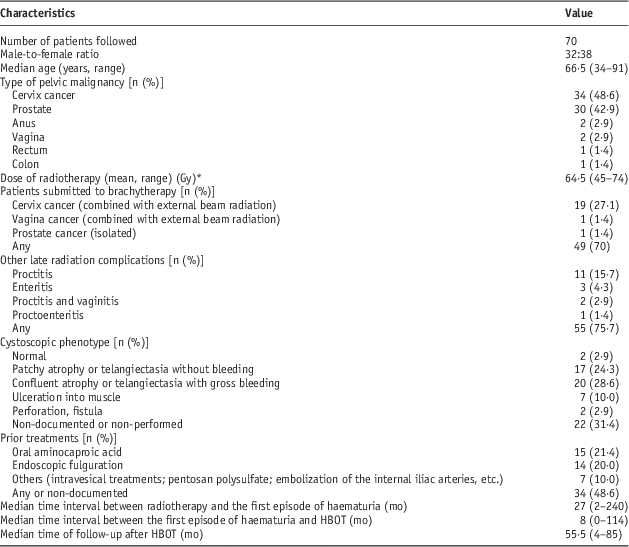
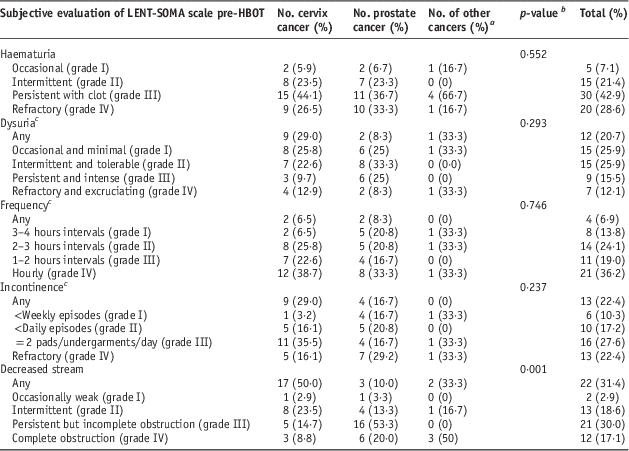
Patients’characteristics are summarised in Table 1 and patients’ symptoms collected by using LENT-SOMA scale are presented in Table 2. The main pelvic malignancies of our patients were cervix (48·6%) and prostate cancer (42·9%) with a mean radiation dose delivered of 53 and 65 Gy, respectively. The total dose of radiotherapy admistered was only available in 14 patients (20%) as all our patients performed radiotherapy in different institutions, and the treating institutions did not provided or was not possible to find these informations. One man received brachytherapy as primary treatment for prostate cancer and 20 women underwent external beam radiotherapy combined with brachytherapy—19 for cervix cancer and one for vaginal carcinoma. Twenty-one women received chemotherapy. Any patient was treated with cyclophosphamide before.
Patient characteristics

*Notes: The radiation dose for pelvic malignancies was available in 14 of 70 patients.
Abbreviation: HBOT, hyperbaric oxygen therapy.
Baseline subjective score of LENT-SOMA scale (pre-HBOT)
Notes: a Other cancers: 2 vaginal, 2, anal, 1 rectal, 1 colon cancer.
b p<0·05, differences statistically significant under χ 2 tests.
c In all, 12 (17·1%) patients had an urethral stent before HBOT and were not evaluated to this parameter.
Abbreviation: HBOT, hyperbaric oxygen therapy; LENT-SOMA, Late Effects of Normal Tissues – Subjective, Objective, Management, Analytical.
Late complications such as bowel morbidity or perineal inflammation were present in 17 patients (24·3%). Abnormal cystoscopic appearance was present in 46 patients (96% of patients who had this exam documented). About half of the patients (51·4%) had previously undergone systemic treatments (oral aminocaproic acid or pentosan polysulfate) or one or more bladder lavage procedures with elimination of clots and/or cauterisation under anaesthesia.
Patients’ baseline symptoms (Table 2) demonstrate that 71·5% of patients had persistent and refractory haematuria with clots. Twenty-two patients (31·4%) needed multiple blood transfusions before or during HBOT. No significative difference was found between baseline symptoms (haematuria, dysuria, frequency, incontinence) and type of pelvic malignancy irradiated with the exception of decreased urinary stream (p<0·001). Twelve patients had an urethral stent before HBOT.
The success rate after the follow-up period (median of 55·5 months) in terms of haematuria resolution or improvement was 91·4% (71·4 and 20%, respectively). Half of the patients performed more than 40 sessions of HBOT (range: 10–93 sessions) to achieve this success. One patient who previously had noted improvement after 40 sessions underwent re-treatment for recurrent bleeding symptoms 18 months after completion of the first course of therapy. Haematuria persisted in six patients of whom five performed a cystectomy as a salvage resource. These patients had no response to HBOT and performed other treatments such as endoscopic fulguration or formalin instilation without any success. Average post-HBOT transfusion requirement on these patients was six units. Pathology reports from cystectomy specimens confirmed radiation cystitis, indicating diffuse haemorrhagic changes, inflammation, and fibrosis without signs of malignancy. One patient with persistent refractory haematuria and incontinence after 60 hyperbaric treatments underwent loop urinary diversion without cystectomy.
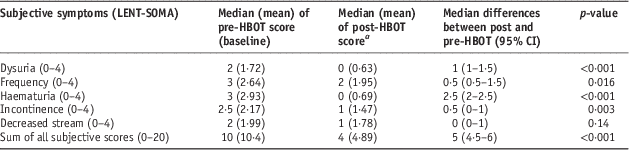
In the entire group of patients, the mean score of each subjective variable of LENT-SOMA scale (dysuria, frequency, haematuria, incontinence) were significantly lower after the follow-up period (p<0·05) with the exception of decreased stream (p=0·14). The sum of all subjective scores of LENT-SOMA scale was also significantly lower after the follow-up period (p<0·05) (Table 3). Significative differences were also found between haematuria response and the time interval between the first episode of haematuria and HBOT (p<0·05). However, the success rate was not related to patient gender or age, hypocoagulation or antiaggregation, number of hyperbaric sessions, type of primary pelvic tumour, dose of radiation or previous brachytherapy, previous chemotherapy, other late radiation comorbidities, cystoscopic phenotype, type of prior treatments and time interval between radiotherapy and the first episode of haematuria (p<0·05).
Changes in subjective part of LENT-SOMA score pre- and post-HBOT
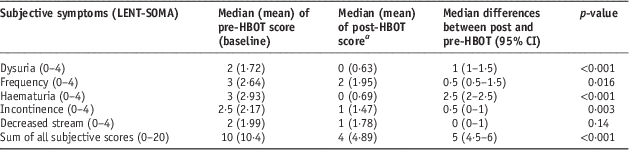
Notes: a Last month of 2013 (end of follow-up period).
Abbreviation: LENT-SOMA, Late Effects of Normal Tissues – Subjective, Objective, Management, Analytical; HBOT, hyperbaric oxygen therapy; CI, confidence interval.
With regard to HBOT complications, there were three cases of barotraumatic otitis treated with miringotomy, subsequently completing their treatments with HBO. All these patients continued their treatments subsequently. No other complications were observed.
Discussion
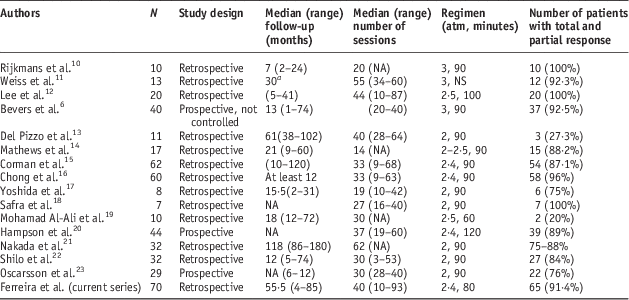
Radiation cystitis is a challenging complication for the urologist. Several studies have reported a positive effect of HBOT on this chronic complication of radiotherapy (Table 4).Reference Rijkmans, Bakker, Dabhoiwala and Kurth10–Reference Oscarsson, Arnell, Lodding, Ricksten and Seeman-Lodding23 It manifests as presence of persistent or intermittent episodes of haematuria, frequency, incontinence, dysuria and decreased stream with a great impact in patients’ quality of life.Reference Sidik, Hardjodisastro, Setiabudy and Gondowiardjo24 The underlying mechanism of radiation cystitis is tissue ischaemia resulting in reduced ability to replace normal collagen and compromised cellular loss which causes difficulty in healing.Reference Tarun and Puneet7 Increased oxygen supply stimulates neovascularisation and induces collagen production through fibroblasts, culminating in wound healing and tissue regeneration.Reference Craighead, Shea-Budgell and Nation25
Efficacy of HBOT in the treatment of late radiation cystitis
Notes: a Mean.
Abbreviations: HBOT, hyperbaric oxygen therapy; NA, not available.
Our study is one of the largest series of patients undergoing HBOT for radiation cystitis and with the third longest period of follow-up (Table 3). Our response rate was 91·4% compatible with previous studies (Table 4) and with a median follow-up of 55·5 months. Del Pizzo,Reference Mohamad Al-Ali, Trummer, Shamloul, Zigeuner and Pummer19 reported worse results with a long-term follow-up. With a median follow-up of 30 months, 8 of 11 patients were asymptomatic (three had required urinary diversion) but with a median follow-up of 60 months only three had complete resolution of their symptoms (eight had been treated with surgery). On the other hand, the study of Nakada et al.,Reference Nakada, Nakada and Yoshida21 offers retrospective data from a series of 34 patients with a past history of prostate cancer followed for an average of more than 84 months with higher level of success (75–88%). One of the main explanations pointed for the long-term success of Nakada et al.Reference Nakada, Nakada and Yoshida21 compared with Del PizzoReference Mohamad Al-Ali, Trummer, Shamloul, Zigeuner and Pummer19 series was the higher mean of HBO sessions performed (62 versus 40), some of which were repeated treatments for intractable cases and those of relapse. In our institution we normally prescribe 40 sessions as Del Pizzo,Reference Mohamad Al-Ali, Trummer, Shamloul, Zigeuner and Pummer19 and in some patients we expand our protocol in case of persistent haematuria. With a median of 40 sessions we just repeated treatments in one case of recurrent haematuria after 18 months with complete resolution aftwerwards. Repeat HBOTs can provide additional benefit,Reference Yoshida, Kawashima, Ujike, Uemura, Nishimura and Miyoshi17 however, we were not able to prove any relationship between the number of treatments and patient outcomes in terms of haematuria or all symptoms score during our long period of follow-up.
It should be noted that in almost all studies hyperbaric oxygen was used after radiation cystitis had failed to respond to other treatments, sometimes allowing deterioration to a severe state.Reference Parra, Gómez, Marchetti, Rubio, Felmer and Castillo3 Our median time interval between the first episode of haematuria and HBOT was very short (8 months) and only half of all patients received prior treatments to control their symptoms. In our series, there were significative differences in haematuria response according to the time of evolution of radiation cystitis previous to the initiation of HBOT. Starting HBOT earlier seems to result in a total resolution of haematuria in opposition to delayed treatments which seem to result in just a partial improvement. Nevertheless, we were not able to demostrate that success (haematuria improvement or resolution) or failure was directly related with the period of time the patient waited for HBOT.
The majority of the studies do not use a bladder toxicity scale to compare the results pre- and post-HBOT, making their comparison difficult. Oliai et al.Reference Oliai, Fisher and Jani26 evaluated 15 patients retrospectively according to the LENT-SOMA scales on the basis of their documented signs and symptoms—and were scored accordingly. It provides an order of severity of radiation-induced complications. As far as we know, no other series were evaluated with LENT-SOMA scale before to compare HBOT effectiveness on late radiation cystitis. Comparing our mean pre-HBOT score (sum of subjective scores divided by five) with the one of Oliai et al.,Reference Oliai, Fisher and Jani26 our patients were on average much more symptomatic (2·04 versus 0·72) and with severe haematuria before HBOTs (70·9% persistent or refractory versus 53·3% persistent). The mean post-HBOT score between our study and the one of Oliai et al.Reference Oliai, Fisher and Jani26 was also different (1·0 versus 0·2, respectively). Their haematuria resolution rate of 100% has to be analysed carefully as two patients with ‘temporary resolution of haematuria’ presented recurrent and uncontrolled haematuria after additional HBOTs. Our results were not related with prior severity of haematuria, however, were comparable or even better in terms of permanent resolution or improvement of bladder bleeding.
Besides haematuria, the most severe pre-HBOT symptoms of late radiation cystitis were decreased stream, frequency and incontinence. The reference to decreased stream was statistically different between males and females (p<0·05) in probable relation with anatomical diffences between both. The outcomes of HBOT had also a significant impact on frequency, incontinence and dysuria (p<0·05), however, urinary stream did not change considerably after the follow-up period (p>0·05).
The major limitation of our study is the retrospective nature of its design, preventing an accurate measurement of the effect of HBOT in urinary symptoms after pelvic radiotherapy. There are only few prospective and non-randomised studies conducted on the effects of HBOT on late radiation cystitis. Bevers et al.Reference Bevers, Bakker and Kurth6 reported a prospective but non-randomised study of 40 patients; most of them with refractory haematuria. Patients had received unsuccessful treatments: clot evacuation, electrocoagulation, alum, tranexamic acid. They received a regimen of 20 sessions and with a median follow-up of 23 months only 3 (7·5%) patients with severe haemorrhagic cystitis pre-HBOT failed to achieve a total or partial response. Unlike us, in this study, the severity of initial haematuria appeared to influence the response to hyperbaric oxygen. Until now, as any prospective study has a control group not receiveing HBOT, one cannot exclude the possibility that some element in the improvement in symptoms from urinary bladder is a result of chance or a placebo effect. To eliminate these confounders, a Scandinavian prospective, controlled, multicenter trial, RICH-ART (radiation-induced cystitis treated with hyperbaric oxygen – a randomized controlled trial), has recently been initiated.Reference Oscarsson, Arnell, Lodding, Ricksten and Seeman-Lodding23
Another limitation of our study is the lack of information about radiotherapy details. The total dose was only available in 14 patients (20%). Some patient’s records date back more than 10 years and all of them performed radiotherapy in different institutions. More detailed information about radiotherapy treatment protocols would be extremely useful. However, it is important to emphasise that success rate was not related to primary pelvic tumour or type of radiation therapy (combined or isolated external beam radiotherapy and/or brachyterapy).
The tolerance of HBOT by the patients was extremely good, with limited side effects being reported. Barotraumatic lesions caused by compression or expansion of enclosed gas volumes, were responsible for three middle ear otitis easily treated.
Our Hyperbaric Medicine Unit receives patients with radiation cystitis from many regions of Portugal. Treatment expenses include costs attributable to the chamber, staffing and monitoring. The average cost per treatment was $134 and per patient was $5,360. Six patients from our hospital were admitted in our Urological Department during HBOTs to perform continuous bladder irrigation and analytical studies. The average cost per night was about $400. The total number of patient days was 308 with an economic burden of about $120,000. Some other patients were from far away places and travel or hospital admission expenses were supported by local hospitals. An economic comparison with other treatments (conservative and surgical interventions) is being performed in our hospital in terms of quality of life, cost-effectiveness and cost-utility. Until the presentation of these outcomes, our long-term improvement rate of haematuria of 91·4% issued the capacity of HBOT to decrease the number of emergency episodes, inpatient admissions and consultations in our population of patients. The similar impact observed on urinary frequency, incontinence and dysuria represented an expected improvement of quality of life to our patients. Conservative treatments often require repeat hospitalisations to control symptoms and may leave patients with a contracted bladder, urinary urgency, frequency and incontinence in opposition to HBOT which seems safe and promote healing in radiaton injured tissue, including bladder.
Conclusions
HBOT is a non-invasive, safe, effective and durable treatment of chronic radiation cystitis and its haemorrhagic component. According to other studies, our results, based on one of the largest series ever reported, support HBOT as an alternative treatment for radiation cystitis caused by pelvic radiation. This paper goes a bit further and shows that HBOT is useful not only for those patients who were refractory to other treatments, but also, for patients with intermittent or persistent haematuria and other distressful urinary symptoms as a first presentation. Finally, we highlight the potential of HBOT to produce long-term resolution or improvement of haematuria without the need of any other treatment or hospitalar readmission.
Acknowledgments
The authors thank to all the professional staff of Hyperbaric Medicine Unit who assisted them in data collection and patient care.
Financial support
This research received no specific grant from any funding agency, commercial or not-for-profit sectors.
Conflicts of Interest
None.