As inequalities of wealth and income have skyrocketed in the United States, pundits and scholars alike have started paying more attention to the political activities of billionaires and multimillionaires. Media stories feature famous contributors such as Tom Steyer, Charles and David Koch, Michael Bloomberg, and Sheldon Adelson, while academic researchers increasingly track aggregate election contributions from large numbers of wealthy donors.Footnote 1 Useful as such work may be, it misses an important aspect of plutocratic influence in American democracy—the sustained efforts of organized groups and networks of political mega-donors, who work together over many years between as well as during elections to reshape politics and agendas of public policy. Only recently have political scientists started to look into these kinds of institutional and network ties among wealthy political donors.Footnote 2
Our work contributes to this new direction by focusing on two formally organized consortia of wealthy political donors that have recently evolved into highly consequential forces in U.S. politics. On the right, the Koch seminars directed by Charles and David Koch and their close associates were launched in 2003 as twice-yearly gatherings of very wealthy conservatives aiming to push the Republican Party and U.S. government toward libertarian and ultra-free-market politics. Meanwhile, the Democracy Alliance (DA) was launched in 2005 to bring together more than a hundred left-leaning wealthy liberals to meet twice a year and channel contributions to advocacy and constituency organizations operating on the left edge of the Democratic Party. We have assembled unique membership and organizational data on both consortia, enabling us to track their development and compare their impact at the two ends of the U.S. partisan spectrum.
This article presents early findings from two kinds of analyses. At the aggregate individual level, we describe the social and economic characteristics of the very wealthy Americans who have joined the Koch seminars and the DA and, at relevant points, consider the impact of those characteristics on consortium operations. More importantly, we probe the organizational rules and routines of the Koch and DA consortia, to discover how they structure member participation and direct large sums of donor money to additional arrays of think tanks, advocacy groups, and constituency-mobilizing groups active on the left and right edges of America's two major political parties. Understanding how donor money is raised and channeled allows us, in turn, to explain the different kinds of influence these two consortia have wielded in contemporary U.S. politics.
To briefly foreshadow our bottom line: As the Koch seminars have fueled a tightly integrated political machine capable of drawing national and state Republican officeholders and candidates toward the ultra-free-market right, the DA has orchestrated more limited results by channeling resources to large numbers of mostly nationally focused and professionally managed liberal advocacy and constituency groups. Both donor consortia have helped to reshape American politics, but the Koch impact has been much greater and has encouraged both rightward-leaning polarization and rising inequality.
As we develop our analysis, we consider alternative explanations for the greater impact of the Koch network—including suggestions that conservative mega-donors are simply more numerous or inherently more ideological and unified than progressive wealthy donors. Over recent years, in fact, liberal wealth holders have become more prevalent in the United States, and the leftist DA initially attracted more donors than the early Koch seminars. What is more, both Koch and DA donors espouse varied and at times conflicting political priorities and worldviews. Rather than reduce these donor consortia to individual member characteristics, we present evidence that their divergent strategies and impact have been shaped by contrasting organizational rules and strategic choices implemented at key junctures in recent national political time. Simply put, the Koch seminars have encouraged members to support a highly centralized and strategically nimble political operation, while DA rules encourage the decentralized scattering of member contributions and give individual donors substantial authority over which priorities, tactics, and groups the DA supports. As a result, the Koch seminars were well-equipped to seize on conservative discontent, first under the Bush presidency and later the Obama administration, to shift state and federal policy to the right. In contrast, the decentralized DA rules left the consortium poorly situated to address rising political threats from the far right by making it hard for the DA to prioritize new issues or build enduring cross-state organizational infrastructure.
The remainder of our article proceeds as follows: We begin by outlining our concept of donor consortia, indicating the special combination of functions we see these organizations as performing and situating consortia in comparison to other forms of concerted political funding. After this conceptual introduction, we discuss our sources of evidence and briefly summarize the origins and evolution of the Koch seminars and the DA. With the stage thus set, we unfurl in turn the results of our analysis of individual characteristics of consortium members and proceed to explore membership rules and procedures for aggregating and deploying donor resources to support other conservative or liberal organizations. In the final sections, we weigh alternative explanations and offer preliminary hypotheses about the sharply contrasting effects of the Koch seminars versus the DA on the larger organizational terrain of U.S. politics.
CONCEPTUALIZING DONOR CONSORTIA
We propose five features that, taken together, set organized donor consortia such as the Koch seminars and the DA apart from other well-known examples of concerted political fund-raising that share some but not all of these defining characteristics.
1. Continual giving by members. Wealthy donors in the Koch seminars and the DA do not simply write one-off checks as they might to political action committees (PACs) or advocacy groups. The consortia attract member donors in order to foster longer-term commitments among like-minded wealthy people who give at or above a predictable minimum level year after year. DA partners who are individuals or two-member households pay $30,000 annually in dues and pledge donations to DA-recommended or DA-approved organizations that total at least $200,000 each year.Footnote 3 Analogously, Koch seminar members contribute (apparently individually) “at least $100,000 a year to the causes Charles Koch and his brother David promote.”Footnote 4 Such membership rules, plus the fact that many donors, especially Koch donors, clearly donate a lot more than the annual minimums, ensure that these organized consortia have much more predictable access to deep and continuous pools of funding than typical PACs or advocacy groups.
2. A time horizon beyond individual election cycles. Because they can deploy substantial and sustained resources, donor consortia can do more than simply try to elect or reelect Democrats or Republicans. They can focus on advancing sets of principles and policies over time, and they can channel resources to idea creation, civic action, leadership development, and policy formulation unrelated to winning particular election contests. Consortia have some similarities to foundations, because they can, in principle, play the long game and make risky investments that might take a long time to realize objectives such as shifting American political culture, reorienting policy agendas, or empowering future generations of political leaders.
3. Focus on a wide range of political endeavors and policy issues. While other donor groups focus laser-like on one overall goal (such as the Club for Growth, which seeks to block tax increases and fight for tax and spending cuts to shrink government), donor consortia are guided by overall political worldviews and get involved in many domains of policy and politics. The Koch seminars, for instance, fund activities ranging from academic work on libertarian thought to more directly political activities such as defeating policies to address climate change. And unlike foundations, consortia are far less restricted by tax laws or norms in the kinds of political activities their donors support.
4. Focus on supporting fields of organizations, not just candidates. Support for individual candidates is certainly encouraged by donor consortia—for instance, when particular GOP or Democratic candidates, party committee leaders, or heads of PACs are invited to Koch or DA sessions where they can impress and court wealthy donors. And consortium-supported organizations do channel resources into election campaigns.
Nevertheless, the overarching agendas of donor consortia focus on funding entire arrays of political organizations, including those involved in education and the production of ideas, as well as advocacy groups and constituency-mobilizing organizations. Sets of organizations funded through the consortia operate both within and between elections and focus both on getting particular kinds of candidates and staffers into office and, even more, on changing public policy.
5. A major social component. Last but not at all least, donor consortia build and leverage social solidarity—weaving ties among wealthy donors and between donors and other political players. Participation in an organized consortium offers donors opportunities to attend recurrent meetings with a mix of serious discussions and social events held over several days in posh locations. At these meetings, donors attend sessions with important political operatives, media figures, advocacy group heads, and the occasional intellectual from their side of the ideological spectrum. Even more to the point, the wealthy donors get to know one another and, in the process, construct a purposeful community where they come to share political vocabularies, values, and morally grounded perspectives on political challenges to be addressed.Footnote 5 In various cities and regions, smaller, self-organized gatherings of Koch and DA donors also occur in between the formal national meetings, including get-togethers where established members can reach out to potential new consortium members.Footnote 6 Such social activities further set consortia apart from PACs or even foundations.
The Koch seminars and the DA are far from the only organized groups of wealthy donors engaged in U.S. politics. For many decades, issue-oriented political organizations have channeled member donations into lobbying and electoral contributions—as do groups like the American Israel Public Affairs Committee, the Sierra Club, the Natural Resources Defense Council, the National Organization for Women, and Planned Parenthood. However, most such groups reach beyond the ranks of very wealthy donors to gather smaller contributions from large numbers of middle-income participants. More closely resembling the wealthy donor consortia examined here are two other issue advocacy groups focused on blocking tax increases and enacting tax cuts that shrink government. Both the Club for Growth, founded in 1999, and Americans for Tax Reform, launched in 1985, recruit wealthy conservative members to provide large-scale funding to lobbying campaigns and selected Republican primary and general-election candidates.Footnote 7 Nevertheless, the Koch and DA consortia are distinct because they tackle a broader range of issues and channel resources to many other political organizations engaged in a full array of politically relevant activities.
Another set of kindred organizations to consider specialize in election funding. The current period of relaxed U.S. campaign finance laws has enabled the proliferation of “super PACs” that amass and deploy unlimited election contributions from individuals, companies, or unions, so long as the PACs operate independently of candidates. Like the Koch and DA consortia, PACs such as Karl Rove's GOP-oriented American Crossroads GPS and the Democratic-leaning Priorities USA use contributions from wealthy donors to support functions once controlled by political parties such as voter outreach, strategic research, and messaging. Furthermore, donor consortia and super PACs both attempt to coordinate partisan efforts. For example, Priorities USA serves as a focal point for major groups on the liberal end of the Democratic Party coalition—convening strategy sessions with donors and with other electoral funders like Planned Parenthood, the American Federation of Teachers, and the Human Rights Campaign.Footnote 8 Still, there are differences, because the wealthy donor consortia require members to make regular annual contributions and go well beyond funding electoral activities to support idea generation, policy development, and legislative campaigns. Nor can the Koch and DA consortia be understood as responses to shifts in campaign finance rules such as the landmark 2010 Citizens United decision by the United States Supreme Court. Both consortia were well established by that year—and much of what they do would be possible regardless of campaign finance regulations, however strict or loose.
Beyond PACs, the DA and the Koch seminars also share important features with philanthropic foundations. Like more politically oriented charities, such as the Olin and Scaife Foundations on the right, the Koch and DA consortia encourage long-term investments aiming to reshape the American political landscape for decades to come.Footnote 9 Both the politically oriented foundations and the consortia accomplish this goal by spreading investments across a variety of other organizations: universities, think tanks, grassroots groups, and lobbying operations. In principle, too, both foundations and donor consortia can make risky bets, given the breadth and longevity of their investments.Footnote 10 Nevertheless, despite some similarities to traditional philanthropic foundations, the donor consortia we study face few legal or practical limits on the money they can raise and spend. Using multiple legal devices in the U.S. tax code, members of the DA and the Koch seminars can invest in consortium-featured electoral or lobbying efforts that many charitable foundations cannot support for legal or cultural reasons. Another distinctive feature lies in the fact that consortia involve large networks of wealthy members who regularly meet and confer with one another, establishing a social grounding not seen in foundations that usually rely on bequests from deceased donors or infusions from a few living benefactors.
A final set of organizations that resemble the consortia examined here involve what political scientist Daniel Schlozman calls the “anchoring political movements” that have backed twentieth-century U.S. political parties—particularly organized labor for the Democrats starting in the 1930s and the Christian right for the Republican Party starting in the 1970s. As Schlozman and others have documented, the parties reoriented their core agendas in return for the money, activists, and ideas those movements could provide.Footnote 11 There are indeed real parallels between the party reorientations achieved by the modern U.S. labor movement and the religious right and the right or left reorientations the Koch seminars and the DA have tried to accomplish in the early twenty-first century. Both then and now, group leaders have tried to pull an entire party toward their favored political agendas. But there are also differences, because the wealthy donor consortia analyzed here are formal organizations, rather than loosely knit coalitions of various groups, activists, and leaders. In addition, very wealthy individuals and families play a much more central role in the two consortia we examine. Although affluent donors have supported many Christian right organizations, for instance, the churches and pro-life associations centrally involved in that anchoring movement also include millions of grassroots citizen members. The Koch seminars and the DA may channel funds to kindred constituency-mobilizing efforts, but they themselves lack grassroots participants.
In short, despite various overlaps with other political formations, the donor consortia featured in this article stand out because they have all five of the key defining features enumerated above, not just some of those characteristics. Because of their combined features, the Koch seminars and the DA have the potential to achieve political clout beyond similarly partisan super PACs and single-issue advocacy groups. As we argue below, there is good reason to think that the Koch seminars and the DA successfully use social ties to sharpen moral and ideological purpose and enhance the collective impact of politically engaged wealthy Americans. To date in U.S. history, we believe that the Koch seminars and the DA are the only full-blown instances of the wealthy donor consortia we conceptualized here. But there is nothing to say that additional iterations of this kind of political funding collective will not emerge in the future. We tend to assume that such future variants will happen, so we see it as worthwhile to describe and analyze the workings and impact of today's Koch and DA consortia.
SOURCES OF EVIDENCE
What about data? Anyone who follows media coverage or has even superficial familiarity with current U.S. laws knows that billionaires and millionaires involved with political funding entities are able to operate largely in secret.Footnote 12 We have had to pull together information from many sources. For both of our donor consortia, muckraking journalists on the right and the left have gathered many documents on which we happily rely—including leaked conference programs and documents dropped or left behind by mistake at Koch seminar gatherings or DA conferences.Footnote 13 One of the two consortia examined here, the DA, has provided us with organizational materials beyond those found and publicized by journalists, including copies of the programs for fall and spring DA conferences from 2005 to the present and lists of the liberal organizations DA partners have supported over the years. One of the authors (Theda Skocpol) has been an invited speaker on specific panels at three different DA conferences over the past decade and has therefore had the opportunity to observe parts of these gatherings (apart from sessions restricted to DA donor partners). We do not have access to DA's yearly confidential lists of individual wealthy members, so we have instead worked to assemble partner names from conference programs and various public sources.
We face even greater challenges in documenting the Koch seminars. We have consulted legally required Internal Revenue Service (IRS) filings for the Freedom Partners Chamber of Commerce, which has helped organize the seminars in recent years; and we have consulted op-eds by wealthy people who openly proclaim their seminar memberships. Mainly, though, we have assembled information from journalistic reports and internet sources, including full Koch seminar programs for spring 2010 and spring 2014 Koch meetings, plus a fall 2010 invitation letter from Charles Koch that included a full list of the names and home locations of more than 200 wealthy participants in the previous spring 2010 Koch seminar held in Aspen, Colorado.Footnote 14 Other Koch information comes from crumpled documents left behind in hotel rooms and from audio recordings of speeches captured surreptitiously by participants or hotel workers and passed to media outlets.Footnote 15 Specific data sources will be cited as we go. Overall, we are very indebted to investigative journalists as well as conservative and liberal muckrakers who have unearthed important information about the DA and the Koch seminars—and our work shows that political scientists can benefit from systematically assembling and coding such discoveries.
ORGANIZING BIG POLITICAL DONORS RIGHT AND LEFT
Both the Koch seminars and the DA are creatures of the 2000s, drawing together subsets of wealthy Americans, highly politically attuned individuals and families recruited from the burgeoning ranks of U.S. millionaires and billionaires whose personal fortunes have ballooned in an era of income and wealth concentration. But the origins of the two donor conclaves are quite different—as are their membership trajectories.
The Koch Seminars
Launched in 2003, the Koch seminars were the brainchild of Koch Industries chieftain Charles Koch along with his brother David and a handful of close advisors, especially former academic and political strategist Richard Fink.Footnote 16 The first seminar met in Chicago, where fewer than twenty business leaders, mostly friends of Charles, joined Koch insiders to hear nonstop, dry lectures about libertarian philosophy and free-market economics.Footnote 17 Even fewer participants turned up next time. In due course, the seminars were spiced up with invited speakers from the worlds of GOP politics and conservative media, and attendance trended up from 2006.Footnote 18 After Democrat Barack Obama moved into the White House, rising numbers of wealthy conservatives clamored for invitations, and the twice-yearly seminars “exploded as antagonism toward Obama built among the 0.01 percent on the right.”Footnote 19
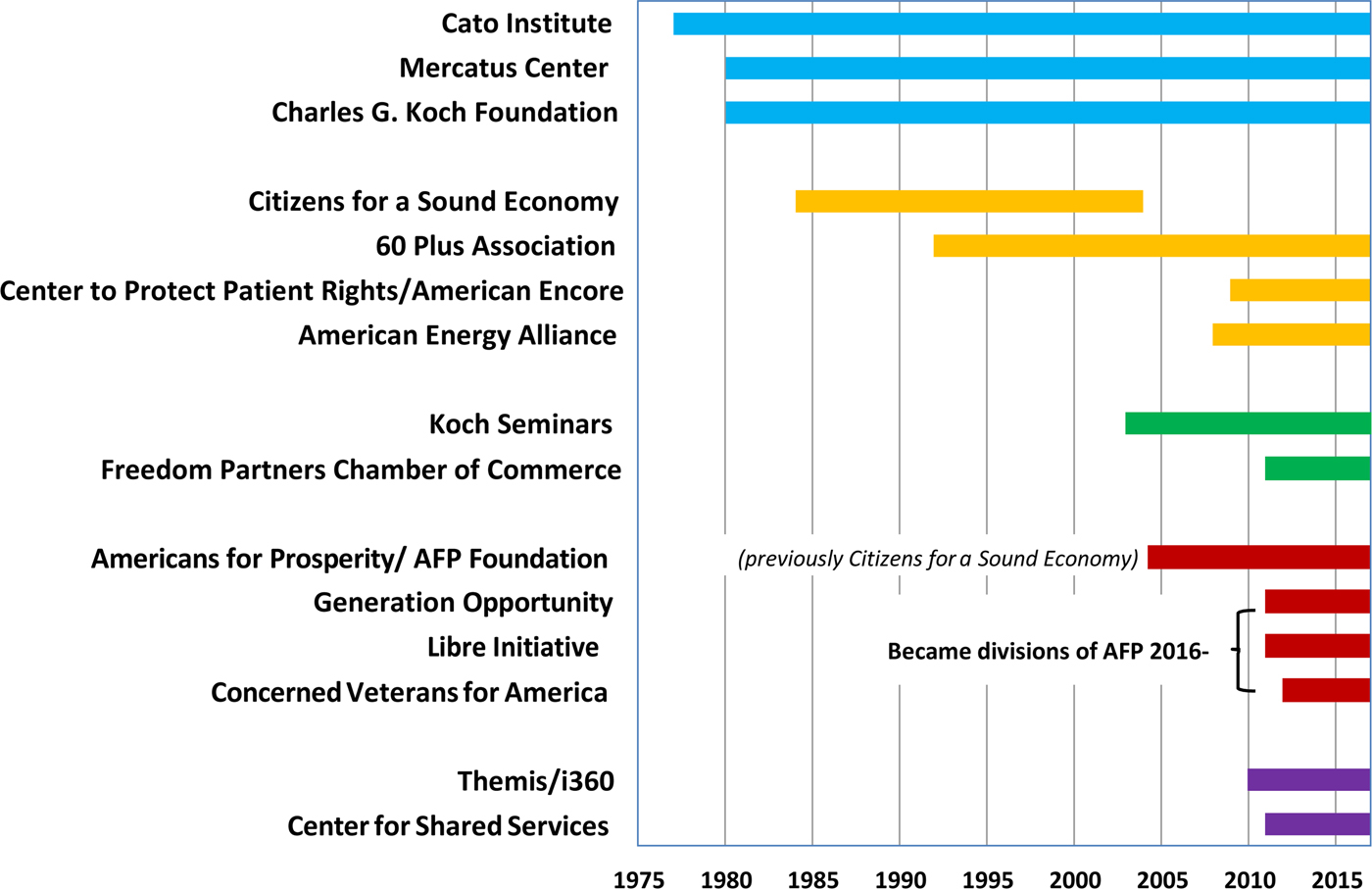
Importantly, the Koch donor seminars were not some brand new, stand-alone venture; they have always been a symbiotic part of an integrated set of political endeavors known by now as “the Koch network.” Figure 1 portrays the evolution of that network.Footnote 20 For decades, Charles and David Koch (called “the Koch brothers” in the popular media) have poured money from their rapidly growing industrial fortunes into efforts to reshape U.S. politics and policies. Currently, Charles and David have a net worth of more than $49 billion apiece and were tied for sixth place on the Forbes list of the 400 wealthiest Americans in 2018. A half century ago, the brothers were stalwarts of libertarian third-party politics, and they set out to encourage the spread of libertarian ideas and fund educational ventures by making sustained contributions to the Cato Institute, the Charles G. Koch Foundation, and the Mercatus Center at George Mason University.Footnote 21 In the 1980s, Charles and David turned away from the Libertarian Party and added funding for lobbying and policy organizations like the 60 Plus Association, a group focused on privatizing social insurance programs and repealing the estate tax, and Citizens for a Sound Economy, an advocacy group that attracted corporate funding to fight regulations and taxes.
The Evolution of Koch Core Political Organizations: Ideas, Policy Advocacy, Donor Coordination, Constituency Mobilization, and Utilities.

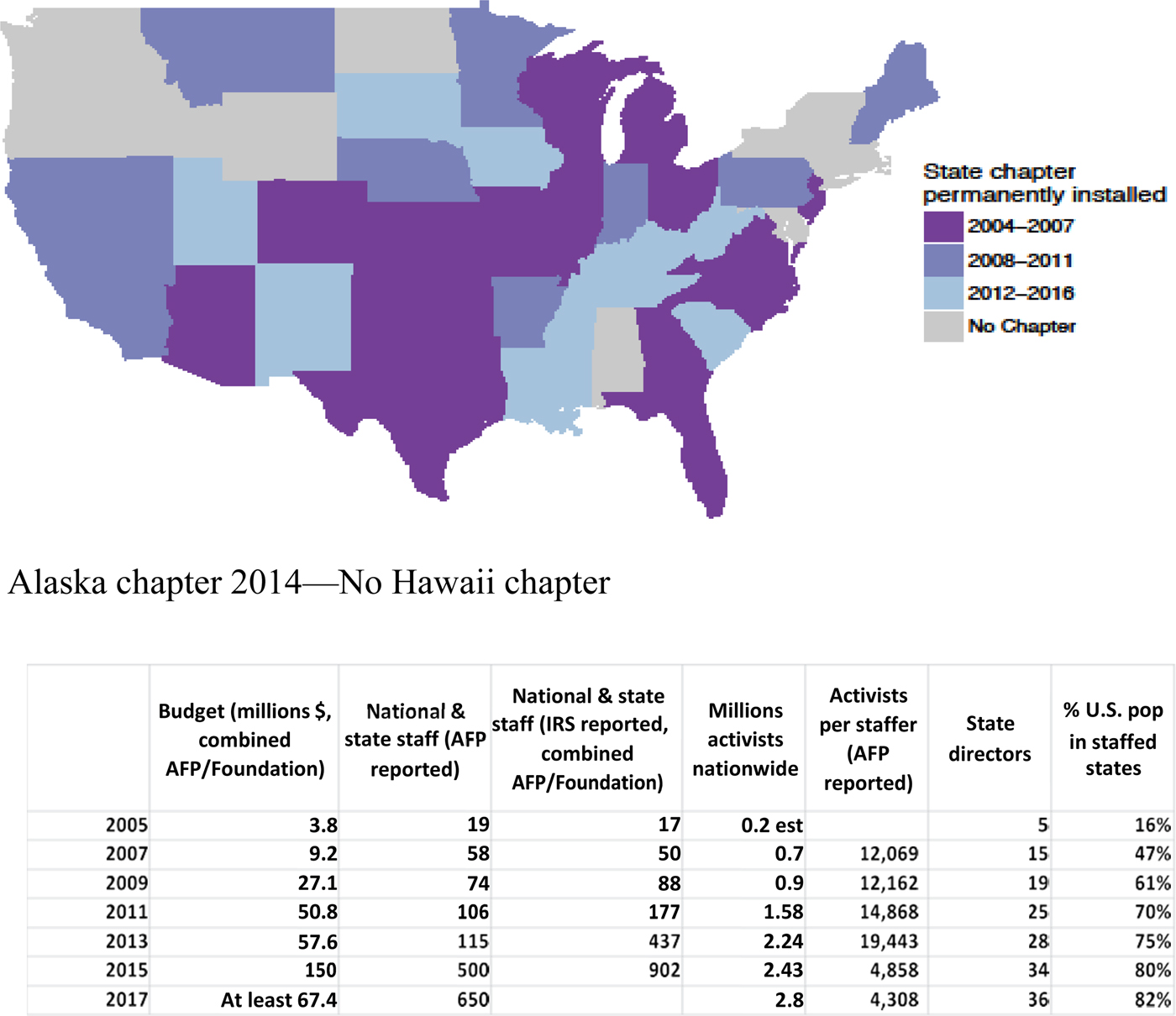
Believing that government should do very little beyond securing order, the Kochs were for many years skeptical of Republicans as well as Democrats. If the Republican Party “is our only hope then we are doomed,” Charles once explained to a business group, because the GOP accommodates government and supports “the prevalent statist paradigm.”Footnote 22 In the early 2000s, the Kochs’ worries about the GOP and insider consultants like Karl Rove reached a new peak when President George W. Bush invaded the Middle East and proposed the addition of an expensive prescription drug benefit to Medicare.Footnote 23 In response, the brothers unveiled a bold new third phase of political organization building. In 2003, they started the Koch seminars, and in 2004, they launched a new political-party-like federation called Americans for Prosperity (AFP) to synchronize lobbying and grassroots mobilization for elections and policy battles across dozens of states as well as in Washington, DC.
A nation-spanning organization, AFP is by far the most important political organization in the overall network supported by the Koch seminars—and tellingly, AFP was launched while Republicans, not Democrats, held power in Washington, DC. This belies any interpretation that sees the contemporary Koch political operation as primarily a defensive reaction to Democrats or the presidency of Barack Obama. By 2007, before Barack Obama even declared his candidacy for the presidency, AFP had installed paid directors and usually additional paid operatives in fifteen states spread across all U.S. regions and encompassing close to half the U.S. population (as well as their representatives in Congress and state legislatures)—and by now, AFP has become a massive political-party-like operation with paid staff and contact lists of millions of volunteer activists stretching across thirty-six U.S. states that are home to more than 80 percent of the population.Footnote 24 In key states like Wisconsin and North Carolina, AFP has a network of local offices as well as a state headquarters.
In recent years, the Kochs have added specialized pieces to the network mix, including constituency-mobilizing organizations focused on military veterans, young people, and Latinos, plus the Center for Shared Services to provide personnel and other support to all Koch organizations and a data operation called “Themis/i360” focused on collecting and analyzing voter data (similar to Catalist on the left).Footnote 25 In 2016, the previously separate Koch organizations Generation Opportunity, the Libre Initiative, and Concerned Veterans for America were folded into AFP, meant to operate as distinctively “branded projects” within the dozens of state chapters that make up the Koch network's “main political arm.”Footnote 26 Starting in 2012, a centerpiece “Koch political bank” called the Freedom Partners Chamber of Commerce took over running the fast-growing Koch seminars, and in 2014, an affiliated political action committee was set up to allow Koch donors to make federal campaign contributions through an affiliated super PAC.Footnote 27 By 2017, the whole Koch operation was rebranded as “the Seminar Network” with its own website.Footnote 28
The Democracy Alliance
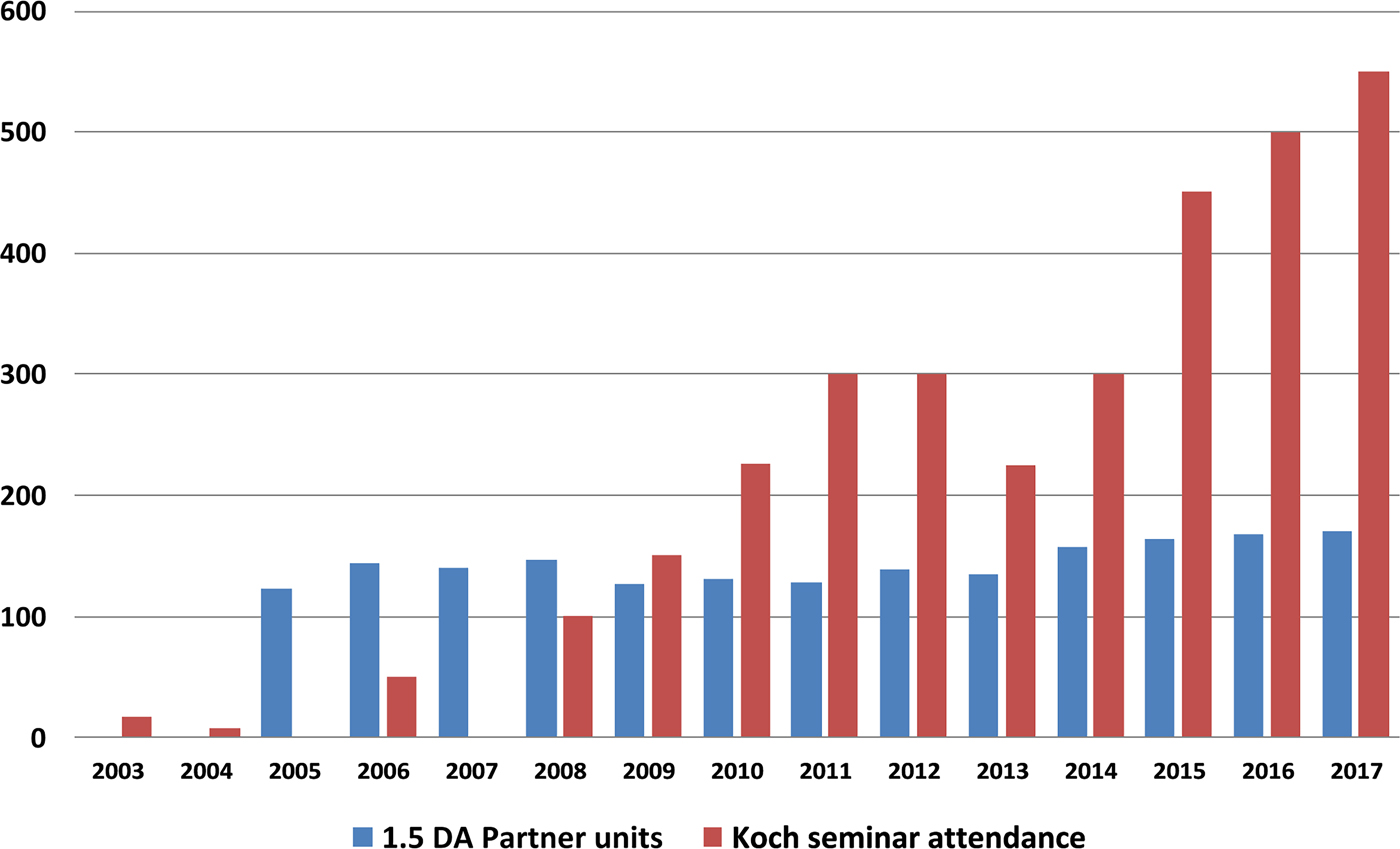
Launched in 2005, the DA at first attracted a larger donor membership than the contemporaneous Koch seminars. But the DA advantage was short-lived, as Figure 2 shows. Net recruitment of DA partners stalled after 2009, even as reported Koch membership trended upward—despite a dip for the Koch seminars right after Barack Obama, to conservative dismay, was re-elected to the presidency in 2012.
Donor Participation in Koch Seminars and the Democracy Alliance.

It is important to note that Koch seminar trends displayed in Figure 2 are approximate individual seminar attendance numbers reported in the media (using the higher number for the two seminars in a given year if two different numbers were reported for winter and spring/summer). Furthermore, especially in the current period, donors can be formal members of the Koch seminars and Freedom Partners without attending every meeting. Our DA numbers are from internal DA reports and reflect a more institutionalized definition of the yearly numbers of donor “partner units,” which include individuals, two-person family households, and multihousehold family clusters (like parents and children). In recent years, up to twenty-three foundations and nine other institutions, most of them labor unions, have also been tallied as DA partners. To translate the DA partner trends into something closer to the Koch seminar participant trends, we have (conservatively) used a 1.5 multiplier to approximate as best we can the number of wealthy donor members that likely correspond to the yearly totals of partner units. Nevertheless, the within-consortium trajectories in Figure 2 are much more meaningful and reliable than the absolute levels between consortia, given data uncertainties and divergent definitions of DA partners and Koch seminar participants. The key takeaway is that DA partner counts have grown only modestly in recent times, mostly through institutional memberships, while Koch seminar attendance has ballooned.
The impetus behind the creation of the DA differed from the Koch seminars. To the extent that the DA was the brainchild of one individual, that founder was not an ideologically motivated multibillionaire industrialist, but a veteran of Democratic Party politics named Rob Stein, who had worked for the late Democratic National Committee chairman Ron Brown and served on the Clinton-Gore transition team and as chief of staff at the U.S. Department of Commerce during President Bill Clinton's first term. As journalist Matt Bai tells the story, in the early 2000s, Stein became alarmed at conservative dominance and put together a “killer slide show” entitled “The Conservative Message Machine's Money Matrix.” His PowerPoints dramatized the decades-long accomplishments of wealthy conservative families who built up think tanks, policy advocacy groups, and media efforts to shape agendas of public debate in sustained ways. Starting months before the 2004 elections, Stein toured the country sharing this presentation in confidence with small clusters of Democratic Party donors and key political players, aiming to spark discussions about a new strategic approach. Later, Stein would recall that “there was an unbelievable frustration … among the donor class on the center-left, with trying to one-off everything—with every single one of them being a single, ‘silo,’ donor and not having the ability to communicate effectively with a network of donors.”Footnote 29
After John Kerry's 2004 defeat, Stein's project got seed funding from the George Soros and Peter Lewis families. In April 2005, some fifty of America's wealthiest liberals arrived at the DA founding meeting in Scottsdale, Arizona—with most traveling from major metropolitan areas on the East Coast as well as from Hollywood, the Bay Area, and Seattle on the West Coast and from a few other spots such as Denver and Dallas.Footnote 30 At the retreat, answers to a questionnaire revealed that three-quarters of the founding partners did not want the DA to have “close ties to the Democratic Party,” although that seems to have meant simply that they wanted the new group to remain under the separate control of its staff and wealthy members.Footnote 31
In this way, there are important similarities between the founding of the DA and the Koch seminars. The creation of both organizations was in part motivated by a sense of political threat: purported Bush administration betrayals of libertarian, small-government principles for the Kochs and their initial donors, and John Kerry's presidential defeat at the hands of George W. Bush for the DA. As the current head of the DA has put it, in his mind it takes “wilderness years”—years when power appears far out of reach—to foster audacious thinking and donor investments for the long term.Footnote 32 The importance of political threats in spurring mobilization of wealthy participants in the Koch and DA consortia resonates with political scientist Isaac Martin's chronicling of U.S. antitax movements among the rich.Footnote 33 As he shows, wealthy Americans undertook collective action to lower taxes when they felt that their individual tactics had failed and when antitax entrepreneurs presented them with opportunities for joint action. Even so, as we will see in tracking the evolution of Koch and DA efforts, political threats alone are not sufficient to spur institutional and strategic changes, especially once consortia are founded.
Existing institutional rules and leadership arrangements can either facilitate or frustrate strategic recalibrations at moments of political loss and threat, and the procedures of the Koch seminars facilitate strategic nimbleness much more than those of the DA.
To return to describing the origins of the DA, once founding partners came together, they made decisions about which other progressive organizations to support—and how to raise and channel partner dues and annual contributions. By the fall of 2005, when sixty-five partners “representing two-thirds of … total membership” convened at the second DA conference in Braselton, Georgia, elaborate procedures had been used by DA leaders and staffers to vet the first round of organizations to be recommended for partner funding.Footnote 34 Some long-standing organizations like the Center on Budget and Policy Priorities were included, but other recommended organizations were recently established or new creations, including such future mainstays of the Democratic Party establishment as the Center for American Progress and the data operation Catalist (originally called Data Warehouse). Recommended groups on the first DA list were classified under four headings that suggest the types of endeavors founding partners thought necessary to counter the conservative “messaging machine”:
• Leadership: Center for Progressive Leadership; Progressive Majority
• Ideas: Center on Budget and Policy Priorities; Economic Policy Institute; Center for American Progress
• Media: Media Matters for America; Citizens for Responsibility and Ethics in Washington
• Civic Engagement: America Votes; Data Warehouse (later called Catalist)Footnote 35
Also on the original recommended list was an “Innovation Fund” to be managed by the DA itself, to give “partners the option to fund organizations with new and provocative ideas headed by young and developing leaders.”Footnote 36 Overall, more than $30 million was channeled to the recommended entities, a third of that amount reportedly pledged by the Soros and Lewis families.Footnote 37 DA rules and rhetoric stressed equality among partners and, certainly, the Soroses and Lewises were not directly in charge of DA the way the Koch brothers have been in charge of their consortium. Nevertheless, according to Matt Bai, the biggest DA contributors exercised a lot of sway behind the scenes—and that surely remains true to this day, even if the ranks of the largest DA funders have evolved (and has recently included environmentalist Tom Steyer, for example).
From the start, the DA had its own professional staff managed by a DA president and supervised closely by a small elected board that has always included some elected donor members along with union leaders and philanthropists. This organizational pattern is typical for a liberal nonprofit organization, but unlike many such nonprofits, the DA has experienced repeated leadership shifts. By 2006, in fact, founder Rob Stein was pushed out of day-to-day DA management, to be followed by a succession of presidents, each of whom readjusted DA's relationships to the Democratic Party, to party-linked PACs, and to other groups in the center-left landscape.Footnote 38
Crucially, even though many DA founders believed that their consortium ought to concentrate on supporting on a small, highly effective number of progressive organizations, within a few years the list of recommended liberal groups tripled.Footnote 39 The DA was formed following several decades of a proliferation of professionally run liberal advocacy groups in the larger U.S. civic landscape. Many wealthy donors the DA wanted to recruit as partners already had established ties to subsets of such groups—to environmental or rights groups or women's groups or left-leaning think tanks, for example. As a result, founding members and newly recruited partners in the early years tended to press for the DA to add their favorite causes to the recommended investment lists presented to all partners for potential contributions.
As we will detail later, a modest number of long-standing organizations have always been on the DA-recommended list, but many others have been subtracted or added across ever-changing versions of the core list. In 2014, the most recently installed DA president, Gara LaMarche, a veteran of George Soros's philanthropies, proceeded to take a hard look at how the consortium had evolved and articulate a new strategy.Footnote 40 Currently, the DA aspires to be not only a list of progressive organizations recommended for philanthropic support, but also a national hub for movement building, where wealthy donors, labor unions, and many philanthropic foundations all work “in alignment” (as the organization's favored phrasing puts it) to further support progressive political goals. Since 2016, and especially following the Democratic presidential defeat in November of that year, the DA has placed a strong emphasis on mobilizing and directing contributions toward building state-level electoral and policy capacities on the left—to counter the accumulated clout of the Koch network and other right forces across nearly two-thirds of U.S. state governments.
WHO ARE KOCH SEMINAR AND DA DONORS?
Because there are no publicly available, annually updated lists of the wealthy Americans who join and donate through the DA and the Koch seminars, we have used an array of tactics and sources to assemble incomplete—but we believe indicative—datasets on them.
• For the Koch seminars, our best sources include a full list of all 226 attendees at the spring 2010 seminar held in Aspen, Colorado, supplemented by names from documents or audiotapes from other seminars published by various journalists.Footnote 41 In 2015, moreover, after Charles Koch called on seminar donors to have the courage to speak publicly, some of them met with a Wall Street Journal reporter and wrote op-eds for their hometown newspapers to proclaim their memberships in the Koch seminars and Freedom Partners.Footnote 42
• For the DA, we have relied on names listed in conference programs and reported in books, media stories, and reports from conservative opposition research groups such as the Capital Research Center and the right-leaning Washington Times and the Washington Free Beacon.
In assembling our master lists, we have done the best we can to verify Koch seminar and DA memberships. As indicated, we relied mainly on unchallenged meeting lists or public quotes from wealthy members. Because certain internet sources turn out to have assigned wealthy people mistakenly to these consortia, we do not use names from those sources without additional confirmation from public quotes, meeting lists, or knowledgeable informants. Despite our efforts, our lists surely still include a small number of “false positives.” But the larger issue is that we have inevitably missed quite a few people who have been secret members of these consortia at some point. In addition, we can only loosely date the spans of membership for each individual donor. Despite all of the uncertainties, we believe we have assembled sufficiently robust lists to construct broad portraits of DA and Koch seminar memberships. The units of analysis include both individuals and family groups (where marital or kin ties are apparent). Most of the family units are husband-wife couples, who often participate together, especially in the Koch seminars; in addition, sibling sets or parents and adult children sometimes join these consortia together.
Using the overall Koch seminar and DA lists, our research team drew from as many sources as possible to find and code various characteristics for individuals or families—including primary residences (by city and zip code); service on corporate boards (using data from BoardEx, a commercial repository of boards of directors); industry of primary wealth (using media records and BoardEx and coding by the classifications employed by the federal government); and major involvement in philanthropic activities (using media sources and data from BoardEx on participation on nonprofit boards of directors). The following comparisons use the data we have been able to assemble to date. In some parts of the analysis, we benchmark our Koch seminar and DA donors against aggregate descriptions that Lee Drutman has offered for the top “1% of the 1%” of wealthy political donors to electoral campaigns in 2012.Footnote 43 This allows us to get some sense not only of how the DA and Koch seminar participants compare with one another, but also how each group compares with very active political donors in general.
Where Do Koch and DA Donors Live?
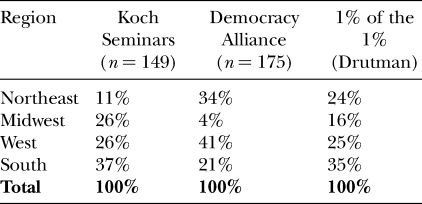
The residences of wealthy political donors involved in the DA and the Koch seminars cluster across the U.S. geography much as we might expect for progressive-liberals versus ultraconservatives. As Table 1 shows, DA donors are disproportionately likely to hail from the West and Northeast, while residences in the South and Midwest are much more common for Koch seminar participants.
Residences of Koch, DA, and 1 Percent of 1 Percent Donors

For comparison purposes, Table 1 also shows that the residences of Drutman's 2012 donors from the top 1 percent of the 1 percent tended to be spread across the South, West, and Northeast, but least often located in the Midwest. Overall, the locations of Drutman's donor residences look more like those of our DA partners than the residential patterns of the Koch seminar participants—especially because so many Koch seminar participants come from the Southwest, mountain states, and Midwest, areas where Drutman found relatively fewer top donor residences.
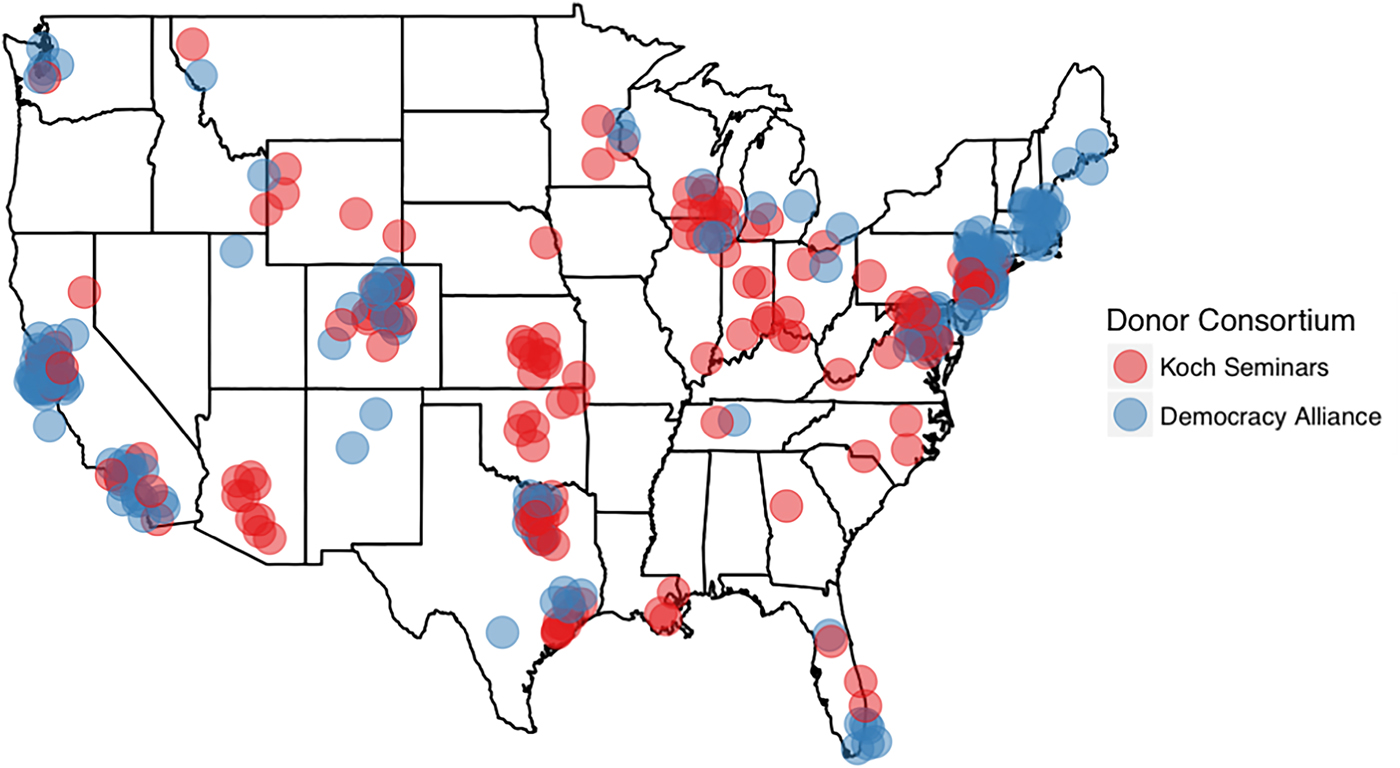
Offering more detail, the map in Figure 3 displays 149 Koch donors and 175 DA donors based on the zip code of their primary residence. (Clustering by zip code is randomly jittered to show the density of observations—otherwise, most of the dots would be on top of the major cities). This drives home the point that DA partners mostly have primary residences in just three areas—the Acela corridor on the East Coast, the Bay Area, and Los Angeles, while Koch seminar members come from all over the country. Certainly, the Koch seminars are attracting more wealthy contributors from the heartlands.
Residences of Koch and DA Donors, mid-2000s.

Donor Activities and Sources of Wealth
Available evidence about donors who sit on corporate boards shows that Koch seminar donors are much more involved in business leadership than are DA partners. More than a third of Koch donors (37 percent) are currently serving on a corporate board, and 40 percent of them have served on corporate boards at one point or another. In sharp contrast, only 14 percent of DA partners currently sit on corporate boards (and only one in ten have in the past).
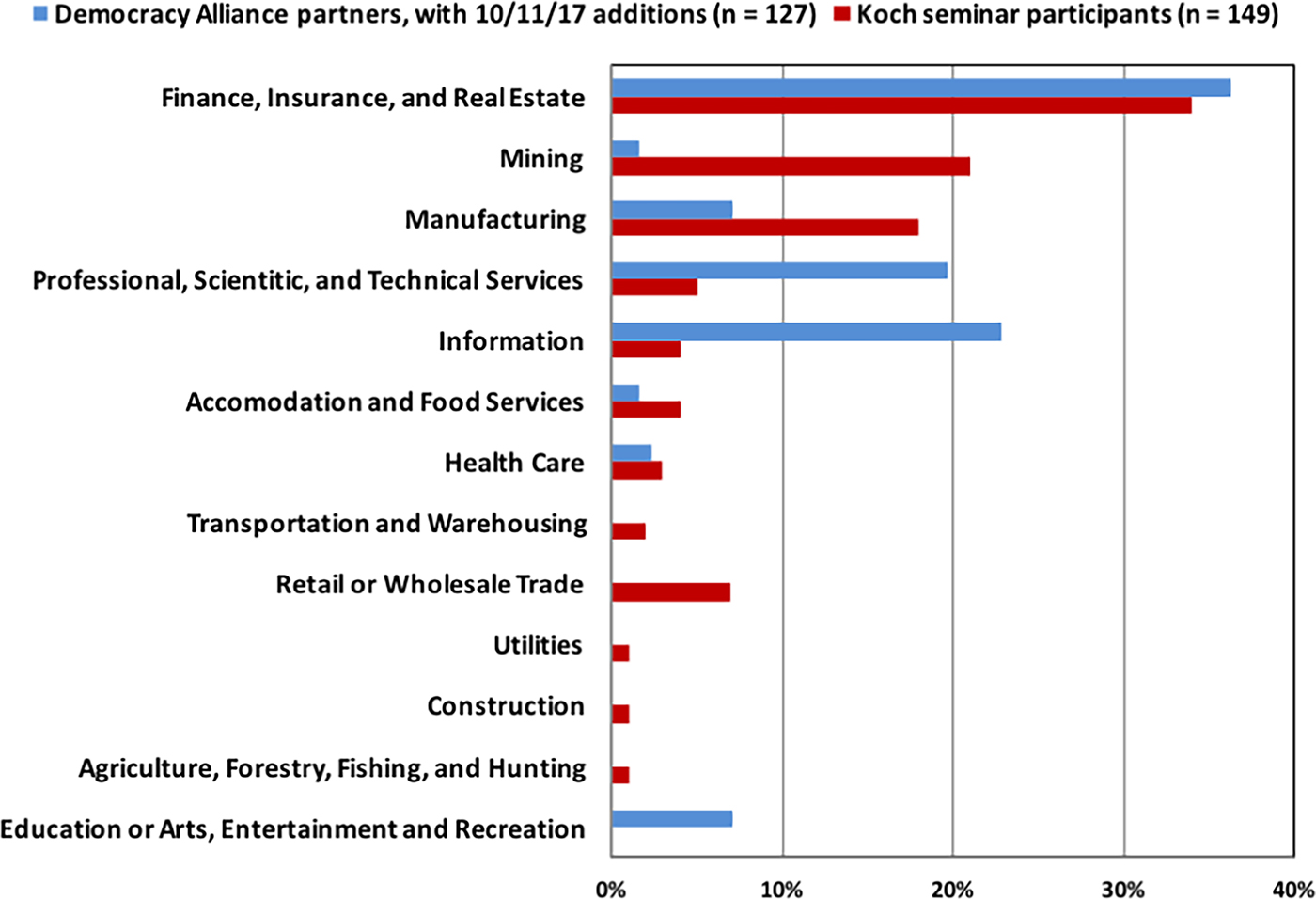
DA partners are more often primarily involved with philanthropic activities, often at family foundations. One-fifth of the DA participants are coded this way, compared with only 6 percent of Koch participants. Although we have not so far been able to pin this down, DA partners may have inherited their wealth more often than Koch donors. We do have information, however, on the sectoral sources of the wealth possessed by Koch and DA donors. Not surprisingly, given the ballooning of the financial sector in the U.S. economy over the past half century, the single most important source of wealth for around a third of each set of donors is “finance, industry, and real estate.”Footnote 44 More broadly, however, the sectoral sources of Koch and DA wealth are quite different, as Figure 4 shows. For Koch donors with a readily identifiable industrial sector as the main source of their wealth, the most common sectors (beyond finance, insurance, and real estate) are mining and natural resource extraction (21 percent) and manufacturing (18 percent). In contrast, the most common DA wealth sources (beyond finance, insurance, and real estate) are found in professional services (20 percent, and especially concentrated in the legal services fields) and the information industry (23 percent). In general, the wealth of Koch donors comes from a broader array of sectors than DA donor wealth. Appendix B includes a tabular presentation of the data displayed in Figure 4 and includes, for comparison purposes, the wealth-sector profile for Drutman's 2012 donors, who tend to be more similar to the DA partners than to the Koch seminar participants.
Sources of Wealth for Koch and Democracy Alliance Donors.

Now that we have defined donor consortia, offered brief overviews of the Koch seminars and the DA, and explored the characteristics of their wealthy members, it is time to focus on the primary activities and impact of these two donor consortia. How, exactly, do these consortia attract and channel big-money contributions to arrays of other organizations on the right and left?
CHANNELING RESOURCES TO ARRAYS OF POLITICAL ORGANIZATIONS
The stated missions of the Koch seminars and the DA stress their aspirations to reconfigure organizational resources and ties across the U.S. political landscape. The Koch seminars are central supporters of a larger set of networked organizations all pushing candidates and officials to adopt ultra-free-market agendas. Similarly, in the words of DA founder Rob Stein, the “Democracy Alliance is focused on creating a more integrated and consistently coherent center-left institutional infrastructure.”Footnote 45 Both of these consortia aim to raise money from many wealthy donors to support other politically significant groups—indeed, these consortia aspire to fund such infrastructural support above and beyond the normal individual political giving of donor members. But how exactly do the DA and the Koch seminars accomplish this distinctive kind of political fund-raising? To shed light on these crucial issues, we have pulled together as much information as possible on the similar and different fund-raising routines of these consortia and the ways in which they channel funding to other organizations.
Meanings and Obligations of Membership
The rhetoric of membership is quite different for the Koch seminars versus the DA, as suggested by telling statements whose phrasings resemble many others in meeting programs and explanatory documents from these two groups. In a 2011 letter to privileged invitees, Charles Koch explained that joining the Koch seminars means signing on to a band of wealthy comrades determined “to combat what is now the greatest assault on American freedom and prosperity in our lifetimes.”Footnote 46 The seminars, Charles stressed, are about more than “fun in the sun” and focus on more than just the next election (although some sessions do address immediate electoral opportunities and evaluate past campaigns). “Our network of business and philanthropic leaders,” he explained, brings together “doers who are willing to engage in the hard work necessary to advance our shared principles… . Our goal for these meetings must be to advance ideas that strengthen … freedom, beat back the unrelenting attacks and hold elected leaders accountable.” Participants in Koch seminars are not called “conservatives” or “Republicans”—indeed, those labels are rarely used—but are instead characterized as leaders dedicated to advancing a free, entrepreneurial American society.
Joining the DA is likewise a value-oriented commitment for wealthy people who do not usually proclaim their party label, but the DA conceptualization is much drier and more transactional. Rather than heeding a call to battle, DA members become “partners” who (in the words of a 2015 DA document reproduced in Appendix C) enjoy
access to … benefits and services… including unique investment, networking, and community building opportunities, and a chance to explore in-depth the issues that will define the progressive agenda for the 21st century. Through participation in the DA, Partners gain a strategic perspective of the political landscape and increase the impact of their progressive philanthropy.
Wealthy donors who join the DA certainly embrace “progressive” as a label for their general political orientation—the word is repeated everywhere in DA communications and conference agendas. But what, exactly, “progressive” means is rarely, if ever, spelled out or debated. Early efforts to define a DA vision were remarkably thin and short-lived.Footnote 47 Currently, a more robust “20/20 vision” is publicly presented on the DA website and handed out in brochure form at every conference. In this statement, many specific objectives are arrayed under three “larger goals”: creating “a fair democracy where everyone can participate,” promoting “a growing economy that works for all,” and ensuring “a planet that is healthy and safe” (https://democracyalliance.org/investments/strategy/). As has been true since the DA launch, the organization promotes loosely linked center-left priorities, each of which resonates with the concerns of subsets of DA partners and approved organizations. Unlike the Koch seminars, the DA does not proclaim any unified political strategy.
Procedurally, membership in the Koch seminars was, at the start, vaguely defined, apparently based on little more than taking part in one of the gatherings hosted by Charles and his associates. For some years, the Koch seminars have had a family-oriented rhetorical framing, with “guests” urged to attend as husband-wife couples. Nevertheless, after Freedom Partners took over managing the seminars in 2012, membership became more formally specified, as DA membership always has been. Just as DA partners must pay yearly dues and contribute $200,000 to recommended organizations, so too must Koch participants pledge $100,000 or more each year to network undertakings (whether there are obligations to pay other fees, we do not know).
Following standard fund-raising techniques, recent Koch seminars have also encouraged giving well above the minimum by setting aside special “invitation only” sessions for “top donors.” Although DA partners vary enormously in the amounts they donate through their consortium, DA documents and meeting agendas never indicate that certain events or meetings are open only to top donors.
As for membership benefits, DA partners have access to the organization's professional staff based in Washington, DC, and Koch seminar participants have similar access at the Freedom Partners Chamber of Commerce based in Arlington, Virginia. These offices dispense information and help members structure donations, no doubt with an eye to tax consequences and public disclosures. However, invitations to consortium meetings are the chief membership perk. As long as members meet annual dues and pledge requirements, they can cover their own travel and hotel expenses to attend either the DA's “investment conferences,” held each spring and fall, or the Koch seminars, convened each winter (usually in January) and again in the late spring or summer. Attended by hundreds of honchos, these conclaves are where the action is—where like-minded wealthy people mingle and conference organizers try to steer “investments” in concerted directions. In addition, to reinforce ties and reach out to potential new recruits between biannual conferences, both consortia encourage social and informational gatherings in major cities, often convened at members’ homes.
How Consortium Meetings Focus Donor Attention
We have a virtually complete run of DA conference programs, but we have found full Koch programs only for the late June 2010 Aspen, Colorado, seminar, entitled “Understanding and Addressing Threats to American Free Enterprise and Prosperity,” and the mid-June 2014 Dana Point, California, seminar, “American Courage: Our Commitment to a Free Society.” For comparison purposes, we use the DA's “Progress 360” conference held in in late April to early May 2010 in Laguna Beach, California (not far from where the 2014 Koch seminar met), and also the DA's “A New Progressive Era?” conference held in late April 2014 in Chicago, Illinois. Fortuitously, these paired sets of meetings happened just before momentous midterm U.S. elections. Furthermore, the 2010 meetings fell at roughly the midpoint in the life spans of these consortia, and the 2014 meetings exemplify recent developments.Footnote 48
Both the Koch seminars and the DA sponsor several-day meetings that mix plenary sessions with breakout groups and intersperse serious sessions with meals, cocktail parties, and recreational opportunities. At both conclaves, some sessions feature media celebrities, top political officeholders, and the occasional author or even university-based academic. But a closer look makes it clear that the Koch seminars and DA conferences bring together quite different segments of the right and left political worlds and choreograph activities in distinctive ways. At typical Koch seminars, hundreds of wealthy, mostly white-male business leaders, many joined by their wives, hear from a modest number of invited speakers and a couple dozen top leaders of Koch organizations, themselves mostly white men. In contrast, at typical DA conferences, about a hundred mostly white-male and some white-female “partners” are joined by more diverse leaders of DA-affiliated labor unions and foundations. Both sets of DA donors interact with several dozen professionals (many of them women or persons of color) who lead the many think tanks, advocacy groups, and grassroots-focused organizations that receive (or aspire to receive) contributions from DA partners.
At DA conferences, furious networking is the order of the day—as invited professional leaders of liberal endeavors do their best to attract attention and impress potential donors about their respective organizations. The DA's basic structure encourages this pattern, because it raises money primarily by exposing donor members to “recommended” progressive organizations whose goals, resources, staffing, and achievements are vetted by the DA each year. Getting (and remaining) on the regularly updated core list of DA-recommended organizations is a big deal, because it ensures attention from DA donors and a chance to attend the conferences and hobnob with donors in person. Even if most approved organizations do not get high percentages of their budgets funded through DA-encouraged donations—and most have not since the very earliest years—their leaders still value the visibility and connections that invitations to attend DA conferences can bring. For their part, many DA partners strive to get visibility for their favorite causes, issues, and organizations.
Given the multiple DA constituencies—individual partners, institutional partners, foundation allies, and leaders of DA-approved organizations—DA staffers face quite a challenge as they assemble panels and sessions. To appear inclusive and hold partners in the fold, DA staff let many individual partners or sets of partners take ownership of particular conference sessions, especially breakout groups, meal-time meetings, or workshops focused on particular issues or groups those partners consider vitally important. (At the Koch seminars, as far as we can gather, donor “guests” almost never take formal charge of parts of the biannual programs.) In addition to allowing donors to set parts of the agenda, DA conference organizers set up sessions and panels to allow as many DA-supported progressive organizations as possible to tout what they are doing or promising to do. Big-picture plenaries address overarching topics such as current political challenges or strategies for fighting economic inequality—and presentations on those panels feature leaders or representatives of multiple DA-supported organizations such as the Center for American Progress or Media Matters for America.
The resulting DA confabs are, quite literally, stuffed with speaking slots for as many progressive organizational leaders as possible—above all for leaders of longtime DA-supported organizations. For example, the spring 2010 Progress 360 conference was spread over three and a half days and featured ten general plenaries, five partner plenaries, and nineteen breakout sessions (offered in four periods). Setting aside dinnertime talks and the last half-day when groups of partners ran a number of workshops, most conference panels had four to six speakers. One plenary session, remarkably, had ten speakers—including six heads of that year's core DA-funded organizations: the Center for American Progress, the Center for Community Change, Media Matters for America, Third Way, the Center on Budget and Policy Priorities, and the Center for Social Inclusion. Indeed, the leaders from fully three-quarters of the core organizations recommended for DA funding that year appeared on spring 2010 conference panels. Most other speaking slots went to leaders from other progressive organizations, including groups working on current issues like health reform and organizations that would in the future win inclusion on the core DA-recommended list. Overall, the spring 2010 conference had more than three dozen speakers from assorted progressive political organizations. Some conference sessions focused on broad themes such as an overview of the 2010 election and “The Progressive Narrative and Lessons Learned in 2009,” while others considered specific policy challenges like immigration or money in politics, or reviewed ways to mobilize key constituencies such as Latinos and millennials. The politicians present that spring were mostly officials from the Obama White House.
Four years later, in the spring of 2014, the DA conference again followed a similar script, so much so that we need not dwell on all the details. Once again, sets of four to six speakers from about three dozen progressive organizations populated thirteen general plenaries and sixteen breakouts (organized in six periods)—with sessions spread, this time, over just two and a half days. Two partner-only sessions were also held. Once again, 2014 was a midterm election year, and some sessions focused on the upcoming November contests. Other sessions dealt with hot topics like gun control and criminal-justice reform, while a number of plenaries focused on economic challenges. Presidents from DA-member unions were more prominent on the spring 2014 program than they had been four years earlier, yet the heads of most major DA-supported organizations still claimed much of the limelight—including the heads of longtime DA partner favorites like the Center for American Progress, Media Matters, and the Center for Community Change. Also featured was one aspiring Democratic Senatorial candidate, Alison Lundergan Grimes of Kentucky.
The 2014 conference marked the beginning of Gara LaMarche's DA presidency, which would soon propel the consortium in new directions—placing a reinvigorated emphasis on state-level and grassroots organizing and focusing initiatives around core themes of fighting economic inequality, slowing climate change, and reforming U.S. democracy. Some panels, accordingly, included fresh faces from organizations like the New York Working Families Party, NextGen Action, Color of Change, and the Restaurant Opportunities Center. Also prominently featured were leaders from Demos and the Roosevelt Institute, soon to be recommended for partner support in yet another revamp of the list of core DA organizations.
By the time DA partners leave DA fall or spring investment conferences, they have heard about dozens of possible groups and priorities to which they might donate. Wrap-up sessions sometimes urge partners to make specific commitments. But no matter when partners finalize their contributions, they usually do not write checks to the DA itself. Instead, DA partners choose which among dozens of liberal or progressive groups they want to support and then make donations directly to them (perhaps with some DA staff advice and help). In some periods, the DA has set ideal annual targets for partner support to each core recommended group and has tried to persuade donors to make choices that fulfill those targets. Recently, the DA has set up a number of special “funds” supervised by committees of partners and staffers, entities meant to disperse grants to smaller progressive groups doing grassroots outreach or working in specific state and local polities. For the most part, however, DA leaders (unlike Koch network leaders, as we will see) do not collect tens to hundreds of millions of dollars to deploy as they see strategically fit. Instead, the DA staff and board manage a kind of progressive investment marketplace, which selects and certifies dozens of worthy groups and funds, so partners can scan the possibilities and make their own choices.
Koch seminars are much more focused affairs than the DA organizational bazaars. While DA conferences are crowded with speakers from separate organizations and issue networks, the Koch gatherings expose conservative wealth holders and their spouses to libertarian and free-market ideas and outline the latest version of a regularly updated coherent strategy for shifting U.S. political culture, politics, and policies toward the far economic right. As we discuss below, the seminars and their agendas generally set aside social policies, like those involving abortion, gay marriage, or religion, even though many Koch donors themselves care intensely about these issues and often support groups espousing them with donations delivered apart from the Koch network. This downplaying of social issues sets the Koch seminars apart from the DA, which features sessions on social issues like women's reproductive freedom and gay marriage, as well as sessions on economic topics. Notably, sessions at the Koch seminars feature leaders of a small set of interrelated political organizations run by leaders designated by the Kochs and their close associates. This game plan is apparent from the types and sequences of sessions listed in Koch seminar programs.
At the very start of the June 2010 Aspen seminar, for example, the Koch's political-strategist-in-chief, Richard Fink, led “An Introduction to these Meetings for First-Time Participants” to enable them “to learn about the strategic framework that has guided past success and that guides future action.” Four years later at the June 2014 Koch seminar in Dana Point, two such orientation sessions happened—one led by David Koch and Richard Fink on “Saving America: Our Fight to Advance Freedom and Reverse the Country's Decline” and another on “Understanding the Network: A Discussion with Capability Leaders.” At the second orientation session, five major heads of core Koch organizations—Freedom Partners, AFP, the Libre Initiative, Generation Opportunity, and the Charles G. Koch Foundation—explained their interrelated efforts to redirect U.S. politics. DA conferences, in contrast, always have welcome receptions for new partners, but not special orientation sessions. The DA newbies are deemed up to speed just by being there, whereas the Koch first-timers are considered in need of careful instruction about the purposes and organizational arms of the overall Koch network.
More broadly, Koch seminars have a standard choreography, featuring a logical sequence of plenary sessions through which attendees are herded (pleasantly, of course, with meals and breaks for socializing in between). At the 2010 seminar, twelve of fifteen sessions (80 percent) were plenaries and three were breakout sessions (two periods offering alternative workshops plus the one breakout restricted to first-time attendees). At the 2014 seminar, the proportion of plenaries dropped to two-thirds (15 out of 23), and there were eight breakout periods. But only some of those 2014 breakout periods involved alternative sessions any donor could attend, because many segregated first-time versus repeat participants and, at times, drew “top donors” into specialized breakout sessions such as meetings with important GOP politicians. During both the 2010 and 2014 Koch seminars, plenaries followed a coherent pattern, starting with an opening speech by Charles Koch—who in 2010 outlined “The Threats to American Freedom and Prosperity” and in 2014 spoke about “American Courage: Our Commitment to a Free Society.” In both gatherings, subsequent plenary sessions explained threats to liberty and strategies for responding. Then strategy sessions outlined immediate and longer-term efforts: to deploy resources for the next election and to shift ideas and policy agendas in American society overall. In 2014, for instance, panels about election “opportunities” introduced promising GOP candidates for the upcoming November contests, while equally prominent panels informed donors about the Koch strategy to transform U.S. higher education in the years ahead.
As Koch seminars convey the master narrative in sequenced plenaries, the high-dollar donors in attendance are exposed to the leaders of two sets of Koch organizations that stand ready to counter perceived threats to American liberty. On the one hand, donors hear from officials at the Charles G. Koch Foundation and the Mercatus Center, both of which support libertarian scholars, policy research, and educational efforts. On the other hand, donors hear from strategists directing policy and electoral campaigns at AFP, the Libre Initiative and Concerned Veterans for America, as well as from experts at the Koch data operation Themis/i360. (Brief descriptions of core Koch organizations appear in Appendix A.) Only occasionally do people from independently led outside organizations appear on Koch seminar panels, and the tendency to feature insiders seems to be getting more pronounced as the Koch network matures. In 2010, certain plenary panels included, side by side with inner Koch honchos, the president of the American Enterprise Institute and the head of the National Right to Work advocacy organization. But by 2014, organizational representatives on seminar panels were almost entirely core Koch leaders. (The chief exception was the head of the United Negro College Fund, which had just received a $25 million grant from the Charles G. Koch Foundation.)
In addition to organizational leaders, spring 2014 Koch seminar sessions also featured leading GOP politicians, including Senate leader Mitch McConnell and three aspiring Senate candidates: Cory Gardner of Colorado, Tom Cotton of Arkansas, and Joni Ernst of Iowa. Gardner and Ernst were at the time little-known politicians, and our research shows that both got bump-ups in contributions from Koch donors after their appearances at the spring 2014 meeting.Footnote 49
Beyond hearing Koch leaders and favored GOP officials or candidates speak, selected donor guests also get one-on-one briefings. Following the winter 2014 Koch seminar, someone left behind in a hotel room a crumpled sheet detailing dozens of small meetings between forty named donors (individuals or family sets) and subsets of leaders from twenty-nine Koch organizations.Footnote 50 The Koch leaders involved in those sessions included ten national officials and state directors from AFP, the head of the Libre Initiative and the president of i360, three officials from the Charles G. Koch Foundation and one from the Mercatus Center, and a dozen top Koch managers affiliated with Freedom Partners, Koch Industries, and Koch Industries Public Sector. Some intimate sessions involving the wealthiest donors were held off-site, including at a nearby Koch personal residence.
The tight choreography of the Koch seminar programs and encounters has a purpose. By the time the gatherings wrap up and donors are thinking about where to direct their contributions, they have had plenty of chances to hear about strategy and tactics from people in charge of most of the core organizations in the integrated Koch network that will receive the bulk of their donations (as we will soon show). Unlike partners in the DA, Koch seminar guests contribute directly to and through Koch-controlled organizations, with most of their donations going to the core network entities listed above in Figure 1. Seminar members may donate through Freedom Partners, the conduit now used by the Koch network to disperse general-support grants to political organizations. They can donate to the recently established Freedom Partners PAC.Footnote 51 Or they can give directly to Koch entities—including by directing anonymous, tax-deductible contributions to support educational missions pursued by the Mercatus Center, the Charles G. Koch Foundation, or foundations affiliated with AFP. Whichever of these routes they choose, however, Koch seminar participants fulfill their membership obligation in a very different way than DA partners meet theirs. Each individual DA partner chooses from long lists of recommended or permitted groups to fashion his or her own menu of progressive organizations to support in fulfillment of the annual membership pledge, but Koch seminar guests concentrate their giving on interrelated groups directed by the Koch inner cadre.
How Much Money Is Raised?
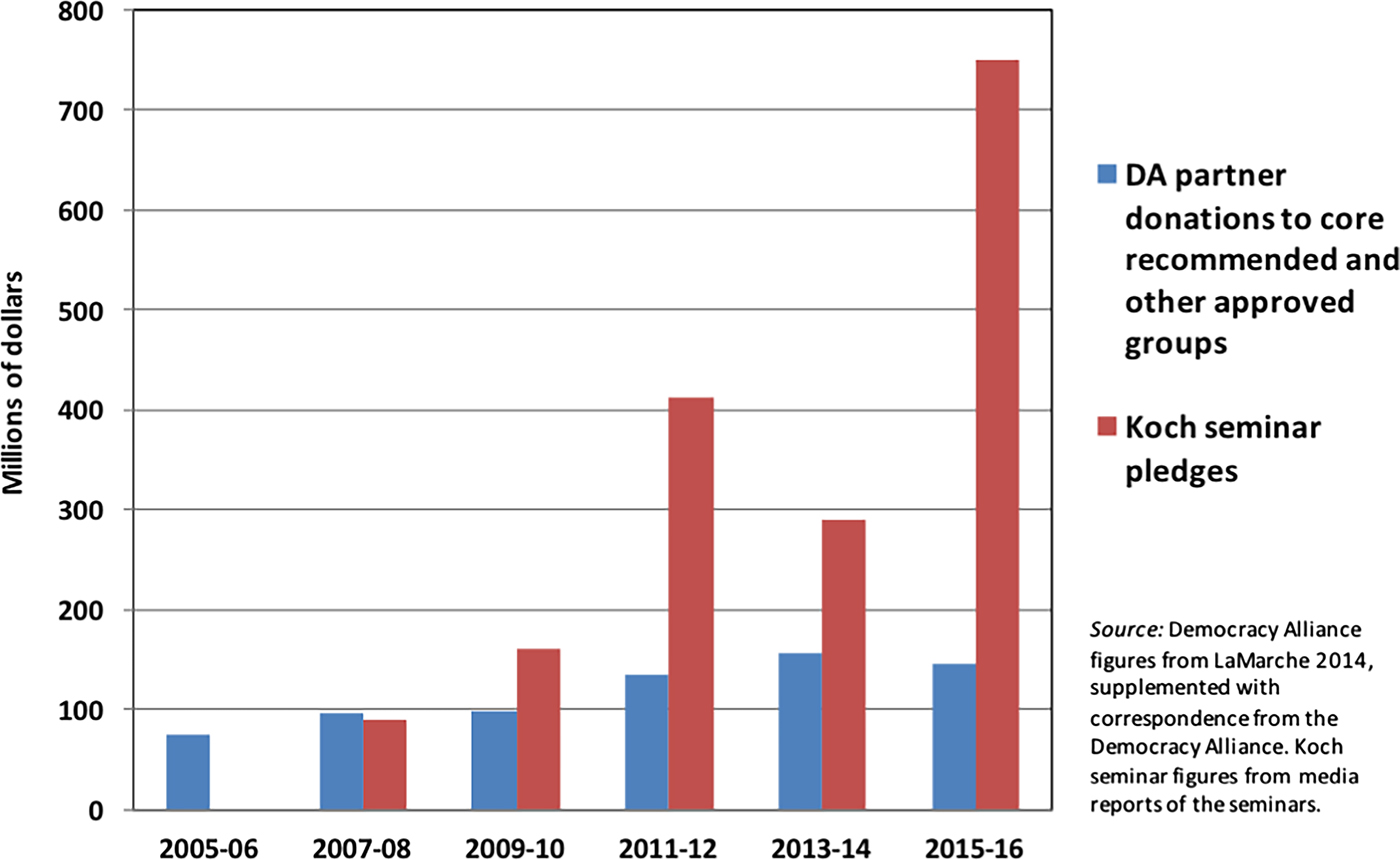
Big-money donor consortia have remarkable capacities to aggregate and direct political funding, as both the Koch seminars and the DA do on their respective ends of the U.S. political spectrum. But available evidence suggests that fund-raising by the Koch operation for its affiliated organizations substantially outpaces resource mobilization by its leftist counterpart. This is apparent in Figure 5, which juxtaposes reported two-year totals for Koch donor pledges to two-year aggregations of donations to recommended groups made by DA partners.Footnote 52 The DA totals in Figure 5 include reported partner donations to both core recommended groups and to other groups approved for partner donations (dozens of which are listed on a larger DA “progressive infrastructure map” included in each conference program). These totals come from reports of the Koch seminar pledges made to the media or leaked by investigative reporters, along with internal DA records.
Fund-raising by the Democracy Alliance and the Koch Seminars.

Earlier we noted that while membership in the Koch seminars has increased sharply in recent years, the ranks of DA partners have grown only modestly. To be sure, the DA has recently broadened its resource capacities by adding more institutional partners and affiliates—including such major labor organizations as the Service Employees International Union, Communications Workers of America, the American Federation of State, County, and Municipal Employees, the National Education Association, and the American Federation of Teachers. Such institutional partners owe higher dues than individuals ($60,000 per year) and pledge higher annual contributions (at least $1 million per year). In addition, up to twenty-three affiliated foundations can now send representatives to DA conferences and make use of DA services, with the understanding that they will make grants to DA-listed organizations of about $200,000 per year (see Appendix C). Nevertheless, recent DA increases in both individual/family partnerships and institutional partnerships or affiliations have not matched the growth of Koch seminar memberships. And there are reasons to believe that many Koch donors give at much higher levels than most DA partners do, since the total Koch seminar pledges each year exceed what we would expect given the minimum contributions required of Koch seminar participants.Footnote 53 Accordingly, it should come as no surprise that the overall resources raised through these two consortia have diverged.
As tracked in Figure 2, since 2009–10, membership in the Koch seminars has overtaken DA partners, and more recently, the hundreds of millions generated by the Koch seminars exceed DA giving by two- to threefold (see Figure 5). For the Koch side of the equation, Figure 5 includes a conservative estimate of pledged spending in the 2015–16 cycle. That funding was originally planned for up to $889 million—and Charles Koch told the Wichita Eagle that about $500 million of this two-year target was actually raised and spent in 2015.Footnote 54 In 2016, the Koch network ended up redirecting funding from presidential to Congressional races, after Donald Trump, not a Koch brothers favorite, won the GOP nomination. But there is every indication that hundreds of millions were still spent on 2016 elections.Footnote 55
Where Does Koch and DA Money Go?
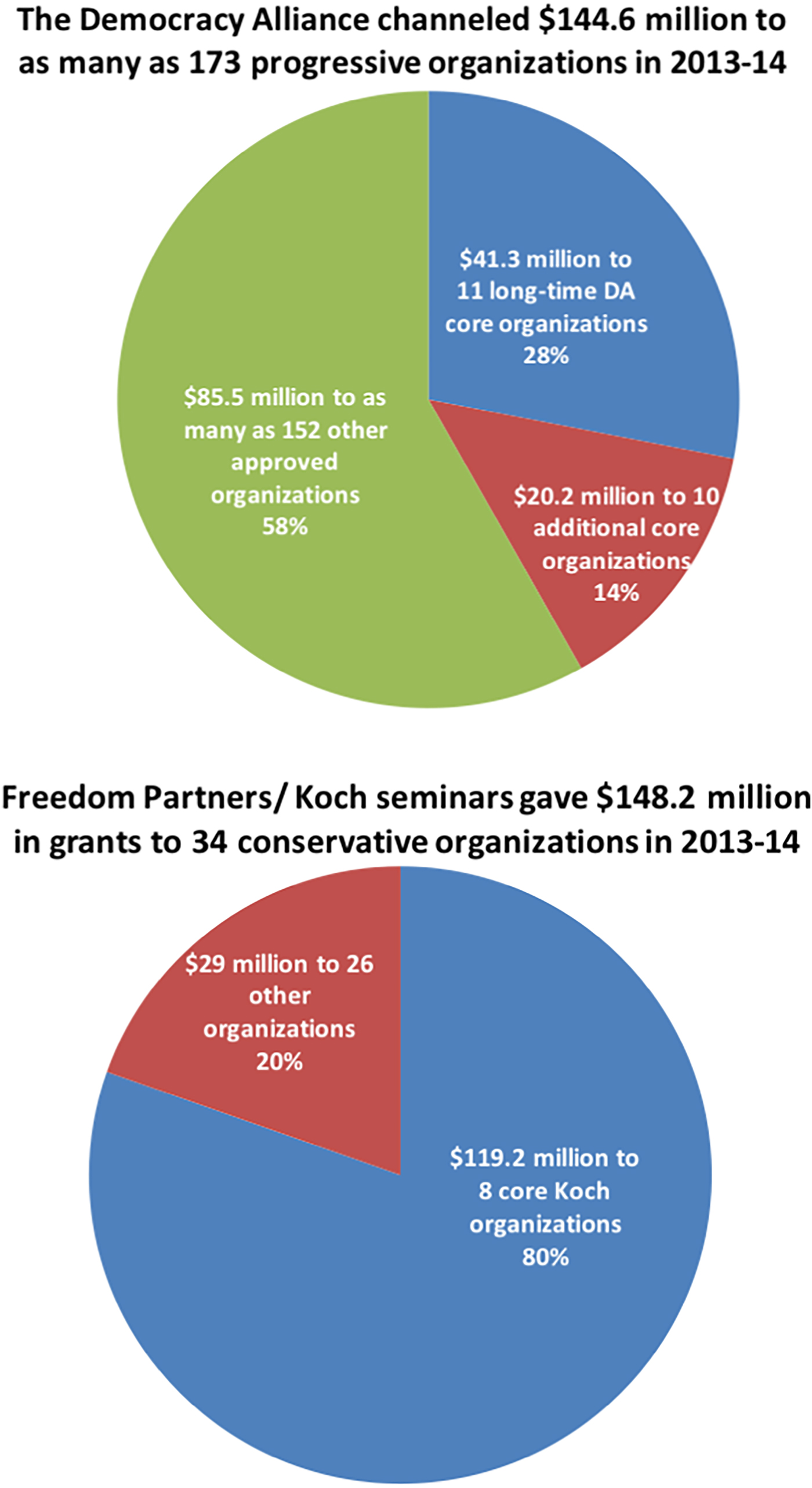
The divergent money-raising trajectories we see for the Koch seminars versus the DA would be significant even if the two consortia were allocating the donations they amass or coordinate in analogous ways. But that is not at all the case. Simply stated, the Koch seminars are not only raising greater sums than the DA, they are channeling those heftier resources to a more compact set of organizations directly controlled by the Koch network itself. By contrast, DA partners are spreading more limited funding across a much larger number of center-left organizations and funds, most of which the DA itself does not manage.
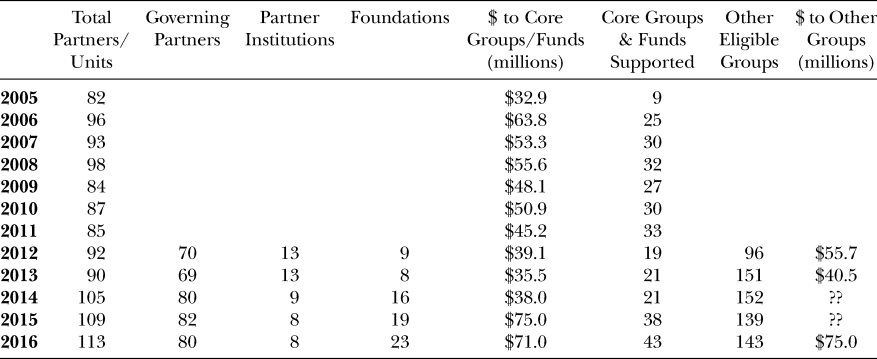
Data assembled from internal reports for Table 2 tell the basic DA story. Even in its earliest years, the DA expanded its core list of groups recommended for partner support faster than it added to the ranks of donating partners—although the tens of millions of dollars raised to beef up the center-left infrastructure did grow through 2008. By 2011, however, aggregate DA donations were declining even though the number of groups on the core recommended list rose to a high point. From 2011 to 2012, the recommended list of core organizations was pruned significantly, but at that same juncture, a longer secondary list of groups was placed on a “Progressive Infrastructure Map.” Partner donations to those dozens of additional groups counted toward meeting their yearly minimum required contributions of $200,000. In recent years, total partner donations to the additional approved groups have regularly exceeded donations to core recommended groups.
Democracy Alliance Trends, 2005–2016

In very recent years, the DA's approach of supplementing individual with institutional memberships has allowed it to orchestrate more funding for both core recommended groups and additional approved entities. At the same time, however, the core recommended list of groups has seen many changes and has expanded through the addition of new organizations, as well as many new DA-managed special funds focused on supporting state-level political groups.Footnote 56 By late 2016, the full array of highly recommended core DA organizations and funds stood at forty-three, a longer list than ever before—and dozens more groups appeared on the 2016 version of the DA's Progressive Infrastructure Map, any of them fair game for DA partners looking to fulfill their annual pledge commitment. “There are so many worthy groups,” a DA board member exclaimed to one of the authors—and clearly there are not enough donated millions to meet the demand for organizational sustenance on the left.
Meanwhile, Koch seminar dollars have followed quite a different trajectory. In Figure 5 we note that, since 2009–10, Koch seminar pledge targets have ballooned and now reach the hundreds of millions. As far as we can tell, pledge targets have been met, but public documentation about where all the funds have gone is incomplete. In particular, we do not know much about donations made directly by Koch seminar members to the Charles G. Koch Foundation, the Mercatus Center, and other think tanks and educational entities. We know from Koch seminar programs that these organizations and their projects are touted to donors, and interviews given by Charles Koch indicate that roughly 40 percent of pledge monies may go to support network efforts to shape ideas, research, and policy debates.
Beyond educational contributions, Koch seminar members also channel major funding directly or indirectly to political organizations engaged in citizen mobilization, policy campaigns, and election-related activities or spending. But which organizations benefit? Obviously, Koch-orchestrated donations could go to a wide variety of organizations on the U.S. right. A well-known portrayal of the Koch network in 2012—the “Maze of Money” map issued by OpenSecrets and the Washington Post—suggested that the Kochs and their donors routinely spread grants to a wide array of independently run conservative organizations.Footnote 57 That OpenSecrets chart suggested that Koch money is used to bankroll a vast tangle of conservative organizations from business groups to pro-gun and right-to-life efforts. We find, however, that the 2012 juncture was unusual; in other years, especially since 2012, contributions from seminar donors have been used primarily to support other organizations inside the Koch network.
Before 2012, possibilities for donating to political organizations inside the Koch network were somewhat limited. The Freedom Partners Chamber of Commerce was not set up until late 2011; before then, well-established Koch groups that engaged in electioneering and public campaigns were limited to AFP plus a trio of policy advocacy groups: the 60 Plus Association, the American Energy Alliance, and the Center to Protect Patient Rights (CPPR, also known as American Encore). During the Koch network's fierce fight against President Obama's Affordable Care Act and the conservative crusade to defeat Obama in 2012, CPPR served as a major conduit to fund political ads.Footnote 58 Reportedly, Koch donors also used additional political funding conduits during the early Obama years, including a group favored by many conservatives called Donors Trust and another Koch-tied group called the TC4 Trust.Footnote 59 However, from 2012 on, the Koch's own “political bank,” Freedom Partners, took over as the major political funding conduit, displacing CPPR.Footnote 60 By then, there were many more Koch-run political groups for donors to support—including the Libre Initiative, Generation Opportunity, Concerned Veterans for America, Themis/i360, and Aegis Strategic (see Appendix A). In 2014, Freedom Partners also launched its own super PAC.Footnote 61
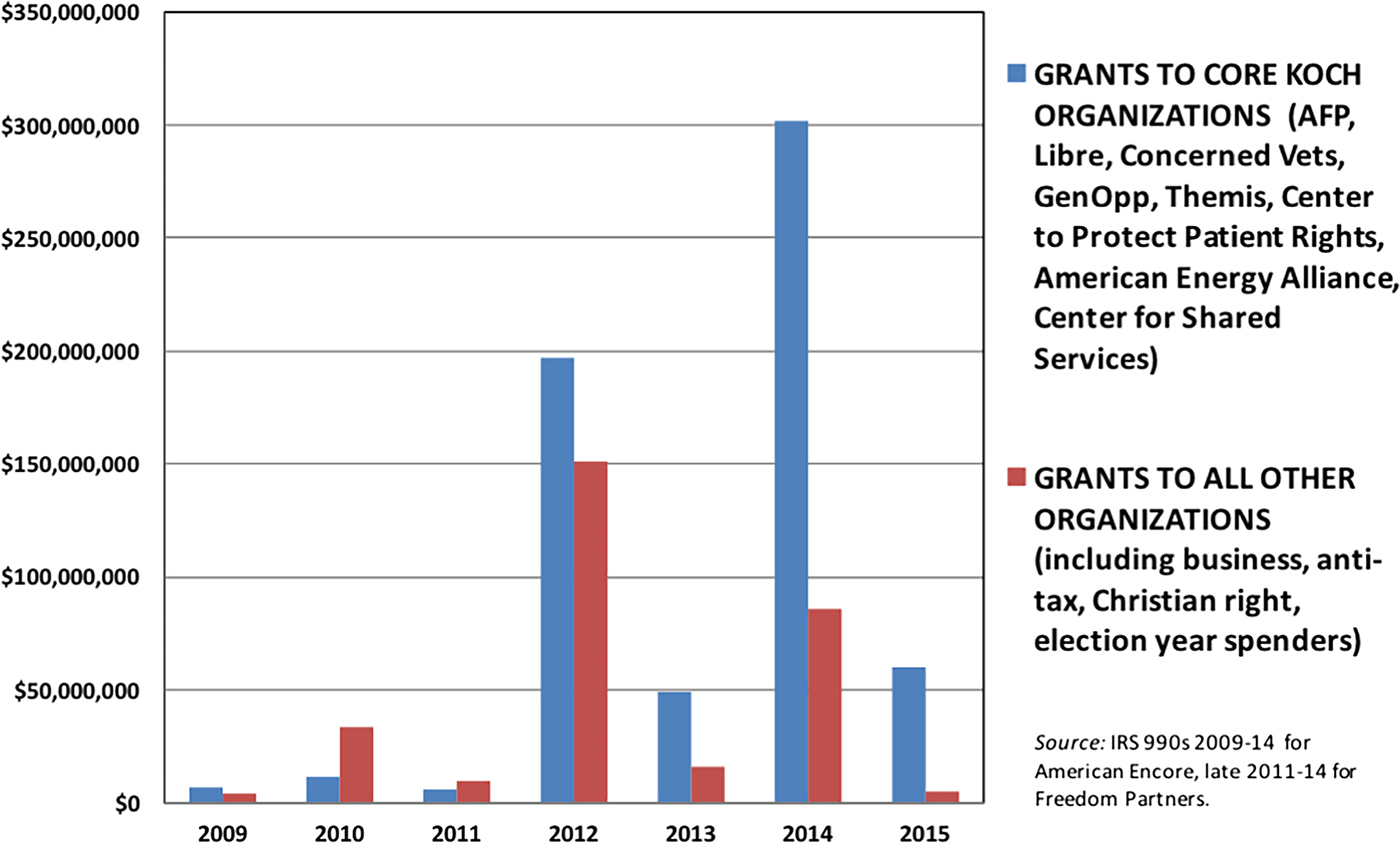
Empirically, we have no way to trace the specific destinations for any Koch seminar-inspired donations that flowed some years ago through Donors Trust. But for recent years, we can use IRS 990 reports that list donations for “general support” that went to various political groups through Koch conduits, including the TC4 Trust, CPPR, and Freedom Partners. Figure 6 sums up the grant totals from these conduits in recent years—and also indicates the percentages of total funding that went to the Koch network's own political organizations during each period.Footnote 62
Grants from Koch Funders: How $936 Million Was Allocated by American Encore and/or Freedom Partners, 2009–2015.

From these data, we can see that more than $350 million in political funding channeled through Koch conduits was widely distributed during the 2011–12 election cycle—the juncture at which OpenSecrets prepared its Maze of Money chart. At that moment, about half of funding through these conduits went to Koch-run political operations like AFP, but the other half funded grants scattered to several dozen other conservative and business organizations engaged in constituency mobilization, advocacy, and political messaging in the 2012 election cycle. In that election cycle, the Koch network still lacked many political capabilities of its own, so the network channeled grants to many other conservative groups—including the U.S. Chamber of Commerce, the Club for Growth, the National Rifle Association, and assorted Christian right organizations.
But after the 2012 efforts fell short, Koch leaders delayed the winter 2013 Koch seminar from January to April, so that the results of their network's autopsy and strategic reevaluations could be presented to donors.Footnote 63 From that point, as Figure 6 suggests, donations to political organizations flowed overwhelmingly through Freedom Partners, now the central conduit for Koch political funding. Equally important, no longer were grants spread around to business associations and independent conservative groups outside the Koch orbit. Instead, Freedom Partners channeled large amounts in general-support grants to core Koch groups—including $23 million to AFP, $5 million to Generation Opportunity, and another $14 million to Concerned Veterans of America.
For a final comparison between the political funding strategies of the DA and the Koch seminars, we have pulled together the pie charts in Figure 7 to dramatize their respective 2013–14 patterns of organizational funding. We use this time point because it is one where, thanks to leaked documents as well as IRS records, we have relatively full information on allocations by the two consortia. (However, the Koch funding allocations explored here are only about half of all the monies that network deploys. As noted earlier, these data only show the explicitly political donations channeled from Koch donors through Freedom Partners and then regranted to other organizations disclosed on tax returns; additional hundreds of millions have also gone in untraceable ways to the Charles G. Koch Foundation and other educational entities in the larger network.)
Funding for Political Organizations through the Democracy Alliance and the Koch Seminars, 2013–14.

In the DA pie chart, we classify organizations to which partners donated into three categories: longtime core recommended groups that had been on the main DA funding list continuously since 2007–09, all other core groups on the 2013–14 recommended list, and the remaining groups on the DA's very large Progressive Infrastructure Map listing dozens of organizations to which partners may donate in fulfillment of their membership pledges. In the much simpler Koch pie chart, recipients of Freedom Partners grants are sorted into two categories: political organizations controlled directly by the Koch organization versus all others (see Figure 1 for this classification; unlike with the DA, we do not know if the Koch seminars use an “extended” approved list to classify groups).
The bottom line contrast is clear. Even in a two-year period where roughly similar amounts of donor money were given by DA partners and to explicitly political groups through the Koch seminars/Freedom Partners conduit, the patterns of deployment were quite different. The DA encouraged (and allowed) relatively small gifts to many dozens of organizations, while Koch seminar members who channeled donations through Freedom Partners ended up concentrating their support on eight core Koch political organizations.
ALTERNATIVE EXPLANATIONS
At this point, it makes sense to step back and consider alternative theoretical explanations to the historical-institutional approach we are invoking here to make sense of the contrasting features and activities of the Koch and DA consortia. We have argued that the divergences are attributable, in part, to the specific political junctures at which each consortium was formed and the strategies consortium leaders devised to respond to political challenges. Above all, we stress the impact of the different organizational structures put in place for these consortia, especially their membership rules and very different procedures for directing member contributions to arrays of kindred right or left political organizations. Koch seminar rules concentrate donor resources inward in support of an integrated political network that can nimbly form and revise overall strategies, while DA rules have promoted scattering of resources and undercut possibilities for advancing any coherent strategy.
But our explanatory approach is not the only possibility. Some scholars might reason that Koch versus DA differences are better understood as straightforward expressions of the underlying individual characteristics of U.S. millionaires and billionaires (in terms of their wealth or fundamental ideological orientations), while others might attribute the evolution of these donor groups to the partisan threats they have tried to counter, namely, progressive Democratic clout for the Koch network and GOP rule for the DA. We consider such alternative lines of explanation here and, in the process, sharpen our own explanatory account involving organizational rules and structure.
According to one line of argument, the preferences of most U.S. wealth holders lean conservative and donors who have joined the Koch seminars may have very unequal holdings. Consequently, this logic suggests, the Koch consortium finds it easier to enroll big donors than the DA—and wealth differentials among Koch members allow the extraordinarily wealthy Charles and David Koch to impose central direction on donors with less financial clout. But there are clear reasons to question such economic-reductionist reasoning. Although the political leanings of very wealthy Americans do lean right overall, in the wake of upward-tilted wealth concentration since 1979, there are currently many multimillionaires and billionaires on both ends of the partisan spectrum. Using the Forbes 400 annual rankings of the wealthiest Americans, political scientists Adam Bonica and Howard Rosenthal have matched names to political donation records and devised scores indicating each person's ideological leanings.Footnote 64 Their data show that Democratic donors have gained ground on the Forbes 400 lists, rising from about a third in 1983 to about 40 percent in 2012—a development that has unfolded as high-tech and information businesses (which lean left) have gained ground and older right-leaning manufacturing industries have receded in the U.S. economy. By the time the Koch seminars and the DA were formed in the early 2000s, both consortia could fish for members in very large pools—and in its earliest years, the DA actually attracted more members than the Koch seminars (see Figure 2).
Nor can we say that there are big differences in the distribution of wealth within the consortia. Because our lists of DA and Koch members are not complete, we cannot compare the exact wealth distributions of their memberships. Still, on the (incomplete) membership lists we do have, both consortia have many Forbes 400–listed members. The Koch seminars have always had many more Forbes 400 listees than just the two Koch brothers, suggesting that Koch leadership cannot simply be attributed to holdings that tower over all others in their consortium. And the DA has always included multibillionaires from the Forbes 400, too—indeed, George Soros helped launch the group and has always been very influential, and others such as Peter Lewis, Marion Sandler, and Tom Steyer have been DA partners over the years.
A second alternative to our historical-institutional approach focuses on political beliefs instead of just wallets. The pedigree of this theoretical approach stretches back to 1967, when Lloyd Free and Hadley Cantril argued that Americans tend to be, simultaneously, “philosophical conservatives” and “operational liberals”—that is, committed to general values favoring free markets and individual liberty and at the same time supportive of many specific government efforts that deliver benefits to subsets of individuals, families, and businesses.Footnote 65 Repeatedly since then, political scientists have translated this insight into a theory of modern U.S. party differences. The most recent version appears in Asymmetric Politics: Ideological Republicans and Group Interest Democrats by Matt Grossmann and David A. Hopkins, who argue that Republicans have long been ideologically united around free-market, antigovernment positions, while Democrats argue about scattered policies that benefit various interest groups and constituencies.Footnote 66 The Grossmann-Hopkins theory is rigorously substantiated with data about U.S. public attitudes, voting trends, and the styles of argument used by activists, politicians, and disclosed election donors. Although the organized Koch and DA consortia of very wealthy donors consortia are not discussed, the Grossmann-Hopkins logic implies that the Koch seminars are able to concentrate donor resources on a strategically unified set of organizations because their individual wealthy members are happy to advance free-market principles in all realms of politics. Conversely, according to this line of argument, the DA scatters largesse because, like other liberals, wealthy progressives are invested in many different policy causes and specific social constituencies.
Is it as simple as that? Do the Koch seminars and the DA merely reflect inherent, enduringly different proclivities between U.S. conservatives and liberals? For various reasons, we do not find this account convincing. In the first place, there are reasons to doubt that wealthy members of the Koch seminars agree more than their DA counterparts. DA partners certainly vary in their policy priorities, for example, between those who stress the fight against global warming and those who worry most about social equity. And DA partners also disagree about political strategies, with some stressing policy research and lobbying, while others favor empowering outside constituencies. But Koch donors have diverse passions, too, as evidenced by the varied conservative groups and causes they support outside the network itself—ranging from Christian right or Zionist organizations, for example, to pro-gun groups, libertarian causes, and antiabortion groups. Although the Kochs themselves prioritize libertarian and free-market economic policies and steer clear of issues like restricting abortion, immigration, and LGBT rights, donors to their network espouse many additional conservative commitments. Members of the DeVos family, which includes patriarch Richard DeVos as well as daughter-in-law and current Trump Secretary of Education Betsy DeVos, have been participants in the Koch seminars while also being longtime supporters of the Christian right.Footnote 67 Similarly, even as the Templeton family was singled out for praise from Charles Koch for giving more than $1 million through the seminars, its evangelical Christian members have given large contributions to efforts fighting the legalization of gay marriage.Footnote 68
Nor do Koch donors concur in presidential politics any more than DA partners do. In the 2015–16 GOP presidential cycle, for instance, the Koch brothers and many of their donors opposed Donald Trump, who was nevertheless (sooner or later) supported by other Koch seminar participants such as Robert and Rebekah Mercer, the DeVos family, and Sheldon Adelson.Footnote 69 This resembles the DA situation, where partners divided in 2008 to back Hillary Clinton, Barack Obama, or John Edwards (early on), and split again in 2016 between Clinton versus Bernie Sanders.Footnote 70 Both the DA and the Koch seminars encourage discussion of various electoral candidates but do not try to force overall agreements.
In the Koch seminar quest to bring members together around a particular ultra-free-market agenda, cross-cutting fault lines are downplayed or ignored. If the Koch seminars were to feature religious or social-conservative causes—which they do not—members would not all cheer for the same positions. Furthermore, any discussions about the details of business policy could very well surface tensions between the interests of the particular firms owned by many Koch seminar participants versus calls by many ultra-free-market-minded Koch participants to abolish business subsidies altogether.Footnote 71 Our findings are consistent with careful historical work by scholars such as Steven Teles, who stresses that conservative leaders often have trouble knitting together diverse constituencies active on the right—including social conservatives focused on culture war issues, corporate interests supportive of friendly government subsidies and regulations, and free-market libertarians determined to oppose all forms of active domestic government.Footnote 72
Still, without systematic interviews or access to attitude surveys, we have no direct measures of the individual preferences across all DA and Koch members. We do not know how attitudes are distributed or how they have evolved. From personal interactions, we know a bit about internal disagreements on the DA side, but for the Koch side, we only have access to public rationales offered by members who write op-eds or allow themselves to be quoted by name in news articles. Overall, such published rationales do lend some credence to the Grossmann-Hopkins theory of a unified conservative rhetorical style, because Koch donors use almost the same phrasings again and again as they tout Charles Koch's leadership to defend a “free society” and unfettered markets from “big government” threats of regulations, taxes, spending, and subsidies. Indeed, entire groups of Koch seminar members have endorsed some such op-eds—such as the one that appeared in the Dallas Morning News in 2015.Footnote 73 Tellingly, op-eds like this proliferated starting in 2015, when Koch network leaders encouraged their donors to defend the Koch brothers and seminars against liberal critics and, quite likely, provided them with talking points and model language.Footnote 74
Beyond ideological boilerplate, some of the Koch donor rationales cite social ties and political strategies of the sort we have stressed as distinctive to contemporary donor consortia. On social underpinnings, Minnesota television owner Stanley Hubbard explained that, as of 2012, he had been attending for years and offered that “I've gotten friends to be involved, and I think others have, too, so I would guess, yes, that's expanding.”Footnote 75 In 2015, the chief executive of a lab equipment manufacturing company, Steve Hamilton of Reno, Nevada, explained as he attended his fourth Koch meeting that he “relishes the camaraderie of these events.”Footnote 76 Also speaking in 2015, Michael Shaughnessy, former president of ColorMatrix Corporation, said he was recruited to the seminars by a friend and now “organizes his own twice-yearly meetings to recruit other Cleveland-area conservatives to join the broader Koch network.”Footnote 77
As for strategic motives, a few public accounts suggest that wealthy conservatives may have thrown in with the Kochs out of frustration with Republican electoral politics as usual. “I don't like to be considered a Republican,” says longtime seminar attendee Bob Fettig, a Wisconsin business owner who is “proud to be affiliated with the group because it's more about principles.”Footnote 78 Similarly, Bill O'Neill, the retired Ohio president of Leaseway Transportation Corporation, “likes the group because it isn't just focused on election results and short-term campaigns but rather on broadly influencing society as a whole. ‘They're looking at much longer time horizons,’ he said.”Footnote 79 And the previously quoted Michael Shaughnessy explains that he joined the Koch seminars because “I was desperately looking for some way to do something significant, and not just write a $2,700 check” (the maximum donation to particular candidates in federal elections).Footnote 80
Even if the Grossmann-Hopkins theory resonates with the overall rhetorical style displayed by Koch members, it cannot explain how the consortia changed (or not) over time, with the Koch seminars and larger Koch network moving from marginality to centrality in the conservative U.S. organizational universe of the early 2000s, even as the DA failed to gain comparable momentum on the left. Despite the fact that Charles Koch was, as always, pushing libertarian, free-market ideas, the Koch seminars were in their first years tiny and not very attractive to most conservative big-money people. Even after the 2006 and 2008 elections, alarmed conservative wealth holders had other venues where they could channel attention and money—for example, Republican Party committees, the Chamber of Commerce and other business associations, and social-conservative associations like the National Rifle Association and Christian right operations. All of these were established core sectors in the Republican Party coalition and the conservative organizational universe of the early 2000s. Yet within a decade the rising Koch network rivaled earlier core conservative players, including the Republican Party itself, in its capacities to raise and deploy resources. As we will describe below, the centerpiece organization in the Koch network—AFP—had by the 2014 election cycle about as many field staff as the GOP.Footnote 81
If constant philosophical proclivities cannot explain post-2000 shifts on the U.S. right, these important changes can be understood as a confluence of national political shifts and organizational choices made by the founders of the Koch consortium. This brings us to yet another, very different line of counterargument that some analysts might make to the institutional as well as historically dynamic account we offer here. There is no question that both the Koch seminars and the DA were formed at key moments in response to perceived threats their original wealthy members felt from the other side of the U.S. ideological spectrum—threats these founders did not think their own side was adequately meeting. But the key threats were not just partisan, and the founders of each consortium put in place rules and procedures that ultimately shaped membership possibilities and clout thereafter.
On the Koch seminar side, we acknowledge that membership burgeoned after 2005 in response to partisan gains by Democrats in the 2006 Congressional elections and, even more spectacularly, after Obama and Congressional Democrats both triumphed in 2008. But in our view it is crucial to note that the Koch network's institutional foundations and early organizational achievements were already in place prior to these partisan shifts. The Koch seminars were launched in 2003 and thus were already meeting when, following 2006 and 2008, growing numbers of wealthy U.S. conservatives were jarred into looking for new ways to build extra-party power. Furthermore, the Kochs and their seminar donors were already funneling resources into AFP, which by 2006 and 2007 had state as well as national organizational capacities to push ultra-free-market candidates and policies outside the GOP itself.
For wealthy U.S. conservatives frustrated with the late Bush administration and with the GOP's capacity to counter rising Democrats, the Koch seminars and Koch-created political organizations including AFP offered something new and hardline.Footnote 82 As more and more wealthy conservative business people attended Koch meetings in the mid-2000s, camaraderie kicked in—and participants responded favorably to the political strategies outlined by the Koch brothers and their closest associates that had been previously established. Sufficient enthusiasm and loyalty was built to keep donors on board even when the Koch leaders had to recalibrate following defeats like those in 2012. Very likely, conservative business leaders appreciated that Koch-orchestrated reevaluations were prompt, much as they might have hoped would happen when the sales of a business enterprise fell off. Unlike the Republican Party's autopsies, Koch recalibrations happened very fast and decisively.
Arguably, the structures and rules of wealthy donor consortia go hand in hand with their appeals to potential members. The Koch seminars have flourished at a time when wealthy conservatives are desperate to push back against Democratic gains and policies—and when many do not see GOP politics as it existed through the Bush era as adequate to the task. As wealthy individuals—more so than corporate managers with organizational reasons to be cautious—the Koch donors can respond enthusiastically to an ideologically pure message delivered in socially congenial meetings they attend with spouses. But the Koch “guests” are also hard-headed elites used to getting their way; they want to win elections and policy battles and build political power, not just talk. Aided by the downs and ups of recent GOP and conservative fortunes, Charles Koch and other network leaders have convinced their millionaire and billionaire donors that they know more about how to build conservative elite power than the GOP itself.
The centralized structure of the Koch seminars and network allows for trial-and-error strategic nimbleness across election cycles, along with longer-term efforts to pursue educational as well as political goals. Furthermore, the placement of the seminars within the overall Koch network has prevented donors from being locked in or captured by any one grant-receiving organization or fixed strategic approach. If any given tactic or organization fails or does not become associated with political gains, it can be scrapped or revised. People can be moved around across network efforts, and Koch-run political organizations funded by the consortium can be created, shut down, or merged as performance measures warrant and strategies change.Footnote 83 Empirically speaking, all of these things regularly happen in the larger Koch political operation—in sharp contrast to the greater degrees of organizational and leadership lock-in that seem apparent in the hundreds of separate organizations operating on the U.S. political left.
When the DA got going in 2005, the founders expressed a resolve to avoid doing the same old things, similar to the resolve of the post-2000 Koch network builders. DA founders planned to redirect donations to bolster a few innovative operations that would beef up the Democratic Party's infrastructure for policy planning, messaging, and voter mobilization. But in the formative phases these DA founders adopted marketplace procedures for membership and channeling donations that—perhaps unintentionally—encouraged actual and potential DA donor partners to push for ever more preexisting U.S. liberal organizations to be added to the DA's regularly updated investment menus. Against the backdrop of the larger U.S. political context, those procedures helped to set the early twenty-first-century DA on paths not fully envisaged by the founders.
Neither of the wealthy donor consortia featured here was launched on virgin terrain. As any historical-institutional analysis recognizes, new organizations are invariably established amid others already in place. For the DA, in particular, the preexisting organizational context was crowded. Between the 1960s and 1990s, new waves of liberal advocacy and social rights groups emerged by the thousands in U.S. civic life, and they were usually led by highly educated professionals pursuing nonprofit careers in Washington, DC, New York, and other liberal metropolitan centers.Footnote 84 Wealthy donors of liberal bent had long been courted by such advocacy groups working on behalf of causes ranging from environmental protection to LGBTQ and minority rights to pro-choice reproductive policy. By the time DA got off the ground in 2005, most of the wealthy donors it sought to recruit had strong, preexisting organizational commitments. As DA founder Rob Stein observed in a 2006 symposium, the left already had “a lot of existing institutions” of the sort the DA hoped to foster.Footnote 85 Thus when the fledgling DA put in place membership rules that required regular debates about lists of liberal organizations to recommend for partner donations, the effect—perhaps not foreseen at the time—was to create overwhelming incentives for existing and new members to push for their favorite existing groups to be endorsed by the DA. That is exactly what happened (as Table 2 shows). Over the years, much DA staff and donor energy was devoted to arguments about adding or subtracting listings of particular advocacy groups, think tanks, constituency-mobilizing efforts, and so forth.
Furthermore, resource flows through the DA tended to become locked into the accumulation of recommended groups, each run by its own professional leaders who maneuvered to present their cause to DA donors at biannual conferences—and who certainly fought any efforts to remove their groups from the recommended DA list. All of this has made it difficult for DA consortium leaders to pursue any overarching political strategy—and has made it cumbersome for even determined DA reformers of the sort that have recently emerged to free up donor resources to meet new U.S. political challenges as they arise.
In principle, something similar could have happened on the right. Although the conservative interest group landscape in the early 2000s was probably less fragmented than the liberal one, when the Koch seminars got started, there were many established conservative power players—including the U.S. Chamber of Commerce and other business associations, antitax groups like the Club for Growth, the National Rifle Association and other gun rights groups, and a plethora of Christian right and pro-life associations. However, the Koch seminars never installed any rules or procedures analogous to the DA marketplace arrangements. Even though leaders from independent conservative groups such as the U.S. Chamber of Commerce or the American Enterprise Institute appeared on particular Koch seminar panels, their organizations were never officially endorsed to receive ongoing Koch donations (in fact, in one of our interviews, we were told that the head of the American Enterprise Institute resented the Kochs for “stealing” his donors at a seminar meeting).
Unlike the DA, the Koch consortium remained “free” of fixed entanglements to independent, professionally run organizations, so donor money could be directed to the Kochs’ own political operations and educational charities, including some groups the Kochs had already built up before the launch of the seminars. This could not have happened without agreement from actual and potential donors. But because previous conservative power players faltered soon after the seminars were started and conservatives panicked about the rise of Democrats and the effectiveness of the Bush GOP, the Koch network builders could pick up the slack—offering a socially congenial and politically attractive outlet for right-leaning wealth holders determined to find new venues for their passions and their money.
WEALTHY DONOR CONSORTIA AND THE SHIFTING U.S. POLITICAL TERRAIN
If the chief missions of both the Koch seminars and the DA are to bolster and reconfigure long-term organizational infrastructures on the right and left, what can we say about their accomplishments to date? Although much more research remains to be done, we briefly suggest how the rise of these wealthy donor consortia has shifted organizational resources on the right and left and influenced policy agendas and battles in national and state politics.
The Big Right Tilt
At the start of our work on donor consortia and other organizations two years ago, we worked with existing literatures and experts to draw up lists of all of the major think tanks, issue advocacy groups, constituency-mobilizing associations, national political party committees, and donor organizations (apart from individual candidate PACs) as of 2002 and 2014. We also gathered data on groups’ annual budgets at those junctures. Detailed in Appendices D and E, these left and right universe lists are not the only ones that might be drawn up, but we are confident that they reflect the most important left and right political organizations operating at two nonpresidential years before and after the establishment of the two wealthy donor consortia examined here. By examining changes in the shares of the total budgetary pies from 2002 to 2004, we can see that especially telling shifts occurred in the U.S. conservative universe over this short period.
On the right, there were startling shifts away from party control, as documented in Figure 8. Especially telling is the shrinking share of total right resources controlled by Republican Party committees—a share that plummeted from 53 percent in 2002 to 30 percent by 2014—and the correlative expansion in shares controlled by nonparty entities, and especially by right-wing donor groups and, above all, the Koch seminars. Although various old and new groups were involved in the growth of the extra-party shares on the right from 2002 to 2014, the expanding Koch network was crucial, as we can see from the groups listed in blue boldface in Appendix D. The Koch seminars, the Freedom Partners Koch funding conduit, and AFP all played big roles in shifting funding flows and reconfiguring the organizational universe toward the ultra-free-market right. The Kochs and their donors say they want to push and pull Republican officeholders and candidates in order to move the center of gravity in U.S. politics and policymaking toward the antigovernment, ultra-free-market right. Shifting organizational patterns and resource shares suggest that they have done just that.
Shifting Organizational Resource Allocations of the U.S. Right, 2002–2014.

In contrast, Democratic Party committees did not lose ground compared to nonparty organizations. The DA may have played a small role in boosting shares for some sectors but, overall, Democratic Party committees and long-standing major liberal organizations like the labor unions, the NAACP, and Planned Parenthood continued to hold sway in 2014 just as they had in 2002—and the overall shares of party versus nonparty resources remained remarkably stable. Clearly, the DA did not displace the Democratic Party in the same way as the Koch seminars have done for the GOP.
A second way to look at the impact of America's wealthy donor consortia is to consider whether—and how effectively—they have targeted cross-state infrastructure development. Because the United States is a federated political system, “national” political clout in Congress and the Electoral College is grounded in widespread leverage across political geography, not just in money and staffers deployed in big metropolises and Washington, DC.
Well before the Koch seminars and the DA were launched in the early 2000s, cross-state organizational networks grew on both the left and right (beyond the two major political parties themselves). On the left, labor union federations were crucial—especially the public-sector unions, including teacher unions, that had a presence and clout in many states and often took the lead in fights about taxes and social programs generally. In addition, from the late 1980s, two cross-state networks, the State Priorities Partnership (earlier called the State Fiscal Analysis Initiative) and the Economic Analysis and Research Network, linked liberal policy research organizations spread across the states.
Meanwhile, the right built its own state-level think tank network, called the State Policy Network (SPN), from 1986 on; after starting small in 1973, the American Legislative Exchange Council (ALEC) became very effective from the 1990s on at linking businesses seeking state-level policy changes to draft “model bills” for Republicans to introduce in state legislatures.Footnote 86 Over several decades, these cross-state organizational networks were supported by the Koch brothers and donors who would eventually join their seminars. Tellingly, however, when the Koch donor consortium was established in the 2000s, it did not just keep doing more of the same. Instead, it added to conservative cross-state capacities by building up AFP as a federated organization able to deploy money, paid staffers, and volunteer activists in state-level elections and public policy battles.
As Figure 9 displays, the spread of AFP was steady after its launch in 2004—and notably, the organization quickly expanded into long-standing liberal and Democratic Party strongholds. By 2005 AFP had already installed a paid director in the state of Wisconsin and started to build capacities the Koch network and right-wing allies would use to help defeat labor unions and reshape that state's politics and public policies. North Carolina was an early AFP target, too. In 2008–10, even as Democrats controlled the presidency and both houses of Congress in Washington, DC, the right-wing “troika” (as we label the combination of SPN, ALEC, and AFP) was positioned to shape policy agendas and legislative outcomes in dozens of states as soon as Republicans gained new governorships and legislative majorities starting in 2010.
The Growth of Americans for Prosperity.

On the other end of the partisan spectrum, the DA from its inception has recurrently tried to build capacities at the state level. Key staff leaders and groups of donors have repeatedly focused on particular states, especially those that are home to many partners. And the DA's lists of core recommended organizations have always included the Center on Budget and Policy Priorities, which coordinates liberal research organizations across many states through the State Priorities Partnership.
Furthermore, since Gara LaMarche took the DA helm in 2014—and especially after Hillary Clinton lost her bid for the White House in November 2016—the DA has ramped up efforts to build infrastructure and coordinate donor work in the states. New state-focused DA funds have been added to the core investment menus, and starting in 2014, the DA also began recommending support for the newly launched State Innovation Exchange, or SiX for short. This organization seeks to counter ALEC by supporting self-identified “progressive” officeholders in state legislatures across the country. In 2017, SiX announced the creation of a new political arm called SiX Action to channel contributions to the campaigns of progressive candidates in the states.
Despite such long-standing and recently intensified DA efforts, however, the progressive consortium clearly remains far behind the Koch network in nurturing cross-state capacities. Not only do left-leaning cross-state organizations receive much less largesse from DA donors and work with much smaller budgets than the conservative troika powerhouses, the overall reach of the left efforts falls far short of the reach of conservative cross-state networks. Unlike the Koch network's AFP, even recently ramped-up DA efforts mostly focus on friendly territories. So far, for example, SiX and assorted DA-encouraged state donor groups principally hold sway in liberal states like California, Minnesota, Washington, and Oregon, and do not reach into GOP or conservative strongholds.
Why It Matters—Donor Consortia and Pivotal Policy Battles
America's recently established wealthy donor consortia, as we outlined at the beginning of this article, set out to reshape the overall organizational terrain of politics and governance—above all because their donor members hope to further very different public policy agendas. Koch seminar members want to shrink taxes, social spending, and government's regulatory footprint in the market economy, while DA donors favor government steps to promote social inclusion and socioeconomic equality. The bottom line for both consortia, therefore, lies in reshaping public policy debates and government activities at all levels of the U.S. federal system—and the available evidence (which we can only briefly indicate here) suggests that the Koch seminars and Koch network have had a much greater impact than the DA and its aligned organizations.
With the Koch seminars providing big money, the Koch network has very rapidly built virtually a third political party machine in the United States—a machine that is intertwined with the GOP but not directly under the control of official party leaders or committees. With AFP and the Koch seminars at its heart, this new machine both helps fund election campaigns for free-market-oriented Republicans and, once such GOPers win office, effectively pushes them to legislate free-market policy goals in the states and U.S. Congress, even when the policies at issue are not popular. Elsewhere we have described some of the key Koch policy accomplishments in recent years: persuading most Republicans in Congress to obstruct carbon taxes and other steps to deal with global warming, supporting state-level curbs of labor union rights, and rolling back pro-labor measures like minimum wage increases.Footnote 87
On the left edge of the Democratic Party, meanwhile, DA donors have contributed to groups that advocate for progressive policy stands such as a $15 minimum wage, single-payer health insurance, and stronger regulations to fight global warming. Nevertheless, such progressive regulatory gains and urban ordinances stand at risk of being undone by GOP-dominated state legislatures and by the post-2016 Trump administration. For example, although some twenty-six states have recently increased their minimum wage levels and more than thirty cities have followed suit, the right-wing troika of ALEC, the SPN think tanks, and AFP state organizations has been quite successful in persuading GOP legislatures to block or undo pro-labor laws and have also used state legislative clout to preempt or roll back urban ordinances. As of 2016, nearly six in ten Americans lived in a state that had preempted local-level minimum wage hikes.Footnote 88
The battles that have raged over comprehensive health reform since 2008 in Washington, DC, and across the U.S. states are especially telling for understanding the contrasting accomplishments of the Koch versus DA consortia. As David Leonhardt of the New York Times pointed out, the Affordable Care Act enacted by Congress in March 2010—following years of fierce partisan warfare—was the single most economic-equality-enhancing U.S. federal legislation enacted in half a century.Footnote 89 What is more, when the Supreme Court upheld this law in June 2012, it also ruled that each state could decide whether or not to implement the new federally funded expansion of Medicaid coverage—setting off new partisan and ideological battles that have raged across the U.S. states ever since.
Through all phases of the enactment and implementation of health reform, the wealthy donor consortia and their affiliated organizations played predictable partisan roles—but operated in tellingly different ways to quite different effects.
From the start, the Koch network spearheaded unremitting opposition to health reform. At the January 2009 Koch seminar meeting in Palm Springs, California, wealthy donors sounded the alarm about Democratic plans for health reform, prodding the network to launch comprehensive efforts to block, undercut, and delay.Footnote 90 This coincided with floods of new wealthy conservatives clamoring to join the Koch seminars and channel resources to further Koch-led efforts. As Congress deliberated over health reform legislation in 2009 and 2010, AFP helped organize “kill the bill” protests outside the U.S. capitol plus some 300 rallies across the country. Most visibly, AFP coordinated 2009 town hall protests targeting lawmakers. As one Koch operative explained, “We packed these town halls with people who were just screaming about this thing. …We knew we had to make that summer absolute hell.”Footnote 91
AFP again moved front and center after the 2012 Supreme Court decision tossed Medicaid expansion choices back to the states, because Koch network leaders quickly realized that this ruling offered a second chance to limit and eviscerate health reform. “From the very beginning, we turned to a state-by-state effort to stop the expansion of Medicaid,” AFP's head Tim Phillips explained to a journalist, “Medicaid expansion and Obamacare has been the issue we've worked on more than any other single issue.”Footnote 92 In 2015 and 2017, AFP donor prospectuses (found by journalists) featured blocking implementation of the Affordable Care Act as one of AFP's top priorities.Footnote 93 Fueled by burgeoning flows of Koch donor money, AFP and other Koch network groups ran ads against state-level GOP lawmakers who so much as contemplated acquiescing to pressures from many business associations to accept federal money to expand Medicaid; AFP also organized opposition rallies on the steps of statehouses and flooded legislators’ inboxes and voicemails with messages from activists. Such efforts were not always successful, but research we have published elsewhere shows that they contributed significantly to blocking Medicaid expansion in many of the nineteen holdout states between 2013 and 2016.Footnote 94
In contrast to the often successful contributions Koch donors made to oppositional efforts, the DA has been only a minor and temporary player in Affordable Care enactment and implementation. During the policy planning and grassroots mobilization efforts that happened from 2006 through early 2010, the DA was just taking shape, building from eighty-two partners in 2005 to eighty-seven in 2010. DA donors certainly cheered on Democratic and Obama administration efforts to enact health reform, and DA-connected organizations were involved in the overall drama. But the DA itself was not central, because the lead role was taken by an umbrella group called Health Care for America Now (HCAN).Footnote 95 Launched in 2007, HCAN knit together some 900 local, state, and national organizations, including labor unions, community groups, and advocacy groups, and at its height, HCAN deployed forty-five state directors.
This multiyear, nationally federated HCAN coalition was funded not by the DA but by dues from participating groups and grants from private foundations—buoyed above all by tens of millions of dollars from Atlantic Philanthropies, whose president at the time was Gara LaMarche. It was fortunate for the DA that it was not called upon to support HCAN or an effort like it, because the fledgling progressive consortium could not have met this challenge at a time when DA donors were spreading about $50 million per year across some twenty-five to thirty progressive groups (see Table 2). Some of the DA's beneficiary organizations were certainly involved in HCAN, so the DA helped indirectly. But DA donor contributions were small in relation to overall needs. Furthermore, the DA in its first years was contending with strong pushes and pulls from wealthy members or recruits pressing many particular liberal organizations and causes for DA support. In the DA world, there could be nothing comparable to the strategic recognition that dawned on top Koch network leaders in 2009 that America's next big battle over redistributive social spending, the health reform wars, was worth pushing to the top of the agenda. DA leaders lacked the financial and strategic capacities it would have taken to spearhead reform enactment.
Major reform legislation is, however, never accomplished simply in the enactment phase. Implementation battles rage for years, as happened for Social Security in the past and has certainly proven true for the Affordable Care Act now.Footnote 96 So the DA had later opportunities, beyond the enactment phase, to get involved—especially when HCAN folded its tents. HCAN celebrated victory when the Affordable Care Act passed Congress in 2010, yet also kept its doors open, in reduced form, through the early judicial battles, initial administrative rulings, and Obama reelection campaign, before deciding to wind down most of their substantive operations at the end of 2013. Founder Richard Kirsch explained that “HCAN had done its job of winning and securing the law. It's leaving to other organizations the job of defending and improving the law.”Footnote 97
For all of its comprehensive and impressive qualities, HCAN was a one-time coalition-building effort, a larger example of the sorts of ad hoc, temporary cooperation that liberal groups engage in constantly to fight one or another legislative battle.
HCAN was not, and could not be, the equivalent of the kind of sustained federated organization building that the Koch network of the 2000s was engaged in by marrying the Koch seminar donors to a steadily expanding political machine centered in AFP. However, by the time HCAN disbanded at the end of 2013, why couldn't the DA consortium fund sustained and nationally federated efforts to fully carry through health reform? In hindsight, it would have been an ideal moment for the DA to step in—either to fund a new iteration of HCAN or to construct some kind of continuing replacement—especially since HCAN had already involved many DA allies and funded organizations in creating a meaningful grassroots presence in so many of the Medicaid expansion holdout states. By 2014, in fact, the DA recruited as its new president none other than Gara LaMarche, who had funded HCAN when he was the director at Atlantic Philanthropies, so it can hardly be said that DA lacked leaders who understood what HCAN had done and how crucial it had been to pushing Democrats in Congress to enact health reform in the first place.
But it was not to be. Considerable evidence supports the conclusion that the DA has done little to draw attention to or support cross-state efforts on behalf of Medicaid expansion. Since 2014, as we have recounted, the DA-endorsed SiX has never made Medicaid expansion one of its priorities. And, more broadly, Medicaid expansion barely registered on agendas of the DA as state battles raged. Reviewing the full run of DA conference agendas and programs from the spring of 2010, shortly after the Affordable Care Act was signed into law, through the fall 2015 meeting, we found only eight panels or events that mentioned the health reform law, most of them convened before the 2012 Supreme Court ruling that sparked the ongoing state-level Medicaid battles.
In short, both before and after Gara LaMarche became DA president in 2014, DA investment in sustained cross-state organizing around Medicaid expansion was never a top consortium priority. Why not? We can rule out the possibility that alternative liberal organizations were adequate to the challenge. The leading federated labor union active on behalf of health reform was the Service Employees International Union, but its memberships and resources were concentrated in Democratic states. National progressive advocates doing outreach into GOP states never had an amount of funding even close to conservative opponents, and pro-expansion coalitions mostly had to be assembled state by state without access to the cross-state support available on the right through AFP and the other existing conservative federated networks.Footnote 98
Once again, we hypothesize that limitations imposed by the DA's structure may well explain the consortium's absence from this key struggle. Over its entire life span, the left consortium's marketplace design has made it difficult for the DA to prioritize any one specific issue or campaign, given all of the competing demands from partners. Unlike the Koch seminars, the DA is much more dependent on the varied passions of its partners to set agendas and priorities—and Medicaid expansion just never seemed to capture a lot of liberal donor imagination. This crucial redistributive battle was not constantly in the national spotlight, and it received only sporadic attention at DA meetings amid all of the other potential topics that concern partners—such as campaign finance reform, climate change, gender equality, and candidate recruitment. What is more, during the crucial years at issue, the DA's increasingly important institutional partners, the unions, were preoccupied with other concerns such as defending union rights and advancing minimum wages and worker protections.
Limited capacities for cross-state action are another reason for relative DA disinterest, we believe, because strategies and structures often evolve together. Even if certain DA leaders—like Gara LaMarche starting in 2014—understand how important Medicaid expansion battles are in the larger U.S. political economy, the DA and its panoply of supported organizations simply have not had much capacity to reach into and across most U.S. states. The Koch seminars, by comparison, could seize that moment to redirect AFP's already widely institutionalized capacities toward Medicaid battles in dozens of states. Investments in the cross-state capacities of AFP enabled Koch donors and their political network to make nimble and extensive contributions to dozens of state-level campaigns against Medicaid expansion, many of them successful. Meanwhile, the absent or underdeveloped cross-state presence of organizations supported by the DA may have weakened that consortium's willingness as well as ability to help supporters of Medicaid in lagging states get over the finish line in this pivotal battle over socioeconomic equality in the United States.
CONCLUSION: THE VALUE OF RESEARCH ON DONOR CONSORTIA
Political scientists are increasingly paying attention to wealthy political donors, but most research to date has treated the nation's growing ranks of multimillionaires and billionaires as disaggregated contributors to particular election campaigns. As we have shown, such approaches do not capture the full impact of current U.S. political philanthropy. Since the mid-2000s, newly formed conservative and progressive donor consortia—above all the Koch seminars and the DA—have magnified the impact of wealthy donors by raising and channeling ever more money not just into elections but also into full arrays of cooperating political organizations.
These consortia also matter socially and culturally, because they bring donors and political leaders together in repeated interactions that foster shared identities, priorities, and vocabularies. Furthermore, as we have shown in detail in this article, the rules and institutional arrangements of donor consortia matter above and beyond the characteristics and views of their individual wealthy members. The Koch seminars, from their inception, were run according to rules that allowed donations to be channeled into building a virtual third political party organized around AFP, an overarching political network able not only to electorally support the Republican Party but also to push and pull its candidates and office holders in preferred ultra-free-market policy directions.
Attention to organized donor consortia can speak to ongoing debates in political science about rightward-tilted partisan polarization and the ways government fuels growing economic inequality. Research on these innovative formations takes scholars well beyond traditional concerns with individual activism toward sharper understandings of divergent organizational capacities on the U.S. left and right. To the degree that wealthy donor consortia have succeeded in building organizational infrastructures, they have shifted the resources available for developing policy proposals, pressing demands on lawmakers, and mobilizing ordinary Americans into politics. What is more, as Steve Teles reminds us, the influence of philanthropists on organizations can reverberate widely.Footnote 99 When plutocratic collectives impose new agendas on political organizations seeking to attract financial resources, the funders reshape routines, goals, and centers of power in U.S. politics well beyond the budgetary impact of particular grants.
Our analysis of the Koch and DA consortia highlights that a great deal of big-money influence flows through mechanisms other than individual or business donations to the electoral and lobbying operations highlighted by most existing studies of money in politics. To understand how the wealthy are reshaping U.S. politics, we need to look not just at their election and lobbying expenditures but also at their concerted investments in many kinds of political organizations operating across a variety of fields and functions. Only in this way can we account for the stark inequalities in government responsiveness documented by researchers such as Martin Gilens, Larry Bartels, and Benjamin Page.Footnote 100
Finally, wealthy donor consortia raise normatively weighty questions. If political organizations of all sorts are increasingly funded by purposeful groups of very wealthy people, what reverberations does that have in U.S. democracy—including effects that go well beyond immediate expressions of shared donor self-interest? Many DA partners, for instance, donate to progressive organizations that call for higher taxes on the wealthy and business; while the Koch network, for its part, stresses opposition to most government subsidies, including some that profit businesses. Despite such counterintuitive features, it may be that organized DA and Koch donors weigh in overall against the values and concerns of most Americans. As Benjamin Page, Larry Bartels, and Jason Seawright have persuasively shown, regardless of partisanship, the preferences of wealthy Americans are often different from those of the less advantaged.Footnote 101 Consequently, donor organizations that magnify the values of the wealthy by concentrating the financial clout of many like-minded privileged people may undercut democracy even when they do not merely further elite economic interests.
Clearly, much more remains to be learned about donor consortia as pivotal organizations in American politics. Although data are spotty, the facts can be assembled and analyzed much more systematically than political scientists have attempted so far, especially if scholars are willing to assemble new data sets on organizations as well as individuals and are open to piecing together evidence from all available sources. Furthermore, additional empirical research and theorizing are not all we need. As scholars learn more about the activities, membership, and impact of donor consortia like the DA and the Koch seminars, we must continue to reflect on how these organized efforts by the wealthiest Americans are reshaping U.S. democracy and governance for better and worse.
APPENDIX A. KOCH CORE POLITICAL ORGANIZATIONS
IDEAS
Cato Institute (1977–): Libertarian think tank.
Mercatus Center (1980–): Center based at George Mason University that sponsors libertarian research and education.
Charles G. Koch Foundation (1980–): Family foundation that funds research and educational endeavors.
POLICY ADVOCACY
Citizens for a Sound Economy (1984–2004): Advocacy and lobbying group, some constituency building.
60 Plus Association (1992–): Advocacy group that promotes Social Security privatization, free-market health programs for seniors.
American Energy Alliance (2008–): Advocacy group that opposes cap and trade, promoting Keystone, carbon fuels.
American Encore (formerly, Center to Protect Patient Rights) (2009–): Advocacy group against ObamaCare, health programs.
DONOR COORDINATION
Koch seminars (2003–): Twice-yearly meetings of wealthy donors to orchestrate support for Koch ideas and political strategies.
Freedom Partners Chamber of Commerce (2011–): Group that raises and directs political funding; now runs the Koch seminars.
CONSTITUENCY MOBILIZATION—FOR BOTH POLICY BATTLES AND ELECTIONS
Americans for Prosperity (AFP) Foundation (2004–): Cadre-led federation for advocacy, elections, and constituency mobilization.
Generation Opportunity (2011–16, then part of AFP): Group that promotes libertarian policies to young people; runs issue ads.
Libre Initiative (2011–16, then part of AFP): Group that does community and voter outreach in Latino communities; runs issue ads.
Concerned Veterans for America (2012–16, then part of AFP): Group that does constituency outreach and promotes privatization of veterans’ programs.
UTILITIES
Themis/i360 (2010–): Nonprofit and for-profit voter data bank and vendor.
Center for Shared Services (2011–): Center that provides personnel and other support services to other Koch organizations.
APPENDIX B. SOURCES OF WEALTH FOR KOCH, DEMOCRACY ALLIANCE, AND 1 PERCENT OF THE 1 PERCENT DONORS

APPENDIX C. DA MEMBERSHIP DESCRIPTION (2015)

APPENDIX D. BUDGETS OF ORGANIZATIONS IN THE U.S. REPUBLICAN/CONSERVATIVE UNIVERSE (IN MILLIONS OF 2015-ADJUSTED DOLLARS)

APPENDIX E. BUDGETS OF ORGANIZATIONS IN THE U.S. DEMOCRATIC/LIBERAL UNIVERSE (IN MILLIONS OF 2015-ADJUSTED DOLLARS)