Significant outcomes
The use of social media and online dating appears to have a mood-congruent pattern with decreased and more passive use during depressive episodes, and increased and more active use during hypomanic/manic episodes.
Having a history bipolar disorder was positively associated with use of online dating.
The use of social media and online dating may be related to symptom deterioration among individuals with affective disorders.
Limitations
The questionnaire used for the survey was made for the purpose and has not been subjected to psychometric validation.
The different recruitment strategies across populations may have led to selection bias.
The survey was cross-sectional, limiting the possibilities for causal inference.
Introduction
With its rapid growth in both number of users (Ortiz-Ospina, Reference Ortiz-Ospina2019) and time spent on use (OECD, Reference Soo, Zhang, Khong and Low2012; Clement, Reference Clement2019), social media platforms like Facebook, Instagram and Twitter have become virtually ubiquitous and profoundly changed the way humans interact (Ortiz-Ospina, Reference Ortiz-Ospina2019). This development has spurred a growing research field investigating how this new way of interacting affects the mental well-being of the users. The majority of these studies suggest an association between social media use and lower mental well-being, lowered self-esteem, and increased symptoms of anxiety and depression (Chou & Edge, Reference Chou and Edge2012; Shaw et al., Reference Shaw, Timpano, Tran and Joormann2015; Tromholt, Reference Tromholt2016; Hanna et al., Reference Hanna, Monique Ward, Seabrook, Jerald, Reed, Giaccardi and Lippman2017; McCrae et al., Reference McCrae, Gettings and Purssell2017; Shakya & Christakis, Reference Shakya and Christakis2017; Vannucci et al., Reference Vannucci, Flannery and Ohannessian2017; Riehm et al., Reference Riehm, Feder, Tormohlen, Crum, Young, Green and Mojtabai2019; Yoon et al., Reference Yoon, Kleinman, Mertz and Brannick2019). While causality is inherently difficult to establish in this case, studies taking temporality into account (investigating mental health downstream of social media use (Shakya & Christakis, Reference Shakya and Christakis2017) as well as a randomised (though unblinded) intervention study (Tromholt, Reference Tromholt2016) have generally confirmed the notion of social media use reducing mental well-being.
Interestingly, it seems that it is not only the quantity of social media usage that is responsible for the likely negative effect on mental health but also the nature of this use (Verduyn et al., Reference Verduyn, Lee, Park, Shablack, Orvell, Bayer and Kross2015; Gerson et al., Reference Gerson, Plagnol and Corr2017; Aalbers et al., Reference Aalbers, McNally, Heeren, de Wit and Fried2019; Thorisdottir et al., Reference Thorisdottir, Sigurvinsdottir, Asgeirsdottir, Allegrante and Sigfusdottir2019). Specifically, when dividing the use of social media into ‘active use’ (text messaging, posting pictures, contributing to public debates, etc.) and ‘passive use’ (scrolling through feeds and watching other users’ updates, pictures and videos) (Gerson et al., Reference Gerson, Plagnol and Corr2017), there is some evidence to support that passive use may be more harmful than active use (Thorisdottir et al., Reference Thorisdottir, Sigurvinsdottir, Asgeirsdottir, Allegrante and Sigfusdottir2019). This resonates well with the ‘upward social comparison’ hypothesis (Hanna et al., Reference Hanna, Monique Ward, Seabrook, Jerald, Reed, Giaccardi and Lippman2017; Boers et al., Reference Boers, Afzali, Newton and Conrod2019), which is based on the assumption that people tend to selectively display the most positive aspects of their lives on social media (active use) (Chou & Edge, Reference Chou and Edge2012; Nadkarni & Hofmann, Reference Nadkarni and Hofmann2012) and that other people – who tend to take these positively biased projections at face value (during passive use) – therefore, get the impression that their own life compares negatively to that of other social media users (Østergaard, Reference Østergaard2017).
As outlined above, there is a growing body of evidence suggesting that social media use may be harmful to mental health. This raises the question as to how individuals with established mental disorders use social media and how this use interacts with their illness. Given the negative cognitive bias characterising the depressive phases of affective disorders (Kilford et al., Reference Kilford, Foulkes, Potter, Collishaw, Thapar and Rice2015) and hence the likely hypersensitivity to upward social comparison, it seems particularly prudent to study social media use in this population. Therefore, we conducted a survey with three main objectives:
I: To investigate the use of social media among individuals with a history of affective disorder compared with individuals without a history of affective disorder – having emphasis on (i) the time spent on social media, (ii) the nature of use (active vs. passive) and (iii) potential changes in use during depressive and hypomanic/manic episodes, respectively.
II: To study the use of a particular type of social media – namely online dating (e.g. Tinder, Happn and Grindr) among individuals with a history of affective disorders compared with individuals without a history of affective disorders. This objective was included due to the pleasure-seeking and hypersexual behaviour commonly seen in relation to manic episodes in bipolar disorder (Correll et al., Reference Correll, Hauser, Penzner, Auther, Kafantaris, Saito and Cornblatt2014; Kopeykina et al., Reference Kopeykina, Kim, Khatun, Boland, Haeri, Cohen and Galynker2016; Wang et al., Reference Wang, Shao, Jia, Ho, Harris and Wang2020), where the constant availability of online dating may represent a challenge.
III: To investigate the self-perceived impact of social media and online dating on the symptoms/course of affective episodes among individuals with a history of affective disorders.
Methods
Design
We conducted a questionnaire-based survey, aimed at three different populations: individuals with a history of unipolar depression, individuals with a history of bipolar disorder and individuals without a history of affective disorders (controls). The questionnaire was in Danish and made specifically for the purpose (an English translation of the questionnaire is included in the supplementary material). The survey was conducted in Denmark at four sites: (1) the outpatient unit for unipolar depression (including the ‘collaborative care’ unit, where patients with depression are referred to by their general practitioner) at Aarhus University Hospital – Psychiatry, (2) The outpatient unit for bipolar disorder at Aarhus University Hospital – Psychiatry, (3) an urban general practice and (4) a rural general practice. All Danish citizens have free access to a general practitioner (and secondary/tertiary health care services), so the two general practices provided access to individuals from the general population without affective disorders, which served as controls in the study. An urban and a rural general practice were chosen deliberately to roughly reflect the catchment area of the outpatient units at Aarhus University Hospital – Psychiatry. Only individuals aged 18–75 years, who were current or prior users of social media and/or online dating, were invited to participate.
Recruitment
The survey was conducted from October 2018 to May 2019 (except for the rural general practice where the recruitment ended in February 2019). The recruitment of participants was organised by the individual sites in order to fit the local logistics/clinical practices. At the rural general practice (one doctor practicing), the questionnaire was handed out directly to all patients meeting the age criterion. In the urban general practice (several doctors practicing), the questionnaire was available in the waiting room. At the outpatient units for unipolar depression and bipolar disorder, respectively, individual treatment providers (doctors, nurses and psychologists) invited their patients to participate on the basis of feasibility. This approach was required by the treatment providers to ensure that vulnerable patients with unipolar depression or bipolar disorder could discuss the questionnaire and/or their (emotional) response with a professional if needed. The participants’ answers to the questionnaire were however not disclosed to the doctors/treatment providers. This was specifically stated on the front page of the questionnaire.
Questionnaire
The questionnaire consisted of three sections: Part I focused on socio-demographic and clinical aspects such as age, sex, educational level, relationship status and history of affective disorders (e.g. onset and number of depressive episodes, onset and number of manic/hypomanic episodes, and onset and number of mixed episodes). Part II focused on use of social media (e.g. time spent on social media, the use of passive and active functions, and use during depressive, and hypomanic/manic episodes), while part III focused on the use of online dating (questions analogue to part II).
Ethical standards
The study was registered with the Danish Data Protection Agency and the data were processed and stored in accordance with the European Union General Data Protection Regulation. Ethical review board approval is not required for survey-based studies in Denmark. On the front page of the questionnaire, it was stated that handing in the completed questionnaire to the doctor/treatment provider would be considered as consent for use of the data for research purposes.
Definition of respondents with unipolar depression, bipolar disorder and controls
The respondents were divided into three groups (unipolar depression, bipolar disorder and controls) based on the study site they were recruited from as well as their answers to the questionnaire:
Respondents from the two psychiatric outpatient units: As a general rule, the respondents from the two outpatient units (for unipolar depression and for bipolar disorder) were grouped according to the unit they attended. However, there were some exceptions to this rule. As individuals with bipolar disorder are not treated at the outpatient unit for unipolar depression and individuals with unipolar depression are not treated at the outpatient unit for bipolar disorder, we excluded ‘misclassified’ individuals (n = 16), that is, if there was a mismatch between their reported psychopathology and the unit they attended. A detailed explanation of this procedure is provided in the supplementary material.
Respondents from the two general practices: These respondents were categorised according to their answers to the questions regarding affective psychopathology:
i) Unipolar depression: Those reporting a history of one or more depressive episodes (and no hypomanic/manic/mixed episodes) and/or gave consistent answers to questions regarding social media and online dating use during depressive episodes (question number 22–25 and/or number 47 and 48).
ii) Bipolar disorder: Those reporting a history of either a manic, hypomanic or mixed episode and/or providing consistent answers to the questions regarding social media and online dating use during hypomanic/manic or mixed episodes (question number 26–36 and/or number 49–57).
iii) Control group: if reporting neither hypomanic/manic, mixed nor depressive episodes.
Exclusion
Respondents were excluded from the analyses for three reasons: (I) respondents reporting no current or prior use of neither social media nor online dating, as they failed to meet the inclusion criterion for the study. (II) Respondents who failed to report age or sex were excluded from the analyses as these variables were essential for the analyses. (III) Respondents who were misclassified (see above as well as supplementary material).
Handling of ambiguous responses
As the questionnaire was completed using pen and paper, some respondents occasionally put checks between boxes. This was handled by rounding off (away from zero). Specifically, for ‘Yes/No’ response categories, a check between the boxes was classified as ‘yes’. Similarly, for a check between Likert-scale response categories such as ‘No difference’ and ‘Reduced/relieved to a mild degree’, the latter was chosen as the response used in the analyses.
Merging of response categories
In order to have sufficient numbers to allow for statistical analyses, we merged Likert-scale response categories as follows: for questions with five response categories including a neutral middle category, the two response categories on each side were merged, creating a three-level variable (−1, 0 and +1). For questions with three response categories (e.g. ‘No’, ‘Yes, sometimes’ and ‘Yes, often’), the two affirmative response categories were merged, creating a dichotomous variable.
Statistical analyses
The three populations (unipolar depression, bipolar disorder and controls) were characterised using descriptive statistics. The association between unipolar depression/bipolar disorder and the use of social media and online dating was investigated by means of logistic and linear regression analyses, adjusted for age and sex (as well as relationship status in the case of online dating), as appropriate for the investigated outcome.
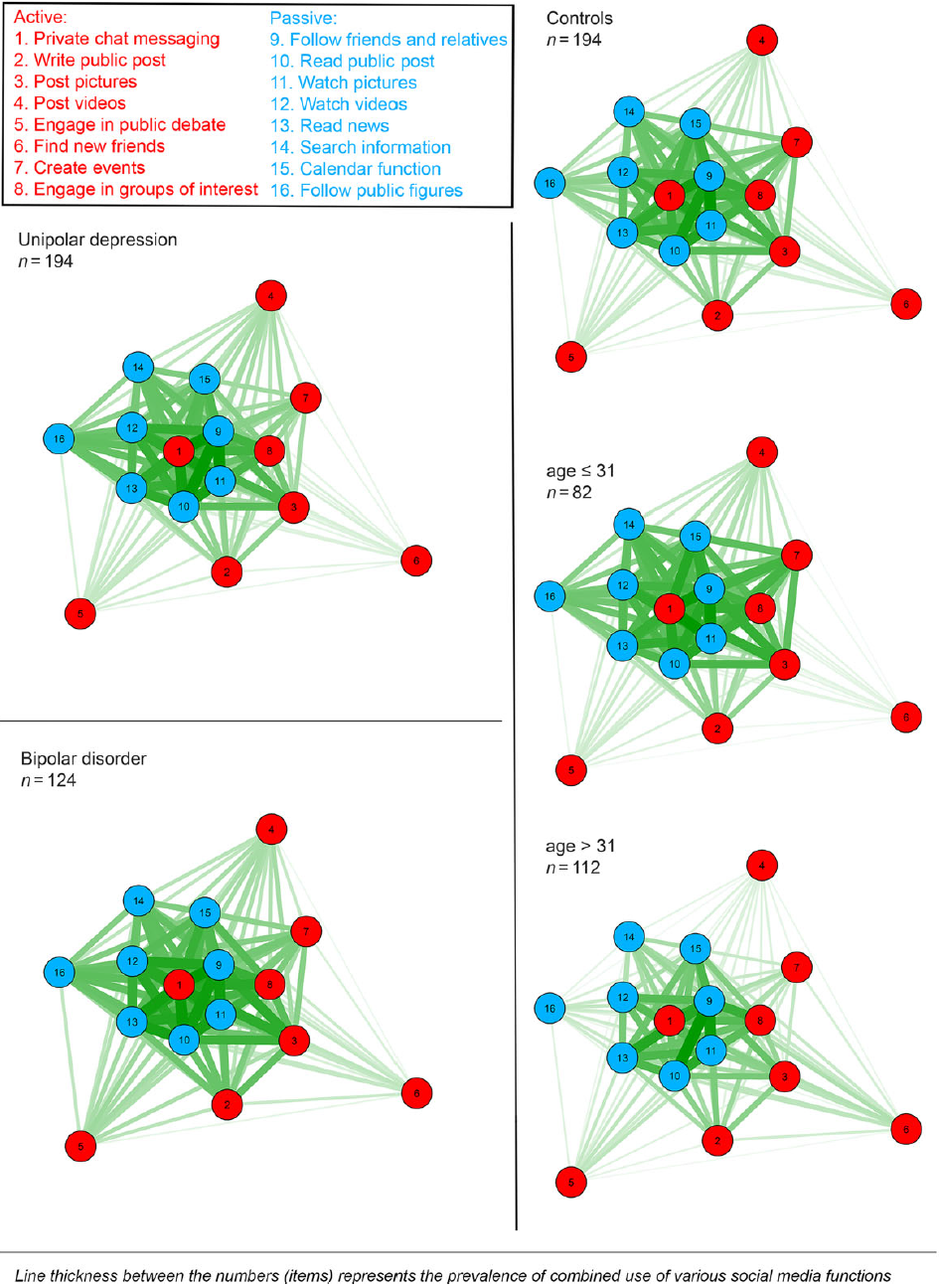
Furthermore, in order to visualise and describe the pattern of use of social media and the motivation for using online dating, we conducted a series of network analysis. Specifically, data regarding social media (stratified a priori into passive and active functions) and motivations for online dating use were plotted visually with the Fruchterman–Reingold algorithm (Fruchterman & Reingold, Reference Fruchterman and Reingold1991) using the qgraph package (Epskamp et al., Reference Epskamp, Cramer, Waldorp, Schmittmann and Borsboom2012). This algorithm presents strongly connected nodes (social media functions and motivations for using online dating) centrally on the network graph and visualises the degree of combined use of two functions/motivations via the thickness of edges. Each combination between functions of use/motivations were counted for each person and summarised in a symmetric matrix. The networks were unweighted and plots of the same questionnaire were averaged to produce network graphs that were comparable between populations. The edges were not penalised, such that use of two functions/motivations endorsed by at least one respondent is displayed as an edge with the lowest edge thickness, while progressively increased edge thickness indicates increasing numbers of respondents reporting use of two specific functions/motivations.
Post hoc analysis
Based on inspection of the network graphs illustrating the motivations for using online dating, we conducted a follow-up analysis of the association between ‘getting approval’ and ‘finding a sexual partner’ in order to determine whether this combination was more commonly endorsed among those with bipolar disorder compared with the controls. This analysis was carried out using logistic regression adjusted for age, sex and relationship status.
Sensitivity analysis
The logistic regression analyses were evaluated for appropriate fit via the link test developed by Pregibon and influential observations were diagnosed by Pearson’s residual, deviance residual and Pregibon’s leverage, respectively (Pregibon, Reference Pregibon1981). In cases where the link test indicated that the model was misspecified, we changed the right-hand side of the link function based on hypotheses and visual inspection of different residual and leverage plots until the model was appropriately fitted. In cases of doubt regarding influential observations, we compared a model without these observations with the model with these observations. All linear regressions were evaluated by plotting the Pearson’s residuals to assess outliers and kernel density. P-P and Q-Q plots were used to evaluate the normal distribution of the residuals. In case of outliers, these were evaluated for influence on the estimates, while non-normal data were fitted by changing the function on the right-hand side. Moreover, both the logistic and linear regressions were bootstrapped to assess the robustness of the estimates.
Software
Data analysis was conducted in STATA 16 (StataCorp LP, College Station, TX) or R version 3.6.2 (R Core Team (2013)).
Results
Respondents
A total of 577 individuals from the four study sites responded to the survey (138 from the outpatient unit for unipolar depression, 134 from the outpatient unit for bipolar disorder, 116 from the rural general practice and 189 from the urban general practice). The questionnaires returned by 63 of the respondents were not included in the analyses for the following reasons: (I) eight respondents reported no current/prior use of social media or online dating, (II) 39 respondents did not include information on either sex and/or age and (III) 16 respondents were misclassified (see the Supplementary Material). Of the remaining 514 respondents that constituted the final sample for analysis, 194 had a history of unipolar depression (116 from the outpatient unit and 78 from the general practitioners), 124 had a history of bipolar disorder (118 from the outpatient unit and 6 from the general practitioners) and 196 had neither unipolar depression nor bipolar disorder (controls). A flowchart illustrating the recruitment and the definition of the final sample for analysis is available in the Supplementary Material.
Table 1 shows data regarding demographics, episodes of unipolar depression/bipolar disorder and use of social media/online dating for the 514 respondents included in the analyses. Of these, 513 used social media, 266 used online dating and 265 used both social media and online dating. The majority (74%) of the respondents were female – relatively equally distributed across the three groups. The controls were older, more likely to be married, have children and to have a higher education compared with the respondents with a history of unipolar depression or bipolar disorder.
Demographic, clinical and social media/online dating characteristics of the sample

a one individual who used online dating did not use (other) social media platforms.
Social media use among individuals with unipolar depression and bipolar disorder
The median time spent on social media (question: ‘How much time did you spend daily (on average) on social media in the periods when you used these media?’) was 60 min among respondents with unipolar depression as well as those with bipolar disorder and 30 min for the controls. However, following adjustment for age and sex, neither unipolar depression nor bipolar disorder was associated with increased time spent on social media at the level of statistical significance (see Table 2(A)).
The association between affective disorders and use of social media (A) and online dating (B)

Time spent on social media and online dating was analysed using linear regression analysis, while online dating use was analysed using logistic regression analysis.
a Among those using social media/online dating, respectively.
b Reference: Controls.
c Reference: Female.
d Reference: In a relationship (having a partner or being married).
The network graphs in Fig. 1 illustrate the use of 16 social media functions for the respondents with unipolar depression, bipolar disorder and the controls, respectively. Generally, the most widely used functions are the ‘passive’ ones in combination with mainly three ‘active’ functions, namely ‘chatting with friends/family/acquaintances’, ‘posting photos’ and ‘participating in “groups”’. There were no clear differences in the pattern of use between the three groups of respondents. When stratifying the controls (which were older than the members of the two other groups) into those aged ≤31 years and >31 years (median split), we observed a tendency towards more use of picture posting, event creation and following of public figures among the younger users.
Network graphs showing the use of various social media functions.

Reported changes in use of social media during depressive and hypomanic/manic episodes
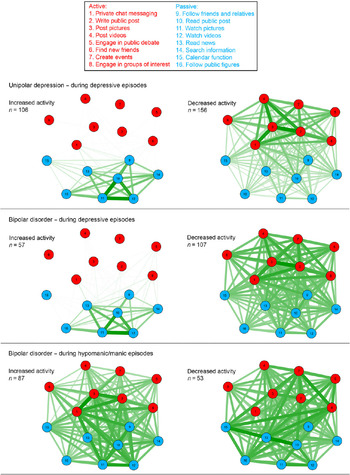
Among the respondents with unipolar depression reporting use of social media, 90% responded to the questions concerning social media use during depressive episodes (questions 22–25). Among the respondents with bipolar disorder reporting use social media, 91% responded to the questions concerning social media use during depressive episodes and 89% responded to the questions concerning use of social media during hypomanic/manic episodes (questions 26–36). Among the respondents with unipolar depression using social media during a depressive episode, 24% reported no change in social media activity, 30% reported increased activity and 46% reported decreased activity. Similarly, among the respondents with bipolar disorder using social media during a depressive episode, 13% reported no change in social media activity, 29% reported increased activity and 58% reported decreased activity. Among the respondents with bipolar disorder using social media during a hypomanic/manic episode, 9% reported no change in social media activity, 74% reported increased activity and 17% reported decreased activity.
Fig. 2 illustrates how the use of social media functions changes during depression and hypomania/mania according to the respondents. Both the respondents with unipolar depression and bipolar disorder reported a strong tendency towards increased use of passive functions (in particular reading posts and watching pictures/videos) and decreased use of active functions (in particular chatting and posting pictures/videos) during depressive episodes. During hypomanic/manic episodes, those reporting increased activity used both active and negative social media functions more, with emphasis on the ‘core’ active functions, namely chatting and posting pictures/videos.
Network graphs showing change in use of social media functions during depressive and hypomanic/manic episodes.

Use of online dating
The results of the analyses of the association between affective disorders and use of online dating are shown in Table 2(B). Using the controls as reference, there was a statistically significant positive association between bipolar disorder and use of online dating (odds ratio (OR) adjusted for age and sex: 2.6 (95% CI: 1.6; 4.2)), which remained (OR: 2.2 (95% CI: 1.3; 3.7)) following additional adjustment for relationship status (dichotomously defined: yes: married, living together, having a partner but living alone. No: single, divorced/separated, widow). Furthermore, among the respondents using online dating – using the controls as reference – there was a statistically significant positive association between bipolar disorder and spending more time on online dating (regression coefficient adjusted for age and sex: 43.0 (95% CI: 16.1; 69.9)), which also remained (regression coefficient: 49.2 (95% CI: 21.5; 75.9)) following additional adjustment for relationship status (defined as above).
The network graphs in Fig. 3 illustrate the motivations for using online dating among the respondents with unipolar depression, bipolar disorder and the controls, respectively. Across the three groups, the most frequent combinations of motivations were (a) ‘finding a romantic partner’ and ‘getting approval’, (b) ‘finding a romantic partner’ and ‘finding a sexual partner’ and (c) ‘getting approval’ and ‘finding a sexual partner’. When stratifying the controls (which were older than the members of the two other groups) into those aged ≤31 years and >31 years (median split), it became evident that the ‘getting approval’ and ‘finding a sexual partner’ combination of motivations was more common among the users aged ≤31 years, while the ‘finding a romantic partner’ and ‘finding new friends’ combination was more common among those aged >31 years. We also noticed that the ‘getting approval’ and ‘finding a sexual partner’ combination appeared to be particularly common among the respondents with bipolar disorder using online dating. Therefore, we investigated this association in a post hoc logistic regression analysis, which showed that the respondents with bipolar disorder were indeed significantly more likely than the controls to endorse this combination (OR after adjustment for age and sex: 3.4 (95% CI: 1.5–7.8), and OR: 3.1 (95% CI: 1.3–7.1) following additional adjustment for relationship status).
Network graphs showing the motivations for using online dating.

Changes in use of online dating during depressive and hypomanic/manic episodes
Among the respondents with unipolar depression reporting use of online dating, 69% responded to the questions concerning use of online dating during depressive episodes (questions 47 and 48). Here, 27% reported that they experienced no change in the use of online dating during depressive episodes, 24% that they were more active and 49% answered that they were less active during depressive episodes. Among the respondents with bipolar disorder reporting use of online dating, 69% responded to the questions concerning use of online dating during depressive episodes. Here, 7% reported that they experienced no change in the use of online dating during depressive episodes, 22% that they were more active and 71% that they were less active during depressive episodes. Among the respondents reporting use of online dating with bipolar disorder, 80% responded to the questions concerning use of during hypomanic/manic episodes (questions 49–57). Here, 5% reported that they experienced no change in the use of online dating during hypomanic/manic episodes, 92% that they were more active and 3% that they were less active during hypomanic/manic episodes.
Self-reported effect of social media and online dating on symptoms of affective disorders
The results regarding self-reported effect of social media and online dating on symptoms of affective disorders during affective episodes are shown in Fig. 4. The general pattern – across episodes of unipolar depression, bipolar depression and hypomania/mania – was that more respondents reported aggravating than beneficial effects of social media and online dating.
Self-reported effect of social media (A) and online dating use (B) on symptoms of affective disorders.

Sensitivity analyses
The link test indicated that the logistic regression analyses were appropriately fitted and the residuals and leverage plots indicated no influential observations. Similarly, Pearson’s residuals, P-P and Q-Q plots showed that the assumptions were also met for the linear regression analyses. Similar differences in slope between groups was seen for the regression on time spent on social media and online dating when including or excluding potential influential observations (e.g. individuals spending more than 400 and 300 min and online dating sites each day, respectively).
Discussion
The objective of this study was to explore the use of social media and online dating among individuals with a history of unipolar depression or bipolar disorder as this aspect is of potential clinical importance due to reported associations between social media use and lower mental well-being, lowered self-esteem, and increased symptoms of anxiety and depression among general users of these platforms (Chou & Edge, Reference Chou and Edge2012; Shaw et al., Reference Shaw, Timpano, Tran and Joormann2015; Tromholt, Reference Tromholt2016; Hanna et al., Reference Hanna, Monique Ward, Seabrook, Jerald, Reed, Giaccardi and Lippman2017; McCrae et al., Reference McCrae, Gettings and Purssell2017; Shakya & Christakis, Reference Shakya and Christakis2017; Vannucci et al., Reference Vannucci, Flannery and Ohannessian2017; Riehm et al., Reference Riehm, Feder, Tormohlen, Crum, Young, Green and Mojtabai2019; Yoon et al., Reference Yoon, Kleinman, Mertz and Brannick2019). We focused on three aspects, namely I) the self-perceived extent and pattern of use of social media among individuals with a history of unipolar depression or bipolar disorder – including potential changes in use during depressive and hypomanic/manic episodes, II) the self-perceived extent of and motivation behind the use of online dating among individuals with a history of unipolar depression and bipolar disorder – including potential changes in use during depressive and hypomanic/manic episodes, and III) the self-perceived impact of the use of social media and online dating on the symptoms of unipolar depression and bipolar disorder.
With regard to the use of social media, the time spent on this activity did not seem to differ between those with unipolar depression, bipolar disorder and the controls – when taking age and sex into account. As for the pattern of use, it was also largely similar across the groups, with a tendency towards more use of passive functions among the respondents with unipolar depression. While the overall use of social media among individuals with affective disorders appeared to be little different compared to that of controls, our findings point towards a marked mood congruence in the use of social media among individuals with affective disorders. Specifically, the respondents reported a tendency towards decreased time spent on social media during both unipolar and bipolar depressive episodes – and increased time spent during hypomanic/manic episodes. Furthermore, the respondents reported that the use of passive functions increased, while the use of active functions decreased during both unipolar and bipolar depressive episodes. In contrast, during hypomanic/manic episodes, there was a tendency towards a global increase of all social media functions – including core active elements such as messaging and posting content. The apparent mood-congruent use of social media resonates well with the findings of Thorisdottir et al. (Reference Thorisdottir, Sigurvinsdottir, Asgeirsdottir, Allegrante and Sigfusdottir2019), who found that passive social media use was associated with increased levels of anxiety and depressed mood, and that active social media use was associated with decreased levels of anxiety and depressed mood, among adolescents. However, due to the cross-sectional and non-experimental nature of both the present study and that of Thorisdottir et al., it is not possible to determine if this association is causal – nor the direction of potential causality. Nevertheless – from a clinical perspective – it seems somewhat problematic that the use of social media is predominantly passive during depression and active during hypomania/mania as this may contribute to sustaining these states of pathological mood/activity level (Lam et al., Reference Lam, Jones and Hayward2003; Scott et al., Reference Scott, Paykel, Morriss, Bentall, Kinderman, Johnson and Hayhurst2006; Lam et al., Reference Lam, Watkins, Hayward, Bright, Wright, Kerr, Parr-Davis and Sham2010).
The analysis focusing on online dating showed that individuals with bipolar disorder were more likely to engage in this activity. Furthermore, compared with the controls, who also used online dating, those with bipolar disorder spent more time on it and were apparently more motivated by the perspective of getting approval and finding a sexual partner compared with the controls. This seems consistent with the tendency towards hypersexuality in bipolar disorder (Correll et al., Reference Correll, Hauser, Penzner, Auther, Kafantaris, Saito and Cornblatt2014; Kopeykina et al., Reference Kopeykina, Kim, Khatun, Boland, Haeri, Cohen and Galynker2016; Wang et al., Reference Wang, Shao, Jia, Ho, Harris and Wang2020). Finally, there was also a mood-congruent pattern in the use of online dating, with decreased time spent on this activity in relation to unipolar and bipolar depressive episodes, and increased time spent during hypomanic/manic episodes. As for the use of social media, this mood congruence may be unfortunate with regard to sustaining depression and hypomania/mania (Lam et al., Reference Lam, Jones and Hayward2003; Scott et al., Reference Scott, Paykel, Morriss, Bentall, Kinderman, Johnson and Hayhurst2006; Lam et al., Reference Lam, Watkins, Hayward, Bright, Wright, Kerr, Parr-Davis and Sham2010).
In the questionnaire, the respondents were asked to evaluate the effect that the use of social media and online dating has upon their symptoms during depressive and hypomanic/manic episodes. The response to these questions was highly indicative of a negative effect of both social media and online dating use on the symptoms of depression and hypomania/mania. This could suggest that the concern raised above regarding the mood-congruent use of social media and online dating is indeed relevant and should potentially be taken into consideration in clinical practice, where advice on balanced/healthy use of social media/online dating could easily be integrated in psychoeducation (Reinares et al., Reference Reinares, Colom, Sánchez-Moreno, Torrent, Martínez-Arán, Comes, Goikolea, Benabarre, Salamero and Vieta2008; Tursi et al., Reference Tursi, Baes, Camacho, Tofoli and Juruena2013; Soo et al., 2018). Furthermore, it is worth mentioning that studies of social media use among individuals with other mental disorders, namely eating disorders (Mabe et al., Reference Mabe, Forney and Keel2014) and psychotic disorders (Berry et al., Reference Berry, Emsley, Lobban and Bucci2018), have also pointed towards mainly negative effects. With the tremendous role that social media is playing in today’s society, these results are worrying and call for further studies investigating the effects of social media (including online dating) on mental health.
This study has four main limitations. First, we developed a questionnaire specifically for the purpose of this study, which has therefore not been subjected to formal psychometric validation. Nevertheless, we believe that the questionnaire has sufficient face and content validity to support the (cautious) conclusions drawn in this manuscript. Second, relying on cross-sectional and self-reported data regarding the use of social media/online dating, as well its effect on symptoms of affective disorders, is clearly not optimal (Boase & Ling, Reference Boase and Ling2013; Junco, Reference Junco2013; Scharkow, Reference Scharkow2016; Deng et al., Reference Deng, Kanthawala, Meng, Peng, Kononova, Hao, Zhang and David2019). However, this project was unfortunately neither logistically nor financially scaled to enable objective measures of both exposure and outcome over an extended period time from participants recruited at multiple sites. While it is inherently difficult to determine if and how this limitation has affected the results, it seems likely that the negative cognitive bias associated with depressed mood (Beck, Reference Beck2008; Jabben et al., Reference Jabben, Arts, Jongen, Smulders, Van Os and Krabbendam2012; Kilford et al., Reference Kilford, Foulkes, Potter, Collishaw, Thapar and Rice2015) and the positive cognitive bias associated with hypomania/mania (Schönfelder et al., Reference Schönfelder, Langer, Schneider and Wessa2017; Kærsgaard et al., Reference Kærsgaard, Meluken, Kessing, Vinberg and Miskowiak2018) may have contributed to the reported mood congruence in the use of social media and online dating. For this reason, we suggest that future studies should ideally be based on a more sophisticated technical set-up to enable more accurate and unbiased measures of both exposures and outcomes over an extended period of time. Third, the fact that the questionnaires were distributed differently at the four sites may have resulted in selection bias, where the two most obvious sources seem to be the following: (i) in the urban general practice where the questionnaire was available in the waiting room, those without affective disorders who chose to participate may have a social media/online dating use that is not representative for the general population and (ii) at the outpatient units for unipolar depression and bipolar disorder, the treatment providers handed out the questionnaire and may – consciously or subconsciously – have done this selectively. The existence and impact of these biases cannot be determined based on the data at hand. However, future studies should aim at a more systematic and uniform recruitment strategy. Fourth and finally, social desirability bias may have affected the response to the more sensitive questions from the survey, for instance, those relating to the motivation for using online dating (e.g. ‘Getting approval’ and ‘Finding a sexual partner’) (Krumpal, Reference Krumpal2013). The positive cognitive bias associated with hypomania/mania may be part of the reason why these motivations tended to be endorsed more often by the respondents with bipolar disorder.
In conclusion, this study is among the very first to investigate the use of social media and online dating among individuals with a history of unipolar depression or bipolar disorder. The main findings were the tendency towards mood-congruent use of social media and online dating (less/passive use during depression and more/active use during hypomania/mania), and the predominantly negative self-reported effects of social media and online dating use upon symptoms of depression and hypomania/mania (worsening). While we can – by no means – claim that there is a causal negative effect of the use of social media/online dating on the course of affective disorders, it seems worth considering whether advice on balanced/healthy use of social media/online dating should be included in the psychoeducation provided in relation to treatment of unipolar depression and bipolar disorder.
Data availability statement
As the data used for this study can be linked to individual participants, it cannot be shared.
Author contributions
All authors contributed to the design of the study. Ms. Rydahl and Dr. Brund conducted the analyses. The manuscript was drafted by Ms. Rydahl and Dr. Østergaard and was critically revised for important intellectual content by the remaining authors. The final version of the manuscript was approved by all authors prior to submission. Ms. Rydahl and Dr. Brund had full access to all of the data in the study and take responsibility for the integrity of the data and the accuracy of the data analysis.
Conflict of Interest
Dr. Straszek has received fees for speaking and for contribution to educational material from Lundbeck A/S. The remaining authors declare no conflicts of interest.
Acknowledgements
We thank the staff from the two general practices (Lægehuset i Vorgod and Lægerne Borggade) and from the outpatient units for unipolar depression and bipolar disorder for their contribution to recruitment of participants. Also, we are grateful to the participating patients.
Financial support
The study was supported by unrestricted research grants from the Lundbeck Foundation and ‘Fonden til Forskning af sindslidelser’. Dr. Østergaard is supported by grants from Aarhus University Research Foundation, The Novo Nordisk Foundation and Independent Research Fund Denmark. The funders had no influence on the design and conduct of the study; the collection, management, analysis and interpretation of the data; the preparation, review or approval of the manuscript; or the decision to submit the manuscript for publication.
Supplementary material
To view supplementary material for this article, please visit https://doi.org/10.1017/neu.2020.36