Introduction
Learning is a change in behaviour that occurs as a consequence of individual experience (Matthews and Matthews Reference Matthews and Matthews2010). Depending on learning conditions (e.g., number of trials, inter-stimulus and inter-trial intervals, stimulus intensity, etc.), learning may induce memory formation, which is the ability to encode, store, and retrieve acquired information (Kandel Reference Kandel2001; Dudai Reference Dudai2002). Insects are well-established models for the study of learning and memory due to their accessibility in controlled conditioning protocols (Giurfa and Sandoz Reference Giurfa and Sandoz2012). Learning may be associative or nonassociative, depending upon experience with single or contiguous events. In nonassociative learning, the individual is exposed only to one stimulus, which may be repetitive and result in habituation or may be unique and sufficient to induce sensitisation (Squire and Kandel Reference Squire and Kandel1999).
Associative learning consists of learning–contingent relationships between events in the environment (Shanks Reference Shanks1990). Linked events may be the animal’s own action and a resulting reinforcement in the case of operant learning, or they may be a neutral stimulus (conditioned stimulus) and a biologically relevant stimulus, either positive (reward) or negative (punishment; unconditioned stimulus), in the case of Pavlovian learning (Pavlov Reference Pavlov1927). In insects, these learning forms may occur at a juvenile stage and be maintained until adulthood. This was observed in Manduca sexta Linnaeus (Lepidoptera: Sphingidae), whereby the adult avoided the odour of ethyl acetate based on a previous aversive experience at the larval stage, in which ethyl acetate was paired with an aversive stimulus, electric shock (Blackiston et al. Reference Blackiston, Casey and Weiss2008). Among tortricid moths, Cydia pomonella Linnaeus (Lepidoptera: Tortricidae) larvae can modify their host-searching behaviour following an associative experience with sucrose (Pszczolkowski and Brown Reference Pszczolkowski and Brown2005). In another tortricid moth, Grapholita molesta (Busck) (Lepidoptera, Tortricidae), which is a cosmopolitan pest of Rosaceae in many agriculture systems around the world (Myers et al. Reference Myers, Hull and Krawczyk2007), Sant’Ana and Gregorio (Reference Sant’Ana and Gregório2016) demonstrated that experience acquired during the larval stage persisted for at least 48 hours after emergence as an adult (in a nonassociative learning bioassay).
Despite the existence of nonassociative learning bioassays in G. molesta and other Tortricidae, no study had examined the capacity of these moths to build an associative memory that would be maintained through metamorphosis. Here, we use an aversive learning protocol in which moths are presented with ethyl acetate and electric shock during the larval stage to determine if aversive memory persists after metamorphosis.
Grapholita molesta were reared using the methodology of Arioli et al. (Reference Arioli, Molinari, Botton and Garcia2007) and kept under conditions of 25 ± 1 °C, 60% ± 10% relative humidity, and a 16:8-hour light:dark photoperiod.
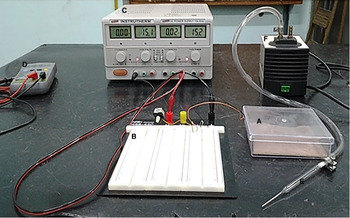
The equipment used for conditioning insects (Fig. 1) was custom built and consisted of a circuit made in Pad2Pad software (IPC Compliance, Mahwah, New Jersey, United States of America) and printed on photographic paper, placed on a phenolate substrate plate (105 mm × 105 mm × 5 mm) made with a polymer (polypropylene) and a copper layer (phenolate), creating the thermal transfer of this circuit. After the transfer, the plate was corroded in a solution of iron chloride III (iron perchloride) that was diluted in water (3:10) for 10 minutes. The circuit used consisted of a conductive “zigzag” track, with two millimetres of distance between tracks, through which the electrical current of the circuit (positive pole) and the rest of the plate circulated, making up the negative pole. This printed circuit board was connected to a contact matrix (protoboard) made of plastic material, covering conductive metal tracks. Two 10-k Ω resistors (5% tolerance) associated in series (voltage divider) were connected to this matrix, with one of the resistors being variable (potentiometer) and the other fixed to control the electrical current focused on the larvae.
Equipment used for larval conditioning: A, printed circuit inside a Gerbox box; B, contact matrix; C, power supply; D, multimeter; E, Pasteur pipette; and F, vacuum pump.

The printed circuit board was connected in parallel with the fixed resistor, and the resistors were subjected to an electrical voltage of 30 V direct current. The circuit was connected to a digital bench power supply MPC-3006D (Siemens Energy, Munich, Bavaria, Germany) responsible for supplying the continuous electrical voltage, which allowed control of the current flowing through the tracks and visualisation of the current and voltage of the circuit. A digital multimeter UNI-T UT83 (Fluke Corporation, Everett, Washington, United States of America) was used to measure voltage and current on the printed circuit board (conditioning arena). The circuit board was deposited inside a Gerbox box (110 mm × 110 mm × 35 mm), where insects were conditioned.
A group of 10 larvae (10–12 days old; 9–11 mm long) was conditioned with an 18-V shock at the circuit previously described. A 20-µL aliquot of ethyl acetate was added to a piece of filter paper (20 mm × 15 mm) and placed at one end of a Pasteur pipette that was coupled to a vacuum pump.
The opposite end of the pipette was placed into a hole in the lid of the conditioning arena where the larvae were stored to expose the larvae to the odour released. Larvae were submitted to the following treatments: (a) pure air, for 20 seconds; (b) pure air, for 10 seconds + electric shock, for 10 seconds; (c) ethyl acetate odour, for 20 seconds; (d) ethyl acetate, for 20 seconds, with electrical shock occurring for the latter 10 seconds; and (e) ethyl acetate odour simultaneously with shock, for 10 seconds + ethyl acetate odour alone, for 10 seconds (adapted from Blackiston et al. Reference Blackiston, Casey and Weiss2008). Each larval group underwent its specified treatment procedure four times in total, with intervals of 30 minutes, completing four sessions in the same day. In the intervals, the insects were kept on the rearing diet.
After 24 hours, larvae were individually tested for odour retention in a two-choice Y-tube glass olfactometer positioned horizontally (1.4-cm-interior diameter), with a 16-cm basal arm that bifurcated at 60° into two 19-cm arms. Airflow was 0.8 l/minute, provided by a vacuum pump connected to a flow meter and a humidifier. Each arm had a glass container (200-mL Erlenmeyer flask; Sigma-Aldrich, St. Louis, Missouri, United States of America) with a piece of filter paper (80 mm × 50 mm) inside. One of the pieces of filter paper was impregnated with ethyl acetate (100 µL) and the other was clean (non-impregnated). The olfactometer tests were conducted following Sant’Ana and Gregorio (Reference Sant’Ana and Gregório2016). The olfactometer was inverted horizontally (180° rotation) every five repetitions, and after every 10 repetitions, it was washed with mild soap, ethyl alcohol, and distilled water, then dried in a sterilisation oven at 150 °C.
Retention was evaluated either at the larval stage (30–35 larvae per treatment) or at the adult stage after metamorphosis (23–29 adults per treatment). Individuals tested for retention as adults were treated during their larval stage; that is, one group of larvae was treated and tested while still larvae and a second group of larvae was treated and tested after metamorphosis. The hypothesis of no preference (i.e., the proportion choosing each odour = 0.5) was tested by a chi-square Wald test (P < 0.05) with BioEstat 5.3 (Ayres et al. Reference Ayres, Ayres, Ayres and Santos2007).
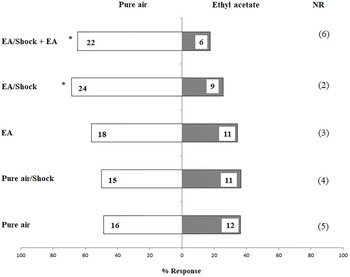
Larvae exposed to pure air (χ 2 = 1.14; df = 1; P = 0.42), pure air + shock (χ 2 = 1.23; df = 1; P = 0.41), and the ethyl acetate groups (χ 2 = 3.38; df = 1; P = 0.115) did not exhibit ethyl acetate avoidance at the olfactometer and chose randomly between the clean arm and that containing ethyl acetate (Fig. 2).
First choice of Grapholita molesta immature stage (larva 10–12 days old; 9–11 mm) to ethyl acetate (EA) versus pure air, previously exposed to one of five treatments: ethyl acetate with shock + ethyl acetate (N = 34); ethyl acetate + shock (N = 35); ethyl acetate (N = 32); pure air + shock (N = 30); and pure air (N = 33). Numbers on the bars represent the total number of insects responding in the treatments. Numbers in parentheses represent the nonresponsive (NR) larvae. Values followed by an asterisk differ significantly (χ 2, P < 0.05) within each treatment.

However, larvae that had experienced either ethyl acetate followed by an electric shock (χ 2 = 13.64; df = 1; P = 0.0006) or ethyl acetate with shock and then ethyl acetate again (χ 2 = 18.29; df = 1; P < 0.0001) avoided the arm containing ethyl acetate (Fig. 2).
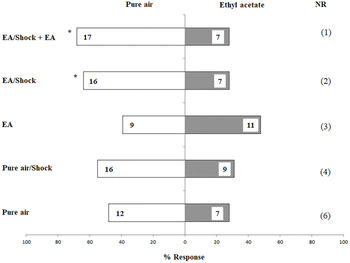
Adult insects from larvae that had been exposed to the pure air, the ethyl acetate, and the pure air + shock treatments chose randomly between the clean arm and the arm containing ethyl acetate. In contrast, the two groups of moths from larvae that had been exposed to ethyl acetate contingent with shock (before shock: χ 2 = 7.04; df = 1; P = 0.01; with and after shock: χ 2 = 8.33; df = 1; P = 0.009) showed a significant avoidance of the arm containing ethyl acetate (Fig. 3).
First choice of Grapholita molesta adult stage (♂ and ♀ 72 hours old) to ethyl acetate (EA) versus pure air, previously exposed to one of five treatments: ethyl acetate with shock + ethyl acetate (N = 34); ethyl acetate + shock (N = 35); ethyl acetate (N = 32); pure air + shock (N = 30); and pure air (N = 33). Numbers on the bars represent the total number of insects responding in the treatments. Numbers in parentheses represent the nonresponsive (NR) larvae. Values followed by an asterisk differ significantly (χ 2, P < 0.05) within each treatment.

These results indicate that G. molesta larvae are able to associate an olfactory stimulus (ethyl acetate odour) with an aversive stimulus (electric shock) and that the aversive memory established is maintained 24 hours after training and even 72 hours after metamorphosis. These findings align with those observed by Blackiston et al. (Reference Blackiston, Casey and Weiss2008), who found that M. sexta larvae of the third instar that had been conditioned with ethyl acetate and electric shock recalled this information (avoidance) from 10 to 14 days later, after two moults, as late-fifth-instar larvae. As in the present study, the aversive memory of M. sexta persisted after metamorphosis. Similarly, Tully et al. (Reference Tully, Cambiazo and Kruse1994), studying Drosophila sp. in a conditioned process with ethyl acetate odour and electric shock observed that adult flies retained a behavioural change for almost eight days after emergence.
These similar results indicate that associative circuits for encoding both odour and shock already exist and interact in the larval insect brain. These circuits have been well characterised in the case of Drosophila larvae, which learn to associate odour with shock and other aversive reinforcements (Pauls et al. Reference Pauls, Pfitzenmaier, Krebs-Wheaton, Selcho, Stocher and Thum2010). Shock is encoded by specific subsets of dopaminergic neurons, which contact the olfactory circuit at the level of the mushroom bodies, which are considered a higher-order centre for memory encoding, storage, and retrieval (Giurfa and Sandoz Reference Giurfa and Sandoz2012). During olfactory conditioning of Drosophila, specific groups of Kenyon cells within the brain’s mushroom bodies are activated, increasing the intracellular concentration of calcium ions (Ca++; Wang et al. Reference Wang, Mamiya, Chiang and Zhong2008), while the electric shock induces a dopaminergic reinforcement signal that is conveyed to Kenyon cells (Aso et al. Reference Aso, Siwanowics, Bräker, Ito, Kitamoto and Tanimoto2010). This synergistic action drives adenylate cyclase, which acts as a coincidence detector and activates plasticity cascades, thereby leading to long-term memory formation and odour avoidance after associative aversive learning (Khurana et al. Reference Khurana, Baker and Siddiqi2009). A similar process may occur in the larvae of G. molesta; the presence of a dopaminergic signal mediating aversive reinforcement and learning has already been shown in other moth species (Dacks et al. Reference Dacks, Riffel, Martin, Gage and Nighorn2012).
Memory retention after metamorphosis suggests that the memory that is built after aversive training is a form of long-term memory and therefore depends upon protein synthesis, which is the mechanism that stabilises memories over time (Kandel Reference Kandel2001). Post-metamorphosis memory has a particular ecological importance for lepidopterans because it allows polyphagous species to identify and oviposit on their host plant, as described by Hopkins (Reference Hopkins1916). From a biological point of view, preserving memory can be advantageous to the species, allowing the individual to remember a specific action that can increase its survival chances compared to those individuals without this ability to remember. Therefore, predicting future events based on experiences can be crucial for the survival of both the individual and the species.