Introduction
CHD is the most common congenital anomaly worldwide. Advances in paediatric cardiology and cardiac surgery have transformed survival, making CHD one of the major successes of modern paediatric medicine. Reference Liu, Chen and Zühlke1,Reference Marelli, Ionescu-Ittu, Mackie, Guo, Dendukuri and Kaouache2 As increasing numbers of children survive into adolescence and adulthood, the focus of care has expanded beyond survival to encompass long-term neurodevelopment, psychosocial adaptation, quality of life, and successful participation in family, school, and community life. Reference Marino, Lipkin and Newburger3–Reference Amedro, Dorka and Moniotte5
Although the child remains at the centre of care, CHD affects an interconnected network of relationships. Parents and caregivers become essential partners in medical decision-making, emotional regulation, advocacy, and long-term caregiving. Reference Wei, Roscigno, Hanson and Swanson6–Reference Lumsden, Smith and Wittkowski11 Children with complex CHD frequently undergo repeated surgical procedures, prolonged hospitalisations, and lifelong cardiac follow-up, placing them at increased risk of adverse neurodevelopmental outcomes and psychosocial challenges. Reference Marino, Lipkin and Newburger3,Reference Sood, Newburger and Anixt4 These experiences also affect siblings and the wider family, who frequently experience significant emotional, practical, and financial burdens. Reference Wei, Roscigno, Hanson and Swanson6,Reference Connor, Kline, Mott, Harris and Jenkins9–Reference Moon, Jung and Lee13
Family-centred care has become a cornerstone of contemporary paediatric care by recognising parents and caregivers as essential therapeutic partners whose well-being influences child outcomes. Reference Kuo, Houtrow, Arango, Kuhlthau, Simmons and Neff14,15 Relationship-centred care extends this concept by recognising that psychosocial adaptation is shaped by relationships among patients, families, healthcare professionals, and the broader community.Reference Beach and Inui 16 Children and adolescents develop within broader relational environments that include siblings, peers, teachers, schools, healthcare professionals, teammates, and, later, romantic partners. These relationships contribute to identity formation, resilience, autonomy, social participation, and a sense of belonging throughout development. Reference Rassart, Luyckx, Apers, Goossens and Moons17–Reference Sable, Foster and Uzark19
The purpose of this narrative review is to examine the psychosocial and relational impact of CHD across childhood and adolescence, synthesising current evidence on parental mental health, neurodevelopment, resilience, belonging, and social participation. We also explore how a relationship-centred care framework may complement established family-centred care models to support long-term psychosocial well-being alongside advances in medical care.
Methods
This manuscript was developed as a narrative review examining the psychosocial, developmental, familial, and relational dimensions of CHD across childhood and adolescence. Literature searches were conducted using PubMed, Scopus, and Google Scholar to identify relevant English-language publications published between May 2000 and March 2026. This time frame was selected to reflect contemporary advances in paediatric cardiac surgery, survivorship, neurodevelopment, psychosocial care, and family-centred models of care.
Searches incorporated combinations of the terms CHD, family-centred care, relationship- centred care, parental stress, attachment, psychological adaptation, resilience, neurodevelopment, quality of life, social belonging, peer relationships, transition to adult care, heart transplantation, and ventricular assist devices. Priority was given to peer-reviewed original studies, systematic reviews, longitudinal cohort studies, qualitative research, and major scientific statements. Additional key publications were identified through manual review of reference lists.
Because the objective of this review was conceptual and thematic integration rather than formal evidence synthesis, PRISMA methodology and quantitative meta-analysis were not undertaken. The literature was synthesised thematically to examine recurring evidence relating to parental mental health, child and adolescent psychosocial adaptation, neurodevelopment, resilience, belonging, developmental transition, and relationship-centred care within paediatric cardiology.
The emotional impact of CHD on the family
The diagnosis of CHD, whether made prenatally or after birth, is often experienced as a profound psychological crisis for families. Although advances in fetal diagnosis allow earlier counselling and care planning, they do not eliminate the emotional impact of learning that a child has a potentially life-threatening cardiac condition. Parents commonly describe grief, fear, uncertainty, and symptoms of acute or posttraumatic stress following diagnosis. Reference Sood, Newburger and Anixt4,Reference Rychik, Donaghue and Levy24
Following birth, the realities of intensive care and cardiac surgery often compound this distress. Parents are suddenly immersed in unfamiliar medical environments characterised by complex technology, prolonged waiting, invasive procedures, and uncertainty regarding outcomes. Reference Wei, Roscigno, Hanson and Swanson6,Reference Kasparian, Kan, Sood, Wray, Pincus and Newburger25 ) Children with critical CHD may require early surgery involving cardiopulmonary bypass, prolonged ventilation, extracorporeal life support, or staged palliation. Reference Marino, Lipkin and Newburger3,Reference Sood, Newburger and Anixt4 Witnessing these lifesaving interventions while their normal caregiving role is disrupted frequently leaves parents feeling powerless and emotionally overwhelmed. Reference Wei, Roscigno, Hanson and Swanson6,Reference Kasparian, Kan, Sood, Wray, Pincus and Newburger25
Psychological distress frequently persists throughout the child’s clinical journey. Parents of children with CHD experience significantly higher rates of anxiety, depression, sleep disturbance, chronic stress, and posttraumatic stress symptoms than parents of healthy children. Reference Woolf-King, Anger, Arnold, Weiss and Teitel7–Reference Lumsden, Smith and Wittkowski11 Emotional burden may be further compounded by repeated hospitalisations, financial pressures, employment disruption, and concerns regarding future clinical deterioration. Reference Wei, Roscigno, Hanson and Swanson6,Reference Connor, Kline, Mott, Harris and Jenkins9–Reference Lumsden, Smith and Wittkowski11
For many families, uncertainty evolves from an acute reaction at diagnosis into a chronic feature of everyday life. Even after successful surgical repair, concerns regarding neurodevelopment, arrhythmias, exercise capacity, future interventions, ventricular assist device support, heart transplantation, and long-term survival may persist throughout childhood and into adult life. Reference Marelli, Ionescu-Ittu, Mackie, Guo, Dendukuri and Kaouache2–Reference Sood, Newburger and Anixt4,Reference Jackson, Frydenberg, Liang, Higgins and Murphy10,Reference Lumsden, Smith and Wittkowski11 This enduring uncertainty shapes parental decision-making, family routines, and perceptions of the future, while the psychological burden may become particularly pronounced for families facing advanced heart failure therapies such as ventricular assist devices or heart transplantation. Reference Kasparian, Kan, Sood, Wray, Pincus and Newburger25,Reference Rea, McCormick, Lim and Cousino38
Despite these challenges, many families demonstrate remarkable resilience. Adaptation is supported by strong family relationships, effective communication with healthcare professionals, social support, and access to psychological services. Reference Wei, Roscigno, Hanson and Swanson6,Reference Jackson, Frydenberg, Liang, Higgins and Murphy10,Reference Lumsden, Smith and Wittkowski11,Reference Lisanti26 Resilience should not be viewed as the absence of suffering but rather as the capacity to maintain hope, adapt to uncertainty, and find meaning while living with the ongoing challenges of CHD.
The perspectives of children and adolescents
Many children and adolescents with CHD wish to participate fully in everyday childhood and adolescence despite ongoing medical surveillance and treatment. Beyond the physical consequences of CHD, many young people must reconcile awareness of their cardiac condition with a desire for acceptance, normality, and inclusion among their peers. Reference Berghammer, Dellborg and Ekman27,Reference Bratt and Moons28 Friendships, participation in physical activity, increasing independence, and the opportunity to engage in everyday social experiences become central aspects of psychosocial well-being during childhood and adolescence. Reference Rassart, Luyckx, Apers, Goossens and Moons17,Reference Knowles, Day, Wade, Bull, Wren and Dezateux18,Reference Berghammer, Dellborg and Ekman27–Reference John, Jackson and Moons29
Common questions voiced by young people with CHD may include:
• Will I fit in?
• Can I play sports?
• Will I be treated differently?
• Can I date?
• Will someone love me?
• Can I live normally?
These questions reflect broader developmental concerns involving identity, belonging, autonomy, body image, intimacy, and social acceptance. Reference Rassart, Luyckx, Apers, Goossens and Moons17,Reference Knowles, Day, Wade, Bull, Wren and Dezateux18,Reference Berghammer, Dellborg and Ekman27 Peer relationships become increasingly important during adolescence and play a central role in identity formation. Reference Rassart, Luyckx, Apers, Goossens and Moons17,Reference Berghammer, Dellborg and Ekman27 Loneliness and perceived social isolation have been associated with depressive symptoms and poorer self-reported quality of life among adolescents living with CHD. Reference Knowles, Day, Wade, Bull, Wren and Dezateux18,Reference Bratt and Moons28
Participation in physical activity and sport contributes to confidence, social participation, and overall quality of life. Reference Knowles, Day, Wade, Bull, Wren and Dezateux18,Reference Silva, Vaz and Areias23 However, opportunities may be influenced by symptoms, perceived limitations, exercise restrictions, and advice from families or healthcare professionals. Reference Knowles, Day, Wade, Bull, Wren and Dezateux18,Reference Silva, Vaz and Areias23
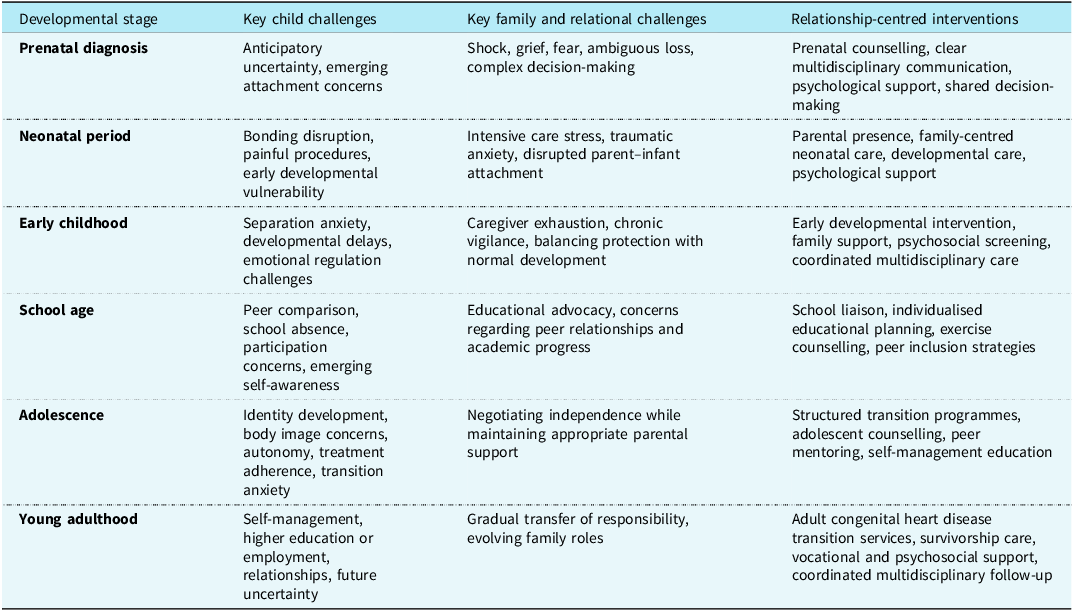
As adolescents mature, developing condition knowledge, self-efficacy, self-management skills, and increasing independence become central to preparation for adult care. Reference Sable, Foster and Uzark19,Reference Stewart, Chahal and Kovacs20 Successful transition is associated with age-appropriate knowledge of CHD, self-efficacy, and constructive involvement of parents and healthcare professionals.Reference Sable, Foster and Uzark 19 , Reference Stewart, Chahal and Kovacs 20 Developmentally appropriate transition programmes should therefore address not only transfer between services but also autonomy, education, lifestyle, relationships, vocational planning, and participation in adult life. Psychosocial and relational needs evolve across developmental stages, from prenatal diagnosis and infancy through childhood, adolescence, and young adulthood, requiring developmentally responsive forms of support (Table 1). Reference Sable, Foster and Uzark19–Reference Moons, Pinxten and Dedroog21,Reference John, Jackson and Moons29
Psychosocial needs across developmental stages in CHD

Table 1. Long description
A table with four columns and six rows, including a header row. The columns are labeled Developmental stage, Key child challenges, Key family and relational challenges, and Relationship-centred interventions. The rows detail the challenges and interventions for each developmental stage: Prenatal diagnosis, Neonatal period, Early childhood, School age, Adolescence, and Young adulthood. Each row provides specific challenges and corresponding interventions for children and families at different stages of development in the context of CHD.
Supportive friendships and inclusive school environments contribute to psychosocial adaptation and resilience. Reference Rassart, Luyckx, Apers, Goossens and Moons17,Reference Fleming, Fitton and Steiner22,Reference Bratt, Järvholm, Ekman-Joelsson, Mattson and Mellander35 Appropriate opportunities for physical activity also improve confidence and quality of life. Reference Knowles, Day, Wade, Bull, Wren and Dezateux18,Reference Silva, Vaz and Areias23 Successful long-term outcomes should therefore be evaluated not only through survival but also through quality of life, belonging, autonomy, and educational participation. Reference Fleming, Fitton and Steiner22,Reference Silva, Vaz and Areias23,Reference Millen, Dempster and Casey34
Parent–child attachment and relational development
Secure parent–child attachment plays a fundamental role in the emotional development of children with CHD. Emotionally available caregivers help children develop trust, emotional regulation, resilience, and confidence, particularly during periods of hospitalisation and invasive treatment.Reference Lisanti, Vittner, Medoff-Cooper, Fogel, Wernovsky and Butler 30 , Reference Avedissian, Noureddine and Bulbul 31 Repeated medical procedures, prolonged hospital admissions, and separation from familiar environments may disrupt normal developmental experiences and place additional strain on parent–child interactions.Reference Sood, Newburger and Anixt 4 , Reference Lisanti, Vittner, Medoff-Cooper, Fogel, Wernovsky and Butler 30 Consistent parental presence and active family participation during hospitalisation therefore represent important protective factors that support both attachment and emotional security.Reference Lisanti, Vittner, Medoff-Cooper, Fogel, Wernovsky and Butler 30
Parents are encouraged to provide physical comfort, calm communication, and developmentally appropriate reassurance throughout hospitalisation.Reference Lisanti, Vittner, Medoff-Cooper, Fogel, Wernovsky and Butler 30 These interactions not only reduce distress during medical procedures but also reinforce the child’s sense of safety, trust, and emotional well-being. Reference Sood, Newburger and Anixt4,Reference Lisanti, Vittner, Medoff-Cooper, Fogel, Wernovsky and Butler30
Parental responses to illness also influence long-term psychosocial development. Following life-threatening events, overprotective parenting is an understandable response.Reference Avedissian, Noureddine and Bulbul 31 However, excessive restriction may unintentionally limit autonomy, social confidence, and the development of age-appropriate independence. Reference Rassart, Luyckx, Apers, Goossens and Moons17,Reference Sable, Foster and Uzark19,Reference Avedissian, Noureddine and Bulbul31 Supporting families to balance protection with gradually increasing autonomy should therefore be considered an important component of paediatric cardiac care. 15,Reference Sable, Foster and Uzark19–Reference Moons, Pinxten and Dedroog21
Neurodevelopmental outcomes are increasingly recognised as major determinants of long-term quality of life in children with complex CHD. Reference Marino, Lipkin and Newburger3,Reference Sood, Newburger and Anixt4 Difficulties involving attention, executive functioning, language, emotional regulation, and academic performance are well documented and may reflect the combined effects of altered fetal and perioperative cerebral development, cardiopulmonary bypass, genetic factors, and prolonged hospitalisation. Reference Marino, Lipkin and Newburger3,Reference Sood, Newburger and Anixt4 Early developmental surveillance, neuropsychological assessment, and family centred intervention facilitate earlier identification of children at risk and may improve developmental, educational, and psychosocial outcomes. Reference Marino, Lipkin and Newburger3,Reference Sood, Newburger and Anixt4,15
Sibling relationships also warrant greater recognition within paediatric cardiac care. Brothers and sisters frequently experience anxiety, loneliness, altered family roles, reduced parental attention, and impaired psychosocial well-being. Reference Parker, Houghton, Bichard and McKeever12,Reference Moon, Jung and Lee13,Reference Schamong, Liebermann-Jordanidis, Brockmeier, Sticker and Kalbe32,Reference Ravindran and Rempel33 Despite these challenges, siblings often receive relatively little attention within routine psychosocial assessment. Greater inclusion of siblings in family support programmes may strengthen adaptation across the wider family system. Reference Parker, Houghton, Bichard and McKeever12,Reference Moon, Jung and Lee13,Reference Schamong, Liebermann-Jordanidis, Brockmeier, Sticker and Kalbe32
Family dynamics, resilience, and psychosocial adaptation
CHD affects the entire family system, influencing communication, parental roles, daily routines, education, employment, and future planning. Reference Wei, Roscigno, Hanson and Swanson6–Reference Lumsden, Smith and Wittkowski11 Although many families experience considerable emotional strain following diagnosis and throughout their child’s clinical journey, others demonstrate positive adaptation over time through effective coping, supportive family relationships, and collaborative partnerships with healthcare professionals. Reference Wei, Roscigno, Hanson and Swanson6,Reference Jackson, Frydenberg, Liang, Higgins and Murphy10,Reference Lumsden, Smith and Wittkowski11
Family resilience is shaped by multiple interacting factors. Open communication, supportive relationships, confidence in the healthcare team, and access to psychological and social support all contribute to a family’s capacity to adapt to the challenges of CHD. Reference Wei, Roscigno, Hanson and Swanson6,Reference Woolf-King, Anger, Arnold, Weiss and Teitel7,Reference Jackson, Frydenberg, Liang, Higgins and Murphy10,Reference Lisanti26 Financial stability and the ability to mobilise internal and external family resources also influence resilience, particularly during periods of repeated hospitalisation or ongoing treatment. Reference Connor, Kline, Mott, Harris and Jenkins9,Reference Jackson, Frydenberg, Liang, Higgins and Murphy10 Conversely, socio-economic disadvantage, travel costs, employment disruption, and limited access to psychosocial services may substantially increase caregiver stress and reduce adaptive capacity. Reference Connor, Kline, Mott, Harris and Jenkins9,Reference Jackson, Frydenberg, Liang, Higgins and Murphy10
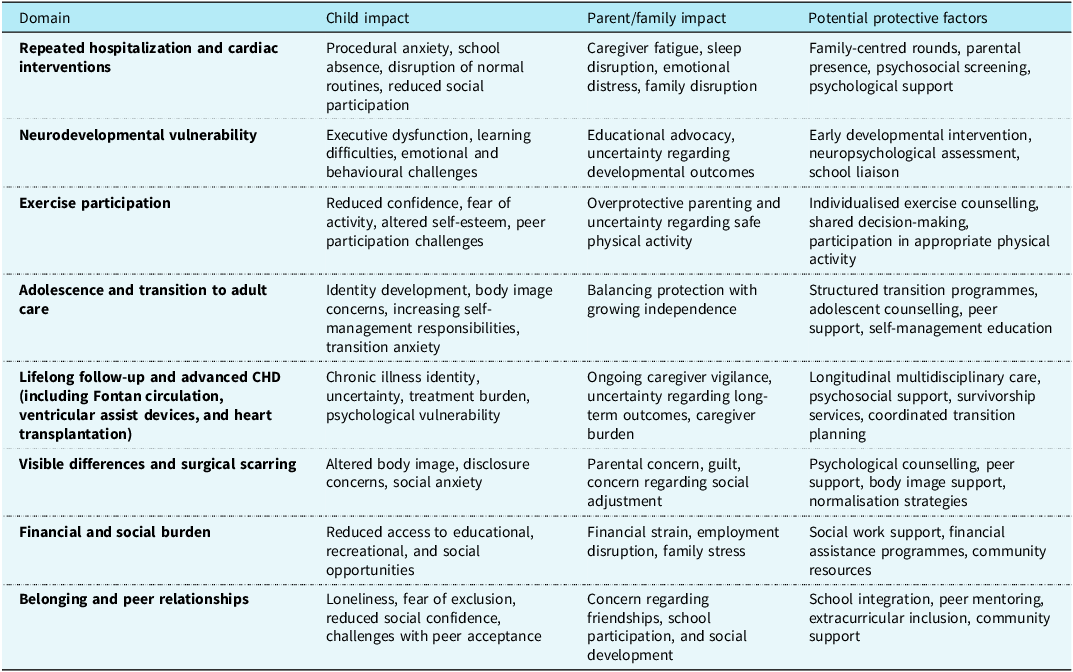
Adaptation should therefore be viewed as a dynamic process rather than a fixed outcome. Families may move between periods of stability and increased vulnerability as children undergo surgery, experience complications, enter school, transition to adult care, or face advanced therapies such as ventricular assist device support or heart transplantation. Reference Wei, Roscigno, Hanson and Swanson6,Reference Jackson, Frydenberg, Liang, Higgins and Murphy10,Reference Lumsden, Smith and Wittkowski11,Reference Sable, Foster and Uzark19–Reference Moons, Pinxten and Dedroog21,Reference Rea, McCormick, Lim and Cousino38 Recognising these evolving psychosocial needs supports timely intervention and reinforces the importance of longitudinal, relationship-centred support throughout childhood and adolescence. 15,Reference Beach and Inui16,Reference Kovacs, Brouillette and Ibeziako36 The major psychosocial and relational challenges associated with CHD, together with their potential protective factors, are summarised in Table 2.
Psychosocial and relational dimensions of congenital heart disease

Table 2. Long description
A table with 8 rows and 4 columns. The columns are labeled Domain, Child impact, Parent/family impact, and Potential protective factors. The table describes various domains such as Repeated hospitalization and cardiac interventions, Neurodevelopmental vulnerability, Exercise participation, Adolescence and transition to adult care, Lifelong follow-up and advanced CHD, Visible differences and surgical scarring, Financial and social burden, and Belonging and peer relationships. Each row details the impact on children, the impact on parents/family, and potential protective factors for each domain. For example, under Repeated hospitalization and cardiac interventions, the child impact includes procedural anxiety, school absence, disruption of normal routines, and reduced social participation, while the parent/family impact includes caregiver fatigue, sleep disruption, emotional distress, and family disruption. Potential protective factors include family-centred rounds, parental presence, psychosocial screening, and psychological support.
Relationship-centred care: expanding the scope of psychosocial care
Relationship-centred care is proposed as a complementary extension of family-centred care, which recognises parents and caregivers as essential partners in clinical decision-making and the care of children with chronic illness. Reference Kuo, Houtrow, Arango, Kuhlthau, Simmons and Neff14–Reference Beach and Inui16 Relationship-Centered Care builds on these principles by recognising that children with congenital heart disease (CHD) develop within a wider network of relationships—including siblings, grandparents and extended family, peers, schools, healthcare professionals, coaches, mentors, and later intimate partners—that influence emotional wellbeing, resilience, identity, autonomy, educational participation, and social belonging. Reference Beach and Inui16–Reference Silva, Vaz and Areias23,Reference Ravindran and Rempel33–Reference Bratt, Järvholm, Ekman-Joelsson, Mattson and Mellander35
This broader perspective is particularly relevant in CHD, where repeated hospitalisations, developmental challenges, lifelong surveillance, visible surgical scars, exercise restrictions, and uncertainty regarding future interventions influence not only physical health but also psychosocial development across multiple social settings. Reference Marino, Lipkin and Newburger3,Reference Sood, Newburger and Anixt4,Reference Rassart, Luyckx, Apers, Goossens and Moons17–Reference Silva, Vaz and Areias23
Rather than focusing exclusively on medical management, relationship-centred care emphasises coordinated psychosocial, developmental, educational, and relational support throughout childhood and adolescence. It provides a conceptual framework that encourages collaboration across healthcare, educational, and community settings to promote resilience, participation, belonging, and quality of life. 15,Reference Beach and Inui16,Reference Fleming, Fitton and Steiner22,Reference Kovacs, Brouillette and Ibeziako36
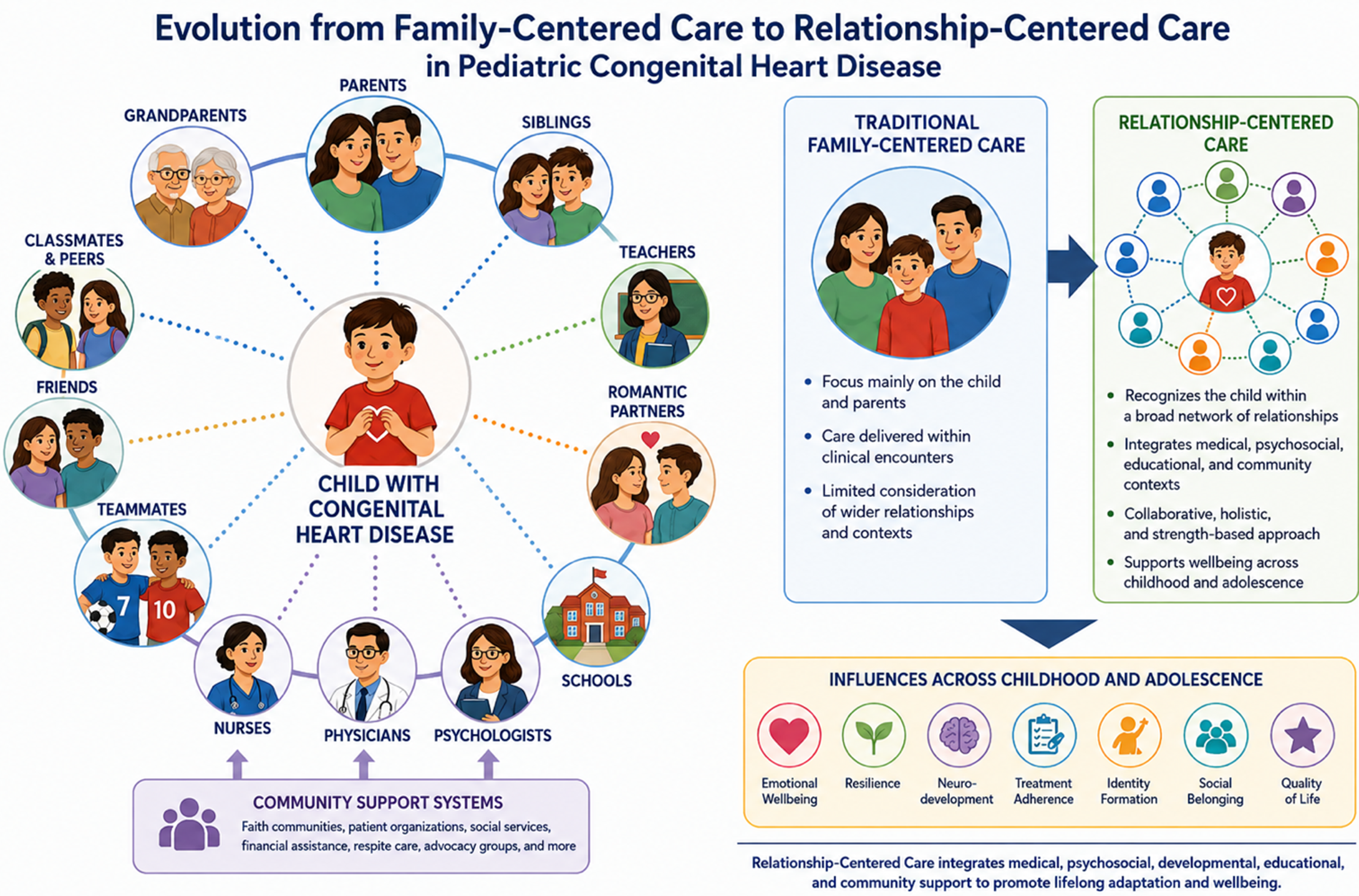
Ultimately, relationship-centred care shifts the focus from survival alone to long-term adaptation, recognising that outcomes are shaped not only by medical treatment but also by the quality of the relationships surrounding the child. It therefore complements family-centred care by integrating medical, developmental, psychological, educational, and social support across the lifespan (Figure 1).Reference Beach and Inui 16
The role of the healthcare team
Healthcare professionals play a central role in shaping the experiences of children with CHD and their families. Beyond providing medical expertise, clinicians influence how families understand the diagnosis, cope with uncertainty, build trust, and navigate lifelong care. Reference Wei, Roscigno, Hanson and Swanson6,Reference Beach and Inui16,Reference Kovacs, Brouillette and Ibeziako36 Clear, compassionate communication strengthens collaborative decision-making and may reduce anxiety, whereas inconsistent or overly technical communication can increase distress and feelings of helplessness. Reference Wei, Roscigno, Hanson and Swanson6,Reference Beach and Inui16
Psychosocial care should be integrated into routine paediatric cardiology rather than viewed as an adjunct to medical treatment. 15,Reference Kovacs, Brouillette and Ibeziako36 Regular assessment of parental mental health may facilitate earlier identification of anxiety, depression, and psychological distress among caregivers. Reference Wei, Roscigno, Hanson and Swanson6,Reference Woolf-King, Anger, Arnold, Weiss and Teitel7,Reference Kasparian, Kan, Sood, Wray, Pincus and Newburger25 Children should also undergo longitudinal assessment of emotional well-being and neurodevelopment, with developmental surveillance and neuropsychological evaluation where appropriate. Reference Marino, Lipkin and Newburger3,Reference Sood, Newburger and Anixt4 Educational participation and school functioning should be reviewed throughout childhood to identify learning needs and support appropriate school liaison.Reference Fleming, Fitton and Steiner 22 Routine psychosocial screening of children and families can further help identify those requiring timely referral to psychology, social work, and other support services. 15 , Reference Kovacs, Brouillette and Ibeziako 36
Optimal care requires collaboration between paediatric cardiologists, cardiac surgeons, specialist nurses, psychologists, social workers, developmental paediatricians, therapists, educators, and primary care providers. 15 , Reference Beach and Inui 16 , Reference Kovacs, Brouillette and Ibeziako 36 Coordinated multidisciplinary care enables medical, developmental, educational, and psychosocial needs to be addressed in parallel throughout childhood and adolescence. 15 , Reference Beach and Inui 16 , Reference Fleming, Fitton and Steiner 22
Healthcare professionals themselves may also experience compassion fatigue, burnout, and moral distress when caring for children with complex CHD.Reference van Mol, Kompanje, Benoit, Bakker and Nijkamp 37 Supporting staff well-being is therefore an important component of sustaining compassionate, high-quality paediatric cardiac care.
Implementing relationship-centered care
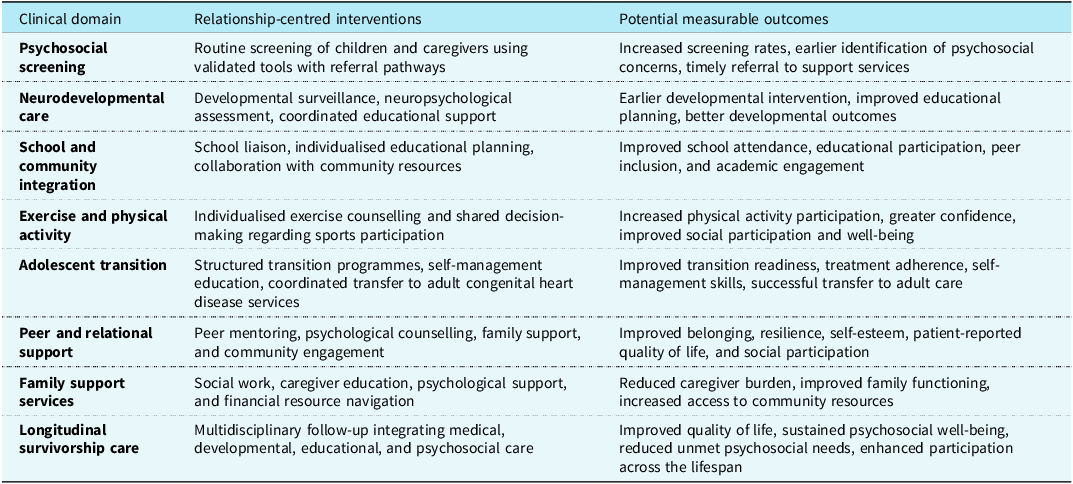
Relationship-centred care has practical implications for the organisation and delivery of paediatric cardiology services. Although resources vary between healthcare systems, many aspects of this approach can be incorporated into existing models of care through multidisciplinary collaboration and earlier recognition of psychosocial needs. Practical components include routine psychosocial screening and referral where appropriate 15,Reference Kovacs, Brouillette and Ibeziako36 , developmental surveillance and neuropsychological assessment Reference Marino, Lipkin and Newburger3,Reference Sood, Newburger and Anixt4 , school liaison Reference Fleming, Fitton and Steiner22, structured transition planning Reference Sable, Foster and Uzark19–Reference Moons, Pinxten and Dedroog21,Reference John, Jackson and Moons29 , exercise counselling, and peer support Reference Knowles, Day, Wade, Bull, Wren and Dezateux18,Reference Silva, Vaz and Areias23,Reference Millen, Dempster and Casey34 (Table 3).
Implementation should be pragmatic and tailored to local resources. Relationship-centred care does not necessarily require new standalone services; many components can be delivered through existing multidisciplinary teams while strengthening partnerships with educational and community services. 15 , Reference Beach and Inui 16 , Reference Kovacs, Brouillette and Ibeziako 36 Future evaluation should extend beyond traditional medical outcomes to include psychosocial well-being, transition readiness, treatment adherence, patient-reported quality of life, family functioning, and social participation. Reference Wei, Roscigno, Hanson and Swanson6,Reference Jackson, Frydenberg, Liang, Higgins and Murphy10,Reference Knowles, Day, Wade, Bull, Wren and Dezateux18,Reference Moons, Pinxten and Dedroog21,Reference Kovacs, Brouillette and Ibeziako36 Establishing the effectiveness, feasibility, and cost-effectiveness of relationship-centred care will be important to support its wider integration into contemporary paediatric cardiology practice. Reference Beach and Inui16,Reference Kovacs, Brouillette and Ibeziako36
Discussion
Advances in paediatric cardiology have transformed CHD into a lifelong condition in which successful outcomes depend not only on survival but also on psychosocial well-being, neurodevelopment, educational participation, and quality of life. Reference Liu, Chen and Zühlke1–Reference Amedro, Dorka and Moniotte5 This review highlights that long-term adaptation is influenced not only by cardiac complexity and neurodevelopmental outcomes Reference Marino, Lipkin and Newburger3,Reference Sood, Newburger and Anixt4 but also by the quality of the relationships surrounding the child, including family, peers, schools, and healthcare professionals. Reference Rassart, Luyckx, Apers, Goossens and Moons17–Reference Silva, Vaz and Areias23
Family-centred care remains fundamental to paediatric cardiology by recognising parents and caregivers as essential partners in care.Reference Kuo, Houtrow, Arango, Kuhlthau, Simmons and Neff 14 , 15 Relationship-centred care builds on these principles by recognising that psychosocial adaptation is also shaped by siblings, peers, educational environments, healthcare professionals, and community supports. Reference Beach and Inui16–Reference Silva, Vaz and Areias23,Reference Millen, Dempster and Casey34–Reference Kovacs, Brouillette and Ibeziako36 Rather than replacing family-centred care, it provides a complementary framework that better reflects the developmental and social realities of children living with CHD.Reference Beach and Inui 16
Psychosocial outcomes remain heterogeneous. Cardiac complexity and neurodevelopmental vulnerability influence developmental trajectories, Reference Marino, Lipkin and Newburger3,Reference Sood, Newburger and Anixt4 while parental well-being and family functioning contribute to children’s psychosocial adaptation. Reference Wei, Roscigno, Hanson and Swanson6–Reference Jackson, Frydenberg, Liang, Higgins and Murphy10 Educational participation may also be affected by school absence and learning difficulties.Reference Fleming, Fitton and Steiner 22 Access to multidisciplinary services further influences the recognition and management of psychosocial needs. 15 , Reference Kovacs, Brouillette and Ibeziako 36 Accordingly, relationship-centred care should be viewed as a flexible and scalable framework that integrates psychosocial screening, 15,Reference Kovacs, Brouillette and Ibeziako36 developmental surveillance, Reference Marino, Lipkin and Newburger3,Reference Sood, Newburger and Anixt4 school liaison, Reference Fleming, Fitton and Steiner22 structured transition planning, Reference Sable, Foster and Uzark19–Reference Moons, Pinxten and Dedroog21,Reference John, Jackson and Moons29 and multidisciplinary collaborationReference Beach and Inui 16 , Reference Kovacs, Brouillette and Ibeziako 36 within existing paediatric cardiology pathways.
Future research should move beyond describing psychosocial burden to evaluating interventions that strengthen resilience and social belonging,Reference Rassart, Luyckx, Apers, Goossens and Moons 17 , Reference Knowles, Day, Wade, Bull, Wren and Dezateux 18 improve family functioning, Reference Wei, Roscigno, Hanson and Swanson6,Reference Jackson, Frydenberg, Liang, Higgins and Murphy10,Reference Lumsden, Smith and Wittkowski11 support successful transition to adult care,Reference Sable, Foster and Uzark 19 – Reference Moons, Pinxten and Dedroog 21 , Reference John, Jackson and Moons 29 and enhance patient-reported quality of life.Reference Knowles, Day, Wade, Bull, Wren and Dezateux 18 , Reference Silva, Vaz and Areias 23 , Reference Bratt and Moons 28 Prospective studies should also evaluate the effectiveness, feasibility, and cost-effectiveness of relationship-centred care across diverse healthcare settings before its widespread implementation.Reference Beach and Inui 16 , Reference Kovacs, Brouillette and Ibeziako 36
Limitations
This narrative review synthesises current evidence but does not represent a formal systematic review or meta-analysis. The included literature comprises heterogeneous study designs, psychosocial frameworks, and healthcare settings, and no formal assessment of study quality or risk of bias was undertaken. Furthermore, much of the available evidence originates from high-income countries, which may limit the generalisability of these findings to other healthcare systems and cultural contexts.
Relationship-centred care is proposed as a conceptual framework that extends established family-centred care rather than as a validated model of care. Although current evidence supports the importance of relationships in shaping psychosocial outcomes, prospective studies are needed to determine whether implementation of relationship-centred care improves developmental, psychosocial, and patient-reported outcomes and to establish its feasibility and cost-effectiveness across diverse healthcare settings.
Conclusion
Children and adolescents with CHD face challenges that extend well beyond their cardiac diagnosis. Alongside advances in survival, increasing attention must be given to the emotional, developmental, educational, and social factors that influence long-term well-being. Family-centred care remains fundamental to paediatric cardiology, but this review highlights the importance of recognising the wider network of relationships—including siblings, peers, schools, healthcare professionals, and community supports—that shape psychosocial adaptation throughout childhood and adolescence.
Relationship-centred care provides a complementary framework that broadens the focus of paediatric cardiac care beyond medical management alone. Integrating psychosocial assessment, developmental surveillance, educational support, and multidisciplinary collaboration into routine care may strengthen resilience, belonging, participation, and quality of life for children and families living with CHD. Future research should evaluate the effectiveness, feasibility, and cost-effectiveness of relationship-centred care to establish its role within contemporary paediatric cardiology.
Conceptual framework of relationship-centred care in paediatric CHD. Relationship-centred care places the child with CHD at the centre of an interconnected network of relationships that includes parents, siblings, extended family, peers, schools, healthcare professionals, and community support systems. Building upon the principles of traditional family-centred care, this framework expands the focus beyond the parent–child dyad to recognise the broader social, educational, and healthcare contexts that influence psychosocial adaptation throughout childhood and adolescence. Through coordinated multidisciplinary collaboration, relationship-centred care aims to promote emotional well-being, resilience, neurodevelopment, treatment adherence, identity formation, social belonging, and quality of life, supporting children and families across the continuum of care.

Figure 1. Long description
A diagram illustrating the evolution from family-centered care to relationship-centered care in pediatric congenital heart disease. The child with congenital heart disease is at the center, surrounded by various relationships including grandparents, parents, siblings, teachers, romantic partners, classmates, peers, friends, teammates, schools, nurses, physicians, psychologists, and community support systems. The diagram shows two main sections: Traditional Family-Centered Care and Relationship-Centered Care. Traditional Family-Centered Care focuses mainly on the child and parents, with care delivered within clinical encounters and limited consideration of wider relationships and contexts. Relationship-Centered Care recognizes the child within a broad network of relationships, integrates medical, psychosocial, educational, and community contexts, uses a collaborative, holistic, and strength-based approach, and supports wellbeing across childhood and adolescence. Influences across childhood and adolescence include emotional wellbeing, resilience, neurodevelopment, treatment adherence, identity formation, social belonging, and quality of life.
Potential clinical components and measurable outcomes of relationship-centred care

Table 3. Long description
A table with 8 rows and 3 columns. The columns are labeled ‘Clinical domain’, ‘Relationship-centred interventions’, and ‘Potential measurable outcomes’. Row 1: Psychosocial screening, Routine screening of children and caregivers using validated tools with referral pathways, Increased screening rates, earlier identification of psychosocial concerns, timely referral to support services. Row 2: Neurodevelopmental care, Developmental surveillance, neuropsychological assessment, coordinated educational support, Earlier developmental intervention, improved educational planning, better developmental outcomes. Row 3: School and community integration, School liaison, individualised educational planning, collaboration with community resources, Improved school attendance, educational participation, peer inclusion, and academic engagement. Row 4: Exercise and physical activity, Individualised exercise counselling and shared decision-making regarding sports participation, Increased physical activity participation, greater confidence, improved social participation and well-being. Row 5: Adolescent transition, Structured transition programmes, self-management education, coordinated transfer to adult congenital heart disease services, Improved transition readiness, treatment adherence, self-management skills, successful transfer to adult care. Row 6: Peer and relational support, Peer mentoring, psychological counselling, family support, and community engagement, Improved belonging, resilience, self-esteem, patient-reported quality of life, and social participation. Row 7: Family support services, Social work, caregiver education, psychological support, and financial resource navigation, Reduced caregiver burden, improved family functioning, increased access to community resources. Row 8: Longitudinal survivorship care, Multidisciplinary follow-up integrating medical, developmental, educational, and psychosocial care, Improved quality of life, sustained psychosocial well-being, reduced unmet psychosocial needs, enhanced participation across the lifespan.
Acknowledgements
None.
Financial support
None.
Competing interests
None.
Ethical standard
The authors assert that all procedures contributing to this work comply with the ethical standards of the Helsinki Declaration of 1975, as revised in 2008.