Introduction
A global economic and financial crisis has been dominating politics across OECD countries since 2008. In addition to overall macroeconomic and fiscal policy, social policy schemes have been caught in the currents of the global economic downturn. Yet, in contrast to what other authors have emphasised (Armingeon, Reference Armingeon, Pierson, Castles and Naumann2013; Farnsworth and Irving, Reference Farnsworth and Irving2012), this article shows that there is typically no uniform crisis response – such as ‘austerity’ – across countries when it comes to social policy.Footnote 1 Instead, policy solutions range from straightforward cutbacks to expansionary reform, even in the face of very similar economic conditions. Why these differences?
This article studies how different crisis responses reflect ideological differences between political parties. We approach the question of party politics in times of crisis by examining the link between government composition and the direction of crisis responsesFootnote 2 in social policy. On average, social expenditure represents about half of overall public expenditure in the core OECD countries, which is at times considered to be an excessive burden on public budgets. At the same time, social insurance and assistance schemes cushion those who lose out during crisis and function as counter-cyclical macroeconomic stabilisers. Politically, both the notion of an excessive fiscal burden and the counter-cyclical effect of crisis responses relate to the overall fiscal and welfare state arrangements within societies that typically form a key issue of left–right inter-party differences.
The link between the party composition of governments and social policy crisis management is studied by comparing four small OECD-economies over a period of about forty years. We specifically focus on short- to medium-term changes in social entitlements. The direction of change (i.e., expansion or retrenchment) is measuredFootnote 3 by studying whether important legislative decisions in response to crisis raised or lowered welfare state benefits, widened or reduced access to benefits and services or even set up or abolished entire schemes. The comparative analysis of crisis responses is complemented with qualitative within-case evidence of the processes of crisis policy-making (see Bennett, Reference Bennett, Box-Steffensmeier, Brady and Collier2008; George and Bennett, Reference George and Bennett2005).
We use a qualitative measurement of crisis responses rather than social expenditure data as provided by the OECD based on the fact that the latter is a problematic indicator for policy change, especially in the short term. If social expenditure is used, regulatory decisions as well as decisions with a longer phase-in period are not captured, due to their lack of an immediate impact on spending (Hinrichs and Kangas, Reference Hinrichs and Kangas2003). Moreover, measures of social expenditure can give a misleading impression on actual policy decisions, as the spending ratio automatically increases during periods of economic crisis due to higher recipient numbers of many benefits (particularly in unemployment and social assistance schemes, if not health and pensions as well) combined with the drop in GDP (the denominator of the social expenditure ratio). According to recent OECD data (OECD, 2013), for example, social expenditure as a percentage of GDP saw a surge from 22.6 to 25.3 per cent, on average, between 2008 and 2009, yet it is evident that in many countries governments have decided to impose austerity measures in social policy.Footnote 4 Therefore, in this article, we look at decisions on the generosity of and access to social entitlements (‘crisis responses’).
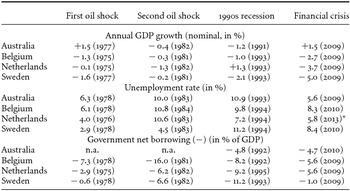
We study Australia, Belgium, the Netherland and Sweden – four cases chosen to represent different welfare state regimes. They also exhibit a large variation in the partisan composition of government, both between and within countries. Moreover, Belgium and the Netherlands are founding members of the European Union (EU) and currently part of the Eurozone, while Sweden only became a member of the EU in 1995 and has not joined the Euro. Australia, naturally, is not a member of the EU. Due to the smallness and external vulnerability of all of these countries, they can be expected to react quickly and decisively to external shocks (Katzenstein, Reference Katzenstein1985). We analyse not only the latest crisis, but the four most significant episodes of international economic shocks over the last forty years: the oil shocks of 1973 and 1979, the early 1990s recession and the on-going global economic and financial crisis which started in 2008. While there is no doubt that these four events had very different causes and characteristics, the depth of the national crises differed surprisingly little across countries. Table 1 sums up the comparative extent of the crisis in a highly condensed way by measuring the peak of the crisis in terms GDP growth, unemployment and public deficits. This demonstrates a striking uniformity of economic ‘problem pressure’ in the four countries; exceptions being the relatively good growth performance in Australia in 2009, and the good unemployment record in Sweden after the oil shocks (see below).Footnote 5
Depth of economic crisis at peak (and year of peak), selected indicators

Note: *forecast; peak of the crisis is defined as the worst annual performance in the five years following the global shock (1973, 1979, 1990, 2008).
Source: OECD (2012): Economic Outlook No. 92.
In developing our argument, we build upon an extensive macroeconomic literature on automatic stabilisers (Darby and Melitz, Reference Darby and Melitz2008; Dolls et al., Reference Dolls, Fuest and Peichl2012; in't Veld et al., Reference in't Veld, Larch and Vandeweyer2013) but, at the same time, go beyond it in an important way. Economic research tells us that the welfare state has an important effect on economic performance in the aftermath of crisis via aggregate demand (for a useful introduction, see in't Veld et al., Reference in't Veld, Larch and Vandeweyer2013). Economists have also analysed the varying effects of different public spending schemes and spelt out the conditions under which automatic stabilisers tend to be more or less effective. There is considerable evidence showing that the size of the state, especially of unemployment benefits and related cyclical policies, matters for recovery from economic shocks (e.g., Dolls et al., Reference Dolls, Fuest and Peichl2012). Our research supports the finding that size, in terms of generosity of the welfare state, matters. But, in addition, we ask what this implies for the politics of crisis management. Does automatic stabilisation affect the political conflict about responses, for example, in the field of social policy? What happens in countries where automatic stabilisers are small and therefore less effective? Under what conditions is the lack of automatic stabilisation compensated for by discretionary fiscal expansion of welfare state schemes?
The argument put forward in this article is that in welfare states with relatively low benefits and therefore small automatic stabilisers, crisis responses are indeed shaped by partisan politics. The decision to deal with the crisis by selectively expanding welfare state schemes or cutting back on benefits is driven by partisan forces. In the more generous welfare states of Continental and Northern Europe, by contrast, this partisan effect on the direction of change is very limited or even non-existent. Since much of the fiscal stabilisation is going on ‘behind the backs’ of policymakers, through large automatic stabilisers, the overall direction of crisis response (expansion or retrenchment) is usually not subject to strong political debate. The direction of change is determined by other factors such as public debt, supra-national regulation and international influences, or a common crisis perception. For example, the current crisis shows how the common fiscal framework of the EU shapes the space for national manoeuvre especially within the Eurozone. Meanwhile political disagreement is not entirely absent in generous welfare states, but it concerns the extent of expansion or retrenchment.
In order to substantiate these claims, we first discuss theories of crisis politics in the light of the literature on political parties and the welfare state. We then examine whether the depth of the economic crisis and the partisan composition of government shaped crisis responses in Australia, Belgium, the Netherlands and Sweden over the last forty years, showing that support for a direct impact of either differences in the depth of the crisis or political parties is weak, at best. In the sections that follow, we therefore consider the conditional effect involving the existing welfare state and assess some alternative explanations. We discuss the generalisability of our findings and their implications for the literature on political parties and public policy and point out promising future avenues of research in the concluding section.
The partisan politics of crisis management
Partisan theories have been highly successful in explaining the development of the welfare state during the immediate post-World War II decades (Castles, Reference Castles1982; Hicks, Reference Hicks1999; Huber and Stephens, Reference Huber and Stephens2001). The basic finding is that social democratic parties – often supported by trade unions (Korpi, Reference Korpi1983) – have had a positive effect on the spectacular expansion of welfare states across the OECD. In addition, Christian democratic parties have had a similar effect on expansion, albeit with particular emphasis on certain types of policies and modes of provision (Stephens, Reference Stephens1979; van Kersbergen, Reference van Kersbergen1995). Concerning the period after 1970, however, the results are more mixed (Allan and Scruggs, Reference Allan and Scruggs2004; Huber and Stephens, Reference Huber and Stephens2001; Kittel and Obinger, Reference Kittel and Obinger2003; Korpi and Palme, Reference Korpi and Palme2003; Pierson, Reference Pierson1994; Swank, Reference Swank2002). An important challenge to partisan theories comes from the so-called ‘new politics’ literature on welfare state retrenchment (Pierson, Reference Pierson1994; see Starke, Reference Starke2006), which focuses on the ways in which reform-minded governments – largely irrespective of partisan composition – are able to conceal unpopular cutback measures through ‘blame avoidance’ strategies. While parties played a subordinate role in Pierson's original analysis, they have been moved to the centre in subsequent studies on retrenchment (Giger and Nelson, Reference Giger and Nelson2011; Green-Pedersen, Reference Green-Pedersen2001; Jensen and Mortensen, Reference Jensen and Mortensen2014; Kitschelt, Reference Kitschelt and Pierson2001). Again, results are much more mixed and more often sensitive to context conditions than in the older literature on the nexus between parties and social policy. Note, however, that the ‘new politics’ literature focuses exclusively on welfare state cutbacks, not on – expansionary as well as restrictive – crisis responses per se.
What are the expectations regarding the impact of parties on crisis management? Interestingly, there is very little on this particular issue in the existing comparative welfare state literature. Nevertheless, left-wing political parties could be expected to be more favourable towards expansion of the welfare state during such moments than parties of the right, for at least two reasons: First, low-income households are particularly at risk during moments of economic crisis (Ahrend et al., Reference Ahrend, Arnold and Moeser2011), which is why expanding the welfare state during crises should benefit these groups more than high-income households. The opposite holds for crisis-induced retrenchment. We can therefore expect that left and right parties first and foremost respond to the distributional demands of their traditional core constituencies of, respectively, low- or high-income earners. Second, crisis responses are likely to be in line with a parties’ long-term ideological stance towards (welfare) state and market. Left parties should also be more eager to blame ‘the market’ and look for state solutions, while parties of the right should be more willing to blame state regulation or the size of the state. It has been shown that the salience of economic issues in public opinion is generally high in the aftermath of crises (Singer, Reference Singer2011). Moreover, socio-economic policy positions of parties still shape electoral politics to a great extent. Hence, externally induced economic crises put some of the most divisive issues of modern partisan conflicts back on the agenda.
Other theoretical arguments, however, speak against a partisan effect on crisis responses. During crises, we may witness a suspension of ideological differences and a ‘rally round the flag effect’, similar to what has been observed during foreign policy crises (Mueller, Reference Mueller1970; Oneal and Bryan, Reference Oneal and Bryan1995). According to the rally round the flag effect, technocratic governance and the centralisation of decision-making should be the rule during moments of shock. This ‘crisis centralisation’ thesis would predict decision-making in small groups involving the executive and a loss of power of typical veto players (for a critical review, see ‘t Hart et al., Reference ‘t Hart, Rosenthal and Kouzmin1993). Moreover, the new politics literature as well as accounts of the post-industrial politics of the welfare state (Häusermann et al., Reference Häusermann, Picot and Geering2013) would perhaps not expect a simple left–right divide, either.
The few studies that empirically test the impact of parties on policy responses to short-term shocks include a quantitative study by Cusack et al. (Reference Cusack, Iversen, Rehm, Beramendi and Anderson2008) of sixteen OECD countries from 1960 to 1995, finding a partisan effect on total government transfers in response to external shocks. Armingeon (Reference Armingeon2012) and Wagschal and Jäkel (Reference Wagschal and Jäkel2010) examine the impact of political parties on fiscal stimulus programmes in the aftermath of the 2008 financial crisis in twenty-five to thirty-four OECD countries (plus a few Eastern European states), but they do not find robust and/or straightforward partisan effects (see also Vis et al., Reference Vis, van Kersbergen and Hylands2011). In line with the ‘rally round the flag’ effect, Lipsmeyer (Reference Lipsmeyer2011) finds a diminishing partisan impact on social expenditure during downturns in seventeen OECD countries between 1981 and 1998. Jensen (Reference Jensen2011) similarly concludes that economic problems diminish the partisan impact on labour market policies between 1980 and 2002. He explains this by pointing out that external shocks affect a large share of the population, including a sizeable proportion of right-of-centre voters. Hence, conservative and market-liberal parties soften their policies in the aftermath of shocks. There is some evidence that partisan effects may be real, but dependent on country-specific factors. In the United States, as case studies show, crisis responses were strongly shaped by party polarisation (McCarty, Reference McCarty, Bermeo and Pontusson2012), while they were implemented in a highly consensual way in the Nordic countries (Lindvall, Reference Lindvall, Bermeo and Pontusson2012). Overall, the existing evidence on the impact of parties on crisis responses is mixed, at best.
So far we have assumed that political parties will be able to enact policies fully in line with their preferences when in government. Yet the impact of partisan politics may be mediated by institutional or partisan veto players (Tsebelis, Reference Tsebelis2002). Again, not many studies exist that test the veto player proposition with respect to crisis politics. An earlier institutionalist account is Weir and Skocpol's (Reference Weir, Skocpol, Evans, Rueschemeyer and Theda1985) analysis of Keynesian responses to the Great Depression. A more recent study examining the impact of partisan veto players (i.e., coalition governments), on fiscal policy in thirty-three parliamentary democracies between 1972 and 2000 is Blais et al. (Reference Blais, Kim and Foucault2010) who find that ‘[c]oalition governments spend more than single-party governments when they are in a difficult fiscal context, but they spend less when the fiscal situation is rosy. It all depends on the fiscal context’ (p. 844). Note that such findings implicitly contradict the ‘crisis centralisation’ scenario posited by the crisis management literature (see also Jensen and Mortensen, Reference Jensen and Mortensen2014).
Another factor that features especially in the literature on the 1970s oil shocks is neo-corporatism (see also Gourevitch, Reference Gourevitch1986). It has been argued that countries with highly encompassing trade unions and employer associations were in a better position to deal with the stagflation crisis. Tripartite bargaining was a way to keep inflation in check through sustained wage moderation in exchange for policies in the interests of trade unions. This worked especially when social democrats were in power and central banks were not in a position to counteract such corporatist deals (Scharpf, Reference Scharpf1991). The role of systems of interest intermediation for crisis politics more generally – including responses in non-inflationary situations – is, however, unclear. Before turning to possible interactive effects, we present the basic pattern of responses in light of the depth of the crisis and the partisan composition of government.
Economic conditions and the partisan composition of government
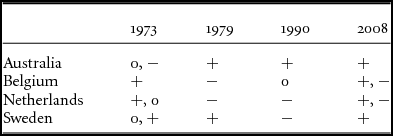
The social policy responses across all four episodes and countries are described in detail in the web appendix to this article (see supplementary material) and summarised in Table 2.Footnote 6 The table depicts expansionary crisis measures with a +, cutbacks with a – and non-responses with a 0. It reveals that the picture of responses is highly diverse. This picture contradicts what common notions of either a general ‘return of the state’ or a new ‘age of austerity’ would lead us to expect.Footnote 7 The immediate responses to the latest crisis show an initial similarity in policy responses (expansionary). Subsequently, however, some of the countries changed course, while others did not – a result that is not in line with unidirectional expectations.
Social policy responses to four international economic shocks

Notes: 0 = non-reaction, + = expansion, – = retrenchment. A comma denotes several stages in the response.
How can this diversity of social policy responses to crisis be explained? The depth of the crisis turns out to be a relatively weak predictor of crisis responses. First of all, it must be noted that economic performance is a partly endogenous factor. The depth (and length) of the recession in Sweden in the early 1990s, for example, is probably in part due to the significant expenditure cutbacks. Just like the relatively mild and short downturn in Australia in 2009 cannot be understood without reference to the stimulus program, one of the largest, earliest and most effective in the OECD (OECD, 2009: chapter 3).
Surely, some countries that were economically particularly hard-hit also reacted with wide-ranging measures, such as Australia and Sweden in the early 1990s. Both countries experienced the deepest recession in decades and responded with decisive reform (i.e., broad cutbacks in Sweden and stimulus and policy innovation in Australia). But it is often overlooked that Sweden was also heavily affected in the 2009 downturn – with a drop in GDP of 5 per cent and unemployment rates above the OECD average – but reacted very cautiously and incrementally. The Netherlands implemented cutbacks in the early 1990s, although it was not ‘in crisis’ by conventional standards, while Belgium, which was deeply in trouble, did not react in an unequivocal manner. Hence, the relationship between the depth of the crisis and the responses across the countries can be called very weak, at best, a finding that is also confirmed by other studies (Armingeon, Reference Armingeon2012; Bermeo and Pontusson, Reference Bermeo, Pontusson, Bermeo and Pontusson2012). More importantly, the depth of the crisis does not tell us much about the direction of responses, as the divergence between Australia and Sweden in the early 1990s demonstrates. As a consequence of an international shock, the nature of the crisis was broadly similar across countries in each period, but responses often went in completely different directions.
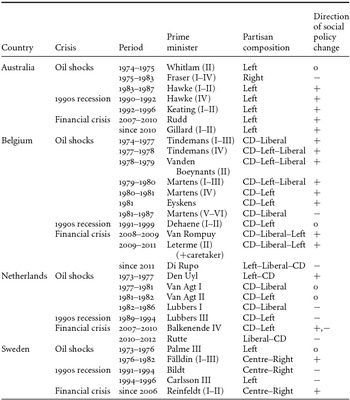
Perhaps genuinely political factors played a role in the decision to either cut back or expand welfare state schemes (or not change them at all). In order to provide a first overview of the association between parties and specific crisis responses, we match the partisan composition of government in the first years after an economic shock on the social policy responses briefly summarised above. Table 3 exhibits the partisan composition of governments in the different countries and at different times of major international crisis, and the respective direction of social policy change (in terms of expansion, non-reaction and retrenchment, see also Table 2). The theory should lead us to expect expansionary responses under left governments and retrenchment when secular conservative (‘right’) or liberal parties are in office.
Political parties and crisis responses

Note: CD = Christian democratic; 0 = non-reaction, + = expansion, – = retrenchment. A comma denotes several stages in the response.
The impact of the partisan composition of governments on the direction of policy responses to crisis seems clearest in Australia. Here, after a first non-reaction in the face of high price inflation, the conservative Fraser government in the late 1970s followed the slogan of ‘Fight Inflation First’ and cut back benefits. After the change in government in 1982, Labor used expansion as part of a corporatist bargain to deal with the crisis, and did so again in the early 1990s. Even after the financial crisis of 2008, expansionary policies were used by Labor. What is more, after each shock, the conservative opposition argued against the government's expansionary measures and proposed fiscally conservative alternatives. For example, in 1991, the conservative opposition launched a radical policy blueprint, entitled ‘Fightback!’, which, among other things, called for a shake-up of the industrial relations system, cuts to health care and strict time limits for unemployment benefits. Similar dynamics occurred after 2008 (see below).
In contrast, we find such partisan differences only to a very limited extent in Belgium and the Netherlands. To be sure, in Belgium and the Netherlands, the early 1980s were a time when partisan conflict over the design of savings measures became somewhat stronger and shifts in the ideological composition of cabinets to the right (in the Netherlands in 1982 and in Belgium in 1981) led to the first clear welfare state cutbacks. Yet these ‘turning point’ events were exceptions rather than the rule. Later on, left-wing and conservative parties were involved in both cutbacks and expansionary responses. In the Netherlands, for example, unemployment insurance was cut back in the early 1990s by a government of Christian Democrats and Labour. And the socialist-led broad coalition of Elio Di Rupo in Belgium introduced cutbacks in pensions and unemployment insurance in 2011/12.
In Sweden, the pattern is even less partisan in nature. Following the second oil shock in the early 1980s, conflict between parties revolved around measures in health policy and unemployment insurance, which, however, were rather symbolic (such as a waiting day for sickness benefits). In the 1990s, retrenchment became the order of the day in fighting massive deficits. Though there was political conflict across left–right party lines, there was general agreement about the need for cutbacks. The expansionary policies carried out by a centre–right government during the most recent crisis period were equally broadly supported across the political spectrum.
The conditioning impact of welfare state generosity
How can we explain the differential impact of the partisan composition of governments on the social policy responses to the crisis in Australia on the one hand, and the European countries on the other? We argue that the crucial conditioning factor for the uneven impact of parties is the generosity of the welfare state. In highly developed welfare states, much of the stabilisation happens behind the backs of political actors when automatic stabilisers are ‘quietly doing their thing’ (Cohen and Follette, Reference Cohen and Follette2000). Hereafter we will show evidence at the aggregate as well as the within-case level to support our explanation.
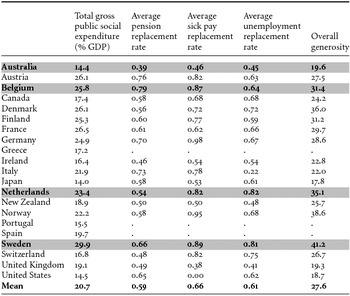
Starting at the aggregate level, Table 4 shows that Sweden holds the title of the OECD welfare champion, both in terms of total social expenditure and overall generosity – measured with the composite generosity score calculated by Scruggs (Reference Scruggs, Beramendi and Anderson2008),Footnote 8 while Australia is the laggard (by a considerable margin). Belgium and the Netherlands are not far behind Sweden, although there are important differences, especially when it comes to social expenditure as a percentage of GDP. Looking at particular welfare state schemes, such as public pensions, unemployment and sickness benefits, Sweden loses some of its special status, as the Netherlands and Belgium catch up on or even overtake the average Swedish generosity values (measured in terms of average replacement rates). Australia, however, consistently retains its status as one of the least generous welfare states in the OECD.Footnote 9 /tabl
Welfare state characteristics, twenty-one countries, 1973–2007

Sources: Social expenditure data was taken from the OECD SOCX database (years 1980 to 2007) (OECD, 2009). Overall generosity scores and replacement rates for the years 1973 through 2002 taken from Scruggs (Reference Scruggs2006). Scruggs reports replacement rates for families (sick pay and unemployment) or couples (minimum and standard pensions), and for singles. Assumed earnings are those of the ‘average production worker’. Average replacement rates were constructed by taking the average of the replacement rates for singles and for families/couples for each year; numbers in table represent averages of these numbers over all years.
As we have shown, the pattern of left expansion versus right retrenchment was most pronounced in Australia, and much less so in Europe. The extent of automatic fiscal adjustment through social policies in Australia is limited. Virtually all benefits are means-tested and flat-rate. As a consequence, people who lose their jobs but have other income are often not entitled to unemployment benefits. Those who are, receive a flat-rate social assistance-type benefit, which over the last forty years was, on average, considerably lower than the OECD mean and just over half the average Swedish or Belgian level (see Table 4). In the absence of automatic stabilisers, the question of stimulus was put on the political agenda each time the economy was in trouble. By contrast, in Continental and Northern Europe, including Sweden, Belgium and the Netherlands, generous welfare states imply larger automatic fiscal stabiliser effects (Dolls et al., Reference Dolls, Fuest and Peichl2010; Girouard and André, Reference Girouard and André2005). Social insurance programmes such as unemployment benefits lead to an automatic counter-cyclical expansion of public spending on social policy in times of crisis not only because average benefit levels are much higher, but also because they are often universal and earnings-related. There is therefore much less need for discretionary stimulus measures.
A look at the typical instruments used in response to crisis also suggests that crisis responses can have different functions, depending on the policy context. In Australia, expansionary responses usually involved raising benefit levels (especially in the early 1980s) and paying lump-sum payments to a large group of beneficiaries (1990s, 2008). In the other three countries studied, such ‘macroeconomic’ short-term measures aimed at lifting aggregate household demand are almost entirely absent. Instead, regulatory instruments targeted at specific vulnerable groups such as older unemployed or those hit by redundancies are more common.
Having shown that the content of crisis responses is shaped by the presence or absence of large automatic stabilisers, we will now turn to the within-case evidence for the kind of conditional impact welfare state generosity can have on the politics of crisis responses. In Australia, whenever stimulus measures are called for, the government cannot rely only on the welfare state to quietly do its job without much debate. Therefore, the question of whether and how fiscal expansion should be implemented has to be put on the legislative agenda. Once it is out in the open, the issue of discretionary fiscal stimulus via welfare state benefits – versus no fiscal stimulus or fiscal stimulus via taxes and infrastructure spending, for example – must be debated in parliament. This is where the long-standing ideological positions of parties come into play, as the Australian crisis debates amply illustrate. In this process, each party tends to advance its ‘pet policies’. The most recent crisis is a case in point. Labor Prime Minister Kevin Rudd stated in October 2008 that:
it is very important to act early and decisively. If you are to learn anything from economic history it is this: at a time when economies need stimulus support, don't leave it too late. (Rudd and Swan, Reference Rudd and Swan2008)
Welfare sceptical secular conservative parties such as the Australian Liberal Party and their traditional ally, the National Party, tend to shy away from using the welfare state as crisis manager in this sense. Although initially supportive, the opposition quickly turned and voted against the second stimulus plan in parliament in early 2009. The leader of the conservative opposition Malcolm Turnbull then stated:
The opposition will vote against this package in the House and in the Senate . . . We know that this is not going to be a popular decision, but it is the right decision. The Prime Minister has made one easy decision after another. He has not made a hard decision since he took up that high office. But somebody has to stand up for what is right. Somebody has to stand up for fiscal discipline. Somebody has to stand up for the taxpayers of Australia and ensure that we do not impose staggering levels of debt on future generations. (Turnbull, Reference Turnbull2009)
In the same speech, he called the first stimulus of 2008 a ‘cash splash [which] did not work’ (ibid.). And again, in 2011, the Liberal opposition leader criticised the government for making ‘the fundamental mistake of thinking that a crisis largely caused by too much spending and too much borrowing could be addressed by yet more spending and yet more borrowing’ (Abbott, Reference Abbott2011). Not that the conservatives were entirely against fiscal expansion, but they tried to get tax cuts rather than social and infrastructure spending on the agenda.
By contrast, in Continental and Northern Europe, where generous social insurance programmes lead to an automatic counter-cyclical expansion of public spending, crisis responses have been more modest. An example is the response to the 2008 financial crisis in the Netherlands. Already in November 2008, Prime Minister Balkenende emphasised that it was essential that ‘automatic stabilisers can do their job’ without political interference.Footnote 10 In spring 2009, the centre–left coalition government (Balkenende IV) announced its crisis response package. In the accompanying document, it was, again, emphasised that ‘automatic stabilisers already stimulate the economy significantly’.Footnote 11 Therefore, the package included only some targeted social policy measures, such as the expansion of part-time unemployment benefits and the establishment of ‘mobility centres’ for job seekers.
Similarly, in Sweden in 2008 the government was able to rely on an extensive system of social protection, and subsequent governments were careful to preserve its stabilising functions. The crisis package enacted by the centre–right government was expansionary. In addition to investing in active labour market policies, cutbacks were circumvented by means of avoiding the so-called ‘pensions brake’Footnote 12 to become effective. As the crisis was relatively quickly overcome, Swedish policy-makers across the political spectrum emphasised how well the country's automatic stabilisers had functioned in preventing a deeper crisis and declared they were going to prevent any future shocks.
Constrained partisanship in generous welfare states
It is certainly not the case that political debate is absent in more generous welfare states. Yet examining the typical kind of post-crisis debate in these countries serves to strengthen rather than contradict our argument on the conditioning impact of welfare state generosity. While in Australia, the political debate typically revolved around the overall direction of crisis responses – i.e., expansion versus retrenchment, social transfers versus other instruments of crisis management – the debate in Belgium, the Netherlands and Sweden was marked by the question of how much – stimulus or retrenchment – is enough. Note that this is not an argument about the depth of partisan conflict but rather about the type of conflict unfolding in the aftermath of economic shocks under different contextual conditions.
In Sweden, for example, social policy crisis management certainly did not occur without intensive political debate, particularly with regard to retrenchment in the 1990s and the resulting discussion about the possible ‘end of the Swedish welfare state’ (Lindbom, Reference Lindbom2001). Significant cuts to social benefits and services resulted, with parts of these hotly debated between political parties, but in effect the policies enacted by changing governments appeared rather coherent. There was a general agreement about the type of response, the necessity of retrenchment following a ‘basic TINA logic’ (Steinmo, Reference Steinmo2002: 841). Similarly, following the global crisis beginning in 2008, there was a debate about the extent of social policy expansion, however there was no major struggle on the overall direction of crisis management.
In Belgium, we see a comparable pattern, where expansionary crisis responses were often driven by the Christian Democrats and the Socialists, in concert with the social partners in the 1970s. When the fiscal situation worsened after the second oil shock, the issue of welfare state cutbacks entered the agenda and was most forcefully supported by the Liberals and, to some extent, the Christian Democrats. In general, retrenchment was limited in Belgium (at least in the immediate aftermath of economic shocks). But it did sometimes emerge and did, at times, involve left parties, most recently in late 2011, when the Socialist-led government of Elio Di Rupo introduced incremental welfare state cutbacks even against trade union opposition. It should be noted that the measures taken by the Di Rupo government were certainly influenced by the fiscal requirements of the EMU, to which we will return below.
In the aftermath of the 2008 financial crisis, we also see a general agreement about the need for cutbacks in the Netherlands. Yet there is strong disagreement between political parties about the extent of retrenchment (Holsteyn, Reference Holsteyn2010: 415). This is clearly visible in the electoral campaign of 2010. In all party manifestos (except for the Socialist Party), we find a commitment to decreasing budget deficits. Yet while the Liberal Party favoured extensive cuts in social policy and health care, the Labour Party advocated much more moderate cutbacks (CPB, 2010).
When looking at medium-term differences, it should be emphasised that large automatic stabilisers have the consequence that, ceteris paribus, they increase the deficit. Of course, the idea of countercyclical stimulus is to stabilise economic growth rates in the medium term and thereby also to reduce the deficit. But, especially when economic recovery does not follow quickly, the short-term hike in the public deficit figures often provokes calls for cutbacks later on. For example, in the Netherlands and Belgium, the oil shocks of the 1970s led to a sharp increase in public expenditure on social policies. After implementing some targeted expansionary measures in the 1970s, in the 1980s there was agreement in both countries that public deficits had reached their limits and should be addressed.
The interplay between automatic stabilisers and retrenchment in the medium term becomes particularly visible in the social policy response to the 2008 financial crisis. As we saw above, in the Netherlands, the centre–left (Balkenende IV) government's crisis response package of March 2009 explicitly emphasised automatic stabilisers and added only some temporary and targeted stimulus measures. At the same time, the government announced cutbacks in pensions, health care and childcare, which were later implemented by a new centre–right government (Rutte I). In the period after 2009, we see a broad agreement across the political spectrum on the necessity of social expenditure cuts in the longer term. This agreement is part of a long Dutch tradition of welfare state retrenchment in times of economic difficulty, started in the 1980s. In addition, it was reinforced by the fiscal requirements of the European Stability and Growth Pact (made even stricter in 2011).
Similarly, in Belgium, at first, the automatic response – supplemented with some additional labour market measures – worked well after the economic shock of 2008. Despite this, fiscal policy became a major political issue. The deficit peaked at 5.7 per cent of GDP in 2009 and gross public debt hit 100 per cent of GDP in 2010 (OECD, 2012). In late 2011, the financial markets and the European Commission put enormous pressure on Belgium to solve the political crisis and introduce fiscal savings measures. In December, a six-party coalition headed by socialist Elio Di Rupo was formed and immediately unveiled an austerity package which included sizeable pension cuts and plans to cut back unemployment benefits for some groups. As in the Netherlands, expansion was thus followed by retrenchment, largely independent of the partisan composition of government, but directly related to the EU's fiscal requirements. In sum, the Netherlands and Belgium are examples of countries where initial – mostly, though not exclusively automatic – expansion gave way to retrenchment under the conditions of high overall debt levels and the requirements of the Stability and Growth Pact. These conditions were absent in Sweden and Australia.
Potential alternative explanations
We have already discussed the limited explanatory relevance of associating the differences in social policy responses with differences in the depth of the crisis. But what about other alternative explanations for the pattern we see? Regarding the structure of political institutions, all four countries are characterised by a moderate to high number of institutional and partisan veto players. Political power-sharing and fragmentation is particularly strong in Belgium and the Netherlands, due to frequent and broad coalition governments, and also in Australia.Footnote 13 Concerted policy-making in Sweden was, in part, determined by the fact that the governments during crisis episodes were all minority governments (with the brief exceptions of Fälldin I and II and Reinfeldt I). While the specific institutional arrangements differ, cross-party consensus requirements exist in all countries and lead to friction and, as a result, compromise costs. A general argument based on institutional restrictions of government decision-making fails to account for the striking diversity of responses both across time and across the four countries.
Is it, then, the presence or absence of multi-party cabinets – which are, after all dominant in Continental Europe – that explains why the partisan effect is stronger in Australia? Does the fairly regular and clear change in government that we see in Australia account for the policy pattern? This is not fully convincing, either (nor is it uncontested in the literature – Jensen and Mortensen, Reference Jensen and Mortensen2014; Pierson, Reference Pierson1994). Multi-party cabinets cannot explain why the direction, and not just the magnitude, of responses have differed so much across time and space, nor can they explain why partisan conflict in Australia has revolved mostly around the overall direction (i.e., expansion versus retrenchment), while in Europe, the conflict between political parties – parties sharing office as well as government and opposition parties – has been rather about the extent of expansion or retrenchment. Here, an explanation taking welfare state generosity into account fares much better.
If it is not institutional and partisan veto players, then it is perhaps interest groups, and corporatism in particular, that play a role in shaping crisis responses. Again, there is no straightforward association between the direction of change and the strength of corporatism. Only in the 1970s and 1980s do we find a pattern according to which sustained expansion of welfare state schemes was dependent on the ability of the government to keep wages in check. In Sweden, corporatist coordination was still largely intact at that time, but both the Netherlands and Belgium showed strong signs of disintegration. Many initial reactions to the first oil shock were still very much in the corporatist mould, but over the 1970s and into the 1980s, relationships between the government, employers and trade unions grew more conflictual. Consequently, the disintegration of classic corporatism made further expansionary measures increasingly difficult, given the inflationary pressures at the time of the second oil shock. In Australia, the quasi-corporatist Accord of 1981 – which did not include employers – supported expansionary crisis responses, but the Wassenaar Accord in the Netherlands that was concluded in 1982 between employers and unions heralded the beginning of important cutbacks. Neither agreement was corporatist in the sense of Scharpf's (Reference Scharpf1991) analysis of social democratic crisis politics; nor was the result in terms of social policy measures the same. During the 1990s financial crisis, the role of classical corporatism was almost non-existent. Trade unions, for example in Belgium, were arguably capable of vetoing wide-ranging retrenchment by threatening massive strikes, but, overall, responses were not fundamentally influenced by interest group politics.
Finally, an important factor that has surely constrained the impact of political parties on crisis response is membership in the European Union, more specifically the Eurozone. Especially during the most recent crisis episode in Belgium and the Netherlands, the requirements of the European Fiscal Compact limited the possibilities for expansionary policy change, at least in the medium term. Yet it is questionable whether EU budgetary requirements really altered the overall direction of policy change. After all, Swedish public finances have fared better in the aftermath of the 2008 crisis, meaning that Sweden would not have had to implement cutbacks even if it had been part of the Eurozone. And while Belgium switched to cutbacks only when explicitly pushed by the European Commission (and financial markets), in the Netherlands, cutbacks were already scheduled as part of the (initially expansionary) crisis package of early 2009, well before the EU's budgetary requirements even became an issue. In both countries, however, the extent to which welfare state schemes were to bear the necessary cutbacks was debated between political parties. In conclusion, Eurozone membership has been shown to have had a reinforcing influence under very specific conditions in Belgium and the Netherlands and must therefore be added to the explanation, but it does not explain the overall pattern across all countries and crisis episodes. A systematic analysis of the exact impact of EU and Eurozone membership on the direction of crisis responses would, however, have to include a larger selection of countries. This task is beyond the scope of this article.
Conclusion
In this analysis, we found strong variations in social policy responses to economic crises. Indeed, some of the policy differences between countries are due to idiosyncratic reasons. We have tried to account for these as much as possible. Some broader patterns remain, however. We have argued that the generosity of the welfare state matters for the type of partisan conflict that dominates during moments of crisis. With regard to crisis-related expectations of a partisan impact on policy responses, our research neither fully supports the partisan view of crisis management nor the expectation of a depoliticised ‘rally round the flag’. In less generous welfare states, partisan strife to an important extent determines the direction of policy change, while in more generous welfare states there is a ‘rally round the flag’, but only in relation to the general direction of policy change.
Although we have tried to select OECD cases with a high degree of representativeness, it will be important to empirically test this hypothesis with other cases to fully assess its generalisability. There is already some evidence that the pattern of partisan responses in less generous welfare states is not confined to Australia. Similar dynamics can, in fact, be observed in the United States and in Britain. In a study on the politics of the US stimulus after the financial crisis, Nolan McCarty (Reference McCarty, Bermeo and Pontusson2012) concludes that ‘[i]deological rigidity and polarization limited the policy response in many important ways. On fiscal policy, the government response became quickly ensnared in age-old partisan divisions over tax cuts, social spending, public investment, and deficits’ (p. 226). In Britain, the initial response under Labour was expansionary, but not primarily in the area of social policy as was the case in Australia. Partisan differences in the importance of social cushioning became much sharper after the 2010 election, when the Conservative–Liberal coalition introduced wide-ranging retrenchment measures (Taylor-Gooby and Stoker, Reference Taylor-Gooby and Stoker2011). Questions about the value of social benefits and the primacy of austerity shaped the debate in the UK. Conversely, the crisis responses of other generous welfare states, such as Germany and the Nordic countries, seem to follow the expected bipartisan agreement about the direction of change (Lindvall, Reference Lindvall, Bermeo and Pontusson2012).
Our findings about the conditional impact of parties on crisis policy-making have larger implications for comparative welfare state research. Parties do matter but in times of crisis, the dynamics of partisan conflicts are strongly influenced by the role of welfare states as macroeconomic stabilisation mechanisms. We believe that, in general, the cyclical aspect of social policy has not found the attention it deserves. Therefore, more detailed work is needed on the exact cyclical determinants and effects of various welfare state instruments – cash transfers versus social services, passive versus active benefits and universal versus means-tested payments – or the role of policy learning during crises.
Supplementary material
To view supplementary materials for this article, please visit http://dx.doi.org/S0047279413000986
Acknowledgements
Research for this article was supported by the German Research Foundation 597 (Collaborative Research Centre, ‘Transformations of the State’, Project C1 ‘Welfare State Transformation in Small Open Economies’). Part of van Hooren's research was financed by Stichting Institute GAK, project ‘For the balance in the new welfare state’. We are grateful for the support.