
























1 Introduction
Let
 ${\mathbb {Z}}$
and
 ${\mathbb {N}}$
be the sets of all integers and positive integers, respectively. Let p be a fixed odd prime. We consider the generalised Ramanujan–Nagell equation of the form
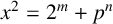
 $$ \begin{align} x^2=2^m+p^n,\quad x,m,n\in {\mathbb{N}}. \end{align} $$
In 2017, Wang and Jiang [Reference Wang and Jiang11] proved that, for any fixed positive integer r, (1.1) has at most one solution
 $(x,m,n)$
with
 $m=r$
. Recently, Luca and Pink [Reference Luca and Pink6] determined all solutions
 $(x,m,n)$
of (1.1) when
 $p=2^{2^l}+1$
is a Fermat prime, where l is a nonnegative integer. They proved that if p is a Fermat prime, then (1.1) has the solutions:
 $$ \begin{align} p&=3,\quad (x,m,n)=(5,4,2),\end{align} $$
 $$ \begin{align} p&=5,\quad (x,m,n)=(3,2,1),\\p&=17,\quad (x,m,n)=(5,3,1),(7,5,1),(9,6,1),(23,9,1),(71,7,3),\notag\\p&=2^{2^l}+1\ \mbox{with} \ l>2, \quad(x,m,n)=(2^{2^{l-1}}+1,2^{l-1}+1,1),(2^{2^l}-1,2^{l+1}-2,1).\notag \end{align} $$
We discuss (1.1) for a general odd prime p. We will prove the following results.
Theorem 1.1. If
 $p\equiv 3 \pmod 8$
, then (1.1) has only the solution (1.2). If
 ${p \equiv 5 \pmod 8}$
, then (1.1) has only the solution (1.3).
Theorem 1.2. If
 $p \equiv 7\pmod 8$
, then (1.1) has at most one solution
 $(x,m,n)$
, except for
 $$ \begin{align} p=7,\quad (x,m,n)=(3,1,1),(9,5,2). \end{align} $$
Moreover, if
 $$ \begin{align} p=2^q-1\quad \text{where }q\text{ is a prime}, \end{align} $$
and p is a Mersenne prime with
 $p>7$
, then (1.1) has exactly one solution
 $$ \begin{align} (x,m,n)=(2^q+1,q+2,2). \end{align} $$
If
 $p \equiv 7 \pmod 8$
, p is not a Mersenne prime and either
 $p<1.5\times 10^{12}$
or
 $p>C$
, where C is an effectively computable absolute constant, then (1.1) has only the solutions
 $$ \begin{align} p=a^2-2\quad \text{where }a \in {\mathbb{N}}\text{ with }2 \nmid a,~(x,m,n)=(a,1,1). \end{align} $$
Theorem 1.3. If
 $p \equiv 1 \pmod 8$
with
 $p \ne 17$
, then (1.1) has at most two solutions
 $(x,m,n)$
.
Obviously, the synthesis of the above three theorems gives the best upper bound for the number of solutions
 $(x,m,n)$
of (1.1). We further propose the following conjectures.

Conjecture 1.5. There exist infinitely many odd primes p such that
 $p \equiv 1 \pmod 8$
, p is not a Fermat prime and (1.1) has exactly two solutions
 $(x,m,n)$
.
2 Preliminaries
Let D be a nonsquare positive integer.
Lemma 2.1 [Reference Nagell8, Theorems 103 and 104].
The equation
 $$ \begin{align} u^2-Dv^2=1,\quad u,v\in {\mathbb{Z}}, \end{align} $$
has positive integer solutions
 $(u,v)$
and it has a unique positive integer solution
 $(u_1,v_1)$
such that
 $u_1+v_1\sqrt {D}\le u+v\sqrt {D}$
, where
 $(u,v)$
runs through all positive integer solutions of (2.1). The solution
 $(u_1,v_1)$
is called the fundamental solution of (2.1). Every solution
 $(u,v)$
of (2.1) can be expressed as
 $$ \begin{align*} u+v\sqrt{D}=\lambda_1(u_1+\lambda_2v_1\sqrt{D}\,)^t,\quad \lambda_1,\lambda_2\in \{1,-1\},~t\in {\mathbb{Z}},~t\ge 0. \end{align*} $$
Lemma 2.2 ([Reference Reinhart9, Remark 5.5]; see also [Reference Reinhart10, descriptions after Conjectures 1.1 and 1.2]).
For any odd prime p with
 $p < 1.5\times 10^{12}$
, the fundamental solution
 $(u_1,v_1)$
of the equation
 $$ \begin{align} u^2-pv^2=1,\quad u,v \in {\mathbb{Z}}, \end{align} $$
satisfies
 $p \nmid v_1$
.
Lemma 2.3 [Reference Nagell8, Theorem 107].
For any odd prime p with
 $p \equiv 1 \pmod 4$
, the equation
 $$ \begin{align} u^{\prime 2}-pv^{\prime 2}=-1,\quad u',v'\in {\mathbb{Z}}, \end{align} $$
has solutions
 $(u',v')$
.
With similar approaches to [Reference Nagell8, proofs of Theorems 106 and 107], we can directly obtain the following two lemmas.
Lemma 2.4. If the equation
 $$ \begin{align} U^2-DV^2=2,\quad U,V\in {\mathbb{Z}}, \end{align} $$
has solutions
 $(U,V)$
, then it has a unique positive integer solution
 $(U_1,V_1)$
such that
 $U_1+V_1\sqrt {D}\le U+V\sqrt {D}$
, where
 $(U,V)$
runs through all positive integer solutions of (2.4). The solution
 $(U_1,V_1)$
is called the fundamental solution of (2.4).
-
(i) Every solution
 $(U,V)$
of (2.4) can be expressed as
$$ \begin{align*} \frac{U+V\sqrt{D}}{\sqrt{2}}=\lambda_1\bigg(\frac{U_1+\lambda_2V_1\sqrt{D}}{\sqrt{2}}\bigg)^t, \quad \lambda_1,\lambda_2\in \{1,-1\},~t\in {\mathbb{N}},~2\nmid t. \end{align*} $$
-
(ii) The fundamental solution
$(u_1,v_1)$
of (2.1) satisfies
$u_1+v_1\sqrt {D}=(U_1+V_1\sqrt {D}\,)^2/2$
.


Proof. Assume that (2.4) has solutions
 $(U,V)$
. Clearly,
 $2 \nmid U$
,
 $2 \nmid V$
,
 $D \equiv 7 \pmod 8$
and
 $(|U|,|V|)$
are positive integer solutions of (2.4). Since D is a nonsquare positive integer,
 $\sqrt {D}$
is irrational and (2.4) has a unique positive integer solution
 $(U_1,V_1)$
such that
 $U_1+V_1\sqrt {D}\le U+V\sqrt {D}$
, where
 $(U,V)$
runs through all positive integer solutions of (2.4). It follows that the fundamental solution
 $(U_1,V_1)$
of (2.4) exists.
Since
 $D \equiv 7\pmod 8$
, for any positive integer solution
 $(U,V)$
of (2.4), (2.1) has the positive integer solution
 $$ \begin{align} (u,v)=\bigg(\frac{U^2+DV^2}{2},UV\bigg) \end{align} $$
with
 $2\nmid v$
. By (2.5), these solutions are related by
 $$ \begin{align} \bigg(\frac{U+V\sqrt{D}}{\sqrt{2}}\bigg)^2=u+v\sqrt{D},\quad 2\nmid v. \end{align} $$
Let
 $(u_1,v_1)$
be the fundamental solution of (2.1). Recall that (2.1) has solutions
 $(u,v)$
with
 $2\nmid v$
. By Lemma 2.1, we have
 $2 \nmid v_1$
. Hence, from (2.6),
 $$ \begin{align} \bigg(\frac{U_1+V_1\sqrt{D}}{\sqrt{2}}\bigg)^2=(u_1+v_1\sqrt{D}\,)^{2s+1},\quad s \in {\mathbb{Z}}, s \ge 0. \end{align} $$
If
 $s \ge 1$
, let
 $$ \begin{align} U'+V'\sqrt{D}=(U_1+V_1\sqrt{D}\,)(u_1-v_1\sqrt{D}). \end{align} $$
From (2.7) and (2.8),
 $U'$
and
 $V'$
are positive integers satisfying
 $U^{\prime 2}-DV^{\prime 2}=2$
and
 $$ \begin{align*} \bigg(\frac{U'+V'\sqrt{D}}{\sqrt{2}}\bigg)^2=(u_1+v_1\sqrt{D}\,)^{2s-1}\ge u_1+v_1\sqrt{D}. \end{align*} $$
It follows that
 $(U',V')$
with
 $U'+V'\sqrt {D}<U_1+V_1\sqrt {D}$
is a positive integer solution of (2.4), which contradicts the definition of the fundamental solution
 $(U_1,V_1)$
of (2.4). So we have
 $s=0$
and, by (2.7), proposition (ii) is proved.
For any positive integer r, let
 $$ \begin{align} u_r+v_r\sqrt{D}=(u_1+v_1\sqrt{D}\,)^r,\quad \frac{U_r+V_r\sqrt{D}}{\sqrt{2}}=\bigg(\frac{U_1+V_1\sqrt{D}}{\sqrt{2}}\bigg)^{2r-1}. \end{align} $$
Then,
 $$ \begin{align} u_r-v_r\sqrt{D}=(u_1-v_1\sqrt{D}\,)^r,\quad \frac{U_r-V_r\sqrt{D}}{\sqrt{2}}=\bigg(\frac{U_1-V_1\sqrt{D}}{\sqrt{2}}\bigg)^{2r-1}. \end{align} $$
By proposition (ii), from (2.9) and (2.10),
 $$ \begin{align} \frac{U_r+V_r\sqrt{D}}{\sqrt{2}} & =\bigg(\frac{U_{r-1}+V_{r-1}\sqrt{D}}{\sqrt{2}}\bigg)(u_1+v_1\sqrt{D}\,)=\cdots \notag\\ & =\bigg(\frac{U_1+V_1\sqrt{D}}{\sqrt{2}}\bigg)(u_{r-1}+v_{r-1}\sqrt{D}\,). \end{align} $$
From (2.11), using the inductive method,
 $(U,V)=(U_r,V_r)\ (r=1,2,\ldots )$
are positive integer solutions of (2.4) with
 $$ \begin{align} \bigg(\frac{U_r+V_r\sqrt{D}}{\sqrt{2}}\bigg)^2=u_{2r-1}+v_{2r-1}\sqrt{D},\quad r=1,2,\ldots. \end{align} $$
Recall that
 $2 \nmid v_1$
. By Lemma 2.1,
 $(u,v)=(u_{2r-1},v_{2r-1})\ (r=1,2,\ldots )$
are all positive integer solutions of (2.1) with
 $2\nmid v$
. Thus, we see from (2.6) and (2.12) that
 $(U,V)=(U_r,V_r)\ (r=1,2,\ldots )$
are all positive integer solutions of (2.4). By (2.9), every positive integer solution
 $(U,V)$
of (2.4) can be expressed as
 $$ \begin{align} \frac{U+V\sqrt{D}}{\sqrt{2}}=\bigg(\frac{U_1+V_1\sqrt{D}}{\sqrt{2}}\bigg)^t,\quad t \in {\mathbb{N}},~2\nmid t. \end{align} $$
Furthermore, every solution
 $(U',V')$
of (2.4) can be expressed as
 $$ \begin{align} U'+V'\sqrt{D}=\lambda_1(U+\lambda_2V\sqrt{D}\,),\quad \lambda_1,\lambda_2\in \{1,-1\}, \end{align} $$
where
 $(U,V)$
is a positive integer solution of (2.4). The combination of (2.13) and (2.14) yields proposition (i). The lemma is proved.
Lemma 2.5. For any odd prime p with
 $p \equiv 7\pmod {8}$
, the equation
 $$ \begin{align} U^2-pV^2=2,\quad U,V\in {\mathbb{Z}}, \end{align} $$
has solutions
 $(U,V)$
.
Proof. By Lemma 2.1, (2.2) has positive integer solutions
 $(u,v)$
. Let
 $(u_1,v_1)$
be the fundamental solution of (2.2). Then,
 $$ \begin{align} u_1^2-pv_1^2=1,\quad u_1,v_1\in {\mathbb{N}}. \end{align} $$
If
 $2 \mid v_1$
, then from (2.16),
 $$ \begin{align} u_1+1=\begin{cases}2a^2,\\2pb^2,\end{cases} \ u_1-1=\begin{cases}2pb^2,\\2a^2,\end{cases}\ v_1=2ab,\quad a,b \in {\mathbb{N}}, \end{align} $$
whence we obtain either
 $$ \begin{align} a^2-pb^2=1 \end{align} $$
or
 $$ \begin{align} a^2-pb^2=-1. \end{align} $$
When (2.18) holds, we see from (2.17) that
 $(u,v)=(a,b)$
is a positive integer solution of (2.2) with
 $a+b\sqrt {p}<u_1+v_1\sqrt {p}$
, which is a contradiction. When (2.19) holds, we have
 $p \mid a^2+1$
and
 $p \not \equiv 7\pmod {8}$
, so we obtain
 $2 \nmid v_1$
. Then, by (2.16),
 $$ \begin{align*} u_1+1=\begin{cases}a^2,\\pb^2,\end{cases}\ u_1-1=\begin{cases}pb^2,\\a^2,\end{cases}\ v_1=ab,\quad a,b,\in {\mathbb{N}},~2\nmid a,~2\nmid b, \end{align*} $$
whence
 $$ \begin{align} a^2-pb^2=\pm 2. \end{align} $$
Further, since
 $p \equiv 7 \pmod 8$
, we see from (2.20) that
 $a^2-pb^2=2$
and (2.15) has solutions
 $(U,V)$
. The lemma is proved.
Lemma 2.6 ([Reference Le5, Lemmas 3 and 12 and Theorem 1]; [Reference Yang and Fu12, Theorem]).
Let p be an odd prime with
 $p \nmid D$
.
-
(i) If
$(\tfrac{D}{p})=1$
, where
$(\tfrac{D}{p})$
is the Legendre symbol, then the equation (2.21)has solutions
$$ \begin{align} X^2-DY^2=p^Z,\quad X,Y\in {\mathbb{Z}}, \;\gcd(X,Y)=1,\; Z \in {\mathbb{N}}, \end{align} $$
$(X,Y,Z)$
and it has a unique positive integer solution
$(X_1,Y_1,Z_1)$
such that
$Z_1 \le Z$
, where Z runs through all solutions
$$ \begin{align*} 1<\frac{X_1+Y_1\sqrt{D}}{X_1-Y_1\sqrt{D}}<u_1+v_1\sqrt{D}, \end{align*} $$
$(X,Y,Z)$
of (2.21) and
$(u_1,v_1)$
is the fundamental solution of (2.1). The solution
$(X_1,Y_1,Z_1)$
is called the least solution of (2.21).
-
(ii) The least solution
$(X_1,Y_1,Z_1)$
of (2.21) satisfies
$Z_1 \mid h(4D)$
, where
$h(4D)$
is the class number of binary quadratic primitive forms with discriminant
$4D$
. -
(iii) Every solution
$(X,Y,Z)$
of (2.21) can be expressed as where
$$ \begin{align*} Z&=Z_1t,\quad t \in {\mathbb{N}},\\ X+Y\sqrt{D}&=(X_1+\lambda Y_1\sqrt{D}\,)^t(u+v\sqrt{D}\,),\quad \lambda \in \{1,-1\}, \end{align*} $$
$(X_1,Y_1,Z_1)$
is the least solution of (2.21) and
$(u,v)$
is a solution of (2.1).


Notice that
 $(\frac{2}{p})=1$
if and only if
 $p \equiv \pm 1 \pmod 8$
,
 $h(8)=1$
and the fundamental solution of the equation
 $$ \begin{align} u^2-2v^2=1,\quad u,v \in {\mathbb{Z}}, \end{align} $$
is
 $(u_1,v_1)=(3,2)$
. By Lemma 2.5, we can directly obtain the following lemma.
Lemma 2.7. For any odd prime p with
 $p \equiv \pm 1\pmod 8$
, the equation
 $$ \begin{align} X^2-2Y^2=p^Z,\quad X,Y\in {\mathbb{Z}}, \;\gcd(X,Y)=1,\; Z \in {\mathbb{N}}, \end{align} $$
has solutions
 $(X,Y,Z)$
and its least solution
 $(X_1,Y_1,Z_1)$
satisfies
 $$ \begin{align} 1<\frac{X_1+Y_1\sqrt{2}}{X_1-Y_1\sqrt{2}}<3+2\sqrt{2} \end{align} $$
and
 $Z_1=1$
. Moreover, every solution
 $(X,Y,Z)$
of (2.23) can be expressed as
 $$ \begin{align*} X+Y\sqrt{2}=(X_1+\lambda Y_1\sqrt{2}\,)^Z(u+v\sqrt{2}\,),\quad \lambda \in\{1,-1\}, \end{align*} $$
where
 $(u,v)$
is a solution of (2.22).
Lemma 2.8. If p is a Mersenne prime with
 $p \ge 7$
, then (2.23) has solutions
 $(X,Y,Z)$
and its least solution is
 $$ \begin{align} (X_1,Y_1,Z_1)=(2^{(q+1)/2}-1,2^{(q-1)/2}-1,1), \end{align} $$
where q is an odd prime defined as in (1.5).
Proof. From (1.5),
 $(2^{(q+1)/2}-1)^2-2(2^{(q-1)/2}-1)^2=2^q-1=p$
. Since
 $2^{(q+1)/2}-1$
and
 $2^{(q-1)/2}-1$
are coprime positive integers, (2.23) has a positive integer solution
 $(X,Y,Z)=(2^{(q+1)/2}-1,2^{(q-1)/2}-1,1)$
. Further, since
 $$ \begin{align} 1&<\frac{(2^{(q+1)/2}-1)+(2^{(q-1)/2}-1)\sqrt{2}}{(2^{(q+1)/2}-1)-(2^{(q-1)/2}-1)\sqrt{2}}=\bigg(\frac{2^{q/2}-1}{2^{q/2}+1}\bigg)\bigg(\frac{\sqrt{2}+1}{\sqrt{2}-1}\bigg)\notag\\ &<\frac{\sqrt{2}+1}{\sqrt{2}-1}=3+2\sqrt{2}, \end{align} $$
by Lemma 2.7, we find from (2.24) and (2.26) that (2.25) is the least solution of (2.23) for
 $p=2^q-1$
with
 $p \ge 7$
. The lemma is proved.
Lemma 2.9 [Reference Mihǎilescu7].
The equation
 $$ \begin{align*} X^r-Y^s=1,\quad X,Y,r,s\in {\mathbb{N}}, \;\min\{X,Y,r,s\}>1, \end{align*} $$
has only the solution
 $(X,Y,r,s)=(3,2,2,3)$
.
Lemma 2.10 [Reference Bennett and Skinner2].
All solutions
 $(X,Y,m,n)$
of the equation
 $$ \begin{align*} X^2-2^m=Y^n,\quad X,Y,m,n\in {\mathbb{N}},\; \gcd(X,Y)=1, Y>1,\;m>1,\; 2\nmid n, \end{align*} $$
satisfy
 $n=1$
, except for
 $(X,Y,m,n)=(71,17,7,3)$
.
Lemma 2.11. All solutions
 $(x,m,n)$
of (1.1) with
 $2 \mid m$
are (1.2) and
 $$ \begin{align} p=2^{2^l}+1,\quad \mbox{where } l \in {\mathbb{N}}, (x,m,n)=(2^{2^l-1}+1,2(2^l-1),1). \end{align} $$
Proof. Assume that
 $(x,m,n)$
is a solution of (1.1) with
 $2\mid m$
. Since p is an odd prime, we see from (1.1) that
 $2\nmid x$
,
 $\gcd (x+2^{m/2},x-2^{m/2})=1$
and
 $$ \begin{align*} x+2^{m/2}=p^n,\quad x-2^{m/2}=1. \end{align*} $$
It follows that
 $$ \begin{align} 2x=p^n+1 \end{align} $$
and
 $$ \begin{align} 2^{m/2+1}=p^n-1. \end{align} $$
When
 $n>1$
, by Lemma 2.9, we can only obtain
 $p=3$
,
 $m/2+1=3$
and
 $n=2$
from (2.29). Hence, by (2.28), we get (1.2).
When
 $n=1$
, by (2.29),
 $$ \begin{align} p=2^{m/2+1}+1. \end{align} $$
It follows that p is a Fermat prime. Therefore, since
 $p=2^{2^l}+1$
, where
 $l \in {\mathbb {N}}$
, by (2.28) and (2.30), we get (2.27). The lemma is proved.


Proof. Assume that
 $(x,m,n)$
is a solution of (1.1) with
 $2 \mid n$
. Since
 $2 \nmid x$
, by (1.1), we have
 $\gcd (x+p^{n/2},x-p^{n/2})=2$
and
 $$ \begin{align*} x+p^{n/2}=2^{m-1},\quad x-p^{n/2}=2, \end{align*} $$
giving
 $$ \begin{align} x=2^{m-2}+1 \end{align} $$
and
 $$ \begin{align} p^{n/2}=2^{m-2}-1. \end{align} $$
Applying Lemma 2.9 to (2.32), we obtain
 $n/2=1$
and
 $$ \begin{align} p=2^{m-2}-1. \end{align} $$
From (2.33), p is a Mersenne prime, so p can be expressed as (1.5). By (1.5), (2.31) and (2.33), we obtain the solutions (1.6). The lemma is proved.
3 Proof of Theorem 1.1
Let
 $(x,m,n)$
be a solution of (1.1). Since
 $2 \nmid p$
, by (1.1),
 $2 \nmid x$
,
 $x^2\equiv 1 \pmod 8$
and
 $$ \begin{align} p^n\equiv x^2-2^m\equiv 1-2^m\equiv \begin{cases}7&\pmod8\quad\text{if }m=1, \\ 5&\pmod8\quad\text{if }m=2 ,\\ 1&\pmod8\quad\text{if }m\ge3.\end{cases} \end{align} $$
When
 $p \equiv 3\pmod 8$
, since
 $$ \begin{align} p^n\equiv \begin{cases}1&\pmod8\quad\text{if }2 \mid n,\\ 3&\pmod8\quad\text{if }2\nmid n, \end{cases} \end{align} $$
we see from (3.1) and (3.2) that
 $2 \mid n$
. Therefore, by Lemma 2.12, (1.1) has only the solution (1.2) for
 $p \equiv 3 \pmod 8$
.
When
 $p \equiv 5\pmod 8$
,
 $$ \begin{align} p^n\equiv\begin{cases}1 &\pmod8\quad\text{if }2\mid n, \\ 5&\pmod8\quad\text{if }2\nmid n.\end{cases} \end{align} $$
By (3.1) and (3.3), either
 $2 \mid n$
or
 $m=2$
and
 $2 \nmid n$
. Hence, by Lemma 2.12, (1.1) has no solutions
 $(x,m,n)$
with
 $2 \mid n$
for
 $p \equiv 5 \pmod 8$
. However, by Lemma 2.11, (1.1) has only the solution (1.3) with
 $m=2$
and
 $2\nmid n$
. The theorem is proved.
4 Proof of Theorem 1.2
Lemma 4.1 [Reference Bugeaud3].
All solutions
 $(X,Y,n)$
of the equation
 $$ \begin{align} X^2-2=Y^n,\quad X,Y,n\in {\mathbb{N}}, \end{align} $$
satisfy
 $n<550\, 000$
.
Lemma 4.2 [Reference Baker1].
Let
 $f(t)\in {\mathbb {Z}}[t]$
be a polynomial of degree n with at least three distinct zeros and coefficients with absolute values at most H. Then, all solutions
 $(X,Y)$
of the equation
 $$ \begin{align*} X^2=f(Y),\quad X,Y \in {\mathbb{Z}}, \end{align*} $$
satisfy
 $\max \{|X|,|Y|\}<\exp \exp \exp ((n^{10n}H)^{n^2})$
.
The following lemma can be obtained directly from Lemmas 4.1 and 4.2.
Lemma 4.3. All solutions
 $(X,Y,n)$
of (4.1) with
 $n \ge 3$
satisfy
 $Y<C$
, where C is an effectively computable absolute constant.
Lemma 4.4. If
 $(x,n)$
is a solution of the equation
 $$ \begin{align} x^2-2=p^n,\quad x,n\in {\mathbb{N}}, \end{align} $$
then
 $2\nmid n$
and
 $$ \begin{align} (U_1,V_1)=(x,p^{(n-1)/2}) \end{align} $$
is the fundamental solution of (2.15).
Proof. Assume that
 $(x,n)$
is a solution of (4.2). Then,
 $2 \nmid x$
and
 $p^n\equiv x^2-2\equiv 1-2\equiv 7\pmod 8$
. It follows that
 $2\nmid n$
and
 $p\equiv 7\pmod 8$
. Hence, we see from (4.2) that (2.15) has a positive integer solution
 $$ \begin{align} (U,V)=(x,p^{(n-1)/2}). \end{align} $$
Applying Lemma 2.4(i) to (4.4),
 $$ \begin{align} \frac{x+p^{(n-1)/2}\sqrt{p}}{\sqrt{2}}=\bigg(\frac{U_1+V_1\sqrt{p}}{\sqrt{2}}\bigg)^t,\quad t \in {\mathbb{N}},~2\nmid t, \end{align} $$
where
 $(U_1,V_1)$
is the fundamental solution of (2.15). By (4.5),
 $$ \begin{align} 2^{(t-1)/2}p^{(n-1)/2}=V_1\sum_{i=0}^{(t-1)/2}\binom{t}{2i+1}U_1^{t-2i-1}(pV_1^2)^i. \end{align} $$
If
 $t>1$
, since
 $t \ge 3$
,
 $U_1 \ge 3$
and
 $$ \begin{align*} \sum_{i=0}^{(t-1)/2}\binom{t}{2i+1}U_1^{t-2i-1}(pV_1^2)^i>tU_1^{t-1}>2^{(t-1)/2}, \end{align*} $$
it follows from (4.6) that
 $n>1$
and
 $p \mid tV_1$
. Let
 $$ \begin{align} p^{\alpha}\,\|\, tV_1,\quad p^{\beta_i}\,\|\, 2i+1,\quad i \in {\mathbb{N}}. \end{align} $$
Since
 $p^{\beta _i}\le 2i+1$
and
 $$ \begin{align} \beta_i \le \frac{\log(2i+1)}{\log p}<i,\quad i \in {\mathbb{N}}, \end{align} $$
 $$ \begin{align} V_1\binom{t}{2i+1}U_1^{t-2i-1}(pV_1^2)^i \equiv tV_1\binom{t-1}{2i}U_1^{t-2i-1}\frac{(pV_1^2)^i}{2i+1} \equiv 0 \pmod{p^{\alpha+1}},\quad i \in {\mathbb{N}}. \end{align} $$
Hence, from (4.6), (4.7) and (4.9),
 $\alpha =(n-1)/2$
and
 $tV_1\ge p^{(n-1)/2}$
. So
 $2^{(t-1)/2}p^{(n-1)/2}>tU_1^{t-1}V_1\ge U_1^{t-1}p^{(n-1)/2}$
and
 $2^{(t-1)/2}>U_1^{t-1}\ge 3^{t-1}$
, which is a contradiction. It follows that
 $t=1$
and by (4.5), we get (4.3). The lemma is proved.
Lemma 4.5. For any Mersenne prime p with
 $p \ge 7$
, (4.2) has no solutions
 $(x,n)$
with
 $n>1$
.
Proof. Assume that
 $(x,n)$
is a solution of (4.2) with
 $n>1$
. By Lemma 4.4,
 $p \mid V_1$
, where
 $(U_1,V_1)$
is the fundamental solution of (2.15). Further, by Lemma 2.4(ii),
 $v_1=U_1V_1$
, where
 $(u_1,v_1)$
is the fundamental solution of (2.2). So
 $p \mid v_1$
. Therefore, by Lemma 2.2,
 $p>1.5\times 10^{12}$
and by (1.5),
 $$ \begin{align} q>40. \end{align} $$
According to well-known properties of Mersenne primes, by (4.10), we just need to consider the case
 $$ \begin{align} q \ge 61,\quad p \ge 2^{61}-1>2\times10^{18}. \end{align} $$
We see from (4.2) that (2.23) has a solution
 $$ \begin{align} (X,Y,Z)=(x,1,n). \end{align} $$
Applying Lemmas 2.7 and 2.8 to (4.12),
 $$ \begin{align} x+\sqrt{2}=(X_1+\lambda Y_1\sqrt{2}\,)^n(u-\lambda v\sqrt{2}\,),\quad \lambda \in \{1,-1\}, \end{align} $$
where
 $X_1$
,
 $Y_1$
satisfy (2.25) and
 $(u,v)$
is a positive integer solution of (2.22). Since the fundamental solution of (2.22) is
 $(u_1,v_1)=(3,2)$
, by Lemma 2.1,
 $$ \begin{align} u+v\sqrt{2}=(3+2\sqrt{2}\,)^t,\quad t \in {\mathbb{N}}. \end{align} $$
Hence, by (4.13) and (4.14),
 $x-\sqrt {2}=(X_1-\lambda Y_1\sqrt {2}\,)^n(u+\lambda v\sqrt {2}\,)$
and
 $$ \begin{align} \frac{x+\sqrt{2}}{x-\sqrt{2}}=\begin{cases}\bigg(\dfrac{X_1+Y_1\sqrt{2}}{X_1-Y_1\sqrt{2}}\bigg)^n(3+2\sqrt{2}\,)^{-2t}&\text{if }\lambda=1,\\[8pt] \bigg(\dfrac{X_1-Y_1\sqrt{2}}{X_1+Y_1\sqrt{2}}\bigg)^n(3+2\sqrt{2}\,)^{2t}&\text{if }\lambda=-1. \end{cases} \end{align} $$
Here,
 $n>1$
,
 $2 \nmid n$
,
 $x>p^{n/2}\ge p^{3/2}>10^{27}$
,
 $1.01>(x+\sqrt {2}\,)/(x-\sqrt {2}\,)>1$
and
 $X_1$
,
 $Y_1$
satisfy (2.24) by Lemmas 2.7 and 2.8. If
 $\lambda =1$
, then from (2.24) and (4.15),
 $$ \begin{align*} (3+2\sqrt{2}\,)^{2t}<\bigg(\frac{x+\sqrt{2}}{x-\sqrt{2}}\bigg)(3+2\sqrt{2}\,)^{2t}=\bigg(\frac{X_1+Y_1\sqrt{2}}{X_1-Y_1\sqrt{2}}\bigg)^n<(3+2\sqrt{2}\,)^n, \end{align*} $$
whence we obtain
 $2t<n$
and
 $$ \begin{align} n \ge 2t+1. \end{align} $$
Similarly, if
 $\lambda =-1$
, then
 $$ \begin{align*} (3+2\sqrt{2}\,)^{2t}=\bigg(\frac{x+\sqrt{2}}{x-\sqrt{2}}\bigg)\bigg(\frac{X_1+Y_1\sqrt{2}}{X_1-Y_1\sqrt{2}}\bigg)^n<1.01(3+2\sqrt{2}\,)^n<(3+2\sqrt{2}\,)^{n+1}, \end{align*} $$
whence
 $n+1>2t$
and (4.16) is still true, since
 $2 \nmid n$
.
Further, by (2.26) and (4.15),
 $$ \begin{align} \frac{x+\sqrt{2}}{x-\sqrt{2}}=\begin{cases}(3+2\sqrt{2}\,)^{n-2t}\theta^{-n}&\text{if }\lambda=1,\\ (3+2\sqrt{2}\,)^{-(n-2t)}\theta^{n}&\text{if }\lambda=-1, \end{cases} \end{align} $$
where
 $$ \begin{align} \theta=\frac{2^{q/2}+1}{2^{q/2}-1}. \end{align} $$
If
 $\lambda =1$
, then from (4.16) and (4.17),
 $$ \begin{align} 1.01\theta^n>\bigg(\frac{x+\sqrt{2}}{x-\sqrt{2}}\bigg)\theta^n=(3+2\sqrt{2}\,)^{n-2t}\ge 3+2\sqrt{2}. \end{align} $$
Similarly, if
 $\lambda =-1$
, then
 $$ \begin{align*} \theta^n=\bigg(\frac{x+\sqrt{2}}{x-\sqrt{2}}\bigg)(3+2\sqrt{2}\,)^{n-2t}>(3+2\sqrt{2}\,)^{n-2t}\ge 3+2\sqrt{2}. \end{align*} $$
This implies that (4.19) is still true for
 $\lambda =-1$
.
Taking logarithms on both sides of (4.19),
 $$ \begin{align} n\log \theta>\log \bigg(\frac{3+2\sqrt{2}}{1.01}\bigg)>1.75. \end{align} $$
Further, since
 $\log (1+\alpha )<\alpha $
for any
 $\alpha>0$
, by (4.18),
 $$ \begin{align} \log \theta=\log \bigg(1+\frac{2}{2^{q/2}-1}\bigg)<\frac{2}{2^{q/2}-1}. \end{align} $$
Therefore, by (4.11), (4.20) and (4.21),
 $$ \begin{align} n>\tfrac12(1.75(2^{q/2}-1))>0.87(2^{61/2}-1)>10^9. \end{align} $$
However, by Lemma 4.1, (4.22) is impossible. The lemma is proved.
Proof of Theorem 1.2.
Assume that
 $(x,m,n)$
is a solution of (1.1) for
 ${p \equiv 7 \pmod 8}$
. Since
 $$ \begin{align} p^n\equiv \begin{cases}1&\pmod8\quad\text{if }2\mid n,\\ 7&\pmod8\quad\text{if }2 \nmid n,\end{cases} \end{align} $$
by (3.1) and (4.23), the solution
 $(x,m,n)$
satisfies either
 $2 \mid n$
or
 $m=1$
and
 $2\nmid n$
.
We first consider the case that p is a Mersenne prime. Then, p can be expressed as (1.5), where q is an odd prime. By Lemma 2.12, (1.1) has only one solution (1.6) with
 $2 \mid n$
. However, by Lemma 4.5, if the solution
 $(x,m,n)$
satisfies
 $m=1$
and
 $2 \nmid n$
, then
 $n=1$
. Hence, by (1.1) and (1.5),
 $$ \begin{align} x^2-2^q=1. \end{align} $$
Applying Lemma 2.9 to (4.24), we can only obtain
 $x=3$
,
 $q=3$
and
 $$ \begin{align} p=7,\quad (x,m,n)=(3,1,1). \end{align} $$
From the combination of (1.6) and (4.25), if
 $p=7$
, then (1.1) has exactly two solutions (1.4); otherwise, (1.1) has only one solution (1.6). It follows that the theorem holds when p is a Mersenne prime.
Next, we consider the case where p is not a Mersenne prime. Then, by Lemma 2.12, (1.1) has no solutions
 $(x,m,n)$
with
 $2 \mid n$
. Hence, the solution
 $(x,m,n)$
must satisfy
 $2 \nmid n$
. Further, by Lemma 2.10, we have
 $m=1$
. Therefore, from the uniqueness of the fundamental solution
 $(U_1,V_1)$
of (2.15), by Lemma 2.4(i), we find from Lemma 4.4 that (1.1) has at most one solution
 $(x,m,n)$
for any fixed p in this case. Further, by Lemmas 2.2, 2.4, 4.4 and 4.3,
 $p>1.5\times 10^{12}$
and
 $p<C$
if
 $n>1$
. However, if
 $n=1$
, then from (4.2), we obtain only the solution (1.7). From this analysis, the theorem is proved.
5 Proof of Theorem 1.3
In this section, we assume that
 $D \equiv 1 \pmod 8$
and
 $p \equiv 1\pmod 8$
with
 $p \nmid 17$
. Then, (1.1) is related to the equation
 $$ \begin{align} y^2-D=2^{z+2},\quad y,z \in {\mathbb{N}}. \end{align} $$
If D satisfies one of the following three types, then D is called an exceptional case of (5.1); otherwise, it is called nonexceptional:
-
(I)
$D=2^{2r}-3\cdot 2^{r+1}+1$
, where
$r \in {\mathbb {N}}$
with
$r \ge 3$
; -
(II)
$D=((2^{2r+1}-17)/3)^2-32$
, where
$r \in {\mathbb {N}}$
with
$r \ge 3$
; -
(III)
$D=2^{2r_1}+2^{2r_2}-2^{r_1+r_2+1}-2^{r_1+1}-2^{r_2+1}+1$
, where
$r_1,r_2\in {\mathbb {N}}$
are such that
$r_2>r_1+1>2$
.


Lemma 5.1 [Reference Le4].
If D is nonexceptional and the equation
 $$ \begin{align*} u^{\prime 2}-Dv^{\prime 2}=-1,\quad u',v'\in {\mathbb{Z}} \end{align*} $$
has solutions
 $(u',v')$
, then (5.1) has at most two solutions
 $(y,z)$
.
Lemma 5.2. If D is an exceptional case of (5.1) with
 $D \ne 17$
, then D is not an odd prime.
Proof. When D is an exceptional case of type (I) with
 $D \ne 17$
,
 $$ \begin{align*} D=(2^r-1)^2-2^{r+2}=(2^r+1)^2-2^{r+3}\quad \mbox{with } r \in {\mathbb{N}},\;r \ge 4, \end{align*} $$
whence we get the following factorisations of D in positive integers:
 $$ \begin{align} D=\begin{cases}(2^r+2^{r/2+1}-1)(2^r-2^{r/2+1}-1)&\text{if }2 \mid r ,\\ (2^r+2^{(r+3)/2}+1)(2^r-2^{(r+3)/2}+1)&\text{if }2\nmid r. \end{cases} \end{align} $$
Since
 $r \ge 4$
, we have
 $2^r+2^{r/2+1}-1>2^r-2^{r/2+1}-1>1$
and also
 $2^r+2^{(r+3)/2}+1> 2^r-2^{(r+3)/2}+1>1$
. Hence, we see from (5.2) that D is not an odd prime.
When D is an exceptional case of type (II),
 $$ \begin{align} D=\tfrac19(2^{2r+1}+2^{r+3}-1)(2^{2r+1}-2^{r+3}-1). \end{align} $$
Since
 $r \ge 3$
, we have
 $2^{2r+1}+2^{r+3}-1>2^{2r+1}-2^{r+2}-1 \ge 95$
and
 $$ \begin{align} 0\equiv \begin{cases}2^{2r+1}+2^{r+3}-1&\pmod9\quad\text{if }r \equiv 0,2,4\quad\pmod6, \\ 2^{2r+1}-2^{r+3}-1&\pmod9\quad\text{if }r\equiv 1,3,5\quad\pmod6. \end{cases} \end{align} $$
We see from (5.3) and (5.4) that D is not an odd prime.
When D is an exceptional case of type (III),
 $$ \begin{align} D= \begin{cases}(2^{r_2}-2^{r_1}+2^{r_1/2}-1)(2^{r_2}-2^{r_1}-2^{r_1/2+1}-1)&\text{if }2 \mid r_1 ,\\ (2^{r_2}+2^{r_2/2+1}-2^{r_1}-1)(2^{r_2}-2^{r_2/2+1}-2^{r_1}-1)&\text{if }2 \mid r_2, \\ (2^{r_2}+2^{r_1}+2^{(r_2+r_1)/2+1}-1)(2^{r_2}+2^{r_1}-2^{(r_2+r_1)/2+1}-1)&\text{if }2 \nmid r_1r_2. \end{cases} \end{align} $$
Since
 $r_2>r_1+1>2$
, we see from (5.5) that D is not an odd prime. The lemma is proved.
Proof of Theorem 1.3.
Since
 $p \equiv 1\pmod 8$
, by Lemma 2.12, (1.1) has no solutions
 $(x,m,n)$
with
 $2 \mid n$
. So we have
 $2 \nmid n$
. Further, since
 $p \equiv 1 \pmod 8$
, we see from (1.1) that
 $m \ge 3$
. Therefore, since
 $p \ne 17$
, by Lemma 2.10, the solutions
 $(x,m,n)$
of (1.1) must satisfy
 $n=1$
. This implies that there is a one-to-one correspondence
 $(x,m,n)=(y,z+2,1)$
between the solutions
 $(x,m,n)$
of (1.1) and the solutions
 $(y,z)$
of the equation
 $$ \begin{align} y^2-p=2^{z+2},\quad y,z\in {\mathbb{N}}. \end{align} $$
In particular, if
 $p \equiv 1\pmod 8$
and
 $p \ne 17$
, then the numbers of solutions to these two equations are the same.
Since
 $p \equiv 1\pmod 8$
, by Lemma 2.3, (2.3) has solutions
 $(u',v')$
. Since p is an odd prime with
 $p \ne 17$
, by Lemma 5.2, p is nonexceptional for (5.6). Therefore, by Lemma 5.1, (5.6) has at most two solutions
 $(y,z)$
. The theorem is proved.
Acknowledgement
The authors thank the referee for careful reading and pertinent suggestions.



