INTRODUCTION
The political relationship between the Party-state[Footnote 1] and the private sector has always been an appealing topic in the field of organizational studies in contemporary China. When this sector was very small at the beginning of the reforms in 1978, political support and protection from local governments were prevalent. Since the ‘Southern Tour’ of Deng Xiaoping in 1992, a large portion of the private sector has been created through the restructuring and privatization of medium and small state/collective-owned enterprises or grassroots entrepreneurship activities. This was a de-politicization process that aimed to cut off the closely netted ties between the governments and enterprises inherited from the planned economy. When the private sector grew bigger and absorbed more and more high talents, it became necessary for the government to rebuild a sound relationship with private enterprises because this sector has produced over 60% of the national GDP and accommodated more than 80% of the labor force.[Footnote 2] The recent large-scale Party branches building campaign that started in 2012 attempted to regain the Chinese Communist Party's (CCP) political influence and control of the private sector. The new political initiative demanded that private enterprises with three or more CCP members build a Party branch and carry out substantive Party-related activities. The work of Party branches building within the private sector is proceeding remarkably fast, promoted by the Central Committee of the CCP, which places immense political pressure on private enterprises because a Party branch is now embedded into the governance structure of private enterprises. How would these private enterprises respond when the social and political goals of Party branches building activities may be at odds with those of private enterprises? How do these private enterprises address these potential contradictions between political mandates and maintaining control and interests?
The existing literature examines the organizational behaviors of Chinese private enterprises typically through neo-institutional theory (Chen, Liu, & Zhang, Reference Chen, Liu and Zhang2016; Meyer & Rowan, Reference Meyer and Rowan1977). It emphasizes how consistency has to be reached between the behaviors of private enterprises and demand of the institutional environment through legitimacy mechanisms. Compared with state-owned enterprises, private enterprises in China are more haunted by a legitimacy problem, discriminated against in acquiring critical resources, and are susceptible to the impact of the institutional environment. It forces enterprises to respect external political authorities, societal norms and culture, and to conform to the expectations of these institutions.
However, few studies have incorporated a theoretical perspective of family enterprises to explain the political behaviors of Chinese private enterprises. Most Chinese private enterprises take the form of family businesses.[Footnote 3] In these enterprises, family members are not only major shareholders but also members of the top management team who make critical decisions. In recent years, socioemotional wealth (SEW) theory has risen to be an influential perspective to understand the logic underlying family firms’ decision-making process (Gómez-Mejía, Haynes, Núñez-Nickel, Jacobson, & Moyano-Fuentes, Reference Gómez-Mejía, Haynes, Núñez-Nickel, Jacobson and Moyano-Fuentes2007; Pierce, Kostova, & Dirks, Reference Pierce, Kostova and Dirks2001). SEW theory regards family businesses as an extension of the kinship relationship. It argues that family members usually value noneconomic personal and emotional needs (e.g., family bonding, family fame), the psychological needs of family control, etc. more than the economic performance of firms.
In this study, we argue that to better understand the political behavior (e.g., Party branches building) of Chinese private enterprises, neo-institutional theory should be advanced by considering the logic of preserving family enterprises’ socioemotional wealth because most of these enterprises are medium- and small-sized family businesses. The recent Party branches building initiative offers fertile ground to test the existence of multiple logics underlying behaviors of Chinese private enterprises. Drawing on the Chinese Private Enterprise Survey (CPES) data collected in 2008, 2012, and 2018, this study attempts to propose a new analysis and interpretation for the Party branches building activities of Chinese private firms by integrating the socioemotional wealth perspective and neo-institutional theory. It is found that the coupling and decoupling strategies of Chinese private enterprises rely on the relative strength of political pressure and motivation of preserving socioemotional wealth. When the cost of resisting political pressure outweighs the benefits of preserving socioemotional wealth, and the perceived market and legal environment becomes more munificent, private enterprises will choose to couple with structural mandates (i.e., establishing a Party branch) enforced by the Party-state but decouple from other mandates (i.e., employee protections). However, the dominant internal logic of private enterprises is still to maintain family control and protect family interests no matter how strong the institutional pressure is.
Secondly, we show the ‘embedded agency’ (Greenwood & Suddaby, Reference Greenwood and Suddaby2006; Thornton, Ocasio, & Lounsbury, Reference Thornton, Ocasio and Lounsbury2012: 10) of Chinese private enterprises when confronting political pressures. Neo-institutionalists literally think of institution as one sort of ‘rationalized myth’, and institutionalization as a construction process of social facts (Meyer & Rowan, Reference Meyer and Rowan1977). This sort of institution is lofted above organizations, which only exerts indirect forces on organizational behaviors. Thus, Scott (Reference Scott2013) contends that the obvious flaw of neo-institutionalism lies in the ignorance of the institutional structure itself and the transmission process of pressures, largely overlooking the complicated mechanisms underlying interactions between organizations and institutional environment. The over-socialized view (Granovetter, Reference Granovetter1985) of neo-institutionalism stresses the structural constraints that institutional pressures place on organizations while overlooking the possibility of these ‘iron cages’ being modified by organizations and interactions between institutional environment and organizations. This means that even though political pressures are prevalent in China, there are still opportunities that organizations could take advantage of and achieve their organizational goals. In the case of Party branches building in the private sector, private enterprises with higher motivation of preserving socioemotional wealth were more reluctant to build Party branches because they worried the embedded structure of Party branches would undermine the control of their family. However, when the pressures of Party building were intensified in recent years, the logic of preserving socioemotional wealth had to yield to political mandates on the surface. In this situation, private enterprises with higher SEW would decouple from the political and social goals of Party branches. In addition, Chinese private enterprises can transform the new political connections into resources to promote private enterprises’ growth.
Thirdly, the cause of the decoupling phenomenon of private enterprises in China could be very different from what neo-institutional theory has argued. Neo-institutionalists think that the external environment is composed of both the institutional environment and the technological environment. Distinct from the institutional environment's emphasis on the legitimacy of organizations, the technological environment compels organizations to elevate their operational efficiency, so this conflict in goals leads to separation of structural forms and practical activities of organizations, leading to the ‘decoupling’ phenomenon (Meyer & Rowan, Reference Meyer and Rowan1977). Most organizations usually make strategic decisions based on efficiency principles. However, the priority goal of private businesses in China is the preservation of socioemotional wealth because most of them are family businesses. Therefore, when conflicts occur between family socioemotional needs and political and social goals of the Party-state, Chinese private enterprises usually withdraw the former and pursue the latter and will also pursue decoupling behavior. In addition, decoupling behaviors can occur when mandates from any two of the institutional logics such as state, market, family, religion, or community (Thornton et al., Reference Thornton, Ocasio and Lounsbury2012) contradict. This extends the causes of the decoupling phenomenon interpreted by neo-institutional theory.
THEORETICAL BACKGROUND AND HYPOTHESES DEVELOPMENT
Preserving Socioemotional Wealth (SEW): A Dominant Internal Decision Logic of Chinese Private Enterprises
As Thornton has argued, ‘the institutional order of the family focuses on converting social relations into reciprocal and unconditional obligations oriented to reproduction of family members’ (Thornton et al., Reference Thornton, Ocasio and Lounsbury2012: 44). Similarly, the key logic of family businesses is to extend family relations to the enterprise and to secure the reproduction of family businesses mainly through family members. Not only do family enterprises have to take pains to survive in the market, but they also hold the mission to preserve or enhance the socioemotional wealth of their families. SEW typically represents the affective endowments of family owners (Berrone, Cruz, & Gomez-Mejia, Reference Berrone, Cruz and Gomez-Mejia2012). There are five dimensions in measuring SEW named FIBER, standing for ‘Family control and influence, Identification of family members with the firm, Binding social ties, Emotional attachment of family members, and Renewal of family bonds to the firm through dynastic succession’ (Berrone et al., Reference Berrone, Cruz and Gomez-Mejia2012). It is apparent that the most precious socioemotional wealth for the family is to maintain family control, which guarantees long-term family profits, generational inheritance, and social capital (Gómez-Mejía et al., Reference Gómez-Mejía, Haynes, Núñez-Nickel, Jacobson and Moyano-Fuentes2007). Because most Chinese private enterprises are family businesses, family control and family interests are made the top priority of private enterprises’ management and decision-making process.
At the same time, the institutional environment, including the political, market, and legal institutions all have a significant impact on the survival of Chinese private enterprises. In view of institutional theory, institutions are composed of a series of elements including the legal system, cultural expectations, social norms, and value systems that assure the legitimacy and meaning of social behaviors (Scott, Reference Scott2013). Neo-institutionalists further argue that coercive, normative, and mimetic forces are three pivotal mechanisms that lead to the convergence of organizational forms and behaviors (DiMaggio & Powell, Reference DiMaggio and Powell1983).
Therefore, there will be a dynamic interaction between the legitimacy requirements of the institutional environment and private enterprises’ motivation of preserving socioemotional wealth. The organizational behaviors of Chinese private enterprises depend on the relative strength of the institutional pressures and motivation of preserving private enterprises’ socioemotional wealth. Our argument is that when institutional pressures are not that high and mandates from institutional requirements are not executed forcefully, motivation of preserving private enterprises’ social-emotional needs will be salient. When the institutional environment becomes munificent, private enterprises demonstrate their key interests of maintaining family control. On the other hand, when institutional pressures are very high, private enterprises’ motivation of preserving SEW will have to be concealed or they will choose to employ a decoupling strategy in practice. However, no matter how strong the institutional pressures are, the dominant internal motivation of preserving SEW and maintaining family control will not be changed for Chinese private enterprises.
The recent Party branches building campaign in the private sector illustrates how institutional mandates and family control needs interplay with each other and how these interactions change the way Party branches building activities are conducted in Chinese private enterprises.
Changing Political Pressure, Socioemotional Wealth, and the Party Branches Building of Private Enterprises
Private enterprises used to be very small in the early years when the market-oriented reform started in 1978. There were only very few Party members in this sector so Party building work was not necessary. As the reforms expanded, the building of a ‘socialist market economy’ moved to the top of China's economic agenda after Deng Xiaoping's southern tour in 1992. A lot of private firms began to separate themselves from governmental ties, drop their ‘red hats’ (i.e., collective-owned firms) and formally be registered as private enterprises. In addition, many small- and medium-sized state-owned enterprises were restructured and transformed into private enterprises (Yan & Huang, Reference Yan and Huang2017). Some of these firms grew very successfully into big corporations. However, the political obstacles of joining the CCP for private enterprise owners were not lifted until the theory of ‘three represents’ was coined at the 80th anniversary of the founding of the CCP in 2002 (Yan & Huang, Reference Yan and Huang2017). As the private sector kept growing and produced more than 60% of China's GDP, it attracted more and more high talents to this sector and the Party-state realized that it became necessary to absorb these new ‘advanced’ to the Party. In 2012, when Xi Jinping was about to take power to lead the CCP, a large-scale campaign aiming to regain Party's organizational connections and control in the new social and economic organizations (‘Two New Organizations’, liangxin zuzhi) was launched. Before 2012, the large-size enterprises were the main target of Party-building work, while small- and medium-sized private enterprises had not become the focus (Yan & Huang, Reference Yan and Huang2017). The comprehensive coverage of Party branches building in the private sector was proposed officially in a document released by the Organizing Department of the Central Committee of the CCP in 2012. It was stipulated that (1) firms over 50 employees should develop at least one Party member, and firms with more than 3 Party members should build a Party branch; (2) the functions of Party branches are to propagate Party's thoughts, policies and directives, to conduct social responsibility, to protect workers’ rights, to build advanced enterprise culture, to lead Labor Union and Communist Youth League, as well as to facilitate production.[Footnote 4]
As the designed functions of Party organizations are mostly political and social, this may conflict with private enterprises' pursuit of family interests. Most private enterprises in China do not run like big modern firms in western countries. They may not have thoroughly followed state laws or policies in tax, wage standards and social securities of employees, environment protection etc., because these practices significantly distract private enterprises from market competition and raise operating costs for these firms. More importantly, as an embedded governing structure, Party branches elicit the concern of losing control for private enterprises. Because the majority of Chinese private enterprises are controlled by one family, the underlying logic behind their decision making is also to preserve socioemotional wealth, that is, the nonfinancial assets associated with family enterprises: family control, family reputation, sense of family identity, and smooth succession of family businesses (Gómez-Mejía et al., Reference Gómez-Mejía, Haynes, Núñez-Nickel, Jacobson and Moyano-Fuentes2007). Of these concerns, family control becomes the most important goal that most family businesses will aim to achieve.
Thus, the political demands of building Party branches may produce tensions between maintaining socioemotional wealth and fulfilling the political and social goals of the CCP within private enterprises. The higher the family ownership in a private enterprise, the stronger the intention of preserving socioemotional wealth for this enterprise. Therefore, private enterprises with a high degree of family ownership may be less likely build Party branches.
Therefore, we hypothesize:
Hypothesis 1a: The higher the degree of family ownership in a private enterprise, the less likely that this enterprise would build a Party branch before 2012.
Since 2012, the building of the grassroots Party branches has become an important political task for local Party apparatus. Party branches building has even been listed as one of the performance assessment criteria for local Party officials’ promotions in some places.[Footnote 5] As a result, local Party officials implement the policy vigorously motivated and pressured by the Central Committee of the CCP. Taking Bozhou in Anhui province as an example, a leading work group in charge of the Party branches building in the private sector was established in the economic development zone in 2018. This work group not only evaluated the operation efficiency of existing Party branches, but also proposed a goal of full coverage of Party branches in all firms within the zone. Specific methods included sending Party building instructors, establishing Labor Unions, and the Communist Youth League organizations.[Footnote 6] Similarly, to promote Party branches building in private enterprises, the city of Chongqing emphasized the importance of practicing ‘Two-Way Temporary Serving’ (shuangxiang guazhi) between government offices and enterprises, with government authorities sending Party building instructors and professional civil servants to private enterprises, and also recruiting qualified enterprise employees to the CCP.[Footnote 7] It is the alliance of the strategic design of the central Party-state and the passionate execution of the local Party authorities that exerts extra political and regulation pressure on private enterprises.
Therefore, in this situation, no matter what degree of family ownership is, most private enterprises with a sufficient number of Party members would have to build a Party branch. Therefore, we propose:
Hypothesis 1b: The negative relationship between the degree of family ownership and the likelihood of building a Party branch would disappear when political pressure was intensified after 2012.
Preserving Socioemotional Wealth and the Decoupling Strategy of Private Enterprises When Party Branches Have Been Built
Organizations have to adopt legitimate structures under the political pressure, but when the internal goals differ or even conflict with the demands of the institutional environment, organizations would usually make a strategy to protect organization efficiency, separating the passively accepted organizational forms from the practical activities – a decoupling phenomenon (Meyer & Rowan, Reference Meyer and Rowan1977). A particular decoupling behavior of enterprises appears when it makes temporary promises to satisfy institutional mandates but tends not to implement them.
However, unlike nonfamily businesses whose decoupling behaviors are to mediate efficiency goals and legitimacy pressures, the fundamental goal of family businesses is to preserve the socioemotional wealth (Berrone et al., Reference Berrone, Cruz and Gomez-Mejia2012), and the threat posed by institutional pressure may motivate family enterprises to adopt a decoupling strategy so as to preserve family control. In fact, even though certain decisions could help reach the efficiency goal, once it hampers the family control, family businesses usually would rather maintain family control at the expense of the former. Studies of American, European, and Chinese listed family businesses suggest that being listed dilutes the stock shares of the founding family whose typical response is to assign a family member as the CEO (Barontini & Caprio, Reference Barontini and Caprio2006; Villalonga & Amit, Reference Villalonga and Amit2006). Compared with western family businesses, the Chinese counterparts show more preference for family control due to their heavy weight of trust toward family members. In the developed market economy, sound legal and credit systems based on formal contracts facilitate sufficient trust toward strangers, while in China, a high level of trust traditionally only exists within kindred family members, and is very hard to extend to nonfamily members (Fukuyama, Reference Fukuyama1995). This peculiar kindred-based trust cultivates a strong preference for family control in Chinese family businesses. For small- or medium-sized unlisted family businesses, although they face double constraints in both financial capital and human capital, they are still reluctant to accept external resources due to the family control intention. On the one hand, small- and medium-sized family businesses prefer to rely on self-financing from family members and cousins. As Zhou and Chen's study (Reference Zhou and Chen2009) on family businesses in Zhejiang and Chongqing shows, when the goal of an enterprise is for family control, it will seek a large number of loans from cousins; when the goal of an enterprise is for efficiency, it will raise funds from the capital market. On the other hand, due to family loyalty, family businesses commonly adopt the ‘nepotism’ principle in choosing managers and tend to distrust professional managers from outside.
The aim of the Party Braches building campaign started in 2012 is to regain political presence and control of the burgeoning private sector so that the development of this sector coincides with the political and social goals of the Party-state. For a long period, Party branches in private enterprises have only played a peripheral role such as policy guidance, worker rights protection, and culture building, which is different from the core positions of Party branches in the decision-making of state-owned enterprises. Nowadays, Party branches building in the private sector have become a high priority for the local political authorities. Although those Party branches do not take a formal position in the board or shareholder structure, they still serve as a pivotal part of the management system in an enterprise and may affect decision-making through indirect channels, such as meetings with board members, the influence of top managers who are CCP members, and interactions with the board of supervisors. When the Party branches enter a private enterprise, this institution may have different developing goals from the family members and family interests are likely to be undermined. While the former focuses on political and social goals, the latter concerns more about family interests and preservation of socioemotional wealth. Furthermore, the more family ownership these enterprises have, the higher the probability that these goals are inconsistent so that they are more likely to adopt a decoupling strategy. Existing research has shown that decoupling is one of the strategies private businesses use to buffer external institutional pressures (Liu, Sun, & Zhu, Reference Liu, Sun and Zhu2016). These strategies include internal separation, symbolic management, and limited compromise. In the case of Party branches building in the private sector, because the claimed aims of the Party building campaign are very broad and abstract, how to realize these goals is still under exploration.[Footnote 8] This leaves room for private enterprises to decouple from the political and social goals mandated by the CCP.
One of the core tasks of the Party branches in the private sector is to protect the basic rights and interests of employees in this sector. For example, a document issued by the Organization Department of the Central Committee of the CCP in 2000[Footnote 9] demanded that ‘…safeguarding the rights and interests of employees must become the important task of the Party organization…’. ‘Protecting the rights and interests of all sides in the Non-state sector’ was also written into the Constitution of the CCP in 2002 and was also stressed in the important file ‘Instructions on Strengthening and Improving the Party Building of Non-state Enterprises’ issued by the Organization Department of the Central Committee of the CCP in 2012. Although these guidelines were written into the official documents and created political pressures for private enterprises, how to implement these policies depends on the local political authorities. As we argued above, the dual goal of political legitimacy and preserving family control may be achieved when family enterprises adopt a decoupling strategy. The more family ownership, the stronger the motivation of preserving family control, and the more the likelihood of adopting a decoupling strategy for private enterprises. Therefore, we propose:
Hypothesis 2: The higher the degree of family ownership, the more likely private enterprises that have already established Party branches would adopt a decoupling strategy.
Market and Legal Environment and Private Enterprises’ Party Branches Building
New institutional economists argue that it is critical to minimize the transaction cost and boost economic growth through improving transaction efficiency and reducing opportunistic behaviors (MacMillan, Reference MacMillan2002). However, the institutional environment of China's transitioning economy is immature, which provides room for the emergence of alternative institutions, replacing formal institutions’ role in property rights protection, investment risk moderation, and transaction cost reduction. For private enterprises, the preference for family control not only originates from the internal motivation of preserving socioemotional wealth, but also from a flawed institutional environment where resource constraint and political interventions are still prevalent for these businesses (Shleifer & Vishny, Reference Shleifer and Vishny2002).
The tightening of family control in private enterprises is a mediation strategy in response to the uncertainties of the external institutional environment. Being discriminated against by formal financial institutions, private enterprises are commonly facing loan resource shortage and high financing costs. However, the financial constraint is also closely related to the development of the local capital markets. Private enterprises located in poorly developed areas are facing severe financial constraint and tend to tighten family control because they have to rely on internal family-based loan channels. For example, big family corporations would invest or control other listed companies through the capital markets, building a pyramid-like share structure, and constructing an internal capital market under the control of the family to relieve financial constraint (Shin & Park, Reference Shin and Park1999). Secondly, the interventions of the local governments in private enterprises are also related to the local legal environment. A flawed legal system and ineffective law enforcement agencies cannot protect the property rights of private enterprises, and some political agencies are even involved in conspiracies to plunder wealth of private enterprises. Therefore, private enterprises have strong motivations to avoid institutional risks through strengthening family control. For instance, Morck, Stangeland, and Yeung (Reference Morck, Stangeland and Yeung1998) examined the strategic connections between family enterprises and local authorities in different areas, and found that in underdeveloped states, family control was stronger and family businesses were more likely to adopt a rent-seeking strategy to reduce the risks of being exploited.
In contrast, a well-functioning market and legal environment could loosen family control in family businesses. In such an environment, the legal system is sound and operates efficiently, assuring the allocation of resources largely through the market forces, not the power of government. The dependence of family businesses on the government diminishes. There is little need for family businesses to respond to the constraints of external institutions by strengthening family control. Chen, Wei, and Xiao's (Reference Chen, Wei and Xiao2013) study on Chinese listed family businesses showed that in areas with an efficient legal system and sufficient financing sources, the degree of family control was reduced, reflected in the separation of control for cash flow and for the number of family board members. The study of Chen and Wang (Reference Chen and Wang2013) on unlisted private enterprises also showed that the degree of family control would decrease as the degree of marketization increased.
Private enterprises would have strong motivations to build Party branches when it facilitates the maximization of firm benefits. As a practice of institutional entrepreneurship (Greenwood & Suddaby, Reference Greenwood and Suddaby2006), some private enterprises would build Party branches as a vital political connection to acquire key resources externally and relieve political interventions. Party branches may serve as an open, formal, and authorized interacting medium between enterprises and the Party-state. For example, when building joint Party branches with local governments or state-owned enterprises, private enterprises tend to choose partners from relevant departments and industries, such as energy, taxation, customs, banking, and media, which may benefit the operations of the firms in practice.[Footnote 10] This pattern of Party building certainly increases the capability of acquiring precious resources for private enterprises. The study of He and Liu (Reference He and Liu2020) on unlisted private businesses finds that building Party branches can significantly increase the quantities of bank loans and government subsidies. On the other hand, the CCP and the government are two interdependent components of China's political system. Therefore, Party branches within private enterprises could help avoid the interventions from the government. Cao's (Reference Cao and Zhang2006) study suggested that even in Wenzhou, Zhejiang province, where the institutional environment was comparatively friendly, local family businesses still faced obstacles and interventions from a few local officials. Hence, establishing Party branches provides legal channels of voicing interests, and thus increases the negotiation power of private enterprises.
In sum, building up Party branches in a well-developed market and legal environment not only elevates private enterprises’ capability of attaining resources, but also satisfies the demands of the local authorities; therefore, the possibility of building Party branches for these private enterprises is increased. We accordingly propose the following hypothesis:
Hypothesis 3: The improvement of the market and legal environment could significantly weaken the negative effect of family ownership on the likelihood of establishing Party branches in private enterprises.
RESEARCH DESIGN
Data Sources
To investigate the relationship between institutional environment, family ownership, and private enterprises’ coupling and decoupling strategies in the Party branches building campaign, we acquired three unique datasets from the Chinese Private Enterprise Survey (CPES) conducted in 2008, 2012, and 2018. The survey was jointly conducted by the United Front Work Department of the CCP Central Committee, the All-China Federation of Industry and Commerce, the State Administration for Market Regulation, the Chinese Academy of Social Sciences, and the Research Association of Chinese Private Enterprises. This survey adopted a multistage sampling strategy, covering privately owned enterprises of various industries and sizes from all the 31 provinces of mainland China. The survey collected 4,096, 5,073, 7,476 valid responses of firm owners in 2008, 2012, and 2018, respectively. After ruling out samples with missing values in our interested variables, the numbers of private enterprises left in the final analysis vary in different models and years.[Footnote 11]
Measures of Variables
Dependent variables
Party branches building. Party branches building within the private sector serves as a coopting strategy of the CCP. According to the document released in 2009 by the Organizing Department of the CCP Central Committee, three levels of Party organizations in the private sector should be established based on the number of CCP members in the firms: joint Party branches with other organizations for enterprises with less than 3 CCP members; Party branches with more than 3 and less than 50 CCP members; and General Party Branch Committee or Basic Party Committee with more than 50 CCP members.[Footnote 12] The three CPES surveys only asked whether Party branches were established in the enterprises but did not distinguish the types of Party branches. In this context, if the enterprise has established a Party branch, it was encoded as 1, and 0 otherwise.
Decoupling of Party branches building
We use the gap between the symbolic organizational forms and actual behaviors of organizations as the indicator of decoupling strategy. As far as the Party branches building of private enterprises is concerned, we see the establishment of Party branches in enterprises as an institutionally enforced structure. However, the surveys lack direct information on the practical operations of Party branches building, so it is hard to quantitatively operationalize the actual behaviors. Therefore, we used one indirect measure of the political decoupling strategies of the private enterprises: to what extent the political and social goals of Party branches have been achieved in practice. One of the core political and social goals in the private sector is to safeguard the rights and interests of employees, and social security (e.g., pension) is definitely one of the employees’ core rights. We thus measure the degree of decoupling using the percentage of employees covered with social securities in each private enterprise. In private enterprises that have established Party branches, the percentage of employees with social securities reflects the extent to which private enterprises are willing to couple with CCP's political and social goals.
Explanatory variables
Family ownership. In the literature, the percentages of family members in the board of shareholders and top management team are the two main indicators of the family's intention to control (Anderson & Reeb, Reference Anderson and Reeb2003). In the CPES 2008, 2012, and 2018 data, the family’ intention to control is measured by the percentage of family shares in the total net asset value of the enterprises. The higher the family ownership, the greater the intention of maintaining family control, the more the motivations to preserve socioemotional wealth for private enterprises.
Political pressure. This is indirectly measured by the time, using 2012 as a cut point year when the large size Party branches building campaign kicked off. Political pressure to build Party branches is much higher after 2012.
Moderating variables
Perceptions of market and legal environment. In examining the post-reform Chinese institutional environment, previous studies mostly used objective measures of market development. For example, the Fan index describing the different levels of marketization in every province of China has been released since 1997 and has been widely accepted by scholars in China and abroad (Fan, Wang, & Zhang, Reference Fan, Wang and Zhang2001). Although this objective market environment does have a significant impact on business operations and survival rate of enterprises, it is entrepreneurs who make direct business decisions under a certain institutional environment. And important decisions are only made when the external pressures are perceived and interpreted by entrepreneurs (Miller & Shamsie, Reference Miller and Shamsie1999). In this sense, entrepreneurs’ perceptions of the market and legal environment could better measure the effects of institutional environment on organizational behaviors. In this study, we use entrepreneurs’ evaluations of the local market environment and legal enforcement conditions as two measures of the institutional environment. The 2018 CPES contains 11 questions on the local market environment and 9 questions on the degree of satisfaction with the legal enforcement conditions. The higher the scores in these questions, the worse the market environment perceived by the entrepreneurs. We reverse coded all the responses and calculate the means of the two sets of questions, creating a separate measure of ‘Market environment perception’, and ‘Legal environment perception’. In this way, higher values of the two indicators represent a better institutional environment. In addition, considering those two variables of institutional environment perceptions are measured using evaluation scales, we adopt a factor analysis to reconstruct two new indicators ‘Market environment perception (new)’ and ‘Legal environment perception (new)’ as a robustness check.
Control variables
The controlling variables in this study include the characteristics of the owners and their enterprises, including owners’ gender (1 if owners are males, 0 otherwise), education (1 if owners’ education is college and above, 0 otherwise), Party membership (1 if owners are Party members, 0 otherwise), political status (1 if owners are People's Congress delegates or Chinese People's Political Consultative Conference (CPPCC) members, 0 otherwise), firm size (logged number of employees), firm age, firm profit (winsorized and logged), and industry (1 if firms are in the manufacturing industry, 0 otherwise). In addition, the study also controls for the regional variations, that is, the provinces that these firms are located in.
Modeling Strategy
We first used the Logistic Regression model and the Ordinary Linear Regression model to estimate the effects of family ownership on the establishment of Party branches and the degree of political decoupling in these enterprises, respectively. The full models were set as follows:


where Partyi means the logged odds of the enterprise establishing a Party branch relative to not establishing a Party branch; Social_securityi refers to the percentage of employees with social securities in a private enterprise. The core explanatory variable in the two equations is Family_ownershipi, which represents the percentage of total net assets owned by family members and measures the degree of socioemotional wealth in the years 2008, 2012, and 2018. Party i indicates whether a private enterprise has built a Party branch. Institution_Envii denotes the evaluation score of owner perceived institutional environment. Family_ownershipi * Institution_Envii denotes the interaction term between family ownership and institutional environment. Finally, X i denotes a series of control variables, including the characteristics of the business owners, organizational and regional characteristics. ɛi is an independent and identically distributed variable with the standard normal distribution, representing random unobservable disturbance factors. We first estimate the coefficients of family ownership in models (1) and (2) without the interactions in the years 2008, 2012, and 2018, and then examine the effects of the interaction terms in the year 2018.
RESULTS
Summary Statistics
Table 1 reports the summary statistics of the variables used in the empirical models in the years 2008, 2012, and 2018. It is found that 37% and 35% of the private enterprises established a Party branch in 2008 and 2012, respectively, while 40% of the private enterprises had established a Party branch by 2018. It is also found that the percentage of employees with social securities increased dramatically from 21% to 52% between 2008 and 2018. The increased the percentage of Party branches building in the private enterprises and the increased percentage of employees with social securities from 2008 to 2018 suggest positive effects of the new Party building campaign since 2012.
Summary statistics of main variables in 2008, 2012, and 2018

The percentage of family shares increased significantly from 66.7% to 84.1% between 2008 and 2018. This suggests the dominance of family enterprises in the private sector of China. We also find 28–33% of enterprise owners in the three years were CCP members and 29–56% were People's Congress delegates or CPPCC members within the three years, suggesting a high level of political connections. These enterprises were 8–12 years old and have 173–219 employees on average, suggesting that most of them were small- and medium-sized enterprises.
The Effects of Family Ownership on the Establishment of Party Branches and Political Decoupling from 2008 to 2018
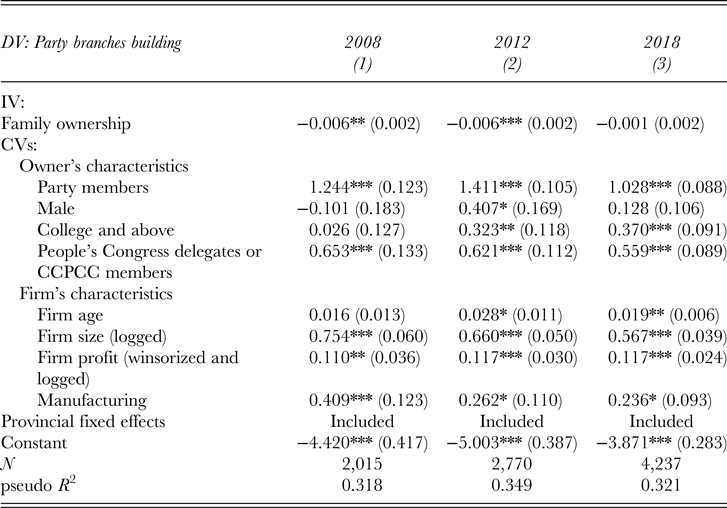
In Table 2, Column (1) reports the estimated coefficients of the effect of family ownership on the establishment of Party branches in the year 2008 when the new Party branches building campaign had not started. It can be seen that the effect of family ownership is −0.006, and it is very significant (p < 0.01), indicating that the likelihood of establishing Party branches decline significantly with the increase of family ownership in private enterprises when the important owners’ and enterprises’ characteristics are controlled. That is to say, there is a significant difference between the private enterprises with a low level of family ownership and those with a high level of family ownership with regard to Party branches building. This finding supports Hypothesis 1a.
The ML estimates of the effects of family ownership on the establishment of Party branches in 2008, 2012, and 2018

Notes: *p < 0.05, **p < 0.01, ***p < 0.001 (two-tailed test), standard errors in parenthesis.
Column (2) in Table 2 reports the estimate of family ownership on Party branches building in 2012, when the new Party branches building campaign was about to start. We can see family ownership still has a significant and negative effect on the building of Party branches (β = −0.006, p < 0.01), and this also supports Hypotheses 1a.
Column (3) in Table 2 is the coefficient estimate of family ownership on Party branches building in the year 2018 when the political pressure was intensified. It shows that the negative effect of family ownership on Party branches building is no longer significant (β = −0.001, p > 0.05), which suggests the preservation of socioemotional wealth has yielded to the political mandate in private enterprises. This finding suggests that the impact of family ownership on Party branches building is no longer as strong as that in 2012 or 2008. The effect of political pressure takes over that of socioemotional wealth in 2018. This means in recent years, private enterprises, no matter how high the level of family ownership is, are all have to be compliant with the political mandate of Party branches building, which supports Hypothesis 1b.
In terms of the control variables, Party branches are more likely to be set up in enterprises with owners who are themselves Party members, People's Congress delegates, CPPCC members and have college or higher education in the years 2012 and 2018. Enterprise characteristics also significantly affect the likelihood of Party branches establishment. The coefficients of firm age (except in 2008) and firm size on Party branches building are positive and significant, suggesting that the longer an enterprise survives, the more the number of employees, the more likely the enterprise is to set up a Party branch. The effects of enterprise profit on Party branches building are very significant and positive in all three years, suggesting that private enterprises with better economic performance will be more likely to build Party branches.
Table 3 reports the impact of family ownership on the de facto functioning of Party branches in the enterprises where Party branches have been established (Model 1) and whether the establishment of a Party branch increases the level of social securities in private enterprises (Model 2). The first column reports the estimates for the year 2008 when the new Party branches building campaign had not started. We can see that the coefficient of family ownership is −0.0001, not significant at the 5% level, suggesting that family ownership did not have a significant impact on Party branches establishment. In the year 2012, when Party building in the private sector started to become one of the top priorities in the political agenda, we can see the negative effect of family owership on the percentage of employees with social securities become significant (β = −0.001, p < 0.05). We can also see the significant and positive effect of a Party branch on social security level of a private enterprise (β = 0.030, p < 0.05) in the year 2012, suggesting the positive effect of the political pressure on social securities of employees in private enterprises. In the year 2018, when the new Party branches campaign was being carried out extensively, the negative effect of family ownership on the percentage of employees with social securities was also significant (β = −0.001, p < 0.01, Column (5)) while Party building did not have a significant effect (β = 0.014, p > 0.05, Column (6)), which supports Hypothesis 2 that the decoupling strategy does exist. The results in Table 3 suggest that although the political pressure was intensified significantly and the percentage of Party branches building also increased from 2008 to 2018, the degree of family ownership could still significantly inhibit the achievement of Party branches’ political and social goals.
The OLS estimates of the effects of family ownership on the percentage of employees with social securities in 2008, 2012, and 2018

Notes:*p < 0.05, **p < 0.01, *** p < 0.001 (two-tailed test), standard errors in parenthesis.
The sample used in Model 1 only includes private enterprises which have already established the Party branches. The sample used in Model 2 is the full sample.
The above results indicate that although private enterprises with a high level of family ownership allow Party branches to enter their enterprises, and the building of Party branches may force these enterprises to ameliorate the social security conditions of employees, private enterprises with a higher level of socioemotional wealth tend to offer lower percentage of social securities, which is a typical decoupling behavior. The decoupling strategy is probably the outcome of the interaction between the legitimacy constraint and the family control logic. Under the circumstance of great political pressures, family enterprises follow the legitimacy logic and adopt the policy call for Party branches building. However, this may be at odds with family businesses’ priority goal of preserving socioemotional wealth, and thus, the role of Party branches may be undermined in the internal operations of these enterprises when private enterprises try to maintain family control.
The Moderating Effects of Market and Legal Environment Perceptions
Having confirmed that family ownership inhibits the establishment of Party branches in private enterprises when the political pressure is not that high, this section mainly examines how the owners’ perceptions of the market and legal environment affect private businesses’ coupling and decoupling choices in the year 2018. Estimated results using Logistic regression models are presented in Table 4.
The ML estimates of the effects of family ownership, market and legal environment perceptions on Party branches building of Chinese private enterprises in 2018

Notes: * p < 0.05, **p < 0.01, ***p < 0.001 (two-tailed test), Standard errors in parentheses.
In Table 4, the dependent variable and independent variable are the same as those in Table 2 while the interaction terms of family ownership and market and legal environment perceptions are added. In Column (1), the interaction term is significantly positive (β = 0.008, p < 0.001), suggesting that the higher the owners’ evaluation of the local market environment, the weaker the inhibiting effect of family ownership on the Party branches building. That is, in places where the market environment is better, private enterprises are more likely to establish Party branches, supporting Hypothesis 3. In addition, we include owners’ subjective evaluation of the local legal environment as another measure of the institutional environment. The interaction coefficient of the variable and family ownership is significantly positive in Column (2) (β = 0.009, p < 0.001). These findings suggest in family enterprises with a higher level of family ownership, owners’ awareness of a better market and legal environment will enhance the likelihood of setting up the Party branches, which supports Hypothesis 3.
Robustness Checks and Additional Analyses
The CPES 2018 survey measures both the perceived market environment and legal environment using a scale comprised of a series of questions. Although the indexes generated by averaging the two groups of questions are straightforward, the underlying assumption of this method is that each question is equally contributed to the measure of the perceived institutional environment, which obviously ignores the varying importance among these questions. Therefore, it is necessary to adopt a factor analysis so that appropriate weight could be allocated to the different aspects of the market and legal environment.
Table 5 and 6 report the results of the principal component factor analysis. The KMO scores for the two factor analyses are 0.914 and 0.933, respectively, much higher than the threshold value of 0.6, suggesting that the two sets of questions are suitable for factor analysis. We extract a common factor from the nine questions of business owners’ legal environment perceptions. Two common factors could be extracted from the 11 questions based on the eigenvalue and a comprehensive factor score can be calculated based on their respective contributions to the ‘Market environment perception’ variable. In addition, Table 6 shows the Cronbach's alpha for the reliability of the measurement index. Since both coefficients of the two variables are greater than 0.93, it suggests that the items contained in the common factors have good reliability.
The results of extracting common factors

Loadings of factor analysis and relevant test results

Table 7 reports the results of the regulation effects of the above two new institutional environment perception factors. Column (1) shows that the interaction term between the market environment perception and family ownership is significantly positive (β = 0.008, p < 0.05). Similarly, the coefficient of the interaction term between the legal environment perception and family ownership is statistically significant and positive (β = 0.006, p < 0.01). Therefore, the results in Table 7 are consistent with those in Table 4. It confirms again the improvement of the perceived market and legal environment, can promote the establishment of Party branches in the private sector, which supports Hypothesis 3.
The ML estimates of the effects of family ownership, market and legal environment perceptions on Party branches building in 2018 (The principal component analysis)

Notes: *p < 0.05, ** p < 0.01, ***p < 0.001 (two-tailed test), standard errors in parenthesis.
To overcome the potential endogeneity problems such as omitted variables and reversal causal relationship between family ownership and Party branches building or level of social securities in employees, we use whether or not the private enterprise has established a family office as an instrument variable in the regression analysis. Since 2013 establishing a family office has become a fast rising fashion in mainland China, intending to preserve financial as well as nonfinancial wealth.[Footnote 13] There are two types of these offices based on their purposes: investment purpose and noninvestment purposes such as legal service, philanthropy, tax planning, and trustee management (Gao & Ye, Reference Gao and Ye2018). Establishing a family office reflects a private enterprise's clear intention to preserve socioemotional wealth and has a positive correlation with family ownership. However, the trend did not emerge in the private enterprise sector until very recently. About 14% of private enterprises have established a family office according to the CPES 2018 survey. Establishing a family office in this stage is more of a symbolic and imitative action than of a substantive structure, we thus argue that this should not directly affect a private enterprise's decision making in the establishment of a Party branch and the level of employees’ social securities. Employing this instrumental variable and a two-stage least square (2SLS) estimation approach, we re-estimate the effects of family ownership on Party branches building and percentage of employees with social securities. It is found that the effects of family ownership on Party building and social security protection are all negative and significant (β = −0.007, p < 0.001 for Party building, β = −0.009, p < 0.01 for percentage of employees with social securities)[Footnote 14], suggesting strong intentions to preserve socioemotional wealth in these private enterprises. Therefore, the endogeneity problem should not be a big concern. In sum, our findings on the relationship between political pressure, family ownership, and the coupling or decoupling decisions are very robust.
DISCUSSION
China's market-oriented reform is an important driving force to the transformation of its economy. As a burgeoning sector, China's private enterprises still have a strong dependence on political and economic policies, making them vulnerable to institutional changes when they grow. Drawing on three waves of CPES in 2008, 2012, and 2018, this study examines the effects of family ownership on the establishment of Party branches in private enterprises, the actual functions of these Party organizations, as well as the changes of these effects in the varying market and legal environment. The empirical analyses reveal that before the initiation of the Party branches building campaign in 2012, private enterprises with a high level of family ownership tend not to build Party branches, while in recent years, the significance of the negative relationship between family ownership and Party branches building disappeared. This suggests that private enterprises, regardless of the degree of family control, have to respond to Party branches building requirements due to the legitimacy constraint under the strong political pressure. This coercive pressure forces most qualified private enterprises to build Party branches. Secondly, in private enterprises with Party branches, family ownership will inhibit the participation rate of employees’ social securities, although promoting employees’ social securities is definitely one of the core functions of Party organizations. This suggests that the Party branches have not played a substantial role in private businesses, showing a decoupling of the actual operations from the formal governance structure. Thirdly, business owners’ good perceptions of the market and legal environment can encourage private enterprises to set up Party branches. These findings suggest that private enterprises’ responses to the institutional environment are dynamic and adaptive.
This study offers a theoretical framework to reinterpret the strategic political behaviors of Chinese private enterprises by integrating the socioemotional wealth theory and neo-institutional theory. It argues that the political behaviors of private enterprises depend on the relative strength of the two logics-family control and institutional legitimacy. Under the pressure of political forces, private enterprises have to strike a balance between maintaining family control and political legitimacy. On the one hand, when the political pressure is not that high, private enterprises will demonstrate their strong motivation to preserve family control and socioemotional wealth. On the other hand, when the institutional environment puts forward strong requirements for the political behaviors of private enterprises, the huge pressure from the political authorities forces private enterprises to comply with these mandates. However, no matter how strong the political pressure is, the endogenous motivation to preserve family control would not be changed for private enterprises.
Secondly, this research demonstrates the ‘embedded agency’ (Greenwood & Suddaby, Reference Greenwood and Suddaby2006; Thornton et al., Reference Thornton, Ocasio and Lounsbury2012) of Chinese private enterprises when they are challenged by political pressures. When embedded in the formal political structure, private enterprises adopt a strategy of loosely coupling: the organizational structure is consistent with the institutional requirements, but the actual operation is still driven by family-oriented motivations. In addition, when owners of private enterprises feel the market and legal environment is benign, they will be more encouraged to establish Party branches. In addition, private enterprises can transform political pressure into channels that are conducive to resource acquirement and eventually benefit the growth of private enterprises. The establishment of Party branches represents an organizational political connection that can help enterprises get access to the key resources through an open and legal channel, and this function will be more significant and effective in a sound institutional environment. Even though private enterprises have a strong preference for control, it is undoubtedly a very favorable choice to obtain practical benefits by following political arrangements on the condition that they do not endanger the actual control right of private enterprises. In this case, the legitimacy logic urges the organization to respond to the requirements of the external institutional environment in a way that elicits practical benefits rather than coercive pressure, which suggests that there is a two-way interactive relationship between the institutional environment and the agency of private enterprises. Although Party branches can be embedded in the private enterprises by means of legitimacy logic, it is still restrained to some extent in actual operations, which demonstrates the profound impact of socioemotional wealth motivation on business owners’ behavioral decisions and the agency to resist political pressures effectively.
Thirdly, this article shed new light on the causes of the decoupling phenomenon raised by the neo-institutionalism perspective more than 40 years ago (Meyer & Rowan, Reference Meyer and Rowan1977). On the one hand, we extend the analysis of the decoupling phenomenon to the behaviors of small- and medium-sized private enterprises in China. Previous studies utilizing neo-institutionalism theory mostly focused on governments, social organizations, institutions of higher education, as well as the public-listed companies or state-owned enterprises (e.g., Bromley, Hwang, & Powell, Reference Bromley, Hwang and Powell2012). On the other hand, drawing on the socioemotional wealth theory, we enrich the interpretations of the causes of organizational decoupling in the neo-institutionalism framework. Neo-institutionalism holds that decoupling is a viable strategy adopted to coordinate the contradictions between efficiency requirements from the technical environment and legitimacy goals from the institutional environment. However, for Chinese private enterprises, driven by the fundamental goal of preserving socioemotional wealth, the control goal is being placed higher priority than the efficiency goal and institutional mandates. Therefore, the decoupling phenomenon of Party branches building in private enterprises mainly reflects the efforts of business owners to reconcile the conflicts between control intention and legitimacy goals. The decoupling strategy, along with other strategies (e.g., resisting, manipulating) may be also used to address contradictions arising from other institutional logics such as religion, corporation, and community, as Thornton et al. (Reference Thornton, Ocasio and Lounsbury2012: 50–73) has argued.
Limitations and Future Research Directions
This study also has some limitations that future research needs to address. On the one hand, the degree of family control can be measured from multiple aspects, such as the distribution of ownership and management rights within family members (Welsch, Reference Welsch1993), because the governance practice is manifested in the actual influence of family members on major corporate decisions (Handler, Reference Handler1989). The three waves of CPES data only asked about the percentage of family members in the ownership structure of the enterprise, which makes it impossible for us to fully investigate the influence of family control on the establishment of Party branches building and decoupling within the enterprise. However, the modern transformation of the governance structure of small- and medium-sized private enterprises in contemporary China has been relatively slow, and professional managers have not been put into popularity in private enterprises. Family members not only occupy the board of shareholders, but also dominate the management positions in these enterprises. For example, according to the CPES 2010 survey data, there is a considerable overlap of ownership and management rights in Chinese family enterprises, and thus, we have much confidence in the reliability of our measure of family control and SEW. On the other hand, organizational decoupling is embodied in the degree of consistency between the commitment made by an organization and its actual behaviors, such as the gap between the claimed and the actual expenditures of an organization on a certain social responsibility project. The three waves of CPES survey data do not collect direct information on the enterprises’ commitments to and performance of the Party branches building, and questions available cannot help us learn more about the actual activities of the Party branches in depth. Future research using better measures supplemented with case interviews and participant observations may overcome some of these deficiencies.
Data Availability Statements
The data that support the findings of this study are openly available at Harvard Dataverse https://doi.org/10.7910/DVN/ZOZ61J