Introduction
Although archaeological excavations along the northern coasts of the Persian Gulf began many years ago, significant gaps remain in our understanding of the prehistoric chronological sequence in this region of Iran. Moreover, due to limited and fragmented research, there is still no comprehensive picture of the social, economic, political, and religious life of the prehistoric communities that once inhabited this area.
Archaeological studies in this region have largely focused on the historical and Islamic periods. Extensive research has been conducted in the historical-Islamic city of Siraf (e.g. Whitehouse Reference Whitehouse1974), Achaemenid palaces (e.g. Yaghmaei Reference Yaghmaei2004), and the Elamite site of Lian (Toll-e Pitol) (Pézard Reference Pézard1914), all of which point to long-term settlements and sustained human occupation. These studies also attest to the region’s extensive maritime trade relations with various parts of the ancient world, from the historical to the Islamic periods.
The harsh environmental conditions of this region—characterized by a dry climate, saline and seasonal rivers, intense heat and humidity for much of the year, and sparse vegetation—have always posed challenges to human settlement, especially in prehistoric times. Even today, despite modern technological advances, the summer climate remains extremely demanding.
Nonetheless, archaeological surveys have identified several sites dating to the prehistoric period and specifically to the fifth millennium BCE (Carter et al. Reference Carter, Challis, Priestman and Tofighian2006). While research on fifth millennium BCE cultures in this region remains limited, a number of sites and their cultural features have been introduced (Azizi Kharanaghi et al. Reference Azizi Kharanaghi, Ebrahimi, Azarian, Nokandeh, Dashtizadeh and Ghafoori2020). The site of Chahar Rustai, close to Ganaveh, was excavated and revealed cultural material from the Bakun period as well as evidence of cultural connections with the Fars region (Azizi Kharanaghi et al. Reference Azizi Kharanaghi, Khanipour, Niknami and Taheri2018). More recently, the prehistoric site of Toll-e Tahmachi at Deylam port has also been documented (Moghaddam and Rashidian Reference Moghaddam and Rashidian2024).
Given the importance of investigating both regional and interregional interactions along the northern Persian Gulf during the fifth millennium BCE, and of understanding this area’s role as a southern extension of the Bakun cultural sphere—distinct from that of the Fars highlands—excavations were carried out at Toll-e Sohzu (Azizi Kharanaghi Reference Azizi Kharanghi2016, Reference Azizi Kharanaghi2022). These excavations resulted in the identification of cultural layers corresponding to the fifth millennium BCE (Bakun) and the fourth millennium BCE (Lapui), which will be discussed below. The primary aim of this project was to establish the site’s cultural sequence and to gain a deeper understanding of Toll-e Sohzu’s prehistoric cultural characteristics.
The site
Toll-e Sohzu is located in Bushehr Province, Dashtestan District, near the Shabankareh Town and in the vicinity of Khalifa village (Figure 1). The site was officially registered on Iran’s National Heritage List on November 8, 2015 (Registration No. 17112). Based on current evidence, the tell covers an area of approximately two hectares and rises about 4 m above the surrounding plain (60 m above sea level). It is one of the few sites in Bushehr Province with preserved prehistoric deposits. Surface evidence indicates two main cultural phases: the fifth millennium BCE (Bakun period) and the fourth millennium BCE (Lapui period).
The geographical location of Toll-e Sohzu and mentioned sites in this paper, and the general view of the site (February 2017). Map showing the distribution of fifth millennium BCE prehistoric sites on the northern coasts of the Persian Gulf in Bushehr Province (Map courtesy of ICAR, Department of Cartography).

The site has been repeatedly cultivated for agricultural purposes, resulting in the annual destruction of up to half a meter of its surface layers (Figure 2). Nevertheless, the cultural deposits remain sufficiently intact to address important archaeological questions regarding prehistoric occupation in the southern Fars region and the northern Persian Gulf.
Toll-e Sohzu Hariss matrix showing the succession of the contexts and related radiocarbon dates.

The distribution of prehistoric sites along the northern coast of the Persian Gulf in Bushehr Province is sparse. Six prehistoric sites were identified and briefly reported in 2019: Chahar-Rustai, Toll-e Choghabur, Toll-e Sohzu, Toll-e Nasrak, Toll-e Qashi, and Toll-e Hamachi (Azizi Kharanaghi et al. Reference Azizi Kharanaghi, Ebrahimi, Azarian, Nokandeh, Dashtizadeh and Ghafoori2020) (Figure 1). Of these, only Chahar Rustai and Toll-e Sohzu have been excavated to date.
Excavations at prehistoric sites along the northern coast of the Persian Gulf are crucial for deepening our understanding of the historical presence of Iranian peoples in this region. Archaeological evidence has demonstrated the presence of Bakun cultural elements in these areas as early as the fifth millennium BCE. However, due to the limited scope of archaeological research in the region, our knowledge of the relationship between Persian Gulf cultures and the cultural heartland of Fars remains incomplete. The excavation of Toll-e Sohzu offers an opportunity to address some of these unanswered questions. To this end, Trench A was opened at the summit of the tell and the context-based recording method was employed to achieve a clearer understanding of the cultural sequence and to prevent the mixing of materials from different stratigraphic layers. By documenting the cultural deposits using the Harris Matrix system, an effort was made to reconstruct the stratigraphic sequence of the cultural materials and to better understand their spatial and contextual relationships.
Trench A
In order to study the cultural sequence and gain a better understanding of the settlement context of the site, Trench A was excavated at the summit of the mound, measuring 4 × 4 m (Figure 1). Unfortunately, approximately 1.5 m of the upper cultural layers had been completely destroyed in recent years due to bulldozing activity, resulting in a wide scattering of cultural materials around the site.
The excavation of Trench A was conducted in two distinct operations. From the surface down to Context 1017, the trench maintained its full 4 × 4 m dimensions. However, due to the discovery of architectural features, it was no longer feasible to continue the excavation at full scale. Consequently, the decision was made to proceed only in the northwest corner of the trench, within a reduced area of 1.5 × 1.5 m. The total depth of cultural deposits excavated in Trench A reached 5.80 m. The excavation was halted upon reaching Context 1036, identified as the virgin (sterile) soil.
Late Bakun period (end of 5th millennium BCE)
Contexts 1015 to 1035 at Toll-e Sohzu represent the Bakun cultural phase (Figure 2). The ceramics recovered from these layers are predominantly buff ware, including both hand-made and wheel-made sherds. The pottery is typically decorated with geometric motifs, though a few sherds display stylized representations of animals and humans. Comparative analysis indicates that these ceramics date to the Late Bakun period. This period generally dated to the second half of the fifth millennium BCE (Alizadeh Reference Alizadeh2006: Table 30).
The pottery assemblage can generally be divided into two main categories: plain buff ware and painted buff ware (black-on-buff). Each category includes three variants based on texture: fine, medium, and coarse. The exterior surfaces of the vessels are well-smoothed and often polished, with decorative colors ranging from light brown to red to black. Decoration is typically applied in a limited range of motifs, including zigzag patterns with negative spaces and rhombus shapes filled with triangular elements—hallmark features of Bakun pottery, which are also common in the Toll-e Sohzu assemblage (Figure 3A, Supplementary Material Figure 1, Supplementary Material Table 1).
Potsherds and vessels from Trench A, Toll-e Sohzu. (A) Painted black and red-on-buff wares of the Late Bakun period; (B) Plain (Nos. 23, 26, 27) and painted (Nos. 28, 30-34) red wares, plain buff (Nos. 24, 25, 29, 38, 39) and coarse (Nos. 35-37) wares of Lapui period (for detailed description see Supplementary Material Table 1).

The clay is well-kneaded and generally tempered with fine sand. Most vessels appear to have been fired in technologically developed kilns, as indicated by their consistent color and hardness. Interestingly, some sherds show signs of partial melting due to exposure to extremely high temperatures, suggesting local pottery production.
A wide variety of vessel forms were identified, including beakers, small and large bowls with open mouths, small jars, and cups. With the exception of open-mouthed bowls, painted designs are typically confined to the upper third of the vessel’s exterior surface. A smaller number of course, chaff-tempered sherds with spherical bodies appear to have been fired in open pits at lower temperatures; these likely represent utilitarian wares intended for daily use.
The painted buff ware pottery from Toll-e Sohzu—black-on-buff or red-on-buff—is comparable to ceramic assemblages from other well-documented Bakun sites in Fars province and the Persian Gulf region, including: Tall-e Bakun (Alizadeh Reference Alizadeh2006), Toll-e Gap (Egami and Sono Reference Egami and Sono1962), Tepe Rahmatabad (Azizi Kharanaghi et al. Reference Azizi Kharanaghi, Fazeli Nashli, Nishiaki, Matthews and Fazeli Nashli2013; Bernbeck et al. Reference Bernbeck, Fazeli and Pollock2005) and Tol-e Mianrud (Zare and Abolahrar Reference Zare and Abolharar2010) in Marvdasht plain, Tole Bashi in Ramjerd plain (Pollock et al. Reference Pollock, Bernbeck and Abdi2010), sites in the Bolaghi Valley (Helwing and Seyedin Reference Helwing, Seyedin, Carter and Philip2010; Karami Reference Karami2014), Toll-e Nokhodi, Pasargadae plain (Goff Reference Goff1964), Tol-e Nourabad Mamasani region (Potts and Roustaei Reference Potts and Roustaei2006; Weeks et al. Reference Weeks, Petrie, Potts, Carter and Philip2010), Tepe Mehr Ali, Eqlid highlands (Sardari et al. Reference Sardari Zarchi, Fazeli Nashli, Hejebri Nobari and Khatib Shahidi2011), Toll-e Pir near Mohr (Askari Chaverdi et al. Reference Askari Chaverdi, Cameron and Taylor2008), Tal-e Mash Karim Semirom plain (Sardari and Taheri Reference Sardari Zarchi and Taheri2015), Chahar-Rustai, near Ganaveh (Azizi Kharanaghi et al. Reference Azizi Kharanaghi, Khanipour, Niknami and Taheri2018).
Polished red-ware pottery was first identified during excavations at Tall-e Bakun (Egami and Sono Reference Egami and Sono1962, 1–4; Langsdorff and McCown Reference Langsdorff and McCown1942, 24–60; Schmidt Reference Schmidt1939, 123). This distinctive pottery type was later named Lapui after being discovered at Toll-e Lapui near the village of Lapui in the Marvdasht Plain (Abdi and Rajabi Reference Abdi, Rajabi and Choubak2016). Vanden Berghe was among the first to use the term in the prehistoric chronology of Fars to refer to 4th millennium BCE cultures (Vanden Berghe Reference Vanden Berghe1954).
During the Kur River Basin Archaeological Survey, W. Sumner identified 101 sites containing Lapui pottery (Sumner Reference Sumner1972, 41) and later explored socio-political organization (Sumner Reference Sumner, Finkbeiner and Rollig1986) and settlement patterns (Sumner 1988) of the period. Gotch (Reference Gotch1968, 168–170) also documented 18 Lapui sites in the Persepolis and Shiraz plain surveys.
Lapui pottery has been found in numerous other surveys and excavations: Tall-e Korah (Alden Reference Alden and Sumner2003), Mamasani surveys: 13 sites, including Tol-e Nurabad and Tol-e Spid (Petrie et al. Reference Petrie, Sardari Zarchi and Javanmardzadeh2007; Potts and Roustaei Reference Potts and Roustaei2006) Eqlid region: 8 sites and excavations at Mehr Ali Tepe (Sardari Zarchi et al. Reference Sardari Zarchi, Fazeli Nashli, Hejebri Nobari and Khatib Shahidi2011), Bavanat survey: 7 sites (Khanipour et al. Reference Khanipour, Mirghaderi, Nikzad, Emadi and Tahmasebi2019). Other Lapui-period finds include Toll-e Khari in the Pasargadae Plain (Sardari Zarchi and Mousavi Reference Sardari Zarchi, Mousavi and Moussavi2018), Toll-e Bondu in the Nourabad-Mamasani Plain (Darvishi et al. Reference Darvishi, Saraf and Tavousi2007), and Toll-e Jalian (Mirzaei and Sardari Reference Mirzaei and Sardari Zarchi2021).
Despite the wide geographical distribution, our knowledge of the Lapui period remains limited. Most data come from surface surveys, and only a few sites—most notably Tepe Mehr Ali—have been excavated extensively. Excavations at other sites such as Nurabad, Tol-e Spid, and Tall-e Korah were limited in scale and have not yielded sufficient information for a full understanding of Lapui-period architecture and social organization.
Sumner noted a general decline in the number of settlements in the Kur River Basin from the late Bakun period (end of the 5th millennium BCE) through the 4th millennium BCE, continuing into the Kaftari period (end of the 3rd millennium BCE). He attributed this trend to a decline in agricultural productivity due to increased salinity in the land (Sumner Reference Sumner, Finkbeiner and Rollig1986, 209).
Sumner categorized Lapui pottery into two general types: fine and coarse/plain. However, since this classification is based largely on surface collections, it requires revision based on stratified excavation data; Fine Lapui pottery typically has a red or buff core with uniform and well-controlled firing, a thick red slip, and a polished surface. Forms include bell-shaped or cylindrical cups, open-mouthed bowls, and closed vessels with short necks. Coarse/plain Lapui pottery often has a red surface with sand temper and a gray core. The surface is generally smoothed and sometimes polished. Shapes are similar to the fine type but include more utilitarian forms such as jugs, bowls with inwardly inclined rims, and jars with flared rims (Sumner Reference Sumner1972, 40–42).
Until recently, nearly all information on the Lapui period came from the northern and central regions of Fars. In contrast, evidence from the southern Fars region and the northern coasts of the Persian Gulf has been minimal. However, at Toll-e Sohzu, contexts 1000 to 1014 correspond to the Lapui period (Figure 3B). In addition to ceramics, right-angled mudbrick architecture has also been identified, contributing to our understanding of settlement structure in this region during the 4th millennium BCE (Supplementary Material Figure 2).
A wide range of Lapui-period pottery types has been recovered at Toll-e Sohzu (Supplementary Material Figure 3B and Supplementary Material Table 1), which can be grouped into five main categories:
-
1. Plain polished red-ware, wheel-made: Some pieces are decorated with polished motifs. These are well-fired, with open-mouthed bowls as the dominant form.
-
2. Painted red-ware with geometric designs: Patterns such as parallel/intersecting lines and triangles are applied to the vessel exteriors. Forms include bowls and beaker-like vessels.
-
3. Plain buff ware, wheel-made: Typical forms are small jars and large bowls.
-
4. Handmade gray pottery with polished decoration: Mostly represented by closed-mouth bowls. This type appears in limited numbers at Toll-e Sohzu.
-
5. Coarse handmade kitchenware: Made with heavy chaff temper and poorly fired. These large open bowls show uneven heating, indicating utilitarian use.
Absolute chronology and cultural implications
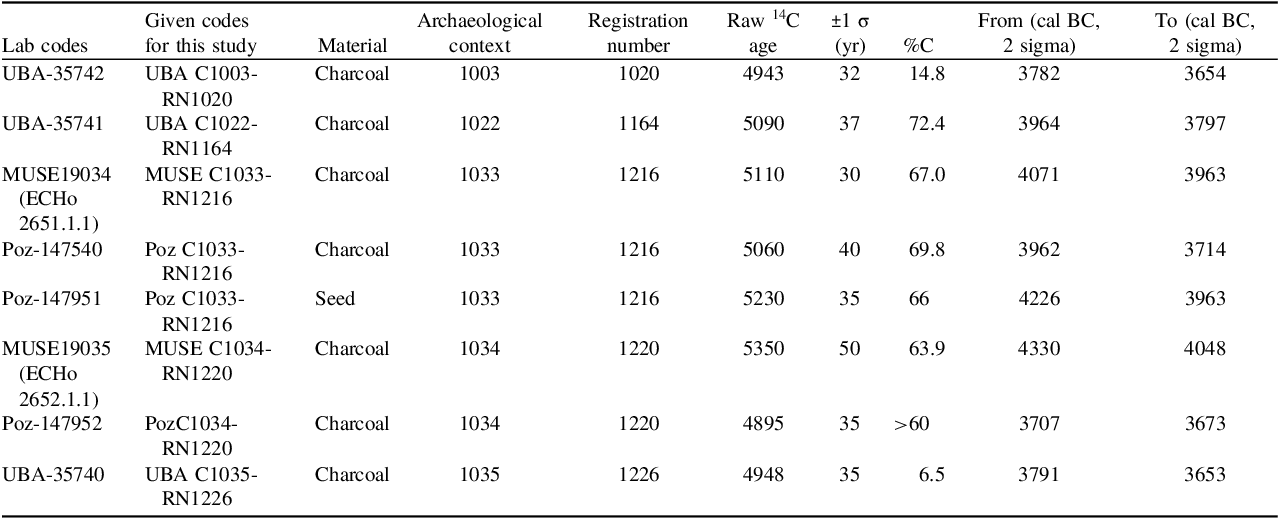
Eight charcoal and charred seed samples from different contexts (1003, 1022, 1033, 1034, and 1035) were selected for absolute 14C dating from Toll-e Sohzu (Table 1). Three of these samples were dated at the Belfast Queens University 14C facilities (UBA), two samples at the AMS ECHoMICADAS in the Laboratoire des Sciences du Climat et de l’Environnement (LSCE, UMR 8212, CNRS/CEA/UVSQ) in Saclay (France) (MUSE), and finally three samples, dated at Poznan 14C Laboratory (Poz). The general preservation quality of charcoal and charred seed is indicated by the %C calculation, that is more than 60% in most cases. Two samples yielded less than 20%C (UBA C1035-RN1226 and UBA C1003-RN1020). The processing notes of the 14Chrono Centre of Queens University of Belfast specified that there were only tiny fragments of charcoal present, the rest consisted of little stones/grit. The %C calculation uses the total loaded sample weight. It is most likely that the presence of grit has led to a false overall weight and resultant (misleading) low %C. The charcoal itself combusted fine and the data from the AMS run looks perfectly acceptable (Michelle Thompson pers. comm 8 May 2026).
Radiocarbon dates of Toll-e Sohzu Excavation.

Table 1. Long description
A table with eight rows and nine columns detailing radiocarbon dates from Toll-e Sohzu Excavation. The columns are labeled Lab codes, Given codes for this study, Material, Archaeological context, Registration number, Raw 14C age, ±1 σ (yr), %C, and From (cal BC, 2 sigma) to (cal BC, 2 sigma). Each row lists specific data for different samples. Row 1: UBA-35742, UBA C1003-RN1020, Charcoal, 1003, 1020, 4943, 32, 14.8, 3782, 3654. Row 2: UBA-35741, UBA C1022-RN1164, Charcoal, 1022, 1164, 5090, 37, 72.4, 3964, 3797. Row 3: MUSE19034 (ECHo 2651.1.1), MUSE C1033-RN1216, Charcoal, 1033, 1216, 5110, 30, 67.0, 4071, 3963. Row 4: Poz-147540, Poz C1033-RN1216, Charcoal, 1033, 1216, 5060, 40, 69.8, 3962, 3714. Row 5: Poz-147951, Poz C1033-RN1216, Seed, 1033, 1216, 5230, 35, 66, 4226, 3963. Row 6: MUSE19035 (ECHo 2652.1.1), MUSE C1034-RN1220, Charcoal, 1034, 1220, 5350, 50, 63.9, 4330, 4048. Row 7: Poz-147952, PozC1034-RN1220, Charcoal, 1034, 1220, 4895, 35, >60, 3707, 3673. Row 8: UBA-35740, UBA C1035-RN1226, Charcoal, 1035, 1226, 4948, 35, 6.5, 3791, 3653.
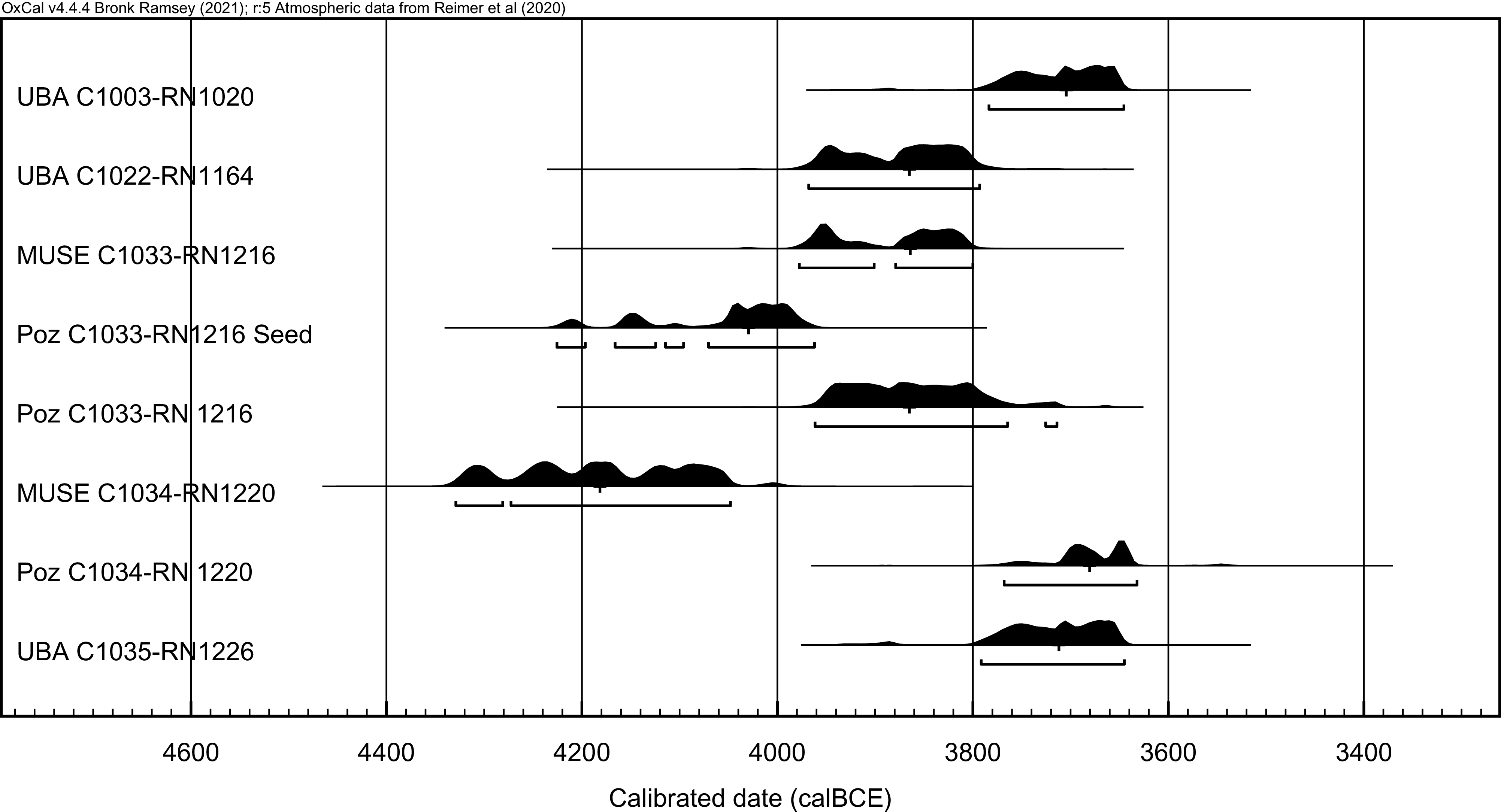
The calibrated dates (Figure 4) range from the end of the fifth millennium BCE to the mid of the fourth millennium BCE (4200–3600 BCE), all of which correspond to the end of the Bakun and Lapui period.
Calibration of Toll-e Sohzu 14C radiocarbon dates.

Because of the importance of these basal layers (1033 and 1034) near the virgin soil in the stratigraphy we dated several samples of charcoal and charred seed to verify the coherence of the related 14C results. We did not have enough charcoal remains for 1035 to date several samples; thus, we only got one date from that context.
Some mixture is visible in these basal contexts that seem to have been disturbed by the borrowing activity of a rodent for which we had their remains, or other possible disturbing taphonomic events.
We can observe the following: (1) the charred seed recovered in context 1033 (Poz-147951), dated to 4226-3963 cal BCE, is in an expected Late Bakun chronology. (2) An intrusive sample in the same context with a date 3962-3714 cal BCE (Poz-147540), very close to the date obtained from context 1022 (UBA-35741). (3) Two radiocarbon dates (UBA-35740 and Poz-147952) provide later dates than expected; They belong to the Lapui period chronology, while the pottery remains belong to the Late Bakun period (Table 1, Figures 3A and 4).
As a whole, we can observe three temporal sequences in the calibration curves (Figure 4). Two samples (MUSE19035.5, Poz-147951), date to the end of the fifth millennium BCE, and corresponds to the final phases of the Late Bakun period. Three samples (UBA-35741, MUSE19034.5, Poz-147540), date to the beginning of fourth millennium BCE, intermediate between the Late Bakun and Lapui periods. Finally, three samples (UBA-35742, Poz-147952, UBA-35740), date to a later phase of Lapui period.
Few sites from the Lapui period have absolute dates, such as Tepe Mehr Ali (3950 BCE) (Sardari Zarchi Reference Sardari Zarchi2011, 200) and Toll-e Spid (4050 BCE) (Petrie Reference Petrie, Roberts and Vander Linden2011, 138). Sumner suggested that the Lapui period spanned from 3900 BCE to 3400 BCE (Sumner Reference Sumner1972, 9). However, based on the AMS radiocarbon dates from Toll-e Sohzu, the beginning of Lapui period in this region is attested at most to 3900 BCE, and spanned until 3600 BCE.
The diagnostic pottery of the Bakun period has been identified in the underlying deposits of the Lapui period (contexts 1036–1016). However, due to the limited excavation of the Bakun layers in the forward trench and the small, excavated area of this period at Toll-e Sohzu, several radiocarbon dates from the contexts 1033 and 1034 are associated with the Late Bakun period were successfully identified. According to the material culture and AMS radiocarbon results from Toll-e Sohzu, the occupation of the Late Bakun period spanned from 4300 to 3900 BCE.
The general chronological trend observed in the radiocarbon dates shows an occupation of approximately 600 years in Toll-e Sohzu. Given the fact that in the sounding and the absence of organized architecture for the late Bakun phase, the settlement pattern during this period is not yet clearly understood.
Discussion
The lower layers (contexts 1016–1036) correspond to the Bakun period (late 5th millennium BCE), characterized by diagnostic buff ware pottery. These ceramics closely resemble those found in neighboring Fars province and show clear interactions between Fars highlands and coastal region of the Persian Gulf.
Given the widespread distribution of Bakun pottery—from the Persian Gulf in the south to the Bakhtiari mountains in the north, and from the eastern borders of Khuzestan to the western borders of Kerman—the hypothesis of itinerant potters maybe proposed (Askari Chaverdi et al. Reference Askari Chaverdi, Cameron and Taylor2008, 38; Weeks et al. Reference Weeks, Petrie, Potts, Carter and Philip2010). Another possible explanation is the tradition of matrimonial alliances between local communities and other regions, facilitating the exchange of technical knowledge, decorative motifs, and cultural practices (Alizadeh Reference Alizadeh, Miller and Abdi2003, 48–49).
The cultural material of Lapui period contexts was recovered in contexts 1000–1015, is another cultural phase identified in the excavation. Beneath the surface layers, remains of right-angled mudbrick architecture were uncovered. Architectural evidence suggests that, settlements during the Lapui period may have been more permanent. Prior to the archaeological excavations at Toll-e Sohzu, and based on earlier research, the Lapui culture was regarded solely as a local cultural phenomenon confined to Fars Province, particularly within the Marvdasht Plain. No evidence of its presence had been identified beyond this geographical range, and its emergence following the Late Bakun phase was generally interpreted as representing a transition to communities characterized by simpler social structures.
Conclusion
The first season of archaeological excavations at Toll-e Sohzu, located near the Persian Gulf coast, led to the identification of cultural layers from the late 5th millennium BCE (Bakun period) and the 4th millennium BCE (Lapui period). The excavations, conducted in the winter of 2015, aimed to determine the core, buffer zone, and stratigraphy of the site. A 4 × 4 m trench was dug in the central and upper portions of the mound, revealing a cultural deposit thickness of 5.80 m, which can be divided into two distinct cultural periods.
These results collectively indicate that human communities associated with the Late Bakun culture, a conclusion further supported by diagnostic pottery types, inhabited the site for the first time during this period. In contrast, the Lapui period, based on extensive excavation of the upper layers (1000–1015) and the identification of associated mudbrick architecture and a variety of pottery types, has much more reliable absolute dating. This is the first time a site with such cultural evidence has been archaeologically excavated along the northern coasts of the Persian Gulf, providing secure archaeological evidence of the 5th millennium (Bakun) and 4th millennium (Lapui) cultures in this region.
Supplementary material
To view supplementary material for this article, please visit https://doi.org/10.1017/RDC.2026.10257
Acknowledgments
The first author thanks the ICHHTO-Iran for authorizing and supporting the excavations at Toll-e Sohzu. We are grateful to Dr. Antoine Zazzo for supporting and processing two of the radiocarbon dates (MUSE codes), and to the UMR 7209 CNRS/MNHN for supporting the remaining radiocarbon analyses. We also thank Dr. Hossein Davoudi for reading and commenting on the manuscript, as well as the two anonymous reviewers for their insightful comments, which greatly improved this paper. Finally, we are deeply grateful to the editors of Radiocarbon, particularly Managing Editor Kim Elliott, for their help and support during the review process in a particularly challenging period, during war against Iran in early 2026.