The ventriloquism of the speaking subaltern is the left intellectual's stock-in-trade.
—Gayatri Spivak
Though with the North we sympathise, It must not be forgotten That with the South we've stronger ties Which are composed of cotton
—“Shop and Freedom,” Punch
Three black dolls appear in the etchings by H. K. Browne (Phiz) that accompany Charles Dickens's Bleak House (1853). They hang, strange fruit, from strings on walls and in shop windows, and their purpose as commentary on the text remains unclear because it is also initially unclear what they might represent. The dolls are never mentioned in the text of the novel, nor do they receive any substantial criticism in readings of Bleak House's illustrations. This article plumbs the archive for evidence of the dolls, and uses the resulting range of associations, from the American cotton trade to Victorian advertising techniques, to argue for a greater integration of the analysis of text and illustrations in serialized, illustrated novels such as Bleak House. Material culture readings of the novel to this date have overlooked elements of the illustrations (which are themselves material objects), or have focused on illustrations as print culture, and not conversations with the written text. Examining the dolls in this context not only enriches Bleak House, but also attests to the value of observing the interplay of text and illustration, as well as text and advertising, in readings of the novel's serialized form.
In the first etching where a doll appears, “The Lord Chancellor Copies from Memory,” the doll hangs from a string so far to the right of the etching that it seems to leave the frame of the drawing. Depicted in silhouette, the doll appears dark-skinned, its face heavily crosshatched. It wears the suggestion of a servant's white mobcap, and a plain dress with fitted sleeves and a full skirt. The setting is Krook's Rag and Bottle Shop, and the doll is one more item amidst the rags, keys, masks, hats, and papers; however, the doll occupies a prominent position in the shop's front window, right next to a sign for “Rags and Bottles” (Figure 1).
H. K. Browne, “The Lord Chancellor Copies from Memory.” Etching, from Charles Dickens, Bleak House (London: Bradbury & Evans, Bouverie Street, 1852–53), 2, preceding 33. By courtesy of the Department of Special Collections, Memorial Library, University of Wisconsin-Madison.

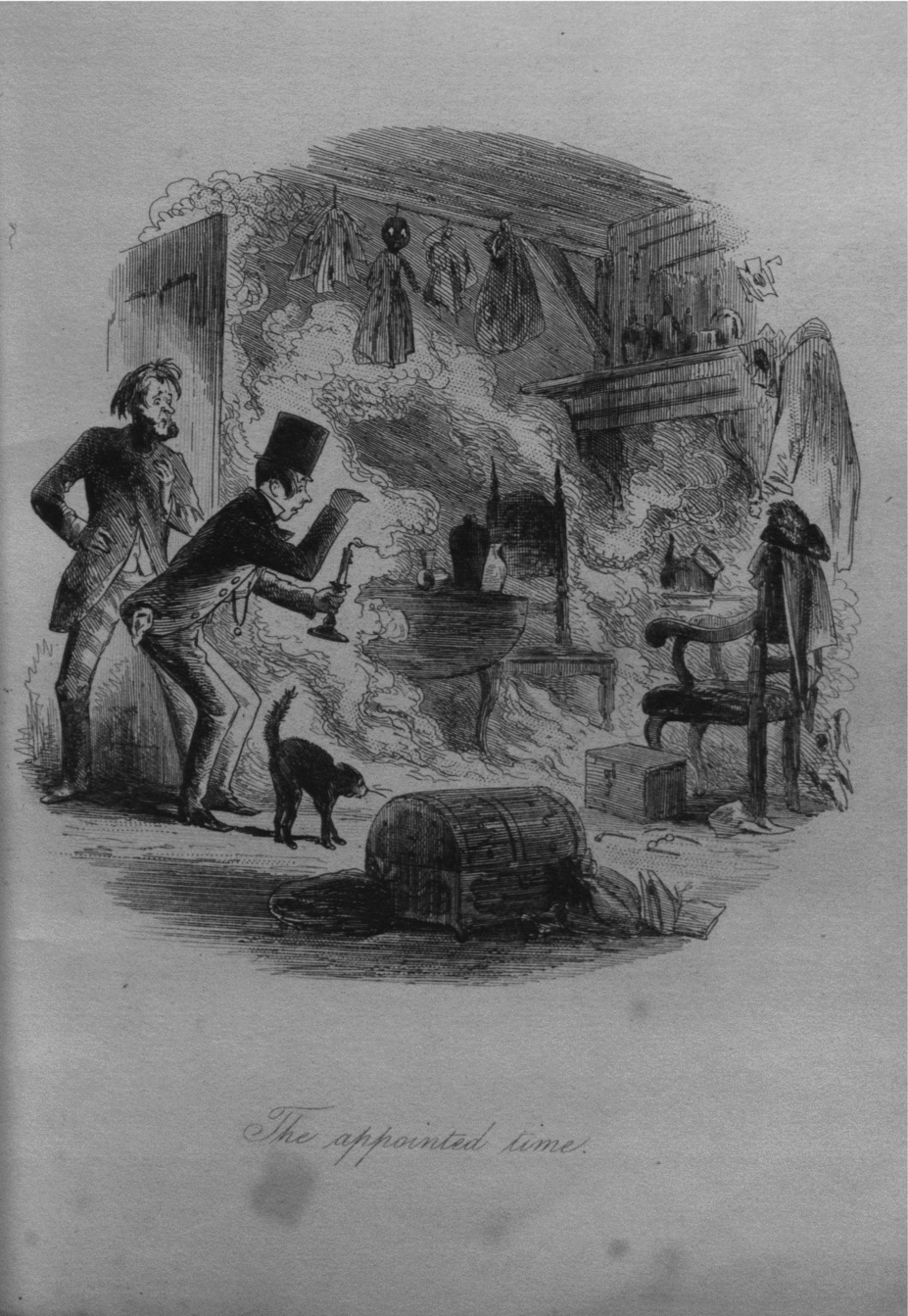
In the second illustration, “The Appointed Time,” depicting the moment in which Weevil and Guppy discover that Krook has spontaneously combusted, a very similar doll hangs up on the wall next to bundles of rags, observing the proceedings. In this illustration, its eyes are wide and white, showing up in striking relief against its dark face. The doll appears shocked, wary, scared, and most definitely watchful. This illustration makes it clear that the darkness of the first illustration's doll was not simply due to it being backlit against the shadowy rag shop's window, as this second doll is explicitly black. The two dolls, dressed in plain dresses with identical silhouettes and hanging in the same rag shop, are similar enough to be the same type of doll if not the exact same doll (Figure 2).
H. K. Browne, “The Appointed Time.” Etching, from Charles Dickens, Bleak House (London: Bradbury & Evans, Bouverie Street, 1852–53), 10, preceding 289. By courtesy of the Department of Special Collections, Memorial Library, University of Wisconsin-Madison.

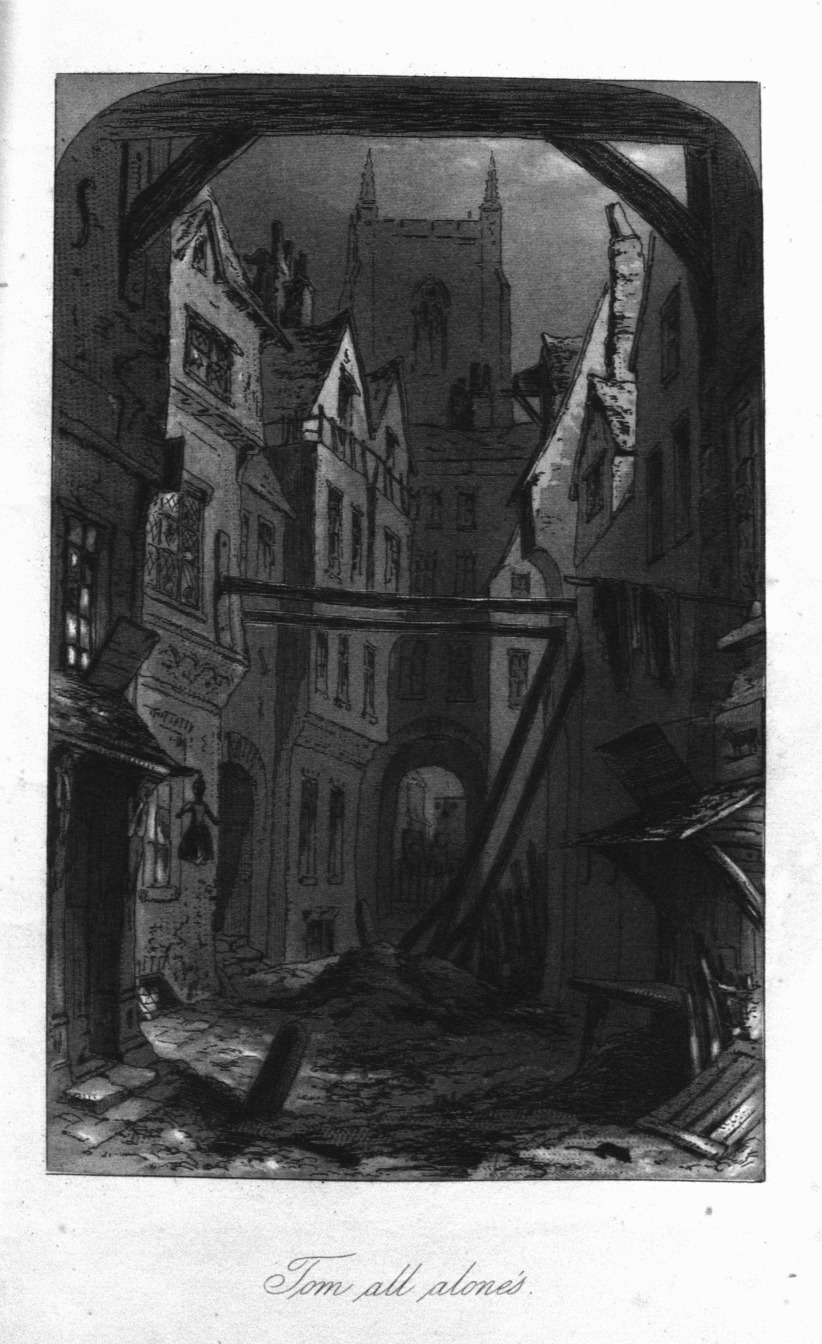
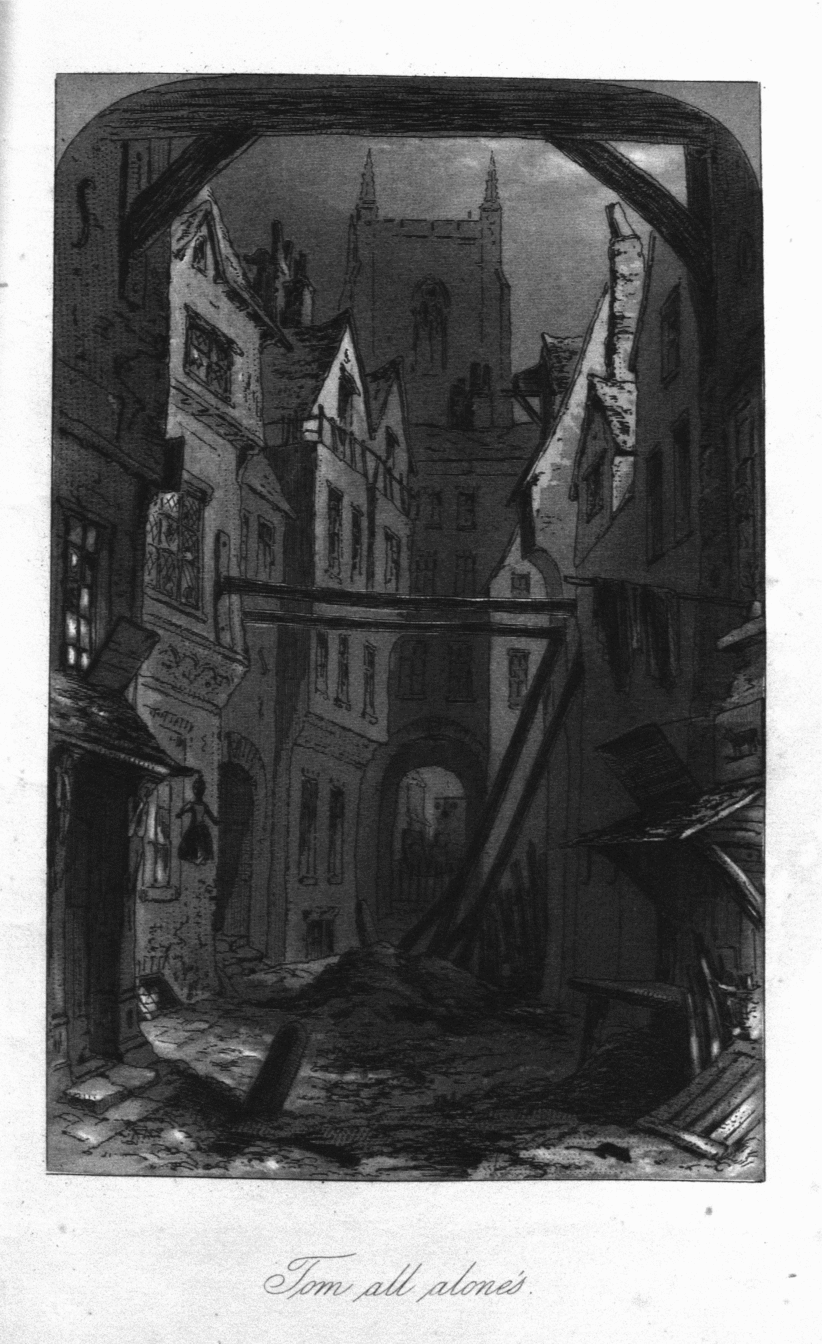
Finally, in the third illustration, “Tom all-Alone's,” a depiction of the slum by the same name, a black doll in the same style of dress hangs from the front awning of a building in the left of the picture. It is not immediately clear that the area contains commerce; on closer inspection, the building across the way takes shape as a butcher's shop, seemingly defunct. The building with the doll, lost to the darkness that is the nighttime slum, does have a vacant shop placard leaning over the door, but we are left wondering what kind of shop it might have been. Michael Steig, in his comprehensive study of Browne's illustrations for Dickens entitled Dickens and Phiz, notes that “Through the arch at the rear we can see into the churchyard which . . . includes the pawnbroker's three balls, symbol of decline into poverty” (151). Given the pawnbroker's presence, it seems that the shops within the confines of Tom-all-Alone's are less than savory and most likely contribute to the social issues that plague the slum. While current readers may be unfamiliar with the use of dolls as shop signs, I was able to use the historical archive to determine that the dolls are an advertising sign for a “dolly shop,” indicating the presence of a rag and bone shop, and most likely an unlicensed pawnbroker. Off in the distance of the etching, the official pawnbroker and the graveyard await; more illicit dealings lurk in the forefront where the doll dangles as a sort of gatekeeper to this shadowy realm. The doll becomes a similar gatekeeper in the historical archive, since, although it is ultimately possible to provide a definitive answer for the doll's existence, the search for its meaning also discloses a jumble of associations and cultural anxieties that are often as submerged and murky as the illustration of Tom-all-Alone's (Figure 3).
H. K. Browne, “Tom All-Alone's.” Etching, from Charles Dickens, Bleak House (London: Bradbury & Evans, Bouverie Street, 1852–53), 14, preceding 417. By courtesy of the Department of Special Collections, Memorial Library, University of Wisconsin-Madison.
Literary critics are used to turning to the text for answers to conflicts in meaning or interpretation. In the case of the black dolls and Bleak House, the written text is indeed a useful place to start in thinking through the relationship between text and illustration. The black dolls are of course not the only dolls present in the Bleak House volumes. They are the text's shadowed twin to the doll that Esther Summerson has as a young child, which she describes as follows: “So she used to sit propped up in a great arm-chair, with her beautiful complexion and rosy lips, staring at me – or not so much at me, I think, as at nothing” (16; ch. 3). The shadowed ambiguity of the black dolls encourages us to read Esther's doll with greater care: it may or may not be white, given the vagueness of the description of a “beautiful complexion” in this passage. This doll fulfills a crucial role in young Esther's life, for Esther is so shy and retiring due to her repressed upbringing that she “seldom dared to open [her] lips, and never dared to open [her] heart, to anybody else” (16; ch. 3). Esther's doll thus becomes the repository of all her secrets. Like the black dolls, which upon closer inspection eventually reveal Britain's participation in commerce fueled by the American slave trade as a kind of “open secret,” Esther's doll holds the secret of her illegitimacy, which Esther repeatedly tells to the doll after she learns of the stain on her person from her religious aunt. When Esther leaves the house of her childhood, she wraps the doll in a shawl and tells us she “quietly laid her – I am half ashamed to tell it – in the garden-earth, under the tree that shaded my old window” (23; ch. 3). Whether or not the doll is white, the fact that the doll is buried and will be blackened and obscured by dirt links Esther's secret doll to its darker twins in the shop windows. Esther's doll does not resurface in the narrative until much later, when the amorous Mr. Guppy proposes marriage to Esther by telling her that he will try to find out anything about her past that might be put to work in “advancing [her] interests and pushing [her] fortunes” (124; ch. 9). Esther makes it clear that she is not interested in either his marriage proposal or his offer of detective work. After Mr. Guppy leaves, Esther tells us that she “was in a flutter for a little while; and felt as if an old chord had been more coarsely touched than it ever had been since the days of the dear old doll, long buried in the garden” (127; ch. 9). The doll stands in for anxieties about her illegitimate past, and Esther has no desire to uncover these truths about her past, for fear her illegitimacy will become public knowledge.
Yet this textual appearance of a doll is not enough to fully explain the presence of the black dolls in the illustrations or their significance in terms of commentary on the written text. The black dolls, unlike Esther's doll, only appear in the illustrations, apparently resurfacing as a way of providing teleology for the illustrations’ developments. Still, the layered material presence of the black dolls in Bleak House is important not only as commentary on the progression of illustrated plot, but also because the dolls depict material elements in the historical archive that summon the specter of slavery, commercial consumption, and the hypocrisy of a British public that condemned slavery in America while ignoring its own complicity in the slave trade. Both the black doll and Esther's doll are thus sites of danger and possibility. One embodies a single girl's fears about her illicit past; the other, though less present in the historical and literary archive, reveals itself as a figurehead at the intersection of several shadowed spheres that include issues better thought ignored by the British public. Slavery, industrialization, the turning of the human body into a “thing,” and the underbelly of commerce are the doll's midwives.
The Illustration As Thing
In looking through studies of Browne's work for Dickens, I was able to find two acknowledgements of the presence of the dolls, only one of which acknowledges the dolls’ blackness. One of these general mentions is from John Harvey's Men in Black, which notes, “The only figure in the grim slum-study ‘Tom-all-Alone's’ is the doll hung for a shop-sign, which looks like a person hanged” (160). The second more specific description occurs in the aforementioned book of essays by Michael Steig. Steig writes “In terms of plot sequence, the action depicted [in ‘The Lord Chancellor copies from memory’] is completed only at the end of the tenth part, with Krook's death in ‘The appointed time’ (ch. 32), in which the junk dealer's black doll (of the earlier plate) appears to be shocked at the event” (136). Steig does note the presence of the doll here, and even connects it to the earlier illustration; however, in Steig's analysis, the doll is only deemed important insofar as it reflects on the activities within the text. In both cases, the description of the doll is focused on the doll as a plot device or a piece of atmosphere rather than as an item with its own signified (Harvey notes that the doll is hung as a shop sign, but does not explore this context further). I believe that overlooking the meaning of the doll is problematic, since Steig and others have argued convincingly for the significance of Phiz's drawings, noting that Phiz often used symbols in his drawings that not only shed further light on the action in the drawing, but on what was occurring in Dickens's text as well. As I sought to uncover how the doll might fulfill this purpose, the critical and historical archive offered up a wealth of conflicting information. In cases where elements of the etchings were discussed, primacy was given to the literary aspects of the etchings: the titles of books, paintings, and pamphlets appearing in the works were unpacked completely. Explicit attention was given to the material world as well; busts, clothing, spider webs, cows’ hearts, and animals were all examined. These items were then identified as standing in for a specific idea – a bird in a cage indicating imprisonment, for example. Yet Paradise Lost and a caged canary, while certainly taking place in a nexus of meaning outside of the etchings, can also stand alone within the confines of the etching's frame. Since they are familiar symbols, they thus also appear most frequently in analyses of the etchings. It is the unfamiliar, the uncategorizable, or the far too familiar that are overlooked. The black dolls, perhaps all three, are a strange and resistant element to analysis. In my research in the historical archive, their origins appeared tangled in semantics and representations, making them an elusive and illuminating historical element whose very complicatedness reflects cultural anxieties about representations of racial difference.
While much of the material culture represented in Browne's etchings has either clear literal or symbolic connections to Dickens's text itself, the black dolls are unusual in that they are initially unidentifiable in any fixed way. We may assume, however, that they would have been identifiable to a Victorian reader: thus the value in uncovering the dolls’ historical context. In looking through documents that might provide some reason for the dolls’ appearance in the etchings, I uncovered a description of events that became an additional means of establishing Bleak House in the richness of its transatlantic context. Scholars such as Daniel Hack and Jennifer Phegley have worked to explore this transatlantic context, pointing out that the novel was serialized on both sides of the Atlantic, and that Dickens read and critiqued Uncle Tom's Cabin as he worked on Bleak House; later American writers, especially in the abolitionist context, were also influenced greatly by Bleak House. As Hack writes in “Close Reading at a Distance: Bleak House,” “antebellum African Americans and abolitionists seized upon Bleak House and put it to work in a surprising number of ways, from brief if suggestive references . . . to reprintings of the novel in part or in whole and from the literal reenactment of one of its events to an actual rewriting of the novel” (423). Yet the bi-coastal nature of Bleak House's reception remains, in Hack's words, an “underexplored transatlantic, interracial encounter” (424). The dolls provide a new opportunity to return to Bleak House as not just transatlantic in its reception, but in its very nature.
The black dolls raise new aspects of England and America's connection through their materiality: recent focus on the transatlantic connection has either focused on the text as thing or the slave as thing, and the doll is neither text nor slave. Material culture studies has long moved away from an assumption that things are present in the novel to give it the weight and heft of reality. Instead, scholars such as Bill Brown and Elaine Freedgood have encouraged an examination of the material world of the novel for what it can tell us about circulation and function. Things can be removed from the world of the novel, illuminated in their historical context and usage, and then restored to the text of the novel with new resonances in tow. Illustrations prove another interesting facet to material culture studies. They themselves are part of the material construction of the novel, yet they are only sketches of “real” items. Often, as mentioned, the items in illustrations take on allegorical values, creating a conversation between themselves and the text. Yet these conversations have been under-theorized in the context of material culture, perhaps because they seem to be the purview of art history rather than literary studies. However, as J. Hillis Miller writes in Illustrations, “Adeptness in reading pictures as well as words is a skill most cultural critics need. Or rather, what is needed is the ability to read not just pictures and words separately, but the meaning and forces generated by their adjacency” (9). As Miller then points out, the representation of an item is a kind of besmirching, with writing as well as engraving being a “double simultaneous movement of bringing to light and burying” that addresses what drawings “bring into the open at the same time they hide” (93). With the black dolls, the dolls are literally darkened onto the page, simultaneously illuminating a historical element and hiding anything but their own representation. I argue that the illustrations of the dolls are neither completely allegorical nor provided to the illustration simply for a sense of cluttered realism. The dolls are purposeful blots that signify both the dolls themselves as well as representations of the dolls. They are an unavoidable stain on the illustration, and in their juxtaposition and location, on the text itself.
To begin with, the dolls are a diverse textual element because of the multiple ways in which they are made material. First, there is the illustration, which is a thing in and of itself. Second, there is the illustration's representation of the doll, a thing in the world of the illustration. Third, this representation references a real doll, a thing outside the text. In order to understand how the illustration comments on the text, it is important to determine what the “real doll” referent might be. The dolls cannot be made to speak in the way Gayatri Spivak cautions against in this article's first epigraph because dolls are things and do not speak themselves. However, the dolls represent a black female woman, who at this point in history was often conceptualized as a thing. In order to think through the reasons behind the appearance and significance of the dolls, I engaged with several archives: the literary, in the form of Bleak House; the historical and representational, in the form of other illustrations and photographs from the time period; and the historical and economic, in the form of documentation of the slave trade and the cotton trade. The dolls themselves appeared in the historical archive as one sign among many in Victorian advertising, as mentioned above, yet this meaning no longer adheres to the dolls for current readers. The dolls have been abandoned in some way as history has progressed, a process Spivak identifies in her work: “It is when signifiers are left to look after themselves that verbal slippages happen” (A Critique 255). In the case of this project, the black doll's signified has slipped in a significant way – too well known to be explained at the time it was used, the doll, looking after itself, has slipped from the non-verbal to the nearly silent.
For Spivak, archival elements such as the doll “haunt” history and the archive, providing a new kind of possibility (A Critique 208). I argue that the presence of the dolls in Bleak House's illustrations is a literal haunting. As the dolls are depicted hanging from the rafters or the wall, the presence of black bodies and the intimations of violence towards black bodies present themselves as powerful aspects of the historical register that refuse to be tamed, and insist on making themselves decipherable amidst the slippages of the archive. The dolls are productive examples of haunting, silence, or discontinuity, which can then become zones of proliferation and complication.
Bleak House and Africa
In the text of Bleak House itself, the doll is not specifically referenced. However, the text does discuss race at length, examining Africa, Britain, and America's policies in the process. In Bleak House, the discourse ultimately shapes itself around the idea of humanitarian work, and its utility at home versus its futility abroad. Dickens was interested in the question of Africa and the imperial projects there. Timothy Carens notes in “Failed Colonies in Africa and England: Civilizing Despair in Bleak House” that Dickens avidly read travelers’ accounts; he even reviewed the two-volume work, A Narrative of the Expedition Sent by Her Majesty's Government to The River Niger in 1841 under the Command of H. D. Trotter (1848) in the Examiner in the same year of its publication. Carens limns the ways in which Dickens's satirical criticisms in Bleak House, as well as the effective model he creates through the character of Esther of “charity begins at home,” reflect his views that the imperial endeavors represented by debacles such as the Niger Expedition were misplaced. Throughout the text of Bleak House, Dickens makes it clear that there is far more to be done at home before and instead of undertaking any humanitarian projects abroad.
The African Civilization Society launched the Niger expedition in 1841; the expedition was dedicated to founding a farm on the banks of the Niger as evidence of Britain's civilizing presence in Africa. Most of the European participants were killed by malarial fever fairly quickly, and the farm barely functioned for one year before falling apart. These failings were closely documented in popular printings concerning the expedition. Dickens criticized the failure of the project in his review of the abovementioned narrative about the expedition. He uses the text of Bleak House to do the same critical work. Dickens's character Mrs. Jellyby, with her desire to cultivate “coffee – and natives” in Borrioboola-Gha on the banks of the Niger, becomes a target for Dickens's satirical wit; he makes it clear to the reader that not only is Mrs. Jellyby's desire to help the natives of Borrioboola-Gha an ocean away misplaced and ineffective (the colony fails “in consequence of the king of Borrioboola wanting to sell everybody – who survived the climate – for Rum” [859, ch. 67]), Mrs. Jellyby herself is completely incapable of even tending to the household that is directly beneath her nose. Mrs. Jellyby's household is transformed into the very savage wilderness she seeks to ameliorate abroad; her husband, given his silence, “might have been a native, but for his complexion” (41; ch. 4), Caddy is stained dark with ink, and her children run around with faces blacked with dirt and bruises.
Carens also outlines, through Thomas Carlyle's and Dickens's imagery, the trope of depicting the London working class and poor as savages or blacks as the result of the negative impacts of industrialization. The mid-nineteenth century impact of the Industrial Revolution became the nexus for this image, as both those who championed industrialization and those who cautioned its unchecked development used images of the colonial Other to support their respective arguments. Those who sought to praise the advancing power of industry did so by positioning the colonizing country as dominant, simultaneously devaluing the spaces of native darkness and disorder that it oversaw. Yet social reformers and political critics who looked for powerful imagery with which to address the social problems that arose at the same time suggested “that industrial labor and exploitation had reduced English working-class subjects to the condition of enslaved and exploited Africans” (Carens 84). Mrs. Jellyby, despite her efforts abroad, neglects to make sure that her children do not slip into this same situation – her daughter is little better than an exploited slave beneath the volume of her dictation, and her other children fall down the stairs and are imprisoned behind bars, having neither guidance nor manners.
While the text reveals the dangers of telescopic philanthropy in the world of the Jellybys, they are not the working-class “others” in the text, as they live in a house and have a middle-class existence, however shabby. The true “others” in Bleak House are Jo the street sweeper, who literally sweeps shit from the city's crossroads; or the brickmakers, whose lives are circumscribed by industry and the poverty it inflicts. These individuals, relegated to the slums or to their hovels filled with abuse and alcoholism, are barely acknowledged as human by other participants in the text, and when they are, the acts of charity extended to them are as ineffective as the disastrous farm on the banks of the Niger. (We might think of Mr. Snagsby uncomfortably bestowing Jo with half-crowns, or “some broken meats from the table” [268; ch. 19]). These individuals are difficult to acknowledge, the text points out, because, for example, Jo is “not one of Mrs. Pardiggle's Tockahoopo Indians, he is not one of Mrs. Jellyby's lambs, being wholly unconnected with Borrioboola Gha; he is not softened by distance and unfamiliarity; he is not a genuine foreign-grown savage; he is the ordinary home-made article” (628; ch. 47). Focusing on far away areas of savagery allows characters like Mrs. Jellyby to ignore the savage conditions of the poor around her.
The dolls intersect with these issues in multiple ways. First, depictions of the doll in Bleak House consistently place it in areas that are tainted by the “savagery” of the poor. The rag and bottle shop is a site of refuse and danger; spontaneous combustion, blackmail, and insanity rub shoulders along its corridors. The doll is also present at the entrance to the slum of Tom-all-Alone's, a kind of gatekeeper to the realm of the “Other.” In the discourse of Bleak House, the doll presents an object-sign that aligns it with poverty, the poor industrial “Other,” and the rag trade. The doll functions as a literal figure of a black slave among the working poor, a manifestation of the words of the political theorists, and problematically, a signifier identifying commerce and trade.
Other Illustrations
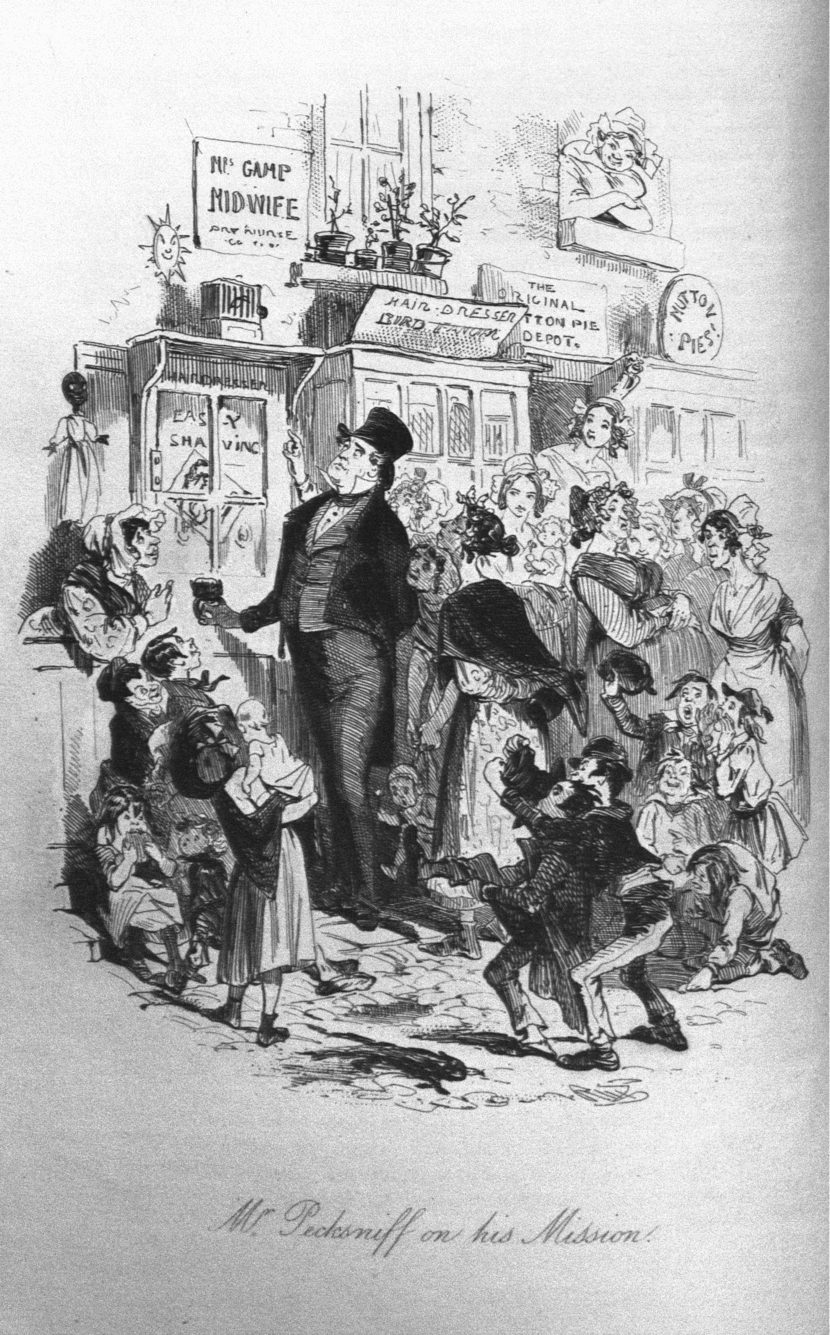
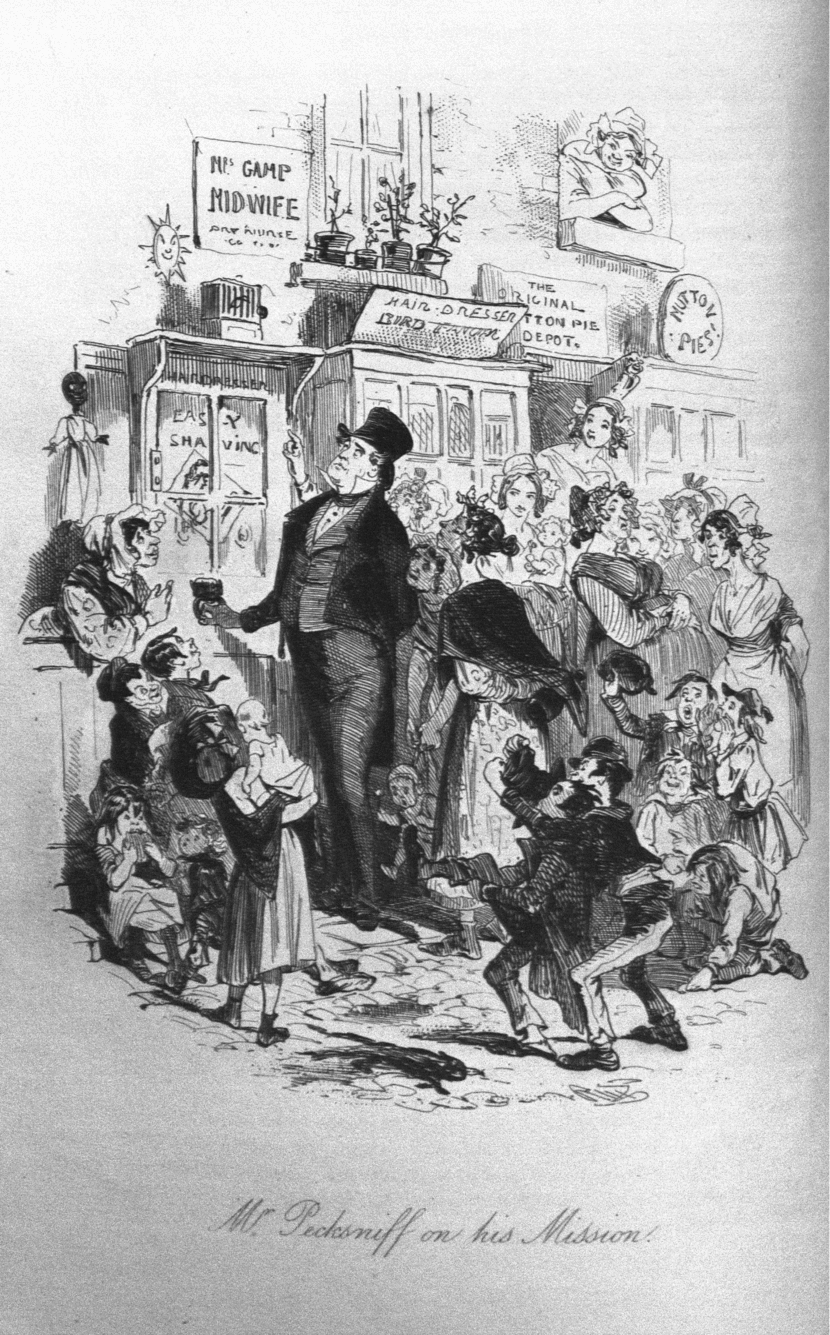
These three presences of dolls in poverty-stricken areas are not unique to Bleak House's illustrations. Phiz also used the figure of the black doll in illustrations for Martin Chuzzlewit and Dombey and Son, two texts preceding Bleak House. In the first etching, “Mr. Pecksniff on his Mission,” a joke based on the lower class's misinterpretation of Mr. Pecksniff's “mission,” a black doll hangs from a dirty storefront adjacent to the door to Mrs. Gamp's midwifery service. Mr. Pecksniff is seeking out Mrs. Gamp for her assistance in preparing a body for burial, but the individuals populating the street interpret him as an expectant father, and the woman who leans on the half-open door nearby casts an especially knowing look at him. This misinterpretation of Mr. Pecksniff's purpose highlights the distance separating Mr. Pecksniff and the commoners – the doll, in this etching, is yet another symbol of this “otherness” (Figure 4).
H. K. Browne, “Mr. Pecksniff on his Mission.” Etching, from Charles Dickens, Martin Chuzzlewit (London: Chapman & Hall, 186, Strand, 1843–44), 8, preceding 225. By courtesy of the Department of Special Collections, Memorial Library, University of Wisconsin-Madison.
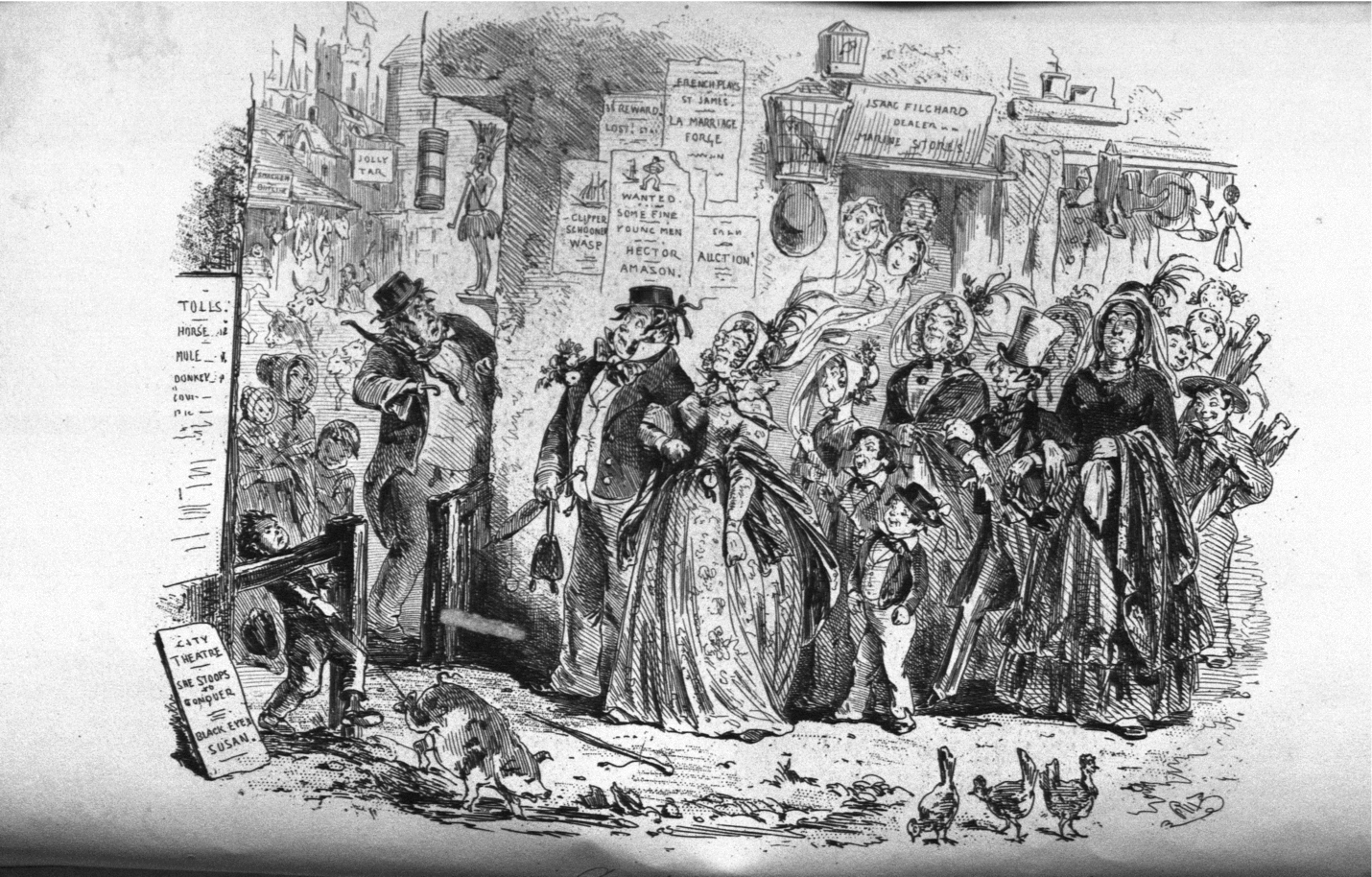
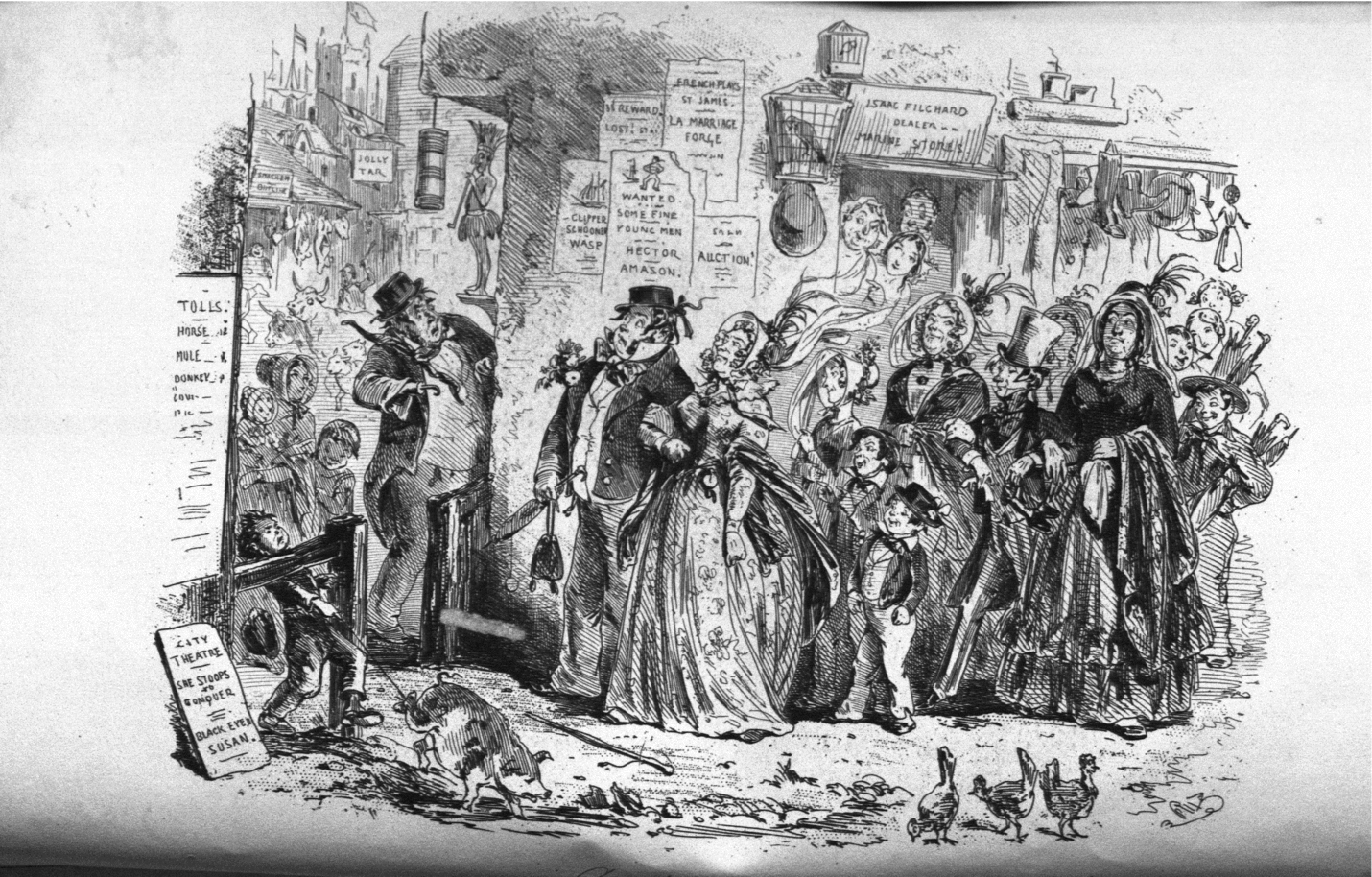
In the second etching in which the doll appears, Dombey and Son's “Another Wedding,” the wedded couple, Jack Bunsby and Mrs. MacStinger, passes through an area of town filled with shops. As Steig details for us,
Individual details either reflect the main idea of capture and imprisonment – or worse – or comment on some aspect of the marriage. . . . Several animals are emblems for Jack Bunsby in his present woeful state: the cows and sheep being led through the street . . . and the carcasses of animals (including two detached hearts) hanging up outside Smashem the butcher's next to the Jolly Tar suggest that the capture is to be followed by a slaughter, at least symbolically; the pig, tethered by the hind leg and striving to escape his little owner, reflects Bunsby's present state of mind; and the caged birds over the hung up sailor's hat predict his future state as a married man. (109)
The doll, which hangs among an assortment of boots and clothes along a wall that the couple passes, is not alone in being an overlooked element in this exhaustive description of Phiz's etching: a carved Native American holding a pipe stands outside the smoke shop is also absent from this list. In fact, statues of Native Americans outside smoke shops appear in several of Phiz's etchings and are also ignored by critics like Steig with consistency. This symbol is not so unfamiliar as the doll, as statues of Native Americans still stand in front of general stores and cigar shops in parts of the United States. The symbol would have been familiar to Bleak House's readers on both sides of the Atlantic. Ralph Sessions, in The Shipcarver's Art: Figureheads and Cigar-Store Indians in Nineteenth-Century America, recounts that “at mid-century, nearly every tobacco store [in America] had a carved image of an Indian or some related type to advertise its wares” (9). The cigar store Indian was most commonly constructed by shipcarvers, a fact that contributes a fluid element to its transatlantic provenance (Figure 5).
H. K. Browne, “Another Wedding.” Etching, from Charles Dickens, Dombey and Son (London: Bradbury & Evans, Whitefriars, 1846–48), 9 & 10, preceding 577. By courtesy of the Department of Special Collections, Memorial Library, University of Wisconsin-Madison.
Why does this signified still register for us, whereas the black doll's no longer does? Unlike the sign of the Native American, which we still understand today on some level as a representation of “cigars and smokes sold here,” time has amputated the doll's signified when it is present outside of a shop, as it most often appears to be in illustrations. Yet both the doll and the Native American can be read in our contemporary set of signs and signifiers as representations of a colonial or enslaved subject. Depictions of the Native American, subjugated by America's treaties and policies of westward expansion, were executed in “the Noble Savage mode,” emphasizing the “ancient stoic and doomed modern hero on an inevitable course of destruction due to forces beyond his control” (Sessions 11). The black doll was a sign for either the slave on the American plantation system, or the colonial “black” subject in spaces as diverse as Barbados and India. Like the etchings, which reveal and obscure simultaneously, the doll and the Native American are depicted as advertising signs only because of their expendability and their ability to be controlled: the Native American, impressive because of his stoicism in the face of erasure; the black doll, a symbol of industry that was self-immolating, as it consumed the bodies of the workers that furthered it.
In the historical British context, the Indian and the black individual were sometimes interchangeable. Sessions notes a 1617 text by British author Richard Brathwait entitled The Smoaking Age, or The Life and Death of Tobacco, which contains a frontispiece depicting the inside of a tobacco shop. “On the counter, is a sculpture of a small, vaguely African figure in a feathered skirt with a tobacco roll under his left arm,” which Brathwait describes in racialized terms as “a Black-more” (22). These counter-size figures are an interesting forerunner to the female black doll hanging outside the rag and bone shop, and represent a link between black men and tobacco that is later paralleled by the link established between black women and cotton. Sessions observes that sometimes these carved figures were also affixed to external shop signs in the seventeenth and eighteenth century. Due to clutter, laws passed about projecting signboards, and an increase in literacy, these kinds of signs became less common during the Victorian Era (24). The figure of the black boy was used as a stand-in for the American Indian and eventually the Virginian beginning in the seventeenth century because the blackamoor, or the Ethiopian, was a more familiar symbol of Otherness for the British. What becomes even stranger about this habit is that slave labor was eventually used to supply the British with tobacco, bringing the advertising symbol of Otherness into full resonance as a subject of economic oppression.
The use of the figure of the Native American or the black boy in front of the tobacco shop is therefore a kind of colonial shorthand: the idea that Native Americans or Africans were profiting from the sale of American tobacco in the mid-nineteenth century is laughable, yet by using the original agent of introduction and procurement as a form of advertising, the colonial power both reminds viewers of those previously under its powers and asserts its power to continue controlling those subjects through its ability to delineate the marketplace with demands for tobacco and cotton.
Advertising
Through examination of the historical archive, the black doll takes shape as a sign among many signs, such as the pawnbroker's globes, the Native American or black boy statue, or the tavern's placard, in the world of Victorian advertising. Both dictionaries and literature from the latter half of the nineteenth century note the presence of the black doll as a sign outside of “dolly shops,” or rag and bone shops (and sometimes maritime shops) that functioned as unlicensed pawnbrokers. In Benjamin Leopold Farjeon's 1899 Samuel Boyd of Catchpole Square: A Mystery, the narrator notes the shops that the protagonist passes, including “more rag and bone shops, with black dolls spinning and strangling” (74). Farjeon's language choices indicate that modern critics are not alone in noting the violent nature of the doll's display.
The varied sources that mention the doll attribute its makeup to different materials, including “a portion of the large leg-bone of a cow dressed in a bundle of rags,” that, “as can well be imagined . . . becomes black and dirty” (Lovett 597); wood; or cloth (specifically muslin). The doll is also described as having two faces, as in Dickens's Sketches by Boz (1835), which notes, “imagine, in addition to this incongruous mass, a black doll in a white frock, with two faces – one looking up the street, the other looking down, swinging over the door” (qtd. in Farmer 212). Dickens himself was thus aware of the doll's associations, and used the doll for effect in some of his earliest work.
The origin stories of the doll are varied as well. Barrere and Leland's A Dictionary of slang, jargon, and cant notes that a Dolly shop is “a pawnbroker's shop of the poorest and lowest description. From the Yiddish dal or doll, poor, which suggested the hanging up a doll as a sign for such places” (319). In Ebenezer Cobham Brewer's Dictionary of Phrase and Fable, he notes that “A black doll used to be the sign hung out to denote the sale of silks and muslins which were fabricated by Indians” (237), indicating that the labor represented by the doll could also be attributed to another of Britain's colonies. Finally, in Edward Walford's Old and New London (1881), the origins of the dolly shop, or “Black Doll Shop,” are explicitly slavery. He reports the following story of a white woman who brings a black baby back from her travels with her, hoping to make a profit on it. As Robin Bernstein paraphrases in Racial Innocence: Performing American Childhood and Race from Slavery to Civil Rights:
The woman found “that such an article had no value in England,” so she “wrapped it up in a bundle of rags and sold it to one of the founders of the [used goods] trade.” That is, the white woman discovered that she could not sell a slave in England and therefore disguised the baby as stolen rag and bone, as a thing, which was salable. According to the legend, the “little nigger” – a girl – was raised at the expense of the church. When she grew up, she opened her own used goods shop. . . . She marked her storefront with a black doll “hung out as a sign.” (224)
In England after the passage of the Slavery Abolition Act of 1833, the black individual must be disguised as a thing in order to be sold, and even then, the item can only be sold to a rag and bone shop, a shop which will buy almost any thing in the name of profit. This is, of course, in contrast to America, where the black individual was routinely sold as a thing; however, though slavery was outlawed in Britain during this time period, the violence of the slave trade still found a welcome berth in Britain's ports, raising questions of Britain's contributions to violence against black bodies and individualism.
Descriptions of the sign frequently note the fact that the doll is hanging, and several nineteenth century British texts identify this as an act of violence, perhaps subconsciously tapping into the dark vein of British complicity in the slave trade. In Richard Rowe's Episodes in an Obscure Life: being experiences in the Tower Hamlets (1871), the narrator writes “A rusty gibbet protrudes from the lintel of the shop-door, and at the end of the gibbet dangles a grinning, goggle-eyed wooden negress, with cataleptic arms and legs, and arrayed in a flaring-bordered nightcap and gown of what was once perhaps white calico” (133). The indeterminacy of its origins (semantic, bone, cloth, or wood), contrasted with the precise way the doll is used to advertise, seems to contribute to its ability to unsettle the consciousness of the viewer, either through its seeming monstrosity, the violence of its presentation, or the strangeness of its display. This unsettledness may also be due to the unacknowledged role the viewer realizes he or she may play in the violent display of black bodies at American auctions, in the form of the historical British facilitation of shipments of black individuals destined for slavery in America, and perhaps, eventual lynching.
This unsettling presence places the doll in a particular relationship and way of meaning to the Victorian consumer and the Victorian reader. Baudrillard, in The System of Objects, outlines a way of reading advertising that also uses the same key word that Spivak employs in her work: “haunts.” Baudrillard uses “haunts” (210) to refer to advertising's ability to “haunt” the consciousness of the consumer; advertising's system of speaking objects communicates directly with the viewer and consumer through a kind of psychological language. “Advertising,” he tells us, “is mass society itself, using systematic, arbitrary signs to arouse emotions and mobilize consciousness, and reconstituting its collective nature in this very process” (198). Both Baudrillard and Spivak direct attention to haunting, which all too often goes unexamined as unimportant, or is purposely neglected as a critical way for the economic system to further itself. If this haunting were better understood, advertising and the monolithic historical register could lose their talismanic power.
For example, in relation to Baudrillard's system of advertising signs, the Native American statue in Britain does seem asyntactic. We can only uncover the real linkage of signifiers if we can dig beneath “Native American statue means smoke shop” to “smoke shop means tobacco” and then “tobacco means Native American.” The purpose of the Native American is not to provoke the consumer to ruminate on the nature of the tobacco trade with the United States. Instead, it is a visceral, direct, systematic sign that is designed to align the British consciousness with the idea that the statue means they can buy cigars. Any of the residual, “logical” reasons for this linkage are relegated to the realm of the “haunting,” and any rumination on the logical reasons raises problematic questions about the status of the rights of the Native American, as well as the slave-picked source of the favored crop.
Historical Context for the Black Doll
The black doll performs this same act of submerged advertising “haunting” thanks to a complex linkage of signifiers, not all of them sequential or teleological. In the mid-nineteenth century, the cotton market was dominated by the United States, specifically the Southern states. This was not always true. Before the invention of the cotton gin in 1793, Britain relied heavily on its colonies in South America, especially Surinam, for its raw cotton. Yet after Eli Whitney's invention, production of cotton in the American South increased rapidly. By 1858, Senator Hammond of South Carolina could famously remark, “No, sir, you dare not make war on cotton. No power on earth dares make war upon it. Cotton is king” (Bailey 333). “King Cotton” supplied the textile markets of England with raw cotton, where “about one fifth of the population of England earned its livelihood, directly or indirectly, from the manufacture of cotton products. About 80 per cent of the fiber that supported this huge establishment came from the [American] South” (Bailey 333). The South placed great pride in its dominance in the cotton market and depended heavily on the market in political maneuvering. Britain recognized this dependence, as shown in the epigraph from Punch: while Britain might consider itself anti-slavery, it was more than willing to look the other way if it meant a continued supply of cotton. However, during the Civil War this pride and dependence caused the South one of its biggest disappointments. The South believed that a Northern blockade of its cotton supply would ultimately bring the war to a quick resolution, its supply of cotton to Britain being so essential to British commerce that a reduction in the amount of “white gold” being exported would force Britain to intervene in the war on the South's behalf. However, there was a 50% oversupply of cotton in England at the time the North did institute a blockade, and the English cotton manufacturers were instead able to make a huge profit off of their stockpiles of cotton. In the meantime, Britain began expanding its cotton markets in India and Egypt. While the sentiment of the Punch poem might make it seem like the British were concerned with the American South and their ties to it that were composed of “cotton,” once that source of cotton was unavailable, they quickly turned this to their advantage. The ties of cotton were not so strong after all, or were only strong as long as they were economically convenient. Once they were not, the geographical search for larger and less expensive sources of cotton began. This flexibility in the face of reduced supply indicates that not only was Britain's complicity in the cotton market problematic (despite Britain's anti-slavery actions and treaties, it still continued to deal with a market that relied solely on slave labor), this complicity was completely by economic choice rather than necessity, and might therefore have been addressed more directly and ethically.
At the time the black dolls were appearing in Phiz's drawings, the United States’ South was unquestionably the dominant player in the cotton market. This dominance meant a corresponding dependence on slave labor. British politicians and abolitionists were under no illusions as to the source of the labor producing the nation's cotton. Early in the nineteenth century, around the passage of the 1807 Slave Trade Act, Britain's budding abolitionist movement had to take a hard look at the ways in which the British economy was complicit in the slave trade as it furthered its own economic interests. As historian Hugh Thomas explains, “Wilberforce and his friends realized bitterly that, ten years after the formation of the abolitionist movement, British ships were still carrying over 50,000 slaves a year to the Americas, and that the years 1791–1800 had seen the British slave trade at its most grandiose – nearly 400,000 slaves had been landed from about 1,340 voyages” (Thomas 541). These slaves worked on the cotton plantations that turned the wheels of the British textile industry.
The demand for slaves from America was gendered as well as clamorous. “[The triumph of the cotton gin], depending on the cultivation on a large scale of green seed-cotton in Georgia and the Carolinas, marked the conversion of this crop into the most important item in North American exports, and caused an unprecedented demand for slaves; especially women, since it was supposed that the sensitive harvesting of cotton demanded female labor” (Thomas 571–72). The figure of the black rag doll in front of the British rag shop becomes clearer, if no less strange, in light of these historical details. The doll, dressed in the textile products derived from her labor, seems to hang in the shop window as a sign representing the cotton market and its American origins.
As with the Native American statue, we can attempt to construct an advertising “reasoning” for this presence: “Black doll means rags bought here/rag shop” predominantly, but also “rags bought here/rag shop means textile industry,” “textile industry means raw cotton,” “raw cotton means American South,” “American South means slave labor,” and “slave labor means black female.” Again, the sign subsumes all of these direct meanings into a general, overarching symbol of commerce. Additionally, the dolls represent unlicensed pawnbrokers. The reason behind this linkage is more nebulous, and seems to be associated with the way that the doll can also represent Otherness regarding the working poor patrons of the dolly shops. The unlicensed pawnbrokers, or dolly shops, were frequented by the poorest of the poor: the very individuals Carlyle and other social theorists equated with black savages. Loans on pawned goods had short durations (around three days at the most), and the profits often went to necessities such as food or drink. The dolly shop was thus an emblem of a society in which the poor were often no better off than indentured slaves, forced to pawn what little they had to subsist, and kept in their social place by a system that allowed for little economic mobility and relied on a form of class fatalism that kept the dolly shops in business. If the poor were savages, it was not a darkness that could be sloughed off like ash from the factory, it was a permanent darkness that both marked the working-class as worthy of pity from social theorists, and denoted the futility and danger of trying to “civilize” them.
The commerce of rag shops existed in England because of the value of the textile market. Clothes worn by middle class and upper class British citizens found their way into the hands of the “clobberer” and the “translator,” who used their skills to transform worn-out clothes into clothes for children or newer-looking articles sold cheaply to the lower classes. These items were then worn until they, too, wore out and fell to rags. Yet there was even a market for rags in England, represented by the rag shops:
The cast-off clothes of all Europe are imported to supply food for the mills of Leeds, Dewsbury, Batley, and other great industrial centres. Here they are torn into shreds by toothed wheels, animated with all the power of steam, till they are reduced to the condition of wool. They may then be mixed with a certain amount of new wool, and finally reappear as new cloth, woven according to the latest pattern, and resplendent in the dye of the most fashionable colors. (Thomson 56)
This insistent system of circulation draws continual value from a single item. Like the slave, who is an ongoing source of income for a master (and specifically the female slave, who can bear new generations of workers), a single piece of cloth could also be pressed into service for an indeterminate amount of time and could even give rise to new cloth.
While the black dolls were thus signs of productive though somewhat seedy commerce during the Victorian era and were not offensive signs (for what shopkeeper would hang an offensive doll outside his or her door in hopes of drawing in customers?), they are certainly a complicated one. The rag shop, housed in a junk shop or standing alone, was hoping to entice rag pickers to sell their “crops” to the shop. Instead of Baudrillard's sign that signifies consumption of the consumer, this sign signifies consumption of the nation. While the sign of the black American woman could be a simple metonymic stand-in for cotton in this form of consumption, the figure also irrevocably and insistently calls up the specter of slavery, presenting a constant haunting reminder of the source of the cotton running the British textile industry – fields in the South of the United States peopled with slaves hunched over in the sun for hours a day, picking cotton with cracked fingers, themselves clothed in little better than rags.
Material Culture and the Doll
To the twenty-first century reader, the black doll is something that perhaps calls up the problematic use of blackface for comedic purposes, or the still-current advertising usage of the domesticated mammy figure of Aunt Jemima. The black doll is obviously still inescapably associated with the economic and advertising register. The reader might even have grown up as a child with a “golly doll,” or a “golliwog”; these black dolls, themselves caricatures of the American minstrel caricature, became popular in Britain in the 1890s and were still used in British advertising well into the late twentieth century. Many British advertisers did not understand why some individuals found the caricature offensive (Danna 131). Incidentally, Bleak House’s black doll predates the golly doll by a good forty years – the earliest depiction of the black doll I could find was from the 1840s, hypothetically around the time the events of the novel take place, while the first book featuring the golliwog did not appear until 1895.
The well-established presence of the doll or black body as a transatlantic marketing strategy in the twentieth century is not a coincidence, and has strong roots. While the earliest sign of the black body and commerce coinciding may be the smoke-shop statues of black boys, the black body was certainly not an unfamiliar presence in mid-nineteenth century marketing. In Martha Katz-Hyman and Kym S. Rice's extensive Encyclopedia, World of a Slave, they note “Pre- and post-Civil War, Harriet Beecher Stowe's 1852 novel Uncle Tom's Cabin spawned commercial tie-ins of every conceivable sort, including dolls. . . . Uncle Tom's Cabin rag dolls, including Topsy Turvy dolls featuring Eva and Topsy, proliferated from the 1850s through the 20th century” (187). While the most common manufacturing tie-in was the ceramic “Tomitude,” the Topsy Turvy doll, which presents as one doll, but then flips over to reveal another doll hidden under its skirt, was well-established enough through this marketing that it is still a doll form in use today (Usually employed with Red Riding Hood and the Wolf, say, rather than Eva or Topsy; the idea of “opposites” still seems to apply.). However, given the timing of Phiz's illustrations, the dolls are obviously not Topsy Turvy dolls, despite not always having feet: the doll depictions predate not only the manufacture of these dolls, but Uncle Tom's Cabin itself.
Yet even before Uncle Tom's Cabin, black dolls were apparently used as a specifically abolitionist tool. Katz-Hyman and Rice go on to note that, “For their part, abolitionists in Great Britain and the United States used dolls to raise public awareness about slavery and to generate empathy for slaves. Philadelphia Quakers sent black dolls, both male and female dressed in traditional Quaker Clothing, to Friends in Britain, perhaps as testimony to free black's piety and respectability” (187). Philadelphia's Atwater Kent Museum's exhibit on Quakers and abolitionism includes two black dolls of this nature made in the 1830s. According to the curator of collections, Jeffrey Ray, the dolls “were made when an inquiry came from England about what black Friends, or Quakers, looked like. England had no black Friends, but Philadelphia did. Paintings weren't made because Friends shunned them as self-celebratory. But the dolls, dressed for Sunday meeting, are a kind of portraiture of black Friends” (Garcia-Barrio). These dolls, circulating outside the economic system, were sent as gifts or instructional aides. Their express purpose was to encourage people to examine black people as individuals, and not as things to be exchanged on the commodity market. The fact that the dolls were used as gifts or sent overseas removes the dolls themselves from a system of commerce. Yet the fact that dolls were used to restore humanity to black individuals seems problematic. Since a doll is a thing, why would a thing be used to show that a black human is not a thing?
One explanation might be the rich interior life that dolls led, from the early eighteenth-century onward, in object-narratives. Phiz even illustrated one of these narratives himself, entitled The Doll and her Friends, Or, Memoirs of the Lady Seraphina (1862), by Julia Charlotte Maitland. In one of his illustrations, several girls play with dolls, and the central doll is a black doll in fancy dress. Nineteenth-century readers would be acquainted with narratives expressing the interiority of things, including dolls, which would then encourage them to view the objects less as inanimate things and more as things with a spiritual, rounded history and existence. Esther, telling stories to her doll, surely imbues the doll with an interiority and an ability to absorb secrets that the doll does not have.
While the dolls gifted by Quakers might have worked towards establishing this aura of personhood or interiority to black individuals, the doll as an advertising sign seeks the opposite: a hollowing out of black women's history in the service of insistent circulation and exploitation. A consumer would not want to think about the slaves producing the cotton for the coat or rag industry, and rag-pickers themselves would not want to be identified as slave labor. The doll then seems to walk a fine line between the rich personal thing histories of the eighteenth and early nineteenth century, and the movement towards things entering the commodity market and becoming stripped of their specific and personal histories.
Katz-Hyman and Rice note one other use of dolls, this time white, which explicitly addresses this issue. “The Boston Antislavery Bazaar sold Scottish fashion dolls holding paper declarations such as ‘Sell me as they do women and children in your country. It will be no sin in my case.’ Aimed at adults as well as children, these abolitionist dolls drew a hard line between buying “things” and buying people. Dolls were human replicas, not human beings” (187). Yet there was still some way in which a representation of a human was designed to garner sympathy or understanding in the abolitionist context. This drive seems to move against the direction in which advertising pushes a thing like the doll; advertising helps accomplish the work of capitalism by severing the doll from its history and haunting. Abolitionist uses of the doll push back against this tide.
Slavery and Bleak House
Efforts towards the abolition of slavery had voices opposing them that were disconcertingly like what Dickens offers his reader in Bleak House. Further back in the historical archive, “In a debate in 1791, Colonel Banastre Tarleton suggested that people . . . who were looking for philanthropic work should concern themselves with the poor laws rather than devote their time to ruining a trade of great benefit to the country” (Thomas 516). The call for attention to return to Britain from abroad thus has historical precedent. Yet Dickens does not appear to outline his “charity begins at home” philosophy out of a desire to avoid abolitionist concerns (though this blind eye might be a side effect of his suggestions). In fact, Dickens satirizes those who supported slavery in Bleak House through the character of Mr. Skimpole, who remarks, “Take an extreme case. Take the case of the Slaves on American plantations. I dare say they are worked hard, I dare say they don't altogether like it, I dare say theirs is an unpleasant experience on the whole; but, they people the landscape for me, they give it a poetry for me, and perhaps that is one of the pleasanter aspects of their existence” (251; ch. 18). Here, Dickens turns a critical eye on the practice of privileging the pleasure of the viewing British subject. He excoriates the idea that the British subject should derive aesthetic value from a system that is clearly damaging and deadly, however much they might “dare say” about its debilitating impact. Yet the ambiguity of Skimpole's unexamined aesthetic hints at something darker and deeper-set in the British psyche: if a slave-populated tableau can be poetic, then the lives of the slaves are somehow elevated and made easier; therefore, they are not cause for guilt. Similarly, if a picturesque, domesticated black doll can represent cotton, this elides the historic stench of the Middle Passage taking temporary refuge in England's ports before traveling to the Americas, and the abused black slaves whose labor made that new overcoat possible.
Serialization and Illustration
A concrete example of the linkage between Bleak House and the issue of slavery in America can be found in the original serialized volumes of the Dickens novel. While the frontispiece of the first volume includes a figure of a woman with a black child underneath each arm (perhaps a rather charitable depiction of Mrs. Jellyby's activities), the third volume includes an ad for Uncle Tom's Cabin in the Bleak House Advertiser. Stowe and Dickens's novels, published on opposite sides of the Atlantic in almost the same few years, thus speak to one another. Given Uncle Tom's popularity (the advertisers note that it has gone through ten editions in fourteen days), it is not surprising that it is advertised in a successful publication like Bleak House. Yet the linkages are stronger than that of mere promotion. The advertising references to Uncle Tom's Cabin in the Bleak House serialization uphold the British sense that slavery is a brutal, American habit.
By the fifth volume, the advertisers tap into this sentiment explicitly: “It is only after reading such a book that we can fully appreciate and realize the humanity of a principle which has annihilated slavery in the British Colonies. Never till now did we comprehend the reasons for self-congratulation” (5). The advertising literature, much like aspects of the novel Bleak House itself, emphasizes the ways in which Britain, cleansed of the taint of slavery, holds itself above America. Directly after Skimpole's remark about the picturesque aspects of black slaves, Esther remarks “I always wondered on these occasions whether he ever thought of Mrs. Skimpole and his children, and in what point of view they presented themselves to his cosmopolitan mind. So far as I could understand, they rarely presented themselves at all” (251; ch. 18). Daniel Hack and others have read this moment as another indictment of “telescopic philanthropy,” as well as an explicit directive that it is wrong and problematic to consider American slavery at the cost of considering one's family or countrymen. As Hack describes it in “Close Reading at a Distance: The African-Americanization of Bleak House,” Esther's response reveals that “Skimpole's moral deficiency consists not in the point of view in which American slaves present themselves to his mind, as one might imagine, but rather in the very fact that he thinks about them.” However, I argue that Esther's comment is instead designed to expose Skimpole's hypocrisy by highlighting his self-congratulation and aligning the slaves he observes with Skimpole's economically oppressed family. It is not necessarily that charity should begin at home, it is that a focus on far-away issues with no acknowledgment of Britain's complicity in their manufacture is what also encourages characters like Skimpole or Mrs. Jellyby to ignore the destruction and pain of their own making in more local and familial spheres. Rather than condemning Skimpole's consideration of the slaves, Dickens parallels the hypocrisy of the individual with the hypocrisy of the nation. The problem is not that Skimpole thinks of the slaves, it is that he does not think of them critically enough. In Esther and the novel's vision, this hypocrisy is widespread. Phiz's use of the black dolls strengthens this sense of testifying to Britain's hypocrisy regarding the slave trade, as does the fact that the Bleak House volumes themselves are inescapably intertwined with the cotton trade through their advertising and paper content.
In addition to the Uncle Tom's Cabin advertisements, Bleak House also contains advertisements for E. Moses and Son's “Anti-Bleak-House” warm clothing. Several of the serialized volumes include pages that double as needlepoint patterns (Crochet Cotton slips), making the text itself into a seamless integration of words and fabric. Christina Lupton notes that thinking about serialization and publishing in the mid-nineteenth century “may mean thinking bibliographically or aesthetically about an edition of a book – in this case, for instance, one could take Freedgood's point [about curtains in North and South] a step further by pointing out that most paper on which quality books were printed in the 1850s was still made from cotton rags, and was therefore implicated in the very economy of the curtains” (237). Indeed, even the paper that the serialized editions would have been printed on was partly comprised of cotton rags in 1853, as alternate sources for paper production such as straw and wood pulp were not pursued commercially until 1853 and 1854, respectively. Even then, as economic historian Marjorie Plant points out, “paper of this kind was of little direct use in the book industry,” which maintained a reliance on rags (334). The paper industry was still importing 15,000 tons of rags per year in order to supplement its other sources in the British linen and cotton manufacturing industries as late as 1861, when the Excise Duty on rag-paper that the public and book-sellers chafed against was finally lifted (Plant 335).
It is thus fitting that the rag trade is implicated throughout the extra-textual material in the volumes. Cotton, from Harriet Beecher Stowe's work to the crochet patterns to the paper itself, is inescapable. The published novel, whether it is Uncle Tom's Cabin or Bleak House, is a kind of Skimpole, demanding advertising and materials for its aesthetic and economic existence that are damaging; hypocritically, texts then further the very systems they critique with their explicit pursuit of increasing readership and demand for their content. This desire for more readers is built into the very form of the serial novel, which draws readers in with the promise of fulfillment in the next installment. More readers mean more cotton content; more cotton content means that the novels cannot escape the very insidious systems that they and Phiz identify.
Conclusion
While the black doll is unfamiliar to contemporary readers, it proves, on closer examination, to be an important element of H. K. Browne's work, one that both illuminates and obscures. A closer integration of analysis of illustration and text reveals that the dolls ask readers to examine their own complicity in a system of slavery that Britain would prefer not to consider in order to maintain its own economic benefit. However, the dolls do not press for too much examination, as they are ultimately an advertisement not for the actual dolly shops they represent outside the realm of the text and illustration, but for Bleak House itself. Artfully, atmospherically, and even humorously rendered, the dolls represent the seamless partnership between Dickens and Phiz in the economic register of the book trade, suggesting that such a gifted pairing deserves new readership and attention. Consumers of books may consider slavery and the cotton trade, but should not pursue the logical connections too far. To make the final link from the rag-paper book in their hands to the insidiousness of the demands of the cotton trade would be to eliminate the very readers who might hypothetically protest against the brutalities of slavery and Britain's role in producing these injustices. Therefore, the dolls continue to haunt the realm of the illustration and perhaps the subconscious of the reader, yet are left at the mercy of the historical register, slipping towards silence.