Introduction
Tonsillectomy is one of the most frequently performed surgical procedures in the world. Tonsillectomy-associated morbidity can have a negative impact on the patient's quality of life during the post-operative period. Many patients avoid the operation because of post-operative throat pain and the risk of haemorrhage, and this may cause serious systematic problems. Sometimes patients may refuse to swallow or to eat because of the severity of pain and this may cause more serious problems.Reference Stoeckli, Moe, Huber and Schmid1–Reference Nandapalan and McIlwain3 Hence, many studies have focused on reducing post-operative pain and haemorrhage.
A variety of methods have been employed with the aim of reducing post-operative pain and haemorrhage. These include: obliteration of the tonsillar fossa;Reference Nandapalan and McIlwain3 the use of various antibiotics;Reference Telian, Handler, Fleisher, Baranak, Wetmore and Potsic4–Reference Dhiwakar, Clement, Supriya and McKerrow6 the injection of local anaestheticReference Uzun, Ozkiriş, Akbulut and Unver7–Reference Kitajiri, Tabuchi, Hiraumi and Kaetsu9 or steroidsReference Mahant, Keren, Localio, Luan, Song and Shah10, Reference Magdalena, Caragol, Solé and Rodrigo11 to the tonsillar fossa; the use of mouthwash containing antibiotics;Reference Jahanshahi, Pazira, Farahani, Hashemian, Shokri and Karkhanei12 the application of sucralfate to the tonsil region;Reference Jahanshahi, Pazira, Farahani, Hashemian, Shokri and Karkhanei12–Reference Miura, Saleh, de Andrade, Assmann, Ayres and Lubianca Neto14 the use of honey;Reference Ozlugedik, Genc, Unal, Elhan, Tezer and Titiz15 the application of fibrin glue;Reference Stoeckli, Moe, Huber and Schmid1, Reference Moralee, Carney, Cash and Murray2, Reference Kitajiri, Tabuchi, Hiraumi and Kaetsu9 aromatherapy;Reference Soltani, Soheilipour, Hajhashemi, Asghari, Bagheri and Molavi16 transcutaneous electrostimulation;Reference Lombard, Tomasi, Charpentier, Drouet and Salgas17 and acupuncture treatments.Reference Ochi18
Autologous serum has been in use for more than 20 years and is currently used for the treatment of ocular surface diseases,Reference Kaya and Akova19–Reference Scardovi, De Felice and Gazzaniga21 in the form of intra-articular and intraosseous injections,Reference Matsuo, Yamazaki, Takase, Aoyagi and Uchinuma22 and as a carrier for augmentation material.Reference Yanaga, Yanaga, Imai, Koga, Soejima and Ohmori23 The serum contains epidermal growth factor, tumour growth factor beta, fibronectin and vitamin A, all of which have the property of accelerating epithelisation. In addition, the serum has antibacterial properties because of the immunoglobulin G and lysozyme ingredients. Autologous serum can be preserved for one month in a refrigerator and for up to three months in a deep freezer.Reference Kaya and Akova19
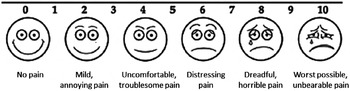
Pain is a subjective symptom and varies depending on the patient's personality, environment, personal perception of pain and ability to express pain. As a result, pain is very difficult to measure. Many methods have been developed for evaluating pain after surgery. The visual analogue scale (VAS) is a frequently used measure. In one such scale, a range of facial expressions are presented: the face at one end indicates no pain (with a score of 0) and the face at the other end represents the most pain (with a score of 10) (Figure 1). Patients are asked to indicate which facial expression corresponds with their pain, and this is converted into a numerical score. The VAS has been found to be an effective method of rating pain.Reference Bieri, Reeve, Champion, Addicoat and Ziegler24
Visual analogue scale used for the assessment of pain; scores range from 0 (no pain) to 10 (worst imaginable pain).

With regard to the effect of autologous serum, we hypothesised that it may reduce throat pain duration and shorten healing time by accelerating epithelisation in the tonsillectomy region. Given its bacteriostatic effect, it was expected that the autologous serum would prevent bacterial colonisation of the surgical area, which is left as an open wound in the post-operative period, and facilitate healing. This study aimed to compare the efficiency of autologous serum applications in terms of reduced post-operative throat pain, haemorrhage and healing duration in patients who had undergone tonsillectomy.
Materials and methods
The present study was conducted based on the principles of the Helsinki Declaration of 1975, as revised in 2008, and was approved by the Ethics Committee of Canakkale Onsekiz Mart University. Informed consent was obtained from both parents of each child.
Thirty-two patients aged between 4 and 15 years were included in the study. The indications for tonsillectomy included: chronic tonsillitis, recurrent acute tonsillitis or chronic obstructive sleep apnoea. Patients with a history of systemic diseases, such as severe cardiovascular disease or severe pulmonary disease, peritonsillar abscess tonsillectomy, and those who rejected participation in the study, were excluded. The data recorded, which included the patients’ age and gender, visible tonsil size before the tonsillectomy, the tonsillectomy indications, and medical history, were collected before the operation.
Autologous serum preparation and administration
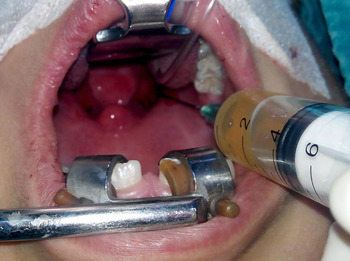
On the morning of the surgery, 8–10 cc of peripheral venous blood was taken in a standard gel straight tube and centrifuged at 1500–2000 ×g for 10 minutes to separate the serum. The autologous serum was administered with a sterile injector on three occasions (2 cc at each time point): during the operation, and at 8 and 24 hours post-operatively. The serum was administered topically (by the same team) for 10 minutes to the right tonsillar fossa only (Figure 2), while the patient leaned to the right side.
Administration of autologous serum.

Surgical procedure
The general anaesthetic technique was standardised across patients. Tonsillectomy was performed under general anaesthetic by the same surgical team using the cold dissection technique in the classic tonsillectomy position. Haemostasis was achieved by suture ligation and bipolar cautery on both sides. The autologous serum was applied topically to the right tonsillar fossa only (approximately 2 cc). The left tonsillar fossa was identified as the control side.
All patients were prescribed amoxicillin clavulanic acid suspension (50 mg/kg) for 7 days and analgesic suspension of oral paracetamol (15 mg/kg) 3 times per day. The patients were advised to use analgesics depending on pain. They were given a soft diet for 10 days. Generally, patients were discharged on the 1st post-operative day.
Throat pain evaluation
The patients’ parents were asked to evaluate right- and left-sided throat pain separately, on a daily basis, using the VAS to attain scores from 1 to 10 (Figure 1). The total VAS score was used to determine overall pain severity (ranging from 0 (no pain) to 100 (severe, extreme pain)).
Oropharyngeal examination
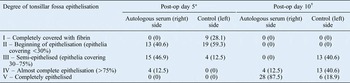
On the 5th day and 10th day, the oropharynx of each patient was examined, in terms of haemorrhage and healing time, by the same physician (MK). The appearance of both tonsillar fossa (assessed separately), in terms of epithelisation, was rated using the method described by Ozlugedik et al.Reference Ozlugedik, Genc, Unal, Elhan, Tezer and Titiz15 Epithelisation was staged according to the appearance of tonsillar fossa, as follows: I – completely covered with fibrin; II – beginning of epithelisation (epithelia covering less than 30 per cent); III – semi-epithelised (epithelia covering 30–75 per cent); IV – almost complete epithelisation (more than 75 per cent); and V – completely epithelised.
Statistical analysis
Patients’ age, gender, tonsil size, tonsillectomy indications and medical history were recorded. Non-parametric gender data were analysed for differences using a chi-square test. Daily VAS scores were determined, beginning with those recorded on the first evening following the operation; the total scores for the right and left sides were calculated and statistically compared for differences using the Wilcoxon signed-rank test. Epithelisation of both tonsillar fossa was rated separately, and epithelisation rates were compared on the 5th and 10th post-operative days using a Wilcoxon signed-rank test. Statistical analyses were performed using SPSS statistical software, version 19 (SPSS, Chicago, Illinois, USA). Statistical significance was set at p < 0.05.
Results
A total of 32 patients, aged between 4 and 15 years (mean = 7.13 ± 2.99 years; median = 6 years), underwent tonsillectomy surgery and were included in the study. Sixteen of the patients were female and 16 were male. There was no significant difference in terms of gender (p > 0.05). Regarding tonsillar size prior to the operation, 18 of the patients were grade 2, 12 were grade 3, and 2 were grade 4, according to Brodsky's grading scale.Reference Brodsky25
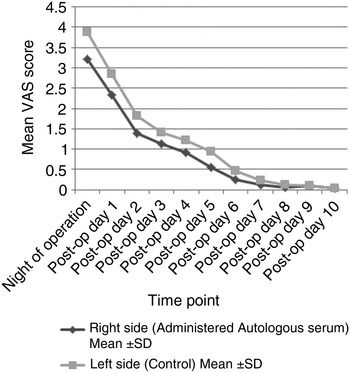
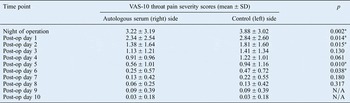
On the night of the operation, the mean VAS scores were 3.22 ± 3.19 for the study side (side administered autologous serum) and 3.88 ± 3.02 for the control side (opposite side). However, on all subsequent post-operative days, the mean VAS scores were below 3 (Table I). On the night of the operation, and on post-operative days 1, 2, 5 and 6, the pain scores for the study side were significantly lower than those for the control side (p = 0.002, p = 0.014, p = 0.015, p = 0.010 and p = 0.038, respectively). On other days, the pain scores for the side administered autologous serum were lower, but the difference was not significant (Figure 3).
Mean 10-point visual analogue scale (VAS) throat pain severity scores for the autologous serum (right) and control (left) sides during the 10 days post-tonsillectomy. Post-op = post-operation

Post-tonsillectomy throat pain scores for autologous serum and control sides

*Statistically significant difference; p < 0.05. VAS-10 = 10-point visual analogue scale; SD = standard deviation; post-op = post-operative; N/A = not applicable
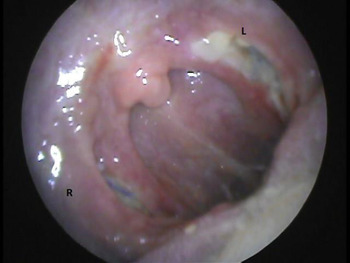
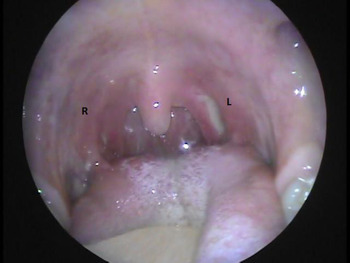
The patients used analgesics for an average of 3.53 ± 1.88 days (range, 0–7 days). Oropharyngeal examination, in which tonsillar fossa epithelisation of the study side was compared with the control side, revealed a statistically significant difference on post-operative days 5 and 10 (p = 0.008 and p = 0.002, respectively) (Figures 4 and 5; Table II). Tonsillar fossa epithelisation was accelerated following the application of autologous serum.
View of tonsillar fossa at post-operative day 5. R = right (autologous serum) side; L = left (control) side

View of tonsillar fossa at post-operative day 10. R = right (autologous serum) side; L = left (control) side

Tonsillar fossa epithelisation of both throat sides at 5 and 10 days post-operatively

Data represent numbers (and percentages) of patients. *p = 0.008; †p = 0.002 (statistically significant differences). Post-op = post-operative
In only one patient (3.12 per cent), bloody oozing was seen on the control side; this was spontaneously resolved on the 3rd post-operative day. No other complications were observed.
Discussion
Throat pain is common following tonsillectomy. Severe pain may cause a variety of problems such as reduced food and fluid intake, resulting in dehydration. It delays the patient's return to normal living and affects quality of life. In recent years, studies have focused on reducing post-operative pain. However, throat pain is still the most common and serious complaint post-operatively. In this study, we evaluated the effect of autologous serum administration for pain control after tonsillectomy. There are no risks involved in autologous serum application. To the best of our knowledge, these effects have not previously been reported.
Post-tonsillectomy throat pain can be the result of post-operative inflammation of the operation area, nerve irritation and pharyngeal spasms. As the post-operative area is no longer covered by mucosa, there is an infection risk. Some studies have reported that antibiotics administered after tonsillectomy decrease pain by reducing local flora and inflammation.Reference Telian, Handler, Fleisher, Baranak, Wetmore and Potsic4, Reference Jahanshahi, Pazira, Farahani, Hashemian, Shokri and Karkhanei12 Other studies have shown that antibiotic treatments have no effect on post-operative pain.Reference Burkart and Steward5, Reference Dhiwakar, Clement, Supriya and McKerrow6 While some studies examining the effect of bupivacaine injection in the peritonsillar region on post-operative pain have provided evidence for reductions in pain,Reference Uzun, Ozkiriş, Akbulut and Unver7 other studies have found no such effect.Reference Johansen, Harbo and Illum8, Reference Kitajiri, Tabuchi, Hiraumi and Kaetsu9
The VAS is frequently used to evaluate a patient's pain following surgery. Thus, we used the VAS to determine pain following tonsillectomy. As shown in Table I, while the mean VAS scores of our patients showed that pain was most severe on the night of the operation, from post-operative day 1, it was consistently reduced on both sides. On all post-operative days, the VAS scores were lower on the side given autologous serum, and this difference was statistically significant on the evening of the operation, and on post-operative days 1, 2, 5 and 6.
Miura et al. found that in 90 per cent of children given paracetamol after tonsillectomy, pain continued for the first 24 hours, and for the first 3 post-operative days 60–70 per cent had VAS scores of 3 and above.Reference Miura, Saleh, de Andrade, Assmann, Ayres and Lubianca Neto14 The same study reported that the average VAS score for the side given sucralfate after tonsillectomy was lower, and they emphasised that pain control was better, compared to the side given placebo. In our study, on all days except the night of the operation, the mean VAS scores were below 3 on the study side given autologous serum. Moreover, when we compared our patients’ VAS scores to those of patients where other treatments, such as fibrin glue, tramadol, prednisone, sucralfate, clindamycin, honey and lavender essential oil, were used, it can be seen that the scores in the present study were lower (Table III).Reference Stoeckli, Moe, Huber and Schmid1, Reference Magdalena, Caragol, Solé and Rodrigo11–Reference Soltani, Soheilipour, Hajhashemi, Asghari, Bagheri and Molavi16
Comparison of VAS scores in our study with previous studies

Data represent mean (±standard deviation) visual analogue scale scores. *Statistically significant difference; p < 0.05. VAS = visual analogue scale; post-op = post-operative
As pain is a subjective symptom, the amount of analgesic used after tonsillectomy and the duration of analgesic use are accepted as objective criteria to evaluate pain. Pain after tonsillectomy lasts about 9 days, and the pain is at its most intense on post-operative day 1, and it decreases thereafter.Reference Jahanshahi, Pazira, Farahani, Hashemian, Shokri and Karkhanei12 In our study, the average duration of analgesic use by patients was 3.53 ± 1.88 days. This duration appears to be lower than that reported in other studies, which leads us to consider that autologous serum is an effective method for post-tonsillectomy pain control.Reference Stoeckli, Moe, Huber and Schmid1, Reference Kitajiri, Tabuchi, Hiraumi and Kaetsu9, Reference Ozlugedik, Genc, Unal, Elhan, Tezer and Titiz15
Stoeckli et al. reported a relatively continuous level of pain in patients for the first 7 days after surgery, with a significant reduction after 8 days.Reference Stoeckli, Moe, Huber and Schmid1 In our study, the duration of analgesic use by patients ranged from 1 to 10 days, and was reduced from the evening of the operation onward. The mean VAS scores for the side given autologous serum were lower than those for the control side, although the VAS averages for both sides were lower compared to values reported in the literature. These results may be linked to the autologous serum contacting with the other side during swallowing. The findings lead us to believe that our results for pain control after tonsillectomy will be even better in the future.
The tonsillar fossa is left as an open wound after tonsillectomy. We believe that epithelisation of the tonsillectomy region was accelerated as a result of epitheliotropic factors contained within the autologous serum, which speed up the healing process. The main epitheliotropic factors contained in autologous serum are epidermal growth factor, tumour growth factor beta and fibronectin.Reference Chen, Hu, Huang, Shen, Tsai and Chen20 Additionally, the antibacterial properties of materials such as immunoglobulin G and lysozyme suggest the serum has bacteriostatic properties.Reference Kaya and Akova19 Epidermal growth factor is a mitogen growth factor found in serum, and has been found to be effective in healing epithelial defects.Reference Scardovi, De Felice and Gazzaniga21 Studies have reported positive results following treatment with drops containing topical epidermal growth factor or autologous serum in patients with corneal epithelial defects.Reference Kaya and Akova19, Reference Scardovi, De Felice and Gazzaniga21 Tumour growth factor beta stimulates the proliferation and migration of stromal fibroblasts, and regulates the epithelial proliferative effects of other growth factors.Reference Kaya and Akova19 When epithelisation of the study and control sides in our patients was evaluated, there was a significant difference on post-operative days 5 and 10 (p < 0.05). Our review of the literature indicates that our study is the first to evaluate the effect of autologous serum administration on epithelisation of the tonsillar fossa.
Haemorrhage is one of the most frequently observed and most serious complications following tonsillectomy. Primary haemorrhages may occur in the first 24 hours, while secondary haemorrhages may occur after 24 hours from any point in the tonsillar fossa. Ikoma et al. reported a general haemorrhage rate of 11.6 per cent, with primary haemorrhages accounting for about 1.6 per cent and secondary haemorrhages for about 10 per cent of this rate.Reference Ikoma, Sakane, Niwa, Kanetaka, Kawano and Oridate26 In our study, focal bleeding was only observed in one patient (3.12 per cent), on the control side, and this resolved spontaneously.
• Post-tonsillectomy morbidity affects quality of life during the post-operative period
• A variety of methods have been used to reduce post-operative pain and haemorrhage
• Autologous serum includes growth factors, antibacterial proteins, vitamins and epitheliotropic factors, which have potential to accelerate healing
• Topical administration of autologous serum seems to be useful for reducing tonsillectomy morbidity
The limitations of our study include the relatively small sample size. Although VAS scores were recorded by parents of the children and may be considered to be misleading, post-operative images of tonsillar fossa epithelisation are consistent with the VAS scores, indicating that the results are reliable. Further large-scale, multi-centred research studies are needed to assess the effectiveness of topical autologous serum for reducing post-tonsillectomy symptoms (differentiated by age, gender and different operation techniques) and to evaluate the effects of autologous serum on patients’ quality of life.
Conclusion
In tonsillectomy cases, the prevention of inflammation and/or acceleration of tonsillar fossa epithelisation play important roles in reducing the pain experienced by the patient. In our study, autologous serum accelerated tonsillar fossa epithelisation, prevented infections of the fibrin tissue covering the tonsillar fossa, reduced inflammation and nerve irritation, and contributed to the healing process. No allergic reactions to autologous serum and no other complications were observed. In the present study, VAS pain scores were lower and tonsillar fossa epithelisation was accelerated following the application of autologous serum. In our opinion, the morbidity of tonsillectomy can be reduced with autologous serum, which is easily administered and obtainable.