There are several neuropsychological tasks to assess decision-making behavior according to specificities of affective engagement and degree of uncertainty. For example, the Iowa Gambling Task (IGT) – developed by Bechara, Damasio, Damasio, & Anderson (Reference Bechara, Damasio, Damasio and Anderson1994) – is a well-known neuropsychological task to evaluate decision-making under uncertainty scenario, which demands implicit learning from the game’s feedback and triggers affective responses (Bechara, Damasio, Damasio, & Anderson, Reference Bechara, Damasio, Damasio and Anderson1994). On the other hand, the Game of Dice Task (GDT) – developed by Brand, Fujiwara, Borsutzky, Kalbe, Kessler, Markowitsch (Reference Brand, Fujiwara, Borsutzky, Kalbe, Kessler and Markowitsch2005) – assesses decision-making under risky scenarios, and some studies indicated that GDT does not require affective responses, exploring only cold decision-making processes (Brand et al., Reference Brand, Fujiwara, Borsutzky, Kalbe, Kessler and Markowitsch2005). Despite that, until 2004, no decision-making task has attempted to estimate at which level the use of explicit information (clearly stated information from situations/scenarios) may contribute to risk behavior.
To fill this gap, Figner and Voelki (Reference Figner and Voelki2004) introduced a novel computer card task, the Columbia Card Task (CCT) based on dual-processing models. The dual-processing models of decision-making suggests that risk taking are related to an imbalance between subcortical affective brain areas involved in reward processing and frontal cortical areas involved in higher cognitive control. Thus, differently from any other task, the CCT considers the complexity of the decision maker’s information use, which allow researchers to access both deliberative (cold) as well as affective (warm and hot) decision-making processes under risky scenarios (Figner & Voelki, Reference Figner and Voelki2004; Figner, Mackinlay, Wilkening & Weber, Reference Figner, Mackinlay, Wilkening and Weber2009).
The task comprises three distinct experimental conditions: the cold condition, the warm condition, and the hot condition (for further details of CCT, see supplemental material). According to Figner, et al. (2009), the hot and warm versions of CCT trigger affective processes, because participants make stepwise incremental decisions by turning over as many cards as they want – dynamical choice task. In addition, hot and warm versions of CCT provides feedbacks about their own performance. The main difference of these conditions remains in the fact that during the hot CCT participants receive an immediate feedback after each card turned, while during the warm CCT the feedback is delayed. On the other hand, during the cold CCT participants have to decide how many cards they judge as too risky, making only one choice per round without any feedback about their own performance. In this sense, in cold CCT participants may base their choices mostly on logical reasoning, triggering deliberative processes.
Previous findings have showed that CCT is able to distinguish deliberative processes and affective processes among different samples, from adolescents to elders (Figner et al., Reference Figner, Mackinlay, Wilkening and Weber2009; Huang, Wood, Berger, & Hanoch, Reference Huang, Wood, Berger and Hanoch2013). Important deliberative-control processes, such as executive function and working memory, were found to be strongly associated with cold CCT (Buelow, Reference Buelow2015; Figner et al., Reference Figner, Mackinlay, Wilkening and Weber2009). Furthermore, Figner and colleagues (2009) also demonstrated that hot CCT elicited higher emotional arousal, as indexed by electrodermal activity (EDA), when compared to the cold CCT and to the baseline. Aiming to examine the hemodynamic and affective correlates of both decision and outcome responses during performance on the CCT, another study tested the CCT through the potential of functional near-infrared spectroscopy (fNIRS) in combination with EDA (Holper & Murphy, Reference Holper and Murphy2013). Their findings revealed correlations between fNIRS, EDA and the heart rate frequency during the hot as compared to the cold condition, corroborating to dual-process models. Regarding the warm CCT, Huang et al. (Reference Huang, Wood, Berger and Hanoch2013) found different patterns of risk-taking among warm and cold conditions, suggesting that in the cold condition older adults took more risks than younger adults did. However, the authors reported that both older adults and young adults take more risks in cold condition, which raise some issues regarding CCT conditions. Finally, other studies were performed to replicate and explore specific personality traits, mood state, or daily emotional regulation strategies that could affect risky choices during CCT (Buelow, Reference Buelow2015; Panno, Lauriola, & Figner, Reference Panno, Lauriola and Figner2013; Penolazzi, Gremigni, & Russo, Reference Penolazzi, Gremigni and Russo2012).
Considering the need of more neuropsychological instruments and experimental cognitive tasks for the Brazilian context, and that the CCT have been extensively used to assess decision-making from a dual-processing perspective the current study had three main goals. (1) To adapt the CCT to Brazilian Portuguese, including all three distinct conditions that comprise it (hot, warm, and cold conditions), as well the Need-for-Arousal Scale and Hot-Cold Manipulation Check. (2) To investigate risk-taking and information use among the three versions of the task, adding to the literature a comparison between them. We hypothesized that cold CCT will triggered more deliberative processes and, consequently, less risk taking behavior than hot and warm CCT (which are supposed to trigger more affective processes and more risk taking behavior than cold CCT). Lastly, considering that previous studies investigated electrodermal activity (EDA) during CCT performance, but only compared cold versus hot condition (Figner et al., Reference Figner, Mackinlay, Wilkening and Weber2009; Holper & Murphy, Reference Holper and Murphy2013), we also aimed (3) to extend such findings and investigate how warm CCT differs from hot CCT with respect to EDA. Thus, we hypothesized that affective CCT condition will show higher levels of skin conductance than deliberative CCT condition. Therefore, beyond the adaptation of CCT to Brazilian context, this study investigated how warm CCT differs from hot CCT with respect to EDA.
Method
Adaptation
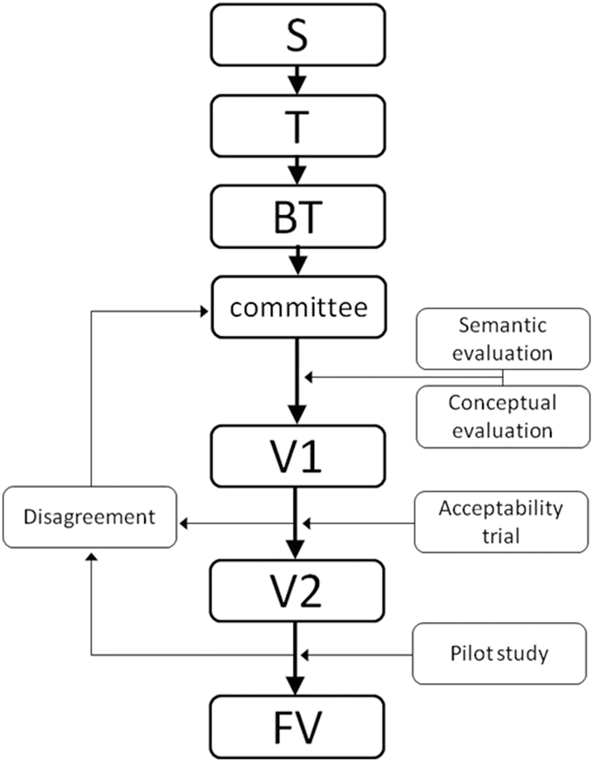
We contacted and received the authorization from the author to conduct the Brazilian adaptation. The Brazilian Version of CCT included three conditions (cold CCT, warm CCT, and hot CCT with no rigged feedback) with 24 rounds each and two scales (Need-for-Arousal Scale and Hot-Cold Manipulation Check). The study was conducted in accordance with standardized national and international guidelines, as well as an International Test Commission procedure for translation and cross-cultural adaptation (Figure 1 presents the performed procedures) (Beaton, Bombardier, Guillemin, & Ferraz, Reference Beaton, Bombardier, Guillemin and Ferraz2000; Fonseca et al., Reference Fonseca, Casarin, Oliveira, Gindri, Ishigaki, Ortiz and Scherer2011; Geisinger, Reference Geisinger1994; Guillemin, Bombardier, & Beaton, Reference Guillemin, Bombardier and Beaton1993; International Test Commission Guidelines for Translating and Adapting Tests, 2005).
Flowchart. S, Source version; T, Translated Version; BT, Back-Translated Version; V1, Version1; V2, Version2; FV, Final Version.

Translation, Semantic and Conceptual Evaluation
A qualified specialist company conducted the translation. After that, we submitted the translated material to back-translation, aiming to identify possible misunderstandings in first translation, as ambiguities and failures to adapt to the cultural target context. A professional bilingual native English-speaker conducted this step. The professionals were not aware of the intent and concepts underlying the material not be influenced by the translation, as recommended by guidelines (Guillemin et al., Reference Guillemin, Bombardier and Beaton1993; International Test Commission, 2005). After translation and back-translation step, we formed a bilingual committee review to produce a semantic and conceptual evaluation of the entire modified material. Also following guidelines, the membership of the committee was formed by multidisciplinary professionals, two psychologists (BKS, BSV), one psychiatrist (RGO), and one computer engineer (EKV) (Guillemin et al., Reference Guillemin, Bombardier and Beaton1993). The experts attest the general meaning of the terms in light of theoretical models, suggesting instructions modifications if necessary, checking for inappropriate items, and ensuring that the translation is fully comprehensible for cross-cultural equivalence, achieving a consensual version called Version 1 (V1).
Acceptability Trial
After the translations steps and committee review, an acceptability trial was performed as a probe technique phase (Guillemin, Bombardier, & Beaton, Reference Guillemin, Bombardier and Beaton1993). The aim was to check for general failures during the computerized task performance, as computer interface and action buttons, as well incomprehensible or unusual words and difficulties in understanding instructions. We performed the trial individually, on a 14-inch color monitor using a free web development environment (Wampserver 2.2E, 64 bits, PHP 5.3), which allows the creation of web applications. The task was programmed by EKV. Participants sat in front of the computer screen, approximately 50cm from the display. To respond to the task, participants used an optical mouse.
We invited three raters to take part in this trial. During acceptability trial, participants were encouraged to judge the applicability of the task and possible misunderstandings. If participants reported some doubts during the task, the professional wrote down their difficulties and suggestions for solutions, and the item was returned to the committee for review and modification. Once the acceptability trial was complete and all corrections had been made, a Version 2 (V2) was achieved. After the acceptability trial, a pilot study (pre-test) was conducted to look for problems in CCT behavioral outcomes in a non-clinical sample.
Pilot Study
The aims of the pilot study were to test the applicability of the task and to investigate the two main outcomes of CCT: risk-taking and information use. We were also interested to find out how the scales would behave generally.
Participants
Twenty-nine individuals (14 females, 15 males), aged between 19 to 31 years old (M = 23 years old, SD 2.33), comprised the sample. The mean educational attainment was 14.48 years (SD 1.59), and the mean monthly household income was US$ 4353.00, which in the Brazilian context represents a high socioeconomic class. Participants were selected by convenience, and the inclusion criteria were age 18 to 50 and no visual disability. Twenty participants were university students, who received course credits for participation, independent of their performance on CCT. The sample was unaware of the goals of the experiment and gave informed written consent. Exclusion criteria were any history of visual, neurological, or psychiatric disorder or any current medication. There were no dropouts during the study. Moreover, this study was in conformity with the Ethical Committee of PUCRS (registered: 16216313.7.0000.5336).
Procedures
The Brazilian Version of CCT included three conditions (cold, warm and hot) with 24 rounds each and two scales (Need-for-Arousal Scale and Hot-Cold Manipulation Check). The CCT gives a series of outcomes that can be analyzed according different models and research interests. However, the task allows the evaluation of two main variables: risk taking and information use. An index of risk taking refers to the average number of cards turned over across all rounds. The information use refers to the number of cards chosen as a function of the information that vary across the rounds (gain value, loss value, number of loss cards). The Need-for-Arousal Scale assesses the amount of novel stimulation that an individual seeks out as a motivational variable. According to the authors, it serves as ideal-point value in an affect-based homeostatic system that regulates the arousal level in the organism (Figner et al., Reference Figner, Mackinlay, Wilkening and Weber2009). The Hot-Cold Manipulation Check Scale assess whether the two CCT versions differentially involved affective versus deliberative processes, investigating decision strategies and emotional arousal in a self-reported scale (Figner et al., Reference Figner, Mackinlay, Wilkening and Weber2009).
Regarding EDA assessment, participants were instructed about the physiological measurement process before being invited to participate in the study. As participants consented to participate, they were prepared for the EDA measurement. Based on Holper and Murphy (Reference Holper and Murphy2013), during the baseline recording, subjects were asked to remain motionless for 120 seconds. Thus, the baseline recording was performed before the experiment began. The data set was divided in four stages for each participant: three decision phases (from the start of the first trial to the end of the last trial for each CCT condition) and a baseline. A PROCOMP Infinity 5 System was used for recording EDA, while BioGraph Infiniti software was used to display the physiological data. The system allows for the acquisition of completely raw, unfiltered EDA data sampled at 256 Hz. EDA was measured using two electrodes attached to the distal phalange of the index and middle fingers of the non-dominant hand. Following recommendations of Figner and Murphy (Reference Figner, Murphy, Schulte-Mecklenbeck, Kuehberger and Ranyard2010) regarding the most common measures used in judgment and decision-making research, the area under the curve (AUC) for statistical analysis was estimated from onset and amplitude (for further details see supplemental material).
Data analysis
CCT analysis were conducted using the Statistical Package for the Social Sciences (SPSS 20). The Shapiro-Wilk test was used for the analysis of normality of data distribution. Non-parametric data were analyzed by a Quade analysis of variance (ANOVA). With regards risk-taking index, a repeated measure ANOVA was conducted to compare the mean differences of the number of cards chosen across CCT conditions.
We used the MATLAB based tool Ledalab version 3.4.6, developed by Leipzig Electro-Dermal Activity Laboratory (2008), for the decomposition of raw skin conductance (SC) data into tonic and phasic components (Benedek & Kaernbach, Reference Benedek and Kaernbach2010; Holper & Murphy, Reference Holper and Murphy2013). Following Figner and Murphy (Reference Figner, Murphy, Schulte-Mecklenbeck, Kuehberger and Ranyard2010) recommendations regarding the most commonly measures used in judgment and decision-making research, we focused on the area under the curve (AUC) for statistical analysis, estimated from onset and amplitude (Figner & Murphy, Reference Figner, Murphy, Schulte-Mecklenbeck, Kuehberger and Ranyard2010). To perform the AUC analysis we downsampled the raw data at 128 Hz, this procedure leads to implicit low-pass filtering of the data and result in smoother data (Figner & Murphy, Reference Figner, Murphy, Schulte-Mecklenbeck, Kuehberger and Ranyard2010). The low pass-filter is set to 5 Hz and there is no hardware high-pass filter. We applied the continuous decomposition analysis (CDA) fitting and optimizing the data (parameters: tau1 = 1, and tau2 = 3.75) (Benedek & Kaernbach, Reference Benedek and Kaernbach2010).
Results
Translation, Semantic Evaluation, Conceptual Evaluation, and Acceptability Trial
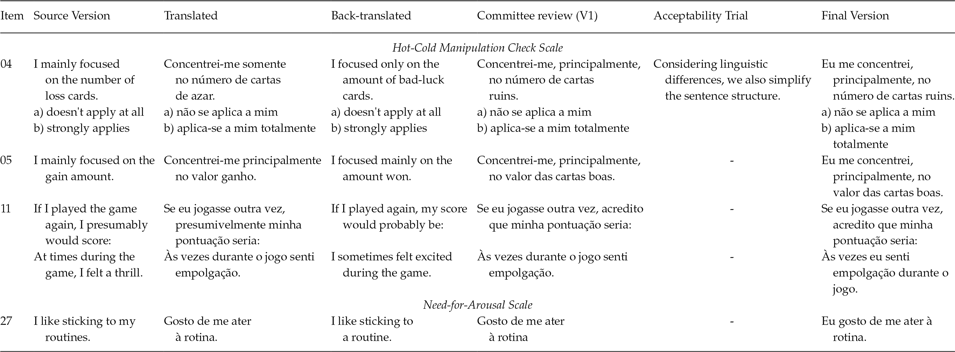
Taking into account the extension of the material, Table 1 summarizes all previously planned steps that were completed and the main alterations that were necessary during translation and adaptation procedures.
Main alteration that was necessary during translation and adaptation procedures

Risk-taking analysis
Investigating risk-taking per conditions: Each participant performed the cold, warm and hot CCT conditions. The average number of cards chosen was 10.47 (SD 5.50) in cold CCT, 7.38 (SD 2.32) in hot CCT, and 7.89 (SD 3.31) in warm-CCT. A repeated measure ANOVA was conducted, including the CCT experimental conditions as dependent variables. As predicted, we found a significant main effect for CCT condition F(2, 56) = 7.03, η2 = .201, p < .005, β = .915. Bonferroni pairwise comparisons indicated that in the cold condition, participants accepted greater risk than in hot and warm conditions (p < .05). No significant effect was found between the hot and warm conditions. Additionally, to avoid a potential confounding variable regarding the immediate feedback of hot CCT in which participants are artificially stopped when they encounter a loss card, the same analysis was performed using the average number of cards chosen in the hot CCT without losing rounds. However, the results were similar to the prior analysis.
Information Use analysis
Investigating information use at the individual level: A Quade ANOVA for each participant per condition were performed, with the three main information factors (loss card value, gain card value, and number of loss cards) as independent variables and the number of cards chosen as dependent variables (Figner et al., Reference Figner, Mackinlay, Wilkening and Weber2009). According to how many factors participants had taken into account (indicated by a significant effect in the analysis), we scored them from 0 (no factor had a significant effect) to 3 (all factors had a significant effect). From the whole sample, in the hot CCT, 10.3% considered all three factors, 20.7% considered two factors, 41.4% took one factor into account, and 27.6% did not take any factor into account. The most frequently used information was the number of loss cards (taken into account by 69% of participants), followed by loss card value (24.1% of participants), and gain card value (20.7% of participants). In the warm CCT, 24.1% considered all three factors, 27.6% considered two factors, 37.9% considered one factor, and 10.3% did not consider any factor. In the same way, the most frequently used information was the number of loss cards (taken into account by 89% of participants), followed by loss card value (48% of participants), and gain card value (27.6% of participants). Finally, in the cold CCT, 37.9% considered all three factors, 41.4% considered two factors, 13.8% considered one factor, and only 6.9% did not consider any factor. As with the other conditions, the most frequently used information was the number of loss cards (taken into account by 86% of participants), followed by loss card value (72% of participants), and gain card value (51% of participants). Together, these findings indicate that according to the feedback (i.e., the affective engagement level of each condition), participants used more or less information. In the cold CCT (i.e., no feedback and the most deliberative condition), participants considered more information, while in the hot CCT (i.e., immediate feedback and the most affective condition), participants considered less information. As expected, in warm CCT (i.e., delayed feedback and neither “colder” nor “hotter” condition), participants considered more information than in hot CCT but less than in cold CCT.
Investigating information use per condition: We performed a Quade ANOVA for each condition independently, with the three information factors as independent variables and the number of cards chosen in each condition as the dependent variable. To control for the potential increase of Type 1 error in the study, the significance threshold was set at the level of p = .008 (i.e., 0.05/6, according to the number of independent variable levels) (Gelman & Robert, Reference Gelman and Robert2014; Penolazzi et al., Reference Penolazzi, Gremigni and Russo2012). We found a significant effect for all the three information factors on the number of cards chosen, indicating that information factors influence all conditions. For hot CCT, we found: loss card value F(1, 688) = 23.13, p < .001; gain card value F(1, 688) = 5.56, p < .05; and number of loss cards F(1, 688) = 157.03, p < .001. For the warm condition, we found: loss card value F(1, 688) = 35.52, p < .001; gain card value F(1, 688) = 10.61, p < .001; and number of loss cards F(1, 688) = 156.72, p < .001. Finally, for the cold condition, we found: loss card value F(1, 688) = 66.02, p < .001; gain card value F(1, 688) = 19.82, p < .001; and number of loss cards F(1, 688) = 118.01, p < .001. Only in hot CCT was the gain card value not significantly different considering the p = .008 threshold.
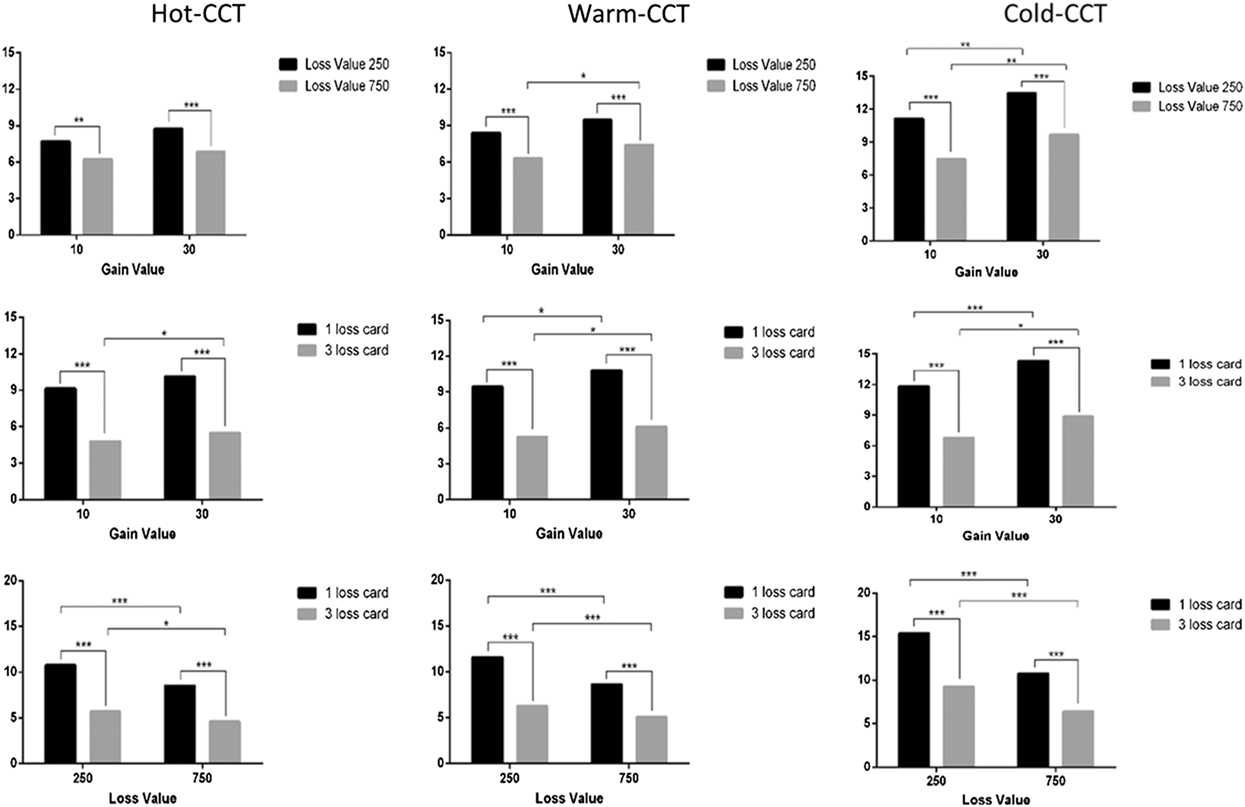
Investigating interactions between information-use per conditions: We also performed an ANOVA with the number of cards chosen as dependent variable and two of the three factors as independent variables for each condition separately. In other words, we investigated the average number of cards chosen as a function of the three information factors, by task conditions (Figner et al., Reference Figner, Mackinlay, Wilkening and Weber2009). For all conditions, we found significant effects of information integration in the average number of cards chosen and an interaction effect for most of the information factors (Figure 2).
Interactions between information-use per conditions. Each graph shows the interaction of two factors collapsed over the third factor. ***p<.001; **p<.

Investigating risk-taking per advantageous level for each condition: Finally, we aim to investigate if the round advantageous level of each trial could predict the number of cards chosen. We set the advantageous level by ranking the largest expected value for each one of the eight possible combinations of the three main information factors. A higher level indicated an advantageous round condition; for example: the combination “loss card value = 250,” “gain card value = 30,” and “number of loss cards = 1” represents the most advantageous round condition. Instead, the combination “loss card value = 750,” “gain card value = 10,” and “number of loss cards = 3” represents the less advantageous round condition. A linear regression analysis showed that advantageous level significantly predicted number of cards chosen, R 2 = .029, F(1, 3119) = 94.68, p < .001, 95% IC [.42, .64] accounting for 17% of the variance in the number of cards chosen.
Hot-Cold Manipulation Check and Need-for-Arousal
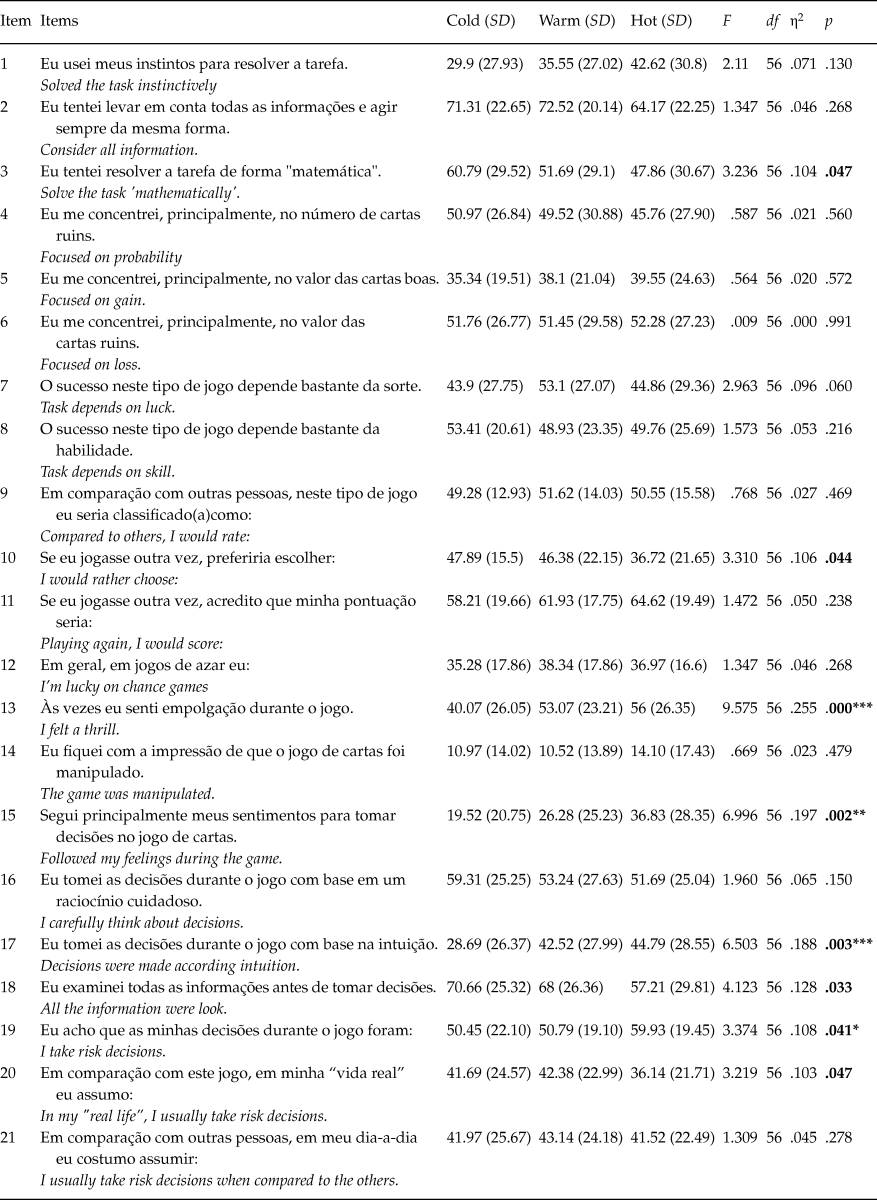
Investigating Hot-Cold Manipulation Check: The Hot-Cold Manipulation Check Scale was primarily developed to investigate correlational patterns between hot and cold conditions and individual perceived measures of affective or deliberative engagement in the tasks (Figner et al., Reference Figner, Mackinlay, Wilkening and Weber2009). All participants responded to the Hot-Cold Manipulation Check Scale three times between each condition. To investigate if the individual perceived measures of affective or deliberative engagement differed between conditions, we performed an ANOVA taking CCT conditions as independent variables and each item as dependent variables. Table 2 summarized the total score for each item (ranging from 0 “never” to 100 “always”).
Hot-Cold Manipulation Check Scale within-subject analysis

Note: Pairwise comparison, *** = Warm, Hot > Cold; **Hot > Cold; *Hot > Warm.
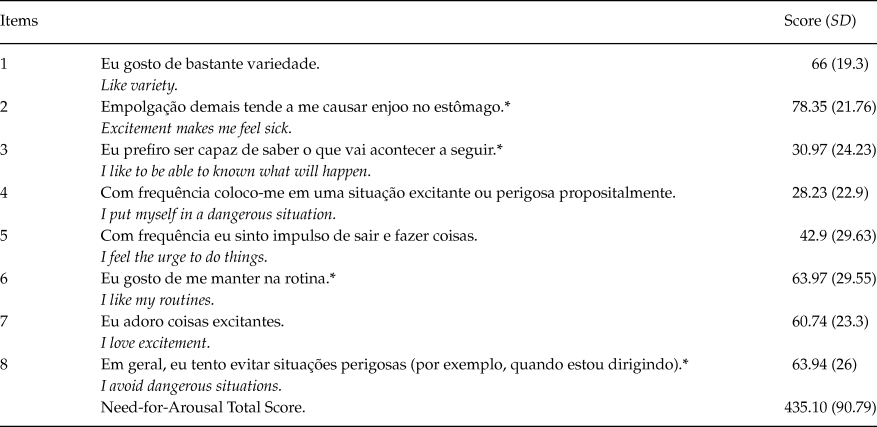
Investigating Need-for-Arousal: To capture more situation-unspecific trait-like aspects of need-for-arousal, Figner and collaborators (2009) used an eight-item questionnaire about broad preferences regarding level of novelty and propensity to risk exposure (Figner et al., Reference Figner, Mackinlay, Wilkening and Weber2009). As with the Hot-Cold Manipulation Check Scale, responses were made on an analogue-visual scale, with endpoints being “never” and “always.” The Need-for-Arousal Scale was the last step performed by participants (Table 3).
Need-for-Arousal scores

Note: *Reverse-scored items. All italic English-writing items were modify to preserve copywriters.
Electrodermal Activity (EDA)
Given the non-parametrical distribution of the AUC, a Quade ANCOVA analysis was performed with the AUC as the dependent variable, with each one of the CCT conditions as an independent variable. In order to control for individual variability, baseline AUC values were subtracted from CCT-AUC conditions data. The results indicated a significant effect of CCT conditions, suggesting that CCT condition influences electrodermal activity F(2, 75) = 12.771, p < .001, β = .996. Bonferroni post-hoc analysis indicated that both hot (p < .005) and warm (p < .001) condition were significantly different from the cold condition, with no significant difference between hot condition and warm condition. The average time spent to perform the hot- CCT was 6 minutes, the warm CCT was 7.5 minutes, and the cold CCT was 4.3 minutes.
Discussion
This study reports a cross-cultural translation and adaptation of CCT (cold, warm, and hot conditions) and its self-report scales (Hot-Cold Manipulation Check and Need-for-Arousal) to Brazilian Portuguese, which was a need due the lack of decision-making tasks including affective and deliberative scenarios. Besides that, it reports a pilot study indicating that participants behave differently according to CCT conditions regarding both the risk-taking index as well as information use. Our findings support that CCT conditions triggered different emotional arousal responses (measured by EDA), corroborating with previous studies (Figner et al., Reference Figner, Mackinlay, Wilkening and Weber2009; Holper & Murphy, Reference Holper and Murphy2013). In addition, this is the first study that compared EDA during hot CCT with the warm CCT. Finally, further analysis reported a novel way to compute the level at which participants distinguish advantage scenarios, which in sum allow to investigate if the advantageous level predicted the number of cards chosen.
Beyond the translation procedures, we achieved a semantic and conceptual evaluation by a committee of multidisciplinary professionals formed by experts in cognitive processes and computer programming. These procedures guarantee the general meaning of terms by maintaining the conceptual significance of them. Regarding cultural adaptations, the Brazilian version of CCT added three training rounds before each condition in order to facilitate the understanding of the instructions. Although the training rounds could be repeated as often as necessary, this was not requested in either the acceptability trial or the pilot study.
Concerning the risk-taking, the Brazilian version of CCT has an important difference compared to the two CCT versions designed by Figner (Figner et al., Reference Figner, Mackinlay, Wilkening and Weber2009; Figner & Voelki, Reference Figner and Voelki2004). After we contacted the original author, we opted to translate, adapt, and test the 24-round version of CCT, in which there is no rigged-feedback in the hot CCT. This modification plays an important role in risk behavior choices, as previously observed in others studies that used the hot CCT with no rigged-feedback (Buelow, Reference Buelow2015; Pripfl, Neumann, Köhler, & Lamm, Reference Pripfl, Neumann, Köhler and Lamm2013). In accordance with these studies, our risk-taking analysis revealed that in the cold CCT, participants behave riskier than in the warm and hot conditions. Similar to Pripfl et al. (Reference Pripfl, Neumann, Köhler and Lamm2013), the differences in cards chosen per conditions were reversed and smaller than reported by Figner et al. (Reference Figner, Mackinlay, Wilkening and Weber2009) and other studies that used the hot CCT with rigged-feedback (Penolazzi et al., Reference Penolazzi, Gremigni and Russo2012; Pripfl et al., Reference Pripfl, Neumann, Köhler and Lamm2013). This could be explained by the fact that Figner’s task was programmed in a way such that loss cards would only be selected at the end of a game’s round (Pripfl et al., Reference Pripfl, Neumann, Köhler and Lamm2013). These procedures imply the possibilities that participants detected the rigged feedback and chose more cards since they perceived that the task was manipulated. However, Figner and colleagues (2009) investigated if participants thought that the card game was manipulated, and then excluded the cases for which participants detected the rigged-feedback.
Interestingly, regarding information use at the individual level, we found that participants considered more information during cold CCT, even with a higher risk-taking. Our findings are in accordance with the current literature, which indicates that in the cold CCT participants paid greater attention to all three information variables in making decisions than those in the hot CCT (Buelow, Reference Buelow2015). In relation to information use per conditions, our findings suggest that participants mostly focus on losing factors (primarily the number of loss cards) before taking into account the gain value. This data corroborates prospect theory, which postulates that people are more sensitive to the possibility of losing than they are to the possibility of gaining (Tom, Fox, Trepel, & Poldrack, Reference Tom, Fox, Trepel and Poldrack2007). Furthermore, similar to Penolazzi and colleagues (2012), we found that participants considered two factors in the hot CCT while in the cold and warm conditions all factors were considered. However, we did not find significant effects in three information factors in the hot CCT due to the fact that the significance threshold was set at the level of p = .008 to control for the potential increase of Type-1 error (Gelman & Robert, Reference Gelman and Robert2014; Penolazzi et al., Reference Penolazzi, Gremigni and Russo2012).
With regard to the Hot-Cold Manipulation Check Scale, we found that participants use different affect-based or deliberative strategies according to conditions. Moreover, we found reduced emotional arousal in the cold CCT when compared to warm and hot conditions. Moreover, items 10, 19, and 20 refer to participants’ impressions regarding their own performance. Despite the fact that the risk-taking index analysis indicated that participants chose more cards in the cold CCT when compared to the others, the self-reported results suggested that they did not perceive the cold CCT as the riskier one (item 19). Although we did not find significant pairwise effects, our findings revealed that participants believed that they should choose even fewer cards in the hot CCT than in the cold CCT, if they could play again. These results indicated that even though participants had stated that they comprehended the task, in which more cards chosen increased the risk to take a loss one, the feedback played a key role in the perception of performance. Finally, as with Huang and colleagues (2013), we failed to replicate the findings of Figner and colleagues (2009) regarding Need-for-Arousal.
Our results also showed that EDA data obtained confirmed previous findings concerning the affective responses elicited by the CCT (Figner et al., Reference Figner, Mackinlay, Wilkening and Weber2009; Holper & Murphy, Reference Holper and Murphy2013) and corroborated with Hot-Cold Manipulation Check Scale. As we expected, both hot and warm conditions triggered more affective responses compared with cold CCT. In addition, the present study was the first one to compare both hot and warm conditions, suggesting that there were no significant differences between them regarding EDA.
Our findings might be discussed in light some limitations. First, the sample had a high level of educational attainment in order to maintain a similar sample used by Finger and colleagues (2009), which are university students. Therefore, the possibility of different patterns of risk-taking and information use by socio-demographic and individual factors must be considered in future studies. Second, most of our data were non-normally distributed, which could interfere with our findings. Nevertheless, skin conductance responses, as well as general biometrics measures, usually do not have normal distributions, and data transformations were recommended by specialized guidelines (Braithwaite, Watson, Jones, & Rowe, Reference Braithwaite, Watson, Jones and Rowe2013). Moreover, our sample size was smaller than the majority of studies that used the CCT. Nevertheless, it should be noted that the observed power of our statistical analysis were adequate when differences were detected (all greater than 0.8). However, future studies with Brazilian samples should consider larger samples. Lastly, concerning EDA, many studies that assessed affective decision-making on CCT have included an inter-trial interval so that affective responses can return to baseline before the next round. Our study did not include an interval between each round, but analyzed the entire block of 24 rounds per condition. Therefore, it is not possible to investigate if there are any differences in the decision-making phase from the outcome phase (Holper & Murphy, Reference Holper and Murphy2013). Therefore, we included an interval between each condition (an average of 5 minutes) that was used to explain the next task and prepare the EDA recording. The lack of a uniform resting inter-trial interval could have bias our findings.
Despite of that, our findings support that the Brazilian version of CCT is successful in triggering decision-making processes of different natures. In addition, we also showed that the manipulation of information had an effect on the number of cards chosen, since higher gain card value, lower loss card value, and lower number of loss cards resulted in higher number of cards chosen. A linear regression confirmed these findings, showing that participants could differentiate the advantageous levels by information use. Together, our results suggest that the Brazilian version of CCT performs well and is a versatile method for the assessment of affective and deliberative decision-making under risk according to different feedback manipulation scenarios. Based on the notion that to learn about an ever-changing environment an individual must evaluate and predict computations of reward and punishment (Dreher & Tremblay, Reference Dreher and Tremblay2009), the short version of CCT might be a sophisticated task to assess the capacity of establishing predictive evaluations of reward and punishment that guide future decisions. CCT is primarily an experimental task, thus, our main contribution was to translate and adapt all contents of all tasks, allowing other researchers to readapt the experimental design according to their purposes. Moreover, this study goes further, comparing EDA during hot and warm conditions and addressing a novel conceptual and methodological issue regarding the assessment of deliberative processing by advantageous level index analysis. In conclusion, future studies should aim to validate the Brazilian version of CCT among the Brazilian population and investigate the psychometric properties of this task.