INTRODUCTION
The world-wide eel family Ophichthidae includes more than 300 species, 54 of which inhabit the western Atlantic and at least 31 are found in Brazilian waters (Ramos & Vasconcelos, Reference Ramos and Vasconcelos1987; Leiby, Reference Leiby and Böhlke1989; McCosker et al., Reference McCosker, Böhlke, Böhlke and Böhlke1989; Haimovici & Klippel, Reference Haimovici and Klippel1999; McCosker, Reference McCosker and Carpenter2002, Reference McCosker, Froese and Pauly2010; Menezes, Reference Menezes, Menezes, Buckup, Figueiredo and Moura2003; Castro & Bonecker, Reference Castro, Bonecker, Bonecker and Castro2006). Due to the cryptic and fossorial habits of these eels, several species are poorly known, particularly those from deeper waters.
Deep-sea research off Brazil has been sparse, but recent exploratory fishing has resulted in a number of new records and new species for the south-western Atlantic and Brazil (e.g. Bernardes et al., Reference Bernardes, Figueiredo, Rodrigues, Fischer, Vooren, Haimovici and Rossi-Womgtschowski2005; Mincarone et al., Reference Mincarone, Nielsen and Costa2008; Melo et al., Reference Melo, Nunan, Braga and Costa2009; Carvalho-Filho et al., Reference Carvalho-Filho, Marcovaldi, Sampaio, Paiva and Duarte2010). In this paper we report the capture of the rare ophichthid Asarcenchelys longimanus McCosker, Reference McCosker1985, in the deep waters off Bahia State, eastern Brazil, extending its previous known range to about 2400 km south. McCosker's (Reference McCosker1985) original description of this deep-water eel was based on two somewhat damaged specimens, collected near Belém, Pará, northern Brazil in 1966 by P. Fourmanoir. A comparison of the now known four specimens is presented below, broadening the knowledge about the species.
MATERIALS AND METHODS
Measurements were taken with a digital caliper to tenths of millimetres (mm); measurements between 150 and 300 mm were taken with a manual caliper to the nearest tenth of a mm and over 300 mm with a ruler to the nearest tenth of a mm. Length of specimens are given in standard length (SL). Digital pictures were taken of the specimens and computerized X-rays were taken at the Hospital Veterinário da Faculdade de Medicina Veterinária e Zootecnia da Universidade de São Paulo, with Raytech 500 equipment and processed through Fuji Film TCR Capula X. For details about the collection methods see Carvalho-Filho et al. (Reference Carvalho-Filho, Marcovaldi, Sampaio, Paiva and Duarte2009). Institutional abbreviations follow Sabaj Pérez (Reference Sabaj Pérez2010).
RESULTS AND DISCUSSION
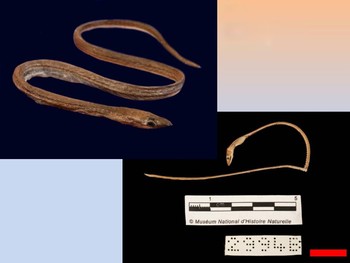
Asarcenchelys longimanus. (1) Reconstructed appearance, after McCosker, Reference McCosker1985; (2) holotype, MNHN 1968-215, 277 mm TL. Claude Ferrara.

Asarcenchelys longimanus. Top: TAMAR 07-01, 222.4 mm TL. Equipe TAMAR; bottom: paratype, MNHN B. 2994, 147 mm TL. Claude Ferrara.

Asarcenchelys longimanus. Top: head of holotype, MNHN 1968-215, after McCosker, Reference McCosker1985; bottom: head of TAMAR 07-02, 374.3 mm TL. Alfredo Carvalho-Filho.

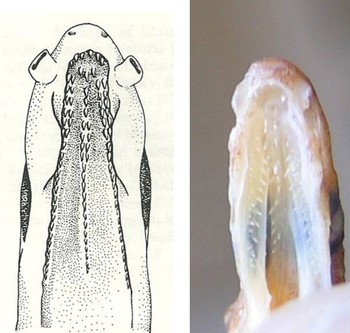
Asarcenchelys longimanus, dentition of upper jaw. Left: MNHN 1968-215, after McCosker, Reference McCosker1985; right: TAMAR 07-02, 374.3 mm TL. Alfredo Carvalho-Filho.

Enguia Lombriga (Brazilian Portuguese).
MATERIAL EXAMINED
TAMAR 007 (1, sex undetermined: 374.3 mm total length (TL)), Brazil, Bahia, Mata de São João, Praia do Forte, from the stomach content of Eumegistus brevoorti (Bramidae), coll. G. Marcovaldi, depth 400 m, December 2006; MZUSP 108422 (1, sex undetermined: 222.5 TL), same data as above.
On December, 2006, a large adult tropical pomfret, Eumegistus brevorti (Poey, 1861) was caught some ten miles off Praia do Forte (12°36′96″S 37°53′78″W), Mata de São João, Bahia, Brazil, about 400 m depth, with electric reel and sardines as bait (Carvalho-Filho et al., Reference Carvalho-Filho, Marcovaldi, Sampaio, Paiva and Duarte2009). In its stomach, examined in situ, there were two eels among several other small fish and crustaceans. The eels were immediately fixed in formalin 10% and, after a week, preserved in ethanol 70%. They were identified as Asarcenchelys longimanus: the extremely elongate body, large pectoral fins, dentition, and cephalic pores, are diagnostic for this species.
DESCRIPTION
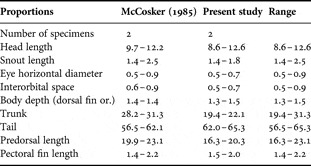
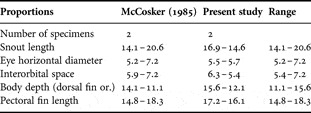
Based on our specimens and McCosker's (Reference McCosker1985) (Tables 1 & 2). Our data increase the range of several teeth counts and body proportions, and the description below follows that of McCosker, except for proportions that are presented as % of TL.
Asarcenchelys longimanus. Proportional measurements in percentage of TL.

Asarcenchelys longimanus. Proportional measurements in percentage of head length.

Body very elongate, its depth 1.3–1.5 in TL, laterally somewhat compressed behind head. Head and trunk 28.0–43.9, and head 8.6–12.6 in TL. Snout subconical, bulbous; lower jaw included, its tip reaching the front of anterior nostril bases, leaving several intermaxillary teeth exposed. Anterior nostrils tubular, directed ventrally; posterior nostril at outer edge of lip, covered by a flap whose posterior edge is incised. Eye large, anterior edge of orbit above middle of upper jaw. Gill openings mid-lateral, not as constricted as those of most myrophines, about equal in length to isthmus. Dorsal fin low, its origin at anterior trunk region. Anal fin elevated. Median fins expanded in posterior tail region, extended beyond caudal tip. Pectoral fin lanceolate, broad based, its length 1.4–2.2 in TL. Head pores developed, much more apparent than those of lateral line, which are difficult to see. Single temporal and interorbital pores. Five pores along mandible, widely spaced posteriorly. Two pores between anterior and posterior nostrils. Four supraorbital pores. Three preopercular pores. Lateral line pores 14 above branchial basket. Teeth conical, fairly large, not close set, nearly uniform in size and recurved. An intermaxillary chevron of 6–8 teeth, visible when mouth is closed, followed by closely abutting vomerine dentition consisting of 3–6 pairs of teeth and a uniserial row of 10–15 teeth. Maxillary teeth biserial anteriorly, with an inner row of 6–8 teeth and an outer row of 21–24 smaller teeth. Lower jaw biserial anteriorly, with an inner row of 4–5 teeth and an outer row of 23–25 smaller teeth. The vertebral counts (the two additional specimens given in parentheses) are: total 142–148 (142 and 145); predorsal 26–27 (26 and 27); and preanal 53–55 (54 and 55).
Colour of recently collected specimens: body reddish-brown, lower sides and belly silvery-white; numerous small dark spots on snout, upper head and behind eyes; fins transparent, peritoneum pale. According to McCosker (Reference McCosker1985), coloration in isopropyl alcohol cream to white, with the same fine spotted pattern on head and snout. Largest specimen recorded to date is 374.3 mm TL (TAMAR 007).
DISTRIBUTION
South-western Atlantic, Brazil, from Pará in northern Brazil (McCosker, Reference McCosker1985) to Bahia in eastern Brazil (present paper). Our record extends the range of Asarcenchely longimanus by about 1800 km southwards in a straight line and 2400 km southwards along the Brazilian coastline.
PROPOSED BRAZILIAN NAME
‘Enguia-Lombriga’, resembling the popular name of the very elongate nematoid worm Ascaris lumbricoides Linnaeus, 1758, which bears a remote resemblance to Asarcenchelys longimanus.
DEPTH OF OCCURRENCE
Previously collected from about 50 m depth (McCosker, Reference McCosker1985). According to Carvalho-Filho et al. (Reference Carvalho-Filho, Marcovaldi, Sampaio, Paiva and Duarte2009), adult tropical pomfrets occur between 300 and 900 m of depth and prey in the water column as well as at the bottom; thus we suggest that the new records possibly expand the depth range of the species to at least 300 m.
ACKNOWLEDGEMENTS
The authors are grateful to John McCosker (CAS), Ivan Sazima (UNICAMP), Osmar Luiz Jr (ILV) and João L. Gasparini, for their suggestions, comments and support; to Ana Carolina B.F.C. Pinto, Silvana M. Unruh and Hugo Idalgo at the Hospital Veterinário da Faculdade de Medicina Veterinária e Zootecnia da Universidade de São Paulo, for their support with the X-ray pictures; to Romain Causse with the Muséum National d'Histoire Naturelle, for his help and support concerning the specimens deposited at the MNHN collection and to Claude Ferrara, for his wonderful pictures of the same specimens; to Domingos Dantas de Carvalho, Renildo Dantas de Carvalho and Adriano de Jesus Santos, captain and crew of the ‘Tamar’ vessel; to Pedro Mariano Monteiro de Barros Cordeiro with the ‘Tamar’, for his superb picture; to Sergio de Azevedo Vinhes, Gustavo Rodamilans de Macedo, both also with the ‘Tamar’, for their help in the field; to Neca Marcovaldi and Eliane M. Pinto for their loving support; and finally to Ivan Sazima, for his support and advice.