The International Committee of the Red Cross (ICRC) Library's collectionsFootnote 1 are constantly updated with new acquisitions covering international humanitarian law (IHL) and the work of the organization. However, one of these collections has remained unchanged since the end of the First World War. The ancien fonds,Footnote 2 as it is known in French, is a Heritage Collection, comprising almost 4,000 books, brochures, reports, manuals and press cuttings from over forty countries. The ICRC began to carefully assemble and classify these resources when the organization was founded, and they form its original library. This Heritage Collection is a unique witness to the first decades of the ICRC's work, the emergence of IHL and the development of what is now the International Red Cross and Red Crescent Movement (the Movement).Footnote 4
In this article we shall retrace the history of the ICRC from its inception to the end of the nineteenth century by examining the development of the Heritage Collection, which is closely linked to the Bulletin International des Sociétés de la Croix-Rouge.Footnote 5 This unique collection of documents is a mine of information on the principal concerns of the ICRC at the time of its founding, including the development of new medical techniques and means of transport, and the situation of prisoners of war. It also includes precious documents that bear witness to the main events of the ICRC's early history, such as the mission reports from its first two delegates, the records of the first International Conferences of the Red Cross and Red Crescent (International Conferences), and the writings of the first National Red Cross and Red Crescent Societies (National Societies). The richness of the Collection also stems from the diversity of the types of documents that it houses. These include manuscripts, rare books full of illustrations or engravings, and books signed by their authors. While we cannot provide an exhaustive account of the Collection's contents in these few pages, we nonetheless hope to give some idea of its richness and to encourage its consultation by researchers interested in the history of the ICRC, the Movement and humanitarian endeavours in general.
This article starts by discussing the creation of the ICRC's first library and introducing its founder, Gustave Moynier, before moving on to present the topics that the collection covers, from the birth of IHL to the development of an international Movement. Along the way, we shall examine some of the most important works in the collection and highlight how they embody the Movement's first milestones. The article also contains a section on publications related to the ICRC's first field activities, which were mainly medical as two of the ICRC's five founding members were doctors (Drs Théodore Maunoir and Louis Appia). Finally, we shall look at the way the Heritage Collection has transformed over time, and how the ICRC Library team works today to ensure its preservation and facilitate its use.
Gustave Moynier: President of the ICRC and founder of the ICRC Library
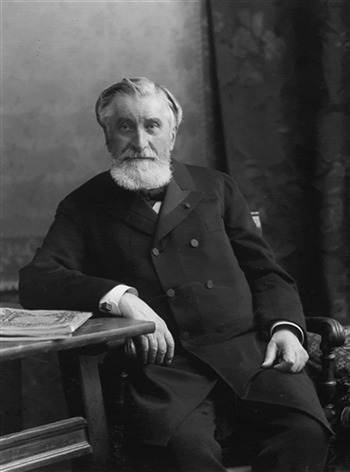
The ICRC Library and its Heritage Collection came about through the initial establishment of the Red Cross's first library, which was created and maintained by Gustave Moynier, ICRC president from 1864 to 1910. Even though he played a crucial role in the birth and development of the ICRC, Moynier's contribution is often underestimated today and bears some explanation.Footnote 6
When we imagine the founding of the ICRC, the first name that comes to mind is that of Henry Dunant. In 1862, when he so eloquently portrayed the horrors of war in A Memory of Solferino, this Genevan businessman convinced both statesmen and the general public of the need to change the way wounded soldiers were treated, as at the time, they were often left to die on the battlefield.Footnote 7 To make up for the shortcomings of the army medical services, Dunant proposed that every nation create a volunteer society that would train in peacetime to treat wounded soldiers in time of war. Gustave Moynier was not just one of the first to read Dunant's book, he was also responsible for founding the organization that would implement Dunant's innovative proposals – the future International Committee of the Red Cross.Footnote 8
In 1855 Gustave Moynier became the chairman of a local philanthropic organization, the Société Genevoise d'Utilité Publique (Geneva Society of Public Utility), which brought together “the great and the good” of the Geneva region. Its activities revolved mostly around supporting the publication of works on education, poverty and the situation of workers.Footnote 9 As one of its most active members, Moynier founded its journal, the Bulletin Trimestriel de la Société Genevoise d'Utilité Publique. He also reorganized the Society's library so that its collections would follow the latest advancements in the social sciences and support the work of its members. Convinced by the ideas presented in A Memory of Solferino, Moynier shared them with the Society's members, who, after some initial hesitation, agreed to set up a committee to consider how Henry Dunant's proposals might be implemented. The five members of this first committee – Henry Dunant, Gustave Moynier, Doctors Louis Appia and Théodore Maunoir, and General Guillaume-Henri Dufour – became the founders of the International Committee for Relief to the Wounded, which is today known as the ICRC.Footnote 10
Gustave Moynier was a lawyer by profession and combined a passion for the physical and natural sciences with an unshakable philanthropic vocation – he was especially drawn to statistics and sociology, the emergence of which he followed with great interest. As a man of science, he firmly believed in the field's potential to improve the lives of his contemporaries. In a work he co-authored with Dr Louis Appia in 1867, he wrote that “sentiment calls science to its aid”.Footnote 11 To this end, he based his concept of charity on the study of the ills of society and on the exchange of publications and knowledge. Moynier considered the written word to be of vital importance and was himself a prolific author. There were few subjects in the fields of society and public health that he had not studied to the extent of penning a few lines, be it on orphans, the situation of workers, social security or the abuse of alcohol.Footnote 12
While he may have lacked the impact of Dunant's declarations or the affinity with fieldwork of Dr Appia (another co-founder who is often overlooked), Gustave Moynier was an untiring administrator of the ICRC. He ensured its smooth day-to-day running and until 1898 signed most of its letters, circulars and general publications. As Jean de Senarclens put it in his biography of Moynier, “it was he who took the decisions and, most of the time, it was also he who carried them out, after consultation with the Committee”.Footnote 13
Portrait of Gustave Moynier, co-founder and president of the International Committee for Relief to the Wounded. © Frédéric Boissonnas/Geneva City, ICRC Archives (ICRCA), V-P-HIST-0354903.

As president and administrator of the International Committee, Gustave Moynier created its Library. He seems to have conceived it as an integral part of the Committee's main office in Geneva, which it has remained over time, following the organization in its successive moves.Footnote 14
From the outset, the Library's mission was to bring together what Moynier called “the literature of the Red Cross”.Footnote 15 In keeping with this vision, he collected essays on philanthropic and charitable activities, international law treaties and military manuals, together with works by the Committee and its members. From the time of its inception, the Heritage Collection included numerous works on first aid, military surgery, the transportation of the wounded and the training of medical personnel. Over time, the collection also came to hold what are now historical sources of great value to the study of the conflicts of the second half of the nineteenth century and the beginning of the twentieth.Footnote 16
Moynier not only founded the International Committee's Library, he also strove to develop its services and its collections. As a true nineteenth-century documentation centre, the Library's role was to serve as a resource for those who sought to advance the fields of military medicine, transportation and care of the wounded, and the humanitarian endeavour. The Library was therefore open to outside visitors, and a succession of researchers and doctors used its services in the years following its creation, as we can see from the minutes of the Committee's meetings. The minutes first mention the Library on 12 January 1875, when Moynier announced that it had been used by “Dr Prévost, a hospital doctor, who is looking for a type of vehicle to carry the wounded”.Footnote 17 This visitor could very well have been the famous Genevan doctor Jean-Louis Prévost (1838–1927), who was then deputy chief medical officer at the Cantonal Hospital, and whose work contributed to the invention of the defibrillator. In 1877, the Library was visited by “Dr Schramm, a Prussian living in New York, who was visiting Geneva and consulted the Library in connection with an essay on the Red Cross that he was preparing”.Footnote 18 As well as consulting documents in the Library, readers could borrow them, and in 1878, Gustave Moynier wrote that “there have already been frequent opportunities to lend books to researchers from Geneva and abroad, and the Committee has been able thereby to render some modest service”.Footnote 19 Unfortunately, these first indications of the existence of a library open to researchers at the Committee's headquarters do not allow us to fix the date of its creation with any certainty. As its holdings include earlier works, we may suppose that it was born at the same time as the organization, initially perhaps simply taking the form of a collection of works belonging to the Committee's founders.
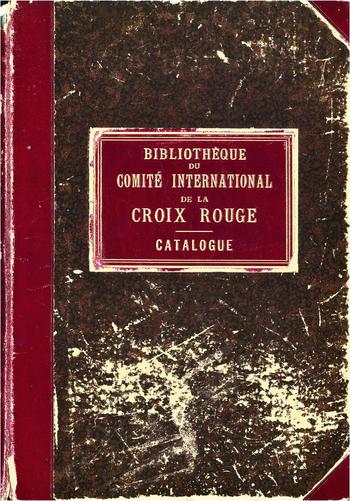
As the Library collected more and more works over the years, the need for a formal organization and a registry of the publications became apparent. Moynier tackled this issue in 1878 and completely reorganized the Library's collections. He drew up a handwritten catalogue (see Fig. 2) showing the date of publication, title, author and call number of each item. The Heritage Collection remains to this day organized according to the classification system that he set up. Items are shelved first by source, then by subject, author and date of publication. This classification system makes it possible to follow the spread of Red Cross action across the world and the creation of a network of National Societies first in Europe and then further afield. The largest number of items in the Heritage Collection come from Germany, Switzerland, France, Italy and the United Kingdom. As well, the Collection includes publications from China, Cuba, Brazil, the United States and Mexico, and even one from a short-lived micro-nation, the Free State of Counani.Footnote 20
The ICRC Library Catalogue handwritten by Gustave Moynier in 1878. © ICRC.

In the words of Moynier, the manner in which the Library was organized made it possible to “highlight the contribution of each people to this rich literature …. One need only see the space on the shelves occupied by the various countries, arranged in alphabetical order, to appreciate the fertility of each one.”Footnote 21 While most works arrived in the form of gifts or exchanges, Moynier was keen to ensure that the collections were exhaustive. In an article he published in the Bulletin International des Sociétés de la Croix-Rouge, he reported that “as regards the work of the Red Cross itself, that is to say the Societies for the relief of military wounded and the Geneva Convention, the Library is well-stocked, and it is probable that few gaps remain”.Footnote 22 Moynier's efforts to keep track of the Movement's geographical expansion and chronological development are apparent in the contents of the Heritage Collection, going back to its emergence in the 1860s.
From an idea to reality: The birth of the Movement and international humanitarian law reflected in the Heritage Collection
Since it was conceived by Moynier as a comprehensive collection on the “work of the Red Cross”, it is not surprising that the Heritage Collection includes many important documents related to the early history of the Movement. Three in particular illustrate the rapidity of its initial development. The Collection holds the first edition of Un souvenir de Solférino from 1862 (published in English as A Memory of Solferino),Footnote 23 the report of the International Conference which took place in Geneva at the initiative of the International Committee in 1863,Footnote 24 and the handwritten report of the first Diplomatic Conference of 1864,Footnote 25 which led to the adoption of the original Geneva Convention. The Heritage Collection also contains publications that informed the Committee's work for the redaction of the 1864 Geneva Convention, as well as titles showing members of the Movement's efforts to promote the development and application of IHL in the following years.
In Un souvenir de Solférino, Dunant called for the creation of national societies of volunteers prepared to assist the wounded in time of war. Convinced by this idea, Moynier and the other founders of the International Committee started to work on its implementation the year after Dunant published his memoir. To this end, they organized in 1863 an International Conference which was attended both by government delegates and by private individuals, as it aimed to establish aid societies capable of raising funds from both public and private sources. The report of that Conference (AF 3012) is the second of the aforementioned documents kept in the Heritage Collection that note down the Movement's first milestones. It contains the Conference's resolutions, but also the minutes of the sessions and the invitation to the Conference written by Henry Dunant and finalized with the help of Gustave Moynier. The resolutions drawn by members of the Conference, which laid the foundation for the future aid societies, were to form the statutory basis of the Movement for the next sixty years. The first notably stipulated: “Each country shall have a Committee whose duty it shall be, in time of war and if the need arises, to assist the Army Medical Services by every means in its power.”
Support of the States would be required for those newly founded aid societies to do the work with which they were entrusted in the 1863 Conference's resolutions. Participants at the Conference therefore adopted a number of suggestions addressed to governments. They demanded that States extend their patronage to relief committees and that in time of war they proclaim the neutrality of ambulances, military hospitals, official and voluntary medical personnel, inhabitants of the country who went to the relief of the wounded, and the wounded themselves. The Conference also suggested that a uniform distinctive sign be recognized for the medical corps of all armies and that a uniform flag be adopted in all countries for ambulances and hospitals.
A Diplomatic Conference was then organized to transform the aforementioned suggestions into legally binding instruments for States. After the end of the 1863 International Conference, the Swiss government, at the request of the International Committee, sent letters of invitation to the governments of the European nations, the United States, Brazil and Mexico, for the purpose of adopting a convention for the amelioration of the condition of the wounded in war.Footnote 26 In August 1864, a mere two years after Dunant published his memoir and one year after the report of the Committee's first International Conference was drafted, delegates from sixteen States met in Geneva for a Diplomatic Conference.
Two months before the Conference opened, the Committee produced a publication entitled Secours aux blessés: Communication du Comité international faisant suite au compte-rendu de la Conférence internationale de Genève.Footnote 27 Its aim was probably to ensure that the nations of Europe would attend the Conference and support the draft convention.Footnote 28 The Committee wished to “encourage the men of this age to be no less compassionate than their predecessors”.Footnote 29 To that end, it highlighted the success of the 1863 Conference, emphasizing the large number of national committees – the first National Societies – that had been set up by then.
With an eye to the Diplomatic Conference that would shortly be taking place, the Committee also wished to show that it was realistic to grant neutrality to the wounded and to those who were assisting them, as the 1863 Conference had shown this to be a sensitive topic. To support its case, the Committee quoted several historical examples of such a practice in the Secours aux blessés publication, where they were cited as precedents. The Committee's publication also quoted an article from a German newspaper, the Allgemeine Militär-Zeitung, published on 9 March 1864, which presented such precedents.Footnote 30 Furthermore, the Committee used that article to address in advance certain points that might be raised during the Diplomatic Conference, such as the concern that granting neutrality to medical personnel could facilitate espionage.
It is therefore clear that the members of the Committee used many of the Heritage Collection's works during the first few years of the Committee's existence, particularly in the follow-up to the first Geneva Convention. Indeed, it is likely that some of the Collection's resources were used during the drafting of that Convention, as it was the Committee that prepared the “draft concordat” (draft convention) which served as the basis for discussion at the Conference. Unfortunately, few details are known regarding the drafting process. Moynier is often cited as the draft convention's author, but even he gave different accounts of this episode in his writings. In a letter written in 1864, he said that General Dufour had produced the draft. In 1900, in an article in the Bulletin International des Sociétés de la Croix-Rouge, he spoke of a joint effort involving General Dufour and himself. Finally, in his 1902 autobiography, he presents himself as the sole author of the draft.Footnote 31 Sadly, one cannot draw on the minutes of the Committee's meetings to discover more about the drafting of the convention, as those for the meetings that took place between March 1864 and September 1867 have disappeared.Footnote 32
Ultimately, the Geneva Convention was signed on 22 August 1864. The draft convention produced by the International Committee became the Geneva Convention, with a few minor modifications. The only controversial issue was the neutral status of volunteer nurses. The Conference's members found a compromise: volunteer nurses would be assimilated to the personnel of the army medical services. This ensured that they would enjoy neutral status, even though they were not mentioned in the Convention.Footnote 33 The handwritten report of the Diplomatic Conference, signed by Gustave Moynier, is to be found in the Heritage Collection.Footnote 34 The volume includes the minutes, the “draft concordat” prepared by the Committee, and the 1864 Geneva Convention. This publication is the third document in the Heritage Collection that reflects the Movement's rapid expansion during the early years of the International Committee's formation.
The Heritage Collection also holds other publications linked to the first Geneva Convention that can be interesting from a historical perspective, such as the report produced for the 1864 Diplomatic Conference by Guillame-Henri Dufour, Gustave Moynier and Samuel Lehmann, entitled Le Congrès de Genève: Rapport adressé au Conseil fédéral.Footnote 35 One will also find a few newspaper clippings, such as “La Suisse et le Congrès international de Genève”, which provides a critical account of the Diplomatic Conference by an elected official from the Canton of Vaud, Colonel Ferdinand Lecomte, whose arguments Gustave Moynier later refuted in an article.Footnote 36 The fact that these documents were kept in the Library shows that the Committee wished to keep track of the way its actions were received and to engage with both its critics and its supporters.
Another Heritage Collection document that is related to the first Geneva Convention is a work entitled Étude sur la Convention de Genève pour l'amélioration du sort des militaires blessés dans les armées en campagne (1864 et 1868).Footnote 37 Authored by Moynier, the text is an article-by-article commentary on the Convention (similar to those that the ICRC produces today) and includes a section on the history of the Convention. In his study, Moynier at last raised the question of the penalties that should be imposed for breaches of the Convention. His conclusion was that these should be set out in the military law of each State. Two years later, seeing how unwilling the States were to specify such penalties, he changed his mind and wrote a note proposing the creation of an international judicial body.Footnote 38
Many of the publications in the Heritage Collection not only evidence the history following the adoption of the first Geneva Convention, but also bear witness to Moynier's activities in the field of international law. Notably, Moynier was behind the creation of the Institute of International Law. The Heritage Collection includes the statutes for this Institute, which was set up in 1873 as an independent body that brought together eminent lawyers with the primary aim of promoting the progress of international law. The Institute still exists today. Its members meet every two years in a different city and adopt resolutions, which are then brought to the attention of governmental authorities and other relevant actors.Footnote 39 In 1880, the Institute published the Manuel des lois de la guerre sur terre,Footnote 40 written by Moynier, which would influence military regulations in several countries and the 1899 Hague Convention Respecting the Laws and Customs of War on Land.Footnote 41
The Manuel des lois de la guerre sur terre was acquired by the Library and is thus now part of the Heritage Collection. Indeed, in the decades following the adoption of the Geneva Convention, the Committee worked to support its implementation and encouraged research on the laws applicable to armed conflict. The Library, on its end, kept collecting related works, in particular those commenting on or interpreting the Convention's articles and their application on the battlefield. These efforts culminated in July 1903 with the publication of a bibliography covering all the existing works dealing with the Geneva Convention, which appeared in the Bulletin International des Sociétés de la Croix-Rouge. It was based partly on publications presented in earlier issues of the Bulletin and partly on the catalogue of the Library. This bibliography was drawn up for the conference to revise the Geneva Convention, to be held in September of that year. It bears a certain resemblance to the International Humanitarian Law Bibliography that the ICRC Library now publishes three times a year.Footnote 42 The introduction to the 1903 bibliography mentions that the works listed will be available to the members of the conference in the Committee's offices. The Library thereby ensured that the conference participants had access to every publication concerning the Geneva Convention available at the time.
Selected publications included in the Heritage Collection also reveal that other members of the Movement were committed to studying how the law could be adapted to the realities of war. The organization of literary competitions, a common practice of the time, was another way to encourage research on the emerging field of IHL. The publications winning these competitions were given a place on the shelves of the ICRC Library. The Prussian committee, for instance, announced at the 1869 Berlin International Conference that it was offering a prize for a study on the application of the work of the Red Cross to war at sea. Two years later, this prize was awarded to J. H. Ferguson of the Dutch Navy for his work entitled “The Red Cross Alliance at Sea”,Footnote 43 which the interested reader could have consulted in the ICRC Library as a part of the Heritage Collection. Three decades would pass before the provisions of IHL were adapted to war at sea, with the adoption of the first Hague Conventions in 1899.Footnote 44 Notwithstanding, the competition held by the Prussian committee in 1869 showed that this matter had already been under consideration decades before, and is testimonial to actors of the Movement's long-time commitment to the development of IHL.
How the Heritage Collection reflects the expansion of the International Red Cross and Red Crescent Movement
The Heritage Collection is a rich source of information on how the resolutions of the 1863 Conference, which gave birth to what would become the Movement, were implemented by the newly founded National Societies. These aid societies were invited to put pen to paper, and they contributed to the Library's growing collections. Moynier frequently encouraged them to produce and send regular reports on their work to the International Committee. These reports document how the 1863 resolutions were adapted to new operational situations and put into practice on the battlefield. The languages used in the publications sent to Geneva reflect the geographic expansion of the Movement. They include, for example, reports by the Prussian Red Cross on its work during the 1870–71 Franco-Prussian War.Footnote 45 Similarly, when the Serbian Red Cross held public conferences on ratification of the Geneva Convention in 1876, it sent the texts of the speeches to the Library, where they are shelved alongside other documents from the same Society.Footnote 46 In some cases, such as the Serbian Red Cross speeches, the original in the Heritage Collection is accompanied by a handwritten French translation. While the sources of these translations are generally undocumented, their presence indicates a clear desire to render the publications of the national committees accessible to users of the Library.
The Heritage Collection reflects the development of the Movement, but also reveals the challenges that its expansion posed to the Committee. It became necessary to define the structure of the Movement and the role of the ICRC within it, and to permit communication between the committees of these diverse nations, to ensure the coherence and cohesion of the work at an international level. While defending the independence of the National Societies, Moynier emphasized the need for them to get to know one another and to keep one another informed of their activities. It would be a mistake to see this merely as an expression of noble sentiment – the aim was to ensure that these different organizations could work side by side, if not together, during times of war.
Selected items in the Heritage Collection highlight the role played by the ICRC as an intermediary between the various parts of the Movement and document its initiatives to facilitate the circulation of information. Most notably, in 1867 Gustave Moynier and Louis Appia examined the role and activities of the National Societies and set up the first framework for their work in the form of a publication entitled La guerre et la charité: Traité théorique et pratique de philanthropie appliquée aux armées en campagne.Footnote 47 In the pages of this ancestor of today's Handbook of the International Red Cross and Red Crescent Movement,Footnote 48 these two co-founders of the ICRC identified “an area eminently propitious for the exchange of communications [between the committees:] … the theoretical and technical study of the relief to be given to the victims of war, and the development of human rights in accordance with humanitarian ideas”. Pointing out that “science has no nationality”, they wrote that “the committees have not only the right, but the duty to undertake such work together, and to exchange their ideas”.Footnote 49
Two initiatives played a central role in facilitating communications between members of the Movement and cementing its unity: the publication of a journal, the Bulletin International des Sociétés de la Croix-Rouge, and the recurring organization of the International Conferences.
The ancestor of the International Review of the Red Cross, the Bulletin was first imagined in 1869. Until 1919, it was the main means of communication and coordination within the Movement. Each issue contained material from the national committees and their branches. From the start, it included reviews of new publications on the activities of the Movement and the development of international law. The Library and the Bulletin fed into one another, in that publications sent to the Committee for inclusion in the Bulletin were then added to the Library and made available to anyone interested.Footnote 50 Right up until the 1940s, these two aspects of the Committee's work were in the hands of the same person. Initially that was Gustave Moynier; he was later succeeded by the secretary of the Committee, Paul Des Gouttes, followed at the end of the First World War by Étienne Clouzot. Under Moynier's influence, publications and the press became the driving forces behind the Committee's work and its international dissemination. This meant that the Library had a clear role to play, not only as a repository of the books collected by the Committee, but as a growing centre of knowledge on the Movement and its global development.
Along with the Bulletin, the organization of the International Conferences reflected the desire to develop a cohesive, universal Movement. The International Conferences allowed representatives of the national committees to share their experiences with each other and facilitated coordination and communication between the various parts of the Movement.Footnote 51 The Heritage Collection holds the reports of the first ten International Conferences, from the 1863 inaugural Conference in Geneva to the Washington Conference of 1912, as well as documents of various nature submitted to the Conferences.Footnote 52
The records of the International Conferences featured in the Heritage Collection allow readers to follow the discussions and debates between the delegates from the various National Societies. For example, in 1867, delegates from the National Societies met in Paris while the International ExpositionFootnote 53 was under way there. As part of the Heritage Collection, a bound volume contains the records of the Conference, together with the detailed minutes of preparatory meetings on the topics that the delegates would be discussing.Footnote 54 The volume highlights how the delegates studied the motor ambulances presented at the Champ de Mars (near the Eiffel Tower) and the best types of artificial limb or stretcher. Subjects discussed included the revision of the Geneva Convention, the dissemination of humanitarian principles to the armed forces and the best means of repatriating wounded military personnel. The volume ends with illustrations on a number of topics, including stretchers. The delegates endeavoured to pool their expertise and to advance technical and medical research, in line with the principle of exchanging knowledge that Moynier was promoting.
The Committee made the Library available to the delegates during the first International Conferences as a resource to aid them in their work. The Heritage Collection also evidences how the Library was perceived, through the documentation on the International Conferences. Specifically, a report submitted to the 7th International Conference of 1902 devotes a few lines to the Library:
The Library of the Committee has undergone quite substantial development, while remaining specialized and containing only works related to the Red Cross or the Geneva Convention. It is consulted often, especially by visitors from abroad, who find within it documents and series that are absent from the majority of public collections. The handwritten catalogue has been compiled with care over a number of years, and facilitates research.Footnote 55
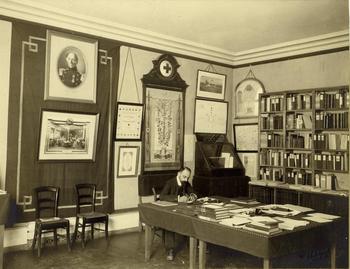
In order to ensure that the Library could be used as a resource, the Committee made it available to the delegates during the first International Conferences. In 1907 for instance, at the opening of the 8th International Conference, Committee secretary Paul Des Gouttes (see Fig. 3) was asked to bring to the Library any delegate who was interested.Footnote 56
ICRC secretary Paul des Gouttes at ICRC headquarters in 1900. ICRCA, V-P-HIST-03046-30. © ICRC.

The Heritage Collection and the International Committee's first operating activities for war victims
On top of documenting the role played by the International Committee in the birth and development of the Movement and IHL, the Heritage Collection also reflects the Red Cross's early operating activities. In particular, it comprises the very first mission reports ever written by ICRC delegates, notably by Dr Louis Appia. Before becoming a member of the original “Committee of Five”, Appia had been present during the July 1859 Italian campaign, and helped care for the wounded after the battle of Solferino. A true pioneer of first aid, Appia had distributed at Solferino a document to the Italian and French doctors entitled Le chirurgien à l'ambulance ou quelques études pratiques sur les plaies par armes à feu. When he returned to Geneva, he added to this document the Lettres à un collègue sur les blessés de Palestro, Magenta, Marignan et Solférino, which were extracts from his correspondence with Théodore Maunoir, another doctor and member of the “Committee of Five”. In those letters, he detailed his experiences and the conclusions he drew from them. In particular, his view had been strengthened that amputation was a sound course of action and that it was best to amputate immediately. Published in August 1859, this work would become part of the Heritage Collection.Footnote 57
In April 1864, just six months after the International Conference of 1863, Appia was sent as a delegate to the Prussian army and Captain Van de Velde of the Netherlands was sent to the Danish army, as the two countries were at war over Schleswig. This made them the first two ICRC delegates in mission.Footnote 58 It was Appia who suggested wearing a white armband, to which the Red Cross emblem was later added. In June 1864, Appia and Van de Velde's reports were published together by the Committee in Secours aux Blessés, the publication that the Committee produced in the lead-up to the 1864 Conference.Footnote 59 The Committee probably wanted these reports to play a role in the drafting of the first Geneva Convention. These first mission reports from ICRC delegates included detailed descriptions of the medical equipment that the armies were using and the care provided for wounded soldiers. They also discussed the possible activities of voluntary first-aiders and the implementation of Dunant's propositions on the battlefield.
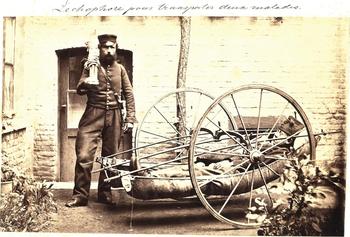
Highly interested in the medical and technological advancements of the time, the International Committee studied how they could serve its action for the relief of sick and wounded combatants. This concern is reflected in the Heritage Collection, as it holds many documents on military medicine, war surgery, the training of medical personnel and the transportation of casualties, all of which were central topics for the Committee during its early years. This part of the collection also dates back to Henry Dunant's publication of A Memory of Solferino. As the book circulated throughout Europe, Dunant received in return publications on similar topics, particularly military medicine and the transport of the wounded.Footnote 60 Some of these seem to have been later given to the Committee's Library, which explains why the earliest of the items in the Heritage Collection, publications of the 1840s and 1850s, cover these subjects (see, for example, André Uytterhoeven's Encore un mot sur les moyens de porter immédiatement secours aux blessés sur les champs de bataille, dated 1855).Footnote 61 Several works present in the Collection highlight technological advances in the transportation of the wounded, such as “Du transport des malades et blessés” by Dr C. de Mooij,Footnote 62 who submitted photographs of what he called a léchophore (a stretcher on wheels) (see Fig. 4).
Photograph of the léchophore invented by Dr C. de Mooij, 1869. © ICRC.

Finally, this part of the collection also comprises manuals for first-aid teams operating on the battlefield. From their format, these were clearly intended to be carried into battle and used at the front. Examples include the Surgeon's Pocket-Book published in 1875 by British surgeon-major J.-H. Porter.Footnote 63 For the volunteer nurse who might have to treat wounded soldiers of many nationalities, there is a small Italian/French/German pocket dictionary.Footnote 64
The ICRC's commitment to adapting its work to the reality of the field is apparent in the documentation on its early action included in the Heritage Collection. The same motivation also prompted the organization to extend the scope of its action to include prisoners of war from 1870 onwards. At the outbreak of hostilities between Germany and France, the ICRC set up the Basel Agency to organize the collection and dispatch of aid to prisoners. Its delegates visited the camps, enquired as to conditions of detention and endeavoured to ensure that the parcels did indeed reach the prisoners. The reports of the Basel Agency are included in the Heritage Collection, reunited in a volume bearing the green cross emblem.Footnote 65 These documents are of clear historical value and tell how the ICRC adapted to changes in the means and methods of warfare, so as to best assist the victims of conflict. Gustave Moynier and, later, ICRC secretary Paul Des GouttesFootnote 66 added to the Library the reports produced by the ICRC, its delegates and its associated bodies. This reflected the clear intention of the Committee to maintain a record of its work and its development over time, both to ensure that this history was preserved and to provide a resource for future decisions.
Continuing Moynier's heritage: The Heritage Collection and the ICRC Library from 1919 to today
The year 1919 marks the end of the development of the Heritage Collection. The ICRC's headquarters moved to the Promenade du Pin that year, as part of the organizational changes following the end of the First World War. No further works were added to the Heritage Collection, and a new current collection was created in the Library under the direction of Étienne ClouzotFootnote 67 to meet the needs of the organization's staff. The Library's services diversified over the next few decades. In addition to acquiring the documentation that the members of the ICRC required for their work, the Library was involved in the dissemination and promotion of its content to the general public. By distributing and exchanging publications, it helped spread the principles of the Red Cross and of IHL around the world. The Library's staff responded to requests for information about the ICRC and sent copies of works such as the Movement Handbook and A Memory of Solferino to an interested public, including many professors and students.
Étienne Clouzot and his staff maintained a regular correspondence with authors, researchers and representatives of international organizations whose work intersected with that of the ICRC. As we can see from letters in the ICRC Archives,Footnote 68 Clouzot developed a system for exchanging publications and reports for the Review, based on a network of authors and specialists. The publications of National Societies continued to enrich the Library, with a collection dedicated to reports, periodicals, handbooks and other documents produced by the National Societies of almost eighty countries. The collection also includes commemorative publications produced by the National Societies.
Today, the Heritage Collection is used by researchers studying the history of the Movement, military medicine, the law of armed conflict, and humanitarian action and its underlying principles. To facilitate their research, the Library is adding the documents from its Heritage Collection to its online catalogue, building on Moynier's handwritten catalogue. In the first semester of the year 2019, more than 500 additional documents have been recorded.
Digitization projects carried out by the staff of the Library and the publication of research guides and online articles also contribute to making the Collection more visible and accessible. An initial digitization programme undertaken in conjunction with the Swiss National Library covered the works in the Heritage Collection concerning the signing of the original Geneva Convention, and was carried out in connection with the Convention's 150th anniversary. The Library is also responsible for the preservation of this unique collection, which forms part of the ICRC's institutional memory. The whole collection was reconditioned in 2017, and the documents will shortly undergo a de-acidification process to counter the deterioration of the paper and to ensure that they are preserved for posterity. Finally, the ICRC Library team hopes to raise researchers’ interest in this collection and looks forward to welcoming those wishing to consult the documents presented in this article, and the many more included in the Heritage Collection.
The ICRC Library today
The ICRC Library is a specialized library with exhaustive collections on IHL and the ICRC's humanitarian action, providing a continuous record of those fields’ development over the past 150 years. Together with the ICRC Archives, it constitutes the leading documentary resource on the ICRC and IHL. In line with Gustave Moynier's original vision, the Library is public: it serves both ICRC staff members and any interested visitor, and supports them through a range of reader services. It aims to reach a global public, notably by making more and more resources directly available online. It thus carries on its illustrious founder's mission, wishing to remain “a source of information both comprehensive and accessible to all”.Footnote 3