Introduction
The African rice gall midge Orseolia oryzivora Harris & Gagné (Diptera: Cecidomyiidae) is the most important insect pest of rain-fed and irrigated lowland rice in Nigeria and many other African countries (Ukwungwu and Misari, Reference Ukwungwu and Misari1997; Williams et al., Reference Williams, Okhidievbie, Harris and Ukwungwu1999; Heinrichs and Barrion, Reference Heinrichs, Barrion and Baños2004; Nwilene et al., Reference Nwilene, Nwanze and Okhidievbie2006), and it has also been reported in rain-fed upland rice production systems in Burkina Faso (Dakouo et al., Reference Dakouo, Nacro and Sie1988). The midge attacks rice plants at the vegetative stage, feeding on the growing primordia, destroying the bud and causing the production of tubular galls (known commonly as silver shoot or onion leaf) (Heinrichs and Barrion, Reference Heinrichs, Barrion and Baños2004). Gall midge attack on seedlings leads to profuse tillering and stunting of plants, and any tiller bearing a gall is irreversibly damaged and does not produce new leaves or panicles. Orseolia oryzivora infestation can cause crop losses of up to 80–100% in endemic areas (Imolehin and Ukwungwu, Reference Imolehin and Ukwungwu1992; WARDA, 2000).
Several studies have been undertaken to identify effective and appropriate control measures for rice pests. The dominant pest control strategies in tropical rice over the past 30 years have been the use of insecticides and the cultivation of resistant plant varieties. However, foliar insecticides, in addition to being hazardous to the environment and often expensive, have limitations in the control of O. oryzivora because of the cryptic nature of the insect pest as an internal stem feeder. On the other hand, the effectiveness of resistant varieties is compromised by the occurrence of virulent biotypes of O. oryzivora that are able to overcome host plant resistance (WARDA, 2000).
Biological control appears to be the most promising option of controlling O. oryzivora. Diverse complexes of effective natural enemies of O. oryzivora that can reduce infestation to tolerable levels have been identified in Nigeria and other West African countries (Umeh et al., Reference Umeh, Joshi and Ukwungwu1991; Ukwungwu and Misari, Reference Ukwungwu and Misari1997). Among these are Platygaster diplosisae Risbec (Hymenoptera: Platygastridae), a gregarious egg–larval koinobiont endoparasitoid, and Aprostocetus procerae Risbec (Hymenoptera: Eulophidae), a solitary pupal ectoparasitoid (Nwilene et al., Reference Nwilene, Togola, Agunbiade, Ogah, Ukwungwu, Hamadoun, Kamara and Dakouo2008). Studies conducted in eastern Nigeria and other parts of Africa indicate that parasitism by these two natural enemies can reach as high as 77% (Hidaka et al., Reference Hidaka, Budiyanto, Klai and Joshi1988; Williams et al., Reference Williams, Okhidievbie, Harris and Ukwungwu1999; Bâ, Reference Bâ2003).
The life cycle of O. oryzivora has been studied by many workers and is fairly well understood, but knowledge on the life cycle of P. diplosisae is lacking. Therefore the objective of the study reported here was to study in detail the life history of P. diplosisae in relation to that of its host.
Materials and methods
Study sites
Experiments were conducted in 2008 under ambient conditions at the Africa Rice Center/IITA in Ibadan, Nigeria, in screen houses (23–33°C, 37–75% relative humidity (RH)) and laboratories (25–27.6°C, 40–70% RH).
O. oryzivora culture
A susceptible rice variety, ITA 306, served as the host plant for rearing the gall midge. Seedlings were raised in seed boxes (50 × 60 × 7 cm) planted in rows at 3 × 3 cm inter- and intra-plant spacing at one seedling per hill, with 20 seedlings per row, giving an estimated plant population of 300 seedlings per seed box. The seed boxes were treated with NPK fertilizer at a rate of 60 kg/ha. The seed boxes were then placed in an oviposition cage. Galled tillers were obtained from experimental fields at Ebonyi State and introduced into prepared seed boxes. These seed boxes were later transferred into the emergence cage.
Twenty O. oryzivora females from emergence cages that had been allowed to mate for 12 h were collected using a glass vial (2.5 cm diameter × 8 cm height) and introduced for continuous oviposition onto the seedlings at 14 days after seeding until the wasps died. Thereafter, the seedlings were sprayed manually with water using a Hills MasterR sprayer at 2-hourly intervals between 06.00 and 18.00 h GMT daily for 3 days to facilitate entry of the O. oryzivora larvae into the rice culms. The seedlings were then transferred to the screen house until galls began appearing, after which they were transferred back into the emergence cages. Emerging adults were collected with the aid of glass vials (2.5 × 18.0 cm) between 08.00 and 09.00 h GMT daily. The emerged adults were used to infest fresh batches of the susceptible rice seedlings to maintain a continuous clean and healthy culture.
P. diplosisae culture
Rice plants with parasitized galls were collected from experimental fields and transferred to the screen house, then transplanted into seed boxes in the emergence cage. Upon emergence, twenty 24-h-old females of P. diplosisae were selected using a glass vial (2.5 × 18.0 cm) and introduced into a screen house containing seedlings that were newly infested with O. oryzivora-infested eggs.
The mass culture cage was watered every 2 h for 3 days to facilitate the hatching and penetration of the parasitized larvae. Emerging adult parasitoids were collected and used for further mass rearing. Because 1-day-old O. oryzivora eggs were the most suitable for parasitism, they were used in subsequent studies.
Effect of O. oryzivora egg and larval stages on the development of P. diplosisae
Platygaster diplosisae has been reported to be an egg–larval parasitoid by other researchers (Umeh and Joshi, Reference Umeh and Joshi1993). To determine the stage/age of the host most suitable for P. diplosisae development, three experiments were performed using eggs and larvae of O. oryzivora. The age of the host stages ranged from 1 to 4 days. Three sets of 10 Petri dishes were used for the experiments: the first set each contained fifty 24-h-old O. oryzivora eggs; the second set each contained fifty 24-h-old O. oryzivora larvae, while the third set contained a mixture of 25 eggs and 25 larvae each. Each group of eggs or larvae in a Petri dish was exposed for 24 h to a pair of newly emerged 24-h-old male and female P. diplosisae. Each Petri dish represented a replicate for each group. The eggs and larvae were examined for parasitism (puncture marks or colour change of the host) under a microscope, after which they were transferred to a caged 14-day-old rice seedling using a camel-hair brush. The seedlings were watered daily for the first 3 days, then twice daily and kept in the screen house until the emergence of adult parasitoids or gall midges. The developmental period of unparasitized gall midges was compared with that of parasitized midges. The numbers of parasitoids emerging from each host stage/age were computed.
Based on preliminary studies, a density of forty 1-day-old O. oryzivora eggs was found to be near optimum, and unless otherwise stated, this density was used in subsequent experiments. This density avoids the crowding effect that occurs at high host densities resulting in the mortality of both parasitized and unparasitized hosts.
Development of P. diplosisae on O. oryzivora eggs on rice seedlings
One newly emerged and mated P. diplosisae was introduced into a cage containing forty 1-day-old O. oryzivora eggs for 24 h to determine the maximum number of O. oryzivora that a single wasp could parasitize. The experiment was conducted under ambient temperature and RH with natural light, approximately 15 h light-9 h dark photoperiod. The hosts were then examined for parasitism (ovipositor puncture marks and colour change) under a microscope. Parasitized hosts were transferred into caged rice seedlings in the screen house using a camel-hair brush. Each day, ten infested rice seedlings were dissected under a SH-ZT binocular dissecting microscope to extract the developing O. oryzivora larvae from the galls. Larvae were killed in 60% alcohol and dissected immediately in a 0.9% saline solution to determine the developmental stage of the P. diplosisae. Any prepupal and pupal stages of the parasitoids found were recovered, and their morphological features were recorded. The remaining parasitized hosts were kept in the screen house until the emergence of adult P. diplosisae, and developmental duration was recorded.
Differences in the duration of development between males and females were analysed using a simple t-test. The parasitoid's adult longevity was estimated based on the observation of 114 individuals (56 females and 58 males).
Preoviposition and parthenogenesis in P. diplosisae
Unmated parasitoids were obtained by extracting the cocoons (pupae) of parasitized galls and keeping them in separate Petri dishes, so that as the adults emerged, the sexes were separated immediately. To determine pre-oviposition time and parthenogenetic reproduction in P. diplosisae, ten mated and ten unmated newly emerged females were released individually onto a caged rice seedling infested with forty 1-day-old O. oryzivora eggs for 24 h. Each female was transferred to a similarly infested rice seedling at 24-h intervals for a total of 72 h. All exposed rice seedlings were maintained in the screen house until the parasitoids emerged. The fecundity, longevity and sex ratio of emerging parasitoids were computed using a simple t-test.
Mating and oviposition pattern of P. diplosisae
Fifty newly emerged females were enclosed in a 14-cm diameter Petri dish with a single 1-day-old male, and mating behaviour was observed under magnification for 1 h.
To determine the effect of mating on oviposition, parasitized galls from which P. diplosisae were about to emerge were identified and caged, and upon emergence, females were immediately isolated. Nine batches of forty 1-day-old O. oryzivora eggs were each exposed separately for 24 h to one newly emerged virgin or mated female parasitoid on a 10-cm-long rice leaf in a Petri dish. On each successive day until their death, the parasitoids were provided with a fresh batch of forty 1-day-old O. oryzivora eggs. By providing fresh host material each day, the likelihood of superparasitism was reduced. The exposed host eggs were transferred onto potted and caged rice seedlings until the next generation of P. diplosisae emerged. Parasitized eggs from each parasitoid age were counted, and percentage parasitism was computed using a simple t-test. The number, sex of progeny and oviposition behaviour were also recorded under a microscope.
Effect of food on longevity of P. diplosisae
Newly emerged P. diplosisae adults (ten males and ten females) were kept without either honey or water, or with water alone, honey alone or water plus honey. Each test was conducted in an oviposition cage and was replicated five times. The mortality of each sex was recorded daily.
Results
Host acceptance and preference by P. diplosisae
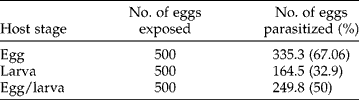
Platygaster diplosisae parasitized both the egg and larval stages of O. oryzivora in no-choice experiments in Petri dishes, though there was variation in the rate of parasitism (Table 1). Percentage parasitism was significantly different (P = 0.015) between the two host stages. One-day-old O. oryzivora eggs were the most acceptable to the parasitoids in both choice and no-choice tests. Two-thirds of the host eggs and a third of the host larvae were parasitized in no-choice tests (Table 1).
Host stage preference by Platygaster diplosisae
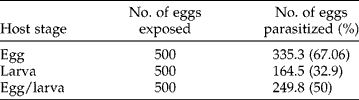
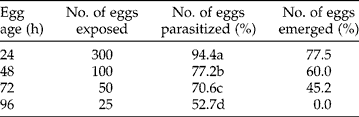
Platygaster diplosisae showed a significant (P = 0.028) preference for newly laid eggs over the other ages of eggs and larvae. Adult emergence of P. diplosisae was significantly affected by the host age/stage. Adult emergence from parasitized eggs declined with increasing age of eggs, from 77.5 to 45.2%. No adults emerged from eggs aged 96 h (Table 2). Dissections made 7 days following parasitism showed that none of the parasitoid eggs in O. oryzivora eggs or larvae had hatched. Hatching mostly occurred on the 13th day after parasitism. When P. diplosisae laid its eggs in the O. oryzivora eggs, they did not develop into 1st instar larvae until the 3rd larval instar stage of O. oryzivora was reached.
Effect of egg age on percentage parasitism by Platygaster diplosisae
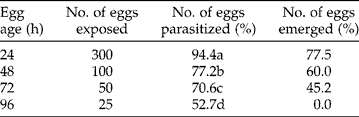
Values followed by same letter are not significantly different (Student–Newman–Keuls test).
Developmental biology of P. diplosisae
The life cycle of P. diplosisae consisted of the egg, three instars, a prepupal, pupal and adult stage.
Because of their placement inside the host's egg or larvae, the parasitoid's eggs were difficult to observe shortly after oviposition. The development of newly deposited eggs in the host eggs was clarified based on morphological characteristics. The ovarian egg was smooth and translucent, blunt at one end and slightly tapered at the other end. As the egg developed, it progressed from a spindle shape, to a rounded shape to a blastula shape.
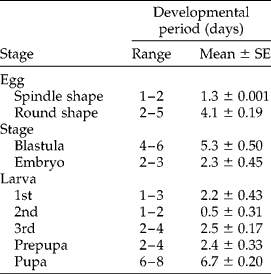
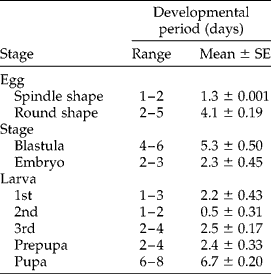
Following oviposition, the eggs were free within the host egg, but later attached to the nervous system or midgut of the host larva. Shortly after egg development commenced, many paranuclear masses were formed and the developing P. diplosisae embryo became encysted within host tissues, where it obtained nutrients. The egg stage lasted about 13 days in total (Table 3). When the 1st instars were fully formed, they broke away from the surrounding trophamnion and initiated feeding. Platygaster diplosisae hibernated during the early embryonic stage in the 1st instar of the host. As the host larva developed, the parasitoid's eggs hatched into larvae. The wasp was polyembryonic, i.e. a single egg gave rise to many larvae within a single host.
Duration of the immature stages of Platygaster diplosisae
Platygaster diplosisae had three instars. When fully developed, the larva was white and ovoid, devoid of setae, or hymenopteriform, with three thoracic and seven abdominal segments. The larva attached itself either to the ganglion or stomach of the host larva. As P. diplosisae began to feed, the host progressively lost its power of locomotion, and eventually died. The parasitoid larva increased in size, developed fat bodies and moulted. The larva's mouth was a simple transverse orifice. After killing the host larva by consuming its entire body contents, the P. diplosisae larva entered the prepupal stage within the oblong, yellow-brown integument of the host puparium and formed ovoid cocoons before pupation. Parasitized O. oryzivora larvae were filled with wasp cocoons and were much bigger than unparasitized larvae.
The larval stage lasted for an average of 5.2 days followed by the prepupal stage (Table 3).
The prepupal stage lasted on average 2.4 days (Table 3). The mature prepupa was white, with three body segments discernible. Its eyes then darkened, and the entire body, except the integuments between the abdominal plates, gradually turned to the shiny black colouration of the adult. The pupal stage took on average 6.7 days (Table 3).
Adult wasps emerge from their cocoons by cutting tiny individual emergence holes (0.3 mm in diameter) in the gall. From each host, 40–65 parasitoids emerged, and these were dominated by the same sex from a particular host, indicating monogenic reproduction. After emergence, empty cocoons were seen inside the gall. The newly emerged adults remained in the host for about four additional days before escaping from the galls. The longevity of the adult female wasps was 4.1 days, while for the male it was 3.0 days. The duration of the complete life cycle from egg to adult emergence averaged 27.3 days. The female adult was shiny black, while the male was dark brown and smaller than the female.
An adult P. diplosisae has short antennae which are 10-segmented with moderately long scape, and at least four antennal apical segments which are light brown. The posterior part of the thorax was densely setose laterally, whereas the forewings are without veins. Legs are pale yellowish brown and have tibiae II and III with one long spur.
The parasitoid is a prosynovogenic species (i.e. a species for which egg maturation starts during the pre-immature stages and continues after the adult has emerged from its host). Egg counts were made from ovaries dissected from ten P. diplosisae females. The eggs were so small and numerous that counts had to be made by spreading the eggs in fluid on an ocular micrometer disk with a 10 × 10 mm square grid reticle. The average number of egg counts in the ovaries per female was 648, but only 95.2 eggs were laid per female during her life time.
Effect of parasitism on the developmental period of O. oryzivora
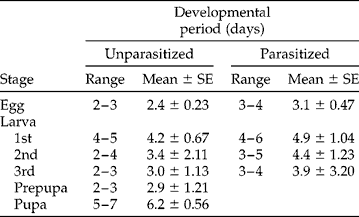
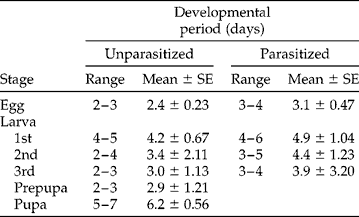
The duration of immature development of O. oryzivora was significantly prolonged (P = 0.011) following parasitism by P. diplosisae, especially when the midge's egg stage was exposed to P. diplosisae (Table 4). However, sex ratio of the midge was not affected by parasitism.
Duration of each developmental stage of Orseolia oryzivora unparasitized or parasitized by Platygaster diplosisae
Mating behaviour and oviposition pattern of P. diplosisae
One-day-old males mated on average 6.4 ± 0.45 times during the hour in which they were observed. Newly emerged females mated only once. On encountering a female, the male mounted the female from behind, and inserted its aedeagus by lowering and curving its abdomen. Insertion of the aedeagus lasted an average of 5.3 ± 0.13 s. Once the insertion of aedeagus was completed, the male grasped the female, lifted itself in a vertical position and flapped its wings for the remaining period of copulation. The whole process took on average 46.0 ± 1.01 s. If a female moved away from a male who may have assumed the mating position before copulation occurred, the male did not flap its wings. On the other hand, if mating was interrupted, the male withdraw its aedeagus, and walked away with occasional stops to flap its wings.
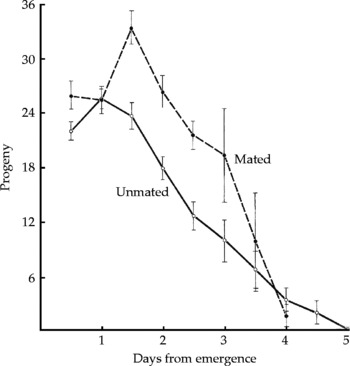
All female P. diplosisae, regardless of mating status, oviposited within 12–24 h of emergence. The pattern of oviposition was similar in mated and unmated females (Fig. 1), except that mated females laid more eggs per day (average 31.7 eggs) and had shorter longevity (average 3.0 days) than unmated ones (average 25.5 eggs per day and longevity of 4.1 days). The mean reproductive period of mated females was 3.2 days. There was no significant difference (P = 0.63) in longevity or reproductive period by the two groups. The rate of reproduction of mated females was higher than that of the unmated ones, but took a shorter time (Fig. 1).
Pattern of oviposition of mated and unmated Platygaster diplosisae

The mean number of eggs laid per female P. diplosisae declined with the parasitoid's age. Percentage parasitism was highest for 1- to 2-day-old females (27.1 ± 1.6 and 30.1 ± 2, respectively).
Effect of food on P. diplosisae longevity
Food availability influenced adult longevity. No significant differences (P = 0.34) were seen between the longevity of male and female parasitoids under any of the conditions provided. Females provided with honey and water lived for an average of 4.7 days, and males lived for an average of 3.9 days, which differed significantly from when only honey was provided (mean longevity of 4.3 and 3.5 days for females and males, respectively). When only water was provided, females lived for 4.2 days and males lived for 3.1 days on average. When neither honey nor water was provided, females and males lived for 4.1 and 3.0 days, respectively. Longevity between all treatment groups was significantly different except in those provided with water only or starved.
Discussion
Host preference
Platygaster diplosisae was able to parasitize both the eggs and larvae of O. oryzivora. However, P. diplosisae showed a preference for eggs in choice experiments. The wasp could parasitize almost all of the egg's developmental stages, but with significant differences in emergence rates depending on the age of host eggs. This capacity to exploit a large age range of host eggs is an important characteristic of P. diplosisae. The preference for O. oryzivora eggs by P. diplosisae was previously observed by Umeh and Joshi (Reference Umeh and Joshi1992, Reference Umeh and Joshi1993) and Williams et al. (Reference Williams, Harris, Ukwungwu, Nacro, Dakouo, Nwilene, Singh and Okhidievbie2002). Further studies are needed to determine whether parasitism of gall midge larvae has negative impacts on the development of P. diplosisae.
Platygaster diplosisae appears to prefer younger host eggs for parasitism, which may indicate that complete development of the P. diplosisae requires certain specific interaction with the host embryo for successful development. Thus in the evaluation of a parasitoid as a biological control agent, it is important to evaluate effective mortality rather than the rate of parasitism. Many workers have used the rate of emergence to estimate percentage parasitism, and therefore have underestimated the impact of the parasitoid on the host population.
Results similar to ours have been obtained for other parasitoids. According to Schmidt (Reference Schmidt, Wajnberg and Hassan1994) and Schuld et al. (Reference Schuld, Madel and Schmuck1999), the emergence rate of Trichogramma chilonis significantly decreased when host eggs were older than 48 h at parasitism (Schuld et al., Reference Schuld, Madel and Schmuck1999). Chong and Oetting (Reference Chong and Oetting2006a, Reference Chong and Oettingb) and Chong (Reference Chong2005) reported that the estimated number of 2nd instar nymphs parasitized by Anagyrus sp. nov. nr. sinope, a parasitoid of the Madeira mealybug, was more than double the number of adult female mealybugs parasitized. The host age at the time of parasitism appears to have implications on the fitness of progeny and parasitoids.
The results of the host age preference experiment provide relevant information regarding the mass rearing of P. diplosisae. To maximize in vivo parasitoid production, P. diplosisae females should be provided with an O. oryzivora egg no older than 2 days.
The parasitoid's preference for the egg over the larval stage may also be attributed to the distribution of hosts of different stages within the host plant. Larval stages are found mostly inside the rice stem, while eggs are exposed on the leaf surface, so the wasp's encounter rates with eggs are higher. Furthermore, hosts are often not passive victims of parasitoids. Larvae may wriggle or otherwise defend themselves. Gross (Reference Gross1993) found that aphids may drop from the host plant, while leafhoppers may jump away to escape parasitism.
Developmental biology
Platygaster diplosisae is a gregarious endoparasitoid, and its reproduction was facultative parthenogenetic. The average number of mature eggs in ovaries was 648, while the average number of eggs laid per female was 95.2. The parasitoid's complete life cycle lasted 27.3 days on average, and newly emerged adults remained in the host for about four additional days before escaping from the gall. A similar observation has been recorded for Platygaster oryzae, a parasitoid of Orseolia oryzae in Asia (Hidaka et al., Reference Hidaka, Budiyanto, Klai and Joshi1988), where the parasitoid's development took about 5 days longer than the host's. This population asynchrony may constitute a serious weakness in the potential of P. diplosisae as an effective biological control agent of O. oryzivora, especially early in the growing season, unless other parts of its life table attributes compensated for it.
Since male and female P. diplosisae have a similar developmental period of about 27 days, it is possible that in any one generation, only some of the males will mate with females from the same generation because (a) the parasitoid has a short pre-oviposition period and (b) females do not mate once oviposition has started. This and the failure to build up continuously overlapping generations may be partly the reason why intensive research has not been conducted into the potential of this parasitoid as a biological control agent of O. oryzivora.
The female-biased sex ratio of P. diplosisae could be the result of the haplodiploid genetic system of sex determination in Hymenoptera (unfertilized eggs produce males and fertilized eggs produce females). The ratio may also be attributed to sex ratio distortion factors like ‘son killer’ (Skinner, Reference Skinner1985), a bacterium that kills all the male progeny of a female at the larval stage.
Conclusion
Field experiments should be conducted to assess the effectiveness of the parasitoid in the field control of O. oryzivora. Practical steps should also be taken towards getting farmers to recognize P. diplosisae and appreciate its importance in rice pest control, and thereby preserve and conserve the wasp in their fields. Other natural enemies of the rice gall midge, such as the predators Neoseiulus spp. (Acari: Phytoseiidae), Cyrtorhinus viridis Linnavuori (Heteroptera: Miridae), Conocephalus longipennis de Haan (Orthoptera: Tettigoniidae), Anaxipha longipennis Serville (Orthoptera: Gryllidae) and ladybird beetles (Coleoptera: Coccinellidae) (Williams et al., Reference Williams, Harris, Ukwungwu, Nacro, Dakouo, Nwilene, Singh and Okhidievbie2002) should also be conserved. If found promising, mass rearing and release techniques for P. diplosisae should be designed for use during outbreaks of the pest on rice farms as part of an integrated pest control strategy.