Introduction
Depression and cognitive impairment, including cognitive impairment with no dementia (i.e. the presence of cognitive impairment but milder than dementia) and dementia, are among the most important mental health problems in old age. Both conditions have severe consequences, including diminished quality of life, functional decline, increased use of services and high mortality (Macdonald, Reference Macdonald1997; Hudon et al., Reference Hudon, Belleville and Gauthier2008). Many prospective and cross-sectional observational studies have demonstrated that depression and cognitive impairment often occur together, suggesting a close association between them (Migliorelli et al., Reference Migliorelli, Teson, Sabe and Petracchi1995; Jorm, Reference Jorm2001; Zubenko et al., Reference Zubenko, Zubenko and McPherson2003; McCabe et al., Reference McCabe, Davison and Mellor2006; Borkowska et al., Reference Borkowska, Drozdz and Jurkowski2007; Brown, Reference Brown, Woods and Storandt2007; Sutcliffe et al., Reference Sutcliffe, Burns and Challis2007; Gabryelewicz et al., 2007; Hudon et al., Reference Hudon, Belleville and Gauthier2008). Inferring causality in the relation between depression and cognitive impairment in old age has been undertaken in many previous studies. Some studies found that depression is a risk factor for the development of cognitive decline (Devanand et al., Reference Devanand, Sano and Tang1996; Yaffe et al., Reference Yaffe, Blackwell and Gore1999; Paterniti et al., Reference Paterniti, Verider-Taillerfer and Dufouil2002; Green et al., Reference Green, Cupples and Kurz2003; Wilson et al., Reference Wilson, Mendes, Leon and Bennett2004); meanwhile, some studies found that depression in old age is a concomitant phenomenon of already existing cognitive impairment rather than an independent risk factor; on the other hand, there is also evidence of cognitive impairment as a risk for depression (Dufouil et al., Reference Dufouil, Fuhrer and Dartigues1996; Henderson et al., Reference Henderson, Korten and Jacomb1997; Cervilla et al., Reference Cervilla, Prince and Joels2000; Brodaty et al., Reference Brodaty, Luscombe and Anstey2003).
The prevalence of depression in patients aged 65 and older may be as high as 40% in hospitalized and nursing home patients, and 8–15% in community settings (Goodwin et al., Reference Goodwin2003; Katon et al., Reference Katon, Lin, Russo and Unutzer2003; Leon et al., Reference Leon, Ashton, Mello and Dantz2003). The prognosis of these depressive states is poor. A meta-analysis of outcomes at 24 months has estimated that only 33% of subjects are well, 33% are depressed, and 21% have died (Cole et al., Reference Cole, Bellavance and Mansour1999). Moreover, studies of depressed adults have indicated that those with depressive symptoms, with or without a depressive disorder, have poorer functioning, comparable to or worse than that of people with chronic medical conditions such as heart and lung disease, arthritis, hypertension, and diabetes (Gurland et al., Reference Gurland, Wilkder and Berkman1988; Wells and Burman, Reference Wells and Burman1991; von Korff et al., Reference von Korff, Ormel, Katon and Lin1992; Katon et al., Reference Katon, Korff, Lin, Bush and Ormel1992; Unützer et al., Reference Unützer1997; Shah, Reference Shah2009).
Cognitive impairment might be a risk factor for depression in old age, which has been shown in some longitudinal and cross-sectional studies (Allen et al., Reference Allen, Jolley, Comish and Burns1997; Prince et al., Reference Prince, Harwood, Thomas and Mann1998; Forsell, Reference Forsell2000; Walters et al., Reference Walters, Breeze, Wilkinson, Price, Bulpitt and Fletcher2004; Bergdahl et al., Reference Bergdahl2005). However, a converse conclusion has also been drawn in some studies (Kulaksizoglu et al., Reference Kulaksizoglu2005; Stek et al., Reference Stek, Vinkers, Gussekloo, Mast, Beekman and Westendorp2006). Moreover, a recent systematic review and meta-analysis has shown that odds ratio (OR) of cognitive impairment as a function of increased depression is not significant (OR = 2.1, 95% confidence intervals (95% CI) = 0.6–8.6) (Cole et al., Reference Cole and Dendukuri2003). In the meta-analysis, only three studies were included and there was a small sample size. Meanwhile, the meta-analysis included subjects aged 50 years and over. However, old age was generally defined above 60 or 65 years. Therefore, it remains unknown in old age whether cognitive impairment is a risk factor for depression or not.
Depression is a critically important issue for the elderly and those working with them. As the population of elderly persons increases, so the number of those with depression can be expected to rise (Cole and Dendukuri, Reference Cole and Dendukuri2003; Harpole et al., Reference Harpole, Williams and Olsen2005). Therefore, it is important to investigate the risk for depression in old age. Although cognitive impairment is generally viewed as a risk for depression in old age, it has not been confirmed. We therefore decided to conduct a meta-analysis in order to measure the magnitude and shape of the association between cognitive impairment and risk for depression in old age. In our meta-analysis, we defined old age as above 60 years old.
Methods
Search method
This study was part of a best-evidence research project on depression in the elderly. We identified sources through searching MEDLINE (from the beginning of 1966), EMBASE (from the beginning of 1980) and the Cochrane Library (1990 to August 2007). The search terms (provided by Cochrane Center) included “depression”, “older” and “clinical trials”. Four researchers selected literature which involved clinical trials, depression (diagnostic criteria using formal depression scales) and old patients (55 years and above). Those studies that were not clinical trials, were unrelated to depression, or did not include old people were rejected. The literature search included three stages: (1) an initial review of article titles to identify those which would be potentially included; (2) a review of titles and abstracts of those articles identified in the first stage, with those failing to meet the inclusion criteria being rejected; (3) a reading of the full text of the articles which survived the second stage. Finally, 6420 articles remained in the third stage and were classified into four subgroups according to the objective of the research program: etiology-related studies (the study of the causes, or origin of disease, the factors which produce or predispose toward a certain disease or disorder) or epidemiological studies (the study of the causes, distribution, and control of disease in populations), diagnostic studies (the study of the science and practice of diagnosis of disease in populations), therapeutic studies (the study of the treatment and cure of diseases in populations) and prognostic studies (the study of the prediction of the course or outcome of a disease in populations). The search terms, search results and classification of the literature have been reported previously (Huang et al., Reference Huang, Dong, Pu, Zhang and Liu2009a; Reference Huang, Dong, Lu, Yue and Liu2010a; Reference Huang, Zhang, Dong, Lu, Yue and Liu2010b). The selection and classification of literature were preformed by the four researchers, and each article was selected and classified by two researchers independently, with any discrepancies being addressed through discussion. In this meta-analysis, we measured the magnitude and shape of the association between cognitive function and depression in old age, so only etiology-related or epidemiological studies might be potentially included. The inclusion and exclusion criteria were.
Inclusion criteria
(1) cross-sectional and longitudinal studies where all participants were 55 years and over;
(2) original research reported in English;
(3) with the complete information on the prevalence or incidence of depression in different cognitive function group (including normal cognitive function, non-dementia cognitive impairment and dementia); and
(4) use of an acceptable definition of depression or cognitive impairment (including non-dementia cognitive impairment and dementia). We accepted the diagnostic category of depression and cognitive impairment as applied by the authors of each study, which included the following: (a) the presence of depressive disorder or depressive symptoms, as defined by scores above a cut point for abnormality on a standard mood scale; (b) severity of depressive disorder or depressive symptoms as defined by scores on a standard mood scale; (c) the presence of major depression or minor depression (or dysthymia) according to the Diagnostic and Statistical Manual of Mental Disorders (DSM-IIIR, DSM-IV, or other standard psychiatric diagnostic criteria); and (4) non-dementia cognitive impairment and dementia according to Diagnostic and Statistical Manual of Mental Disorders (DSM)-IIIR, DSM-IV or Mini-mental State Examination (MMSE) or other standard psychiatric diagnostic criteria.
Exclusion criteria
Studies were excluded if they were limited to specific patient characteristics, such as a specific medical illness; were based on convenience sampling (non-random and small sampling) in a retrospective study; or if there was only an unstructured assessment of mood.
Data extraction and checking
For longitudinal studies, information about the country of study, group size at baseline and follow-up, age, proportion of men, depression criteria, exclusion criteria at baseline, the length of follow-up, number of incident cases of depression in each group were abstracted from each report. For cross-sectional studies, information about the country of study, group size, age, proportion of men, depression criteria, exclusion criteria, the number of cases of depression in each cognitive function group were abstracted from each report. Every paper included in the meta-analysis was read and the data were extracted and cross-checked independently by two authors; discrepancies were resolved by discussion.
The search
Our search found 1027 potential etiology-related or epidemiological articles; of these, 902 were rejected as obviously unsuitable (not related to cognitive function status studies) leaving 125 potential articles. A further 106 of these were rejected for a variety of reasons, including the lack of usable data, and/or no the lack of a recognized instrument used for diagnosis. Thus 19 studies were remained. Since the subjects in all these studies except for two (Sonnenberg et al., Reference Sonnenberg, Beekman, Deeg and Tilburg2000; Steunenberg et al., Reference Steunenberg, Beekman, Deeg and Kerkhof2006) were aged 60 years or more, we excluded these studies. This left 17 studies for the review and it was these studies we used to conduct a meta-analysis to assess the association between cognitive impairment and risk for depression in old age (≥60 years).
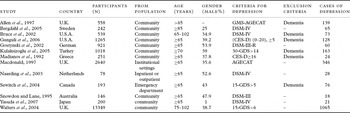
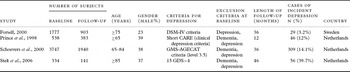
The characteristics of these 17 studies available for meta-analysis, which include four longitudinal studies (Prince et al., Reference Prince, Harwood, Thomas and Mann1998; Forsell, Reference Forsell2000; Schoevers et al., Reference Schoevers, Beekman, Deeg, Geerlings, Jonker and Tilburg2000; Stek et al., Reference Stek, Vinkers, Gussekloo, Mast, Beekman and Westendorp2006) and 13 cross-sectional studies (Madianos et al., Reference Madianos, Gournas and Stefanis1992; Bruce et al., Reference Bruce2002; Snowdon et al., Reference Snowdon and Lane1995; Yasuda et al., 1997; Allen et al., Reference Allen, Jolley, Comish and Burns1997; Gostynski et al., Reference Gostynski, Ajdacic-Gross, Gutzwiller, Michel and Herrmann2002; McCall et al., Reference McCall, Parks, Smith, Pope and Griggs2002; Naarding et al., Reference Naarding2003; Sewitch et al., Reference Sewitch, McCusker, Dendukuri and Yaffe2004; Walters et al., Reference Walters, Breeze, Wilkinson, Price, Bulpitt and Fletcher2004; Bergdahl et al., Reference Bergdahl2005; Kulaksizoglu et al., Reference Kulaksizoglu2005; Ganguli et al., Reference Ganguli, Du, Dodge, Ratcliff and Chang2006), are summarized in Tables 1 and 2.
Characteristics of the 13 cross-sectional studies included in the meta-analysis

CES-D Scale = Center for Epidemiologic Studies Depression Scale; DSM = Diagnostic and Statistical Manual of Mental Disorders; GMS-AGECAT = Geriatric Mental State Schedule Automated Geriatric Examination for Computer Assisted Taxonomy; Short CARE = shortened Comprehensive Assessment and Referral Evaluation; GDS-15 = Geriatric Depression Scale. SADS: Schedule for Affective Disorders and Schizophrenia; CIDI = Composite International Diagnostic Interview; MINI = Mini International Neuropsychiatric Interview; MMSE = Mini-mental State Examination.
Characteristics of the four prospective longitudinal studies included in the meta-analysis

DSM = Diagnostic and Statistical Manual of Mental Disorders; Short CARE = shortened Comprehensive Assessment and Referral Evaluation; GMS-AGECAT = Geriatric Mental State Schedule Automated Geriatric Examination for Computer Assisted Taxonomy; GDS = Geriatric Depression Scale.
Statistical analysis
Data were entered into the RevMan 4.2 meta-analysis program (Cochrane Collaboration, Oxford; see http://www.cc-ims.net/RevMan/current.htm). The meta-analysis of cross-sectional studies has the advantage of huge sample sizes and so can readily show any association between cognitive impairment and prevalence of depression, while the meta-analysis of longitudinal studies has the advantage of readily obtaining a causality conclusion. In the meta-analysis of cross-sectional studies for the prevalence rates of depression, odds risk (OR) and 95% confidence intervals (95% CIs) were calculated. Results were summarized using conventional Forest plots and ORs, stratified by features of the studies included. In the meta-analysis of longitudinal studies for incidence rates of depression, relative risk (RRs) and 95% CIs were calculated. Results were summarized using conventional Forest plots and RRs, stratified by features of the studies included. Summary ORs and RRs were estimated using a random effects model.
Results
Assessment of publication bias
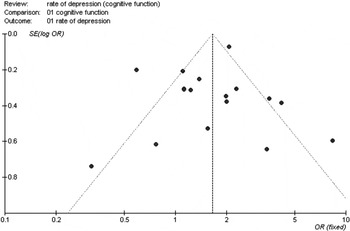
We assessed publication bias using funnel plots (Figure 1). The funnel plot of ORs (under a fixed-effects model) was constructed from the 17 studies in Tables 1 and 2. In the absence of publication bias the points should be symmetrical about the vertical line at the pooled ORs. The reasonably symmetrical shape did suggest the absence of publication bias.
Funnel plot of the 17 studies included in the meta-analysis. In the absence of publication bias, the points should be symmetrical about the vertical line at the pooled odds risk (ORs). The reasonably symmetrical distribution suggests the absence of publication bias.

Non-dementia cognitive impairment and risk for depression in old age
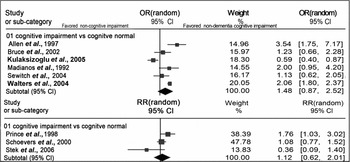
Six of the included studies compared prevalence of depression between subjects with and without non-dementia cognitive impairment (Madianos et al., Reference Madianos, Gournas and Stefanis1992; Allen et al., Reference Allen, Jolley, Comish and Burns1997; Bruce et al., Reference Bruce2002; Sewitch et al., Reference Sewitch, McCusker, Dendukuri and Yaffe2004; Walters et al., Reference Walters, Breeze, Wilkinson, Price, Bulpitt and Fletcher2004; Kulaksizoglu et al., Reference Kulaksizoglu2005). There were 3042 and 12855 subjects with and without non-dementia cognitive impairment, respectively. After pooling these six studies, subjects with non-dementia cognitive impairment had non-significant higher prevalence of depression than those without (OR: 1.48, 95% CI: 0.87–2.52) (Figure 2). Three of the included studies compared incidence rates of depression in old age with individuals with and without non-dementia cognitive impairment (Prince et al., Reference Prince, Harwood, Thomas and Mann1998; Schoevers et al., Reference Schoevers, Beekman, Deeg, Geerlings, Jonker and Tilburg2000; Stek et al., Reference Stek, Vinkers, Gussekloo, Mast, Beekman and Westendorp2006). After pooling these studies, there were 283 and 2474 subjects with and without non-dementia cognitive impairment respectively, and those with non-dementia cognitive impairment had a non-significant higher incidence of depression (RR:1.12, 95% CI:0.62–2.01) (Figure 2). The non-significant OR and RR showed that in old age there was no association between non-dementia cognitive impairment and depression.
Forest plot of ORs and RRs from the 9 studies comparing the prevalence and incidence rates of depression in old age between subjects with and without non-dementia cognitive impairment.

Dementia and risk for depression in old age
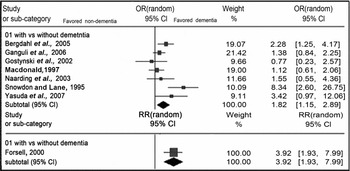
Seven of the included studies compared the prevalence of depression between subjects with and without dementia (Snowdon and Lane, Reference Snowdon and Lane1995; Yasuda et al., 1997; Bergdahl et al., Reference Bergdahl2005; Gostynski et al., Reference Gostynski, Ajdacic-Gross, Gutzwiller, Michel and Herrmann2002; McCall et al., Reference McCall, Parks, Smith, Pope and Griggs2002; Naarding et al., Reference Naarding2003; Ganguli et al., Reference Ganguli, Du, Dodge, Ratcliff and Chang2006). There were 686 and 2185 subjects with and without dementia, respectively. After pooling these seven studies, subjects with dementia had higher prevalence of depression than those without dementia (OR:1.82, 95% CI:1.15–2.89). One of the included studies compared incidence rates of depression in old age between individuals with and without dementia (Forsell, Reference Forsell2000). This study, where subjects with and without dementia were 156 and 753 included respectively, showed that subjects with dementia had significantly higher risk for depression (RR:3.92, 95% CI: 1.93–7.99) (Figure 3). The significant OR and RR showed that in old age, dementia was an important risk factor for depression.
Forest plot of ORs and RRs from 8 studies comparing the prevalence and incidence rates of depression in old age between subjects with and without dementia.

Discussion
The results of the meta-analyses of cross-sectional studies and the prospective longitudinal studies were clear: in old age, there was no association between depression and non-dementia cognitive impairment; however, there was definite association between depression and dementia, and dementia might be a risk for depression. This was a robust finding about the relationship between cognitive impairment and risk for depression in old age.
In this meta-analysis, OR and RR of depression among old individuals (60 years and over) with non-dementia cognitive impairment were both non-significant. A previous systematic review and meta-analysis showed that odds ratio (OR) of cognitive impairment as a function of increased depression was also non-significant in the elderly (50 years and over). Thus, we concluded here that there was no association between non-dementia cognitive impairment and depression in old age. In this meta-analysis, OR and RR of depression among elderly individuals with dementia were both significant. We concluded here that there was a definite association between depression and dementia and thus that dementia might be a risk for depression. Since this meta-analysis only focused on risk factors for depression, but not dementia, and we did not attempt to collect the data on the incidence of dementia in the individuals with and without depression, we could not draw a conclusion about whether depression was a risk factor for dementia.
In old age, the association of depression with non-dementia cognitive impairment was different from the association of depression with dementia. Non-dementia cognitive impairment was milder than dementia in cognitive decline. So our results indicated that in old age, cognitive decline was associated with depression and might be a risk factor for it; however, both the association and risk could be shown only in the severe stages, even in dementia.
In old age, the association between depression and dementia may be related to increased risk of depressive symptoms in individuals with dementia, increased risk of dementia in individuals with depressive symptoms, or both; moreover it also may be related to the same risk factors for them such as older age, low education level, poor health status, limitations in daily activities and so on. In this meta-analysis, we made no attempt to identify the increased risk of dementia in individuals with depressive symptoms and to identify the same risk factors for depression and dementia, so we could not make conclusions about them. On the other hand, this meta-analysis showed that individuals in old age with dementia had a higher risk for depression. Thus, we conclude here that dementia might be a risk factor for depression in old age. However, there was only one study comparing the risk of depression between individuals with and without dementia, so the conclusion should be further confirmed.
Although we attempted to adhere to the guidelines for reporting meta-analyses of observational studies (Stroup et al., Reference Stroup, Berlin, Morton, Olkin, Williamson and Rennie2000), this review did have some limitations. First, we did not hand-search journals and made no attempt to identify unpublished studies. We only included MEDLINE, EMBASE and the Cochrane Library in our search; other databases such as CINAHL and PsycINFO were not included. Moreover, the search was limited to articles published in English. Therefore, some studies will have been missed. Secondly, there was heterogeneity among the included studies, which perhaps related to different definitions of depression in different studies and small study groups in some studies. Therefore, a random-effects model, which had less precision than the fixed-effects model, was used in the review. Thirdly, comorbidity with the other psychiatric disorders, which might be related with both depression and cognitive function, might be confounding factors in the relationship between depression and cognitive function; But we did not exclude them. In fact, in most of the studies included in the review, comorbidity with the other psychiatric disorders had not been excluded nor analyzed stratifiedly. So it was impossible for us to differentiate them in our meta-analysis. Fourthly, the data were only gathered up until August 2007, and so any studies published since then have been missed. This was a definite limitation of the meta-analyses. However, this was only one part of a best-evidence research project on depression in the elderly. In the whole project, there were over 10,000 original articles to screen, and thousands of full texts to gather and to read. It was deemed impossible to report on each part of the research in full. Finally, only four longitudinal studies were included, so the results of the meta-analysis for these risk factors must be interpreted cautiously. Consequently, the risk of cognitive impairment for depression should be studied further.
Conflicts of interest
None.
Description of authors' roles
Wang Zheng-Rong was the advisor of the other authors. The literature was collected, selected and classified by Huang Chang-Quan, Li Yong-Hong, Xie Yi-Zhou and Liu Qing-Xiu. The data was abstracted and analyzed by Huang Chang-Quan and Li Yong-Hong. The paper was drafted by Huang Chang-Quan.
Acknowledgments
This work was supported by Discipline Construction Foundation of Sichuan University. Mr. Rebbo is thanked for his language assistance.