


Engineering in Canada
To be a practicing engineer in Canada, a license is required from a provincial or territorial association within the national organization of Engineers Canada/Ingénieurs Canada.1 The gateway to engineering for early-career Canadians is through four-year accredited programs at universities.
There are hundreds of accredited degree programs across more than 45 universities in the country. Both English and French programs exist, and bilingual engineering degrees are offered (e.g., at the University of Ottawa/l’Université d’Ottawa). The most popular programs of study include chemical, civil, computer, electrical, and mechanical engineering. Materials engineering (or Génie des matériaux) is offered at only seven universities, but variations such as materials and metallurgical engineering (Génie des matériaux et de la métallurgie) and closely related degrees such as nanotechnology are available. Dedicated ceramics and metallurgy programs have fallen along the wayside in recent decades. In practice, materials science and engineering careers arise from education in a wide range of disciplines other than materials engineering (e.g., chemistry,Reference Madsen2 physics, and other engineering backgrounds).
Cooperative education entails work terms of four months or longer, interspersed with periods of academic study. Co-op programs are offered at 55 universities, 26 colleges, and three institutes in Canada;Reference Tamburri3 about half of the universities with engineering programs have co-ops.4 Engineering co-op programs can also be found in Australia, Britain, Hong Kong, The Netherlands, Philippines, and United States.
An iron ring is presented to graduating Canadian engineering students during the ceremony, The Ritual of the Calling of an Engineer, a practice dating back to 1922. The ring is worn with pride on an engineer’s working hand. The ring and its facets act as a symbol and reminder of the obligations and ethics associated with the engineering profession. Since 1970, members of the United States Order of the Engineer wear a similar Engineer’s Ring.
Licensure requirements include academics, work experience, language, good character, professionalism, and ethics. Because Canadian university programs are accredited, many graduates simply pass the mandatory Professional Practice Examination (affirming knowledge of ethics and Canadian law as it relates to engineering) after obtaining the necessary years of work experience and providing reference letters. A province or territory issues the licenses; provision for transfer to other regions of Canada is straightforward.
Engineering education at Canadian universities
There are two key aspects to education—students (the trainees) and faculty (the trainers). It is important to consider if the students represent the population and examine the areas they choose to study and why. Faculty members drive research, teach, and mentor and train students and postdoctoral scholars. However, whom the faculty represents is also important because utilizing and developing talent, serving as role models, and bringing different perspectives and approaches to complex problems is significant to creating an effective engineering workforce.
Students
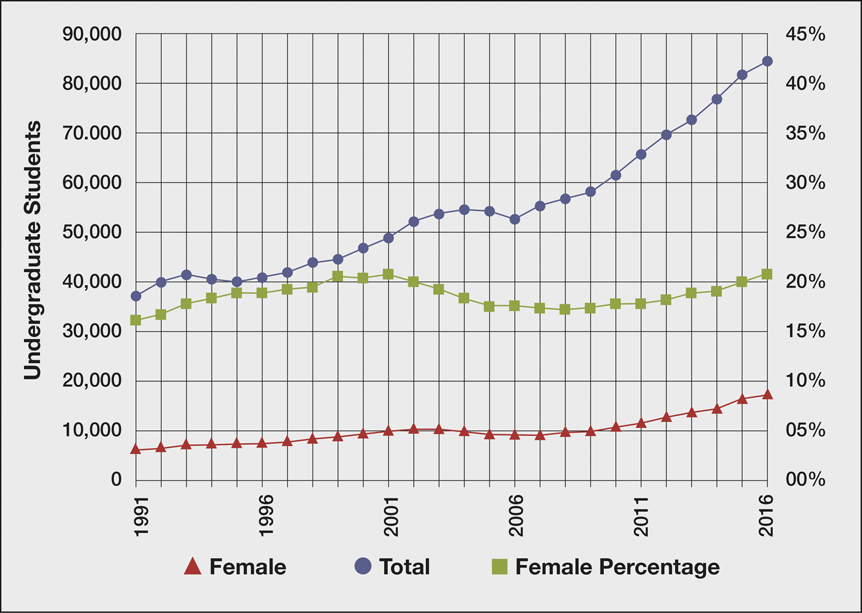
For the past quarter century, women have comprised more than half of the undergraduate students enrolled in Canadian universities.5 However, their underrepresentation in engineering remains well below this level (Figure 1), never reaching 21% in any year. This trend could be described as mostly flat, with a slight increase overall. Even though the number of engineering students more than doubled in the past few decades, the percentage of women only fluctuated between 16.1% and 20.7%. Engineers Canada is working to raise the percentage of newly licensed female engineers to 30% by the year 2030. While this is a significant increase, it does not go far enough—it is a milestone, not the finish line.
Female undergraduate enrollment in Canadian postsecondary institutions (full-time equivalent). Source: Canadian Engineers for Tomorrow, 2016 report.
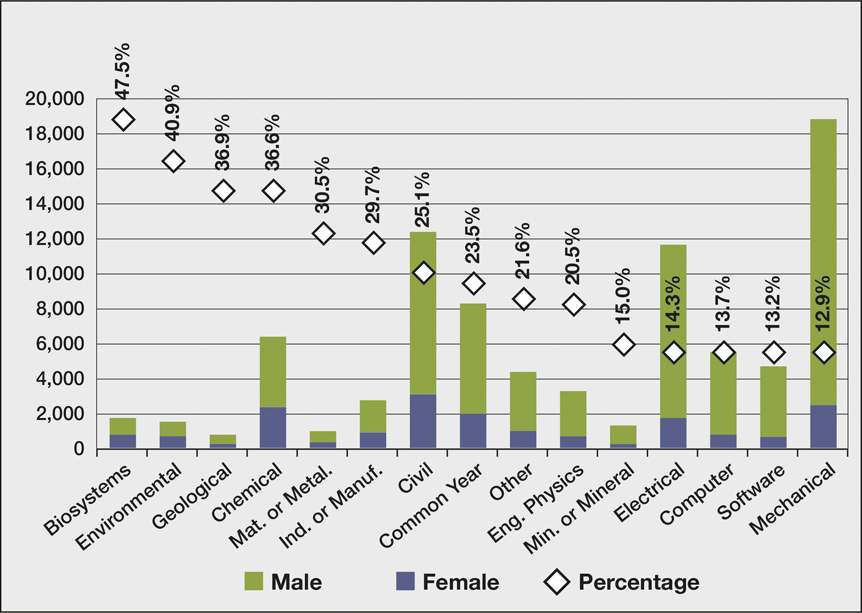
A closer look reveals that in addition to women not selecting engineering in significant numbers, they steer away from certain engineering disciplines. Similar trends have been noted in other countries. According to the data (Figure 2), women appear to be less attracted to mechanical, software, computer, electrical, and mining/mineral engineering, which are some of the most heavily subscribed disciplines. These disciplines also encompass traditional engineering areas (mechanical and electrical) and areas such as software and computer engineering, which are related to computer science, where women’s representation is also low (at or below 15%). On the other hand, women are well represented in some of the newer disciplines (materials at 30.5% and geological at 36.9%), areas where service to society is likely viewed as significant (environmental at 40.9%) and areas where women’s representation has been solid in related science areas (biosystems at 47.5% which is akin to biology, and chemical at 36.6%, which is close to chemistry). Civil engineering stands out as a positive anomaly (at 25.1%), possibly arising from programs encompassing environment or geological emphases. Also, representation in engineering physics (related to materials science and engineering) is quite high (at 20.5%) considering the lack of women in physics programs.6
Percentage of female engineering undergraduate enrollment by discipline in Canadian postsecondary institutions (2016, full-time equivalent). Source: Canadian Engineers for Tomorrow, 2016 report.
For many years, Indigenous peoples in Canada, including First Nations, Inuit, and Métis, were treated poorly and were overlooked. Attention and respect has risen in recent years (e.g., many universities in Canada now provide territorial acknowledgments), and teaching circles and urban indigenous strategies have become more common. Indigenous peoples comprise more than 4.9% of the Canadian population,7 but only account for 1.2% of total undergraduate enrollment and degrees.8 Graduate student representation is even lower at 0.4% of total enrollment at surveyed Canadian universities. Less than 1% of engineers in Canada are indigenous; the Engineering Access Program at the University of Manitoba is trying to change that with 118 graduates (after 32 years of operation).9
On a related note, the First Nations University of Canada (FNUniv) specializes in indigenous knowledge and provides a culturally supportive environment.10 Today, it has an environmental science program, and new programs in the energy and mining sectors (that include engineering) are under development to meet the emerging needs of communities.11 Additionally, the Canadian Region of the American Indian Science and Engineering Society recently hosted the first national gathering of indigenous STEM students and professionals at Mount Royal University in Calgary, Alberta.12
Nearly 14% of Canadians aged 15 years or older have a disability that limits their daily activities.13 They are less likely to be university graduates, and the likelihood declines as the severity of the disability increases. Similar to many other countries, Canada has scholarships to assist people with disabilities to undertake university education.14 Unfortunately, the number of people with disabilities studying engineering at Canadian universities is difficult to determine.
Although, dedicated disability study programs are offered at 14 Canadian universities,15 none appears to include engineering. These programs are broad-based and interdisciplinary with a focus on education, psychology, sociology, health, rehabilitation, history, political science, and/or management.
Adaptive and rehabilitation engineering includes the development of assistive technology and aids in the recovery of functions. These can improve access to education and quality of life for people with disabilities. Such programs of study often are embedded within biomedical engineering. To help ensure broad applicability of findings, guidance is also provided on how to best account for sex and gender in biomedical research studies.16 There are many notable individuals who contribute to the field. Gary Birch, an electrical engineer and quadriplegic, is a researcher at the International Collaboration on Repair Discoveries at the University of British Columbia. His focus is accessible technology and brain–computer interfaces; he has been recognized for the humanitarian nature of his work as well as innovation and excellence in engineering. James Rennie, a retired mechanical engineer, was just named the 2018 T. Roy Adams Humanitarian of the Year.Reference Forsyth17 To help individuals with physical challenges, he works closely with the Tetra Society18 designing and building innovative assistive devices.
Faculty
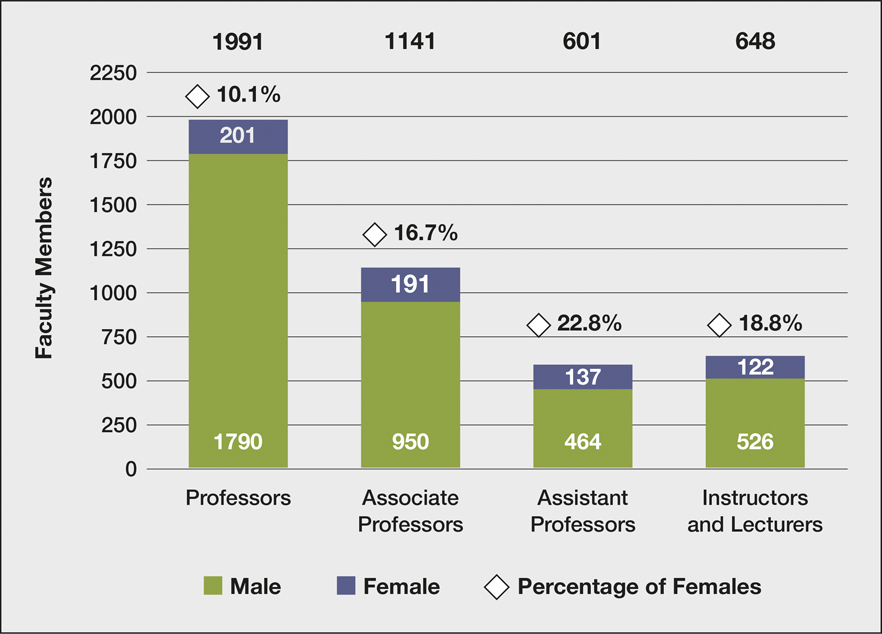
As Figure 3 illustrates, women are still underrepresented in the professoriate in Canada. The highest percentage of women includes Assistant Professors, followed by Instructors and Lecturers, then Associate Professors, and finally Professors. Along the tenure-track path, women drop at every stage (with corresponding increase in the percentage of men). This trend is not unique to Canada. Unfortunately, this means that young women enrolled in engineering have few role models in the professoriate.
Engineering faculty members by sex and position in Canadian postsecondary institutions (2016, full-time equivalent). Numbers at the top of the chart contain the sum of values represented by each column. Source: Canadian Engineers for Tomorrow, 2016 report.
In 2000, a permanent program, Canada Research Chairs, was established to attract and retain some of the world’s most accomplished and promising faculty members. Approximately C$265 million is invested per year through this tri-agency initiative of the Social Sciences and Humanities Research Council, the Natural Sciences and Engineering Research Council (NSERC), and the Canadian Institutes of Health Research. The goals are to deepen knowledge and improve quality of life, strengthen Canada’s competitiveness, and train the next generation. Tier 2 Chairs (emerging scholars) were 37% women in 2015, but active Tier 1 Chairs (full professors or associate professors) were only 17% women.19 In 2008, equity targets were established; in 2017, they had not been met.Reference Hannay20 Action plans to adopt greater transparency in the allocation, selection, and renewal process for Canada Research Chairs are now in place,21 and term limits on these awards are imposed to facilitate greater diversity.Reference Hannay22 However, it is questioned if these efforts are sufficient, particularly because they lack strong enforcement mechanisms.Reference Smith, Supernant and Bray23
The diversity gap is even wider for the Canada Excellence Research Chairs (CERC), a program created in 2008 to attract world-class research talent to Canada. In the first competition, 17 researchers were selected, all men. Consequently, in 2010, the Minister of Industry formed an ad hoc panel to examine the program’s selection process.Reference Dowdeswell, Fortier and Samarasekera24 Based on the panel’s findings, the Minister of Industry asked the Council of Canadian Academies to form an Expert Panel comprised of Canadian and international experts from a diverse set of backgrounds to delve deeper into the underlying factors.25 This Expert Panel examined the statistical profile of women in university research and found the following:
1. The progress of women in Canadian universities is uneven by discipline and rank.
2. At higher ranks, the percentage of women drops in comparison to men.
3. The profile in Canada is similar to that of other economically advanced nations.
4. Findings were limited by a paucity of Canadian data.
The panel also identified the following policies and factors that significantly affect the career trajectories of women researchers in Canada:
1. Canada does not fulfill its commitments to women’s rights. In addition to upholding equality, doing so would bolster Canada’s capacity to engage a diverse and talented set of researchers.
2. The pathway to becoming a researcher is predetermined in the period before university.
3. Youth lack knowledge about educational requirements and a clear understanding of STEM careers.
4. There is a paucity of women in leadership positions serving as role models.
5. Career trajectories of women researchers are influenced by non-collegial, unsupportive, or hostile working environments and negative biases.
6. A persistent salary gap can have significant financial effects with time.
7. The paid work–family life balance is a challenge for women researchers with families.
In the second competition, 10 CERCs were selected, including two women. One of these women has already returned from the University of British Columbia to Harvard University.Reference Semeniuk26 None of the selectees is indigenous, and 14.8% are visible minorities.15 The third competition is under way; institutions are inviting nominations of world-leading researchers to fill the 11 proposed chairs.27
Election to prestigious national or international bodies influences career paths and opportunities.Reference Madsen and Colwell28 Three such honors stand out for Canadian engineers: (1) The Order of Canada that recognizes a lifetime of outstanding achievement, dedication to the community, and service to the nation; (2) election to Fellowship in the Royal Society of Canada (RSC) considered to be the highest distinction for scientists, artists, and scholars in Canada; and (3) election as Fellow of the Canadian Academy of Engineering (CAE) by the membership, due to one’s distinguished achievements and career-long service to the engineering profession. In December 2015, the Governor General announced 69 new appointments to the Order of Canada; 46% of the new members were women—their highest ratio ever, and some indigenous communities were represented.29 “The fellowship of the RSC comprises over 2000 Canadian scholars, artists, and scientists, peer-elected as the best in their field.”30 Approximately 20% of the fellowship have French as their first language. The CAE has ∼750 members, where ∼10% are women, 1% identify as Indigenous, 5.1% are persons with a disability, 22.5% are members of a visible minority, and one person identifies as gender fluid. CAE is taking proactive measures to increase diversity.
A few numbers …
Candadian University Students
Canada ranks first among the Organisation for Economic Co-operation and Development countries in the proportion of college/university graduates. In 2016, more than half of Canadians (age 25 – 64) had college/university qualifications. (See Statistics Canada.)
•. Canada has 96 universities.
•. The University of Toronto has the most full-time undergraduate and graduate students, 81,000.
•. York University, also in Toronto, is second with 46,000 students.
•. An additional 17 Canadian universities have more than 20,000 full-time students.
•. In 2017, the Georgia Institute of Technology awarded 3060 bachelor’s degrees, the most in engineering in the United States. By comparison, that same year, the University of Waterloo had the largest undergraduate engineering enrollment in Canada and awarded 1208 undergraduate degrees. The University of Waterloo would rank 18th in terms of size if included in the US listing. (See https://uwaterloo.ca/engineering/about/faculty-engineering-statistics#note1.)
Center for World University Rankings
The Center for World University Rankings (CWUR) uses data rather than opinions and surveys to establish its world rankings. According to CWUR, the United States has the most universities (213), in the “world’s top 1000,” China is second (108), followed by the UK (62), France (58), Japan (56), Germany (54), Italy (45), Spain (38), and South Korea (35). Canada is 10th with 28 universities in the “world’s top 1000.”
Canadian University Rank
University of Toronto 17
McGill University 37
University of British Columbia 38
University of Alberta 96
University of Montreal 110
McMaster University 121
University of Calgary 196
Western University 198
University of Ottawa 205
University of Manitoba 231
Queen’s University 261
University of Waterloo 268
Laval University 269
Dalhousie University 278
Simon Fraser University 311
University of Guelph 326
University of Victoria 363
York University 388
University of Saskatchewan 411
University of Sherbrooke 468
Carleton University 557
Memorial University of Newfoundland 579
University of Québec at Montreal 584
Concordia University 719
Ryerson University 801
University of Regina 842
University of New Brunswick 928
University of Windsor 952
Dedicated efforts toward excellence and equity
Students
NSERC launched a Student Ambassadors initiative to promote STEM to Canadian youth in groups that are underrepresented in STEM, including girls, indigenous youth, and students in rural or remote areas.31 Grants (with a value up to $1000) help engage youth directly as mentors and role models to foster a stronger science and engineering culture in Canada.
Additionally, NSERC has Aboriginal Ambassadors in the Natural Sciences and Engineering (AANSE) Awards (with a value of up to $5000), which aim “to engage aboriginal students and fellows in promoting interest and participation in the natural sciences and engineering by visiting Canada’s aboriginal communities and schools and sharing their research and education experiences or participating in science promotion events and activities.”32
Postdoctoral scholars
In addition to AANSE awards, NSERC, L’Oréal Canada, and the Canadian Commission for UNESCO jointly offer an annual postdoctoral fellowship supplement ($10,000) “to a Canadian woman scientist involved in a promising research project who has demonstrated exemplary involvement in science promotion, mentorship, and leadership.”33
L’Oréal Canada, in cooperation with the Canadian Commission for UNESCO and the Association of Universities and Colleges of Canada, offers two annual Women in Science Research Excellence Fellowships ($20,000 each). The fellowships alternate between fields of life sciences and engineering/pure and applied sciences each year.
Postdoctoral candidates look beyond NSERC for other funding opportunities; campus advisors and on-campus research offices may assist.
Faculty
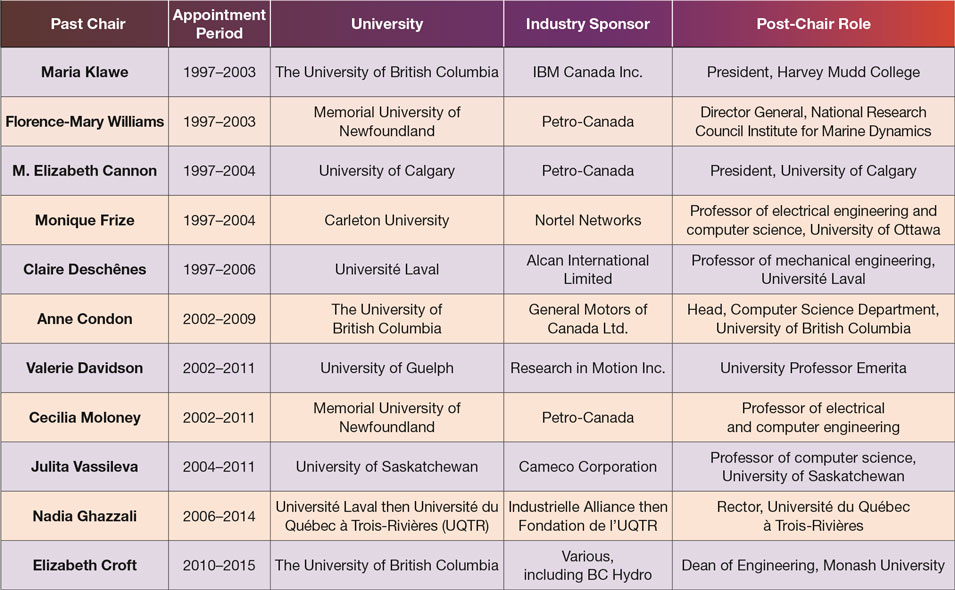
In 1996, NSERC launched its Chairs for Women in Science and Engineering Program. The goals are to increase the engagement of women in science and engineering, to enhance connections to industry, and to provide role models for younger women and girls. There are five current chair holders covering the Atlantic, Quebec, Ontario, Prairie, and British Columbia/Yukon regions. Past chairs (Table I) have been successful, not only in these endeavors, but in subsequent ones in their careers as well. There is a provincial chair (e.g., for the Ontario Network of Women in Engineering) and several other significant efforts through various professional science/engineering societies.
Past Chairs of Women in Science and Engineering Programs.
Many Canadian universities are working on ways to entice a broad spectrum of the research-education community to join them, by making the so-called boilerplate in job announcements more welcoming: “[We are] committed to fostering diversity within [our] community as a source of excellence, cultural enrichment, and social strength. We welcome those who would contribute to the further diversification of our university including, but not limited to, women; visible minorities; First Nations, Inuit and Métis peoples; persons with disabilities; and persons of any sexual orientation, gender identity, and/or expression. All qualified candidates are encouraged to apply.”
According to NSERC, “Equity, diversity, and inclusion (EDI) strengthen the scientific and engineering communities and the quality, social relevance, and impact of research.”34 Two key priorities in their 2015–2020 strategic plan35 are to increase diversity and gender equity in the research enterprise toward the goal of “building a diversified and competitive research base.”
Additional pathways forward
The 2018 Canadian federal budget provides an additional $3.8B over the next five years in support of scienceReference Zilio, Cardoso and Lundy36 (including physical sciences), and this represents the largest single increase to fundamental science. Also, a significant focus of the 2018 federal budget is equality.37 This shift follows on the heels of Canada introducing its first gender-balanced Cabinet in 2015, which also included two Aboriginal members.Reference Murphy38 The 2018 budget is supportive of women in many ways, including in leadership roles, STEM careers, and innovation and entrepreneurship. There is interest in growing “the capacity of indigenous communities to conduct research and partner with the broader research community.” The Government of Canada also announced it would implement a Made-in-Canada version of the UK’s Athena Scientific Women’s Academic Network Initiative—a certification process signifying the extent to which universities adopt equality principles.39
Improve personal safety
To make a discipline appealing, deterrents must be removed. Safety in the workplace and in educational institutions is paramount.
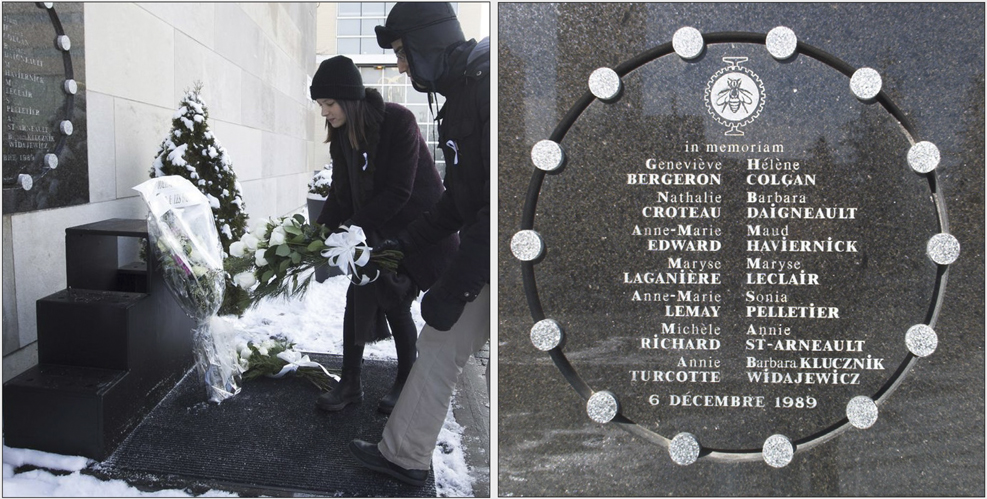
On December 6, 1989, 14 women engineering students were killed by a man armed with a semi-automatic rifle and a hunting knife at École Polytechnique, Montreal in Canada’s deadliest massacre. This tragedy is still noted annually across Canada, and there are memorials on many campuses (Figure 4). Gradually, a white rose became the symbol of Polytechnique Montréal’s commemorative activities. To mark the 25th anniversary, Polytechnique created the Order of the White Rose—a $30,000 annual scholarship awarded to a woman engineering student for graduate studies in engineering at the institution of her choice.40 Today, many engineering students were not even born before 1989, but it is still considered a current issue. Although Canadians undergo training, screening, and licensure to own a gun, many think controls need to be tighter and should include having records of sales, banning of assault weapons, and maintenance of ownership lists to make Canada safer.
École Polytechnique Memorial Plaque. (Left) Image by Pierre Obendrauf. Credit: Montreal Gazette. (Right) Credit: Bobanny/WikiCommons.
A 2017 book, Sexual Violence at Canadian Universities, states that one in four female university students will be sexually assaulted by the time they graduate.Reference Quinlan, Quinlan, Fogel and Taylor41 This issue should not be avoided because a university fears negative publicity and repercussions on their reputation and fundraising abilities.Reference Browne42 Programs and policies need to be in place; additionally, changes to laws and cultural norms are in order. Policy implementation has occurred at some campuses and provinces (Figure 5).Reference Shen43 Hazing and other inherently uninviting climate issues warrant attention. Admittedly, these problems are part of larger cultural issues, but a positive change to engineering’s image could serve them well. In Canada, sexual assault is widely underreported, in part because victims do not understand their options.44 By providing guidance to Canadian students, senior academic officials can also identify pathways to improve their universities.Reference Madsen45
Canadian provinces with sexual violence policies for universities. Source: University Affairs.

Eliminate discrimination in earnings
A wage gap continues in Canada: Women in Ontario make 29% less than their male counterparts, and Indigenous women in Ontario face a 43% gap.Reference Racco46 Women who work in STEM fields still earn 18% less. At higher salary levels, the gap increases. The 2018 federal budget specifies (without funding) the implementation of pay-equity legislation for federal government employees and those employed in federal-regulated sectors.35 In 2017, Canada was ranked eighth by the Organisation for Economic Co-operation and Development for having the largest wage gap disparity in more than 40 countries.47
Provide avenues
Historically, there have been many barriers for Indigenous populations in seeking higher education. Today, deterrents include unemployment and poverty, occasionally combined with an inadequate or insufficient high-school education, alongside only sparse information on career options.Reference Ricci48 Recent calls to action indicate that university administrators acknowledge that their institutions must change to include Indigenous peoples and familiarity with their ways. Benefits of greater indigenous engagement in engineering are significant; these include fostering greater innovation and entrepreneurship, enhancing community participation and partnerships, giving a positive voice for the profession, providing more role models, and increasing organizational capacity.
Support family responsibilities
Family care, whether that be child care or elder care, may entail a leave of absence from work; this affects women more often than men. Support during a leave period, overall flexibility, and appropriate avenues after such a disruption to continue or start a new strong career path are all important if women are going to pursue careers in engineering and stay in the workforce. Due to its importance, Engineers Canada published a report “Managing Transitions: Before, During and After Leave” that is geared toward both employers and employees in engineering.49
Canada provides support to new parents. Biological mothers (including surrogate mothers) who cannot work due to pregnancy or having recently given birth are entitled to up to 15 weeks of employment insurance maternity benefits.50 Parents who are caring for a newborn or newly adopted child/children, can share a maximum of 61 paid weeks within the first year-and-a-half after birth or adoption. The amount paid varies from 33% to 55% of one’s regular salary based on the time taken and is subject to a cap (of C$51,700 per year). To encourage parents to share responsibilities of raising a child, the 2018 federal budget introduced a new “use-it-or-lose-it” program to encourage men to take at least five to eight weeks of paid parental leave. This shift brings Canada’s coverage closer to what is offered in Sweden.35
Acceptance and inclusion
A cultural mosaic, a mix of ethnic groups, languages, and cultures that coexist, has been used to describe Canada. Throughout this article, various ways to improve diversity or add to inclusion have been described particularly for the engineering profession. While the focus has been on engineering, these approaches are equally important to other STEM backgrounds to diversify the field of practicing materials scientists and engineers. To this end, we should work on all career levels simultaneously. Transitions are critical,51 since at these points, many talented individuals slip away. Embracing diverse individuals in STEM fields and developing their talent is good for business, and is positive for the individuals involved so that they reach their full potential and fulfill their ambitions.Reference Madsen52 Moreover, ideas and approaches to solve complex problems are more likely to be realized when teams are comprised of individuals with different backgrounds and perspectives.
Acknowledgments
This research was, in part, performed in an Independent Research /Development Program while serving at the National Science Foundation. I am grateful for the thoughtful comments from Drs. Karl Booksh (University of Delaware), Kevin Goheen (The Canadian Academy of Engineering), Kathryn Grandfield (McMaster University), Randy Herrmann (University of Manitoba), Catherine Mavriplis (University of Ottawa), and Erik B. Svedberg (National Academies of Sciences, Engineering, and Medicine).



