


Introduction
For more than fifty years, the U.S. aluminum industry has promoted the aluminum can as “the most sustainable beverage package on virtually every measure.”Footnote 1 Melting scrap cans to make “secondary” aluminum eliminates the energy-intensive steps required to mine bauxite, reduce it to alumina, and smelt alumina into “primary” aluminum. But despite the advantages offered by secondary metal, the U.S. industry has not achieved what it predicted for American consumers in the 1970s: a “closed loop” in which every discarded can becomes a new can. Americans recycled only 43 percent of their aluminum cans in 2023, lagging far behind most other parts of the world.Footnote 2
Most histories of recycling blame this outcome on Keep America Beautiful (KAB), an industry-funded lobby group. Formed in 1953 after Vermont banned disposable bottles, KAB portrayed waste and litter in its advertising as problems of individual behavior, not the inevitable consequences of disposability.Footnote 3 The scholarly literature treats KAB’s subsequent advocacy for recycling with skepticism. Historian Ted Steinberg describes it as “a profoundly individuated response to the problem of waste.” Sociologist Samantha MacBride argues that the KAB-endorsed model of voluntary recycling kept consumers, activists, and governments busy cleaning up the symptoms of disposability without addressing fundamental causes.Footnote 4 These arguments have resonated across the field of discard studies, where scholars have challenged the idea that any industry can “close the loop” solely through technology or policy; waste has social, cultural, and political dynamics that must also be addressed.Footnote 5
Scholars of the aluminum industry, including Mimi Sheller, Carl Zimring, and Grace Ong Yan, have highlighted the contradictions between aluminum’s recyclability and the industry’s development of new disposable products and expansion of primary aluminum capacity.Footnote 6 In this article, we build on this research by showing how two firms—Alcoa and Reynolds—approached disposability and recycling in the context of the most important disposable aluminum product, the beverage can. While we find ample evidence that aluminum firms used recycling as a political tool to fight “can bans” and other restrictive legislation, we also show that recycling created material interests for Alcoa and Reynolds that did not always align with the KAB coalition.
In reexamining the history of aluminum can recycling, we also challenge the technological determinism found in many accounts of the aluminum can’s adoption.Footnote 7 Aluminum was not widely adopted, as Louise Skyggebjerg has recently argued, because it was an inherently superior material for beverage containers.Footnote 8 Aluminum firms competed with steelmakers in the can market, as well as with the glass and plastic industries. We show that recycling was critical in the aluminum can’s introduction and eventual triumph over the steel can in the U.S. market. In the Danish and Swedish cases Skyggebjerg examined, the aluminum can’s success hinged on how aluminum’s materiality intersected with economic, cultural, and political forces. The same was true in the U.S. case, but the outcome was very different. Aluminum cans reached many European consumers under existing or new container-deposit regimes that facilitated can reuse, but most of the cans sold in the United States from 1958 to the present wound up in the trash. The KAB literature offers a partial explanation for this, showing how recycling obtained “hegemonic” status in debates over waste in the 1970s and 1980s.Footnote 9 KAB promoted recycling as a voluntary, market-driven, and ultimately ineffective way to solve waste problems.
Aluminum recycling has a much longer history than this, however, dating to the very beginning of the industry. Initially, this reuse of scrap produced what Geoffrey Jones calls “accidental sustainability,” where environmental benefits emerge from purely business decisions.Footnote 10 We show that can recycling was not accidental: the aluminum can’s promoters saw as early as the 1950s how recycling could serve economic and ecological ends. Aluminum firms told Americans, “Don’t throw money away,” promoting salvage recycling—in which consumers are paid for their discards—as a thrifty and environmentally friendly way to consume. Can salvage developed alongside the environmental movement of the 1960s, not as a reactionary attempt to derail the post–Earth Day environmentalist movement as some accounts argue.Footnote 11 KAB’s ability to sell recycling in the 1970s relied, in large part, on earlier successes with aluminum can salvage.
Alcoa and Reynolds used salvage recycling as a marketing strategy to sell cans to consumers, and they also employed aluminum’s salvage value to fight “can bans” and to crush aluminum’s main competitor, the steel beverage can. As Finn Arne Jørgensen observes, many critical accounts of recycling’s history decry the means—the market mechanisms for recycling that KAB and others endorsed—more than they evaluate outcomes.Footnote 12 Salvage recycling did recover cans, and the U.S. aluminum industry made progress toward closing the loop for cans throughout the 1970s and 1980s. When the salvage model began losing ground in the 1990s, it was not because aluminum firms no longer wanted to reuse scrap cans: salvage recycling was undone by the market logic it once relied on to recover cans, leaving the industry without a viable path to a closed loop.
Archival and Oral History Sources
Archival records and oral histories from the Aluminum Company of America (Alcoa hereafter) and the Reynolds Metals Company (Reynolds) provide the core evidence for this article. Together with Kaiser, Alcoa and Reynolds were the largest U.S. aluminum firms between 1950 and 1990. Historians have made effective use of the archives of Alcoa and Reynolds over the two decades they have been accessible, exploring the structure of the aluminum industry, product development and advertising, bauxite mining, and the politics of aluminum.Footnote 13 This article is the first to use archives from both firms alongside previously unused oral histories. Together, the archives and oral histories provide a new look at the intertwined histories of aluminum cans and recycling in the United States.
The Alcoa Oral History Project interviewed current and former Alcoa employees in 1998–1999, spurred by Alcoa’s 1996 move out of its iconic Pittsburgh headquarters and subsequent donation of archival materials to the Historical Society of Western Pennsylvania. While the bulk of the documents we consulted came from Alcoa’s marketing and public relations units, the oral histories included interviews with former engineers and executives, as well as salesmen and PR staff.Footnote 14 Alcoa’s acquisition of Reynolds in 1999–2000 featured in many of the interviews and inspired the Reynolds Oral History Project, which interviewed plant managers, salesmen, engineers, and executives in 2002-2005. Reynolds donated archival documents in 2002 to the Virginia Museum of History & Culture. Most interview subjects from both firms were retirees, reflecting on careers in an industry plagued by recent job losses and plant closures. Some accounts were nostalgic, but most were frank and at times highly critical of management. Importantly, we could compare oral testimony across firms and with archival records and published sources, allowing for more critical readings of oral and text sources.Footnote 15 There is no comparable collection available for Kaiser, which was the smallest of the three U.S. aluminum “majors” throughout the period under study.Footnote 16 While not an aluminum firm, Coors Brewing played a pivotal role in introducing the aluminum can in the U.S. market, and we use an oral history from chairman Bill Coors and other materials on the firm to supplement the Alcoa and Reynolds sources.Footnote 17
We also collected evidence from trade publications. Our key source is Modern Metals, which we thoroughly examined from 1956 to 2000. We lacked access to a complete run of the other major North American aluminum magazine, Light Metal Age, but we found that its content was comparable with Modern Metals. Both publications were targeted at readers across the aluminum industry, from smelting to retail. Monthly issues featured lavishly illustrated business-to-business advertising (often with shiny aluminum-foil pages), along with articles describing new products, economic indicators, interviews, and regulatory news. We also examined Modern Packaging from 1950–1990, a magazine for the container and packaging industry with similar structure and content to Modern Metals. Close readings of these sources provided important context for the evolution of technologies and ideas about cans and recycling, and we supplemented these sources with other engineering, packaging, and brewery and bottling publications accessed through digital repositories. Together, the trade publications show how industry insiders talked about aluminum and recycling when the consuming public was not the target audience.Footnote 18 We balance these industry-centered materials with additional evidence from newspapers, government documents, and other publications.
Disposable Aluminum
The proliferation of disposable products in the United States after 1945 was well documented by contemporary critics and later historians. Journalist Vance Packard’s The Waste Makers (1960), a best-selling critique of consumerism, painted a grim picture of a nation that had traded a “waste not, want not” mentality for a “throwaway spirit.”Footnote 19 American cultural critic John A. Kouwenhoven was less pessimistic in his widely cited 1957 essay about a “beer can by the highway”; Kouwenhoven argued that that litter was perhaps a necessary and solvable blight on the road to an abundant consumer society.Footnote 20 Historian Susan Strasser argues that wastefulness was an inevitable part of mass consumption under capitalism: corporations designed and advertised for disposability to keep consumers shopping.Footnote 21 While waste occurs throughout product life cycles, end-consumers are often free to ignore landfills and distant mining and industrial waste. Litter like Kouwenhoven’s beer can was so objectionable because it was encountered in the “wrong” places.Footnote 22
Until 1935, there was relatively little postconsumer waste in the U.S. beverage industry. Most beer was consumed at saloons, with a hiatus during Prohibition, 1920–1933. Sipping a beer or soft drink at home or outdoors required a hefty deposit for a refillable glass bottle. That changed with the arrival of “one-way” tinplate cans and glass bottles in 1935.Footnote 23 As historian Cody Patton shows, brewers rebuilt sales after Prohibition through a massive advertising campaign that promoted canned and bottled beer as a respectable “home beverage.”Footnote 24 Disposable containers gave consumers the freedom to drink where they wished without thinking about the safe return of a bottle, although they paid for a valueless container that cost as much as or more than the contents.
Tinplate beer can sales surged after 1945, as demobilizing soldiers brought back tastes for the canned beer that had been offered to American troops overseas (Table 1).Footnote 25 Retailers and distributors liked one-way containers, too, as they avoided the costs of collecting and transporting returnable bottles. Studies by Walth and Elmore have shown that one-way containers allowed larger breweries and soft drink bottlers to break into markets where the logistics of returnable bottles deterred entry, spurring growth at the expense of smaller firms.Footnote 26 One-way containers did face resistance from state and municipal governments, and littered cans and broken glass featured in numerous angry letters and editorials printed in newspapers and magazines in the 1950s–1960s. The leading environmental voices of the period were focused on more pressing issues through the mid-1960s, however, including pesticides, air and water pollution, and nuclear contamination. Can and bottle waste was an eyesore, not an existential risk.Footnote 27
Market share (percentage) of beer and soft drink containers in the United States, 1947–1998

Table 1. Long description
Table showing market share of glass, metal, and plastic containers from 1947-1998. Refillable glass loses market share, falling rapidly for beer and somewhat slower for soft drinks in the 1960s-1970s. Disposable glass grows for beer, reaching 40 percent by 1998, but is not important for soft drinks after 1980, when plastic bottles appeared. Market share for metalcans grows steadily for beer, peaking at 65 percent in 1984, falling to 56 percent by 1998. The share for soft drinks grows slower and later, peaking at 48.3 percent in 1998. The tables does not differentiate between aluminum and steel cans.
a Soft drink figures for 1954.
Note: Metal cans include steel and aluminum.
Source: Compiled by authors from data in CalPIRG, Can and Bottle Bills, 10; Container Recycling Institute, “The Decline of Refillable Beverage Bottles in the US,” https://www.container-recycling.org/index.php/53-facts-a-statistics/glass/428-the-decline-of-refillable-beverage-bottles-in-the-us.
The aluminum can followed the success of one-way tinplate and glass. While the end of World War II left the U.S. aluminum industry with huge capacity and mountains of scrap, the era of mass aluminum consumption only began after the Korean War, over the course of which U.S. aluminum capacity tripled. Allocation and stockpiling policies reserving aluminum for priority industries finally eased in 1957, and aluminum firms promptly got to work “Digging up new users of aluminum and developing them into lucrative accounts.”Footnote 28 These companies were not dumping a surplus on unwilling consumers; as Sarah Nichols has argued, they were meeting pent-up consumer demand and offering innovative products.Footnote 29
Disposable packaging was an important market for aluminum, but it posed a contradiction for an industry that had, from its inception, relied on scrap to augment output. By 1950, fully a third of U.S. aluminum production used secondary rather than primary metal.Footnote 30 Aluminum companies frequently “played upon … the salvage value of aluminum” to convince manufacturers to use it.Footnote 31 One example was railcars; railroads adopted aluminum after Reynolds and Alcoa offered to buy the metal back when a railcar was scrapped. Scrap value was the key feature of Reynolds’s first widely marketed aluminum can, an automobile oil can. Service station owners ordinarily paid to dispose of tinplate cans, but in 1956 Reynolds offered to buy its cans back. According to one Reynolds executive, “Deeply ingrained in the organizational consciousness is the idea that you do not throw valuable metal away.”Footnote 32 Reynolds Metals Co. began as a manufacturer of aluminum foil, but conflict with Alcoa over access to raw aluminum and the outbreak of World War II pushed the firm to invest in primary aluminum production along with efforts to reuse scrap.Footnote 33
Reynolds soon abandoned the oil can in favor of a cheaper, unrecyclable container made from foil-lined fiberboard. By 1960, foil was the most common form of aluminum packaging in the United States ( Figure 1). As Carl Zimring argues, waste “is a product of design,” and foil was never designed to be recoverable.Footnote 34 The thinness of foil, the difficulty of separating laminated paper or plastic layers, and the often messy contents that foil held meant that little of this aluminum entered the scrap stream.Footnote 35 A scrap expert lamented in 1959, “There has never been a better quality of scrap than that from rigid foil food containers—if they are clean.” But throwing away messy foil was the whole point of these products, as brand names like “Y-Wash” suggested.Footnote 36 Observers warned about the growing share of landfilled, incinerated, or littered aluminum that could not be reused, but concern over foil soon shifted to another product that promised to use much more metal in a disposable form: the beverage can.Footnote 37
Disposable aluminum in the United States.
Note: “Aluminum Cans (all)” includes beverage, aerosol, food, and other can types. Figures show millions of lbs. shipped from U.S. manufacturers and used cans collected and do not account for relatively small imports and exports.
Source: Compiled by authors from data in Aluminum Association Aluminum Statistical Review, 1960–2021.

Figure 1. Long description
A line shows shipments of all aluminum cans, including beverage, aerosol,and food cans, rising from near zero in 1960 to more than 4,000,000,000 lbs. by the 1990s. A dashed and dotted line shows beverage cans alone, which rise from zero in 1960 to more than 3,000,000,000 lbs. by 1990. A dashed line shows the recycling rate for aluminum beverage cans, which rose from nearly 0 in 1970, rising sharply in the early 1980s and peaking around 2,100,000,000 lbs in 1992, and remaining flat through the rest of the 1990s. A dotted line shows shipments of foil products, which began at around 200,000,000 lbs in 1960 and rose very slowly to about 800,000,000 lbs by 2000.
“Entirely on the Merits of the Metal”
Kaiser, Reynolds, Alcoa, and Coors all get credit in competing accounts for inventing, introducing, or perfecting the aluminum beverage can.Footnote 38 While all four firms made important contributions, the first can to reach U.S. consumers in 1958 was sold by Hawaii Brewing Co. as an experiment for Coors. Coors had partnered with Hawaii Brewing’s parent company in 1954 on a venture called Aluminum International, Inc. (AII) with the aim of developing an all-aluminum beer can. Brewers and soft drink bottlers typically bought glass bottles and tinplate cans from other manufacturers; after adding labels and liquids, machines would cap bottles or seam a lid on the three-piece can. AII disrupted this model with what Modern Packaging called a “revolutionary new principle in packaging,” modeled on a German brewery’s system.Footnote 39 A round aluminum slug entered the AII production line, and it exited as a filled, sealed, and decorated two-piece beer can (Figure 2).
AII can manufacturing process.
Note: Top left, clockwise: A worker feeds an ingot into a melter; a continuous caster; shaped and decorated cans; punched slugs ready for impact-extrusion.
Source: Cover image, Modern Metals, February 1959. Image courtesy of Modern Metals.

The new aluminum technology was a wager “entirely on the merits of the metal,” as Modern Packaging put it.Footnote 40 AII formed cans with impact-extrusion, forcing soft aluminum slugs around a die to form a cylinder closed at one end. Impact-extrusion made cans faster than traditional three-piece can equipment, and it did not work with tinplate. Observers praised the shiny, seamless can produced by impact-extrusion as attractive in its own right, and it was a fantastic palette for uninterrupted decoration. Three-piece cans had an unsightly raised seam where the rolled cylinder was soldered. In testing, consumers found that aluminum cans were easier to open and faster to cool than tinplate. For Coors Brewing—especially chairman Bill Coors, who mentioned this fact repeatedly in interviews and speeches—the flavor benefits of aluminum were most important.Footnote 41 Coatings inside tinplate cans failed over time, allowing iron and tin to leach into beer and create unpleasant tastes. Beer in aluminum did not suffer from the same chemical reactions, resulting in better flavor and a longer shelf life.
There was also a geographical dimension to the AII project. For every case of twenty-four tin cans Hawaii Brewing filled, it had to ship a box with 5 lbs. of empty cans over 2,000 miles. AII’s machines only needed 1.5 lbs. of thin aluminum slugs to make twenty-four cans.Footnote 42 Coors’s brewery in Colorado was less remote than Hawaii, but as Bill Coors explained, “the [aluminum] can was essential to our economics.” Returnable glass bottles weighed as much as the beer inside, and Coors’s bottles had to make an average one-way trip of 700 miles to reach customers, and then come back intact.Footnote 43 Coors’s regional market, spread across vast distances and hot climates in the American Southwest, had developed a “marked preference for canned beer.”Footnote 44 To grow sales, Coors needed one-way cans that would not compromise the quality of its beer.
While media coverage of the AII can was positive, Hawaii Brewing learned hard lessons. The original lacquer for the can interior—which was designed to avoid contaminating the metal when the can was melted—failed in contact with liquid, leading to off-tasting beer. Later cans used polymeric coatings, creating a thin plastic liner.Footnote 45 Aluminum was too soft for some experienced can-opener users, who spilled beer when they punched through the lid and into the can sidewall.Footnote 46 Coors addressed these issues with an improved 7 oz. can for its own beer in 1959.
Notably, AII’s model assumed that cans would be reclaimed and turned into new cans, a decision shaped in part by Bill Coors’s frustrating negotiations with aluminum firms over metal prices.Footnote 47 Modern Packaging calculated that it took $0.184 of primary aluminum to make the same number of comparably strong cans as $0.10 of tinplate in 1958. Reusing the aluminum brought the price down to $0.13. That was close enough to compete with tinplate, because of cost savings from the fast and highly automated AII process. Hawaii Brewing planned to offer a one-cent refund for cans to recover metal and deter littering in “scenery-conscious Hawaii,” with a long-term goal of a closed loop for cans.Footnote 48 The firm abandoned aluminum in 1961 before it could implement the deposit and invest in melting equipment, but Coors’s Colorado facility included a melter and a continuous casting line to make slugs. Coors offered customers a one-cent refund for each can returned to a distributor or scrap dealer and paid subsidies to participating scrapyards.Footnote 49
Bill Coors linked the economic benefits of can salvage with emerging environmental concerns. Although the AII can debuted after Vermont’s bottle bill (which did not address cans) expired, Coors nonetheless hoped “there would be enough intrinsic value in the aluminum can that people would pick it up and recycle it.”Footnote 50 Coors’s biographer writes that “Bill decided the industry had to do something about can litter before government did.”Footnote 51 The brewery needed one-way packaging to grow sales, but it also needed that packaging to remain legal as U.S. states and municipalities debated new bottle bills.
A penny was a modest incentive to return a can that sold full of beer for 15 cents, and Coors Brewing only got back about 10 percent of its cans at first. Still, Coors found itself with piles of scrap it could not reuse. Contamination from beer residues, interior coatings, and decorative inks meant that cans could not simply be fed back into the melter. Coors accumulated sixty million cans from 1959 to 1965, when it abandoned its first recycling program. Beth Conny’s corporate history blames “the low percentage of aluminum cans in the marketplace” for the failure, although Coors did not make continuing investments in the technology needed to clean and melt used cans.Footnote 52 Reynolds led the way in this area in the 1960s.Footnote 53
AII’s aluminum cans found few other customers. The high acidity of soft drinks and many canned foods required stronger interior coatings, and these cheaper products could not bear the higher cost of aluminum.Footnote 54 Coors persevered with aluminum because even without postconsumer recycling, the metal offered other advantages. Labor was a special concern for Coors, which had a long history of strikebreaking and antiunion activity.Footnote 55 Coors opened its own bottle and can factories to break free of strike-prone suppliers in distant states, and cans offered ways to cut costs inside the brewery. Each bottle filling unit might require “18 skilled, well-paid men,” and large breweries often had multiple filling units.Footnote 56 Coors’s highly automated production line could turn out one hundred thousand aluminum cans of beer daily with only five workers.Footnote 57
Aluminum also offered important savings from recycling inside the factory. Up to 25 percent of the aluminum used to make a can wound up as “new scrap.”Footnote 58 Aluminum old scrap (postconsumer) is challenging to reuse, as cans, sheet metal, wires, and castings are made from a range of alloys that produce unpredictable results if melted together.Footnote 59 New scrap is uniform and easier to reuse. In 1960, aluminum new scrap sold for about 60 percent of the price of rolled aluminum sheet, offering substantial savings to firms using aluminum.Footnote 60
Making a three-piece tinplate can also produced new scrap from trimming cylinders and punching out round can ends, but the economics of recycling it were not compelling. Tinplate required specialized detinning facilities to separate tin and steel, and tinplate new scrap was only worth about 10 percent of the price of new tinplate. Recovered tin was downcycled into brass, bronze, and other products. Wary of contaminants, U.S. tinplate producers used only new tin for food-grade tinplate.Footnote 61 As Alcoa sales executive Lewis Favorite observed in 1959, new scrap was clearly “one area where aluminum has an edge over tinplate.”Footnote 62 By 1965, Modern Metals reported that aluminum new scrap was worth 70 percent of the cost of new aluminum, while tinplate new scrap was “worthless.”Footnote 63
Relaunching the Can with Salvage Recycling
Dan Baum’s biography of Bill Coors asserts that AII’s technology “rendered the entire steel beverage can industry obsolete,” but in fact Coors abandoned the AII system in 1963 in favor of a new system from Kaiser.Footnote 64 Even with new scrap and other savings, AII cans made from primary metal were too expensive to compete with tinplate and disposable glass outside of Coors’s unique market. Kaiser had been working with American Can Co. since the early 1950s on a “draw-and-iron” (D&I) process for cans.Footnote 65 While AII’s impact-extrusion process required the malleability of pure aluminum to force a slug around a die, the D&I process stretched a shallow cup stamped from strong alloys into a cylinder, making a thinner and cheaper can.
The Kaiser–American Can collaboration, dubbed “Operation Survival,” was driven by fears that communist insurgents would seize tin fields in Southeast Asia. But as Kaiser’s Tom Ready recalled, the thought of abandoning billions of dollars of investment in the three-piece tinplate can was, for American Can Co., “far worse than the loss of tin in Southeast Asia.”Footnote 66 Kaiser slowed work on its can, giving Reynolds time to develop its own D&I process. Reynolds introduced what became the industry-standard 12 oz. can in 1963.Footnote 67 Coors’s D&I can, offered in 11 oz. and then 12 oz. sizes, used 40 percent less aluminum than the original 7 oz. can. But without a rolling mill to produce the alloy rigid container sheet (RCS) used to make D&I cans, Coors was at the mercy of Kaiser, Alcoa, and Reynolds for its metal. Coors’s melter and slug-maker were rendered obsolete, ending any hopes of an in-house closed loop.Footnote 68
Reynolds, Coors, and other firms introducing the new D&I cans highlighted the can’s sleek, modern looks in their advertising, but they retained the salvage value concept introduced with AII’s earlier cans. Through plain newspaper ads, Reynolds informed consumers that its new cans could fetch a penny each (a half penny by 1965) at scrap dealers. The can’s cash value, along with Coors’s ongoing penny-per-can program, was widely praised in newspaper and magazine editorials and reader letters. In one example, a columnist wrote that there was “one hope” to the litter problem: an all-aluminum can with enough value to be worth collecting. Another writer predicted that “salvage value … will make a beerdrinker [sic] think twice before throwing them away.”Footnote 69 KAB advertising in the 1950s convinced many Americans that litter was the result of individual choices, and salvage recycling offered individual incentives that could correct bad behavior and clean up the environment.
We lack data for can salvage in this period, but a high recovery rate was not necessary to make the D&I can economically viable. Low prices for primary aluminum, the efficiency of the D&I process, and new scrap values all contributed to making aluminum competitive with tinplate. By 1965 Reynolds had built five D&I can factories with more planned, in addition to fast-growing sales of RCS and lids to other canmakers.Footnote 70 Alcoa did not compete with its downstream customers in canmaking, but the firm’s enormous Warrick rolling plant (opened in 1964) was dedicated to making RCS and lids.Footnote 71
Competing with Steel
Most accounts depict the aluminum can’s story from this point forward as the inevitable triumph of a superior product over the outdated tinplate can.Footnote 72 Bill Coors boasted of having “obsoleted the entire tin can carbonated beverage industry … hundreds of millions of dollars-worth of stuff, none of it could be used for the aluminum can.”Footnote 73 Former Alcoa vice president for packaging Ronald Hoffman asserted that the steel industry “fell asleep at the switch,” letting aluminum seize the market.Footnote 74
Yet as Reynolds executive Steve Walker recalled, “the steel industry did everything in the world in the ’60s to keep the aluminum can from ever seeing the market.”Footnote 75 By the time salesman Dick Downey joined Alcoa in 1975, steel still had a healthy majority of the beverage can market in the United States (Table 2). According to Downey, Alcoa’s “long range goal was to eliminate the steel can from the beverage market.”Footnote 76 It took fifteen more years to accomplish, because the steel industry responded effectively to the challenge from aluminum. Glass and plastic were also important competitors, but they did not directly replace the metal beverage can. Glass bottles persisted as premium containers for beer, but cheaper brands aimed at home and outdoor consumption came in cheaper cans. U.S. consumers never accepted plastic bottles for beer, although plastic was much more successful for soft drinks (Table 1).Footnote 77
Steel and aluminum beverage cans shipped (billions) in the United States, 1972–1998

Table 2. Long description
The table consists of 8 columns: Year, Aluminum beer, Aluminum Soft drink, All aluminum, Steel: beer, Steel: Soft drink, All steel, and Total metal cans. All values are in billions of units.* 1972: Aluminum beer 7.4, Aluminum Soft drink 2.2, All aluminum 9.6, Steel: beer 14.4, Steel: Soft drink 13.2, All steel 27.6, Total metal cans 37.2.* 1974: All aluminum 15.6, All steel 29.5, Total metal cans 45.1.* 1977: All aluminum 25.8, All steel 25.6, Total metal cans 51.4.* 1979: Aluminum beer 21.38, Aluminum Soft drink 12.3, All aluminum 33.68, Steel: beer 7.35, Steel: Soft drink 13.41, All steel 20.76, Total metal cans 54.44.* 1980: Aluminum beer 25.62, Aluminum Soft drink 15.95, All aluminum 41.57, Steel: beer 3.87, Steel: Soft drink 9.79, All steel 13.66, Total metal cans 55.239.* 1985: Aluminum beer 35.47, Aluminum Soft drink 30.25, All aluminum 65.72, Steel: beer 0.14, Steel: Soft drink 4.31, All steel 4.45, Total metal cans 70.177.* 1990: Aluminum beer 38.75, Aluminum Soft drink 49.24, All aluminum 87.99, Steel: beer 0.4, Steel: Soft drink 4.09, All steel 4.49, Total metal cans 92.48.* 1995: Aluminum beer 35.49, Aluminum Soft drink 62.63, All aluminum 98.12, Steel: beer 0, Steel: Soft drink 0, All steel 0, Total metal cans 98.12.* 1998: Aluminum beer 33.39, Aluminum Soft drink 69.4, All aluminum 102.79, Steel: beer 0, Steel: Soft drink 0, All steel 0, Total metal cans 102.79.
* In 1972, steel cans dominated with 27.6 billion units compared to 9.6 billion aluminum units, out of a 37.2 billion total.
* By 1977, aluminum (25.8 billion) surpassed steel (25.6 billion) for the first time.
* In 1980, aluminum shipments rose to 41.57 billion while steel dropped to 13.66 billion.
* By 1985, steel beer cans nearly disappeared (0.14 billion), and total steel shipments fell to 4.45 billion, while aluminum reached 65.72 billion.
* In 1990, aluminum soft drink cans (49.24 billion) became the largest single category.
* By 1995 and 1998, steel shipments for both beer and soft drinks reached 0.
* The final row for 1998 shows aluminum at 102.79 billion units (33.39 billion for beer and 69.4 billion for soft drinks), accounting for 100 percent of the 102.79 billion total metal cans shipped.
Source: Compiled by authors from data in US Department of Commerce, Containers and Packaging: Quarterly Industry Report, April 1974; January 1976; Office of Technology Assessment, Materials and Energy, 185, and Can Manufacturers Institute.
Steel’s first response to aluminum was “thin tin,” a lighter and cheaper tinplate for canmaking. As the aluminum industry “lightweighted” its own cans, the steel industry kept pace. Forming can bodies (without lids) from aluminum required 55 lbs. of metal per 1,000 cans in 1960, but only 24 lbs. by 1974. The figures for steel fell from 103 lbs. to 55 lbs., and by 1975 a beer can used half as much steel and 57 percent less tin than in 1955.Footnote 78 While tin was relatively scarce and in high demand for electronics and other products, only small amounts were needed for tinplating. The base metal, steel, was cheap and ubiquitous. In 1965, steelmakers eliminated tin altogether with the development of chromium-coated “tin free steel” (TFS). Steelmakers offered can manufacturers generous pricing to switch to TFS, which required a welded, crimped, or adhesive-bonded seam instead of the traditional soldered seam. While steel and aluminum prices fluctuated across the 1960s and 1970s, TFS and thin tin cans usually cost at least half a cent less than aluminum on a per-can basis, even after taking into account aluminum’s substantial new scrap value (Table 3; Appendix Table A).
Cost of producing two-piece D&I beer cans (12 oz.) in 1978 in dollars per 1,000 cans

Table 3. Long description
The table consists of three columns: Cost Category, Aluminum, and Tinplate. All values are in dollars.
* Metal: 31.75 for Aluminum, 22.98 for Tinplate.
* New scrap: -3.88 for Aluminum, -0.53 for Tinplate.
* Cleaning and treatment: 0.30 for Aluminum, 0.10 for Tinplate.
* Interior coating: 0.65 for Aluminum, 0.975 for Tinplate.
* Tooling: 0.15 for Aluminum, 0.35 for Tinplate.
* Labor: 4.93 for Aluminum, 5.11 for Tinplate.
* Overhead: 2.33 for Aluminum, 2.41 for Tinplate.
* Depreciation: 3.58 for Aluminum, 4.20 for Tinplate.
* Total cost: 39.81 for Aluminum, 35.60 for Tinplate.
Source: Adapted from Demler, Beverage Containers, 25.
Source: Adapted from Demler, “Beverage Containers,” 25.
Steel also received a boost from the aluminum industry. Kaiser’s aluminum “E-Z Open” lid (introduced in 1960) and Alcoa’s aluminum pull-tab lid (1963) helped steel cans retain the majority of the fast-growing beverage can market into the 1970s. The “E-Z Open” or “soft top” was simply a solid aluminum lid that replaced one end of a three-piece tinplate can. It required less strength to puncture with a bottle opener than steel, and research showed that the aluminum lid changed the can’s chemistry, reducing iron and tin contamination and extending shelf life. The pull-tab lid did away with the need for an opener and drove a phenomenal increase in canned beer—and later, soft drink—sales.Footnote 79 With aluminum lids, steel cans gained two of the key features consumers valued in all-aluminum cans.
Alcoa marketed the pull-tab lid directly to consumers independently of its aluminum can advertising, promoting it in venues like Life magazine.Footnote 80 Modern Packaging dedicated a 1963 illustrated feature to the striking success of the pull-tab. “There are problems,” the magazine noted. “Inexperienced users” cutting themselves on sharp edges could, in the magazine’s view, be solved with “education and improvement in the tab itself.” But the writer lamented, “not much can be done about litterers, who leave torn-off tabs on beaches to cut unsuspecting feet.”Footnote 81 Alcoa and Reynolds only addressed the problem after 1970 under legislative pressure (see below).
Aluminum lids also affected the recyclability of steel cans. Although few tinplate cans were recycled in the 1960s, aluminum lids were a serious contaminant. Aluminum reacted with detinning chemicals, producing noxious gases and boilovers. The arrival of TFS eliminated the need for detinning, however, and TFS cans could be shredded and separated from aluminum lids with magnets. Residual aluminum stuck to steel was in fact useful in steel recycling, burning up as a deoxidizing agent.Footnote 82 By 1971, Modern Packaging reported that “every steel can now produced can be accommodated” in steelmakers’ furnaces.Footnote 83
Steelmakers continued to innovate across the 1970s, although early efforts to replace aluminum lids with steel were not successful. Modern Metals quipped that the jagged edges of steel pull-tab lids “will perform unscheduled surgery on fingers and mouths.”Footnote 84 By 1972, however, American Can Co. had developed a two-piece D&I steel can that was cheaper and stronger than a comparable aluminum can. A tin coating helped steel stretch without tearing in the D&I process, and tinplate enjoyed a revival in this application. By 1978, two-piece tinplate cans had 11 percent of the beverage can market behind aluminum’s 55 percent, the rest being three-piece TFS or tinplate.Footnote 85
Geographic factors also contributed to the longevity of the steel can (figure 4). Because can manufacturers mostly shipped air inside of empty cans to their customers, the U.S. can industry was widely dispersed across regional markets. By 1970, more than one hundred manufacturers operated at least 299 plants spread around the United States, although not all of these produced beverage cans.Footnote 86 Unless they faced pressure from customers—which as we show below, was critical in aluminum’s success—manufacturers had little reason to switch to aluminum. In smaller, less competitive markets, firms continued using their old tinplate and TFS canning lines until the steel industry retreated from the beverage can market in the late 1980s.
Map of major, secondary, and minor markets for aluminum beverage cans, ca. 1970–1974.
Source: Created by authors in QGIS using data from the U.S. Geological Survey and “Geography of aluminum beverage cans,” box 158, folder 7, Alcoa papers.

Figure 4. Long description
A map of the continental United States, with shading including areas of “major,” “secondary,” and “minor” markets for aluminum cans. Major markets include densely-populated areas of Washington, Oregon, and California, most of Florida, a pocket around Denver, the New York City metro area, New Jersey, Philadelphia, and a region central Texas stretching from Houston to San Antonio, and then North to Dallas, including Austin in the middle. Secondary markets include the rest of the west coast, additional parts of Texas, east coast regions bordering those marked “major,” and two discontinuous pockets in the Midwest centered on Chicago and St. Louis. Minor markets include most remaining areas of the USA, with the northeastern US, and a region stretching from Nebraska through Missouri, Arkansas, and inland regions o the southern states marked as insignificant markets.
Rust and Magnetism: Two Proposals for Disposal
From the steel industry’s point of view, Kouwenhoven’s beer can by the roadside—which had to have been tinplate at the time the essay was drafted in 1957—was a minor problem, despite the complaints of environmentalists. When Michigan’s state liquor commission banned one-way glass beer bottles in 1962 to combat broken glass littering the state’s parks and roadways, it exempted tinplate beer cans because they would “rust and disintegrate.”Footnote 87 Farmers complained about roadside trash getting into their hay, but their main concern was glass (and later, aluminum cans) which would injure or kill cattle. Steel cans were easy to catch with magnets. As public debate over responsibility for waste escalated in the 1960s, the steel industry used these two properties of steel to attack aluminum’s growing share of the beverage can market.
Aluminum’s resistance to corrosion was a selling point, but Modern Metals noted that this made for an “unexpected objection” to its use in packaging: “Since aluminum will not rust, rot, or break, any tossed-out can becomes a permanent eyesore.”Footnote 88 An anonymous poet at American Can Co. offered a few lines on the problems facing the packaging industry for the first (and as it turned out, only) National Conference on Packaging Wastes in 1969:
A proposal for disposal is what we dearly crave
For package items we’ve a glut from cradle to the grave
So give us now a package new that holds the product well
But after it has served that use it blows itself to hell.Footnote 89
Steel did not magically disappear, but it did not threaten to linger forever like aluminum or glass. “Paper cartons deteriorate with time, and steel cans eventually rust away,” Dr. Irving Bengelsdorf observed at the packaging conference. “But aluminum cans are longer-lived and plastic containers are nigh ‘eternal’ in the pollution of our landscapes.”Footnote 90 The remarks echoed a comment from Secretary of the Interior Stewart Udall a year earlier. Reflecting on the broader problem of waste and government policy, Udall singled out the aluminum beer can as “a disaster.” “It doesn’t degrade. It will be there a hundred years from now shining in the sun and yet there is nothing to prohibit its manufacture,” warned Udall.Footnote 91
In addition to framing rust as a disposal solution, steelmakers emphasized iron’s magnetic properties as an asset in “resource recovery.” The resource recovery movement emerged in the late 1960s as a joint effort by government and industry to address the waste crisis, promising to retrieve valuable material from garbage.Footnote 92 As a Modern Packaging columnist wrote in late 1972, industry had to “look at all disposable packages from an ecological standpoint,” from which magnetically recovered steel looked appealing.Footnote 93 One brewer identified the “life of aluminum in landfills and the inability to separate it magnetically” as “definite ecological problems.” A Continental Can executive complained that aluminum had unfairly “tied into the environmental-ecology considerations of one-way packaging,” despite selling a product that was “not magnetically collectable—nor does it ever rust away.”Footnote 94 While the aluminum industry invested in research to develop an “aluminum magnet,” the technology proved challenging to implement.Footnote 95 A steel lobby group warned Congress in 1974, “there is no demonstrated method available to date to separate aluminum from mixed municipal refuse. … There is no gold mine in the garbage dump.”Footnote 96
Incinerators and prototype resource recovery plants did pluck steel from waste with magnets in the 1960s–1970s, but the scale of recycling fell far short of steel can consumption. A 1972 study found that “Recovery of metals from municipal wastes or residential sources is virtually non-existent.”Footnote 97 As a last resort, however, the steel industry could argue that tinplate or TFS contained far less embodied energy gone to waste than aluminum, assuming that the cans were made from primary material and wound up in a landfill.Footnote 98
By 1970, aluminum’s reputation for protecting flavor had secured the aluminum can a place in the U.S. beer market, but cheaper TFS and tinplate still had more than 70 percent of the overall beverage can market. Steel’s position began to erode, however, as the environmental movement gripped the United States. Oregon’s 1971 passage of a beverage container deposit bill proved to be a turning point. An important provision of the law banned the sale of metal containers with detachable lids. With over 95 percent of beverage cans sporting aluminum pull-tab tops, the law was effectively a “can ban.” Pull-tab litter was by all accounts a serious problem, slicing open unsuspecting feet on beaches and killing cattle. One consumer solution was to put tabs back in the can, but this led to well-publicized cases of accidental tab ingestion. As Bill Coors recalled, “The ‘green people’ went to work on the can. Ban the can, ban the can.”Footnote 99 While pull-tab bans targeted both steel and aluminum cans, the wave of “bottle bill” proposals that swept the country after 1970 gave the aluminum industry an opening to promote aluminum and its recyclability at the expense of steel.
“If We Can Recycle … Then We Can Beat Steel”
Steve Walker, a former Reynolds government affairs director, recalled the central importance of recycling in the fight against steel and the bottle bills: Reynolds’s leadership concluded, “If we can recycle … then we can beat steel. And that’s exactly what happened.”Footnote 100 Can recycling was not new in 1970, of course. As we showed earlier, Coors bought cans from customers from 1959 to 1965, and Reynolds promoted salvage recycling for its D&I cans from 1963 onward. When Reynolds convinced a major Pepsi bottler to adopt aluminum in 1967, they produced advertising materials noting the usual merits of aluminum—easy to open, rustproof, long shelf life, fast cooling, seamless decoration—but also highlighted the can’s “scrap value—a bonus for the bargain-bent bride.”Footnote 101 Print and illustrated ads told consumers: “Don’t throw money away.”
In 1966, anyone hoping to take advantage of this salvage proposition needed to find a scrap dealer, an increasingly difficult task as scrapyards were driven out of cities.Footnote 102 In 1967, however, Reynolds linked salvage with an anti-litter campaign in Miami. Rapidly growing Miami was “a bellwether for the environmental movement,” as “old-line” conservation organizations pushed against urban sprawl, water pollution, and litter alongside a younger, more radical generation of activists.Footnote 103 Reynolds partnered with a civic organization to host can collection events, encouraging residents to save their own cans and pick up littered ones. Proceeds from the can scrap funded the local children’s hospital. A related promotion encouraged consumers to swap aluminum cans for gas coupons at service stations. Modern Metals concluded the main aim was to “placate the anti-litter movement” but noted that the aluminum industry genuinely wanted the scrap.Footnote 104 Enthusiastic litter-pickers overwhelmed Reynolds with worthless bimetallic steel cans with aluminum lids, however, and Reynolds quietly ended the project.Footnote 105
A purpose-built “reclamation center” opened in 1968 in Los Angeles was much more successful, attracting can collectors from as far away as Arizona and prompting Reynolds to start work on dozens, and then hundreds, of additional collection sites.Footnote 106 The next year, Reynolds ads told shoppers: “Start collecting empty all-aluminum cans. You’ll be helping to keep our city, our parks and our beaches beautiful—and be making money for yourself, your club or your organization.” The messaging and imagery targeted the housewives who were key forces in the environmental movement, selling a consumer choice as thrift and activism (Figure 3).Footnote 107 By the late 1970s, Reynolds employees inspected, weighed, and bought cans directly from the public through a network of hundreds of reclamation centers and at thousands of mobile trailers parked outside supermarkets. Reynolds also paid by the pound for cookware, lawn chairs, clean foil, and other aluminum scrap. One employee remembered the “great PR” Reynolds received as the firm showed “a million people a day” that they could turn aluminum cans into cash.Footnote 108
Image from a 1969 Reynolds sample advertisement.
Note: Advertising sample in box 3, folder 73, Mss3 R3995a, VMHC.
Source: Image used with permission from the Virginia Museum of History & Culture, gift of the Reynolds Metals Company (Mss3.R3995a).

Alcoa opened its own collection center in San Diego in 1968. Reynolds’s Richard Bolling complained that Alcoa’s “carnival atmosphere” undermined the message that recycling was serious business: at one Alcoa event, an elephant smashed cans in the street.Footnote 109 But Alcoa did not try to replicate Reynolds’s model; instead, it partnered with a scrapyard trade association.Footnote 110 Participating scrapyards placed collection containers near supermarkets, schools, and parks, and Alcoa distributed promotional literature and plastic sacks. Through print, radio, and TV ads, Alcoa promised to buy cans at $200 per ton. (Bimetallic cans were only worth $3 per ton.)Footnote 111 Alcoa emphasized community fundraising programs over Reynolds’s reverse-retail model, although salvage value was key to both firms’ messaging.
Reynolds and Alcoa were well positioned to ride the environmental wave leading up to and following the first Earth Day events in April 1970. When protests erupted in response to the January 1969 Santa Barbara oil spill, Reynolds had already received months of glowing coverage in the press for its Miami and Los Angeles can-buying programs.Footnote 112 While many Earth Day speakers railed against disposability, the visibility of salvage programs made aluminum a special case. At one Earth Day teach-in in San Mateo, the admission fee was “a crumpled aluminum can.” Marchers on a “survival walk” through California’s Central Valley collected all sorts of litter, but found 500 lbs. of salable aluminum.Footnote 113 A Florida bottler’s 1970 ad noted the “built-in scrap value” of Reynolds cans; buying the cans was “a great new way to fight litter, raise funds and keep your neighborhood beautiful.”Footnote 114 Reynolds sent retailers signs for store shelves and vending machines that proudly announced “Now in Recyclable Aluminum Cans,” directing consumers away from steel and glass.Footnote 115
Total Packaging News (TPN), a confidential newsletter for Alcoa salesmen, offers a candid look at how Alcoa used recycling to sell aluminum. In 1969, TPN reported on a California bottler who was “more interested in promoting ALCOA and ALUMINUM … than he was in promoting Coca-Cola,” because of consumer demand for an ecologically friendly container.Footnote 116 Aluminum’s reputation as the recyclable option was strong enough in 1970 for a Coca-Cola bottler to run billboard ads with only three words: “All-aluminum cans.”Footnote 117 TPN advised salesmen that beverage companies now wanted their product “in a can that has value and will not appear as litter,” and Alcoa concluded that scrap value “should prove to be a very important factor in this battle [against steel].”Footnote 118
While Alcoa and Reynolds got many environmentalists collecting cans, others in the environmental movement urged policymakers to “ban the can” and “throttle the nonreturnable bottle” across late 1969 and 1970.Footnote 119 Six months after Earth Day, Reynolds pushed back against “ban-the-can” slogans with full-page ads highlighting how Boy Scouts and other groups were cleaning up the environment with can salvage. The headline read: “It’s Working.”Footnote 120 Alcoa responded with the “Yes We Can” campaign in the third quarter of 1970, and Kaiser launched “Can Do” the same year.Footnote 121 “Yes We Can” was consistent with the Keep America Beautiful strategy, blaming ignorant or apathetic consumers for litter and landfilled cans. But these were minor themes: instead, ads focused on how aluminum’s salvage value kept the environment clean. As one “Yes We Can” circular put it, consumers could care for their environment and make money if they were “lucky enough to live in an area where aluminum cans abound.” A California bottler told TPN that a switch to aluminum alongside the “Yes We Can” program “pushed the pedal to the floor” for sales. “Where we were receiving complaints on the aluminum cans before the ‘Yes We Can’ program—now we get favorable letters and phone calls. And my ecology complaint file has stopped growing.”Footnote 122 Aluminum can proponents had successfully made the case that voluntary recycling—incentivized by salvage payouts—could solve the waste problems inherent in disposable containers.
Coors Brewing also reentered the recycling business in 1970 with “Coors Cash for Cans.” Unlike the first attempt when Coors had the only aluminum can on the market, “Coors Cash for Cans” accepted all brands. By 1972, Coors recovered aluminum equivalent to 46 percent of its can sales, a figure that soon rose to 95 percent.Footnote 123 “We think the aluminum can is the environmental package for carbonated beverages. It is the only possible answer to the litter and solid waste problems confronting our industry,” Bill Coors declared in 1972. He told his colleagues: “Gentlemen, our first concern is to sell recycling. Our second concern is to sell beer.”Footnote 124 Between Alcoa’s scrapyard partnerships, Reynolds’s reclamation centers, and the aluminum industry’s collaborations with Coors and Anheuser-Busch, customers in every major aluminum can market in the United States could find somewhere to sell their scrap by 1971.Footnote 125
While most firms in the Keep America Beautiful coalition promoted recycling as something for consumers and municipalities to do, the aluminum firms were physically present during the formative period of the grassroots recycling movement. Around three thousand “ecology centers” opened across the United States in the late 1960s and early 1970s, reflecting both counterculture and mainstream responses to America’s growing piles of waste.Footnote 126 Reynolds and Alcoa (along with glassmaker Owens-Illinois and several newsprint buyers) made recycling possible by providing remunerative outlets for the waste collected at ecology centers.Footnote 127 What Jaeger calls KAB’s “counterattack” on Earth Day, starting with the infamous 1971 “crying Indian ad,” followed on the success of salvage recycling rather than inspiring it.Footnote 128
Importantly, the industry found ways to collect cans without forcing retailers to handle them. As one grocery chain owner complained, returned containers were “the most unsanitary thing we have in our stores.”Footnote 129 Retailers did not mourn the decline of refillables in the 1970s (Table 1), but they had no particular stake in aluminum or steel or even disposable glass. Deposits for refillable bottles had supported what Jørgensen calls “everyday environmentalism,” small habits with positive environmental outcomes.Footnote 130 American retailers put aluminum cans on shelves because consumers had been convinced that salvage value could promote “everyday environmentalism” without the hassle of a deposit. This was the opposite of Skyggebjerg’s Danish case study, where retailers eager to “eliminate the inconvenient work of handling returned glass bottles and deposits” drove aluminum can adoption. Skyggebjerg found “no consumer desire for cans” in Denmark.Footnote 131 But U.S. consumers did demand cans—aluminum ones, thanks to marketing from Reynolds, Alcoa, Coors, and other firms.
“Don’t Buy That, It’s Steel”
Aluminum’s reputation as a recyclable, ecologically friendly product was critical in driving steel from the regionally fragmented beverage can market (Figure 4). Alcoa’s strategy, according to salesman Dick Downey, was to capture “steel pockets.” “If you are going to have a can plant you’re going to ship cans somewhere within a 500-mile radius,” Downey said. Alcoa marketers “would isolate places and … we developed a public relations campaign, about doing various things about recycling.” As salesmen lobbied brewers and bottlers in a region, they sold recycling to end-consumers through “Yes We Can” advertising and community outreach programs. Downey said: “You sort of wore people down, where you had Boy Scouts and you had Girl Scouts and you had all this pressure and the kids were like ‘Don’t buy that, it’s steel.’”Footnote 132 As Alcoa packaging vice president Ronald Hoffman put it, “the public was demanding” recycling. Aluminum firms were ready to buy cans, and “the steel industry couldn’t respond to that.”Footnote 133 In Texas, Alcoa tied “Yes We Can” to an effort to preserve the battleship USS Texas, along with the nationwide “Aluminum Cans for Burned Children” program and other charitable causes.Footnote 134 Alcoa sales executive Lester Gallagher fondly recalled the success of charitable programs that got “Boy Scouts and Girl Scouts and homeless and all that to pick up and make money.” He said: “Steel watched it all go by. They could have added enough money to the steel can to pay for recycling. They never did.”Footnote 135
The persistence of steel cans caused problems for would-be recyclers, however. Bimetallic cans were often stamped “aluminum” on the lid, confusing the public.Footnote 136 Reynolds sales executive Richard Holder recalled a visit to the Los Angeles reclamation center where he recognized the need “to educate the public on the difference between steel and aluminum cans because people would come in and bring steel cans and we couldn’t pay them because it didn’t have any value.” Holder said, “A little boy came in one day that I happened to be there and, with a lot of steel cans, and I think I gave him a dollar out of my pocket.”Footnote 137 Reynolds’s 1971 ad campaign told consumers “How to identify all-aluminum beverage cans,” providing pamphlets on the distinguishing features of cans for Boy Scouts and other groups. Reynolds and Coors distributed magnets to help consumers shop, turning magnetism against steel. If a magnet stuck to a can, the shopper would “know it was steel and they wouldn’t have any recycling value.”Footnote 138
The Paducah Sun profiled Mike Miller, a “paragon of aluminum can collectors,” in a 1982 story. Miller drank two cases of Stroh’s beer per week and diligently saved the cans over four years. Another can collector visited with a magnet, and “Just for fun the two men decided to test one of Miller’s cans. The magnet stuck. It stuck on the next and the next and the next. It stuck to them all.” Miller told the paper: “I switched brands of beer,” undoubtedly to a brewery using all-aluminum cans.Footnote 139
Confusion over materials helped aluminum, however: when a consumer wasted time collecting steel, the brands selling steel were blamed, not the firms buying aluminum. Still, aluminum recycling was dogged by a persistent urban legend which asserted that removing tabs from cans would result in bigger payouts. A Reynolds engineer said, “We never could figure out where that started … And I think we finally decided the more we countered it the more we promoted it.” Another Reynolds employee recalled: “We couldn’t snuff it, and it was one of those things that had a life of its own.”
Sometimes a teacher with a classroom of kids who are all excited about this, and they had a million of them, and they thought they were going to get some poor child a hundred hours on a dialysis machine. We had to look them in the eye and say, “This is five pounds; it’s worth a buck.”
Richard Bolling suggested that the idea may have originated with pull-tab lids on bimetal cans, or with scrap dealers offering incentives to separate the different alloys in can bodies and tabs. But Bolling also suggested it was a “hoax” to discredit recycling, perhaps started by the “steel interest.”Footnote 140
In the end, the “steel interest” was defeated by the Keep America Beautiful rhetoric it endorsed alongside the aluminum firms. Voluntary recycling was KAB’s answer to waste, but only aluminum had the value necessary to make recycling pay. Steel beverage cans lost market share to aluminum across the 1970s before losing the market completely in the 1980s, despite holding a cost advantage throughout (Tables 2 and 3).Footnote 141 Consumers had a choice between steel and aluminum cans, and Alcoa and Reynolds advertising helped convince them that aluminum was ecological and economical.
Stopping the Bottle Bills
While Alcoa and Reynolds used salvage recycling to capture the can market from steel, they also used it to keep cans legal in the face of growing calls for a “can ban.” Beverage firms feared that even less strict laws burdening cans with deposits would slow sales growth. At least 2,200 bottle bills and can ban proposals were introduced nationwide at every level of government during 1969–1980.Footnote 142 When Modern Metals surveyed canmakers in 1972, a third said they did not expect to “stem the tide of anti-can legislation.” Bill Coors warned colleagues that deposits might be the only way to keep aluminum cans legal.Footnote 143
As an Alcoa executive revealed in a 1970 issue of TPN, salvage recycling was how the aluminum industry planned to “defeat legislation against aluminum containers.”Footnote 144 First, Alcoa and other firms moved to address the “detachable lid” problem that turned Oregon’s bottle bill into a can ban. Alcoa tested an “ecology end” in 1973, but Reynolds captured the market with the “Sta-Tab” in 1975. Reynolds got the new lid approved in Oregon, showing that while tabs could be removed, 99 percent were still on cans turned in for recycling.Footnote 145
TPN introduced Alcoa salesmen to the “closed loop” in 1970, framing it in opposition to “repressive, short-term solutions” introduced by “eager but ignorant citizens and legislators.”Footnote 146 Alcoa and Reynolds both adopted the term and their own variations on Gary Anderson’s iconic “chasing arrows” recycling symbol.Footnote 147 Alcoa president W.H. Krome George told Congress in 1974 that his industry “no longer view[s] the aluminum can as nonreturnable—only as nonrefillable.”Footnote 148 Krome George said:
We believe it is no longer prudent to take resources from the earth, process them into products and then discard them into the ocean or a landfill. … It makes economic sense to close the loop in the production, use, recovery and re-use of materials. … Recycling should be established as an explicit national goal to encourage a closed-loop approach to materials use.Footnote 149
Alcoa and Reynolds frequently claimed in their PR materials that aluminum was the only disposable beverage container with a viable closed loop, where materials could be reused with minimal material losses while still being worth enough to incentivize collection and reuse. Reynolds went so far as to open recycling centers in “steel strongholds” where there were few aluminum cans to promote the closed-loop concept. Engineer Chuck Rayfield said: “We wanted very much for the country to stay free of deposit laws.” Steel cans went to the landfill, but the “visibility” of Reynolds turning old cans into new ones offered “an off-set to the people who were trying to institute deposit laws.”Footnote 150
While Alcoa and Reynolds had marketing and political reasons to promote recycling, the onset of the energy crisis in 1973 provided fresh economic incentives to collect cans. As the president of the Aluminum Workers International Union warned in 1975, the “ban-the-can problem” evolved into “an attack directly on energy being consumed in this country,” for which energy-intensive primary aluminum was a key target.Footnote 151 Aluminum firms began describing the can as “an energy bank.” If it was recycled, the aluminum beverage can was the leader among containers in energy conservation, an argument also made by European advocates of aluminum cans.Footnote 152 Reynolds stressed that its approach to resource conservation put “new money into American pockets and purses,” in contrast with mandatory deposits that merely shuffled money from one pocket to another. In a statement to Congress opposing a national bottle bill, Reynolds declared: “Aluminum recycling is a successful example of the private sector’s solution to a problem without government imposing its will on the citizenry.” As KAB president Roger Powers put it, consumers who sold scrap cans were “keeping America beautiful by interfacing with the free enterprise system.”Footnote 153
Deposit supporters retorted that salvage value had not swiftly closed the loop for aluminum. By 1974, only 16 percent of aluminum cans were recycled, at a time when aluminum was close to matching steel’s market share. “Where are the other 84 percent of these ‘aluminum diamonds’?” asked one critic.Footnote 154 Environmentalists recognized that recycling programs exploited the energy of the environmental movement, cleaning litter without systematically addressing responsibility for waste.Footnote 155 In West Germany, activists collected aluminum cans in 1983 as part of a citizen-driven campaign, but they stopped in 1986, seeing that their labor was subsidizing aluminum’s growth at the expense of refillable bottles.Footnote 156
There were success stories for the industry to highlight, however. By 1975, Texas achieved a 40 percent recovery rate. San Antonio’s Pearl Brewing, which built its own can factory and recycling center, recovered 144 percent of its can sales in 1976, falling to 95 percent by 1979.Footnote 157 The brewery’s president argued that aluminum recycling was “the only feasible way to retain convenience packaging” in the face of “continuing pressure from environmentalists.”Footnote 158 Examples like Pearl Brewing proved to skeptics that salvage recycling worked. If it was not working in their own city or state, it was their problem to solve. And the share of cans in the U.S. postconsumer scrap mix did rise substantially, from 10 percent in 1972, to 26 percent in 1975, 44 percent by 1980, and over 75 percent by 1989. Industry used every can that made it back into the scrap stream.Footnote 159
As an Alcoa executive wrote in a 1977 edition of TPN, the threat of bottle bills “aided us tremendously in convincing both brewers and soft drink bottlers that recycling is in the best interest of their business so that the franchise of the convenience package is protected.”Footnote 160 The Carter administration thoroughly studied a national deposit system, and according to one poll, 73 percent of the public supported the idea. Carter’s advisory committee deadlocked after a tied 1979 vote, however. One member abstained; two of the “no” voters wanted time to study newly enacted state deposit laws, acknowledging the strength of the pro-deposit argument.Footnote 161 Bill Coors was so concerned about federal regulation that he tried in vain to convince other brewers and bottlers to adopt a voluntary closed-loop system in the late 1970s. The plan would have imposed five-cent deposits on cans and bottles at a time when cans were only worth up to a penny each as scrap; proceeds or expenses would have been shared according to each firm’s sales.Footnote 162 Swedish and Norwegian firms made similar proposals in the 1980s to avoid an outright ban and punitive taxes, respectively.Footnote 163
Reynolds—as a retail buyer of used cans—remained staunchly opposed to deposits, but Alcoa broke ranks in 1978. Alcoa concluded that deposits applied equally to all containers “would not really have a great impact on Alcoa’s employees, its shareholders or customers.”Footnote 164 According to Dick Downey, Alcoa’s salesmen initially convinced the firm to side with downstream customers who were “dead set against [deposits].” But “industrial thinking” eventually prevailed over salesmanship, as Alcoa’s leadership argued: “well, if you have bottle bills then you don’t need recycling because bottles would come in automatically.”Footnote 165 When Delaware legislators introduced an updated bottle bill in 1981, Alcoa refused to fight it with the rest of KAB. Reynolds dropped its opposition too, after winning a two-year delay for aluminum cans to allow time to build recycling centers. Delaware beverage firms promptly switched to aluminum, killing the market for steel in the state.Footnote 166
While Reynolds executives suggested in interviews that the steel industry secretly supported bottle bills to stop aluminum’s growth—a proposal in Minnesota, for instance, banned only aluminum cans—deposit legislation worked in favor of aluminum in the long run.Footnote 167 One bottler told Modern Packaging in 1979: “If returned aluminum cans are getting me 24 cents a pound, and returned steel is getting me 2 cents, which do you think I’m going to use?”Footnote 168 The deposit was material-neutral in pushing recovery costs for containers onto consumers, but the distributors, brewers, and bottlers who had to do something with returned containers saw clear advantages in aluminum’s salvage value.
“Alcoa Was Really Basically a Mining Company”: The Decline of the Salvage Model
In 1981, Reynolds vice president Bob O’Donnell declared: “Recycling is the death knell of the steel beverage can … They can’t pay … for the material and save money and save energy and succeed.”Footnote 169 By 1990, aluminum firms had indeed killed the steel beverage can (Table 2), along with the movement for a national deposit law. Elmore has argued that beverage firms retreated from recycling once the threat of bottle bills receded.Footnote 170 But the aluminum industry’s recycling efforts continued to grow in the 1980s, as municipal recycling, state deposit programs, and salvage recycling all contributed to rising recovery rates that reached 37 percent by 1980 and peaked at 65 percent in 1992.Footnote 171 Aluminum firms used all the cans that came back to them. “The company that has access to the most cans has a competitive advantage,” one recycler observed, because of a $0.40 difference between the cost of primary metal and used beverage cans by 1991–1992. An industry report from early 1992 predicted an 80 percent recovery rate if more cities or states mandated recycling—still not a closed loop, but getting closer to it.Footnote 172
The media often highlighted examples of unemployed, retired, student, or homeless can collectors, and these groups had been important in salvage recycling during the 1960s–1970s.Footnote 173 However, a 1985 Alcoa survey of five hundred can collectors (out of an estimated two million nationwide) found that the typical participant was a thirty-year-old, employed, homeowning man who gathered 480 or more cans per month. Ninety percent claimed to give their proceeds to charity.Footnote 174 The findings aligned with other studies showing that households approached recycling as both a “do good” activity and an “all-or-nothing decision” which was insensitive to marginal changes in the value of cans.Footnote 175 For these recyclers, salvage value was important because it protected the environment and funded worthy causes. Advertising in the 1980s and 1990s often depicted aluminum cans as a vehicle for virtuous consumption. One multipage Alcoa ad explained how salvaged cans protected the environment while also raising money for school computer labs, Paralympians, and bankrupt farmers. Another full-page ad featuring a sleek, unlabeled can told consumers to “look for aluminum beverage cans when you shop. Then, bask in the knowledge that, in this area of your life at least, you’re doing everything right.”Footnote 176
Shoppers in the ten U.S. states with container deposits (by 2002) had stronger incentives to do the right thing, at times recovering more than 90 percent of cans. Tomra’s reverse-vending machines eased friction in redeeming deposits, although Jørgensen argues in his history of the firm that U.S. bottlers “wanted recycling to be as inconvenient as possible” and foiled plans for a wider implementation of bottle- and can-collecting machines.Footnote 177 In the other forty states, plummeting aluminum prices in the 1990s caused many consumers to give up on can salvage. “They done wrecked it,” one can collector told a journalist, referring to the impact of global aluminum prices on scrap payouts.Footnote 178 Russian firms sold off huge stocks of aluminum while primary aluminum capacity outside the United States entered a massive expansionary cycle. The price difference between primary metal and used cans fell to $0.17 per pound by early 1993, too low for many processors to earn a profit.Footnote 179 The price collapse was felt more acutely by can salvagers because of the aluminum industry’s success in “lightweighting” cans, which conserved metal but reduced the value of each can. An Alcoa official told Modern Metals in 1986, “if you wanted to pick a product to recycle, you probably wouldn’t pick an aluminum can. … We’ve made it too light and flimsy to recycle easily.”Footnote 180
Recycling expert Jennifer Gitlitz concludes that Reynolds “saw the writing on the wall” for salvage recycling, selling its last four hundred reclamation centers in 1998 to Tomra and scrap firm Wise Metals.Footnote 181 “It wasn’t really anything that you would put your money into if you had it. You’d probably put it into a CD and be better off,” recalled former Reynolds vice president John Kelzer.Footnote 182 Another employee recalled that the message from Reynolds management was: “I’m not really interested in whether we’re getting a good reputation. I want to know how much money you make.”Footnote 183
Expanding municipal recycling programs did not make up for the decline in salvaging. While aluminum firms asserted that cans were “urban ore” that made municipal recycling economically viable, these programs blocked the spread of deposit laws that had demonstrably more success recovering aluminum.Footnote 184 Some critics argue that voluntary recycling failed to “close the loop” by design, because the “virgin materials” industries did not want competition from secondary materials.Footnote 185 This was not the case for materials like newsprint, however. Curbside recycling made it so easy to dispose of and recover newsprint that salvage prices collapsed, ending consumer payouts for newsprint. Paper manufacturers, meanwhile, enjoyed greater access to cheap materials.Footnote 186 Would aluminum firms have welcomed that scenario for cans?
Alcoa and Reynolds had reasons to be ambivalent, given their investments in primary aluminum. As Downey put it, “Alcoa was really basically a mining company.”Footnote 187 In his recollection, recycling was initially “mainly PR, they didn’t really want the metal, they wanted the hype around it.”Footnote 188 Former vice president Ronald Hoffman described a 1979 board meeting where he explained his goal of increasing can recycling from 24 to 60 percent over five years, which would meet growing demand without requiring new smelting capacity: “Well, there were people in the company who thought that was absolutely crazy, particularly people who loved to build smelters.”Footnote 189 But Alcoa’s leaders did not actively block recycling to protect mining: the firm broke with peers and its own customers by dropping its opposition to deposits. Alcoa also launched an innovative “tolling” program in 1979. Under the plan, brewers like Coors retained ownership of the metal in salvaged cans—and bore the cost of collecting those cans—while Alcoa charged a “toll” to turn the scrap back into RCS.Footnote 190
Reynolds’s history with mining and primary aluminum was shorter than Alcoa’s, and it was directly invested in salvage recycling. Still, Reynolds executive Brickford Rider conceded that recycling “did start out as a public relations program.”Footnote 191 According to recycling plant manager Charles Kenney, his unit “didn’t fit into their core business … a lot of people in Reynolds didn’t even know we existed, and even fewer of them knew what we did.”Footnote 192 A.H. McCutcheon, another recycling division employee, said the parent company used market rates to set transfer prices within the firm. “I always thought that in recycling that some place in the accounting they ought to give credit some, like goodwill I guess. … But I never was able to sell that. <laughter> They wanted the bottom line.” David Reynolds, the driving force behind both the D&I can and the reclamation centers at his family’s eponymous firm, used “bottom line” calculations to sell aluminum to “the Anheuser Buschs or the Millers or the Coca-Cola’s,” showing them that “this is long term …We’re going to be recycling these cans forever, because it makes financial sense to the company.”Footnote 193
Reusing cans did make financial sense for Reynolds and Alcoa. The problem lay in collecting those cans. Having seen off bottle bills and the threat from steel by 1990, Reynolds did not want to pay more to collect and use scrap than primary aluminum would cost. Alcoa kept can collection at arm’s length, investing in upstream secondary smelting instead. Alcoa management accepted, at least in principle, the idea of closed-loop material management through deposits, but the firm did not actively campaign for deposits. That decision, coupled with Reynolds’s vocal opposition to deposits, left the entire industry without a path to a closed loop as the prospects for salvage recycling faded.
Conclusion
At a global level, the aluminum industry is far from closing the loop. Zimring describes aluminum’s life-cycle diagram as “an upward spiral or funnel cloud drawing more primary material into the cycle of production.” Recycling provides more metal to sell while deflecting “criticism of the industry for generating waste.”Footnote 194 More than a third of global aluminum production today comes from scrap, but the impact of primary production continues to escalate with increasing consumption: landscapes scraped clean to dig bauxite, vast ponds of toxic “red mud” from alumina refining, and a staggering demand for electricity in smelting, much of it produced by burning coal and gas.Footnote 195 Aluminum recycling is not benign either, producing slag and toxic fumes, but it is clear that the primary aluminum footprint would be much larger if no aluminum were recycled at all.Footnote 196 The industry willingly reuses cans when they are available: in 2024, the United States imported more than 200,000 tons of scrap cans (about a third of what U.S. consumers recycle themselves) from countries where collection is more effective.Footnote 197
Aluminum emerged as the winner of Europe’s “can wars” within deposit regimes that effectively recovered cans, but aluminum’s victory in the United States left a patchwork of deposits and salvage-driven recycling programs.Footnote 198 U.S. consumers had lost the “culture of recycling” associated with reusable bottle returns, unlike many Europeans.Footnote 199 Disposable tinplate and glass broke the bottle-return habit in the United States in the 1950s and 1960s, and aluminum reaped the benefits when consumers began to demand more ecological options. The state deposit laws that were enacted in the 1970s–1980s mandated container returns, not refills, and aluminum firms convinced consumers and lawmakers that their metal presented the best economic and environmental scenarios for recycling with or without deposits.
The prominent roles played by Alcoa and Reynolds also distinguished the U.S. experience from European cases. Aside from Coors—which in effect became an aluminum manufacturer—brewers, bottlers, and retailers were not the primary drivers in the adoption of aluminum cans in the United States. They liked selling cans, but had been satisfied with cheaper steel versions, which could be equipped with aluminum lids offering the same features as all-aluminum cans. The aluminum firms used salvage recycling to convince consumers to choose aluminum over steel. And unlike the downstream beverage firms—which as Elmore argues externalized the costs of waste by promoting municipal recycling—Reynolds (and less directly, Alcoa and Kaiser) was active in collecting and reusing salvaged metal.Footnote 200 Recycling had important material dimensions for aluminum firms, in addition to its marketing value.
While Reynolds and Alcoa worked with Keep America Beautiful, their approach to recycling clashed with the goals of fellow KAB members in the steel, glass, and plastic industries. Moving the scale of analysis from international or national interest groups to individual industries and firms allows for a better understanding of how “green business” actually worked, and it makes space to appreciate the very real material differences different firms and industries confronted. The intrinsic value of aluminum meant that Reynolds and Alcoa could pay good prices for cans, while steel, glass, and plastic offered weaker incentives to recycle. Reynolds was heavily invested in recycling as a material strategy through its reverse-retail network; its opposition to deposits reflected business interests that did not fully overlap with those of KAB or Alcoa. Alcoa, meanwhile, promoted community collection and municipal recycling in line with KAB propaganda, but its change of heart regarding deposits was a rejection of KAB’s most important political position.
Despite their different strategies, Reynolds and Alcoa succeeded in framing aluminum as the recyclable choice in the United States. They drove steel out of the beverage can market, and they put environmentally minded Americans to work collecting cans instead of enacting legislation. The salvage model convinced American consumers that buying and recycling aluminum cans paid off for thrifty individuals, for charitable causes, and for the environment. The model made progress toward closing the loop when prices were good, but when global aluminum prices collapsed in the 1990s, so too did consumer salvage. What was left—environmental altruism and an assortment of deposit laws and poorly enforced state and municipal recycling mandates—could not even maintain can recycling levels after 1992, let alone make progress toward closing the loop.
Disclaimer
This manuscript was prepared as an account of work sponsored by an agency of the United States Government. Neither the United States Government nor any agency thereof, nor any of their employees, makes any warranty, express or implied, or assumes any legal liability or responsibility for the accuracy, completeness, or usefulness of any information, apparatus, product, or process disclosed, or represents that its use would not infringe privately owned rights. Reference herein to any specific commercial product, process, or service by trade name, trademark, manufacturer, or otherwise does not necessarily constitute or imply its endorsement, recommendation, or favoring by the United States Government or any agency thereof. The views and opinions of authors expressed herein do not necessarily state or reflect those of the United States Government or any agency.
Appendix
Comparative costs (cents) of U.S. beverage containers in 1987

Table A. Long description
The table consists of five columns: Cost Category, Aluminum, Glass, Plastic, and Steel. All values are in mid-1987 U.S. cents per 12 ounce container.* Raw material: Aluminum 4.6, Glass 1.7, Plastic 1.71, Steel 3.18.* Container manufacturing: Aluminum 3.19, Glass 7.8, Plastic 6.27, Steel 3.81.* New scrap credit: Aluminum -0.41, Glass -0.1, Plastic 0, Steel 0.* Cost to fill: W for all materials, where W indicates data withheld in source.* Cost to distribute: Aluminum 0.05, Glass 0.5, Plastic 0.05, Steel 0.08.* Cost to bottler: Aluminum 7.43, Glass 9.90, Plastic 8.03, Steel 7.07.* Recycling credit: Aluminum -0.88, Glass -2.15, Plastic 0, Steel -0.33.* Total cost with recycling: Aluminum 6.55, Glass 7.75, Plastic 8.03, Steel 6.74.* Disposal cost: Aluminum 0.07, Glass 1.00, Plastic 0.09, Steel 0.17.* Total cost with disposal: Aluminum 7.50, Glass 10.90, Plastic 8.12, Steel 7.24.
Note: Figures show average cost per 12 oz. container in mid-1987 U.S. cents.
Source: Adapted from Munts, New Materials Society, table 4-2.
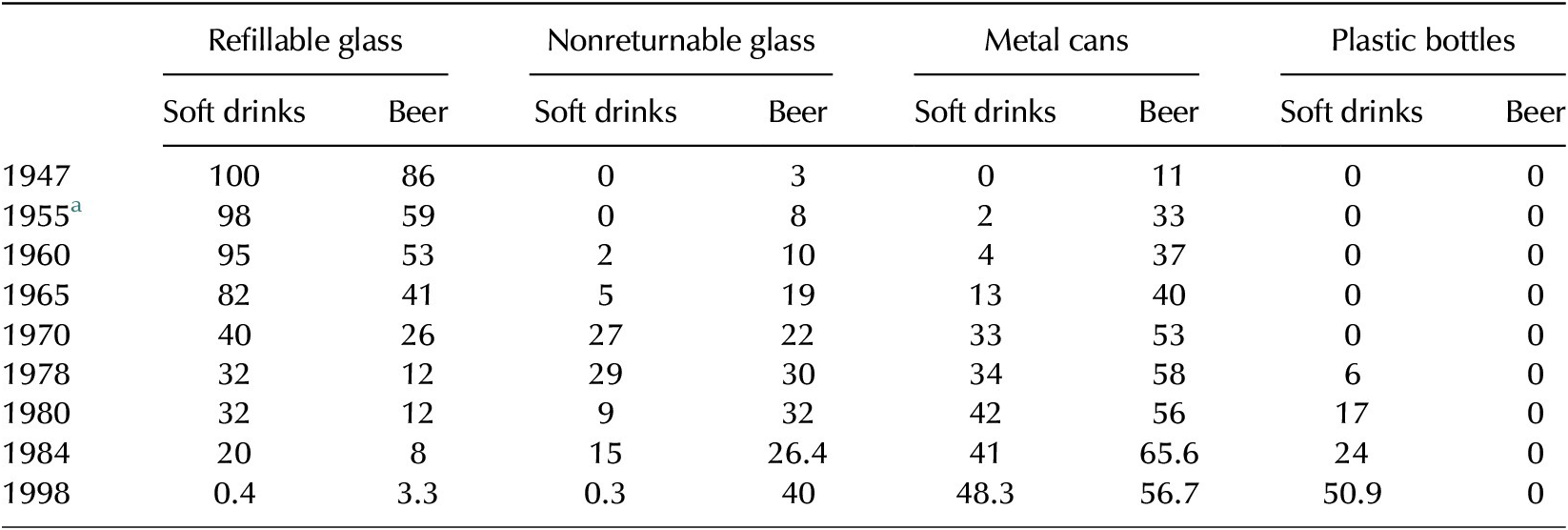
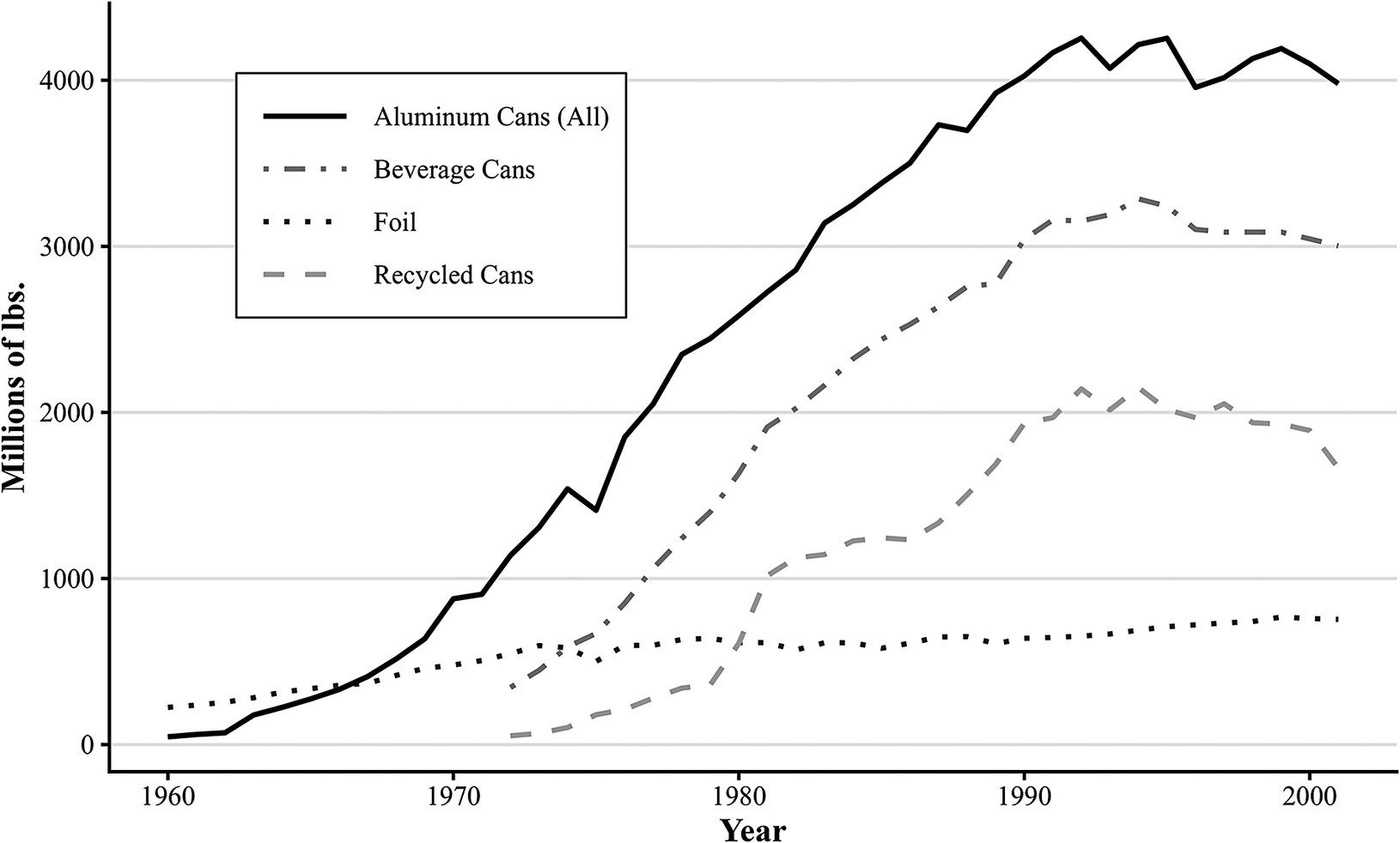

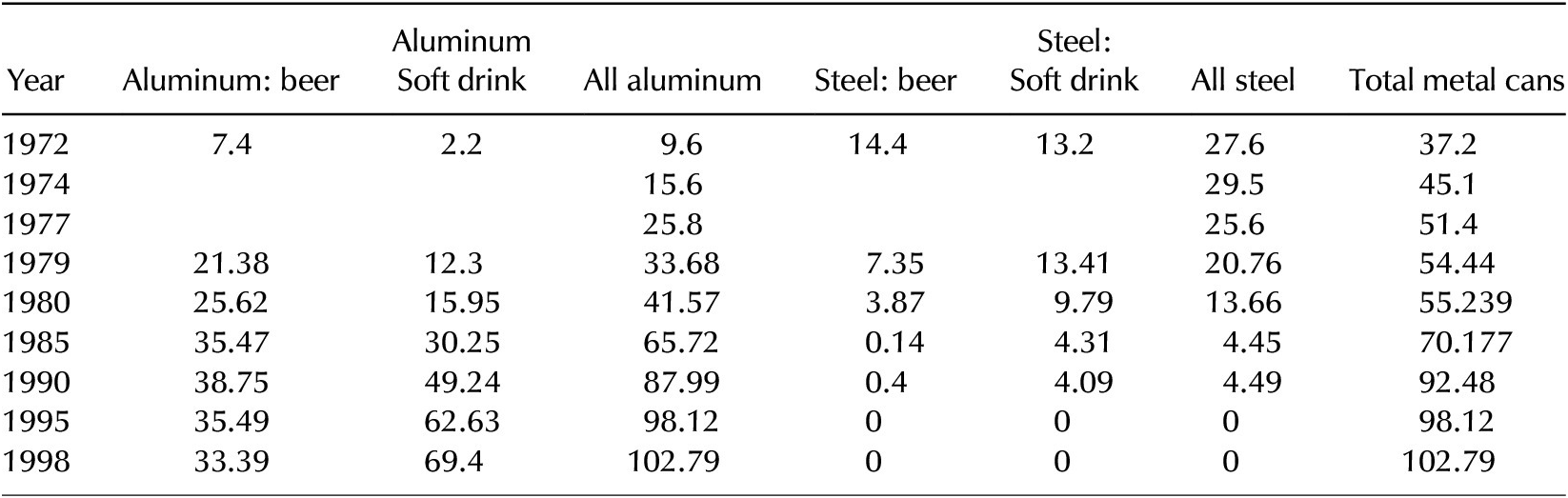
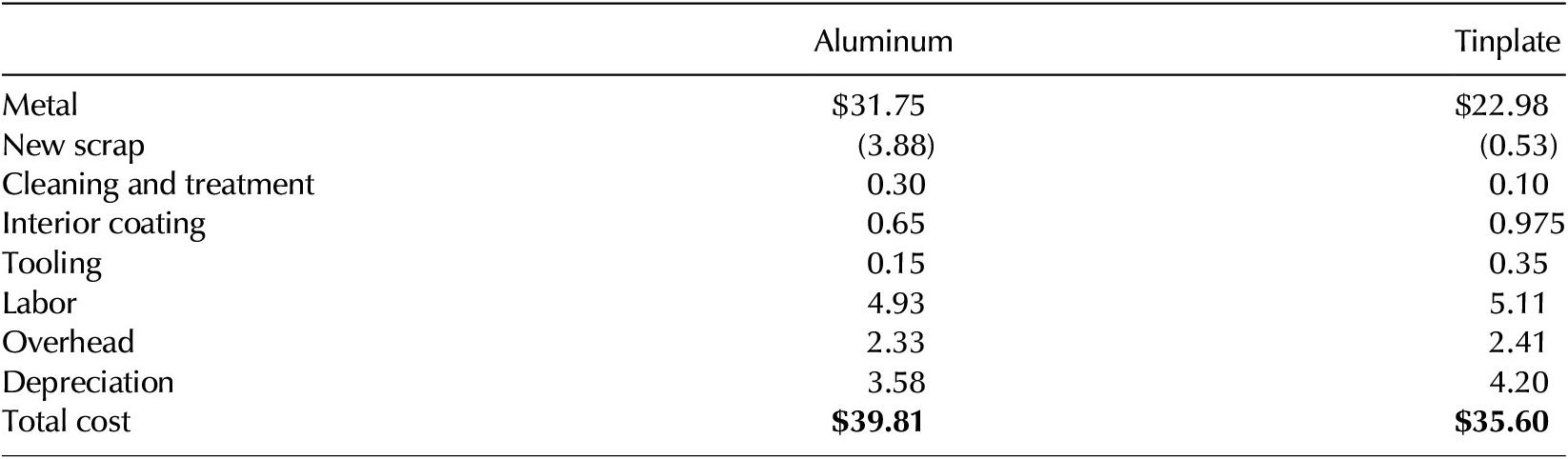


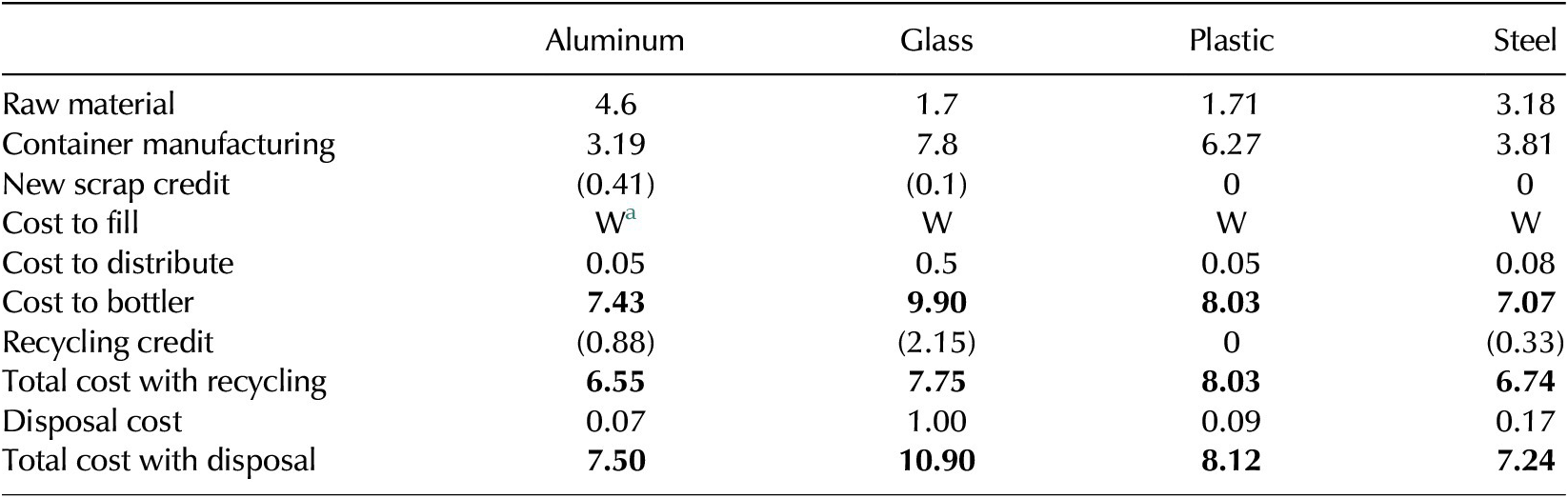

 Open access

