Introduction
This paper analyses the introduction of a systemic standards based programme for governing medical performance in Denmark. The programme is systemic in scope as it aims to incorporate all health care delivery organisations and includes both organisational and clinical standards. Organisations are evaluated both on their ability to incorporate standards in the work processes and their outcome performance.
The programme is thus supposed to make managers of delivery institutions put pressure on health professionals to follow general standards in their application of medical knowledge. The systemic application of standards via the national quality assessment programme is new compared to the previous situation, which was decentralised or professionally driven, and based on the largely voluntary introduction of clinical standards with a case-by-case evaluation of malpractice incidents. In an international perspective, the programme has clear parallels to the introduction quality assurance systems in the UK (see introductory article and the UK case in this volume), although the impetus is slightly different, as will be explained in the following. This indicates that we are dealing with a field where cross-national spread of ideas is important. In the Danish case import of ideas and methods is evident in the collaboration with both the American Joint Commission for Accreditation and the British Health Quality Service (HQS).
The systemic standards based programme has been developed incrementally via negotiations and agreements among the national government, decentralised authorities and professionals. The incremental process has led to several compromise solutions. Most notably, the programme is not explicitly measuring and reporting at the individual physician level, but instead focuses on the hospital and hospital department levels. The programme also combines clinical, organisational, and patient related standards and measures, and it contains both external evaluation and organisational self-assessment based on standards.
The following sections analyse the contents of the new governance of doctors via systemic application of standards as well as the process of negotiating this solution. Key questions to be answered are: why a systemic standards based programme emerged from the policy negotiation processes, and how contextual and institutional factors influenced the process?
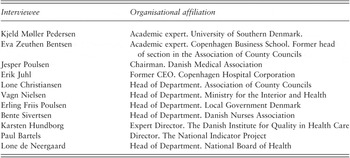
The analysis of the process leading to the adaptation of a systemic standards based governance programme for medical quality in Denmark is based on a systematic review of policy documents and professional journal articles found via searches in Danish library data bases. Policy documents include official formulations of the programme as well as legislation and formal agreements. The written material was supplemented by 11 semi-structured expert interviews with persons who have been directly or indirectly involved in the development of the programme. The interview respondents represent major institutional actors in the health policy field. For an overview, see Table 1. Pilot interviews with two independent academic experts and cross-references have been used to make sure that all relevant actor groups were represented.Footnote 1
List of expert interviews

The interview data was collected by research assistant Andreas Daugaard Jørgensen at the Institute for Political Science, University of Copenhagen. Citations were approved and initially published in Jørgensen, Andreas Daugaard (2007) ‘Den Danske Kvalitetsmodel’, Master thesis, Political Science, University of Copenhagen.
Historical and institutional contexts of governing medical performance
The Danish health system is a public integrated health system with universal access that is free at the point of delivery and financed by taxation. The general regulatory framework is set at the national level while the operational responsibility, as well as ownership of hospital facilities, has been decentralised since the 1970s, currently with five regions as the main actors. Professionals working in hospitals are employed by the regions on a salary basis. General practitioners and practicing specialists operate private clinics, but receive almost all of their income from public sources via agreements with the regions. The regions are responsible for both hospital and primary care, and thus for quality issues related to the delivery of service.
Using the terminology of Moran presented in the introduction to this special issue, the Danish system can be characterised as an ‘entrenched command and control system’. However, the decentralised structure means that there are clear limitations in the ability of the state to command and control. Many policy initiatives are introduced via agreements; this even applies to general regulatory measures, which are subject to extensive negotiations among central government actors, decentralised authorities, and other relevant parties such as the medical professionals (Vrangbæk and Christiansen, Reference Vrangbæk and Christiansen2005). Indeed, the Danish system can perhaps best be characterised as a variant of Moran’s ‘entrenched command and control health care state’, with ‘public corporatist’ features, but which are clearly more limited compared to the corporatist health care state such as Germany. It is ‘public corporatist’ in the sense that triangular negotiations among the state at the national level, the decentralised public authorities and the professions are at centre stage. These negotiations have become more formalised by virtue of being part of annual budget agreements, bi-annual agreements on working conditions and salaries for doctors, and a number of planning and ad hoc working groups and official committees (Larsen et al., 2007). Such negotiations are central pathways for policy making in Danish health care.
The governing ambitions of the state within this entrenched corporatist (“public negotiation”) health care state have grown in recent years. This is reflected in the structural reform of 2007, which dismantled the 15 counties and created five larger regions. The reform also moved financial responsibility from the regions and gave more formal power to the National Board of Health (Bundgaard and Vrangbæk, Reference Bundgaard and Vrangbæk2007). The stronger governing ambition of the state within the negotiation-based health system is an important contextual factor for the development of the systemic standards based assessment programme. The National Board of Health, described in more detail below, has played an important coordinating role in the process of developing the programme (Pedersen, Reference Pedersen2005; Vrangbæk and Røpke, Reference Bundgaard and Vrangbæk2007). This reflects the more general monitoring and control tasks of the National Board, which concern issues of patient safety. In this respect, the agency has traditionally relied on issuing guidelines or general recommendations to be implemented by hospital owners or health professionals, but with limited possibilities for sanctioning.
The normative institutions of medical authority are linked to the structural position of the profession in the health system, and overall medical authority remerges as publicly embedded. Indeed, the statutory body of professional regulation is part of the public health care administration. The National Board is a national agency attached to the Ministry of Health, but due to its close connections with medical societies, and the tradition for having medical professionals in the top management, it is also seen as an important entry point for professionals in health policy matters (Vallgårda and Krasnik, Reference Vallgårda and Krasnik2007). Health professionals, thus, play important roles both as employees within the agency and in collaborating with the agency in terms of scientific assessments, development of guidelines, etc. Yet, the political and administrative profile of the agency has been strengthened particularly after the structural reform in 2007. The appointment of the first non-medical head of the agency in 2007 is indicative, and stirred considerable debate and scepticism among health professionals.
The agency is mandated by law to monitor and control health service delivery and personnel. The monitoring and control of medical practice is both institutional and individual but has traditionally focused on individuals; whereas, institutional quality assessment has primarily been a task for the regional owners of hospitals (NBoH website). Investigation of individual professionals is based on information from a corps of health officers and other relevant authorities. It concerns issues of malpractice, illegitimate prescription, and other types of misconduct. The agency can suspend or revoke licenses to practice medicine, based on individual assessment of misconduct or incompetence. A few minor scandals involving practicing specialists have brought the issues of monitoring/control and intervention on the agenda, but so far there have not been major hospital-related scandals that might have created an acute need for policy change.
Furthermore, agreements on salaries and working conditions are important pathways for introducing new initiatives within the governance of medical performance. Doctors in the Danish hospital sector are employed by the regional authorities on a salary basis. Salaries and working conditions are negotiated in agreements between the Association of Regional Authorities and the Danish Medical Association. General practitioners and practicing specialists operate privately owned clinics, but they receive most of their income through fees determined in general agreements with the Association of Regional Authorities. The medical profession in Denmark is organised in the Danish Medical Association, which represents medical professionals in negotiations on salaries, fees, and working conditions. Affiliated with the Medical Association are a number of scientific medical societies for different specialty areas and more general professional themes such as quality assurance. The medical societies interact with central authorities on specialty planning and specialist education and are active in defining good practice in different speciality areas. Practice guidelines and standards are thus developed in interaction with the relevant medical societies. Importantly, there are no explicit control and sanctioning mechanisms against doctors within the Medical Association or the medical societies.
The integration of doctors via employment, agreements, working groups, and committees are important as a basis for the normative institutional structure of medical authority. At the same time, doctors generally maintain a self-perception of being independent experts seeking to apply the best available evidence, to do as much as possible for the individual patient (Jespersen, Reference Jespersen2005). The professional reactions to the standards-based governance should be seen in this light. Health professionals are obliged to implement the hierarchically decided initiatives, but acceptance and participation is much more likely if the initiatives are perceived to be in accordance with evidence-based practices, and appear to support clinical, patient-oriented practice (Jespersen, Reference Jespersen2005). The evidence orientation of the medical elites has given rise to the introduction of voluntary standards and guidelines, which operate as a supporting framework for medical decision-making. However, the medical professionals have also been adamant about maintaining flexibility for individual judgement within the general guidelines, and about avoiding publication of data related to individual professionals and cases (Heinskou, Reference Heinskou2005).
Summing up, the Danish health system can be characterised as a ‘public corporatist’ ‘entrenched command and control health care state’ based on increasingly formalised and ad hoc negotiations among the central government, the decentralised levels, and the professionals. Governance arrangements are, therefore, also characterised by a considerable degree of decentralisation. The National Board of Health is central in coordinating the different initiatives to governing medical performance. Importantly, this also includes cases of malpractice, and medical authority emerges as publicly embedded. Against this background, the governance of medical performance presents itself as a combination of hierarchy and network-based forms on governance. Here, it is indicative that the National Board traditionally has had limited powers to enforce the application of the national initiatives in the relatively autonomous regions. Negotiated agreements and soft regulation of regions and professionals in terms of guidelines and recommendations have, therefore, been typical approaches to implementing new governance initiatives directed at the medical application of knowledge. The introduction of a mandatory systemic standards based quality assessment programme represents a more integrated and comprehensive governance regime for regions, hospitals, and ultimately health professionals.
The new governance through the systemic standards based programme
The systemic standards based programme is an umbrella strategy aimed to integrate a number of existing projects and combine different strategies. In terms of the governance of medical performance, the programme marks a strengthening of hierarchy-based forms of governance, which co-exists with salient network-based forms of governance as well as some elements of market-based governance. The core of the assessment programme is an accreditation process to be performed at regular intervals for all parts of the health system. The accreditation process consists of both self-evaluation by each organisation (annually) and external evaluation (every third year) by a professional accreditation organisation. The self-evaluation includes assessment and reporting of performance compared to standards, where the use of comparable indicator data allows comparisons over time, and between organisations. The external evaluation takes the organisational self-evaluation results as the starting point and then assesses the status for quality development. The Copenhagen pilot accreditation was performed by the American ‘Joint Commission’, while the Southern Denmark Region collaborated with the British HQS. In the implementation of the programme the Danish organisation IKAS will work with CHKS (formerly HQS) to obtain certification as an accreditation agency by ISQua (International Society for Quality in Health Care). IKAS will train its own surveyors to perform the external accreditations in the future. IKAS is a joint venture between the regions, the state, and the municipalities. It has 25 employees, mostly with medical education. IKAS is in charge of the continued development of the ‘Danish Quality Assessment Programme’.
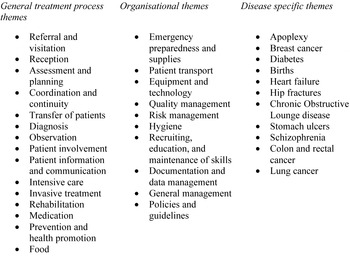
Standards and indicators cover a range of themes such as physical infrastructure, equipment, treatment paths, processes, and results related to three general thematic categories: general treatment process activities, disease specific activities, and organisational activities (Sundhedsstyrelsen, 2004). Strategically important focus points and treatment areas have been selected for the initial implementation (see Figure 1 for details).
Strategic themes in the systemic assessment programme

The themes form the basis for elaboration of detailed standards and indicators. For example, within the broad category of ‘organisational themes’, there are now seven specific focus areas. One of these is ‘hygiene’, which includes five specific standards such as ‘the institution must have a policy for hygiene regulating infection and hygiene matters’; ‘the institution must establish routines to prevent and monitor infections’; ‘appropriate measures must be taken when reusing equipment and materials’. These standards are accompanied by indicators (measuring points) which specify practical actions, and reference to appropriate regulation and guidelines.
The governance of medical performance through the programme is indirect in the sense that measurement takes place at the hospital department level, and standards are supposed to be enforced by management practices in hospitals and hospital departments. The combination of normative pressure on hospital management, publication of benchmarking results, competition for patients, and the implicit threat of bureaucratic intervention are designed to create incentives for compliance at the hospital level. Corrective measures against departments and medical personnel for poor medical performance and lack of compliance with standards are to be taken by management at the individual organisations. The regions, and ultimately the state, can intervene in case of continued quality problems. This threat is implicit in the sense that conditions for intervention and potential sanctions have not been specified.
Cases of individual doctor errors and malpractice continue to be handled in the separate patient complaints system, where ad hoc boards – consisting of a judicial expert as chairman, with two health specialists and two lay persons chosen from a core of experts and lay persons appointed by the Minister after consultation with the decentralised authorities and patient organisations – evaluate each complaint against ‘common clinical standards’ on a case-by-case basis. If clinical standards have been followed, the charge will be dropped, regardless of the outcome. In this sense, the development of standards and the documentation of the adherence to standards have become more important also for the case-by-case governance of individual doctors.
Standards and indicators will thus influence the work processes of doctors, as the organisation is likely to focus on those work processes that will enhance the likelihood of getting good measurement results. Some standards are generic and there is some flexibility in choosing the organisational means for implementing them. Still, it seems likely that some level of uniformity will develop as uniform indicators are applied. Other standards are quite specific in prescribing particular procedures based on reference programmes and guidelines. Here, the scope for individual clinical assessment will be reduced. This is further underscored by the fact that malpractice complaints are evaluated against assessments of compliance with available standards and guidelines.
Importantly, however, standards are developed by working groups, which include representatives appointed by relevant professional groups, in addition to representatives appointed by regional authorities and hospital management. This is a further illustration of the triangular ‘public corporatist’ nature of the health system and, thus, the integration of medical elites in the governance system.
The reporting of compliance with standards is divided into three elements: first, ongoing and periodical feedback from the Quality Programme organisation to the individual health care institution, with overviews over the development of own and other institutions’ indicator data and self-reporting; second, periodical accreditation with a recognition of the work of quality improvement and a report to each individual health care institution, including possible suggestions for improvements; and finally, the publication of indicators, external assessments and accreditation status on the Internet.
In the summer of 2007, the Minister for the Interior and Health formalised the reporting process and changed the scope of the negotiated strategy somewhat when he announced a star rating system. The star rating scheme combines organisational, outcome, and patient satisfaction data, and publishes both aggregate and detailed measures on the Internet for all hospital departments (http://www.sundhedskvalitet.dk). Hospitals are awarded between one and five stars, based on assessment of relative performance on 13 indicators within the overall categories timeliness/waiting times, patient satisfaction, hygiene, and physical conditions. Three stars represent the average score. This system supplements the Internet-based publication of expected waiting times and treatment volume that has been available for a number of years. The explicit goal of the star rating scheme was to improve the basis for choice of hospitals. Although not directly targeting the individual health professional, it is also meant to affect the conditions of medical practice at the organisational level, as hospital management is likely to implement strategies that will help to improve performance in regards to the chosen indicators. Yet, the choice of indicators has been criticised for focusing too much on secondary aspects (physical conditions, patient satisfaction) rather than core medical quality performance dimensions. There is, thus, limited evidence of actual improvement in quality outcome due to the scheme, but several anecdotes on adjustments in infrastructure (e.g., more toilets in the wards), in order to appear better. There has been a stronger focus on waiting times, but this is probably more due to other regulatory measures. The efforts on hygiene also appear to have been stepped up.
In terms of the underlying governance forms, as discussed in the introduction to this special issue, the systemic standards based programme combines several different governance forms. The programme was initiated in the political administrative system as a hierarchical governance attempt to strengthen control over regions and health professionals. The development of external reporting mechanisms and the inclusion of accreditation follow this goal to provide tools for better hierarchical governance from the central level. However, the programme also has strong emphasis on self-evaluation, which accommodates the principles of decentralised governance forms under which specific interventions are negotiated between central and decentralised authorities and professions. In this sense, network governance is present. Network governance has also been an important element throughout the development of the assessment programme. The working groups for developing the core standards and indicators are network constructs with participants from different regions and relevant professional groups.
Hierarchy and network-based forms of governance co-exist with elements of market governance, which are especially apparent in the strategies concerned with the publication of performance results, with the explicit aim to support patient choice.
More broadly, as the academic expert Eva Zeuthen Bentsen suggested in an interview (also see Jespersen, Reference Jespersen2005), the systemic standards based programme both reflects and contributes to a gradual shift in the normative institutional basis for medical practice, from reliance on idiosyncratic local experience to more generic evidence-based practice The speed and degree of penetration on medical practice is likely to vary somewhat across specialties and types of hospital. It seems likely that the centralised and specialised hospitals will be at the forefront in implementing the programme standards.
The process of negotiating the systemic standards based programme
Inspired by developments in particularly the US, the UK, the Netherlands, and Sweden, many counties and hospitals initiated projects for improving medical quality during the late 1980s and early 1990s. The projects were largely bottom-up and learning-oriented pilots (Knudsen et al., Reference Knudsen, Fugleholm and Kjærgård2004). A society for quality in health care was established in 1991, and in 1992 the National Board of Health set up a National Council with representatives from regional authorities, the central government, and the medical profession. In 1992, the Council produced a general strategy paper for quality governance. Some of the local initiatives were gradually expanded into national projects. An important example is the National Indicator Project, which developed standards and clinical databases for strategically selected treatment areas. The medical societies, the Medical Association, counties, and central government agencies, all contributed to this process (Knudsen et al., Reference Knudsen, Fugleholm and Kjærgård2004)
At the time, national level politicians were blaming the counties for the emerging evidence of poor performance regarding waiting times and, more generally, the slower growth in life expectancy in Denmark compared to other European countries. Several national political parties were even in favour of removing the responsibility for health care from the county level altogether (Bundgaard and Vrangbæk, Reference Bundgaard and Vrangbæk2007). An indication of stronger national steering ambitions can be seen in the gradual inclusion of more detailed organisational and performance-related issues in the annual budget negotiations between the central government and the county authorities, throughout the 1990s. However, the budget agreements were not formally binding, and it was not unusual to see large variations in the speed and thoroughness of the implementation of the organisational initiatives that came from the national level.
The counties sought to maintain legitimacy by demonstrating good performance in terms of financial management, patient satisfaction, and clinical performance. The latter naturally led to an increased interest in measuring systems and clinical standards as a way to promote good practices (Knudsen et al., Reference Knudsen, Fugleholm and Kjærgård2004). As a result, there were a number of county-based initiatives during this period. Examples include the previously mentioned National Indicator Project and the use of accreditation schemes in several counties. These initiatives introduced standards and clinical databases as a basis for evaluating medical performance. Importantly, the central government supported these initiatives and supplied part of the funding (e.g., for the development of clinical databases). Some of the initiatives thus became national in scope, but, at the same time, individual counties continued to develop their own governance strategies. This can be interpreted as an attempt on the part of the counties to pursue their own interests vis-à-vis other counties and, more generally, to maintain legitimacy in the face of growing external pressure from the state at the national level.
The medical professions officially supported the various quality management initiatives (Knudsen et al., Reference Knudsen, Fugleholm and Kjærgård2004). Several clinical databases were developed in a bottom-up fashion by doctors in management positions in hospital departments. As Paul Bartels, director of the National Indicator Project, observes in an interview, this reflects of a general change in the normative institutional bases within the profession.
However, the variations in practice and the continued critique of the quality and level of service performance led to increased national steering ambitions. Towards the end of the 1990s, politicians at the national level increasingly pushed for a mandatory system of monitoring and controlling the performance of health care providers.
The counties generally preferred to maintain a bottom-up and voluntary approach, which would facilitate experiments with different solutions in different regions, as Kjeld Møller Pedersen, an academic expert from the University of Southern Denmark, observed in an interview. Best practice examples could then potentially be introduced on a national scale by voluntary action or negotiated agreement, as in the National Indicator Program. Yet, as the pressure from the central government increased, and as the general political climate became less supportive of decentralised variation, it became clear that the voluntary strategy was unsustainable. The counties, therefore, entered into negotiations on a national programme. The general interest of the counties at this point was to influence the design and maintain as much control as possible. Beneath the common interest were diverging views in the different counties. The Copenhagen Hospital Corporation was a leader and a strong promoter of an accreditation-based approach. In contrast, many of the smaller counties worked actively to avoid the rather expensive ‘Copenhagen model’ of accreditation, as suggested by Lone Christiansen of the Associations of County Councils, which played an important role as a forum for negotiating agreement among the counties on quality issues. This largely took place in a sub-committee concerning quality management, which was established in 1995.
An important first part of the negotiation process for a new national model for governing medical performance played out in an informal arena, consisting of a series of meetings between 1999 and 2002, with the four main actors: the Ministry for Health, the National Board of Health, the Association of County Councils, and the Copenhagen Hospital Corporation (Vagn Nielsen, of the Ministry for the Interior and Health, in an interview). The National Board of Health chaired the meetings, but generally took on the role of a facilitator rather than driving the process in a particular direction. The Ministry of the Interior and Health championed the Minister’s interests in creating a standards based system, which could generate performance data for comparison. The Minister was a strong supporter of patient choice, and saw the development of clinical performance data as a way to both promote choice and better (state) manage the health system, according to Vagn Nielsen, of the Ministry for the Interior and Health.
The Medical Association was not formally represented, but several of the interviewed actors emphasised that anticipating the reaction of the professions was an important component of the meetings, and that it was unlikely that an agreement could be made that was fundamentally opposed to the interests of the medical professionFootnote 2. It thus seems, that the Medical Association has had an ongoing influence on the work in the group. The initial development of a framework agreement thus took place in ‘the shadow of the profession’. Within the ranks of the medical profession, there was mostly support for clinically focused approaches, such as the National Indicator Project and clinical databases. Accreditation was less favoured by professionals as it was seen to focus too much on organisational dimensions, such as infrastructure and formal procedures, rather than medical outcome measurementsFootnote 3.
The informal negotiations between the four main parties (plus the Medical Association) led to an agreement on a basic framework for the national programme. A more formal arena was then established in form of the National Council for Quality Assessment, which included both political/administrative and profession-based members, in addition to advisory organisations. The other main actors in the field, including doctors, nurses and the municipalities, thus gained access to the negotiation of the contents of the programme via the Council.
The election of a Liberal/Conservative coalition government in 2001, with a relatively stable majority backing from the anti regional Danish People’s Party, together with a strong and high profile Minister for the Interior and Health, marked a change in the willingness to use hierarchy-based forms of governance. The Government coalition parties had focused on health care in the election campaign and had promised to solve the issues of waiting times and quality failures. There were some indications of waiting-time problems, although in comparison, for example, to waiting times in England, they appeared rather short. There were no systematic indications of quality failures, but a vague perception that ‘things could be better’ fuelled by single case stories. The relatively slower growth in life expectancy and the poor ranking in the WHO 2000 World Health Report, contributed to this general perception; although, the health authorities in both cases argued that life style issues were the main explanation. The minor coalition party (the Conservatives) and the government support party (the Danish People’s Party) were both in favour of dismantling the counties. The counties were thus under continued and increasing pressure in the beginning of the 2000s. The ‘shadow of the (state) hierarchy’ was pushing the process forward. The counties felt a strong need to increase their legitimacy, and one of the possible ways forward was an active stance in regards to quality monitoring and documentation.
Two policy documents were important in this process. The Association of County Councils published a memo for a national quality assurance policy in May 2001 (Amtsrådsforeningen, 2001). This memo was largely supported by the health professionals, as Lone Christiansen, from the Association of County Councils, highlights in an interview. The memo described how existing projects could be brought into a general national policy. Clinical standards would become a part of the programme, but largely in the same manner as in the National Indicator Project. Later the same year, the National Council published a detailed report (Sundhedsstyrelsen 2001a, 2001b) laying out the basic principles for a comprehensive systemic governance programme.
These policy documents provided input to the budget negotiations for 2002 between the Association of County Councils and the Government. The budget agreement presented a formal confirmation of the plans to develop a systemic standards based assessment programme. The agreement states that:
The Government and the Association of County Councils and the Copenhagen Hospital Corporation agree to develop a general Danish programme for quality assessment based on a core of common standards. The counties agree to live up to these standards. Standards will relate to structural dimensions, equipment, patient flows, processes and results. … The standards must facilitate publication of performance results and comparison based on external evaluation (Government and the Association of County Councils, 2001).
The agreement thus placed standards on the centre stage. Both organisational and clinical standards were part of the programme, and the counties formally agreed to a common systemic model with external evaluation and publication of results.
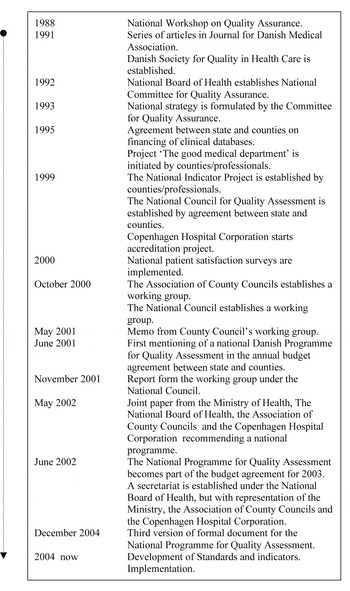
The general framework was thus in place, but a number of details remained to be resolved. This work took place over the following years in an ongoing negotiation process. The first important step was a policy memo from the relevant actors in 2002. This memo specified a timetable for the work and provided the background for establishing a secretariat within the National Board of Health, which also included the Association of County Councils, the Copenhagen Hospital Corporation, and the Ministry for the Interior and Health. The secretariat developed the first draft of a comprehensive programme in 2003. This has since been further specified and standards have been developed in working groups with health professionals and with representatives of the regions. The systemic standards based programme is ready to be implemented in 2008/2009. Figure 2 further illustrates the main developments to date.
Time line of key events in the development of the Danish Quality Assessment Programme

How can we interpret this process of negotiations? Why did the main actors enter the agreement on a systemic standards based programme? Two key questions are at the centre of this puzzle. How did the counties, as the decentralised owners of the hospitals, and the national authorities reach an agreement? And why did the medical profession accept this agreement? The following represents the author's interpretation based on interview data and other general sources.
The first question can be perceived as a game between two actors. The Ministry preferred a national model to a non-national model, at least after 2001. The counties preferred a non-national model, as this would provide maximum autonomy for the individual counties. Because the Ministry implicitly threatened to force a national model through, the counties accepted a national compromise, which incorporated elements from existing projects into a national model and institutionalised a structure where the counties maintained some influence. This outcome should be seen in light of the general political climate favourable to a more interventionist state policy in health care, culminating in a 2004 decision to undertake a major structural reform in 2007, that replaced the counties with five larger regions and formally strengthened power at the national level.
Why did the Ministry not just force a national solution through, rather than negotiate a compromise agreement? This should be seen in light of historical traditions for negotiated solutions, which create an environment of repeated games. If the Ministry were to short circuit this game, it might negatively affect the negotiation climate for future agreements. An open conflict with the counties could endanger the stability of the system and force the Government to seek political support for interventions, and perhaps, ultimately, a restructuring of the administrative system. Although some government members favoured a confrontational course, it was uncertain that the Government could win general support. Even within the main government party there was strong opposition to pushing the decentralised authorities too far (Bundgaard and Vrangbæk, Reference Bundgaard and Vrangbæk2007).
In more practical terms, the central government was dependent on the counties for the implementation of policies. The main source of power for the counties was their ownership of hospitals, which gave them the detailed management knowledge necessary for implementing various policies, and the potential for stalling or preventing the implementation. Therefore, forcing through a national solution was not without risk for the government. Thus, a national compromise appeared to be the first choice for the government, and the logical outcome of the policy negotiations between central and decentralised authorities. The general principles of the agreement have been maintained after the structural reform, although the implementation process has been slowed as administrative resources in the new regions have been tied up with the implementation of the structural reform. A major strike in the spring of 2008 led to further postponement of the implementation until 2009, as organisational resources had to be allocated to catching up after the loss in production.
Why did the medical profession support the agreement for a national programme that might potentially threaten their autonomy in making clinical decisions? They could be expected to prefer a solution focusing on evidence-based approaches and reporting within their own ranks, rather than a national compromise with elements of ‘auditing’ and ‘market-based’ ideas. Also, they had a strong power base in their professional monopoly over medical services strengthened by the current shortage of doctors. Ultimately, doctors could veto the entry of data into databases.
The fact of being salaried employees of the counties/regions played a role. Professionals are formally obliged to implement political decisions. Still, the medical profession was not without power to prevent initiatives, particularly in a situation with shortages of trained professionals. Yet, the position of being salaried staff, but with a strong bargaining position, led to the emergence of a negotiation-based relationship with the state. This had several implications for the strategic position of the medical profession vis-à-vis the systemic standards based programme. First, doctors felt obliged to support the programme, but at the same time had reason to expect that they would be able to influence the design and implementation process in their desired direction. Second, doctors had built up trust in public authorities in terms of reaching common ground in the implementation of reform initiatives. Finally, doctors may have feared losing legitimacy as a negotiation partner if they vetoed this programme, which may have damaged the profession in the public eye and in future negotiations with the public authorities.
A supplementary explanation takes as its starting point, the idea of measuring and comparing medical performance as not alien to doctors. According to Jesper Poulsen, the chairman of the Danish Medical Association, it is not uncommon for doctors to compare their performance with that of other departments and hospitals. Medical elites generally support the development of better and more evidence-based systems for comparing performance as long as reporting is not done at the level of the individual doctors. Representatives of the Medical Association have more generally stated that they would like to see more disease-specific and clinically-related standards as opposed to organisational standards in the Danish Programme, and that they hope that a stronger focus on medical performance will create a strategic platform for the allocation of additional funding to the health sector (Jesper Poulsen, interview).
The institutional context at work: decentralisation, consensus seeking, and institutional shifts
It should be apparent from the above discussion that institutional frames and historical legacies, in terms of policy traditions and institutionalised arenas, are important for developing the systemic standard based programme. The decentralised nature of the health system and the tradition of negotiation and agreements were important conditions for developing new governance forms.
The dispersion of power between central government and decentralised authorities, together with the institutional tradition of entering agreements across governance levels and with professionals, resulted in an incremental approach, where framework agreements paved the way for a more detailed specification of the systemic standards based programme. The inclusion of the central government, decentralised authorities, and professions in the development process led to several compromise solutions. It is notable that existing decentralised solutions were included in the strategy, and that professionals were able to avoid reporting at the individual doctor level.
The negotiated and stepwise process had advantages in terms of establishing co-ownership for the model among the relevant parties. This facilitated a more robust design, as the feasibility of different solutions was constantly tested against the different positions. However, there were also drawbacks in terms of slower progress and in the inherent risk of developing solutions that would accommodate the interests of one of the agreement partners at the expense of other actors.
The process of negotiating new governance forms was influenced by a shift in the institutional basis for governance relations between the central government and decentralised authorities over the past decade. More specifically, the past decades have seen a tendency for more interventionist central government policies in health care, culminating in the administrative reform, which changed the institutional structure for governing health services. The structural reform reflected a shift in the normative institutional basis towards centralisation and standardisation of public services. The same shift was apparent in the implicit threats to intervene if the negotiation-based approach failed to provide an acceptable new governing structure. The ‘shadow of the hierarchy’ had thus become stronger in general, and as a background for the negotiation of the systemic standards based programme for governing doctors.
The normative institutional basis for doctors was another important institutional context factor, which influenced the negotiation process. It seems that the medical community elites were now ready to accept systemic standards based governing forms as long as the measurement and reporting were taking place at an aggregate level. The institutional role of Danish doctors as public employees further facilitated the participation by professionals in the programme development.
The general emphasis on choice and the institutionalisation of this in the rules for ‘free choice of hospitals’ was another contextual factor that affected the negotiation processes for new governance forms. This was especially clear in the decisions on publication strategies and the emphasis on generating performance data, whereby organisations could be measured and compared against common standards. The emphasis on choice was carried forward by the government as an institutional pathway for generating pressure on delivery organisations, and ultimately the doctors working within the organisations.
Discussion: beyond institutions – the role of ideational regimes
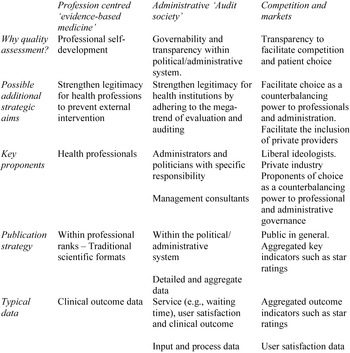
The institutional setting has clearly influenced the negotiation processes for introducing the systemic standards based programme. However, it can be argued that the institutions are embedded in a broader ideational regime, and that changes in the relative weight of different ‘master ideas’ (Røvik, Reference Røvik1998) provide additional environmental factors for explaining the programme’s introduction. More specifically, it appears that at least three different master ideas for governing medical performance have been competing in the Danish health policy debate: profession centred evidence-based medicine, the administrative audit society, and competition and markets. These master ideas represent different approaches to, and justifications for, quality assurance in health care. They are drawn up below as ideal typical approaches. In practical policies the picture is more blurred. An example is ‘evidence-based medicine’, which has become double edged in the sense that it can both facilitate professional self-development, and represent a weakening of professional power and the interference of other actors (epidemiologists, health economists, administrators). Similarly, it can be argued that ‘audit society’ systems can be used to facilitate choice as well as serve administrative control purposes. The practical and strategic use of the approaches may thus differ from the ideal typical representation.
Profession centred evidence-based medicine is the first cluster of ideas that can be associated with the quality assessment idea. It is often associated with the works of Archie Cochrane in the 1960s, but it is fairer to see it as an extension of a long history of quality focus in medical science. The basic idea is that systematically collected data on performance may be used to tease out best practice and identify poor performance. Randomised controlled trial is the preferred methodology for data collection, while follow-up and monitoring may be done through systematic entry into clinical data bases for evaluation and development of meta-evaluations through the Cochrane collaboration centres, HTA networks, etc.
The master idea of an audit society reflects tendencies described by Michael Power (Power, Reference Power1997). It broadly concerns the general growth of systems for evaluating and measuring performance in private as well as public sector organisations. It is driven by the erosion of legitimacy in other steering mechanisms and the decentralisation of management competencies in the wake of New Public Management (NPM). Public officials experience a need for new accountability mechanisms that could signal such accountability to the public at large.
The master idea of competition and markets is related to another part of the NPM universe, namely the orientation to market solutions and the creation of internal public sector competition as a proxy for real markets. The core idea is that individual consumer choice should be a driving force for service, and that quality assessment programmes should provide information to facilitate choice. Data should thus be comparable and presented in a format that lends itself to evaluation by ordinary citizens. Star ratings and other types of aggregate data measures are typical formats to support this effort, although more comprehensive underlying data may also be available for citizens.
Figure 3 summaries the three master ideas. The core idea of standards based quality assessment has spread throughout the Danish health sector in a gradual process over the past 10 to 15 years. It has become a presumed normative basis for health organisations, as illustrated by the pervasiveness of the phenomenon and the institutionalisation in the systemic standards based programme. Legitimacy pressure from the general environment and uncertainty in handling the changing demands in a situation of constrained resources contribute to the processes of adapting quality assurance ideas. External pressure is linked up with the professional logic and the gradual acceptance of evidence-based medicine in its modern and generalist format, and as a successor to the more idiosyncratic and local clinically based way of practicing medicine, where individual head doctors would determine the best course of action.
Three ‘master ideas’ for quality management in health care

Evidence-based medicine is thus one master idea that has become a carrier for new governance initiatives. Another carrier is the master idea of intensified auditing and evaluation in both private and public sectors. This trend is captured by the term ‘audit society’. Here, public officials have a need for greater transparency as the health sector is increasingly being questioned by the public and in the political arena. Similarly, public health organisations have a need to demonstrate that they are in control and can cope with the new demands. This creates a common ground for the introduction of auditing schemes, although not necessarily an agreement on the design of such schemes as described above.
Ideas of competition and quasi markets for public sector activities are another part of the NPM universe that have formed a basis for the introduction of the standards based assessment programme in the Danish health sector. The underlying idea is that consumer choice can be a powerful vehicle for putting pressure on public organisations to increase efficiency and quality. The idea can be found in the introduction of free choice of hospitals in the Nordic countries, and recently also in England. An important prerequisite for positive effects is that consumers/patients are able to make informed choices. The availability of readily interpretable quality assessment data thus becomes an important underlying condition, which drives the institutionalisation of some types of quality assessment programmes.
It can be argued that the interaction between the three underlying master ideas has shaped the policy development of quality assessment in the Danish health sector. Initially, the profession centred evidence-based medicine idea was dominant. This led to an uncoordinated bottom-up effort by professional enthusiasts and local managers. In the mid-nineties, the evidence-based idea was increasingly supplemented by ideas from the administrative ‘audit society’ logic. This corresponded to a rise in political and administrative steering ambitions, and a general turn towards NPM related steering concepts. Auditing regimes became important tools in a more decentralised management setting with external pressure on the legitimacy of health organisations. This created an environment where professionals and administrators interacted in an effort to define acceptable ways of institutionalising the quality assessment strategy. The liberal, market-oriented elements of the NPM universe gradually gained importance in the political thinking about public sector delivery over the past two decades. This was particularly carried forward by the liberal-conservative governments from 2001 onwards. The market ideas added an additional layer to the quality assessment policies. The end result is thus based on a hybrid set of ideas, which are not always in harmony, when translated into practical policies. Such inherent tensions are manifest, for example, in publication strategies.
Concluding remarks
The previous sections have analysed the substance of new medical governance and the process of negotiating this policy solution. In terms of the substance of governance, the programme strengthens hierarchy-based forms of governance; these co-exist with salient components of network-based governance as well as some elements of market-based governance. Here, it appears that institutional and contextual factors are important in explaining why a systemic standards based programme emerged as a result of the policy negotiation processes. The decentralised nature of the Danish health system, and the traditions for negotiated solutions amongst the central government, decentralised authorities, and publicly employed health professionals are important institutional background factors. A number of more specific institutional factors were also important in mediating the policy solution.
First was a general shift towards more hierarchical (state) governance in health care. This reflects changes in the normative basis for the public health sector, whereby greater emphasis is placed on centralisation to larger units, benefits of scale, and standardisation of service levels (Final Report of the Government’s Structural Commission, 2004). A relative decline in life expectancy, and indications of suboptimal quality and service in some specialty areas led national politicians to adopt a more interventionist attitude towards the decentralised levels during the 1990s. Process guidelines, standards, measurements, and comparisons have become part of the state strategy to influence the decentralised service delivery.
Second, decentralised authorities had already initiated a number of quality assessment programmes in collaboration with health professionals and national policy institutions. These programmes involved the development of standards and clinical databases. Two counties had also introduced accreditation programmes. Experiences from these decentralised, voluntary, or agreement-based initiatives facilitated the move to a mandatory, systemic programme. This illustrates the importance of the decentralised institutional structure for generating interaction between bottom-up and top-down solutions.
Third, the institutional and normative basis for the medical profession in Denmark supported a negotiation-based approach to developing and applying national standards, especially reflecting the publicly embedded nature of medical authority. Hospital doctors are salaried employees of the regions, and health professions (medical societies) have traditionally been included at the national, regional, and organisational levels in committees and working groups for developing standards and guidelines. This has created an institutional normative basis, where at least the medical elites have become ‘co-owners’ of standards and guidelines for medical practice. At the same time, a stronger emphasis on general, evidence-based norms for medical practice can be observed among health professionals in Denmark.
Institutional factors, therefore, had a clear and important influence on the negotiation processes and on the end result. Other important contextual factors include the gradual development of three underlying ideational perspectives for governing the quality of public health services. Evidence-based policy, the audit society, and market ideas, have all influenced the thinking about governing systems for doctors in Denmark. The systemic standards based programme represents a compromise between these different ideational perspectives.