Introduction
Obsessive–compulsive disorder (OCD) is a heterogeneous mental illness marked by intrusive, time-consuming thoughts, images, or urges experienced by sufferers as involuntary and distressing (ie, obsessions), and/or repetitive, ritualistic behaviors or mental acts (ie, compulsions). 1 The lifetime prevalence of OCD ranges between 1.1% and 3.5%,Reference Fawcett, Power and Fawcett 2 and it is frequently associated with significant comorbidity and disability.Reference Lochner, Fineberg and Zohar 3 Despite the advances made in research, prognosis for individuals with of OCD remain variable, with 59% eventually relapsing after receiving either cognitive behavioral therapy or pharmacological intervention (e.g., serotonin reuptake inhibitors) or combination thereof.Reference Eisen, Sibrava and Boisseau 4 Due to its heterogeneity, a dominant view among clinical researchers is that phenotype research might play an important role in better understanding OCD etiology and improving therapeutic intervention.Reference Dell’Osso, Marazziti and Albert 5 , Reference Miguel, Leckman and Rauch 6 Recently, some observational studies highlighted the possibility that romantic love state might act as a precipitant for OCD and influence certain phenotypic expressions.Reference Thompson, Torres and Albertella 7 , Reference Marazziti and Stahl 8 However, whether OCD precipitated by romantic love represents a distinct phenotype is yet to be empirically tested. This study aims to bridge this gap in OCD domain by further examining the effects of romantic love on the expression of OCD characteristics.
Since no study hitherto has systematically explored the role of romantic love in the development or expression of OCD, Some researchers have theorized about a potential relationship between the two. Leckman and MayesReference Leckman and Mayes 9 were one of the first to articulate the similar features between some characteristics of romantic love and the symptoms of OCD. From a subjective level, they opined these two phenomena both exhibit prominent and largely involuntary features, including intrusive thoughts or images, heightened awareness of a loved one, exclusivity of focus, and the tendency to obsess over trivial details of an experience.Reference Gottschall and Gottschall 10 , Reference Feygin, Swain and Leckman 11 Here, it should be noted that the type of love described here refers to the early phase of being in love and should not be conflated with the latter stages of committed love that is characteristic of long-term, committed relationships.Reference Sternberg 15
A parallel can also be drawn between the thoughts frequently associated with romantic love and specific OCD symptom dimensions. It is well understood, for instance, that people in love often report an increased sense of responsibility and excessive fears for the safety of their lovers.Reference First, Spitzer and Gibbon 29 The central theme of these thoughts (ie, fear of harm) bears close resemblance to the obsessions in the aggressive dimension.Reference Rosario-Campos, Miguel and Quatrano 12 In addition to concerns for the other person’s well-being, those in love commonly report being inundated by sexual thoughts, desires, and fantasies.Reference Gonzaga, Turner and Keltner 13 Again, these thoughts resemble symptoms in the sexual-religious dimension, which entails sexually charged obsessions and improper thoughts or impulses. Therefore, while the features typical of romantic love are not inherently pathological, they do share similar elements with OCD symptoms in the aggression and sexual-religious dimensions.
Pope’sReference Pope 14 definition of romantic love highlights another phenomena commonly associated with this emotion: the feelings of incompleteness. This ineffable sensation lies at the core of some prominent theories, such as the triangular theory of love,Reference Sternberg 15 , Reference Hatfield, Bensman and Rapson 16 that posits the feelings of incompleteness as a central mechanism underlying romantic pursuits. Interestingly, people with OCD are no strangers to these feelingsReference Cougle, Fitch and Jacobson 17 , Reference Ecker and Gönner 18 , and recent evidence showed that they are a common motivator of compulsions.Reference Lee and Wu 19 Feelings of incompleteness are described among the subjective experiences reported by those with symptoms of OCD driving the performing of the repetitive behaviors, most of the time, in the absence of obsessions, which are prevalent in almost half of individuals with this disorder.Reference Ferrão, Shavitt and Prado 20 , Reference Rosário-Campos, Prado and Borcato 21 This, in concert with other evidence presented so far, highlights the several phenomenological parallels between romantic love and OCD, indicating a much deeper connection than previously conceptualized.
The striking parallels between OCD and romantic love raise an important question: how are these two phenomena connected? According to Leckman and Mayes,Reference Leckman and Mayes 9 the answer might be tied to the evolution of love and its shared neurobiological mechanism with OCD. Love, from an evolutionary perspective, is a highly conserved behavior which has evolved for the purpose of pair bonding.Reference Fletcher, Simpson and Campbell 22 While necessary for securing a desirable partner, love, as described previously, does come at a cost. Hence, a reasonable expectation would be that the neurobiological systems responsible for love must be under stringent regulation throughout one’s life. There will be times when love needs to be switched off or turned down, as failing to do so would result in an excess of obsessional, intrusive thoughts. Much like repetitive negative thinking seems to exacerbate depression, Leckman and MayesReference Leckman and Mayes 9 suspected that it is the dysfunction of these mechanisms and the resultant uncontrollable thoughts that are implicated in the pathogenesis of OCD.
Consistent with Leckman and Mayes’ prediction,Reference First 27 a preliminary study found evidence indicating an overlap between romantic love and OCD at a neurobiological level. Marazziti et al.Reference Marazziti, Akiskal and Rossi 23 performed a study comparing three groups of participants: those who had recently fallen in love, individuals diagnosed with OCD and not in love, and healthy controls. They chose to analyze their platelet serotonin (5-HT) transporter levels through the binding of 3Hparoxetine, which is often considered as a reliable biological marker for OCD.Reference Bandelow, Baldwin and Abelli 24 Surprisingly, people with OCD and individuals who were in love both had significantly lower 5-HT transporter densities, compared to normal controls, but did not differ from each other. When some of the participants who were in love were retested again in 12 to 18 months, the previously noted 5-HT abnormality had dissipated and their transporter levels were indistinguishable from the normal controls. This investigation suggests that love operates similarly to OCD on a neurobiological level, but did not measure obsessive–compulsive behaviors, so whether these abnormalities translated to the manifestation of OCD remains inconclusive.
If Leckman and Mayes’Reference Leckman and Mayes 9 theory is supported by empirical evidence, then a corollary would be that the occurrence of romantic love might herald or exacerbate OCD symptoms in those predisposed to the disorder. Marazziti and Stahl’sReference Marazziti and Stahl 8 case study on a young law student with a family history of OCD provides preliminary support for this notion. Their study described a male law student patient who saw the first occurrence of OCD and clinical levels of symmetry and contamination obsessions immediately after he had fallen in love at 18 years of age. Overwhelming as they were, those symptoms disappeared after that relationship had ended and remained dormant until he was in love with another person a year later. This intimate, cyclic relationship observed between romantic love and the onset of obsessive–compulsive symptoms does suggest a strong correlation, but this has never been empirically examined. This study, therefore, aims to examine whether OCD precipitated by romantic love (from herein referred to as love-precipitated OCD) differs significantly from non-love precipitated OCD in certain phenotypic expressions. Specifically, it was predicted that love-precipitated OCD would be associated with more sexual/religious symptom and aggressive symptoms (eg, fear of harm); sensory phenomena (SP; eg, feelings of incompleteness); episodic onset; increased severity of depression and anxiety symptoms; and increased comorbidities with major depressive disorder, bipolar I and II disorder, generalized anxiety disorder, agoraphobia without panic, and separation anxiety disorder.
Methods
Participants
The current study was a secondary investigation of an initial sample of 1001 OCD patients from seven universities across Brazil as a part of the Brazilian Research Consortium on Obsessive–Compulsive Spectrum Disorder (CTOC).Reference Miguel, Ferrão and Rosário 25 Patients were referred from outpatient and inpatient clinics, clinicians in primary health care units, private psychiatric services in São Paulo, or website and media advertisements. The recruitment period began in 2005 and ended in 2009. To be included, participants had to meet DSM-IV OCD diagnostic criteria (American Psychiatric Association 26 ), confirmed by the Structured Clinical Interview for Diagnosis of Axis I DSM-IV disorders (SCID-I; Reference First 27 ), and had the capacity to provide consent as well as to understand research protocols. Patients incapable of understanding the assessment instruments and those with psychotic disorders were excluded during data collection phase. Given the aims of the current study were to investigate romantic love (ie, limerence), and since adolescents under the age of 15 are unlikely to pursue romantic feelings,Reference Hagan, Shaw and Duncan 28 only those over 15 were included in the final analyses. A final sample of 981 (M age = 35.31, SD = 12.71, Range = 15-82) patients was included in this study. A detailed sociodemographic summary has been described elsewhere.Reference Miguel, Ferrão and Rosário 25
Ethics approval
The CTOC was approved by ethic committees at each participating university in Brazil (Process: USP-968/05; UNIFESP-302/2006; UFRJ-0024.0.249.000-06; UFRGS-06/171; and IPA-6600023).Reference Miguel, Ferrão and Rosário 25 Every participant included in the database has provided written informed consent, and in instances in which they could not, such as the case for underage subjects, parents’ or legal representatives’ consent was sought. Ethics approval for the present study was also obtained from the Monash University Human Research Ethics Committee (project ID: 21842).
Materials
Psychiatric comorbidities
The SCID-I is a clinician-administered, semistructured interview designed to ascertain the presence of Axis I psychiatric diagnosis according to the DSM-IV Reference First 27 , Reference First, Spitzer and Gibbon 29 . A Brazilian Portuguese version of the SCID-I,Reference Del-Ben, Vilela and Crippa 30 which has demonstrated strong inter-rater agreement (weighted Kappa = 0.83) for most Axis I psychiatric disorders was used in this study. The SCID-I was used to identify the presence of OCD and six psychiatric comorbidities related to the hypotheses. Only current diagnoses were used in this study.
Love as a precipitant, age at onset, and developmental course
The Yale OCD Natural History QuestionnaireReference Leckman and Cohen 31 is a self-report questionnaire that explores the events, circumstances, and other potential contributing factors that may have influenced a patient’s OCD symptoms. A Portuguese version was translated specifically for this study.Reference Miguel, Ferrão and Rosário 25 This questionnaire was used to determine love as a precipitant, age at onset for obsessions and compulsions (separately), and developmental course. Participants were considered in love if they responded “yes” to “I was in love when I first experienced compulsions/obsessions.”
Obsessions and compulsions
The Yale–Brown Obsessive–Compulsive Scale (Y-BOCS)Reference Goodman, Price and Rasmussen 32 was used to evaluate the severity of obsessions and compulsions. This 10-item, self-report scale has demonstrated strong internal consistency (Cronbach’s alpha = 0.76-0.90),Reference Woody, Steketee and Chambless 33 and good convergent validity (r = 0.74) with the National Institutes of Mental Health Global Obsessive–Compulsive Scale.Reference Goodman, Price and Rasmussen 34 The Y-BOCS has previously been translated to Brazilian Portuguese.Reference Fontenelle, Marques and Figueira 35 Each item is rated on a 5-point Likert scale, ranging from 0 (no symptom) to 4 (extreme symptoms), adding up to a maximum subtotal score of 20 each for obsessions and compulsions.
OCD symptom dimensions
The Dimensional Yale–Brown Obsessive–Compulsive Scale (DY-BOCS)Reference Rosario-Campos, Miguel and Quatrano 12 is a well-known measure used to assess the presence and severity of OCD symptom dimensions. This self-report instrument contains 88 questions designed to assess the following six dimensions: (a) aggression, (b) sexual-religious, (c) symmetry, (d) contamination, (e) hoarding, and (f) miscellaneous. The severity of each of these dimensions in the previous week is scored on a 6-point Likert scale, from 0 (no symptom) to 5 (symptoms are extremely troublesome), based on the frequency, distress level, and interference. It also provides a global score, ranging from 0 to 30 to evaluate the overall impairment of these symptoms, which can be obtained by aggregating the scores from each dimension. The developers for the DY-BOCS have demonstrated that the scale has high internal consistency (Cronbach’s alpha = 0.94-0.96), and good convergent validity with the Y-BOCS (r = 0.82).Reference Rosario-Campos, Miguel and Quatrano 12 Initially developed at Yale University, this scale has been standardized in Brazilian Portuguese in the validation study.Reference Rosario-Campos, Miguel and Quatrano 12
Sensory phenomena
The severity of SP was assessed by the University of São Paulo Sensory Phenomena Scale (USP-SPS), a self-report scaleReference Rosário-Campos, Prado and Borcato 21 used to measure five different forms of SP, their age of onset, and clinical severity.Reference Rosário-Campos, Prado and Borcato 21 In the validation study, the self-report version was shown to have high reliability (Kappa = 0.84) and convergent validity with the DY-BOCS (χ 2 = 14.23, P < .001). The five different types of SP described in this instrument are physical sensations (generally tactile and/or muscle joint), “just right” perceptions, feelings of incompleteness, energy release, and urge only. Their ratings vary from 0 (no symptom) to 5 (severe) for each of these, adding up to a maximum of a total score of 15. Keeping in line with other measures, only the current total scores were analyzed.
Depressive symptoms
The Beck Depression Inventory (BDI)Reference Beck, Ward and Mendelson 36 was used to evaluate the severity of depressive symptoms. It is comprised of 21 self-report items, each containing four descriptions rated on a 4-point Likert scale (0-3) to denote the intensity of symptoms in the previous week. Together, they make up a total depressive symptom score, ranging from 0 (no symptom) to 63 (severe). The authors have also provided a cutoff score for each category to denote symptoms within the “normal ranges” (1-10), “mild mood disturbances” (11-16) to the more severe end of the spectrum, and “extreme depression” (over 40). It is psychometrically sound, with strong test–retest reliability (r = 0.72),Reference Adewuya, Ola and Aloba 37 internal consistency (Cronbach’s alpha = .86), and criterion validity.Reference Aalto, Elovainio and Kivimäki 38 A Brazilian Portuguese version, which has previously demonstrated similar results,Reference Gorenstein and Andrade 39 was used.Reference Cunha 40
Anxiety symptoms
The Beck Anxiety Inventory (BAI)Reference Beck, Epstein and Brown 41 was used to assess the severity of anxiety symptoms. Similar to the BDI, the BAI has 21 items that contain four descriptions each, covering cognitive and physical aspects of anxiety. These descriptions are each rated on a 4-point Likert scale (0-3), reflecting the level of anxiety over the previous week. Possible total scores for the BAI ranges from 0 (low) to 63 (high); depending on the score, the anxiety level can be interpreted as “minimal” (0-7), “mild” (8-15), “moderate” (16-25), or “severe” (26-63). This scale has shown high internal consistency (Cronbach’s alpha = .88), strong convergent validity with hospital anxiety and depression scale (r = 0.62)Reference Leentjens, Dujardin and Marsh 42 , and excellent discriminant validity.Reference de Lima Osório, Crippa and Loureiro 43 This scale has also been validated in Brazilian Portuguese.Reference Cunha 40
Statistical analyses
To test the research hypotheses, the authors conducted multiple univariate analyses to compare participants who reported love as a precipitant of their OCD and those who did not (coded as 1 and 0, respectively) for categorical variables (eg, comorbid psychiatric disorders) using chi-square tests, and for continuous variables (eg, severity score for obsessive–compulsive symptoms) using Mann–Whitney U tests. Nonparametric tests were used because of the slight positive skew in distribution across nearly all continuous data.
Next, all variables that showed a statistically significant association (P < .05) in the univariate tests were entered as independent variables into a generalized linear model with a binomial distribution (ie, logistic regression). This logistic regression model was conducted using maximum likelihood to evaluate whether and the degree to which the independent variables can predict those with love-precipitated OCD. Confidence intervals (CI) and odds ratios (OR) were calculated for the model. Given the lack of data in this specific area, no statistical correction was applied, and the significance level was set to .05. All the analyses were performed using the R statistic programming environment.
Results
Descriptive analyses
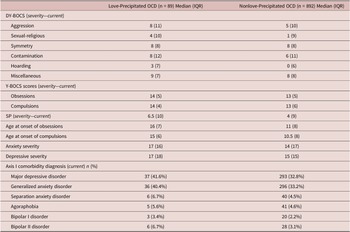
Descriptive characteristics of the independent and dependent variables are shown in Table 1. Out of a sample of 981 patients, 89 (9.1%) reported love as a precipitant of their OCD diagnosis. Of those, love precipitated obsessive symptoms in 79 (88.8%) participants and compulsive symptoms in 68 (76.4.9%) participants. Of the 89 patients who had reported love-precipitated OCD, 51 (57.3%) were females. The mean ages of onset for obsessions and compulsions in the love-precipitated OCD group were 16.7 (SD = 6.53) and 15.3 (SD = 6.54) years. By contrast, the mean age at onset was slightly lower in the nonlove-precipitated OCD group, for both obsessions [M = 13.1, SD = 7.99; t = 4.12, P < .001 (Cohen’s d = 0.457 SDs [SE = 0.112])] and compulsions [M = 12.9, SD = 7.78; t = 2.81, P = .005 (Cohen’s d = 0.313 SDs [SE = 0.111])].
A Summary of Patients’ Clinical Characteristics Grouped by Love-Precipitated OCD

Notes: Continuous variables are reported using median and IQR, whereas categorical variables are reported using whole numbers and relative values (ie, percentage). Aggressive-violence, sexual-religious, symmetry, contamination, hoarding, and miscellaneous dimension severity scores were taken from the DY-BOCS subscale current severity scores. Severity of obsessions and compulsions scores were taken from the Y-BOCS current severity scores. SP scores correspond to the USP-SPS current severity scores. Ages at obsession and compulsion onset were derived from the Yale OCD Natural History Questionnaire. Anxiety and depression severity scores correspond to BAI and BDI scores, respectively.
Abbreviations: BAI, Beck Anxiety Inventory; BDI, Beck Depression Inventory; DY-BOCS, Dimensional Yale–Brown Obsessive–Compulsive Scale; IQR, interquartile range; OCD, obsessive–compulsive disorder; SP, sensory phenomena; USP-SPS, University of São Paulo Sensory Phenomena Scale; Y-BOCS, Yale–Brown Obsessive-Compulsive Scale.
As shown in Table 1, participants with love-precipitated OCD generally reported higher severity of symptoms with respect to all six OCD dimensions and, on average, had more severe symptoms on each dimension compared to clinical samples reported in other studies (e.g., Reference Rosario-Campos, Miguel and Quatrano12 and Reference Pertusa, Fernández de la Cruz and Alonso43). According to the severity threshold proposed by Storch et alReference Storch, De Nadai and Conceição do Rosário 45 for the Y-BOCS, patients with love-precipitated OCD were more likely to report “moderate–severe” OCD symptoms, whereas those without were likely to report “moderate” symptoms.
Univariate analyses
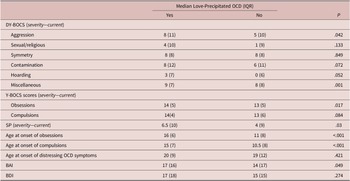
Table 2 summarizes the results of Mann–Whitney U tests performed in the present study. Love-precipitated OCD was significantly associated (P < .05) with the following DY-BOCS dimensions’ severity: aggressive-violence and miscellaneous, as well as with the Y-BOCS obsession severity, SP severity, age at onset of obsessions and compulsions, and BAI anxiety severity. All the above-cited variables, except for miscellaneous dimension, were entered in the multivariate analysis as independent variables. The miscellaneous dimension was excluded, because it was unrelated to the research hypotheses and too heterogeneous to provide meaningful interpretations.
Association Between Love-Precipitated OCD and Clinical Characteristics (Mann–Whitney U Tests)

Notes: Aggressive-violence, sexual-religious, symmetry, contamination, hoarding, and miscellaneous dimension severity scores were taken from the DY-BOCS subscale current severity scores. Severity scores of obsessions and compulsions were taken from the Y-BOCS current severity scores. SP scores correspond to the USP-SPS current severity scores. Age at onset of obsessions, age at symptom distress, and age at onset of compulsions were derived from the Yale OCD Natural History Questionnaire. Anxiety and depression severity scores correspond to BAI and BDI scores, respectively. P = level of statistical significance.
Abbreviations: BAI, Beck Anxiety Inventory; BDI, Beck Depression Inventory; DY-BOCS, Dimensional Yale–Brown Obsessive–Compulsive Scale; IQR, interquartile range; OCD, obsessive–compulsive disorder; SP, sensory phenomena; USP-SPS, University of São Paulo Sensory Phenomena Scale; Y-BOCS, Yale–Brown Obsessive–Compulsive Scale.
Chi-square analyses revealed a marginal association (P < .1) between higher rates of major depressive (χ 2 = 2.76, df = 1, P = .097) and bipolar II disorders (χ 2 = 3.14, df = 1, P = .0.76) among those with love-precipitated OCD. No significant difference was found between love-precipitated OCD and the four other Axis I disorders: separation anxiety disorder (χ 2 = 0.92 df = 1, P = .337), generalized anxiety disorder (χ 2 = 1.91, df = 1, P = .167), bipolar I disorder (χ 2 = 0.45, df = 1, P = .502), agoraphobia without panic disorder (χ 2 = 0.19, df = 1, P = .664), and episodic onset (χ 2 = 0.02, df = 1, P = .886).
Multivariate analyses
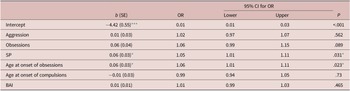
Results of the logistic regression are presented in Table 3. Briefly, two predictors remain independently associated with love-precipitated OCD (P < .05) after performing the logistic regression (Nagelkerke’s R 2 = .064). Love-precipitated OCD was associated with SP and age at onset of obsessions. Interpreted in terms of OR, this model predicted that patients with love-precipitated OCD had 1.05 higher odds of reporting higher severity of SP [95% CI 1.01-1.11] and 1.06 times the odds of experiencing symptom onset, particularly obsessions, at an older age [95% CI 1.06-1.01]. In addition, there was a lower trend between love-precipitated OCD and higher severity of obsessions (P = .089, OR = 1.06), although the association was not statistically significant.
Results of Logistic Regression Model with Love-Precipitated OCD as Dependent Variable

Notes: Aggressive-violence dimension severity score was taken from the DY-BOCS subscale current severity scores. Severity of obsessions was taken from the Y-BOCS current severity scores. SP scores correspond to the USP-SPS current severity scores. Ages at obsession and compulsion onset were derived from the Yale OCD Natural History Questionnaire. Anxiety severity scores correspond to BAI scores. P = level of significance.
Abbreviations: BAI, Beck Anxiety Inventory; DY-BOCS, Dimensional Yale–Brown Obsessive–Compulsive Scale; OCD, obsessive–compulsive disorder; OR, odds ratio; SP, sensory phenomena; USP-SPS, University of São Paulo Sensory Phenomena Scale; Y-BOCS, Yale–Brown Obsessive–Compulsive Scale.
* P < .05.
** P < .01.
*** P < .0001.
Discussion
The aim of this study was to investigate the influence of romantic love on the expression of OCD characteristics. This secondary investigation included a large sample of OCD patients (n = 981) and was the first to perform this type of analysis on a relatively unexplored area. In the present study, love-precipitated OCD was associated with two specific clinical characteristics: greater severity of SP and later age at onset of obsessions. However, love-precipitated OCD was not associated with symptom severity, symptom dimensions, episodic onset, or comorbid mood or anxiety disorders. These findings, therefore, lend partial support for the first hypothesis, in that patients with love-precipitated OCD do present with different clinical characteristics. Nevertheless, the second hypothesis that predicted a greater rate of psychiatric comorbidities among those with love-precipitated OCD was not supported by the current study. Drawn together, the preliminary evidence indicates that romantic love might influence the expression of OCD, reinforcing the possibility that love-precipitated OCD may be a clinically meaningful phenotype. These findings might be useful in guiding future research to determine the clinical utility of this potential phenotype and, more importantly, whether it might be associated with a different treatment profile.
The significant association between love-precipitated OCD and more severe symptoms of SP would indicate that romantic love might have a particularly negative impact on feelings of incompleteness in OCD. This was largely consistent with the research hypothesis, as one of the features of romantic love, feelings of incompleteness, is also a core component of SP.Reference Rosário-Campos, Prado and Borcato 21 As such, the emergence of the romantic love, accompanied by a rise in the feelings of incompleteness, may serve as a trigger for those vulnerable to developing these symptoms. The observed relationship between romantic love and SP in the present study is in line with Leckman and Mayes’Reference Leckman and Mayes 9 hypothesis, which envisaged a shared neurobiological pathway between the two phenomena. Given that SP can cause more distress than obsessions and compulsions,Reference Ferrão, Shavitt and Prado 20 it is conceivable that patients with love-precipitated OCD experience greater levels of distress than those without. Hence, it might be useful to conduct further research to better understand the mechanisms involved in love-precipitated OCD and devise interventions to help patients manage not only their OC symptoms, but also SP.
In this study, later age at onset of obsessions was strongly associated with love-precipitated OCD, which contrasts with earlier evidence showing that SP are associated with early onset OCD. This finding is consistent with the modern understanding that strong, romantic feelings generally do not emerge before the maturation of certain emotional and cognitive processes that takes place in mid-puberty.Reference Suleiman, Galván and Harden 46 What this also highlights is the possibility that romantic love may have acted as a precipitant for obsessive–compulsive symptoms in these people who would have, otherwise, not developed OCD. This novel finding is supported by Marazziti and Stahl’sReference Marazziti and Stahl 8 results in recent case report, which described a young adult who experienced sudden onset of OCD on every occasion he fell in love. While some could argue that patients with love-precipitated OCD might be similar to those with late-onset OCD (ie, typically defined as patients whose symptoms started after age 17), this might not be the case. In a recent meta-analysis, TaylorReference Taylor 47 found that both clinical and nonclinical populations with early onset OCD were significantly more likely to be associated with SP compared to their late onset counterparts. The opposite, however, was observed in the current study. That is, SP were much higher in the love-precipitated OCD group, drawing a distinction between them and those with the typical late onset OCD. The more uncommon combination of late onset and higher SP lends some initial support to the notion of love-precipitated OCD as autonomous OCD phenotype.
Love-precipitated OCD was not associated with the severity of compulsions in this sample. This seems slightly counterintuitive given patients with love-precipitated OCD reported greater symptoms of SP, a known driver of compulsions.Reference Lee and Wu 19 , Reference Prado, Rosário and Lee 48 In a recent cross-sectional study, Ferrão et alReference Ferrão, Shavitt and Prado 20 described that 65% (n = 651) of the OCD patients included in their investigation reported SP preceding their repetitive rituals. Another more recent investigation also found that the feelings of incompleteness tended to predict more symptoms of compulsions, especially for ordering and cleaning rituals.Reference Lee and Wu 19 That said, it should be acknowledged that this study was not intended to assess the connection between SP and compulsions, so only limited inferences can be drawn at this point.
Similarly, love-precipitated OCD was not associated with greater severity of obsessions. Although there was a trend toward significance (P < .09) for obsessions, this nonsignificant relationship seems to indicate that the obsessive thoughts characteristic of romantic love might have a lesser impact on the severity of obsessions than previously hypothesized.Reference Leckman and Mayes 9 Moreover, there was no association between love-precipitated OCD and symptoms in the aggression and sexual-religious dimensions. It is possible that the nonsignificant findings were due to the way obsessions are currently conceptualized. In the Diagnostic and Statistical Manual of Mental Disorders Fifth Edition (DSM-5), 1 obsessions are described exclusively as ego-dystonic thoughts (i.e. thoughts that considered intrusive and inconsistent with who that person is), with no mentions of ego-syntonic thoughts (ie, thoughts that are acceptable and in harmony with who that person is), which could have been equally time-consuming or obsessive. Since ego-syntonic thoughts are rarely viewed as obsessions, these symptoms could have been missed during data collection, leading to underestimating the severity of certain OCD symptoms.
Likewise, there was no association between love-precipitated OCD with episodic onset. This was, again, unexpected since Thompson et alReference Thompson, Torres and Albertella 7 demonstrated that patients who reported being romantically involved when they started exhibiting compulsions experienced a faster progression from subclinical to clinical symptoms compared to other OCD patients. One of the reasons for the observed discrepancy could be related to the different criteria used to group the participants. That is, the present study only included patients who were in love, whereas Thompson et alReference Thompson, Torres and Albertella 7 included even participants who reported being in love, starting an intimate relationship, about to wed all collapsed into one group. Nevertheless, the evidence currently available shows that patients with love-precipitated OCD do not differ from those without with regard to OCD symptom severity, symptom dimensions, and course of onset.
The analyses did not find any difference in relation to the severity of depressive and anxiety symptoms between those with and without love-precipitated OCD. Upon first glance, these results might seem inconsistent with previous research, as romantic love has been shown to correlate strongly with greater rates of depressive symptoms, although only in adolescent girls,Reference Davila, Stroud and Starr 49 and state anxiety.Reference Bajoghli, Joshaghani and Gerber 50 However, this discrepancy might be due to the drastic differences in sample characteristics. For instance, both above-cited studies had included teenage, healthy participants, whereas the current sample was comprised of treatment-seeking patients of different ages ranging from 15 to 82 with severe OCD symptoms. Hence, it is possible that the negative impacts of romantic love, at least on depression and anxiety, are experienced much differently for those with preexisting psychopathological symptoms compared to healthy individuals.
Finally, although patients with love-precipitated OCD did exhibit slightly higher rates of psychiatric comorbidities overall, no significant association was obtained for major depressive disorder, generalized anxiety disorder, agoraphobia without panic disorder, separation anxiety disorder, and bipolar disorder. Despite the large sample included in the present study, it is likely that there was insufficient power to detect meaningful differences, since some diagnoses were infrequent in the love-precipitated OCD group (eg, only 3 patients with love-precipitated OCD presented with bipolar I disorder compared to 20 in those without). In terms of comorbid depression and anxiety disorders, these inconsistent findings might be partly attributable to the fact that comorbidities with these disorders are almost the rule, rather than the exception, in people with OCD.Reference Brakoulias, Starcevic and Belloch 51 , Reference Adam, Meinlschmidt, Gloster and Lieb 52 Having a sample most likely with preexisting psychiatric comorbidities would, in theory, complicate the process of detecting subtle increases in the prevalence of comorbid disorders.
Our findings must be interpreted in light of the limitations. First, the cross-sectional design only provides information about the association between the independent and dependent variables, which precludes any inferences to be drawn about causality. Relatedly, this also implies that reverse causality between the observed relationships cannot be completed ruled out. Moreover, this study only included help-seeking patients who were receiving treatment at the outpatient clinic, suggesting the sample may have been overrepresented by participants with more severe cases of OCD, limiting the generalizability of these results. In addition, some of the responses collected, such as those in the Yale OCD Natural History Questionnaire, were retrospective and, hence, could have been affected by recall bias. Another limitation of this study is that the presence of love-precipitated OCD was assessed based on whether participants had responded “yes” to “I was in love” at the onset of OCD. As this was not a measure designed specifically to measure love, it lacked information that might have been useful in determining if love did precede OCD symptoms as opposed to occurring in a similar time frame. Finally, these results are also limited by the broad age distribution of the participants in our study.
Given these preliminary findings, the next logical steps should be to investigate whether love-precipitated OCD is a clinically meaningful phenotype using a larger sample of people with this type of OCD. This might involve comparing its etiological features and treatment responses against other forms of OCD. The findings could prove to be beneficial, particularly considering a core characteristic of love-precipitated OCD, SP, is generally associated with higher levels of distress. Of note, choosing more reliable and valid instruments devised to measure romantic love, such as the passionate love scale,Reference Hatfield and Sprecher 53 , Reference Graham and Christiansen 54 could also help further improve the study quality.
In addition, future studies should consider a different study design to further explicate the relationship between OCD and romantic love. For instance, evidence from longitudinal designs on this subject matter could be useful in describing the direction of association between romantic love and the onset of OCD. This is necessary to determine if the results observed in the current study were confounded by backward causation or a third unknown factor.
Conclusion
This was the first study to systematically explore the connection between romantic love and OCD as well as its clinical characteristics. The results provided preliminary evidence in partial support of our first hypothesis, showing that love-precipitated OCD is characterized by greater severity of SP and a later age at onset of obsessions. They also indicated that, contrary to the second hypothesis, romantic love did not influence the rates of other psychiatric comorbidities. Together, these findings, as well as those of recent literature, underscore the potential importance in conducting further research to understand the mechanisms shared by the natural features of romantic love and obsessive–compulsive symptoms. Finally, they also shed light on the potential difficulties people predisposed to OCD might experience when they do fall in love, providing a glimpse into a different side of this normal human experience.
Funding Statement
This work was supported by the Conselho Nacional de Desenvolvimento Científico e Tecnológico (LF, grant number 302526/2018-8), Fundação de Amparo à Pesquisa do Estado do Rio de Janeiro (LF, grant number CNE E 26/203.052/2017), the D’Or Institute of Research and Education (LF, no grant number available), and the David Winston Turner Endowment Fund (LF, no grant number available). The funding sources had no role in study design, data analysis, and result interpretation.
Disclosure
The authors do not have any known conflicts of interests associated with this manuscript.