INTRODUCTION
Italian tradition and the tradition of being from Mantua… for us, [this] is obviously a culture and a DNA that we have… inside of us, and which obviously gratifies us and makes us—holds us responsible.
(Moreno, Italian fashion executive, June 2011)For Moreno, a fashion executive in Northern Italy, Italian tradition is in his DNA. A place (Italy, specifically the small town of Mantua (Mantova)), in Moreno's experience, is also a social form (a tradition) that is entrenched in his body (through DNA) and has the power to bring pleasure as well as a sense of morality to those who are connected to it. The indexical and locative work that even just the pronouns and prepositions in this statement do—deictically situating Moreno as an individual connected to other individuals in an exclusive ‘we’ and locating culture both experientially and morally inside of the individual bodies that together comprise this ‘we’—constitutes a phenomenon that we call, in this article, scalar intimacy. Scalar intimacy, specifically, refers to the discursive and socially embedded processes by which people position themselves as embodied, moral, emotional, and social beings vis-à-vis not just other humans, but also multiple culturally salient models of the self, family, and nation.
After an overview of the core qualities of scalar intimacy and a brief description of our theoretical framework, our methods, and our analytical orientation, we demonstrate how scalar intimacy is enacted over the course of two different interviews, one with Moreno, the Northern Italian executive introduced above, and one with a Chinese self-growth aficionado, Gracie. We show how these people, though situated in very different contexts, draw upon various discursive strategies in order to constitute themselves as individuals who are also and always part of multiple scales of collective experience. We include these two cases not in order to set up a direct comparison, but to demonstrate the ways in which the concept of scalar intimacy can be applied to the analysis of a range of diverse data from different geographical locations. We suggest that scalar intimacy offers a framework for understanding how language-in-interaction emerges as an ethical and communicative affordance (Gibson Reference Gibson1979; Keane Reference Keane2016) for people to navigate and/or perform their relationship with (or felt connection to) circulating cultural forms as well as people. We conclude with an examination of the consequences of this process and a discussion of what scalar intimacy offers researchers in multiple disciplines.
DEFINING SCALAR INTIMACY
Scalar intimacy, as we currently propose it, is constituted by two overarching qualities, both of which are indexed by the term itself. First, scalar intimacy is, as the name suggests, ‘scalar’: it is enacted in multiple scaling strategies or ‘scaling projects’ in which individuals use language to make analogies and draw important distinctions among things in the world, including people, ideas, and styles (Carr & Lempert Reference Carr and Lempert2016:2–3). Second, as a contingent process of identification that is fundamentally rooted in ongoing relationships, scalar intimacy is ‘intimate’.
In scalar intimacy, scalarity specifically refers to the often rapid scalar movements that people make, in speaking or writing, between relatively and relationally emergent realms of experience like size (e.g. big/small), time (e.g. past/present/future), place (e.g. town/city/global society), and socially or politically meaningful categories (e.g. private/public). Navigating these temporal, spatial, and ideological relationships in narrative helps speakers ‘anchor and (re)orient’ themselves vis-à-vis already existing scales, such as those offered by various institutions, as well as developing new ones (Carr & Lempert Reference Carr and Lempert2016:4). It also supports people, as we witnessed in Moreno's brief comments cited earlier, to ‘orient their actions, organize their experience, and make determinations about who and what is valuable’ (Carr & Lempert Reference Carr and Lempert2016:9). In the context of personal narratives as socially emergent vessels for organizing the ‘temporal continuum of life’ (Ochs Reference Ochs, Biber and Finegan1994:133; see also Ricœur Reference Ricœœur1984; Brockmeier Reference Brockmeier2009), such scaling work furthermore often occurs through the various chronotopes that a narrator employs to situate oneself in time and space (Lempert & Perrino Reference Lempert and Perrino2007; Perrino Reference Perrino2007, Reference Perrino, Fina and Georgakopoulou2015; Wirtz Reference Wirtz2007, Reference Wirtz2016; Blanton Reference Blanton2011; Stasch Reference Stasch2011; Woolard Reference Woolard2012, Reference Woolard2016; Blommaert Reference Blommaert2015; Blommaert & De Fina Reference Blommaert, De Fina, Fina, Wegner and Ikizoglu2017). As Mikhail Bakhtin argued in his analysis of the novel, an author of a story formulates different chronotopes as narrative devices that organize space and time in order to, among other things, relate everyday human experience to ‘the collective historical life of the social whole’ (Bakhtin Reference Bakhtin and Holquist1981:208). In emphasizing spatiotemporal scale-making projects, scalar intimacy thus pays particular attention to the ways narrators ‘zoom in’ and ‘pan out’ of both time and space, expertly weaving personal experiences together with real and imagined cultural and social histories in order to situate themselves, like Moreno, vis-à-vis other people as well as cultural forms, ideas, and practices.
The discursive process of scaling, it has been observed, denotes one of the major ways in which people accomplish the work of crafting sociopolitically situated identities (Bucholtz & Hall Reference Bucholtz, Hall and Duranti2004; Gal Reference Gal2016). Such work is often achieved through a process that Irvine & Gal (Reference Irvine, Gal and Kroskrity2000) famously call fractal recursivity. Fractal recursivity, specifically, involves ‘the projection of an opposition, salient at some level of relationship, onto some other level’ (Irvine & Gal Reference Irvine, Gal and Kroskrity2000:38). As a scaling device, explains Gal (Reference Gal2016:92), fractal recursivity ‘creates, by analogy, more and less encompassing comparisons, where the degree of encompassment depends on the positioning of the evaluator’. Research has repeatedly shown that what scaling work ‘does’ in the world—especially through the discursive establishment of fractal recursions—includes the maintenance of established structures of power, the formation of new institutions, the acceptance or refusal of certain salient sociopolitical categories such as private and public or urban and rural, and the construction of personal identities (Irvine & Gal Reference Irvine, Gal and Kroskrity2000; Gal Reference Gal2002, Reference Gal2016; Gal & Irvine Reference Gal and Irvine2019). As Gal (Reference Gal2002:86) notes, however, it is important to understand fractal recursivity's implications in terms of what she refers to as peoples’ ‘subjectivities’. Scalar intimacy, in its fundamental reliance upon observing the pragmatic construction of scales in socially situated narratives, is thus highly attentive to the personal, embodied, and experiential (e.g. intimate) aspects of scale-making projects. As such, it expands the boundaries of what we are able to talk about in terms of how various discursive strategies are drawn upon to manipulate and manage the ways in which such recursions are, like Williams’ (Reference Williams1977:132) structures of feeling, ‘actually lived and felt’.
While all scaling work might be analyzed as a discursively accomplished ‘ideological project’ (Gal Reference Gal2016), it is not always indexical of the kind of felt intensity that we highlight by attending to intimacy, in particular, as a scalar process. Although the concept of intimacy is often associated with sexuality and/or romance, we have recently emphasized the importance of understanding intimacy as a contingent and often precarious interactional process that develops between individuals in multiple types of interactions (Perrino & Pritzker Reference Perrino, Pritzker, Hall and Barrett2021; see also Perrino Reference Perrino2002; M. Goodwin & Cekaite Reference Goodwin and Cekaite2018). Developing a definition of intimacy as ‘an emergent feeling of closeness in combination with significant levels of vulnerability, trust, and/or shared identities, that can vary across cultures as well as in time and space’, we note that intimacy is a quality of relationships that must be made and remade over time (Perrino & Pritzker Reference Perrino, Pritzker, Hall and Barrett2021, emphasis in original). In the present article, we further develop and extend this definition to discuss the ways in which people, through scalar intimacy, engage not only with other people but also with nonhuman objects, ideologies, and ideas, all of which we refer to, following Urban & Urban (Reference Urban, Urban, Pritzker, Fenigsen and Wilce2020), very broadly as ‘cultural forms’ (see also Herzfeld Reference Herzfeld2005/2016).
Intimacy, in this extended definition, implies directionality and distance as people move towards, or away from, certain culturally situated ideas and beliefs. It also, importantly, points to the ways in which such ideas get inside of people in ways that impact their moment-to-moment experience and produce not just a socially situated self who is governed by abstract concepts, but an embodied, affective self that is grounded by and created in conversation with such concepts. ‘Cultural forms, through the signal properties associated with their re-contextualizations, act as keys to initiate or unlock affective responses’, write Urban & Urban (Reference Urban, Urban, Pritzker, Fenigsen and Wilce2020:75). Scalar intimacy, we suggest, is one of the ways in which such ‘unlocking’ happens vis-à-vis socially situated and emergent discursive processes that connect personal bodies with public worlds such that each becomes, to varying degrees, vulnerable to the other. Here, we highlight Leticia Sabsay's (Reference Sabsay, Butler, Gambetti and Sabsay2016:286) reframing of vulnerability as permeability, which, following Judith Butler, she defines as ‘the capacity to be affected’. As we discuss later, this points towards vulnerability as mutuality while still recognizing the limitations of an individual's power to disrupt often historically and politically entrenched ideologies in any one interaction (see also Wortham & Reyes Reference Wortham and Reyes2015:180–81).
Scalar intimacy thus highlights intimacy with cultural forms as a phenomenological process that is as much affective as it is embodied. As Seligman (Reference Seligman2018) highlights, experience always includes a distinctly embodied component. Seligman's framing of concepts-as-experience encompasses a view of meaning, based in the theory of grounded cognition (Barsalou Reference Barsalou2008), as emerging in specific social and embodied activities occurring over time and across space (see also Wilce Reference Wilce2003; Pritzker, Pederson, & DeCaro Reference Pritzker, Pederson;, DeCaro, Pritzker, Fenigsen and Wilce2020). It demonstrates, alongside other research in biocultural anthropology in particular, how cultural forms, or what psychological anthropologists call ‘cultural models’ (Strauss & Quinn Reference Strauss and Quinn1997), get under the skin and become embodied. Cultural models, which can be understood as culturally available (though not necessarily always shared) ideals regarding everything from what success consists of or what a family should look and feel like, become entrenched in bodies—in hearts and minds and stomachs and backs—causing stress and suffering when the ideals they uphold are in some way unachievable or when they pull us in too many directions at once (Dressler Reference Dressler2012; Snodgrass, Dengah, & Lacy Reference Snodgrass, Franççois Dengah; and Lacy2014). From this vantage point, the relationships that people have with cultural models are intimate. Scalar intimacy thus attends to the ways in which people draw upon various linguistic forms to index and shape such intimacy, often using biological tropes such as those voiced by Moreno when he references his individual and collective DNA. In using such language, people thus position, adjust, and (re)orient their multiple and concurrent intimacies with cultural forms in socially situated narratives. Pragmatically speaking, scalar intimacy in narratives can serve the intimate purpose of constructing a meaningful sense of self (Taylor Reference Taylor1989; Bruner Reference Bruner2002; Ochs Reference Ochs and Duranti2004; Mattingly Reference Mattingly2014), performing a certain kind of self, and positioning oneself in relation to imagined Others.
In the following, we show how scalar intimacy is enacted in two different narratives collected in the context of ethnographic interviews. We emphasize how our interlocutors use particular discursive strategies (Gumperz Reference Gumperz1982) in interaction with interviewers—in this case, deictic positioning, parallelism, and tropes—to situate themselves as embodied, social beings who are intimately entangled with various cultural forms. This entanglement, we further demonstrate, is contingent and vulnerable in the sense that its existence is reliant on socially emergent narratives, which often challenge cultural forms in addition to maintaining them (Gal Reference Gal2002). Scalar intimacy is not limited to these particular discursive strategies, however. As a broader, communicatively grounded, temporally unfolding activity, scalar intimacy points to the process of becoming a cultural self as it is sustained and embodied in interaction through stancetaking, gesture, gaze, prosody, syntax, format tying, body position, and so forth (M. Goodwin Reference Goodwin1990; Duranti Reference Duranti1994; Jaffe Reference Jaffe2009; Streeck, C. Goodwin, & LeBaron Reference Streeck, Goodwin and LeBaron2011; C. Goodwin Reference Goodwin2018; M. Goodwin & Cekaite Reference Goodwin and Cekaite2018). Before turning to our case studies, we briefly outline our methodology and analytical orientations.
METHODS AND ANALYTICAL ORIENTATIONS
This article is based on research that each author collected separately in Italy and in China. The Italian research, collected by Perrino and her colleague Gregory Kohler in the summers of 2011 and 2012 in Northern Italy (Kohler & Perrino Reference Kohler and Perrino2017; Perrino & Kohler Reference Perrino and Kohler2020), examined oral narratives among executives in Italian corporations. For this project, they collected twenty-five interviews with executives of various small- to medium-sized Italian companies in various towns in the following regions: Emilia-Romagna, Friuli-Venezia-Giulia, Lombardy, Piedmont, Sardinia, and Veneto. They interviewed executives from a wide range of businesses such as glassmaking, fashion, wine production, dairy production, manufacturing, historical cafés, and finance. Perrino and Kohler conducted fieldwork in these diverse businesses and interviewed their executives and representatives to glean and compare their ideologies about ‘Made in Italy’, a political, aesthetic, and moral notion described in more detail below, as they emerged in their stories. The interviews were conducted with both ethnographers present and were then carefully transcribed and analyzed upon their return to the United States. The Chinese data derive from Pritzker's research, conducted over three summers at New Life, a Beijing center for mind, body, and spirit (2014–2016), where she conducted an ethnography focused on the activities and individuals involved with xinling chengzhang or ‘psychospiritual development’ (Pritzker Reference Pritzker2016; Pritzker & Liang Reference Pritzker and Liang2018; Pritzker & Duncan Reference Pritzker and Duncan2019). Psychospiritual development is a growing industry that overlaps with what has been called the ‘psychoboom’ in contemporary China (Huang Reference Huang and Chiang2014; Kuan Reference Kuan2015; Yang Reference Yang2018). In this particular project, Pritzker attended numerous events, including both multiple-day workshops and evening ‘salons’ focused on helping participants—many of whom belonged to the rising middle class in China—connect to their inner child (Bradshaw Reference Bradshaw1990; Ivy Reference Ivy1993; Pritzker Reference Pritzker2016) and guiding them through personal emotional struggles through family constellation therapy (Cohen Reference Cohen2006; Duncan Reference Duncan2017; Pritzker & Duncan Reference Pritzker and Duncan2019).Footnote 1 She also conducted interviews with upwards of eighty workshop participants and leaders, all of which were professionally transcribed by a native speaker and then analyzed.
In both studies, our analyses of interview data include coding of specific discursive strategies. We also track the ways in which interviews emerge relationally between ethnographers and participants. As has been widely demonstrated, oral narratives cannot be studied as isolated texts but must be contextualized within the interactional context in which they emerge—in our case, the interview setting. The analysis of narratives articulated in interviews offers the researcher access to the delicate interactional dynamics emerging between interviewer(s) and interviewee(s) (Briggs Reference Briggs1985, Reference Briggs1986, Reference Briggs2007; De Fina & Perrino Reference De Fina and Perrino2011; Perrino Reference Perrino2011). From this perspective, the interactional text, or the coherence that the interaction itself is felt to have in terms of role inhabitance and actions performed is as important as the denotational text, or its organization in terms of reference and predication about states of affairs (Silverstein Reference Silverstein1998). Narratives in interview settings cannot therefore be studied simply as denotational texts, as they are dynamically and continuously (re)configured by the interactional moves of their speech participants (Schiffrin Reference Schiffrin1996; Wortham Reference Wortham2001; De Fina & Georgakopoulou Reference De Fina and Georgakopoulou2012). In the following, we therefore demonstrate how scalar intimacy is enacted in socially and culturally situated narratives. Rather than comparing the data from Italy and China, the following two case studies thus suggest the diverse range of ways in which scalar intimacy can be enacted to maintain, refine, and question these forms in storytelling events.
INTIMATE RELATIONS AND COLLECTIVE IDENTITIES IN NORTHERN ITALY
Our first example is extracted from an interview that Perrino and Kohler conducted with an Italian executive named Moreno, of a well-known Italian fashion company, which they call M.Moda S.p.A.Footnote 2 As Moreno emphasized during this interview (which lasted a total of one and a half hours), his entire family had been involved in his company for a long time. His grandfather was the founder of M.Moda, and Moreno has been involved in the company since an early age—soon after getting his required school degrees. Moreno spoke, in particular, of the national brand Made in Italy, a topic that frequently emerged in Perrino and Kohler's data. In their stories, Italian executives emphasize that Made in Italy is a national brand (del Percio Reference del Percio2016)—a brand representing the authenticity of Italian products through all stages of production, and a national treasure to be safeguarded. As a cultural value rooted in the Italian Renaissance, a collective responsibility to future generations, and a national DNA, the authentic character of Made in Italy emerged as a point of pride in Northern Italian executives’ collective identities. In their narratives, moreover, executives often highlighted their own role in preserving Italy's prestigious historical and artistic heritage for future generations, and underscored the ways in which Made in Italy cannot and should not be shared with non-Italians (Kohler & Perrino Reference Kohler and Perrino2017:203).
Perrino and Kohler thus found that many of the Northern Italian executives that they interviewed integrated the historical past into their here-and-now narratives, collapsing past and present and interweaving their personal identities with an imagined collective identity. The enactment of this identity emerged through the connections that they made between past and present, creating a sense of Made in Italy as an embodied experience. The maintenance of Made in Italy as a vulnerable, embodied form needing to be protected and cherished for the sake of themselves, their families, and their nation, thus took on an intimate urgency that points to what we are here arguing is the enactment of scalar intimacy. After one of the first questions Perrino and Kohler asked about the history of the company, for example, Moreno replied as follows.
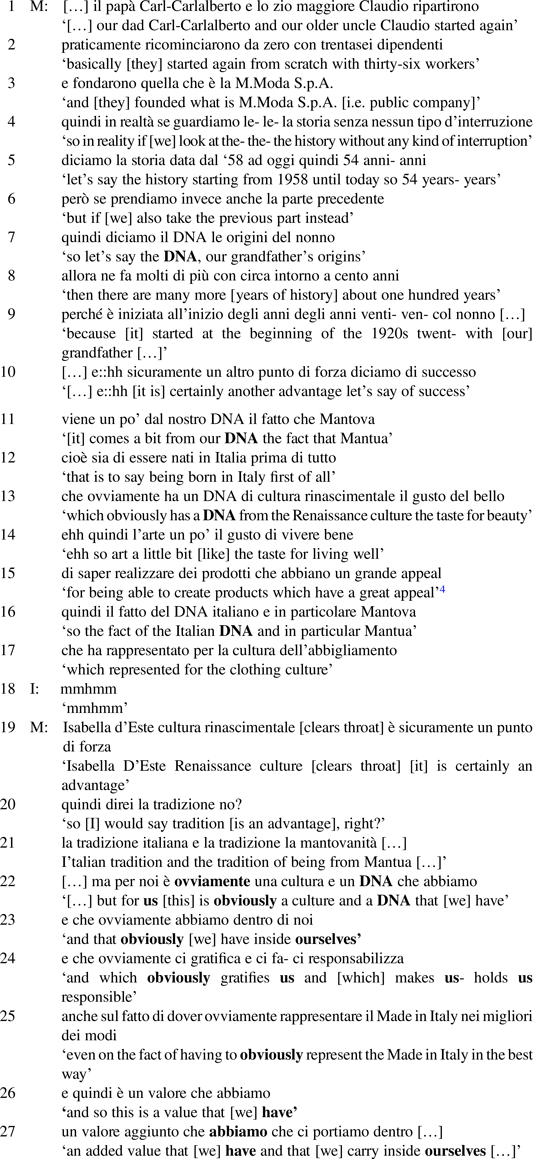
(1) Made in Italy (M: Moreno, I: Interviewer)Footnote 3


In this excerpt, Moreno responds to a question regarding the history of his company by merging it with the history of his family. In lines 1-3, he jumps immediately into what we are suggesting is a process of scalar intimacy, explaining that his father and his older uncle were the founders of the company. With these lines, he immediately creates an embodied connection between his family and his company, a generational connection that not only endures across spatiotemporal scales but provides an affective tenor for his narrative (M. Goodwin & Cekaite Reference Goodwin and Cekaite2018). The two histories then become one as Moreno conflates the chronotope of his family, or his ‘kinship chronotope’ in line 1 (Agha Reference Agha2015), with the chronotope of his company in line 2. His discursive conflation of the two chronotopes is evident also in line 9 when he claims that his company established its roots well before the official foundation year. Here, Moreno re-situates the company's origins in the 1920s when his grandfather was already active in the fashion sector. In this way, Moreno extends the background of his firm even further back in history: From the 1950s, when M.Moda was legally founded, to the 1920s, when the family began working in the fashion industry.
By going back and forth through these historical facts, scaling quickly up and down across spatiotemporal frames, Moreno thus connects the identity of his company with the identity of his family. In one storytelling event, his family pride thus travels across spatiotemporal scales and becomes embodied in the nonsharable family DNA trope that he discursively invokes in line 7. This is indeed the first of many times Moreno talks about the DNA of his family, metaphorically connecting it with that of his company. By drawing on this biological rhetoric, Moreno thus develops a framework for presenting his personal identity as embodied within the shared yet exclusive DNA of his family business. History and art have been, indeed, part of the family's identity and part of their DNA, as he claims in line 7, since his grandfather's times.
In lines 10–14, Moreno uses even broader scales to situate himself and his company in time and space, extending this connection with his family to his town as well. Moreno thus asserts that M.Moda's success is rooted not only in its prestigious historical background, but also in the local DNA of his town, Mantua (Mantova; lines 11, 13). The fact that he was born there is part of this scalar, intimate relationship situating his identity in embodied form (line 12). Mantua's DNA is indeed rinascimentale or ‘from the Renaissance’ (line 13), thus contributing to an authentic historical and artistic aura that pervades his birth town (Benjamin Reference Benjamin1936; Hansen Reference Hansen2008), including its museums, antique churches, buildings, and, of course, M.Moda. Mantua's history, art, and tradition are thus part of a shared DNA, of something that is intimately connected to the idea of being produced in Mantua. In his words, ‘being from Mantua’ (la mantovanità, line 21) is a shared, intimate dimension of being part of the same town that reinforces the collective identities of its inhabitants, and of Northern Italians more generally (Kohler & Perrino Reference Kohler and Perrino2017).
In lines 16–21, Moreno even further extends the local DNA to the national, Italian DNA, thus reinforcing these intimate relations, and their scalar dimension, even more. In the process, however, he also solidifies the circulating ideology of a national Made in Italy brand. This brand, furthermore, cannot be shared with nonconationals, and needs to be protected not only at its town scale, but at a national level too (lines 25–27). With this connection, Moreno also enacts scalar intimacy as he fluidly shifts from a local, Mantua-based identity, to a national, Italian one. Moreno's biological rhetoric is even more pronounced in lines 22–27 when he uses the deictic inclusive first-person plural subject (noi ‘we’)Footnote 5 and object (noi and ci ‘us’) pronouns to refer not only to people from Mantua, his town, but to Italians more generally. Using a scalar framework, he thus intimately connects his personal or familial DNA to a genetically entrenched Italian DNA, a DNA that gratifies Italians but also makes them responsible for representing it to the world with pride.
Finally, Moreno also uses several parallelistic structures, which are bolded in the above lines, giving even more emphasis to his affective and scalar framing of Made in Italy as an intimate, embodied experience. Parallelism—a rhetorical device that can be simply defined as repetition with variation—has classically been studied for its discursive intertextual effects (Silverstein & Urban Reference Silverstein and Urban1996; Tannen Reference Tannen2007). Parallelism helps any discursive practice ‘call attention to itself’, making it ‘memorable, repeatable, [and] decontextualizable’ (Wilce Reference Wilce2001:191). The highly parallelistic structures in Moreno's story thus create an emphatic effect at every line that is typical of political oratory (Lempert & Silverstein Reference Lempert and Silverstein2012), poetry (Webster Reference Webster2015, Reference Webster, Pritzker, Fenigsen and Wilce2020), or religious sermons (Wilce Reference Wilce1998). The intertextual effect of Moreno's parallelism emphasizes not only the uniqueness of Made in Italy (Kohler & Perrino Reference Kohler and Perrino2017), but also its simultaneously collective and intimate dimensions. At lines 22, 23, 24, and 25, he repeats the adverb ovviamente ‘obviously’, to reframe the fact that Italians naturally have a unique, gratifying DNA that holds them together and that cannot be shared. At the same time, at lines 23, 26, and 27 he repeats the auxiliary verb ‘to have’,'which is conjugated in the first-person plural, abbiamo ‘[we] must’ or ‘[we] have to’. This reinforces this ideology of a collective identity even more, as it indexes the shared we that Moreno feels as an embodied truth.
The parallelistic repetition of the first-person plural object pronouns ci ‘us’ in the same lines is yet another discursive strategy confirming Moreno's chronotopic, collective stance. Through these parallelistic moves, Moreno makes his claims more visible and more convincing.
Through these interdiscursive links (Silverstein Reference Silverstein2005), Moreno thus enacts not only his individual identity, but he also reinforces, enacts, and entextualizes a collective identity with people living in his birth town Mantua and with his co-nationals as well who share the same prestigious historical and artistic background. This connection between specific cultural values and Italians becomes more palpable through the association of these values to DNA, an embodied, intimate tropic connection that many of the executives interviewed by Perrino and Kohler made. In Moreno's view, only Italians who have this historical background and who share a particular artistic patrimony can inhabit these identities. These intimate, embodied relationships are inscribed through various chronotopic and intimate stances which are created through connections in which time and space are configured in significant and unpredictable ways. As a result, Moreno's identity can be seen as unstable, fluid, and contingent (Nichols & Wortham Reference Nichols and Wortham2018), even as he frames it as fixed and biologically entrenched.
From an interactional perspective, while the two interviewers are mostly silent throughout Moreno's storytelling event, with just a minimal response in line 18, an affective and embodied stance is (co)constructed and supported by the very fact that Moreno shares his story. The denotational text of this story, which invokes the genetics of both his family and his company, is thus brought into being through an emergent interactional text. In this way, the interview serves as an affordance for Moreno, through scalar intimacy, to perform and (re)instantiate Made in Italy as a powerful and embodied cultural form. In contrast, our next example demonstrates that the interview setting also exists as an affordance for negotiating/challenging existing recursions in an equally embodied process of scalar intimacy.
INTIMATE SUFFERING IN CHINA
Our second example derives from Pritzker's study at New Life, the Beijing ‘mind-body-spirit’ center where she conducted research from 2014 to 2016. Though a detailed explanation of what psychospiritual growth consists of is beyond our scope in this article, it is important to note that one of the major ways that Pritzker has been approaching it in her ongoing analysis of the material is as a search for love born out of a desire to ‘become mature’ (Pritzker Reference Pritzker2016; Pritzker & Liang Reference Pritzker and Liang2018). Becoming mature through psychospiritual growth workshops points, specifically, to the cultivation of skills in fully knowing and loving oneself, the ability to experience and manage one's emotions, and the strength to achieve success in relationships with partners, children, parents, and friends. Within this context, participants often intentionally wrangle with both personal and cultural issues, including the ways in which personal experience make sense in terms of shared pasts that are both highly valued and deeply questioned (Pritzker & Duncan Reference Pritzker and Duncan2019). Participants, furthermore, commonly framed their personal ambitions for learning how to better love their partners and children as a culturally salient goal that creates a certain kind of imagined future. Like Made in Italy explored earlier, the dream of a more loving Chinese future binds individuals to their families, their local communities, and the nation in a way that is exclusive and morally salient.
The following excerpt comes from Gracie, a young woman who worked as an administrator at New Life and had attended almost all of the major workshops offered there. Her interview, which took place one afternoon on the balcony of New Life between events, began as a group interview involving Gracie and two male students of the onsite Chinese medical practitioner. Once the two men had wandered away from the balcony, the conversation moved from more general to more personal in terms of Gracie's experience. In talking about her background, Gracie thus explained that, with her parents always away at work, she had grown up with a sense, in her words, that her heart had no ‘home’. This had caused her to be distrustful, to have little faith in the concept of family. When she married, she therefore struggled with the idea that she would ever be able to create a nourishing home. Gracie's anxiety had lifted a great deal after one particular meditative exercise at a New Life event, however, in which participants were guided to imagine their parents and ancestors in an inverted pyramid behind them, their parents’ hands on their shoulders, their grandparents hands on their parents’ shoulders, and so on. “When I did that exercise”, Gracie said, “the feeling was particularly deep… I was intensely emotional. Actually, the blood flowing in your veins is their blood”. During this exercise, Gracie started to realize that she was part of an embodied, emotionally tethered lineage that stretched into the recesses of Chinese history. The experience, as she narrated it in this instance, had reoriented her ability to connect with her husband, and she began to work towards building the kind of loving family that she now understood to be possible. Instead of working to reproduce ‘the norm’, however, she began to question certain practices that she had inherited from what she frames, in the following excerpt, as a shared past.
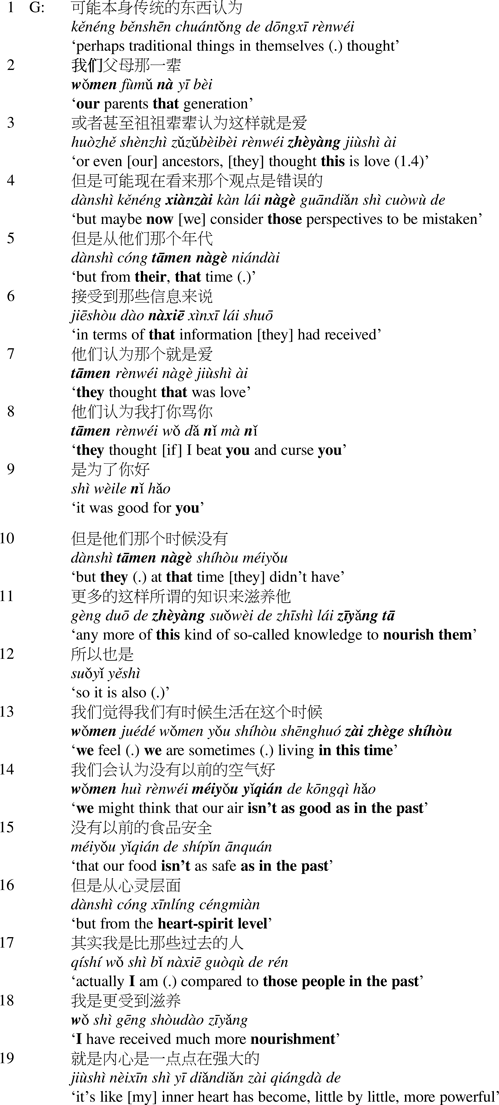
(2) More Nourishment (G: Gracie, I: Interviewer)

This excerpt begins with Gracie's efforts to create contrast—as opposed to continuity, as in the previous example—between past and present. A process of narratively situated scalar intimacy, we suggest, thus begins to emerge right from the outset of her story. She begins by referring to chuántǒng de dōngxī ‘traditional things’ (line 1), immediately switching to talk about what previous generations mistakenly considered to be loving behavior and how it contrasts with what is known today. Over the course of these seven lines, she continually draws upon proximal and distal deictics in order to situate herself in a time-space that is both different and distant from that of her parents’ generation (Hanks Reference Hanks and Lucy1993). Before explaining her perspective on what people thought love was in that spatiotemporal framework, however, she uses proximal deictics to zoom back to the present, suggesting that in current society, people consider the way traditional families enacted love to be cuòwù de ‘mistaken’ (line 4). She shifts immediately back to talking about what they thought ‘during their that time’ (line 5) going on to attribute her ancestors’ thinking to the information they had ‘received’ (line 6). Here, Gracie indicates an attunement to the ways in which knowledge is spatiotemporally situated in particular sociohistorical settings, citing the relative availability of information rather than peoples’ inherent ignorance or wisdom as the cause of her ancestors’ erroneous ways of understanding and expressing love. She continues drawing upon distal pronouns to talk about how people in the past ‘thought that was love’ (line 7).
Scalar intimacy is observable in Gracie's rapid shifting between spatiotemporal frames, where she uses deixis to bring the past (tāmen‘they/them’, nàgè shííhòu ‘that time/then’) into contrast with, but also in proximity to, the present (wǒmen ‘we’, wǒ ‘I’, zhège shíhòu ‘this time/now’) Although her use of contrasting deictics signals distance as well as a negative affective and epistemic stance, her continuous comparison of herself to people of the past simultaneously binds her to them in an imagined trajectory of development that, notably, mirrors dominant development narratives in contemporary China (Rofel Reference Rofel2007; Kuan Reference Kuan2015). Scalar intimacy in Gracie's narrative is thus enacted through her continuous movement between the past and the present, enacting her intertextual distance from as well as her proximity to the past. Despite differences with Moreno's narrative in the previous example, scalar intimacy analogously exists in Gracie's narrative in terms of the ways she links the past to the present using deictics of proximity and distance. Rather than cultivating the similarity that Moreno established between himself and his family as well as town and nation in his narrative, Gracie uses contrast as a mechanism to scale quickly up and down, back and forth, between spatiotemporal frames. Further along in her narrative, however, Gracie's scalar intimacy takes a slightly different rhetorical shape. While continuing to reference the ‘they’ of the past, she uses the personal pronoun ‘I’ to refer to other actors and the impersonal pronoun ‘you’ to refer to an individual situated in her own subject-position, saying ‘they thought [if] I beat you and curse you, it was good for you’ (lines 8–9). In Chinese (as in English), personal pronouns such as ‘I’ and ‘you’ that are used to reference impersonal others often operate in colloquial speech as stand-ins for more generalized pronouns such as ‘anyone’, or ‘one’ (Kitagawa & Lehrer Reference Kitagawa and Lehrer1990). Instead of ‘I’, here, Gracie could have easily repeated the designators that she assigned ‘people in the past’ or ‘them’ in the previous lines. Likewise, she could have referred to ‘their children’ instead of using an impersonal ‘you’ form. That she chooses such terms, however, accomplishes a great deal in terms of her own scalar positioning, and may not, we suggest, be easily swept aside as an example where impersonal pronouns were used instead of either more generalized or more specific terms. Instead, Gracie's use of the impersonal pronoun here situates her narrative, in an intimate move of identification, from the perspective of both the parent and the child recipient of the set of sociohistorically situated behaviors that she has just linked to the distribution of misinformation of the past. Moreover, her pronominal switch collapses the distance established in the previous lines as she places herself in the role of both the parent (the ‘I’ doing the thinking—and the child—the ‘you’ receiving the beating). Gracie thus enacts scalar intimacy by placing herself in contrast to but also in deep, intimate connection with the knowledge, actions, and importantly, the intentions of her parents before them.
Gracie's rapid shifting between proximal and distal deictics continues throughout the rest of the excerpt, as does her position of relative compassion for the situated expression of their knowledge in the home and towards their children and other relatives. She also, like Moreno, uses parallelism to entextualize intimacy across scales (Silverstein & Urban Reference Silverstein and Urban1996; Wilce Reference Wilce2001; Tannen Reference Tannen2007; Webster Reference Webster, Pritzker, Fenigsen and Wilce2020). In lines 5 through 10, for example, Gracie introduces what she assesses as the erroneous ideas of people who lived in the past by starting the segment with ‘that time’, repeatedly using the deictics ‘they’ and ‘that’ to reference their experience, and closing the segment with the phrase ‘at that time’ discursively bracketing the past. Further down moreover, she draws upon another parallelistic structure to talk about how a generalized ‘we’ might idealize the past in terms of the quality air and food they enjoyed. Here, she negatively compares the present-day air and food with that of the past (lines 14–15). These lines, we would like to note, not only repeat the same words, but introduce rhythmic-syllabic patterns that are often found in Chinese classical poetry (Link Reference Link2013). In Chinese, parallelism and rhythm, in addition to making the discourse memorable, lend authority to statements as well as making them sound ‘natural’ (Link Reference Link2013). In Gracie's narrative, parallelism enacted at multiple discursive levels thus locks scalar intimacy in place, so to speak, by rhetorically solidifying both difference and connection.
Finally, Gracie speaks of the knowledge she has accumulated at the center as ‘nourishment’ (zīyǎng, lines 11 and 17). Such sustenance, she explains, is even more vital to her than clean air and food. Despite the fact that she lives in a world of contaminated food and polluted air, Gracie draws upon language that indexes her biological body, saying that she feels fed ‘on the heart-spirit level’ (xīnlíng céngmiàn, line 16) by the material she has learned at the center. She therefore feels more ‘powerful’ (qiángdà, line 19) than her imagined ancestors. Importantly, after this selection Gracie continues talking about the relative importance of her involvement at New Life. “A lot of people feel that my choice to spend thousands of RMB—actually tens of thousands of RMB—to study this kind of thing”, she said, “actually isn't as valuable as going with them to buy a few nice pieces of clothing. They just don't even consider that the profit they would get from these classes is far higher than those few clothing items”. This comment further works to morally situate her efforts in contrast to the present as well as the past, specifically the increasingly capitalist, consumer-oriented cultural setting surrounding her in 2014 Beijing (Kuan Reference Kuan2015; Yang Reference Yang2018).
In closing this section, it is important to note that by the time of this interview, Pritzker had been hanging around New Life long enough that she considered Gracie to be a friend. They would frequently talk about food, clothing, movies, music, and friends. As such, the tone of the interview shifted greatly once the two men had left the room. While this arguably opened up the space for Gracie to be more relaxed in her presentation of herself and her experience, the contrast of the formal interview with the usual casual interaction potentially constrained her comfort. In either case, the chronotopic stances that Gracie deployed reveal Gracie's enactment of her identity as a representative of New Life in a particular interactional setting. The ways in which such an interview provided Gracie with an affordance for wrangling with her embodied and intimate affiliation with various cultural forms is also important to consider, however. In the previous example, we demonstrated that the response to such an affordance, for Moreno, was to use the opportunity to interactionally navigate, through scalar intimacy, his embodied commitment to maintaining a certain kind of Italian tradition, one which depends on several important pre-existing scalar distinctions that frame both Italy and the past as more refined than the imagined Other or the capitalist present. In contrast, Gracie's narrative suggests that the interview afforded her an opportunity to dexterously re-scale and her embodied, intimate connection with her imagined ancestors, using a combination of discursive strategies to maintain it while also questioning certain aspects of it.
CONCLUSION
In our two case studies we have demonstrated how individuals in different cultural settings enact and embody what we have defined as scalar intimacy through their storytelling practices. In our first example, we identified scalar intimacy in Moreno's rapid shifts between scales: from a small, local scale to a larger national scale. This occurred in both intertextual and interdiscursive planes as Moreno brought ‘his nation’ closer to himself and himself closer to his nation. This, we suggest, effectively instantiated Made in Italy as an intimate, embodied reality and relationality that needs to be protected. Through the use of deictics (personal pronouns), parallelistic structures, biological rhetoric, and the use of past and present tenses, Moreno's affective, embodied stance crystallized in his distancing of himself from non-Italians while becoming closer to his co-nationals with whom he shares an exclusionary, intimate identity (Perrino Reference Perrino2018, Reference Perrino2020). Next, we showed how Gracie drew upon rhythm, structure, deictics, and analogies to narrate her intimate identification as a Chinese citizen of a particular place and time. Here, scalar intimacy also emerged both intertextually and interdiscursively as her narrative brought her simultaneously closer to and further from the past, a past in which society was structured—because of the information that was ‘available’ at the time—by ‘erroneous information’ about how to love children. In her narrative, the public thus swiftly became private in a deeply embodied sense, where nourishment with love is more sustaining than access to clean air and food.
In both cases, scalar intimacy, we have argued, is (co)constructed by narrators through their strategic use of deictics, parallelistic structures, embodied rhetoric, and grammar, but also through their deployment of biological tropes and analogies. Their use of this rhetoric indexes speaker's affective, vulnerable relationship to both past and present cultural forms, which they understand as inside of their bodies. In both examples, moreover, our interlocutors made sense of their deeply felt attachments to certain morals—beauty and quality (in Moreno's case); family and love (in Gracie's case)—which were situated in contrast to fast-paced capitalist values. Such positioning is strategic, and, we acknowledge, may relate to the pragmatic context of the interactions in which the narratives were collected. Moreno, then, may have enacted scalar intimacy in the way that he did in order to justify himself, his products, and his company as prestigious and valuable to two researchers who have strong connections with Italy. Likewise, Gracie may have used scalar intimacy to present herself, to Pritzker, as an ‘advanced’ woman who recognizes the value of psychological insights about love. Such possibilities underscore the ways in which narratives about personal identity and projects are often contingent on the circumstances in which they emerge. We argue, however, that regardless of the particular attitudes and stances with which people enact scalar intimacy (and for what ends), interviews—indeed, any interaction—may be considered an affordance for people to navigate their embodied, emotional relationship with (or felt connection to) various cultural forms in multiple and shifting ways.
In both denotational and interactional terms, then, the notion of scalar intimacy offers a framework for analyzing the ways in which people discursively manage their ongoing intimate relationships with other people as well as histories and ideologies (Wirtz Reference Wirtz2016). By attending to the way in which such forms are variously formulated in terms of both directionality and distance and well as embodied space (e.g. inside and outside), scalar intimacy further examines how people chronotopically articulate their sense of vulnerability in relation to both humans and nonhumans. This is not to say that it provides a measure of some kind of enduring or objective form of vulnerability that overrides the sociopolitical, economic, and historic subject-positions of speakers—the polluted air that Gracie consumes, for example, harms her lungs regardless of how nourished she feels by love. Scalar intimacy points, however, to the notion of vulnerability as permeability, a distinction that Sabsay develops in order to investigate vulnerability as ‘something that one feels or is capable of acknowledging to a greater or a lesser extent’ (2016:286). From this perspective, when people scale themselves as affective, embodied cultural beings in particular interactions, they discursively enact what Sabsay refers to as ‘the unstable (and always in the process of being negotiated) boundaries of the vulnerable ‘I’ ’ (2016:286). This not only suggests the dynamic ways in which ‘language and consciousness are intertwined and bring each other into meaningful being, for better or for worse’ (Ochs Reference Ochs2012:149), but also reveals one of the specific ways in which this consciousness is brought into being as a dynamic and deeply felt form of relationality.
Understanding scalar intimacy in terms of permeability further suggests the ways in which cultural forms and ideologies become vulnerable in peoples’ discursive instantiation of them. Sabsay (Reference Sabsay, Butler, Gambetti and Sabsay2016:286) thus further notes that the concept of permeability points not only to the capacity of the world to act upon us, but also shows how the ‘the world, in turn, is permeable as well’. Indeed, as many linguistic anthropologists have shown, cultural forms and ideologies are subject, to the scalar ‘embedding’ of fractal recursions in everyday interaction (Gal Reference Gal2002). They move through affective semiotic encounters that, especially over time and across multiple speakers, reproduce them in ways that can have lasting consequences beyond individuals (Urban & Urban Reference Urban, Urban, Pritzker, Fenigsen and Wilce2020). Scalar intimacy, however, as it is enacted through small shifts in grammar, prosody, deictics, and rhetorical form, provides an additional way to understand the potential for micro-interactional moves to both reproduce and disrupt such forms, further adding to literature showing that ‘identity’ and ‘culture’ must be enacted within conversations that, though highly constrained by structures much larger and more powerful than the individual, include room for slight modification (Gal Reference Gal2002; C. Goodwin Reference Goodwin2018).
The lasting consequences of such moves are indeterminable from a close study of single narratives, and further research is required in order to understand the implications of scalar intimacy as an affordance of conversations and encounters over longer stretches of time (Wortham & Reyes Reference Wortham and Reyes2015). The longer ethnographies of which these narratives derive, however, suggest that the repeated invocation of notions like Made in Italy or becoming mature have real effects in the world, especially across multiple conversations. In Italy, for example, Perrino (Reference Perrino2018, Reference Perrino2020) shows how the instantiation of Made in Italy often works to create ‘exclusionary intimacies’ that carry disastrous consequences for people not included in the imagined biological line. In China, by contrast, micro-interactional shifts that reposition the ‘I’ as ‘we’ have the potential to support people to question and reformulate broad social categories such as selfhood and family (Pritzker & Duncan Reference Pritzker and Duncan2019).Footnote 6 In conclusion, then, we suggest that the close study of the ways in which people refine and rescale their felt sense of vulnerability in particular interactions is not insignificant. Alongside literature investigating the ideological consequences of scales and chronotopes in anthropology as well as scholarship on embodiment, experience, affect, and language, scalar intimacy can also help make sense of the diverse ways that people manage their felt experience of vulnerability in a world characterized by uneven distribution of resources and power. If nothing else, it can help us better understand what Sabsay (Reference Sabsay, Butler, Gambetti and Sabsay2016:295) refers to as the ‘political space’ opened up by momentary interactions not just to reproduce but also to problematize and contest problematic ideologies in ways that may have important consequences over time, for better or for worse.
Appendix: Transcription conventions
- (00.00)
time intervals within and between utterances (length of pauses in seconds, tenths and hundredths of seconds)
- (.)
brief pause
- ::
syllable lengthening
- -
syllable cut-off
- ?
rising intonation
- […]
omitted from original transcript
- bold
portions of transcripts discussed in the analysis