Isolated atrial septal defects represent about 7% of all cardiac anomalies and can be diagnosed at any age.Reference Gurvitz, Dunn and Bhatt1 Both adolescents and adults with simple CHD, as isolated atrial septal defect, are more likely to reach adult age without being diagnosed. Among the four types of interatrial communications, ostium secundum, ostium primum, sinus venosus, and the coronary sinus type of defects, the secundum atrial septal defect is by far the most common type, occurring in 1/1500 live births, with 65% to 75% involving females.Reference Webb and Gatzoulis2 While in ostium primum, sinus venosus superior and inferior variants and unroofed coronary sinus types for their inherent anatomy involving interatrial septum proximity with valve apparatus, large part of caval vein and coronary vein circulation, respectively, surgery represent the only therapy when indicated, ostium secundum defects can be managed with device-based closure. Over the latest years, transcatheter device-based closure has become the first-line therapy for secundum atrial septal defect in young adults.Reference Rigatelli, Zuin and Nghia3 Most recent series have demonstrated that percutaneous device-based closure is safe and effective as surgical closure and remains associated with a lower morbidity and mortality compared to the surgical approach.Reference O’Byrne and Levi4 Despite technologically advances in both transcatheter and surgical techniques have been continuing in the past 20 years, an updated comprehensive evaluation of the available data, especially on the incidence of intrahospital mortality, stroke, and new developed atrial fibrillation, is still lacking. Our study is aimed to investigate the performance of transcatheter device-based closure compared to surgical techniques by a systematic review and meta-analysis of the last 20 years literature.
Methods
The analysis was conducted following the Preferred Reporting Items for Systematic Reviews and Meta-Analyses (PRISMA) statement (Supplementary file 1).Reference Moher, Liberati, Tetzlaf and Altman5 Literature search was performed based on Cochrane Library, Embase, PubMed, and Google Scholar to locate articles published between January 2000 and October 2020, regarding the comparison between short-term outcome and post-procedural complications of atrial septal defect patients receiving percutaneous closure or surgery.
Eligibility criteria
Inclusion criteria for studies were as follows: (1) observational studies comparing transcatheter atrial septal defect closure versus surgery published in English language. Conversely, exclusion criteria were (1) studies without comparison with surgery, (2) studies on intraoperative device closure, (3) studies including patent foramen ovale, and (4) studies in childhood population.
Quality assessment
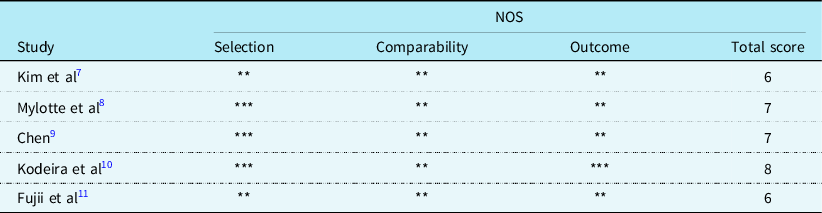
Quality of the included studies was independently appraised by two reviewers (G.R. and M.Z.). Discrepancies were resolved by consensus consulting a third independent reviewer (L.R.). Any disparity in the study selection was resolved by consensus or concluded by an additional author (A.N.). Quality assessment was performed according to the Newcastle–Ottawa quality assessment scale. Reference Wells, Shea, O’Connell, Peterson, Welch, Losos and Tugwell6 Specifically, investigations were classified as having low (<5 stars), moderate (5–7 stars), and high quality (>7 stars).
Search strategy
Three reviewers (G.R., M.Z., and L.R.) independently screened and selected the studies according to the inclusion and exclusion criteria. The following MeSH terms were used for the search: “Atrial septal defect closure” AND “Transcatheter” AND “Surgery.” Case reports, review articles, abstracts, editorials/letters, and case series were excluded. Any discrepancies in study selection were resolved by consensus. Extracted data included study design, year of publication, patients treated with a transcatheter or surgical closure, gender, device type, surgical technique, and different outcomes analysed by the investigations.
Outcomes and definitions
The primary outcome was the comparison of post-procedural mortality rate between patients treated with transcatheter closure or surgery. The secondary outcomes were the post-procedural onset of atrial fibrillation and perioperative stroke.
Statistical analysis
Continuous variables were expressed as mean ± standard deviation (SD), while categorical variables, were presented as proportions. Data were pooled using the Mantel–Haenszel fixed or random effects models, based on the heterogeneity level, using odds ratio (OR) as the effect measure with the related 95% confidence interval (CI). Statistical heterogeneity between groups was measured using the Higgins I2 statistic. Specifically, a I2 = 0 indicated no heterogeneity while we considered low, moderate, and high degrees of heterogeneity based on the values of I2 as <25%, 25–75%, and above 75%, respectively. Publication bias was evaluated according to the Egger’s test and visually with relative funnel plots. Analyses were carried out using Review Manager 5.2 (The Cochrane Collaboration, Oxford, England) and Comprehensive Meta-Analysis software, version 3 (Biostat, United States of America).
Results
Study selection and population analysed
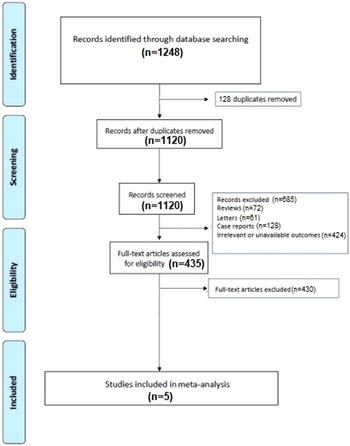
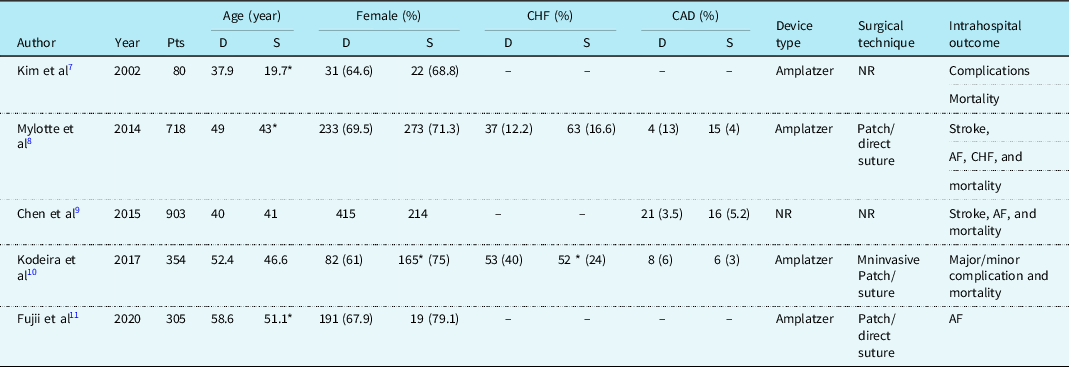
A total of 1120 articles were retrieved after excluding duplicates. After the initial screening, 685 articles were excluded for not meeting the inclusion criteria, leaving 435 articles to assess for eligibility. After comprehensive and careful evaluation of the full-text articles, 430 articles including editorial/letter, reviews, case reports, and publications in other language than English language were excluded. Finally, five articlesReference Kim and Hijazi7–Reference Fujii, Akagi and Nakagawa11 were included into the final analysis (Fig 1 and Table 1).
Flow diagram of selected studies for the meta-analysis according to the Preferred Reporting Items for Systematic Reviews and Meta-Analyses (PRISMA).

General characteristics of the reviewed studies included in the final analysis

AF = atrial fibrillation; CAD = coronary artery disease; CHF = congestive heart failure; D = device; NR = Not reported. Pts = patients’ number; S = surgery.
* p < 0.01.
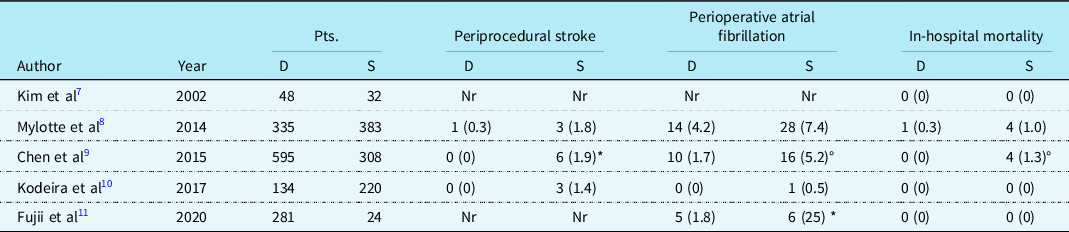
Of these, three were observational studies, whereas the remaining two were cost-effectiveness analyses. A total of 2360 patients were included of which 1393 [mean age 47.6 years, 952 females (68.3%)] and 967 [mean age 40.3 years, 693 females (71.6%)] patients received a transcatheter device-based and surgery closure, respectively. Outcomes retrieved from the analysed studies are shown in Table 2. The quality of the studies included into the analysis are shown in Table 3, using the Newcastle–Ottawa quality assessment scale.Reference Wells, Shea, O’Connell, Peterson, Welch, Losos and Tugwell6
Outcome of the reviewed studies included in the final analysis

Nr = Not reported; Pts = patient’s number
* p < 0.01; p < 0.05.
Quality of the included studies assessed using the Newcastle-Ottawa quality assessment scale (NOS)

Primary outcome
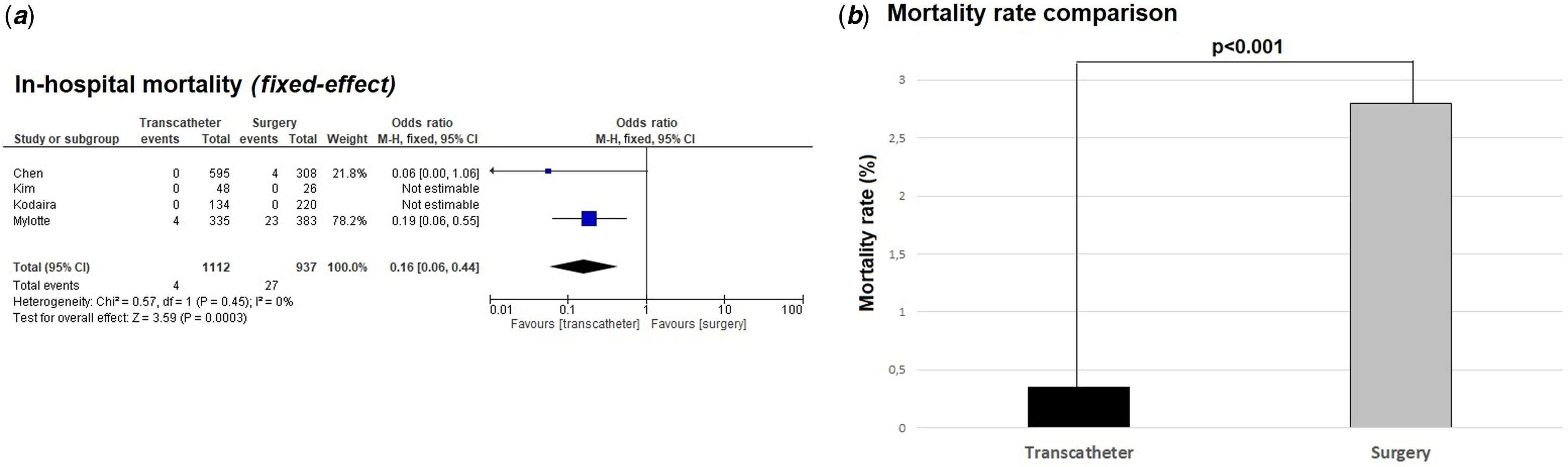
A pooled fixed effect model revealed that intrahospital mortality was significantly lower among patients treated with transcatheter device-based closure [OR 0.16 (95% CI (0.66−0.44)), p = 0.0003, I2 = 0%] (Fig 2, Panel A). The comparison of the mortality rate between the two groups confirmed a lower mortality in transcatheter group (p < 0.001, Fig 2, Panel B).
Panel A: Forest plot representation of intrahospital mortality resulting from the analysed studies. Panel B: Histogram mortality comparison between device and surgical groups of patients.

Secondary outcome
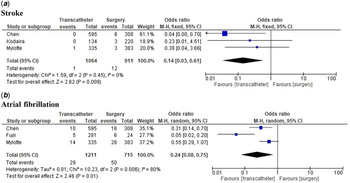
The incidence of perioperative stroke resulted higher in the surgical group; accordingly, the pooled analysis revealed a protective effect of transcatheter closure for the same outcome [OR 0.51 (95% CI (0.31−0.84)), p = 0.003, I2 = 79%]. (Fig 3, Panel A).
Panel A: Forest plot representation of perioperative stroke resulting from the analysed studies; Panel B: Forest plot representation of perioperative new onset of atrial fibrillation resulting from the analysed studies.

Similarly, intrahospital atrial fibrillation occurred more frequently in surgical group compared with device-based closure. In this regard, the pooled analysis using a random effect model confirmed a protective effect of transcatheter closure regarding the onset of the atrial arrhythmia [OR 0.14 (95% CI (0.03−0.61)), p = 0.009, I2 = 0%] (Fig 3, Panel B).
Publication’s bias
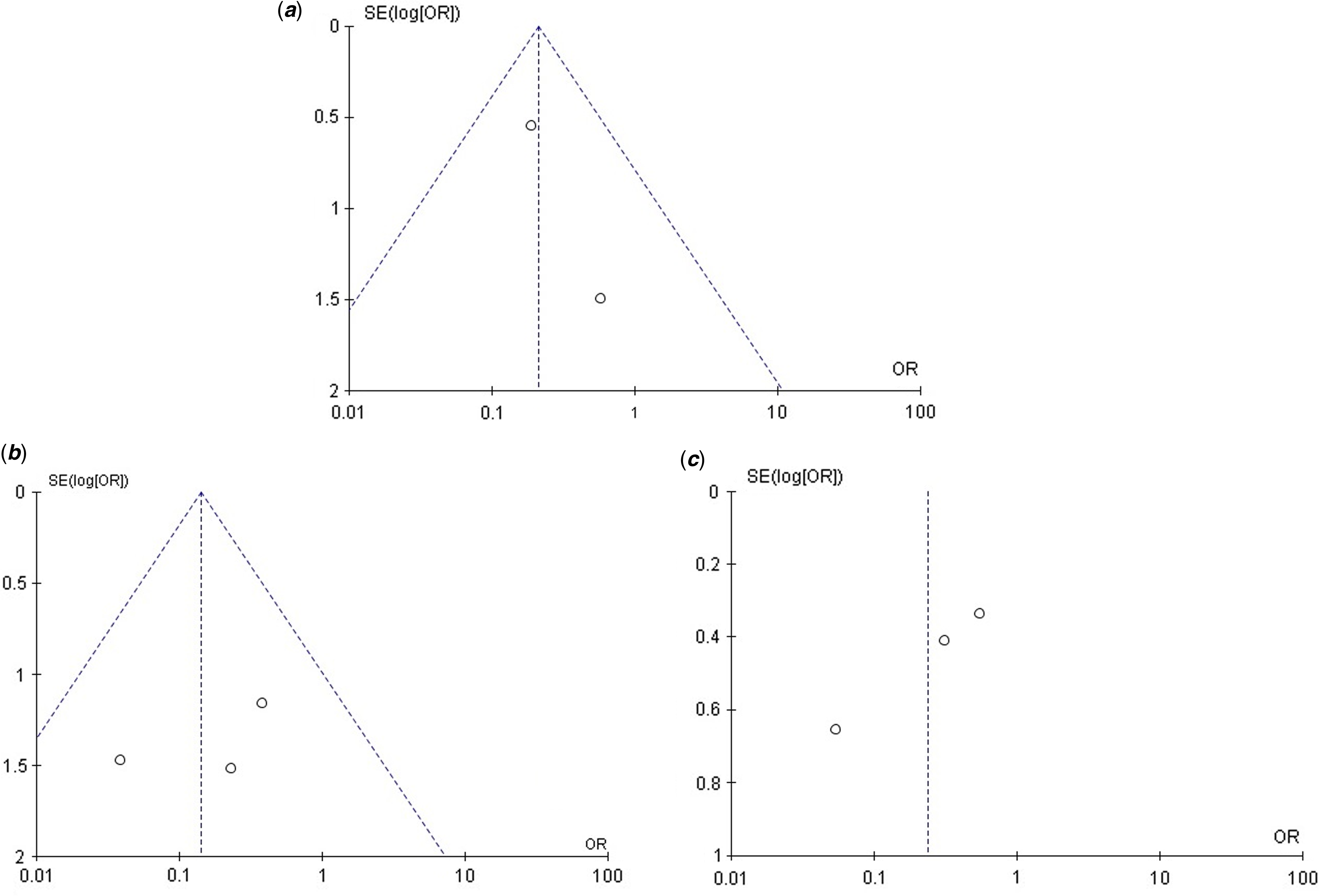
The funnel plots for the analysed outcome are showed in Figure 4 (Panels A, B, and C for in-hospital mortality, perioperative stroke, and atrial fibrillation, respectively).
Funnel plots for the analysed outcome: Panels A, B, and C for in-hospital mortality, perioperative stroke, and AF, respectively.

The Egger’s regression tests for occurrence of atrial fibrillation and perioperative stroke (t = 0.057, p = 0.959; and t = 0.871, p = 0.543, respectively) confirmed that there were no significant evidence of publication bias for the different outcomes evaluated. Conversely, the Egger’s test cannot be calculated for the mortality risk, since at least three studies presenting non-zero events are needed to perform the analysis.
Discussion
Our analysis, based on the available results of the latest 20 years, revealed that the risk of in-hospital mortality, perioperative stroke, and periprocedural atrial fibrillation were significantly lower in atrial septal defect patients treated transcatheter closure compared to those one receiving traditional surgical closure.
Although the data retrieved from literature suggest that surgery and percutaneous repair are at least similar in success and closure rates,Reference Kutty, Hazeem and Brown12,Reference Kotowycz, Therrien and Ionescu-Ittu13 the former seems preferable for the less invasiveness, length of hospitalisation, and right chamber remodelling.Reference Butera, Biondi-Zoccai and Sangiorgi14–Reference Salehian, Horlick and Schwerzmann16 Moreover, the routine use of intracardiac echocardiography guidance during transcatheter device-based closure has significantly modified the interventional practice, reducing the risk of both device over- and under-sizing, the occurrence of late arrhythmic complications,Reference Rigatelli, Dell’avvocata and Cardaioli17 device thrombosis despite light antithrombotic regimensReference Rigatelli, Zuin, Dell’Avvocata, Roncon, Vassilev and Nghia18 and aortic erosion.Reference Rigatelli, Nghia, Zuin, Conte, D’Elia and Nanjundappa19 The recent advancements in mini-invasive surgical techniques for repair of secundum atrial septal defect such as mini-thoracotomy or endoscopic techniquesReference Schneeberger, Schaefer and Conradi20,Reference Mylonas, Ziogas and Evangeliou21 apparently did not significantly impact the mortality rate and/or intrahospital complications, such as atrial fibrillation and stroke. However, such techniques allow to obtain post-procedural results more similar to those achieved using percutaneous closure due to less invasiveness and reduced hospital staying.
Being patients with isolated secundum atrial septal defect usually young or middle-aged, with a lower rate of concomitant comorbidities, as coronary artery disease, congestive heart failure, arterial hypertension, chronic kidney disease, etc, the treatment should be as safe and effective as possible leaving a complete repair with a minimum amount of sequelae. In this regard, the common perception is that a complete endovascular repair can offer the safe guaranties of standard surgical repair without any scar. Mini-invasive surgical techniques appeared comparable to older ones in terms of effectiveness but in any case leave significant surgical scars which are usually perceived undesirable in usually young female patients. Moreover, the inevitable opening of the atrium, needed to expose the interatrial defect, may increase the likelihood of post-interventional supraventricular arrythmias which are considered a remarkable adverse event.Reference Mylonas, Ziogas and Evangeliou21 On the other hand, the risk of possible aortic or atrial wall erosion, which is a well-known complication of device-based techniques,Reference Vida, Berggren and Brawn22 is rarely observed in current years, probably for the intraoperative use of intracardiac echocardiography or 3D-transesopahgeal echocardiography which allows a more accurate sizing and deployment of the device also in most complex anatomies.Reference Amin, Hjiai, Bass, Cheatham, Hellebrand and Klein23,Reference Rigatelli, Dell’Avvocata and Cardaioli24
Study limitations
Our meta-analysis suffers from several limitations including the small number of studies available for review, the huge inhomogeneity of presented data in reviewed investigations which made impossible to obtain further results and/or conclusions. In particular, the lack of a homogenous report of atrial septal defects anatomy, right chambers dimensions, and right ventricle function data in each group throughout the analysed studies should be taken into account because of their potential influence on treatment choice and relative outcomes. Moreover, the Higgins I2 in some pooled analysis suggested significant heterogenicity which probably represents the results of inherited biases from the original studies and differences in the inclusion criteria of patients. These aspects should be considered when interpreting our results.
Conclusion
Our meta-analysis suggests that transcatheter-based closure of isolated secundum atrial septal defect is safer and more effective when compared to traditional cardiac surgery with a remarkable benefit in terms of in-hospital mortality, perioperative stroke, and onset of new atrial fibrillation. Further larger studies are needed to assess if these findings may be extended in the long-term period compared to surgery.
Supplementary material
To view supplementary material for this article, please visit https://doi.org/10.1017/S1047951121001232
Acknowledgement
None.
Financial support
This research received no specific grant from any funding agency, commercial or not-for-profit sectors.
Conflicts of interest
None.
Ethical standards
All study procedures complied with the ethical standards of the Helsinki Declaration.