Prior to widespread acceptance of the arterial switch procedure, atrial switch procedures that performed by the Senning or Mustard technique were the standard surgical approach for patients with D-transposition of great arteries.Reference Senning1,Reference Mustard2 This procedure may be associated with long-term baffle-related problems such as baffle leaks and obstruction, which are often dealt with by surgical treatment.Reference Tobler, Williams and Jegatheeswaran3,Reference Horer, Karl and Theodoratou4 There are limited reports of transcatheter treatment by an Amplatzer septal occluder and outcomes of baffle leaks in adults. We present a child who underwent successful transcatheter closure of a baffle leak.
Case report
A 6-year-old boy was taken to our clinic with exertional fatigue. His medical history was remarkable for an atrial switch operation by a Senning procedure at 3 months of age. The patient received a diagnosis of pulmonary venous baffle leak at 2 years of age, which worsened during follow-up. At the current presentation, he had no complaints of fever or weight loss. Physical examination revealed a mild systolic murmur on the mesocardiac region. He had no hepatomegaly, lower limb oedema, or jugular venous distension. The blood chemistry findings were unremarkable.
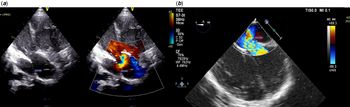
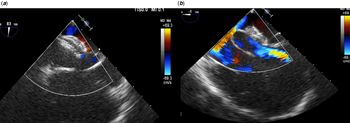
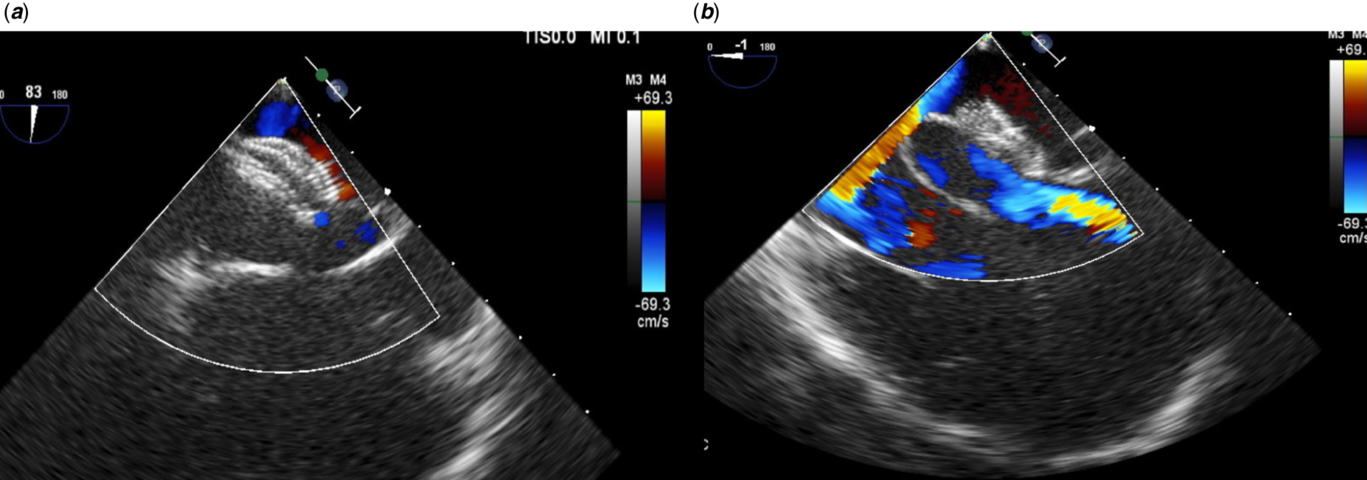
An electrocardiogram revealed first-degree atrioventricular block and right ventricular hypertrophy. Echocardiography showed right ventricular dilatation with mild tricuspid regurgitation and a defect of 9 mm in width with a left-to-right shunt between the pulmonary and the systemic venous baffle (Fig 1a). Transcatheter baffle leak closure was performed using an amplatzer septal occluder under two-dimensional transoesophageal echocardiography guidance under general anaesthesia. The size of the defect was measured as 10 mm (Fig 1b). There was no obstruction in any of the baffles. On cardiac catheterisation, the mean pressures of the pulmonary and systemic venous baffle were 15 and 14 mm Hg, respectively, with a superior caval vein pressure of 15 mm Hg and a pulmonary-systemic shunt ratio of 1.5:1. Contrast injection showed a transition from the pulmonary venous baffle to the systemic venous baffle. The defect was successfully closed using a 12-mm amplatzer septal occluder easily. Control transoesophageal echocardiography and contrast injection showed no residual shunt, pulmonary venous stenosis, or baffle obstruction (Fig 2a,b). He was discharged after 24 hours without complications. Acetylsalicylic acid treatment in anti-platelet dose was initiated to the patient for 6 months. The patient was asymptomatic, and echocardiography showed no residual shunt on the amplatzer septal occluder at 2 years of follow-up.
(a and b) Transthoracic echocardiography showed mild tricuspid regurgitation and a defect of 9 mm in width with a left-to-right shunt between the pulmonary and systemic venous baffle. The size of the defect was measured as 10 mm on transoesophageal echocardiography.

(a and b) Control transoesophageal echocardiography showed no residual shunt on the amplatzer septal occluder.
Discussion
The patients who underwent physiologic correction of D-transposition of great arteries remain at increased risk of cardiovascular complications and have a markedly increased mortality risk compared to the general populations. Complications of this procedure include systemic ventricular dysfunction, tricuspid regurgitation, dysrhythmias, and venous baffles obstruction and/or leaks, which are generally occurred in adulthood.Reference Horer, Karl and Theodoratou4 The clinical consequences of baffle leaks in this population are poorly understood, and the indications for closure are incompletely defined. Baffle leak device closure procedures after atrial switch operations have been reported to succeed in correcting haemodynamic defects. Baffle leaks are reported in 5–10% of atrial switch-operated patients, these being generally resolved by surgical treatment.Reference Khairy, Landzberg, Lambert and O’Donnell5 One study reported baffle leaks in four patients from a cohort of 59 undergoing cardiac catheterisation for electrophysiological or haemodynamic study. One defect was managed with an occluder, and a second with stent. The other two defects were of no haemodynamic importance and were not closed.Reference Patel, Shah, Chintala and Karpawich6 Baffle leaks were detected in 11 patients (15 leaks) during outpatient follow-up of 126 patients following atrial redirection surgery in another study. The mean age of the 11 patients was 26 years, and 10 were cyanosed at rest or during a simple walk test. All underwent transcatheter closure using either an occluding device or a covered stent in the presence of concomitant baffle obstruction.Reference Bentham, English, Hares, Gibbs and Thomson7 Most defects can easily closed by simple closure devices. The use of endografts to exclude Mustard baffle leaks was also reported in a patient with obstructed systemic baffles. In that report, a baffle leak without obstruction was managed by endograft by generating a three-dimensional printed model of the complex anatomy.Reference Porras, Mitsouras and Steigner8 There have also been brief reports describing successful Amplatzer septal occluder use for this procedure in some adult patients, because the Amplatzer septal occluder is easy to deploy and recapture prior to release from the delivery system.Reference Schneider and Moore9,Reference Armstrong, Kwa, Bhat, Romick, Smith and Rogers10 Use of newer imaging methods, such as intra-cardiac echocardiography, may be useful for better visualisation during the procedure.Reference Armstrong, Kwa, Bhat, Romick, Smith and Rogers10
Conclusion
While the patient in the present case was a child with a moderate size baffle leak, patients with baffle leaks in previous reports have been older. Despite the relatively space-occupying nature of the Amplatzer septal occluder, we have not observed any obstruction in the baffles to date. Closure of this moderate size defect may prevent further enlargement and possible temporary right-to-left shunt, which may lead to paradoxical embolism. Transcatheter closure of baffle leaks without surgery should be tried in younger patients with Senning operations.
Acknowledgements
None.
Financial support
This research received no specific grant from any funding agency, commercial or not-for-profit sectors.
Conflict of interest
None.
Ethical standards
All procedures performed in this case were in accordance with the ethical standards of the institutional and national research committee and with the 1975 Helsinki declaration and its later amendments or comparable ethical standards.
Informed Consent
Informed consent was obtained from patients’ parents.