INTRODUCTION
Vagrant birds are usually individuals of migratory species that are observed outside their winter and breeding distributions in unusual areas. The term ‘vagrant’ is often used when referring to migratory birds due to their high mobility, but it is also applied to any bird found outside their home range (Newton, Reference Newton2008; Korczak-Abshire et al., Reference Korczak-Abshire, Lees and Jojczyk2011b). Vagrancy can occur by the increase and expansion of the population or home range, generally as a consequence of change in resources due to environmental changes (Woehler, Reference Woehler1992; Milius, Reference Milius2000; Raya Rey et al., Reference Raya Rey, Trathan, Pütz and Schiavini2007). Besides climatic influences, a species can modify their migratory routes due to natural reasons, such as to increase their home range and foraging areas in search of more abundant resources (Woehler, Reference Woehler1992).
The records of vagrant species are more evident in high-latitude areas or in remote islands, away from their usual distributions (Raya Rey et al., Reference Raya Rey, Trathan, Pütz and Schiavini2007). In the Antarctic continent, the Antarctic Peninsula and the South Shetland Island, vagrant individuals were recorded, such as birds and mammals (Trivelpiece et al., Reference Trivelpiece, Geupel, Kjelmyr, Myrcha, Sicinski, Trivelpiece and Volkman1987; Hahn et al., Reference Hahn, Peter, Quillfeldt and Reinhardt1998; Shirihai & Jarrett, Reference Shirihai and Jarrett2002; Juáres et al., Reference Juáres, Libertelli, Santos, Negrete, Gray, Baviera, Moreira, Donini, Carlini and Coria2010; Pavel & Weidinger, Reference Pavel and Weidinger2012; Torres et al., Reference Torres, Acevedo, Torres, Vargas and Aguayo-Lobo2012). For instance, the Magellanic Penguin (Spheniscus magellanicus) was recorded on King George Island (62°S) (Trivelpiece et al., Reference Trivelpiece, Geupel, Kjelmyr, Myrcha, Sicinski, Trivelpiece and Volkman1987) and Avian Island (67°S) (Barbosa et al., Reference Barbosa, Ortega-Mora, Garcia-Moreno, Valera and Palacios2007). Charadriiformes species such as the Hudsonian Godwit (Limosa haemastica), Chilen Skua (Stercorarius chilensis) and Parasitic Jaeger (Stercorarius parasiticus) were observed in the South Shetlands Islands (Bargagli et al., Reference Bargagli, Monaci, Sanchez-Hernandez and Cateni1998; Hahn et al., Reference Hahn, Peter, Quillfeldt and Reinhardt1998; Juáres et al., Reference Juáres, Libertelli, Santos, Negrete, Gray, Baviera, Moreira, Donini, Carlini and Coria2010), and on the Rothera, Anvers and James Ross Islands, the Pectoral Sandpiper (Calidris melanotos), Red Phalarope (Phalaropus fulicarius) and Brown-hooded Gull (Larus maculipennis) were also reported (Risebrough et al., Reference Risebrough, Watson and Angle1976; Milius, Reference Milius2000; Pavel & Weidinger, Reference Pavel and Weidinger2012). Vagrancies of Procellariiformes (Black-Browed Albatross, Thalassarche melanophrys) and Passeriformes (Barn Swallow, Hirundo rustica and Austral Thrush, Turdus falcklandii) were also recorded; these were registered in the South Shetland Islands and in the Adelaide Islands (Hahn et al., Reference Hahn, Peter, Quillfeldt and Reinhardt1998; Lupe & Weidinger, Reference Lupe and Weidinger2000; Milius, Reference Milius2000; Santos et al., Reference Santos, Montalti, Juárez, Coria and Archuby2007; Korczak-Abshire et al., Reference Korczak-Abshire, Lees and Jojczyk2011b).
The records of vagrants are important to contribute to the research of species distribution, particularly given the expected effects of environmental changes on species movements (Péron et al., Reference Péron, Weimerskirch and Bost2012; Weimerskirch et al., Reference Weimerskirch, Louzao, Grissac and Delord2012; Petry et al., Reference Petry, Rossi, Maciel and Petersen2013). The aim of this study is to present a vagrant bird species list recorded in Elephant and King George Island and to present new registers of vagrant birds in the South Shetland Islands. Research in these two Islands has been carried out since the 1980s, with the monitoring of seabird populations that breed in ice-free areas.
MATERIALS AND METHODS
Data about vagrant species, collected between the 1980s and 1990s during a Brazilian expedition to Antarctica, was compiled with the present information collected in the austral summers of 2009 to 2013. Birds were occasionally observed during the monitoring of breeding Antarctic seabirds at Stinker Point, Elephant Island – an ‘Important Bird Area in Antarctica’ (Harris et al., Reference Harris, Carr, Lorenz and Jones2011), in Admiralty Bay, King George Island – an Antarctic Specially Managed Area (ASMA no. 1) and on Nelson Island. The information on the vagrant species recorded in these two areas was compared with previous data, which is only presented in areas below 60° in latitude.
RESULTS
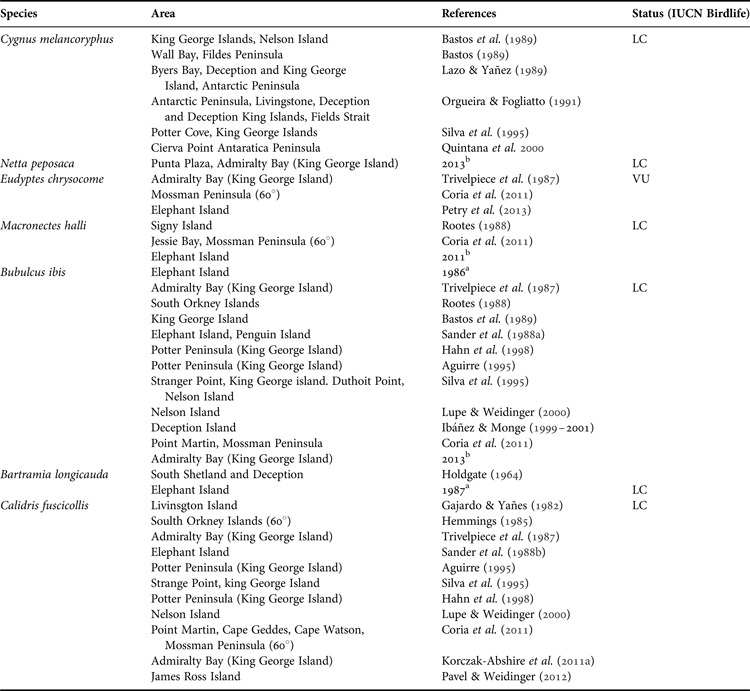
A total of seven species were recorded in the study areas. Five species were observed on Elephant Island, two were observed at Admiralty Bay and one species was recorded on Nelson Island. The Black-necked Swan and the Cattle Egret were the only species recorded in two study areas. Including the previously published data, it was observed that, among the species recorded in this study, the White-rumped Sandpiper and the Cattle Egret represent the species with the most records in the Antarctic region (Table 1). Besides the Elephant and King George Islands, all of the recorded species were observed in other areas of the South Shetlands Islands (Table 1).
Vagrant bird species records in Antarctica regions, from Brazilian data and previous studies. LC, Least Concern; NT, Near Threatened; VU, Vulnerable; EN, Endangered.

aPetry (Reference Petry1994).
bPresent study.
DETAILS ON THE RECORDED SPECIES
Black-necked swan (Cygnus melancoryphus).
In January, February and March 1989, a small group was sighted on King George Island and Nelson Island. This species has a large range, native to Southern South America and sub-Antarctic Islands.
Rosy-billed Pochard (Netta peposaca).
On 11 November 2013, an individual was sighted, dead, on Punta Plaza, Admiralty Bay, King George Island. This species has a large range, extending from Southern Brazil to Southern South America.
Rockhopper penguin (Eudyptes chrysocome).
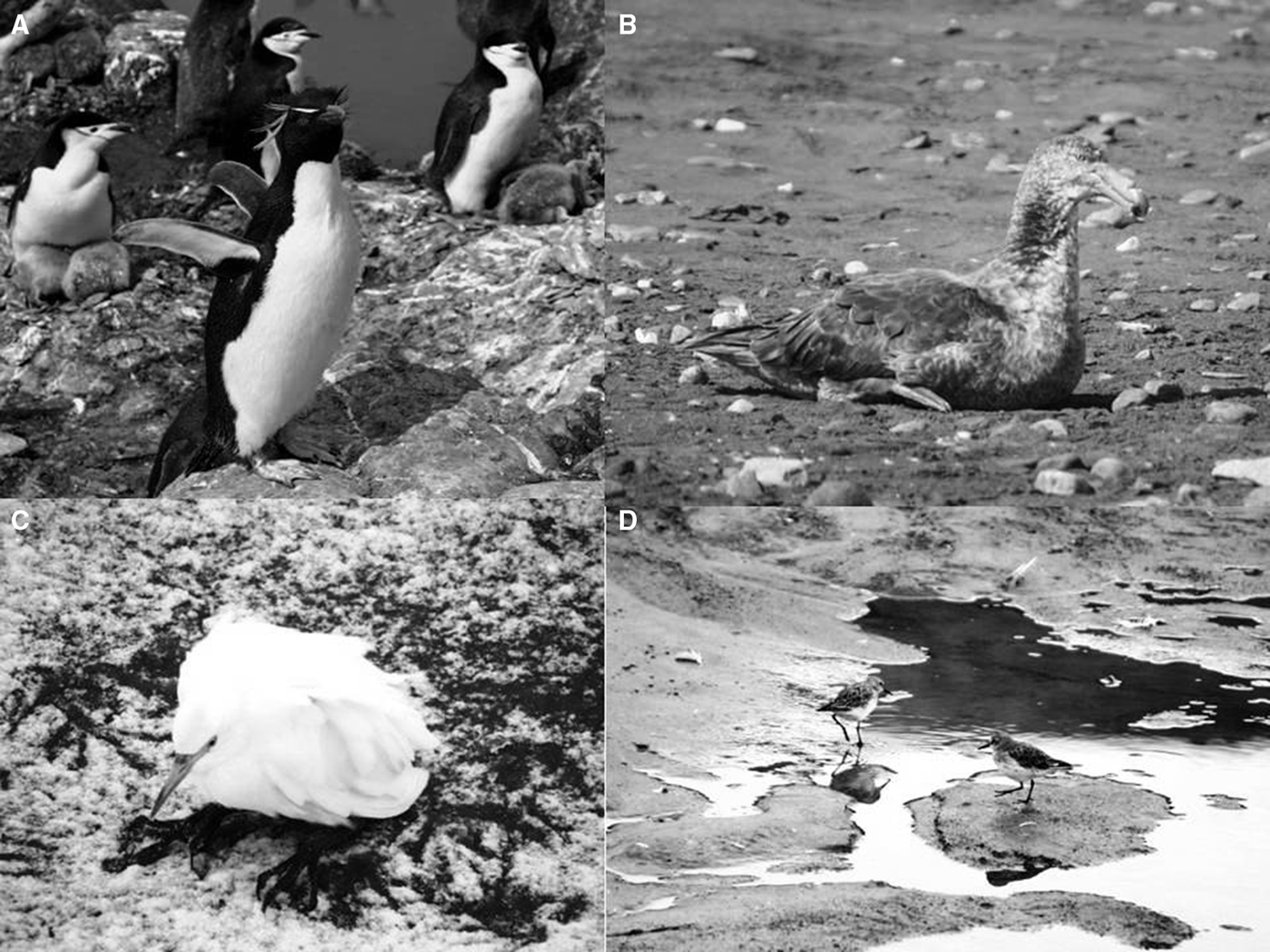
The Rockhopper penguin was observed on Elephant Island, among Chinstrap (Pygoscelis antarcticus) and Macaroni penguin colonies (Eudyptes chrysolophus) for 2 h on 8 January 2012 (Figure 1A). This species breeds in Sub-Antarctic regions and this is the first record from Elephant Island.
Vagrant bird species recorded at Elephant Island and King George Island: (A) Rockhopper penguin on Elephant Island among Chinstrap and Macaroni penguin colonies; (B) Northern Giant Petrel at the beach on Elephant Island; (C) Cattle Egret in Admiralty Bay, observed resting on the Brazilian Polar Ship Almirante Maximiano; (D) White-rumped Sandpiper observed foraging near a defrosting lake in Elephant Island.
Northern Giant Petrel (Macronectes halli).
On 23 January 2011, two individuals of Northern Giant petrel were registered (Figure 1B) resting at the beach on Elephant Island. This is a giant petrel species with a northern distribution in South America. This species breeds in South America and the Sub-Antarctic Islands.
Cattle Egret (Bubulcus ibis).
This species presents a large distribution. It is observed in all continents. At Stinker Point, three carcasses were observed in 1986 on the beach in the beginning of the breeding season. In 1986, a carcass was found on the King George Islands. One individual was registered on 22 March 2013 from Admiralty Bay and it was observed resting on the Brazilian Polar Ship, Almirante Maximiano (Figure 1C).
Upland Sandpiper (Bartramia longicauda).
One individual was recorded foraging on three consecutive days, 27–29 December 1987, over 32 h, near an Antarctic penguin colony on Elephant Island. This species is a boreal migrant that was observed in South America during the non-breeding period in coastal regions.
White-rumped Sandpiper (Calidris fuscicollis).
Ten individuals were observed foraging during January 1986 near a lake defrost on Elephant Island. Two years later (1988), one individual was registered in the same area. In 1989, five individuals were observed foraging in a lake close to the beach and in the previous areas. Three individuals were recorded close to a defrosted lake on 5 January 2012 (Figure 1D) and later in that same period, one individual was registered at the edges of a small defrosted river on 28 February 2012. The White-rumped Sandpiper is a boreal migrant, considered a long-distance migrant that winters in South America.
DISCUSSION
For the most vagrant species, environmental influences such as storms, irregular ocean currents and climate change can elucidate why the birds are registered outside of their usual distribution areas (Woehler, Reference Woehler1992; Pütz et al., Reference Pütz, Smith, Ingham and Luthi2003). The individuals that were recorded by us as vagrants were mostly migratory species that use southern South American or Sub-Antarctica areas as breeding or stopover areas, such as the Northern Giant Petrel and the White-rumped Sandpiper, respectively (Lara-Resende & Leeuwenberg, Reference Lara-Resende and Leeuwenberg1987; O'Brian et al., Reference O'Brian, Crossley and Karlson2006; Hernández & Bala, Reference Hernández and Bala2007; Patterson et al., Reference Patterson, Woehler, Croxall, Cooper, Poncet, Peter, Hunter and Fraser2008), who may have gotten lost when faced with these environmental variables during their natural movements.
For Northern Giant Petrels that forage close to Antarctic regions (Gonzáles-Sólis et al., Reference Gonzáles-Sólis, Croxall and Wood2000), Elephant Island is a boundary area for this species' distribution. These individuals, whom are constantly observed in Drake Passage (M.V. Petry, personal observation), may have, for example, faced severe weather conditions during their foraging trips and been pushed to use the island as a safety place for rest. On the other hand, long-distance migratory species of the northern hemisphere, such as the White-rumped Sandpiper and the Upland Sandpiper, use Patagonia and Southern Brazil as a stopover area. Most likely, these species were recorded at the Elephant Islands because, as with the Northern Giant Petrels, they had faced severe wind conditions that pushed them out of their migration routes, and so some individuals could have lost the direction of their stopover areas. These strong winds were also responsible for influencing the records of the White-rumped Sandpiper, which were recorded in the South Shetland Islands, Antarctica (Raya Rey et al., Reference Raya Rey, Trathan, Pütz and Schiavini2007; Korczak-Abshire et al., Reference Korczak-Abshire, Lees and Jojczyk2011b). In addition, these severe wind conditions can influence the records of small bird species in southern regions – these birds tend to fly into and across headwinds (Spear & Ainley, Reference Spear and Ainley1997). So, we can infer that the birds that have less resistance than the larger species to such winds are carried over them, which can eventually lead to exhaustion, hence explaining the larger number of small vagrant species, such as Charadriiformes, in higher latitudes (Hemmings, Reference Hemmings1985; Harrington et al., Reference Harrington, Leeuwenberg, Resende, McNeil, Thomas, Grear and Martinez1991; Korczak-Abshire et al., Reference Korczak-Abshire, Angiel and Wierzbicki2011a).
The wind also can explain the records of Anseriformes sighted by us in the three studied Islands (Lazo & Yañes, Reference Lazo and Yañez1989). The Black-necked Swan was recorded in January, like other records in the South Shetlands and Antarctica in the same month (Lazo & Yañes, Reference Lazo and Yañez1989; Coria & Montalti, Reference Coria and Montalti1993; Silva et al., Reference Silva, Coria, Favero and Casaux1995; Quintana et al., Reference Quintana, Cirelli and Orgueira2000), but, we also observed the individuals in February and March, showing that the group remained in Antarctica during the spring and summer. These individuals probably remained alive once they were in a group, since this was beneficial to their search for resources – this was not observed by Milius (Reference Milius2000), who found one individual in very poor condition that died a few hours later. The Anseriformes that we recorded are distributed in southern regions of South America and the Black-necked Swan is already considered as a vagrant species in Antarctica by the International Union for Conservation of Nature (IUCN Birdlife, 2012); a status that is not given to the Rosy-billed Pochard. This species also occupies South America, but is also distributed in South Georgia and the South Sandwich Islands. In Antarctica, we believe that this is the first record of the Rosy-billed Pochard.
Besides events in the wind, environmental influences such as climate change can also influence species distributions, once the sea surface temperature is modified, resulting in a different distribution and abundance of prey, reflecting birds' use of different areas with abundant resources (Péron et al., Reference Péron, Weimerskirch and Bost2012; Petry et al., Reference Petry, Rossi, Maciel and Petersen2013). Areas close to the Antarctic Peninsula have presented higher warming temperatures in recent decades, which are contributing to the changes in ecosystems (Turner et al., Reference Turner, Colwell, Marshall, Lanchleton, Carleton-Cope, Jones, Lagun, Reid and Iagovkina2005). The warming temperatures during springs and summers contribute to the increasing number of vagrant species in this region, such as White-rumped sandpipers, which are recorded in the Antarctic region, not only due to severe winds but also because of climatic conditions (Korczak-Abshire, Reference Korczak-Abshire2010). In the last 12 years of the warming seasons, out of 30 years of data, White-rumped Sandpipers were recorded. These observations were correlated with the warmest spring and summer seasons and, most likely, records from the South Shetlands occurred because climate warming becomes favourable to this species who find more resources during these seasons (Korczak-Abshire et al., Reference Korczak-Abshire, Angiel and Wierzbicki2011a). The presence of these species in Antarctica over consecutive years suggests that the White-rumped sandpiper is susceptible to climate changes, in addition to winds, storms and sea surface temperatures, inferring that the same factors can influence other species recorded as vagrant in the study area.
External factors also can affect vagrant species and the presence of ships is an important facilitator for vagrant occurrences. For instance, the Catlle Egret was observed on board the Almirante Maximiano off King George Island, and we can infer that these vagrants travel long distances and explore these platforms as a safety place to rest. The Catlle Egret is distributed worldwide, with colonial behaviour, but its origin is Africa (Blaker, Reference Blaker1969). An explanation for how this species manages to travel long distances is the use of ships as resting and safety places (Siegfried et al., Reference Siegfried, Broekhuysen, Broekhuysen, Broekhuysen, Spronk, Rowan and Clancey1969; Gartshore, Reference Gartshore1987). For example, one individual was recorded as residing for four days in the Barão de Tefé ship's mast in the 1990s, during the crossing between South America and Antarctica (including during the Drake Passage) (M.V. Petry, personal observation).
The area with the highest number of vagrancy records was Stinker Point. This is an ice-free area during the austral summer, where 13 Antarctic birds breed (Petry, Reference Petry1994), which were monitored during the whole seabirds' breeding season, from October to March. Pavel & Weidinger (Reference Pavel and Weidinger2012) emphasize the idea that ice-free areas are important rest and safety places for vagrant species in Antarctica. Elephant Island presents a good safety place for these individuals, because it is the first land area after the Drake Passage and offers the possibility for several food resources. Although the birds we recorded were long-distance travellers, it is important to note that the Drake Passage is a region that connects two oceans (Atlantic and Pacific), and it is characterized by storms and weather changes. These conditions can influence birds, who wish to seek more favourable areas for rest after crossing the Drake.
Sightings of vagrant birds in Antarctica are important as they encourage the collection and publication of data about new vagrant species, not only in the Antarctic region but other regions as well. These phenomena can explain the capacity of species dispersal or how climate change can influence the migration routes of birds.
ACKNOWLEDGEMENTS
This work integrates the National Institute of Science and Technology – Antarctic Environmental Research (INCT-APA), which receives scientific and financial support from the National Council for Research and Development (CNPq process: Grant No. 574018/2008-5) and the Carlos Chagas Research Support Foundation of the State of Rio de Janeiro (Grant No. E-16/170.023/2008). The authors also acknowledge the support of the Brazilian Ministry of Science, Technology and Innovation (MCTI), the Brazilian Ministry of the Environment (MMA) and the Inter-Ministry Commission for Sea Resources (CIRM).