Asthma, a chronic respiratory disorder that results from inflammation and obstruction of the airways, is one of the most common chronic illnesses in childhood (Bloom, Cohen, & Freeman, Reference Bloom, Cohen and Freeman2012). It is also one of the leading causes of pediatric hospitalization, and almost three-quarters of a million emergency room visits for children in the United States each year are due to asthma complications (Centers for Disease Control and Prevention, 2009). The immune system plays a key role in many cases of asthma, launching exaggerated responses to stimuli that result in mucus production, airway constriction, and difficulties breathing. Thus, environmental stimuli, such as allergens, pollutants, and cigarette smoke, play a central and proximal role in the reversible airway inflammation, hyperactivity, and obstruction that underlies asthma (Busse & Lemanske, Reference Busse and Lemanske2001).
Nonetheless, increasing evidence suggests that asthma is a multifactorial disease, wherein other processes influence patients' responses to environmental stimuli. Of particular interest here are the role of psychosocial factors, which have been shown in both experimental and observational studies to modify immunologic and pulmonary responses to environmental stimuli, and thereby contribute to exacerbations of asthma symptoms (see review by Chen & Miller, Reference Chen and Miller2007; Chida, Sudo, Sonoda, Hiramoto, & Kubo, Reference Chida, Sudo, Sonoda, Hiramoto and Kubo2007; Joachim et al., Reference Joachim, Quarcoo, Arck, Herz, Renz and Klapp2003; Kruschinski et al., Reference Kruschinski, Skripuletz, Bedoui, Raber, Straub and Hoffmann2008; Wright, Reference Wright2008; Wright & Subramanian, Reference Wright and Subramanian2007). Some of the most consistent psychosocial predictors of asthma onset and symptom burden in patients with asthma are family-related stressors (Kaugars, Klinnert, & Bender, Reference Kaugars, Klinnert and Bender2004; Klinnert, Mrazek, & Mrazek, Reference Klinnert, Mrazek and Mrazek1994; Klinnert et al., Reference Klinnert, Nelson, Price, Adinoff, Leung and Mrazek2001). For example, Chen, Bloomberg, Fisher, and Strunk (Reference Chen, Bloomberg, Fisher and Strunk2003) found that family conflict was linked to lifetime hospitalizations for children's asthma symptoms. Similarly, Murdock, Adams, Pears, and Ellis (Reference Murdock, Adams, Pears and Ellis2012) identified links between parent–child conflict and asthma-related restrictions in family activities. Additional evidence suggests that exposure to conflict and violence, including exposure in the home, is associated with decreased lung function in children (Suglia, Ryan, Laden, Dockery, & Wright, Reference Suglia, Ryan, Laden, Dockery and Wright2008).
These findings suggest that exposure to harsh experiences in the family is related to asthma symptoms, exacerbations, and disruptions to family activities due to asthma-related concerns. A number of studies have identified possible immunologic mechanisms that could allow family stressors to “get inside the body” to exacerbate children's asthma symptoms. In particular, a growing body of evidence suggests that family stressors might amplify children's immune responses to environmental stimuli (e.g., allergens and pollutants) in a manner that exacerbates asthma symptoms. For example, chronic family stressors have been linked to increased lymphocyte production of T helper-2 cytokines, such as interleukin (IL)-4, IL-5, and IL-13 (Chen et al., Reference Chen, Hanson, Paterson, Griffin, Walker and Miller2006). IL-4 and IL-13 trigger B cells to release immunoglobulin E molecules, which attach to mast cells in the airways. When allergens like dust mites bind to these antibodies, they cause mast cells to degranulate and release allergic mediators that spur mucus production, airway constriction, and other asthma symptoms. IL-5 attracts cells, known as eosinophils, to the airways to eliminate foreign objects (e.g., pollen, mold spores, and pet dander). Eosinophils, in turn, promote ongoing inflammation and release cytotoxic substances, such as eosinophil cationic protein, in an effort to disable and eliminate pathogens (Tomassini et al., Reference Tomassini, Magrini, De Petrillo, Adriani, Bonini and Balsano1996; Venge, Reference Venge2004). Additional evidence suggests that family stressors are linked to higher levels of eosinophils and eosinophil cationic protein (Ehrlich, Miller, & Chen, Reference Ehrlich, Miller and Chen2015; Miller, Gaudin, Zysk, & Chen, Reference Miller, Gaudin, Zysk and Chen2009).
These studies lend support to the notion that family stressors bring about changes in cellular behavior that subsequently contribute to disease symptoms. Less is known, however, about how these stressful family experiences might be associated with the activity of molecular signaling pathways that fundamentally regulate cellular behavior. With a few exceptions, all cells within an individual carry an identical DNA sequence, which is composed of about 21,000 genes, is established at conception, and with the exception of mutations, is fixed for life. The DNA sequence serves as a blueprint for transcription, the process whereby cells synthesize RNA molecules (a process known as gene expression). RNA molecules are later translated into proteins, which cells use for structural and functional purposes. Not all genes are active all times, however, and some genes are thought to be “socially sensitive,” altering their expression patterns as a function of social experiences (Cole, Reference Cole2013). In the present study, we examined the expression of gene products involved with anti-inflammatory signaling in cells of the immune system. Specifically, we focused on messenger RNA (mRNA) for the glucocorticoid receptor (GR) and β2-adrenergic receptor (β2-AR). These receptors are the starting points for signaling cascades that can regulate immune cells' trafficking patterns, antibody generation, and cytokine production, all of which play a role in responses to environmental stimuli and ultimately asthma symptoms. These receptors are also the targets for the two predominate classes of medications used in treating asthma. For example, physicians routinely prescribe inhaled corticosteroids (which act through GR) for daily use to manage symptoms and β-agonists (which act through β2-AR) for quick-acting relief to open airways during acute exacerbations (Busse & Lemanske, Reference Busse and Lemanske2001).
To date, studies of the links between parent–child relationships and gene expression in children with asthma have relied on child reports and interviewer ratings of family experiences (e.g., Miller & Chen, Reference Miller and Chen2006). However, in the study of parent–child relationships, researchers use a variety of methodologies to assess relationship characteristics, and a number of studies have found that correlations among these measures are often modest at best (e.g., Duhig & Phares, Reference Duhig and Phares2009; Ehrlich, Richards, Cassidy, & Lejuez, Reference Ehrlich, Richards, Cassidy and Lejuez2015; Hofer, Sassenberg, & Pikowsky, Reference Hofer, Sassenberg and Pikowsky1999). Self-reports of relationships tap individuals' internal representations, which may or may not reflect dyadic interactions as they unfold in any given moment (e.g., Dykas, Woodhouse, Ehrlich, & Cassidy, Reference Dykas, Woodhouse, Ehrlich and Cassidy2010; Ehrlich, Richards, et al., Reference Ehrlich, Miller and Chen2015). Informant reports have the advantage of capturing individuals' perceptions and interpretations of their relationships, and ultimately their overall experience within the relationship, which may be most relevant when considering potential links to physical health. Informants are sometimes discrepant from one another, however, even when they are reporting about the same relationship experiences (e.g., Ehrlich, Cassidy, & Dykas, Reference Ehrlich, Cassidy and Dykas2011; Ehrlich, Cassidy, Lejuez, & Daughters, Reference Ehrlich, Cassidy, Lejuez and Daughters2014; Treutler & Epkins, Reference Treutler and Epkins2003). These discrepancies are thought to result, in part, from a lack of open communication within the relationship. Structured laboratory observations, in contrast, have the advantage of eliciting observable dyadic behaviors, which can then be examined for individual differences in how dyads behave when given identical instructions for a discussion. Coders can rate dyads' behavior using objective rating scales that are not biased by the unique perspectives of each informant. Thus, we included behavioral observations as well as self-reports of relationship quality in order to compare how observed interactions between parents and children and children's internal representations of relationships are associated with gene expression and daily diary symptoms.
Our interest in comparing methods of relationship assessment was motivated in part by concerns about the clinical implications for children with asthma. In particular, this research can help inform family interventions that are designed for improving children's asthma symptoms. If children's asthma symptoms are tied to their internal representations, then interventions aimed at improving the family emotional climate may need to address children's perceptions of the support they receive from their parents. By contrast, if specific classes of observed behaviors are linked to children's asthma symptoms, then interventions might be targeted at modifying those behaviors.
The Present Study
The present study was designed to investigate the ways in which observed experiences of conflict with parents, as well as perceptions of parental support, were associated with mRNA expression and daily diary reports of asthma symptoms in a sample of children who were diagnosed with asthma. We hypothesized that harsh parent–child interactions would be associated with decreased expression of mRNA for GR and β2-AR and more intense asthma symptoms in the 2 weeks following the laboratory visit. Conversely, we hypothesized that supportive behaviors and perceptions of parental support would be associated with increased expression of mRNA for GR and β2-AR and fewer asthma symptoms. Given the little research to date on the links between parent–child relationship characteristics and children's gene expression, we did not formulate any hypotheses about which type of relationship measure (i.e., self-reports vs. behavioral observations) would be most strongly associated with expression of mRNA for GR and β2-AR.
Method
Participants
Participants included 57 English-speaking children (39 boys and 18 girls) and their parents from the Vancouver, British Columbia, community, who were a subset of families taking part in a larger longitudinal study of asthma (Chen et al., Reference Chen, Hanson, Paterson, Griffin, Walker and Miller2006; Miller et al., Reference Miller, Gaudin, Zysk and Chen2009). Interested families were prescreened and were determined to be eligible for the study if they had a child between 8 and 18 years old at the start of the study who had been diagnosed with asthma by a physician and who did not have a history of major psychiatric illness or any other chronic medical illnesses besides asthma. Laboratory visits were scheduled during times when children were medically stable, had not experienced any upper-respiratory illnesses in the prior 4 weeks, and had not taken any oral steroids in the prior 2 weeks. Participants included in the present analyses ranged in age from 10 to 20 (M age = 14.7, SD = 2.9), were mainly of European (61.4%) or Asian (28.1%) descent, and largely came from two-parent families (68.4%). Most parents (87.7%) reported at least some college education. Most youth (82.5%) were atopic, as determined by the presence of immunoglobulin E antibodies to common allergens on ImmunoCAP Phadiatop screening. Lung function was measured by FEV1 and averaged 93.1% in this sample.
All procedures were approved by the university's institutional review board, and all participants provided informed consent/assent before each session.
Measures
Parent–child conflict
We assessed parent–adolescent conflict using a semistructured revealed-differences task (Dishion & Kavanagh, Reference Dishion and Kavanagh1997). Parents and children first rated how much they disagreed with each other on 18 topics about which parents and children often disagree (e.g., schoolwork, chores, and curfew). A research assistant chose one topic for each dyad to discuss, selecting a topic that was mutually rated as high in disagreement. Dyads were instructed to discuss and try to resolve the disagreement. Discussions, which lasted for 8 min, were videotaped for later observational coding. Trained coders used a modified version of the Coder Impressions coding system (Dishion & Kavanagh, Reference Dishion and Kavanagh2003; Forgatch, Fetrow, & Lathrop, Reference Forgatch, Fetrow and Lathrop1984) to assess parent and child conflict, contempt, nurturance, and indifference behaviors. All codes were rated on a 9-point scale (1 = not at all, 9 = very much). The conflict scale assesses the extent to which parents and children are defensive, critical, and escalate the conflict during the discussion. The contempt scale taps participant use of putdowns, negative humor, and sarcasm. In contrast, the nurturance scale measures positive and supportive behaviors during the discussion, including the use of constructive suggestions, cooperative efforts, and empathy. Finally, the indifference scale reflects participants' failure to be actively engaged during the task, which is reflected in participants' lack of suggestions for resolving the disagreement, inability to acknowledge and respond to the other person, and an absence of active listening. To ensure coder reliability, 18% of the videos were randomly assigned to be coded by two coders, who were blind to the reliability status. Coders were reliable across all scales (intraclass correlations > 0.70).
A principal components analysis with varimax rotation including all parent and child scales yielded three factors that collectively explained 82.8% of the variance. The first factor, which we labeled harsh conflict behaviors, accounted for 36.0% of the variance and included scores for parent and adolescent conflict and contempt. The second factor, which we labeled parent supportive behaviors, explained 25.7% of the variance and included scores for parents' nurturance and indifference (negatively loaded). The final factor, which we labeled child supportive behaviors, explained 21.1% of the variance and included scores for children's nurturance and indifference (negatively loaded).
Parental support
Children completed the six-item parent subscale of the Social Support Scale for Children (Harter, Reference Harter1982). Using the “some kids, other kids” format (constituting a 4-point scale), the questions on this scale tap adolescents' perceptions of the extent to which their parents understand them, care about their feelings, and like them the way they are (α = 0.83).
GR and β2-AR
We collected 2.5 ml of peripheral blood into PAXgene Blood RNA tubes in a randomly selected subsample of 37 participants (for cost purposes) to measure expression of the α isomer of the GR and β2-AR mRNA by white blood cells using real-time polymerase chain reactions (PCR). Total RNA was extracted using PAXgene Blood RNA Kits (Pre-Analytix, Hombrechtikon, Switzerland). PCRs were conducted on an Applied Biosystems Prism 7000 Sequence Detection System (Foster City, CA) using commercially available one-step assays (TaqMan Gene Expression Assay developed in partnership with Applied Biosystems and based on RefSeq NM_000176 for GRα; TaqMan Gene Expression Assay #Hs00240532 for β2-AR; Applied Biosystems). Using the delta CT method, values of each target mRNA were adjusted for expression of a housekeeping gene, 18S, measured in parallel (TaqMan Gene Expression Assay Hs99999901; Applied Biosystems). Results are expressed as relative quantities of mRNA, such that higher values indicate greater expression of the target mRNA relative to the sample range. Because PCR yields data on a log 2 base scale, each unit difference in relative quantity indicates a twofold difference in expression.
Asthma symptom diary reports
Participants were asked to record their symptom severity daily for 2 weeks. After waking and before bedtime, children rated how bad their asthma symptoms were on scale of 0 (none) to 4 (really bad). Symptoms included coughing from asthma, wheezing, chest tightness/chest pain, and shortness of breath. Diary reports were averaged across all symptoms across the 2-week period to yield a summary score of 2-week asthma symptom severity.
Asthma severity and treatment
We considered the possibility that asthma severity and/or treatment could operate as confounds, inflating any association between predictors and outcomes. Asthma severity at Time 1 was calculated using an algorithm from the National Asthma Education and Prevention Program/Expert Panel Report 2 Guidelines (Bacharier et al., Reference Bacharier, Strunk, Mauger, White, Lemanske and Sorkness2004). In this scheme, ratings, which included mild intermittent asthma (n = 12), mild persistent asthma (n = 19), moderate persistent asthma (n = 15), and severe persistent asthma (n = 11), are based on a combination of symptom frequency and medication use. Participants brought their asthma medications to the research center at each visit and reported about their adherence to their prescribed medication regimen every day over the past 2 weeks. For analysis, medications were grouped into the two most common forms of asthma treatment, including inhaled corticosteroids and beta-agonists. Scores reflect the number of days in the past 2 weeks that participants used inhaled corticosteroids (M = 4.3, SD = 6.1) and beta-agonists (M = 3.4, SD = 5.3).
Alternative explanations
We evaluated possible alternative explanations by statistically controlling for plausible demographic and biobehavioral confounders. Reported analyses control for demographic characteristics, including age, race, and gender. We also considered whether person-to-person variations in leukocyte distribution acted as confounds. People vary in the relative proportion of different types of leukocytes their blood contains (lymphocytes vs. monocytes vs. granulocytes). Each of these cells types has different gene expression patterns. Thus, we used data from a complete blood count with differential (ADVIA 70 Hematology System, GMI Inc., Holiston, MA) to estimate each person's balance of cell types, and covaried these values in analyses to check for confounding.
Results
Preliminary analyses
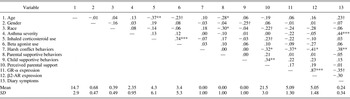
Descriptive statistics and intercorrelations among the variables in the present study are provided in Table 1. No gender or age differences emerged in GR-α, β2-AR, or diary reports of asthma symptoms. Although no race differences emerged for symptom reports or GR-α, White youth had marginally more β2-AR expression than did minority adolescents, t (35) = 1.86, p = .07.
Descriptive statistics and intercorrelations among principal study variables

Note: Gender is coded as 0 = female, 1 = male. Race is coded as 0 = White, 1 = minority. GR-α, Glucocorticoid receptor alpha; β2-AR, β2 adrenergic receptor.
†p < .10. *p < .05. ** p < .01. ***p < .001.
The subsample of participants included in mRNA analyses (n = 37) did not differ from participants included in the diary analyses (n = 57) or the larger sample on any demographic or asthma characteristics (all ps >.13). Dyads in the mRNA analyses were rated as having fewer harsh conflict behaviors (M = –0.23, SD = 0.73) compared to participants who were not included in the analyses because they lacked mRNA data (M = 0.24, SD = 1.19), t (70) = 2.01, p = .048. No other differences in conflict behaviors or perceived parental support were observed, however.
Parent–adolescent behavior and GR and β2-AR mRNA
Harsh conflict behaviors were negatively associated with GR-α and β2-AR at the bivariate level (see Table 1). Positive behaviors and adolescents' perceptions of parental support were not associated with mRNA or symptoms.
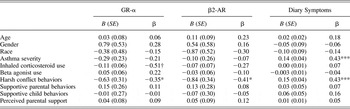
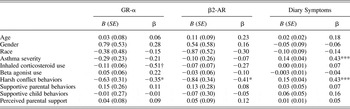
After controlling for demographic characteristics, asthma severity, and medication use, harsh conflict behaviors during the structured interaction were associated with less expression of GR-α (see Table 2 for coefficients). Supportive behaviors during these interactions, by either the parent or the adolescent, were not associated with GR-α. Further, adolescents' perceived parental support was not associated with GR-α.
Linear regression models predicting anti-inflammatory signaling molecules and disease symptoms in children with asthma
Note: Gender is coded as 0 = female, 1 = male. Race is coded as 0 = White, 1 = minority. GR-α, Glucocorticoid receptor alpha; β2-AR, β2 adrenergic receptor.
†p < .10. *p < .05. ***p < .001.
A similar pattern emerged for β2-AR. Harsh conflict behaviors during the interaction covaried with less expression of β2-AR (see Table 2 for coefficients), but the associations for supportive behaviors or perceived parental support were nonsignificant.
Parent–adolescent conflict and asthma symptom severity
Consistent with the gene expression findings described above, harsh conflict behaviors were positively associated with children's asthma symptoms (see Table 1), even after controlling for demographic characteristics, asthma severity, and medication use (see Table 2).Footnote 1 Supportive behaviors and adolescent perceptions of parental support were not associated with children's symptom severity, however.
Effects of circulating leukocyte distribution
Finally, we examined whether variations in leukocyte distribution might account for any observed associations between harsh parent–adolescent conflict and the expression of GR and β2-AR mRNA. We recomputed the regressions after incorporating covariates reflecting counts of granulocytes, lymphocytes, and monocytes (in separate equations). All of the reported links between harsh parent–adolescent conflict behaviors and β2-AR remained significant (all ps < .03). The links between harsh conflict and GR-α expression were attenuated, however, when controlling for monocytes (p = .06) and granulocytes (p = .06). The link between harsh parental conflict and GR-α expression remained significant when controlling for lymphocytes (p = .02).
Discussion
A growing body of research indicates that children with asthma who are exposed to harsh family experiences are at risk for asthma exacerbations and decreased lung function (e.g., Chen et al., Reference Chen, Bloomberg, Fisher and Strunk2003; Suglia et al., Reference Suglia, Ryan, Laden, Dockery and Wright2008), and accumulating evidence suggests that underlying immunologic mechanisms may account for these documented links. Our data provide support for this notion by highlighting associations between observed parent–child conflict behaviors and molecular signaling pathways involved in the regulation airway inflammation and obstruction in children with asthma. Specifically, observations of harsh behaviors during the conflict discussion, including evidence of hostility, anger, and contempt in the relationship, were associated with less expression of GR-α and β2-AR. Further, our findings indicate that these conflict behaviors were positively associated with the intensity of children's asthma symptoms in everyday life. However, observations of supportive behaviors during the discussion were not associated with mRNA or children's reports of their asthma symptoms. These findings are consistent with biopsychosocial models of asthma (e.g., Wright, Rodriguez, & Cohen, Reference Wright, Rodriguez and Cohen1998) and begin to highlight concrete behavioral transactions that might underlie the observed links between family processes and asthma outcomes in children. If these findings are replicated in larger, more diverse samples, then these patterns may be useful to consider as targets in a family intervention.
Why might the experience of harsh parent–adolescent conflict be related to gene expression and asthma symptoms? One possible mechanism could extend through conflict-related changes to the hypothalamic–pituitary–adrenal axis and the sympathetic nervous system. Some evidence suggests that chronic conflict within the family is associated with alterations to the hypothalamic–pituitary–adrenal axis (e.g., Baucom et al., Reference Baucom, Saxbe, Ramos, Spies, Iturralde and Duman2012; see Tobin, Slatcher, & Robles, Reference Tobin, Slatcher, Robles, Newman and Roberts2013, for a review). These changes, if sustained, could modulate patterns of leukocyte gene expression. Behavioral pathways may also explain the observed links in the present study. For example, conflict between parents and adolescents may be especially likely to occur when parents are also struggling to keep up with the demands of everyday life (e.g., keeping the home clean), and exposure to increased conflict may coincide with exposure to environmental allergens that exacerbate inflammatory responses and asthma symptoms. Exploration of possible mechanisms will be particularly important in future research.
In the present study, we also included children's reports of the support they receive from their parents, which allowed us to compare behavioral observations and informant perceptions and their links to children's gene expression and asthma symptoms. Across all analyses, we found that behavioral observations were stronger correlates than informant reports. However, we did not ask adolescents to report about negative experiences with their parents, which limited our ability to examine the comparative predictive roles of self-reports of negative relationship qualities and behavioral observations. It will be important to conduct additional research on the relative predictive roles of behavioral observations and informant reports, particularly given the small sample size of this study. Nevertheless, our findings point to the value of observing actual behaviors within the parent–child relationship. A large body of research on informant reports suggests that informants often provide discrepant reports of their experiences (Achenbach, McConaughy, & Howell, Reference Achenbach, McConaughy and Howell1987). Within dyads, informants often disagree with each other about the quality of their relationship (e.g., Ehrlich et al., Reference Ehrlich, Cassidy and Dykas2011, Reference Ehrlich, Cassidy, Lejuez and Daughters2014), and informant reports are often only moderately correlated with behavioral observations (e.g., Duhig & Phares, Reference Duhig and Phares2009). It may be that informant reports are influenced by a history of experiences within the relationship that do not always reflect the current dynamics of the dyad (e.g., Dykas et al., Reference Dykas, Woodhouse, Ehrlich and Cassidy2010) and, compared to previous experiences, current experiences might be more closely connected to adolescents' gene expression and asthma symptoms.
Of course, there may be times when informant reports are better predictors of children's health than are behavioral observations. Most research on psychosocial contributors to immune functioning and health has relied on informant reports. Furthermore, informants can report about some constructs that are difficult to observe in laboratory or naturalistic settings, such as loneliness and social isolation. It is likely that behavioral observations and informant reports assess different facets of relationships, and each measure may relate to health outcomes in unique ways. For example, recent evidence suggests that naturalistically observed conflict (assessed via an electronically activated recorder) and self-reports of conflict uniquely predicted children's asthma symptoms (Tobin et al., Reference Tobin, Kane, Saleh, Naar-King, Poowuttikul and Secord2015). Future investigations that include both observations and informant reports will help clarify whether informant reports or behavioral observations are most consistently linked to health.
Limitations and future directions
These findings enhance our understanding of the role of the family emotional climate for children's asthma symptoms. Nevertheless, several limitations will be important to address in future research. Of particular concern here is the study's small sample size, which may have limited our ability to detect links between positive relationship characteristics (i.e., perceived parental support and supportive behaviors during the conflict discussion) and children's mRNA and asthma symptoms. Although many studies focus on the role of negative social experiences (e.g., conflict, violence, and social isolation), some studies have identified connections between supportive relationships and children's asthma (e.g., Conn, Swanson, McQuaid, Douthit, & Fisher, Reference Conn, Swanson, McQuaid, Douthit and Fisher2015). Further, our small sample size precluded examination of more complex analyses, including formal tests of mediators and moderators, such as whether children's expression of mRNA mediated the observed links between harsh parent–child conflict and children's asthma symptoms, or whether perceptions of a supportive parent buffered adolescents from the negative effects of harsh interactions during the conflict discussion. These analyses will be important in future research in order to expand our understanding of how these factors contribute to children's asthma functioning.
Another limitation of the current analyses is our reliance on a single laboratory visit for all study measures. Although participants took part in a larger longitudinal study, the conflict task was included only at the final lab visit, so we cannot speculate on the predictive utility of parent–child conflict for children's later gene expression or asthma symptoms. Future research with longitudinal study designs will allow us to test hypotheses about the direction of effects.
Finally, our sample displayed a limited range of harsh behavior during the structured interaction. Our study consisted of a community sample of children who were at risk due to their asthma status and not because they were victims of maltreatment. We can only speculate about how the findings from our sample may compare to findings in samples of maltreated children. Some researchers have conceptualized harsh parenting practices as being on a continuum that includes child maltreatment at the opposite extreme (e.g., Dodge & Pettit, Reference Dodge and Pettit2003; Kim, Pears, Fisher, Connelly, & Landsverk, Reference Kim, Pears, Fisher, Connelly and Landsverk2010; Lansford et al., Reference Lansford, Criss, Dodge, Shaw, Pettit and Bates2009). We suspect that, similar, if not stronger, effects would be observed in samples with child abuse, but this is an open question that needs to be addressed empirically. Evidence suggests that maltreatment is associated with both the onset and severity of asthma (e.g., Coogan et al., Reference Coogan, Wise, O'Connor, Brown, Palmer and Rosenberg2013; Lanier, Jonson-Reid, Stahlschmidt, Drake, & Constantino, Reference Lanier, Jonson-Reid, Stahlschmidt, Drake and Constantino2010), but virtually nothing is known about how such exposure translates to differences at the molecular level in ways that may have implications for children's asthma morbidity. It will be important to revisit the linkages observed here in families with documented cases of parental maltreatment.
Implications for evidenced-based interventions
Prospective longitudinal studies indicate that abrasive family climates are associated with worse childhood asthma outcomes. Building on these findings, our study highlights a connection between harsh parent–child interactions and anti-inflammatory gene expression patterns, as well as asthma symptoms in everyday life. It will be important to replicate these findings in larger samples with multiwave data sets. If replicated, these behaviors could become targets in clinical trials, which aim to augment typical asthma therapy with family-oriented psychosocial interventions. A recent study found that systemic inflammation was lower in healthy youth if families received an intervention focused on parenting skills, effective communication, and youth competency building, relative to untreated control youth (Miller, Brody, Yu, & Chen, Reference Miller, Brody, Yu and Chen2014). It will be important for future research to examine whether family-focused interventions can improve immune mediators and symptoms in children with asthma.