INTRODUCTION
Music and healthcare have been interconnected from the time of the ancient Greeks (Gallagher, Reference Gallagher2011). The healing power of music has been recorded as far back as 1500 bc on Egyptian medical papyri (O'Kelly, Reference O'Kelly2002). Furthermore, music was used to treat physical, psychological, and emotional problems during the Middle Ages and the Renaissance in Europe (Cardozo, Reference Cardozo2004). There has been a more recent resurgence of music in healthcare brought about by music therapists (Hogan, Reference Hogan2003). However, it is important to distinguish what is termed “music medicine” (passive listening to prerecorded music delivered by healthcare professionals) from music therapy (a music intervention tailored to an individual, in the context of a therapeutic relationship, delivered by a trained music therapist) (Bradt & Dileo, Reference Bradt and Dileo2010).
Music therapy is defined as the use of music as part of a developing relationship between a patient and therapist to support and improve physical, mental, and spiritual well-being (Bunt & Hoskyns, Reference Bunt and Hoskyns2002). This holistic approach to healthcare is consonant with that of palliative care, which involves an approach that focuses not only on the physical person but that also encompasses the psychological and existential aspects of the individual (Bowers & Wetsel, Reference Bowers and Wetsel2014). In this context, music therapy aims to improve quality of life through the relief of physical symptoms and psychological difficulties by providing comfort and support, enabling communication, and ameliorating existential concerns. Music therapy also seeks to address the coping, communicative, and bereavement needs of family members and caregivers (Dileo & Bradt, Reference Dileo and Bradt2005). It is therefore not surprising that music therapy has experienced a rise in demand as an adjunct therapy for symptom management among palliative care patients (Hilliard, Reference Hilliard2005).
An investigation of the particular types of music therapy interventions used for palliative care shows the practice to be diverse and tailored to individual needs. Different techniques are categorized as either receptive or interactive and can be employed in combination. They involve listening to music (played by the therapist or recorded), music making (instrumental or vocal performance and improvisation), songwriting and recording (often for life review or legacy work), lyric analysis (Curtis, Reference Curtis2011), and music entrainment (Cottrell, Reference Cottrell2000). In music entrainment, the music therapist matches the musical tempo to the patient's mood and then changes that tempo to alter their mood in the direction of therapeutic goals.
Several studies have reported positive results for music therapy with palliative care patients. These include a systematic review of randomized controlled trials indicating reduced pain (McConnell et al., Reference McConnell, Scott and Porter2016) and a metaanalysis indicating reduced nausea/vomiting, depression, and anxiety, as well as an improved sense of well-being and enhanced mood (Dileo & Bradt, Reference Dileo and Bradt2005). The literature also suggests that most referrals for music therapy are related to anxiety, pain, depression, and quality of life (Bowers & Wetsel, Reference Bowers and Wetsel2014). However, what is still not clear is how music therapy exerts its effect, for whom it works best, and in what circumstances. There is an increasing demand, not only for evidence-based practice but also for a greater understanding and description of how an intervention works in order to optimize success (Pawson, Reference Pawson2006). Therefore, the principal questions for this review were:
-
■ What appeared to be the therapeutic mechanisms?
-
■ For whom did they work?
-
■ Which contexts helped or hindered the intervention to achieve its desired outcomes?
METHODS
Fundamental to critical realism is a rejection of models that assume unilinear causality (such as an assumption that the effectiveness of an intervention is solely the result of its inherent qualities). Instead, it regards outcomes as resulting from the complex interactions of a number of causal mechanisms, whose precise relationship will differ in different contexts. As a consequence, rather than regarding causal mechanisms as determining outcomes, they are seen as tendencies (Blackwood et al., Reference Blackwood, O'Halloran and Porter2010). Pertinent mechanisms may be embedded in the intervention itself (in this case, music therapy), or they may be embedded in the social and organizational context into which the intervention is introduced (in this case, those institutions and services providing palliative care). To make matters even more complex, these program and contextual mechanisms are experienced by people, with their capacities to interpret and choose, which means that an analysis of the effectiveness of an intervention should include consideration of how different types of people tend to respond to it and why. In other words, human agency also has to be taken into account (Porter, Reference Porter2015a ). To sum this up formulaically, the critical realist approach to explaining the effectiveness of an intervention involves explaining outcomes in terms of a combination of contextual mechanisms + program mechanisms + agency (Porter, Reference Porter2015b ).
In line with this formula, the current review identifies the putative mechanisms embedded in music therapy that have been identified in the literature as making an effective contribution to palliative care. It analyzes these mechanisms in terms of their projected effects upon human agency. Finally, it examines the putative contextual mechanisms that are regarded as either promoting or inhibiting the successful implementation of music therapy interventions in palliative care settings.
Theoretical Framework
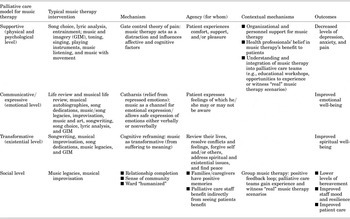
To develop our theoretical framework on music therapy for palliative care patients, we began by conducting a broad and rapid review on music therapy for palliative care patients. This was followed up by interviews with palliative care music therapists to test provisional ideas of what are the underlying therapeutic factors, for whom, and the facilitating or hindering contexts. This first step led to a provisional theoretical framework based on Dileo and Dneaster's (Reference Dileo, Dneaster, Dileo and Loewy2005) palliative care model for music therapy (see Table 1), which we developed further with the addition of a social domain.
Theoretical framework: Palliative care model for music therapy (Dileo & Dneaster, Reference Dileo, Dneaster, Dileo and Loewy2005)

Search Strategy
We did not aim to exhaustively search all available evidence, but rather to build up a representative body of literature to help us test and refine the intervention theories (Wong et al., Reference Wong, Greenhalgh and Pawson2010). We searched the CINAHL, Embase, Medline, and PsychINFO electronic databases from their first available date until December of 2015 using “music therapy,” “hospice,” and “palliative care” as broad search terms. Further studies were identified through pearling (searching the reference lists of included studies). There were no date limits, but we did restrict ourselves to English-language articles due to resource constraints. Searching was iterative and ongoing during the review using the same searching process to identify additional data when required to test developing theories. TM searched and screened citations for inclusion in two stages: the first was of the title and abstract, and the second was of the full text of potentially relevant literature. Articles were included if they met the inclusion criteria for each step of the searching process (they first needed to address music therapy for a palliative care population, and for subsequent searches they needed to address developing theoretical assumptions). Studies were excluded if they involved music medicine (listening to music only with no therapeutic relationship present). The pertinence of included articles was judged by their ability to identify and test intervention theories (their relevance) rather than their overall methodological quality (Pawson, Reference Pawson2006).
Information on the characteristics of included articles were extracted into a word table to include article details: country of origin, article type, aim, research method where applicable, and a record of how the article informed our theoretical framework (available upon request). We coded verbatim sections of text against our program theories in a word document to facilitate transparency and retrieval. Additional codes were created as the synthesis developed to depict new data for theory testing, and articles were revisited to ensure that coding was complete and consistency maintained (Wong et al., Reference Wong, Greenhalgh and Pawson2010).
TM and SP undertook data synthesis and thematic analysis. An interrater reliability strategy was employed throughout to enhance rigor (Hruschka et al., Reference Hruschka, Schwartz and St. John2004). We developed a data analysis template to record key themes of importance for explaining music therapy's outcomes, including any information on context. Prevalent recurring themes and facilitating contexts were noted and utilized to help identify the underlying therapeutic ingredients (program mechanisms) that could explain the most common palliative care outcomes for music therapy. This iterative searching provided us with further data to develop and test theories, and it was repeated for the different domains of our theoretical framework.
RESULTS
Theoretical Framework
Our theoretical framework consisted of four separate but interrelated domains that encapsulate palliative care as a holistic approach to caring for terminal and end-of-life patients. These domains include the supportive (physical and psychological domain), communicative/expressive (emotional domain), and transformative (spiritual/existential domain) (Dileo & Dneaster, Reference Dileo, Dneaster, Dileo and Loewy2005). The social domain was added to the framework based on its prominence in the literature for explaining music therapy's therapeutic effects (see Table 1)
Search and Study Characteristics Used in Synthesis
Iterative searching led to a total of 51 articles that provided the data with which we could test our framework (see Table 1). All of these 51 included articles were in English and dated from 1964 to 2015. The majority of primary research was carried out in the United States (17/33, 51%), followed by Australia (6/33, 18%), Canada (3/33, 9%), the United Kingdom (2/33, 7%), Singapore (1/33, 3%), Tanzania (1/33, 3%), Switzerland (1/33, 3%), Japan (1/33, 3%), and Thailand (1/33, 3%). Some 33 articles were primary research, 4 were reviews, and 4 theoretical papers, and there were 6 discussion pieces, 1 book chapter, and 1 report. The most commonly used method for primary research was quasiexperimental (12/33, 40%), followed by qualitative (13/33, 33%), randomized controlled trials (5/33, 17%), and surveys (3/33, 10%).
Key Outcomes
Both the quantitative (Hilliard, Reference Hilliard2003; Curtis, Reference Curtis2011) and qualitative (Kitawaki, Reference Kitawaki2007) evidence suggest that music therapy improves overall quality of life for palliative care patients. Music therapy has also been shown to reduce physical discomfort (Gallagher et al., Reference Gallagher, Lagman and Walsh2006) and pain (Krout, Reference Krout2001; Gallagher et al., Reference Gallagher, Lagman and Walsh2006; O'Callaghan & Hiscock, Reference O'Callaghan and Hiscock2007; O'Kelly & Koffman, Reference O'Kelly and Koffman2007; Leow et al., Reference Leow, Drury and Poon2010b ; Curtis, Reference Curtis2011; Gutgsell et al., Reference Gutgsell, Schluchter and Margevicius2013). In terms of psychosocial benefits, the quantitative evidence suggests that music therapy improves patients' mood (Gallagher et al., Reference Gallagher, Lagman and Walsh2006; Nakayama et al., Reference Nakayama, Kikuta and Takeda2009; Curtis, Reference Curtis2011) and reduces anxiety (Nguyen, Reference Nguyen2003; Gallagher et al., Reference Gallagher, Lagman and Walsh2006; Horne-Thompson & Grocke, Reference Horne-Thompson and Grocke2008). Furthermore, qualitative studies suggest that music therapy improves emotional well-being (O'Callaghan, Reference O'Callaghan1996; O'Callaghan & Hiscock, Reference O'Callaghan and Hiscock2007; O'Kelly & Koffman, Reference O'Kelly and Koffman2007), social interaction (O'Kelly & Koffman, Reference O'Kelly and Koffman2007; Leow et al., Reference Leow, Drury and Poon2010b ), and spiritual and/or existential well-being (Okamoto, Reference Okamoto2005; O'Callaghan & Hiscock, Reference O'Callaghan and Hiscock2007; Wlodarczyk, Reference Wlodarczyk2007).
While music and the music therapist are referred to as the therapeutic agents of music therapy (Leow, Reference Leow2011), their therapeutic influence remains elusive. However, our realist approach to the literature helped us uncover the underlying interplay of program mechanisms, agency, and contextual mechanisms that help explain the various outcomes observed.
Therapeutic Mechanisms
The following sections identify the therapeutic mechanisms purported by the literature to make an effective contribution to palliative care and their projected effects on human agency for each domain of our theoretical framework.
Supportive (Physical and Psychological Domain)
It is widely recognized that physical and psychological factors have a synergistic effect whereby affective factors impact on pain levels. Thus, higher anxiety, depression, and anger all increase pain perception (Bradt, Reference Bradt2010). One model of pain perception that helps explain how music therapy exerts its effects is gate control theory, which emerged in the 1960s. This is the most widely recognized model of pain perception, acknowledging sensory, affective, and cognitive mechanisms (Melzack & Wall, Reference Melzack and Wall1965). This model provides a neurophysiological explanation for the effects of several psychological interventions on pain reduction and a rationale for using treatments that target brain processes (Jensen & Turk, Reference Jensen and Turk2014). The theory underlying this model postulates that the volume of information from the peripheral nervous system signifying damage or the threat of physical damage that reaches the brain, modulating the experience of pain, is regulated in the spinal cord at the dorsal horn by input from the periphery and output from the brain. As an example, when one rubs part of their body (creates a distraction), this sends information to the dorsal horn, which “closes” this hypothetical gate and decreases pain sensation. Processes such as attention, affect, memories, and interpretation can all impact how “open” or “closed” the gate is and as such influence the intensity of any pain experienced (Melzack & Wall, Reference Melzack and Wall1965). Therefore, to be effective, an intervention needs to act as a distraction and, more importantly, influence attention, affect, memories, and interpretation.
Music therapy appears to influence pain perception, not only by offering a distraction (Groen, Reference Groen2007; Hartwig, Reference Hartwig2010; Bradt, Reference Bradt2010; McClean et al., Reference McClean, Bunt and Daykin2012; Pitts & Cevasco, Reference Pitts and Cevasco2013) but also by influencing a number of affective factors, such as evoking happier memories (Clements-Cortes, Reference Clements-Cortes2004; Cadrin, Reference Cadrin2006; McClean et al., Reference McClean, Bunt and Daykin2012); improving mood (Gallagher et al., Reference Gallagher, Lagman and Walsh2006; Nakayama et al., Reference Nakayama, Kikuta and Takeda2009; O'Callaghan & Barry, Reference O'Callaghan and Barry2009; Leow et al., Reference Leow, Drury and Poon2010b ; Curtis, Reference Curtis2011; McClean et al., Reference McClean, Bunt and Daykin2012); and reducing anxiety (Nguyen, Reference Nguyen2003; Gallagher et al., Reference Gallagher, Lagman and Walsh2006; Horne-Thompson & Grocke, Reference Horne-Thompson and Grocke2008). The developments in the neuro-scientific literature pertaining to music therapy help to further explain how it may improve psychological symptoms (Archie et al., Reference Archie, Bruera and Cohen2013). Numerous studies have shown that music therapy positively modulates the activity of brain structures that affect such psychological processes as levels of anxiety and emotional distress (Fachner et al., Reference Fachner, Gold and Erkkela2013; Raglio et al., Reference Raglio, Attardo and Gontero2015).
As will be seen in the transformative domain of the model, music therapy also helps patients reframe their interpretation of their situation from seeing themselves as a sick/dying patient to believing that they are an empowered individual who still has experiences to enjoy and leave behind for others. Similarly, there is overlap between this domain of the framework and the subsequent communicative/expressive domain. Research has shown that patients and families who are more open about their feelings in relation to a cancer diagnosis suffer less from depression and anxiety (Edwards & Clarke, Reference Edwards and Clarke2004). Music therapy's ability to help patients open up about their feelings appears to result in lower levels of depression and anxiety, and this may consequently also reduce their perception of pain.
Communicative/Expressive (Emotional Domain)
The underlying mechanism of music therapy appears to be the cathartic influence that the therapy has on palliative care patients in terms of bringing relief from repressed emotions (O'Callaghan, Reference O'Callaghan1996; Clements-Cortes, Reference Clements-Cortes2004; O'Callaghan & Hiscock, Reference O'Callaghan and Hiscock2007; O'Kelly & Koffman, Reference O'Kelly and Koffman2007) and a release of frustrations about their situation (Leow et al., Reference Leow, Drury and Poon2010b ). Communication between patients and loved ones is improved through a renewed connection facilitated by the music and the therapist's presence. The simple act of choosing songs together that have meaning for both the patient and family helps all those involved express shared memories, feelings of loss, and hopes for the future, which the music therapist is then able to explore further in working toward helping patients and family members say their goodbyes within a supportive environment (Krout, Reference Krout2003; Dimaio, Reference Dimaio2010; Sato, Reference Sato2011).
Music appears to provide a safe channel for emotional expression (Salmon, Reference Salmon2001) and dialogue around spiritual conflicts (Burns et al., Reference Burns, Perkins and Tong2015; Liu et al., Reference Liu, Burns and Hilliard2015). For example, the indirect expression of emotions through music making or song choice appears to arouse less anxiety in patients than direct verbalization (Salmon, Reference Salmon2001; Clements-Cortes, Reference Clements-Cortes2004; Renz et al., Reference Renz, Schutt and Cherny2005; Cadrin, Reference Cadrin2006; Leow et al., Reference Leow, Drury and Poon2010b ; McClean et al., Reference McClean, Bunt and Daykin2012).
Therapeutic songwriting can help patients communicate thoughts and feelings in a creative, safer way, and open channels of communication. Musical improvisation can also help patients identify painful emotions, enabling them to communicate repressed thoughts and feelings aided by the therapist, and thereby lessening their impact (Heath & Lings, 2013).
Transformative (Spiritual/Existential Domain)
The idea of “spirituality” has permeated the dialogue on health and well-being since the early 1980s. However, it is a confusing term (Chiu et al., Reference Chiu, Emblen and Hofwegen2004). In the healthcare literature, it incorporates a broad range of meanings and as such differs from the idea of religion (Fryback & Reinert, Reference Fryback and Reinert1999). As Post-White and coworkers (Reference Post-White, Ceronsky and Kreitzer1996, p. 1572) put it, spirituality is more about the “search for meaning and existential purpose in life.” Indeed, a recurring theme in the literature on spirituality and health is the search for meaning (Thoresen, Reference Thoresen1999; Coyle, Reference Coyle2002; Tanyi, Reference Tanyi2002; Chiu et al., Reference Chiu, Emblen and Hofwegen2004). Facilitating this search for meaning appears to be one of the key mechanisms by which music therapy can foster improved outcomes. For example, music therapists use music chosen by clients, songwriting, or music improvisation to help patients gain insight into their past accomplishments, make amends for past unreconciled events, find meaning in their present experience, and share the values and beliefs they have learned throughout life. For example, the integral connection between music and emotions means that listening to familiar songs and/or songwriting supports and provides a safe medium for reminiscing, exploring, and expressing feelings in palliative care patients (Cadrin, Reference Cadrin2006; Sato, Reference Sato2011).
Another key theme related to existential comfort is that of “transcendence,” used in this context to denote rising above the monotony of everyday existence (McClean et al., Reference McClean, Bunt and Daykin2012). It is argued that music therapy can help palliative care patients transcend suffering and imminent death by enjoying such simple pleasures as laughter, positive energy, relaxation, and just having fun with the music (McClean et al., Reference McClean, Bunt and Daykin2012). Through a process of cognitive reframing, the patient can move from the perception of themselves as a sick, dying patient to that of an empowered individual who still has experiences to enjoy and leave behind for others. Music enables end-of-life patients “to extend beyond the immediate context to achieve new perspectives … when they are encouraged to maintain a sense of well-being in the face of imminent biological and social loss” (Aldridge, Reference Aldridge1999, p. 107).
Music therapy can also contribute to reduced existential anxiety through its ability to enable patients to produce a lasting legacy in the form of songs they create as a gift for their loved ones. Having something of themselves to leave behind in the form of songs expressing their values, beliefs, and their life's lessons provides patients with a sense of completion and peace, knowing that aspects of themselves will live on past their death (O'Kelly, Reference O'Kelly2002; Cadrin, Reference Cadrin2006). An additional overriding theme in the literature is the comfort legacy work brings to family members after the death of a loved one. Whether it was a song written by the patient or a favorite compilation of songs, this legacy work provided families with a sense of continued connection with the deceased patient (Cadrin, Reference Cadrin2006).
Social Domain
It can be seen that music therapy's legacy function is not simply of existential benefit to the patient but also contributes to the strengthening of social bonds with loved ones. It is also claimed that music therapy can help support relationships in other ways. Many palliative care patients experience a sense of isolation from holding onto feelings too difficult to share with others (Clements-Cortes, Reference Clements-Cortes2004). The music therapist offers a safe place for patients to express these difficult emotions either verbally or nonverbally. However, music therapy focuses not only on the patient/therapist relationship but also on improving communication between patients and their families (Krout, Reference Krout2003), most often through legacy work.
The literature alludes to music therapy's ability to create a sense of community within the palliative care setting (O'Kelly, Reference O'Kelly2002) and to improve relationships with family members (O'Kelly & Koffman, Reference O'Kelly and Koffman2007; Heath & Lings, Reference Heath and Lings2012). Leow and colleagues's (Reference Leow, Drury and Hong2010 a) systematic review of the literature on the experiences and expectations of terminally ill patients receiving music therapy in a palliative care setting also highlighted improved communication and social interaction with family, friends, other patients, and healthcare staff. When music therapy is delivered as a group therapy where visitors can also partake, research suggests that this lowers levels of bereavement for families and caregivers (O'Callaghan & Barry, Reference O'Callaghan and Barry2009). This also appeared to have a knock-on effect for staff. For example, they reported feeling that music therapy helped soften and humanize the palliative care setting by adding life and atmosphere. This helped lift the mood of patients, families, and staff, which they felt led to improved patient care. For example, staff felt that the benefits they derived from the positive impact of music therapy on the ward enabled them to focus on the experience of living rather than on issues around dying.
For Whom?
It was difficult to determine which palliative care patients were most likely to benefit from music therapy. Overall trends from the primary studies included in the review showed that most patients had a diagnosis of cancer, were female, and were close to the end-stage of their illness. Patients ranged in age from 16 to 101 years, with an average age of 61. Apart from three studies that focused specifically on pain (Lee, Reference Lee2005; Gutgsell et al., Reference Gutgsell, Schluchter and Margevicius2013) and anxiety (Horne-Thompson & Grocke, Reference Horne-Thompson and Grocke2008), the reviewed studies did not provide information on patients' physical or psychosocial symptoms, nor information about which patients were more likely to take up music therapy.
Contextual Mechanisms
Key contextual mechanisms for facilitating the implementation of music therapy appeared to include organizational support in terms of management approval for music therapy (O'Callaghan & Barry, Reference O'Callaghan and Barry2009), protected time (Bradt, Reference Bradt2010) and space for music therapy sessions to take place (Hilliard, Reference Hilliard2003; Nguyen, Reference Nguyen2003; Clements-Cortes, Reference Clements-Cortes2004; Okamoto, Reference Okamoto2005; Gallagher et al., Reference Gallagher, Lagman and Walsh2006; O'Callaghan & Barry, Reference O'Callaghan and Barry2009; Bradt, Reference Bradt2010; Curtis, Reference Curtis2011; Gutgsell et al., Reference Gutgsell, Schluchter and Margevicius2013), as well as staff support (Hilliard, Reference Hilliard2003; Nguyen, Reference Nguyen2003; Lee, Reference Lee2005; Okamoto, Reference Okamoto2005; Gallagher et al., Reference Gallagher, Lagman and Walsh2006; Wlodarczyk, Reference Wlodarczyk2007; Horne-Thompson & Grocke, Reference Horne-Thompson and Grocke2008; Nakayama et al., Reference Nakayama, Kikuta and Takeda2009; Bradt, Reference Bradt2010; Curtis, Reference Curtis2011; Gutgsell et al., Reference Gutgsell, Schluchter and Margevicius2013).
Our findings also alluded to the importance of organizational and individual palliative care professionals' understanding of the aims and a belief in the benefits of music therapy for their patients, thus motivating them to be active facilitators of music therapy programs (Hilliard, Reference Hilliard2003; Clements-Cortes, Reference Clements-Cortes2004; Okamoto, Reference Okamoto2005; Renz et al., Reference Renz, Schutt and Cherny2005; Groen, Reference Groen2007; Wlodarczyk, Reference Wlodarczyk2007; Horne-Thompson & Grocke, Reference Horne-Thompson and Grocke2008; Nakayama et al., Reference Nakayama, Kikuta and Takeda2009; Bradt, Reference Bradt2010; Leow et al., Reference Leow, Drury and Poon2010b ).
Support for music therapy can also be strengthened by the integration of music therapists within multidisciplinary palliative care teams (O'Kelly & Koffman, Reference O'Kelly and Koffman2007; Tsiris et al., Reference Tsiris, Dives and Prince2014).
The only hindering contextual mechanism reported in one study related to excessive medical interruptions of music therapy through the performance of other clinical activities (Lee, Reference Lee2005).
DISCUSSION
Notwithstanding the paucity of evidence in relation to the proclivities and interpretations of palliative care patients who receive music therapy, we have endeavored to shed light on the underlying therapeutic factors (program mechanisms) and the facilitating contexts (contextual mechanisms) in order to provide guidance to music therapists delivering the intervention, and also to provide funders and decision makers considering music therapy as an option with a more robust understanding of its active ingredients.
Therapeutic Mechanisms
This review resulted in a number of key findings that, while important, are not surprising given the recognition of palliative care as synonymous with holistic care (Bowers & Wetsel, Reference Bowers and Wetsel2014). However, our findings do highlight the importance of recognizing the synergistic effect one aspect of the human experience has on others and the ability of music therapy to tap into this synergy, thereby providing a therapeutic focus to all aspects of human experience and suffering. For example, despite the many advances in pharmacological treatment programs for symptom control, both research and direct observation show that not all patients benefit (Groen, Reference Groen2007). Pain is subjective (O'Callaghan, Reference O'Callaghan1996), highly complicated in nature, and may be exhibited very differently from patient to patient depending on their physical state as well as individual patients' psychological state (Trauger-Querry & Haghighi, Reference Trauger-Querry and Haghighi1999). Moreover, the research suggests that pain can become resistant to conventional treatment measures if psychological issues are not addressed (Groen, Reference Groen2007). As suggested in our findings, music therapy may be an effective nonpharmacological approach to managing pain in palliative care patients through its therapeutic effects on physical, psychological, emotional, and spiritual suffering.
Furthermore, Kugelmann (Reference Kugelmann2000) analyzed pain narratives using a hermeneutical–phenomenological approach and showed that the loss of a relationship was associated with psychological pain. When we think of bereavement, we think of families who have suffered a loss. However, palliative care patients are in a sense already grieving for the losses implicit in their illness and imminent death, such as separation from loved ones, loss of life's simple pleasures, and lost opportunities. Music therapy not only helps both patients and families through the grieving process, but it also assists them in finding closure (Cadrin, Reference Cadrin2006) and thereby moderating psychological distress and, as a consequence, reducing pain perception.
Our review also highlights music therapy's unique contribution to addressing the spiritual needs of palliative care patients. It has been contended that music therapy is one of the most important approaches employed for spiritual care of patients with an advanced or life-threatening illness (Renz et al., Reference Renz, Schutt and Cherny2005). The intensity of suffering experienced at the end of life is believed to be influenced by finding meaning in one's experience, which may be facilitated by music therapy (Cassell, Reference Cassell1982).
For the social domain, the findings from our review suggest that group music therapy not only benefits patients, families, and healthcare staff, but it also creates a supportive context for music therapy as an intervention by generating an understanding of its aims and benefits. As reiterated in the literature, group music therapy provides an opportunity for multidisciplinary palliative care staff to witness firsthand the benefits of music therapy for patients and families along with deriving emotional, cognitive, and teamwork benefits themselves (O'Callaghan & Barry, Reference O'Callaghan and Barry2009).
Palliative care is associated with many pressures, including psychosocial adjustments (Onyeka, Reference Onyeka2010). Despite the endeavors of staff to maintain professional relationships (Leblanc, Reference Leblanc2007), uncertain illness trajectories and many unexpected deaths may trigger staff grief (Saunders & Valente, Reference Saunders and Valente1994). Losing patients can heighten staffs' own former losses and foster existential questioning (Vachon et al., Reference Vachon, Fillion and Achille2004). Similarly, chronic compounded grief (Feldstein & Gemma, Reference Feldstein and Gemma1995) may lead to burnout (Papadatou et al., Reference Papadatou, Anagnostopoulos and Monos1994), compassion fatigue, or secondary traumatic stress (Figley, Reference Figley1995). Our findings suggest that group music therapy is an incidental, cost-efficient, and effective way to support staff who are caring for palliative care patients (Aasgaard, Reference Aasgaard and Aldridge1999; Hogan, Reference Hogan1999; Amadoru & McFerran, Reference Amadoru and McFerran2007; O'Kelly & Koffman, Reference O'Kelly and Koffman2007).
For Whom?
Despite the likelihood that different people will benefit from music therapy to different degrees (or not at all), there is little information in the literature about the sorts of people who would most benefit and few individual accounts of how music therapy has helped or not helped to improve the experience of living with a terminal prognosis. This is a significant gap in our research knowledge that should be addressed in future research into the effects of music therapy in the palliative care population.
Contextual Mechanisms
As is common in realist reviews, contextual mechanisms were addressed in less depth than therapeutic mechanisms in the literature (McConnell et al., Reference McConnell, O'Halloran and Porter2013). However, we were able to glean some putative contextual mechanisms that appeared to promote the successful implementation of music therapy in palliative care settings. Our review findings alluded to the importance of “buy-in” by the palliative care organization and palliative care healthcare professionals in terms of dedicated time and resources for referring patients and conducting music therapy, along with recruiting to music therapy research. This finding is supported by the wider literature, which suggests that support and advocacy from top management within an organization are key contextual mechanisms for generating successful implementation of complex interventions (McConnell et al., Reference McConnell, O'Halloran and Porter2013). Furthermore, having healthcare professionals who believe in the intervention's benefit for their patients is vital for sustaining an intervention in terms of helping to build up the evidence base through supporting recruitment to research studies (Porter et al., Reference Porter, McConnell and Lynn2014).
LIMITATIONS OF THE REVIEW
While we did not find any comparable literature reviews, we acknowledge that frameworks similar to ours may be available in the grey literature that we did not explore and also as tacit knowledge within the minds of experienced music therapists. However, we hope that this attempt to develop a testable framework will be useful to other researchers wishing to investigate music therapy processes, less experienced music therapists, and funding bodies. Music therapy research should go beyond outcome research to address the causes of observed outcomes. The underlying therapeutic and contextual mechanisms highlighted in this review provide a foundation for a deeper understanding of what works, for whom, and in what circumstances in relation to music therapy within a palliative care population.
As in all realist reviews, we had to make judgments on all inferences made from the included literature. However, we have endeavored to make all steps in the review process and analysis transparent, so that others can clearly see how we arrived at our assumptions and theories of music therapy. We recognize that restricting our search to English-language papers may have resulted in our missing some relevant articles. However, in line with the principles of the realist review, we did conduct comprehensive purposive searching (Pawson, Reference Pawson2006) to arrive at a “maximum variety sample” that could sufficiently test our theories (Wong et al., Reference Wong, Greenhalgh and Pawson2010).
Our included quantitative studies employed a large number of self-report measures that carry a high risk of bias (Ezzati et al., Reference Ezzati, Martin and Skjold2006). Therefore, we recognize that inferences made from these studies may not be as strong. Similarly, the majority of studies were conducted in the United States, which may reflect the higher level of support for music therapy in that part of the world. We recognize that this may also limit the transferability of our intervention theories to other countries. However, this also highlights the need for more music therapy research in other countries, as palliative care is certainly a worldwide concern (World Health Organization, 2014).
CONCLUSIONS
Music therapy is increasingly being recognized as an intervention that has the potential to address the multidimensional needs of palliative care patients, their families, and care providers (O'Kelly, Reference O'Kelly2002; Hilliard, Reference Hilliard2003). This realist review provides a starting point for understanding how music therapy works. We urge others to continue developing the evidence base in order to expand that understanding with the aim of informing and improving palliative care decision making and provision of care.
ACKNOWLEDGMENTS
We would like to thank the Information Scientist at Queen's University Belfast for helping to refine our search strategies. The authors received no financial support for this review.