




No CrossRef data available.
Article contents
A pilot examination of the impact of cancer patients' fatigue on their spousal caregivers
Published online by Cambridge University Press: 13 April 2006
Abstract
Objective: In this pilot project we examined the quality of life of spouses of cancer patients who had significant fatigue.
Methods: We assessed both the spouses of cancer patients and the patients who presented with chemotherapy-induced fatigue and anemia. Study endpoints included the impact that cancer patients' fatigue had on their spouses' quality of life, including their own levels of fatigue, depressive symptoms, activity levels, work absenteeism, and marital adjustment. We examined the extent to which changes in patients' fatigue from baseline to one month follow-up were associated with changes in spouses' quality of life indices.
Results: 25 couples completed the study. Seven (28%) spousal caregivers reported handling fewer responsibilities at work, 8 (32%) had reduced their work hours, and 8 (32%) felt that they were less effective overall at work. Spousal caregivers also missed a significant amount of time at work during the month long study, missing an average of 2.7 (SD = 2.95) days, with an additional 1.29 (SD = 2.97) sick days and 1.76 (SD = 2.63) vacation days during that time. Spouses reporting greater levels of caregiver strain were more likely to have increased fatigue at baseline (F1,23 = 8.11, p < .01), and worse dyadic adjustment at both time points (baseline: F1,23 = 7.80, p < .01; follow-up: F1,21 = 9.24, p < .01). Also, those with more caregiver strain were less likely to engage in social activity at baseline (F1,23 = 6.11, p < .05) and more likely to engage in less work by the one month follow-up (F1,20 = 8.36, p < .01).
Significance of results: Spouses who were identified as having elevated burden experienced more personal fatigue, had worse dyadic adjustment, reported poor energy levels, and tended to engage in fewer work and social activities; the impact of patient's fatigue level on these parameters was highly variable in this small pilot study.
Information
- Type
- ORIGINAL ARTICLES
- Information
- Copyright
- © 2005 Cambridge University Press
INTRODUCTION
Fatigue is a prevalent and debilitating symptom among cancer patients (Mailick, 1979; Curt & Johnston, 2003). In a survey performed at the Community Cancer Care, Inc. oncology network, 353 (62%) patients reported at least occasional impairment in their quality of life as a result of feeling too tired to conduct their typical daily activities (Dugan et al., 1998). However, it is not only the cancer patient who is affected. Debilitating cancer symptoms can adversely affect the patient's entire support system, especially their spouses. When spouses are able to maintain their overall quality of life, they are fortified to continue to provide care to the patient. They are typically less burdened when patients are able to maintain higher levels of functioning.
An important step in understanding the relationship of symptom burden to family/caregiver quality of life is to examine how individual patient symptoms affect the care provider. Few studies have been conducted for this purpose. Although not specifically related to the patient's symptoms, caregivers have been found to report as many, or even more, problems adjusting to cancer than the patient does (Baider & De-Nour, 1988). A study by Smith et al. (1991) examined problems faced by daughters and daughters-in-law who assumed the responsibility of caregiving for parents with cancer. The researchers identified seven areas of concern, including coping skills, meeting patient needs, family issues, caregiver–patient relationships, eliciting support, assuaging guilt and inadequacy, and an ability to plan ahead. One might conclude that spousal caregivers' experiences would be similar; however, some specific differences exist, especially in the area of intimacy.
In the literature, some researchers have concluded that caregivers are differentially affected during different phases of the course of illness (Edstrom & Woehning-Miller, 1981; Oberst & James, 1985). For example, Northouse (1984) advocated for the generation of different interventions to match needs that arise during the initial, adaptation, and terminal phases of disease. The focus of the current study was to specifically study spouses of patients who were actively receiving chemotherapy treatments, and therefore were considered to be in the adaptation phase.
The impact of cancer-related fatigue tends to be underappreciated by oncologists. Although clearly one of the most prevalent cancer treatment related symptoms (Curt, 2000a,b) patients in one study reported more distress over their fatigue than their pain; but their oncologists assumed that pain caused greater distress (Vogelzang et al., 1997). Spouses tended to do just the opposite; they observed a higher rate of fatigue than patients themselves reported, estimating a greater prevalence of fatigue (86%) than the cancer patients reported (78%). Spouses may consider fatigue especially salient if it increases their day-to-day caregiving responsibilities. To compensate for the patients' fatigue-related disability, spouses may cut back on work responsibilities in order to fulfill extra duties at home.
A factor that may serve to reduce spousal caregivers' perceptions of burden is their level of satisfaction with their marriage. Past findings indicate an inverse relationship between marital satisfaction and the development of depression in spouses (Knop et al., 1998). Caregiver satisfaction (i.e., perceived effectiveness in providing care) may serve as a mitigating factor in reported levels of burden. Marital satisfaction may be influenced by patients' abilities to maintain role functioning. Thus, satisfaction could covary with fatigue levels as patients' abilities to maintain their roles fluctuate.
The goals of the study were to investigate the prevalence of depression, relationship dissatisfaction, impaired activity levels, and fatigue in spouses of fatigued cancer patients and to examine the effects of changes in cancer patient fatigue on spousal indices of fatigue, activity levels, depression, and relationship satisfaction.
METHODS
Participants
All spousal caregivers of cancer patients with both anemia and a reported level of fatigue on a two-item screening survey (see below) were invited to participate in this IRB-approved study. Participants had to be able to understand and give informed consent, and had to be 18 years of age or older.
Instruments
Patient Scales
- Screening items. A two-item screening instrument for fatigue was developed for the study. It is based on the criteria for cancer-related fatigue outlined in the ICD-10 by Portenoy and Itri (1999). Patients answering “yes” to both questions were eligible, along with their spouse, to participate in the study.
- Medical and demographic information. All pertinent spouse and patient demographics (age, gender, relationship to patient, socioeconomic status, education, employment status) and medical conditions including hemoglobin and hematocrit levels were recorded. This information was collected at baseline.
- Zung Self-Rating Depression Scale (ZSDS). The ZSDS is a 20-item self-report inventory of depressive symptoms (Zung, 1965). The inventory has shown acceptable levels of internal consistency and preliminary indications of validity. The items are presented in Likert format; statements describe depressive symptoms, and respondents are asked to indicate their response along a 4-point scale ranging from none of the time to most or all of the time. This information was collected at both time points (baseline and 1-month follow-up). The ZSDS can be completed in about 5 min and was administered to both spouses and cancer patients.
- The Brief Fatigue Inventory (BFI). This is a four-item self-report questionnaire assessing the intensity of fatigue and the degree to which it interferes with six domains of psychosocial and physical functioning (Mendoza et al., 1999). All items are rated on an 11-point scale from 0, no fatigue at all, to 10, as bad as I can imagine. The items are summed to create a global fatigue score and the six subcategories of question 4 are summed to create an interference from fatigue score. The scale requires less than 5 min to be completed. This information was collected at both time points.
- Patient rating of fatigue, daily activity level, and quality of life (Visual Analog Scale; VAS). Patients were asked at baseline to rate their fatigue on average during the past week using a 0, no fatigue, to 10, worst fatigue I can imagine, daily activity level on average during the past week using a 0, as low as could be, to 10, as high as could be, scale, and overall quality of life on a 0, worst possible, to 10, best possible, scale. This information was collected at both time points. These ratings can be completed in 3 min.
Spousal Caregiver Measures
- Fatigue Symptom Inventory (FSI). This 14-item self-report measure of fatigue assesses intensity and frequency of fatigue on an 11-point Likert scale ranging from 0, not at all fatigued, to 10, as fatigued as I could be (Hahn et al., 1999). Thirteen of the items on the FSI are summed to create a total fatigue score. This information was collected at both time points.
- Caregiver Numeric Rating Scale (NRS) of Insomnia & Energy Levels. Caregivers were asked to (1) rate their insomnia on average during the past week using a 0, no insomnia, to 10, worst insomnia I can imagine, scale; and (2) rate their current energy level on a 0, very little energy, to 10, high energy, scale. This information was collected at both time points.
- Activity Level Rating Scale (ALRS). Caregivers rated their levels of participation in activities at baseline and at 1-month follow-up. Activity levels were rated from 0, no participation in activity, to 10, high frequency of participation, in the areas of social, religious/spiritual, work, and personal/leisure activities.
- Caregiver Strain Index (CSI). This 13-item tool assesses the perceived level of burden reported in caregivers in providing various degrees of care to patients at home (Robinson, 1983). Respondents indicated whether the statements applied to them (“yes” or “no”) and scoring is accomplished by totaling the affirmative responses. Initial norms suggest a cut-off of 7 or more to indicate a higher than average level of strain. Internal consistency (Cronbach's alpha) was found to be 0.83. This information was collected at both time points.
- Zung Self-Rating Depression Scale (ZSDS). As described above (Zung, 1965).
- Dyadic Adjustment Scale (DAS). The DAS is a 32-item scale designed to measure dyadic adjustment and satisfaction. The measure shows high reliability (Cronbach's alpha: r = 0.96) and evidence of content, construct, and criterion-related validity (Spanier, 1976). The questionnaire can be self-administered and a total score is generated by summing the items. This information was collected at both time points.
- Absenteeism Scale. This questionnaire was constructed for the purpose of this study to assess the extent to which a spouse's employment is affected by caregiving responsibilities. Items elicit information on days missed, sick leave, reduced work hours, and diminished responsibilities at work. This information was collected at both time points. For participants who were not employed outside the home, this scale was omitted.
Procedure
A consecutive convenience sample of spouses of patients with cancer-related fatigue was invited to participate in the study, based on whether the patient had anemia and answered affirmatively to the two-item fatigue screen described above. Spouses were defined as any “significant other” residing with the cancer patient. Informed consent was obtained prior to obtaining the demographics information along with the baseline measures. A 1-month follow-up was conducted either during the patient clinic visits or by telephone. Monetary incentives were provided to improve compliance with data collection.
Due to the sensitive nature of the assessments (e.g., spousal satisfaction, etc.), participants were asked to refrain from discussing their responses to the questionnaires with their spouses. The dyads were assessed separately and confidentially to minimize a skewed response set.
Summary statistics were used to present the baseline characteristics of the study population. A series of analyses were conducted to determine changes over the course of the study in spouses' quality of life, fatigue, insomnia, mood, and activity levels.
RESULTS
A total of 40 married couples were enrolled in the study. Before the 1-month assessment, 9 patients had died (23%) and an additional 6 (15%) were lost to follow-up for a variety of reasons, including a transfer of care to other treatment facilities or problems with disconnected phone lines and inability to contact the patient or spouse. A drop-out analysis was conducted to look for differences among the demographic variables and the baseline measures. A series of one-way ANOVAs found few differences between those who completed the study and those who did not. One important finding was that the drop-out patients had lower hemoglobin (mean 10.4 vs. 12.1 g/dL; F [1,32] = 7.15, p < 0.05) and hematocrit (mean 31.3 vs. 35.6%; F [1,35] = 5.59, p < 0.05) levels combined with elevated ZSDS scores (mean 46.4 vs. 40.9; F [1,39] = 4.49, p < 0.05) compared to the completers. There were no differences between the two groups based on any of the spousal caregiver's responses. The 25 couples who completed the study are discussed in detail below.
Patient Sample
The patient group was comprised of 4 (16%) men and 21 (84%) women with a mean age of 52.84 years (SD = 13.05). They were most likely to have a college degree (n = 7, 28%), a high school degree (n = 6, 24%), or an advanced degree (n = 4, 16%). The majority were Caucasian (n = 24, 96%) with one (4%) Native American enrolled. At the baseline assessment, most were either employed (n = 8, 32%) or disabled (n = 7, 28%) and only 3 (12%) stated that their cancer diagnosis forced them to retire. Type of cancer was most often breast (n = 13, 52%), followed by ovarian (n = 4, 16%) and prostate (n = 3, 12%) cancers. Patients had a mean hemoglobin of 12.06 g/dL (SD = 1.84) and a mean hematocrit of 35.63% (SD = 5.19) at baseline followed by slightly higher hemoglobin (mean = 12.25 g/dL, SD = 1.66) and hematocrit (mean = 35.85%, SD = 4.93) levels at 1-month follow-up. Only 4 patients (16%) were receiving epoetin alfa for treatment of anemia-induced fatigue.
ZSDS scores for the patients indicated only mild distress at baseline (mean = 40.92, SD = 6.59) with a slight increase at 1-month follow-up (mean = 41.12, SD = 7.19). The global fatigue rating as measured by the Brief Fatigue Inventory showed some decrease from baseline (mean = 46.04, SD = 17.49) to follow-up (mean = 42.52, SD = 16.04). Likewise, interference ratings in daily functioning due to fatigue on the BFI decreased from baseline (29.64, SD = 12.24) to follow-up (mean = 26.92, SD = 10.98). Finally the VAS indicated mild improvements in fatigue (baseline mean = 4.64, SD = 1.89; follow-up mean = 4.80, SD = 1.84) and the ability to engage in daily activities (baseline mean = 4.56, SD = 2.23; follow-up mean = 4.80, SD = 1.91). There was no change in the moderate level of quality of life (baseline mean = 6.32, SD = 1.89; follow-up mean = 6.32, SD = 1.97) reported on the VAS. Although the above-mentioned trends were noted, a series of paired samples t tests yielded no significant differences between any of the baseline scores compared to follow-up.
Spousal Caregiver Sample
The spousal caregiver group was made up of 21 men (84%) and 4 women (16%), and all were Caucasian. They had an average age of 54.52 years (SD = 12.49) and were split between those who had a high school degree, some college, or an advanced degree (n = 5 for each, 20%). The majority were working full-time (n = 15, 60%) or were retired (n = 5, 20%) and their job type was most likely to be in a professional field (n = 8, 32%), administrative work (n = 5, 20%), or in sales (n = 3, 12%). When asked about their caregiving effort, most responded that they provided 25% (n = 9, 36%), 50% (n = 6, 24%), or 75% (n = 6, 24%) of the care needed by the patient. They stated that this level of care required about 25% (n = 12, 48%) or 50% (n = 8, 32%) of their available time to provide.
We also recorded the impact of the burden of illness on the spousal caregiver's working situation. Seven (28%) reported that they were handling fewer responsibilities at work, 8 (32%) had reduced their work hours, and 8 (32%) felt that they were less effective overall at work. Spousal caregivers also missed a significant amount of time at work during the course of the month-long study. They missed an average of 2.7 (SD = 2.95) days of work and took an additional 1.29 (SD = 2.97) sick days and 1.76 (SD = 2.63) vacation days during that time.
Scores on the ZSDS for the spousal caregivers indicated less depressed affect than the patients at both time periods (baseline mean = 36.32, SD = 9.32; follow-up mean = 35.64, SD = 7.90) and showed a trend toward decreasing levels of distress. Likewise, the FSI (baseline mean = 41.40, SD = 23.51; follow-up mean = 35.35, SD = 23.26) and CSI (baseline mean = 4.80, SD = 4.08; follow-up mean = 3.96, SD = 3.50) scores exhibited a slight decrease from baseline to follow-up. Scores on the DAS stayed largely the same from baseline (mean = 62.28, SD = 15.93) to follow-up (mean = 62.00, SD = 19.28). The spousal caregivers reported only minor difficulty with insomnia at both time points (baseline mean = 2.64, SD = 2.93; follow-up mean = 3.18, SD = 2.86) and that they had at least a moderate amount of energy (baseline mean = 5.36, SD = 2.20; follow-up mean = 5.54, SD = 1.77) for the NRS items. Finally, the spousal caregivers reported a moderate level for engaging in activities mentioned on the ALRS such as social, religious, leisure, and work activities (range of means = 4.00–5.83) across time points. As with the patients, these trends were not supported as a statistically significant difference when subjected to a series of paired samples t tests.
Correlations between Patient Fatigue and Caregiver Indices
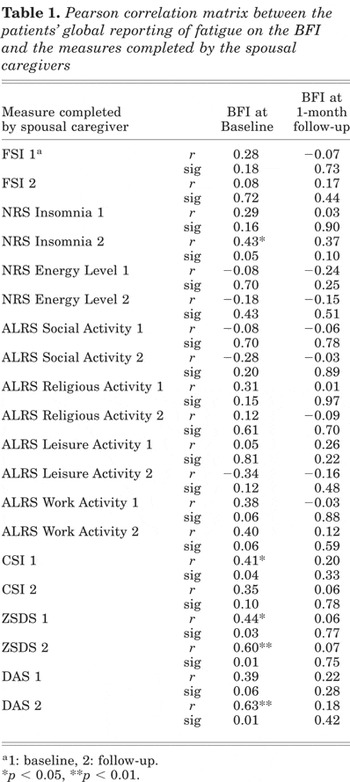
A series of Pearson correlations were conducted between the patient's global rating of fatigue on the BFI and the various indices completed by the spousal caregivers. The resulting correlations are listed in Table 1. As can be seen, the baseline level of fatigue for the patient was correlated to the spousal caregivers' report of depression (ZSDS; r = 0.44, p < 0.05) and caregiver strain (CSI; r = 0.41, p < 0.05) at baseline along with level of insomnia (NRS Insomnia; r = 0.43, p < 0.05) at follow-up. Due to the number of analyses, care should be used and a more stringent level of significance should be applied as per statistical penalties for repeated measures. Given a more stringent standard, the patient BFI at baseline was significantly related to spousal caregiver depression (ZSDS; r = 0.60, p < 0.01) and dyadic adjustment (DAS; r = 0.63, p < 0.01) at the follow-up assessment; the effect on strain should be considered a trend.
Pearson correlation matrix between the patients' global reporting of fatigue on the BFI and the measures completed by the spousal caregivers

The Effects of Patient Fatigue on Spouses
As an exploratory analysis, we were interested in finding out how changes in the patients' fatigue level from baseline to 1-month follow-up impacted the functioning of the spouse. To this end, a series of change scores was conducted between the patients' scores on the BFI, the BFI Interference subscale, and the VAS for fatigue. These results were then collapsed into those who either experienced worsening fatigue or no change versus those who had improvements in their fatigue scores. These results were then correlated to all of the measures completed by the spouses. Although the sample was essentially split on the measures (52% had worsening fatigue on the BFI, 48% had worsening fatigue on the BFI Interference subscale, and 44% had worsening fatigue on the VAS fatigue item), no significant differences were found for any of the variables in the study.
The Effect of Caregiver Strain
Using the cutoff of 7 or greater on the CSI as defined by Robinson (1983), the sample was split, with 60% (n = 15) reporting lower levels of caregiver strain whereas 50% (n = 10) met criteria for higher levels of strain. At the 1-month follow-up, those experiencing high levels of caregiver strain had diminished (n = 6, 26.1%). For purpose of the following analyses, the baseline split was utilized.
A series of one-way ANOVAs was conducted to explore the differences among those with higher and lower degrees of caregiver strain. Those with greater levels of caregiver strain were also more likely to have increased fatigue at baseline (FSI; F [1,23] = 8.11, p < 0.01), and worse dyadic adjustment at both time points (DAS baseline: F [1,23] = 7.80, p < 0.01; follow-up DAS: F [1,21] = 9.24, p < 0.01). In addition, those with more caregiver strain were less likely to engage in social activity at baseline (F [1,23] = 6.11, p < 0.05) and more likely to engage in less work by the 1-month follow-up (F [1,20] = 8.36, p < 0.01).
DISCUSSION
The current study was an initial attempt to explore the effect of cancer patients' fatigue on spousal caregivers. The burden associated with cancer fatigue on spouses has not been studied in this fashion and may have a large impact on the quality of life for the spouse as well as the spousal relationship.
Patients' fatigue can be a component of caregiver strain. In turn, caregiver strain experienced by the spouses of cancer patients plays an important role in their overall well-being and quality of life. This is an important problem that has a sizable potential impact on employment. Nearly a third of the spousal caregiver sample reported that they had reduced their work hours, assumed fewer job responsibilities, and overall felt less effective in their jobs. In addition, acting as a caregiver caused them to miss a significant amount of work, including having to use sick days and vacation days on occasion in order to take care of the patients.
Our results found that a high level of caregiver strain and burden is far from a universal event. Using the cutoff of 7 or more on the CSI as indicative of strain, it is telling that the 40% of spouses thus identified were more likely to be fatigued, have worse dyadic adjustment, poorer energy levels, and to engage in fewer work and social activities as time progresses. The pattern of effect that caregiver strain has on overall dyadic adjustment remained constant whereas its effects on other areas of function was less stable overtime. It may be that increased strain has an unfolding impact that can only be truly uncovered with longer periods of study. Future study may focus on creating better assessments for identifying spouses experiencing high levels of burden and creating pilot interventions to help them cope with this issue.
There were several limitations to the current pilot. First, the sample size was greatly diminished by loss of patients due to death or other factors. Although it would have been preferable to obtain a larger sample with an equal divide between those receiving treatment for chemotherapy-induced fatigue, it was not possible in this exploratory study. Second, the final overall number of couples accrued was smaller than we would have preferred due to the aforementioned drop-out rate. Third, having a 1-month follow-up may have been too short of an interval to truly understand the changing nature of spousal caregiving and how it affects all aspects of the relationship and outside aspects of life such as work and social activity. Finally, the drop-outs in the study were more fatigued due to lower hemoglobin and hematocrit scores and were also exhibiting more signs of depressed mood based on the ZSDS. This creates questions of the sample ultimately completing the trial and whether they are representative of the larger population of fatigued cancer patients and their spousal caregivers.
Future studies attempting to examine spousal caregiver fatigue will have to overcome the major hurdle that the most distressed patients drop out in short order. Despite this drawback, we found that patients' fatigue level at baseline was significantly related to depression, caregiver strain (as a trend), and decreased dyadic adjustment at the follow-up assessment. On the part of the spouse, a patient who starts off more fatigued may create greater stress on the spouse long term, which in turn eventually leads to greater reports of emotional distress, depressed mood, and less satisfaction with the relationship in general. Although this is a difficult area to study, knowing more about a variety of cancer patients' symptoms on spouses will help to better understand the spouse's experience and burden of caregiving.
ACKNOWLEDGMENTS
This research was supported by Ortho Biotech Clinical Affairs, LLC. We acknowledge Sarah Newman, Celia Love, and Stephen Erena for help with data collection and interviews.
References
REFERENCES
Baider, L. &
De-Nour, A.K.
(1988).
Adjustment to cancer: Who is the patient—the husband or the
wife?
Israel Journal of Medical Sciences,
24,
631–636.Google Scholar
Curt, G.A.
(2000a).
The impact of fatigue on patients with cancer: Overview of FATIGUE 1
and 2.
Oncologist,
5(Suppl. 2),
9–12.Google Scholar
Curt, G.A.
(2000b).
Impact of fatigue on quality of life in oncology patients.
Seminars in Hematology,
37(Suppl. 6),
14–17.Google Scholar
Curt, G.A &
Johnston, P.G.
(2003).
Cancer fatigue: The way forward.
Oncologist,
8(Suppl. 1),
27–30.Google Scholar
Dugan, W.,
McDonald, M.V.,
Passik, S.D.,
et al.
(1998).
Use of the Zung Self-rating Depression Scale in cancer patients:
Feasibility as a screening tool.
Psycho-Oncology,
7,
483–493.Google Scholar
Edstrom, S. &
Woehning-Miller, M.
(1981).
Preparing the family to care for the cancer patient at home: Home
care course.
Cancer Nursing,
4,
49–52.Google Scholar
Hahn, D.M.,
Garavoy, N.,
Finklestein, B.,
et al.
(1999).
Measurement of fatigue in cancer patients: Development and
validation of the Fatigue Symptom Inventory.
Quality of Life Research,
7,
301–310.Google Scholar
Knop, D.S.,
Bergman-Evans, B., &
McCabe, B.W.
(1998).
In sickness and in health: An exploration of the perceived quality
of the marital relationship, coping, and depression in caregivers of
spouses with Alzheimer's disease.
Journal Psychosocial Nursing and Mental Health Service,
36,
16–21.Google Scholar
Mailick, M.
(1979).
The impact of severe illness of the individual and family: An
overview.
Social Work Health Care,
5,
117–128.Google Scholar
Mendoza, T.R.,
Wang, X.S.,
Cleeland, C.S.,
et al.
(1999).
The rapid assessment of fatigue severity on cancer patients: Use of
the brief fatigue inventory.
Cancer,
85,
1186–1196.Google Scholar
Northouse, L.
(1984).
The impact of cancer on the family: An overview.
International Journal of Psychiatry Medicine,
14,
215–242.Google Scholar
Oberst, M.T. &
James, R.H.
(1985).
Going home: Patient and spouse adjustment following cancer
surgery.
Topics in Clinical Nursing,
7,
46–57.Google Scholar
Portenoy, R.K. &
Itri, L.M.
(1999).
Cancer-related fatigue: Guidelines for evaluation and
management.
Oncologist,
4,
1–10.Google Scholar
Robinson, B.C.
(1983).
Validation of a caregiver strain index.
Journal of Gerontology,
38,
344–348.Google Scholar
Smith, G.C.,
Smith, M.F., &
Toseland, R.W.
(1991).
Problems identified by family caregivers in counseling.
The Gerontologist,
31,
15–22.Google Scholar
Spanier, G.B.
(1976).
Measuring dyadic adjustment: New scales for assessing the quality of
marriage and similar dyads.
Journal of Marriage and the Family,
38,
15–28.Google Scholar
Vogelzang, N.J.,
Breitbart, W.,
Cella, D.,
et al.
(1997).
Patient, caregiver, and oncologist perceptions of cancer-related
fatigue: Results of a tri-part assessment survey.
Seminars in Hematology,
34(Suppl. 2),
4–12.Google Scholar
Zung, W.W.K.
(1965).
A self-rating depression scale.
Archives of General Psychiatry,
12,
63–70.Google Scholar
Pearson correlation matrix between the patients' global reporting of fatigue on the BFI and the measures completed by the spousal caregivers
 You have
Access
- 25
- Cited by