Implications
Calcium chloride application in meat factory was thought to improve tenderness by increasing endogenous calpain activities. This manuscript was an original research to test whether calcium injection can accelerate tenderization by the caspase system triggering pathway. It provided a new thinking way about the meat conditioning process. Authors think that the studies of changes of caspase activities resulting from calcium injection would very likely trigger intense discussions about apoptosis, which was considered to be a new research model in the conversion of muscle into meat.
Introduction
Tenderness of beef gradually improves during postmortem storage at refrigerated temperatures (Lawrence et al., Reference Lawrence, Dikeman, Hunt, Kastner and Johnson2003). It is the major determinant of meat quality and it can be improved by various physical, chemical and biochemical means. Calcium chloride is added to muscle foods because of its ease of application, safety of use (approved by Food and Drug Administration) and as an additional source of calcium (Jaturasitha et al., Reference Jaturasitha, Thirawong, Leangwunta and Kreuzer2004). It has been suggested to accelerate the tenderization process in the muscles (Morgan et al., Reference Morgan, Miller, Mendez, Hale and Savell1991; Boleman et al., Reference Boleman, Boleman, Bidner, McMillin and Monlezun1995; Kerth et al., Reference Kerth, Miller and Ramsey1995). Perez et al. (Reference Perez, Escalona and Guerrero1998) reported improved tenderness of meat obtained from chicken, horse, cattle and rabbit by calcium chloride injection. The injection of calcium chloride has been thought to improve tenderness by regulating activities of the endogenous proteolytic system (Nurmahmudi and Sams, Reference Nurmahmudi and Sams1997; Polidori et al., Reference Polidori, Trabalza Marinucci, Fantuz, Renieri and Polidori2000). The increase in myofibrillar fragmentation is an indicator of the amount of proteolysis and subsequent tenderization (Huff-Lonergan and Lonergan, Reference Huff-Lonergan and Lonergan2008). Several enzyme systems have been reported to be involved in tenderization of meat; especially the calpain system has been extensively studied as a tool to accelerate postmortem tenderization by calcium ions (Gerelt et al., Reference Gerelt, Rusman, Nishiumi and Suzuki2005). However, the effect of calcium ion injection on certain other proteolytic systems, like caspases, is yet to be explored.
Calcium ion has been indicated to activate caspases by two pathways. First, caspase-9 activity has been indicated to be sensitive to exogenous calcium ion (Menze and Hand, Reference Menze and Hand2007). Second, calcium ion regulates caspases by inducing apoptosis (Tantral et al., Reference Tantral, Malathi, Kohyama, Silane, Berenstein and Jayaraman2004; Chen et al., Reference Chen, Zhang, Kubo, Harris, Mills, Moyer, Berretta, Potts, Marsh and Houser2005). In contrast, some studies indicated that caspases could be inhibited by the cleavage of calcium-dependent protease calpains (Wolf et al., Reference Wolf, Goldstein, Stennicke, Beere, Amarante-Mendes, Salvesen and Green1999; Chua et al., Reference Chua, Guo and Li2000). Furthermore, the application of calcium ion has been reported to accelerate the depletion of ATP in postmortem muscle, whereas the availability of intracellular ATP is a prerequisite for the activation of caspases (Eguchi et al., Reference Eguchi, Shimizu and Tsujimoto1997; Delivoria-Papadopoulos et al., Reference Delivoria-Papadopoulos, Gorn, Ashraf and Mishra2007).
The caspase system has been shown to be involved in postmortem proteolysis and meat tenderization (Herrera-Mendez et al., Reference Herrera-Mendez, Becila, Boudjellal and Ouali2006; Cao et al., Reference Cao, Sun, Zhou, Xu, Peng and Hu2010). However, the effect of added calcium chloride on caspase activities in muscle during postmortem conditioning needs further research. In this study, calcium chloride was injected into longissimus (LM) muscle taken from crossed bulls and was expected to accelerate the myofibrillar degradation by increasing caspase-regulated proteolytic activities, resulting in decreased shear force values depicting increased tenderization of beef muscle during postmortem conditioning.
Material and methods
Experimental design and sample processing
A total of 18 crossbred bulls (Simmental × local Chinese yellow cattle in Anhui province) of 22 to 24 months old having live weights of 450 ± 50 kg were procured from a local processing plant. Animals under study were handled humanely and slaughtered according to the requirements of National Standards of P.R. China ‘Operating Procedures of Cattle Slaughter’. Animals were randomly divided into two equal groups. One group was treated with calcium chloride, whereas the other was taken as control. After 30 min of animal exsanguinations, LM muscles on the right side of the carcasses were taken from 5th to 11th thoracic vertebrae, exposed to air and stored at 4°C. LM muscles in the treatment group were then injected with a pre-chilled 300 mM calcium chloride solution at 10% (v/w) volumes of the meat weight at postmortem second hour, whereas the control group was not injected. Sampling was done by taking 10 g meat samples from each muscle, minced, wrapped in aluminum foil, frozen and stored in liquid nitrogen. These were used for determination of caspase activities and Myofibrillar Fragmentation Index (MFI) analysis at 4 h and at days 1, 2, 4 and 7 during storage.
Shear force measurement
Warner–Bratzler Shear force (WBSF) measurement was done in raw meat as described by Torrescano et al. (Reference Torrescano, Sanchez-Escalante, Gimenez, Roncales and Beltrán2003) after slight modification. Sample strips of (100 mm × 10 mm × 10 mm) from muscles stored at 4°C were taken. The fiber direction of the strips was parallel to the longitudinal axis. The peak force values were determined by placing the strips perpendicular to the longitudinal axis of the muscle fibers under Warner–Bratzler shear blade on XL1155 equipment (Xielikeji Co. Ltd, Herbin, China). The average peak force values of nine strips from each sample were considered as shear force values.
MFI values
MFI values were determined in liquid nitrogen frozen samples as described by Hopkins et al. (Reference Hopkins, Martin and Gilmour2004). Five hundred milligrams of the frozen muscles taken from liquid nitrogen were homogenized in 30 ml pre-chilled buffer. After homogenization, the myofibril suspensions were filtered, washed with 10 ml cold buffer and filtered again. The pellets of myofibrils were re-suspended into 10 ml buffer and centrifuged. This process was repeated thrice. The pellets were finally re-suspended in 10 ml cold buffer. The absorbance values of the diluted protein suspensions were measured immediately at 540 nm with a UV-2450 spectrophotometer (Shimadzu Corporation, Kyoto, Japan). The mean of the triplicate absorbance readings was multiplied by 150 to give index values for MFI values.
Measurement of the activities of caspase-9, -8 and -3
Caspase activities were determined as described by Du et al. (Reference Du, Wang, Miereles, Bailey, Debigare, Zheng, Price and Mitch2004). Two hundred milligrams of frozen samples were taken from liquid nitrogen, pulverized and homogenized on ice in 0.5 ml lysis buffer comprising 100 mM 4-(2-hydroxyethyl)-1-piperazineethanesulfonic acid (HEPES; pH 7.5), 10% sucrose, 0.1% nonyl phenoxypolyethoxylethanol-40, 10 mM dithiothreitol and a commercial protease inhibitor cocktail (Roche Applied Science, Indianapolis, IN, USA). Homogenates were subjected to three cycles of freeze–thaw (freezing was done at −20°C, while thawing at 4°C) before centrifugation at 18 000×g at 4°C for 30 min. Twenty microlitres of supernatant were combined with 0.2 ml of protease assay buffer (10% sucrose, 0.1% 3-[(3-cholamidopropyl) dimethylammonio]-1-propanesulfonate, 100 mM HEPES pH 7.5); and then added 5 μl each reconstituted N-acetyl-Leu-Glu-His-Asp-7-amino-4-methylcoumarin (Ac-LEHD-AMC; catalog no. P444-0005, Biomol, Pennsylvania, USA), N-acetyl-Ile-Glu-Thr-Asp-7-amino-4-methylcoumarin (Ac-IETD-AMC; catalog no. P432-0005, Biomol, Pennsylvania, USA) and N-acetyl-Asp-Glu-Val-Asp-7-amino-4-methylcoumarin (Ac-DEVD-AMC; component no. 51-66081U, PharMingen, San Diego California, USA) substrates for caspase-9, -8 and -3, respectively. The mixture was incubated at 37°C for 1 h. Fluorescence values were determined by using excitation and emission wavelengths of 360 and 460 nm by a 96-Well Plate Reader (Tecan M200, Männedorf, Switzerland), respectively. Results were calculated as relative intensity of fluorescence per minute per milligram of meat.
Statistical analyses
Statistical analysis was performed by using the General ANOVA procedure of SAS 8.0 to determine the changes in values of WBSF, MFI and caspase-9, -8 and -3 activities within postmortem conditioning in both control and treated samples, whereas two samples t-test for means procedure was used to observe the significance of difference between treatment and control groups. The level of significance used to justify a claim of a statistically significant effect was 0.05.
Results
WBSF
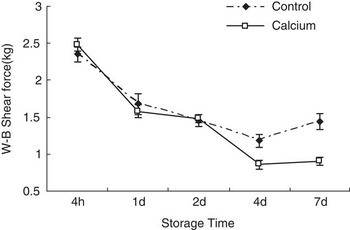
There was a significant decrease of WBSF values in both control and calcium chloride-injected samples (P < 0.001 and P < 0.001, respectively) from 4 h to day 1 and from days 2 to 4 (Figure 1). Maximum tenderness in both the treated and control samples was observed at days 4 and 7. Significant differences were observed between treated and control samples at days 4 and 7 (P < 0.01 and P < 0.001, respectively), which depicted that the injection of calcium chloride at 2 h improved the shear force values at days 4 and 7.
The effect of 300 mM calcium injection at the second hour post mortem on Warner–Bratzler Shear force values during conditioning for 7 days in longissimus muscles of bulls. The bar was defined as s.e.

MFI values
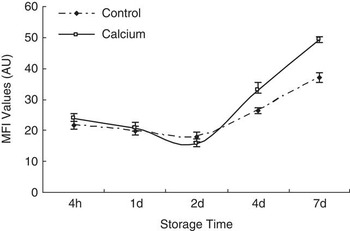
The MFI values slightly decreased from 4 h to day 2, then increased significantly (P < 0.001) on days 4 and 7 of postmortem conditioning (Figure 2) in both the control and treated samples. The calcium chloride treatment yielded significantly higher levels of myofibrillar fragmentation at days 4 and 7 as compared with those of control (P < 0.05 and P < 0.01, respectively).
The effect of 300 mM calcium injection at the second hour post mortem on Myofibrillar Fragmentation Index values during conditioning for 7 days in longissimus muscles of bulls. The bar was defined as s.e.

Caspases
Caspase-9
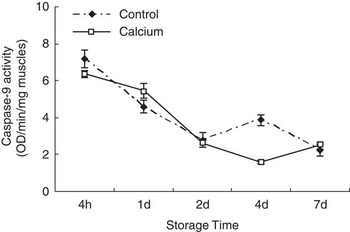
There was a significant decrease in caspase-9 activity from 4 h to day 2 in both control and treated samples (P < 0.001; Figure 3), similar to those reported in postmortem porcine LM muscle by Kemp et al. (Reference Kemp, Bardsley and Parr2006). The caspase-9 activity varied significantly among the treated and control samples at 4 h and day 4 (P < 0.01).
The effect of 300 mM calcium injection at the second hour post mortem on caspase-9 activities during conditioning for 7 days in longissimus muscles of bulls. The bar was defined as s.e.

Caspase-8
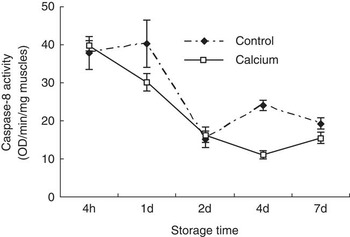
Figure 4 shows that a significant decrease in caspase-8 activity occurred from days 1 to 2 in the control samples (P < 0.001), whereas there was an obvious decline of caspase-8 activities observed from the 4 h to day 2 in the treated samples (P < 0.001; Figure 4). The calcium chloride treatment decreased caspase-8 activities on postmortem days 1 and 4 (P < 0.05 and P < 0.01, respectively).
The effect of 300 mM calcium injection at the second hour post mortem on caspase-8 activities during conditioning for 7 days in longissimus muscles of bulls. The bar was defined as s.e.

Caspase-3
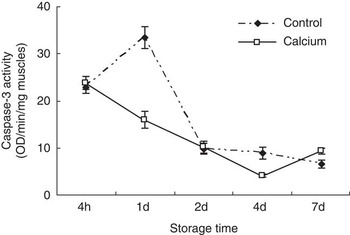
The caspase-3 activity significantly increased from 4 h to day 1, whereas subsequently decreased from days 1 to 2 in control (P < 0.001; Figure 5). Similarly, Kemp et al. (Reference Kemp, Bardsley and Parr2006) reported that there was a general decrease in caspase-3/7 activity over storage with the highest activity at 2 h in pork. In addition, Underwood et al. (Reference Underwood, Means and Du2008) indicated that caspase-3 activity decreased at days 3 and 10 post mortem when compared with 0 day in beef. Like caspase-8 activity, the caspase-3 activity in the treated samples significantly decreased from 4 h to day 4 (P < 0.001), with a significant decrease at days 1 and 4 (P < 0.001 and P < 0.01, respectively) with respect to control samples (Figure 5).
The effect of 300 mM calcium injection at the second hour post mortem on caspase-3 activities during conditioning for 7 days in longissimus muscles of bulls. The bar was defined as s.e.

Discussion
WBSF
The reduction in WBSF values at day 1 showed that LM muscle after 1 day storage went through rigor phase and its toughest period. The data is consistent with the findings of Gonzalez et al. (Reference Gonzalez, Salitto, Carduza, Pazos and Lasta2001) and Rees et al. (Reference Rees, Trout and Warner2002). The injection of calcium chloride at rigor decreased the shear force values at days 4 and 7, depicting the effectiveness of conditioning and calcium ion injection together as compared with conditioning alone in improving tenderness of LM. The results are in accordance with Morgan et al. (Reference Morgan, Miller, Mendez, Hale and Savell1991), Lawrence et al. (Reference Lawrence, Dikeman, Hunt, Kastner and Johnson2003) and Jaturasitha et al. (Reference Jaturasitha, Thirawong, Leangwunta and Kreuzer2004) who injected 300 mM calcium chloride into pre-rigor bovine muscle resulting in significant improvement of meat tenderness.
MFI
The increase of MFI values on days 4 and 7 indicated arising myofibrillar proteolysis during the conditioning period. Our results showed that calcium chloride treatment produced higher levels of myofibril fragmentation during 4 and 7 days conditioning period than the levels achieved by the conditioning process alone. It means that the combination of conditioning and calcium ion injection is more effective in increasing action of endogenous proteolytic enzymes in m. longissimus dorsi than conditioning alone. Beekman et al. (Reference Beekman, Lonergan, Parrish, Robson and Mitsuhashi1994) had similar findings for treated and control samples aged for 3 and 9 days in beef. The increase of myofibrillar proteolysis on days 4 and 7 resulting from calcium ion was responsible for the lower shear force values in treated samples, as many researchers have shown the correlation between MFI values and tenderness (Culler et al., Reference Culler, Parrish, Smith and Cross1978; Parrish et al., Reference Parrish, Vandell and Culler1979).
Caspases
The decrease of caspase-9 activity in porcine LM muscle and that of caspase-3 in porcine LM muscle and bovine m. longissimus thoracis muscle were reported during postmortem conditioning (Kemp et al., Reference Kemp, Bardsley and Parr2006; Underwood et al., Reference Underwood, Means and Du2008). During postmortem ischemia, intracellular ATP is rapidly degraded as a result of insufficient oxygen supply and rapid consumption of glycogen (Shen et al., Reference Shen, Means, Underwood, Thompson, Zhu Mei, McCormick, Ford, Ellis and Du2006); whereas the availability of intracellular ATP is necessary for the activation of caspases. Liu et al. (Reference Liu, Martino, Thangaraju, Sharma, Halwani, Shen, Patel and Srikant2000) indicated that the depletion of ATP prevented the activation of caspase-9 and partially inhibited its ability to activate the terminal caspases and induce apoptosis. Delivoria-Papadopoulos et al. (Reference Delivoria-Papadopoulos, Gorn, Ashraf and Mishra2007) demonstrated that active caspase-9 density increased by 30%, 45% and 60% in the presence of ATP, cytochrome-c and ATP + cytochrome-c, respectively, in the hypoxic condition. Several reports have shown that ATP-dependent steps exist both upstream and downstream of caspase-3 activation in apoptotic signal transduction (Eguchi et al., Reference Eguchi, Shimizu and Tsujimoto1997). Ferrari et al. (Reference Ferrari, Stepczynska, Los, Wesselborg and Schulze-Osthoff1998) reported that ATP was required for caspase-8 and -3 activation during anticancer drug-induced apoptosis. It is therefore plausible to suggest that the postmortem degradation in ATP was associated with the decrease of caspase activities. In addition, the application of calcium ion has been suggested to result in more rapid ATP depletion in postmortem chicken pectoralis major muscle (Young and Lyon, Reference Young and Lyon1997) and porcine semimembranosus muscle (Miller et al., Reference Miller, George, Azain and Reagan1991). In this study, the reduced caspase-9 activity at 4 h and day 4, and those of caspase-8 and -3 at days 1 and 4 with respect to control were attributed to accelerated ATP depletion resulted from calcium treatment.
Lower caspase activities resulted from calcium chloride are also expected to occur through the cleavage of postmortem activated calpains. The autolytic activation of the calpains resulting from calcium chloride injection has been shown in meat science (Pringle et al., Reference Pringle, Harrelson, West, Williams and Johnson1999). Wolf et al. (Reference Wolf, Goldstein, Stennicke, Beere, Amarante-Mendes, Salvesen and Green1999) reported that purified porcine μ-calpain cleaved recombinant procaspase-9 and procaspase-3 to produce novel fragments, but without enzymatic activities. Chua et al. (Reference Chua, Guo and Li2000) indicated that m-calpain cleaved procaspase-9 and decreased its activity. They suggested that calpains may act as negative regulators of caspase processing and apoptosis by effectively inactivating upstream caspases. It was concluded that improved shear force and enhanced myofibrillar proteolysis resulted from calcium ion in bovine muscle could not be associated with caspase activities.
Conclusion
The injection of 300 mM calcium chloride significantly improved the maximum tenderness, reduced caspase activities and increased myofibrillar proteolysis during postmortem conditioning. Therefore, the caspase system is most likely not involved in postmortem tenderizing activated by calcium injection.
Acknowledgement
We are greatful to W. Huang for her input and help in the analysis of the caspases activities data.