Ever since de Tocqueville's critical assessment of democracy in America, scholars have debated whether democracies are disadvantaged at foreign policy. In recent times, this debate has focused on whether democracies make more or less reliable allies. There are those who, like de Tocqueville, claim that frequent leadership turnover and the accountability of leaders to capricious voters put democratic alliance commitments at risk.Footnote 1 Others argue that core features of democratic politics, such as the need of leaders to cooperate with other domestic actors and the tendency to follow the rule of law, make democratic states more rather than less reliable allies.Footnote 2
While these two positions appear contradictory at first glance, it is probably fair to say that both are valid. Frequent leadership transitions and the need to appeal to different constituencies pose challenges to alliance cooperation. At the same time, democratic leaders have tools at their disposal to address this concern. They can opt for different types of security cooperation depending on how they assess the risk for course reversal by their successors. In particular, democratic leaders can choose to conclude defense pacts that commit the state, including any future governments, to close military cooperation with an ally, including assistance in case of an attack. Alternatively, they can opt for looser consultation pacts that explicitly formulate an intent to act jointly but allow for discretion as to how military cooperation takes place and whether the state will intervene militarily to defend its ally.
While the distinction between defense and consultation pacts is well understood, the alliance literature does not provide a good understanding of when states will choose one type of agreement over the other. International relation (IR) scholars focus mostly on examining the effects of alliances, while alliance formation, and especially the choice of alliance commitment, has received less attention. Indeed, the choice between defense and consultation pacts poses an interesting puzzle. In his 1997 article, Fearon suggests that partial or half-hearted alliance commitments will not be as successful at deterring opponents and thus should not be used very often.Footnote 3 Yet, he notes that these types of commitments are chosen quite frequently. Even democracies, whose reliability is considered inherently doubtful by some, often conclude consultation pacts, which are by definition vague and partial agreements, rather than whole-hearted defense pacts. Why?
This research note argues that part of the answer to this puzzle lies in domestic political considerations. Democratic leaders sometimes find it necessary to bind successor governments through firm defense pacts, while other times there is less concern regarding the continued support of the ally and looser consultation pacts suffice. In particular, one should observe attempts to bind successor governments through defense pacts if a government expects that eventual successors have different preferences regarding the alliance relationship and would not support the ally sufficiently if the alliance were merely a consultation pact. Similarly, a government should be more likely to opt for a defense pact if it expects to lose power soon and is thus unable to guarantee continued military support. At the same time, incentives to bind successors are tempered by the costs of doing so. In institutional settings in which precommitment of successor governments is difficult and costly, for example because alliance agreements require legislative approval, one should be less likely to observe precommitment through defense pacts.
These expectations are tested using data on democratic signatories of bilateral defense and consultations pacts in the post–World War II era. The empirical results are generally supportive of the theoretical argument. Domestic precommitment considerations alongside considerations regarding the state's threat environment help explain the choice of defense versus consultation pact.
The research note contributes not only to the alliance literature but to IR scholarship more generally by further elucidating one of the core mechanisms that democratic leaders use to guarantee the long-term stability of their policies. Precommitment has been studied in the context of the adoption of invasive human rights regimes and membership in the International Criminal Court.Footnote 4 This study shows that similar considerations are also at work in the realm of military cooperation. While democracies do face inherent difficulties with policy consistency, they can make use of commitment design to increase the reliability of their military alliances.
Democracy, Alliance Reliability, and PrecommitmentFootnote 5
Some scholars have expressed skepticism regarding the ability of democracies to lead consistent foreign policies and uphold their international commitments, including their alliance commitments.Footnote 6 These skeptics point to regular elections and leaders' need to appeal to their particular constituencies as reasons for democratic unreliability. As Gartzke and Gleditsch point out, the democratic leader who concludes an alliance is often not the same as the leader who is called upon to act on the alliance; and because the latter might represent different preferences than the former, the latter might choose not to honor the alliance.Footnote 7
It is certainly true that due to periodic elections, vote of confidence procedures, and restrictions on tenure terms, democratic leaders generally have shorter terms than autocrats and experience more frequent leadership turnover.Footnote 8 It is also the case that these leadership changes can bring to power new leaders who are accountable to different constituencies with different alliance preferences. As Lobell and Narizny show, different societal groups tend to have divergent views regarding the desirability of alliances generally and the value of particular alliance partners.Footnote 9 Thus, if elections bring to office new leaders who represent different societal interests than their predecessors, this can put existing alliance commitments at risk.
Yet, most empirical evidence suggests that democracies are not particularly unreliable and, in fact, are more reliable than their autocratic counterparts. For instance, Gaubatz shows that jointly democratic alliances last longer, Leeds and Savun demonstrate that democracies are less likely to abrogate their alliances unlawfully, and Leeds and colleagues show that democracies tend to stick to their alliance commitments even when they experience leadership changes that bring to power new leaders with different sources of societal support.Footnote 10 These studies explain their positive findings on democratic reliability by pointing to stringent decision-making procedures and respect for the rule of law. In democracies, leaders have to cooperate with other political actors such as coalition members, legislators, and subnational leaders in order to make policies. The greater number of veto players whose consent is needed to modify the status quo encourages continuity in foreign policy, including the maintenance of alliance commitments. Furthermore, democratic politics tends to be characterized by a pronounced regard for the rule of law. In a survey-based experiment, Tomz shows that voters care about international law and disapprove of actions by their governments that breach international commitments. He also finds that democratic policymakers believe that international commitments constrain state behavior.Footnote 11
Democratic leaders who want to ensure that certain policies remain in place in the long run can make use of these features of democratic politics to precommit future leaders. The notion that democratic governments attempt to bind successor administrations to achieve greater continuity in their domestic and foreign policies is well established. For example, Lipson and Abbott and Snidal argue that one reason states choose legally binding obligations is to precommit other domestic agencies like legislatures and future executives whose policy preferences might be in conflict with the current administration's.Footnote 12 Work by Moravcsik and Simmons and Danner also provides illustrations of the self-binding mechanism in the context of human rights regimes.Footnote 13
The finding that democracies appear to be rather reliable allies suggests that the ability to precommit successor governments, at least to some extent, also exists in the realm of military cooperation. In fact, the desire to ensure that successors maintain close military cooperation with an ally can help explain which sorts of alliance commitments democratic leaders choose and in particular when they would opt for a defense pact versus a consultation pact.
Some clarification on defense and consultation pacts is in order. Consultations pacts are sometimes referred to as ententes but are really a subtype of ententes. Ententes may exist as “general understandings” between states, while consultation pacts are written formal agreements. Understood in this way, consultation pacts are not “broad, sweeping statements that pledge eternal friendship” or vague promises to discuss international issues.Footnote 14 They are a type of military alliance that is quite similar to defense pacts in a number of ways. Like defense pacts, consultation pacts are directed at coordinating behavior specifically in military crises and aim at formulating a joint response to the threat. They obligate the signatories to more than discussing military plans or informing allies about what a state intends to do. Rather they “commit the states to attempt to develop a coordinated response.”Footnote 15 In fact, findings by Siverson and Starr show that members of consultation pacts behave similarly to defensive allies in that they not only are prone to intervene on behalf of their allies but they tend to do so relatively quickly.Footnote 16 An example is the 1912 British-French consultation pact that formalized their existing Entente Cordiale and precipitated Britain's entry into World War I only two days after France's.
While in many regards consultation and defense pacts are similar, they also differ in an important way, namely in the extent to which they commit signatories to military cooperation. Defense pacts provide for tighter military cooperation in two ways. First, they tend to be more heavily institutionalized, often creating military organizations and establishing bases.Footnote 17 Second, they explicitly obligate states to intervene militarily to protect their ally.Footnote 18 An example is the 1948 defense pact between Britain and Jordan that provided for extensive military cooperation in peace time and stated very clearly that “Should either High Contracting Party … become engaged in war, the other High Contracting Party will … immediately come to his aid.”Footnote 19
Consultation pacts, on the other hand, do not institutionalize military cooperation to the extent that defense pacts do. Furthermore, while consultation pacts open up the possibility of military intervention on behalf of the ally, they ultimately leave the decision of whether to intervene in the hands of the government in power at the time. Consultation pacts thus provide governments with more discretion as to how to organize their alliance relationship in peacetime and whether to intervene militarily in wartime.
While the distinction between defense and consultation pacts is well understood, alliance scholars have not systematically examined under which conditions signatories choose one alliance type over the other.Footnote 20 The decision to adopt consultation pacts, in particular, is not well understood. As Fearon points out, effective deterrence of enemies requires an explicit, whole-hearted commitment. If confronted with a partial or ambiguous promise, an aggressor might question the determination of the opponent's ally to intervene. Based on this, Fearon concludes that partial or ambiguous commitments should rarely be used. Yet, he notes that states sometimes conclude half-hearted commitments. Given that they allow for significant discretion regarding the decision to intervene, consultation pacts can be considered a prototype of a half-hearted commitment. While they may be able to deter aggressors, since they help coordinate the actions of the allies and ultimately do raise the specter of possible military intervention, their deterrent effect should be significantly lower than that of defense pacts, which make clear that military assistance will be forthcoming. This raises the questions of why states, especially democratic states that, given frequent leadership turnover, have to be concerned about long-term reliability and credibility, sometimes form defense pacts but other times opt for consultation pacts. I attempt to provide an answer by tying the choice of alliance commitment to domestic political considerations regarding the precommitment of future administrations.
Precommitment and the Choice of Alliance Type
In her discussion of when U.S. presidents choose executive agreements versus treaties, Martin questions traditional arguments that suggest presidents opt for executive agreements when they want to evade congressional opposition.Footnote 21 She points out that this view ignores the international strategic aspect of agreement negotiation. Potential partners will be reluctant to cooperate if they perceive the execution of the agreement to be at risk because of domestic opposition. Thus, it is precisely when there are concerns about the commitment's reliability that presidents will opt for formal treaties over executive agreements.
This logic should apply not only to the choice of agreement form but also to the decision on how binding the commitment will be. In the case of alliances, one should expect that leaders choose defense pacts if they believe that a tighter and more binding type of military commitment is necessary to guarantee long-term support of the ally and to provide a determined signal to potential aggressors. If the current leader, the ally, and potential aggressors have no reason to doubt that the state will continue to cooperate closely on military matters and act determinedly to defend the ally, a looser consultation pact may suffice.
One reason governments may be concerned about long-term cooperation with the ally is that they think they might not be in office much longer. If the government expects that it will soon be replaced, a defense pact becomes a useful tool to ensure that the new administration will be bound to support the ally. If, on the other hand, the government expects that it will remain in power, it may opt for a consultation pact. For a government in the driver's seat, the flexibility of a consultation pact is a plus rather than a liability. The government can organize its security relationship with the ally as it wants to but at the same time ensure that cooperation is close and that joint action is taken to repel aggressors.
Another factor that should affect the government's choice of alliance commitment is whether it expects future administrations to share its preferences regarding the ally. If future leaders have similar preferences, there is no need for precommitment. They will likely maintain close ties with the ally even without a formal defense agreement. On the other hand, if future leaders have different preferences, precommitment becomes desirable. Such successor administrations are unlikely to carry on close military cooperation in peacetime and support the ally in warfare unless the obligation to do so is formalized in a binding defense pact that cannot easily be violated without incurring reputation costs.
Concern about divergent preferences of potential successors was one of the motivating factors in West Germany's decision to join the Western European Union (WEU) and the North Atlantic Treaty Organization (NATO) defense pacts in 1955. Chancellor Konrad Adenauer and his Christian Democratic Union (CDU) party believed that Westbindung would ensure security, allow the newly formed state to attain international respect as a sovereign country, and increase bargaining power in reunification negotiations with the USSR.Footnote 22 Leaders of the main opposition party, the Social Democratic Party (SPD), vigorously fought firm military ties with the United States and Western Europe, mainly because they believed that this would actually endanger reunification. While Adenauer undoubtedly confronted strong international pressures to align with the West, his decision to join the WEU and NATO was also motivated by concerns about potential successors. “I do not know what my successors will do once they are left to their own devices, unless they are set on a clearly defined path and tethered to Europe.”Footnote 23
Adenauer anticipated that membership in the WEU and NATO would ensure that even when there was to be a change in leadership, Germany would remain firmly tied into the West.Footnote 24 In fact, once the Paris Agreements were ratified, SPD leaders immediately stated that the agreements had been passed via regular democratic procedures, were thus legally binding, and any future SPD government would abide by them.Footnote 25 The recognition of the agreements occurred even before the SPD significantly revised its platform in 1959. Since then various SPD leaders have affirmed WEU and NATO membership. For instance, in 1960, SPD chief Wehner declared that the SPD “pledged to support the spirit, as well as the letter, of West Germany's existing international commitments.”Footnote 26 While Wehner's speech acknowledged obvious geostrategic reasons for why West Germany would need to remain in the WEU and NATO, his speech as well as other comments by SPD leaders repeatedly emphasized the notion of pacta sunt servanda.Footnote 27 This supports theoretical expectations that respect for the rule of law, including international law, plays an important role in the ability to precommit future governments in democracies.
Huber and Shipan also highlight the idea that divergent preferences between domestic actors motivate attempts at precommitment.Footnote 28 Their explanation for the variation in statute length suggests that one is more likely to observe precise and detailed statutes when there is political conflict between the actors that write the statute and those that implement it, in this case the bureaucracy. Huber and Shipan also note, however, that the ability to bind the bureaucracy depends on the political constraints politicians face, in particular the existence of veto players. Similar constraints also play a role in governments' attempts to precommit future administrations to close military cooperation with another country.
In some states, ratification of international agreements is the prerogative of the executive branch of the government and precommitment is thus relatively easy. Other countries require that the legislature approve international agreements. Even under these conditions precommitment may be feasible. As noted earlier, Adenauer passed the Paris Treaties despite SPD opposition. Yet, on average, legislative approval requirements are likely to make precommitment through defense pacts more costly and difficult. Precisely because they bind future administrations and entail higher sovereignty costs and because they require very costly action if invoked, it should be harder to convince legislators to approve a defense pact rather than a consultation pact. Mobilizing support for a defense pact will require more extensive lobbying and side payments to legislators than getting them to agree to a more vague commitment such as a consultation pact. Convincing legislators associated with the government's own party may already be difficult, but sometimes the approval of opposition representatives is necessary. Since these representatives may constitute the very politicians that are likely to lead future governments, and may be opposed to a strong and binding alliance, the costs of precommitment can be high—sometimes prohibitively so.
In fact, the costs of concluding any military alliance, whether a defense or consultation pact, may be so high they make the state prefer not to conclude any formal agreement at all. A government might also choose not to conclude a formal alliance when the relationship to the other state is very strong. If virtually all segments of society agree on the importance of supporting the other state, there is no need for a formal alliance. Under either of these circumstances, informal alignments rather than formal alliances are likely to emerge. The choice of “no alliance” is certainly a third option.
Unfortunately, empirically it is exceedingly difficult to deal with no alliance cases.Footnote 29 For this reason, I focus only on the choice of defense versus consultation pact; the dependent variable is thus truncated. This, of course, raises concerns regarding possible bias. It seems that the truncation of the dependent variable might lead to an underestimation of the precommitment argument because more extreme cases—where either the desire to precommit is minimal/nonexistent or the costs of precommitment are excessive—are missing. The inclusion of these more extreme cases would paint a clearer picture of how diverse levels of benefits and costs of precommitment affect alliance choice. At the same time, however, excluding no alliance cases should not bias the results for consultation versus defense pacts.Footnote 30 It is true that these are cases where the desire to precommit was sufficiently high and/or the costs sufficiently low for one to observe a formal alliance, but, within this sample, the predictions regarding precommitment work just like they would if no alliance cases were included. The greater the perceived need of precommitment, the more likely one should observe a defense pact, while greater costs should increase the likelihood of a consultation pact.
H1: The greater the preference divergence between the government and possible future administrations, the more likely the government will attempt to precommit its successors through a defense pact.
H2: The shorter the government's time horizon in office, the more likely it will attempt to precommit its successors through a defense pact.
H3: The more costly precommitment, the less likely the government will opt for a defense pact.
Research Design
To test these hypotheses I rely on the Alliance Treaty Obligations and Provisions (ATOP) member-level data between 1945 and 2003.Footnote 31 While precommitment considerations may influence a country's choice of multilateral alliance commitments (as evidenced by the West Germany example), the empirical analysis focuses on bilateral alliances. Assessment of the precommitment argument is more straightforward in the context of bilateral alliances, where each state has greater control over the alliance format, than in multilateral alliances, where there are many members with different concerns and preferences and bargaining processes are thus more complicated.
Using the sample of bilateral alliance members, I first drop alliance members that did not have consultation or defense obligations.Footnote 32 Second, I eliminate alliance members with Polity IV democracy scores below 6.Footnote 33 The unit of analysis is thus the democratic bilateral alliance signatory with defense or consultation obligations. The dependent variable is a dummy variable that is coded 0 if the alliance provides for consultation in the event of a crisis and 1 if it includes a defense obligation.Footnote 34 There are 161 observations, with 130 consultation pacts and 31 defense pacts.
The best way to assess H1 would be using a measure of the government's and potential future government's preferences for a particular alliance partner. Unfortunately, there does not appear to be a good measure of the extent to which particular domestic groups or leaders prefer close alliance ties with particular states. So instead I focus on preference divergence regarding military issues more generally because such divergence is likely to be associated with divergent preferences regarding particular alliances and allies.
The source of this information is the Comparative Manifesto Project (CMP) that codes party positions on military issues based on party programs in twenty-five Organization for Economic Cooperation and Development (OECD) countries between 1945 and 2003, twenty-four Central and Eastern European countries between 1990 and 2003, and a few other countries at various points in time.Footnote 35 Party positions are coded based on the percentage of positive and negative statements regarding the issues. A CMP variable (per104) codes the percentage of positive statements such as the need to increase military spending, modernize the armed forces, or the need to keep military treaty obligations. Another CMP variable (per105) codes the percentage of negative statements on these issues such as the need to cut military spending. A party's overall position on military issues can be obtained by subtracting per105 from per104.
Before I can take advantage of the CMP data, I need to identify which party constitutes the government at the time of alliance formation and which party can be designated a likely future government party. For presidential or mixed systems, in which the president controls foreign policy, I code the position of the president's party as the government's position. For parliamentary systems, I code the position of the prime minister's (PM) party. Even when the PM's party is not the largest coalition party, the PM tends to dominate foreign policy. I code the position of the opposition party with the most votes as the position of the potential successor government.Footnote 36 This is the party most likely to gain a majority in a future election.
I then calculate the absolute distance between the government's and opposition's overall military positions. I use absolute distance rather than government position minus opposition position because a greater percentage of positive statements on military issues by the government relative to the opposition does not necessarily mean that the government has a more favorable view of alliances. Note that the CMP variables code not only preferences for or against alliance obligations but also preferences regarding military expenditure, conscription, and armament. This means that positive scores on military issues may be the result of a preference for increasing military spending, for example, rather than a preference for military cooperation with an ally. In fact, a party that is opposed to military alliances and advocates self-sufficiency by increasing military spending may have more positive scores than a party that favors alliances. Given the ambiguity in the CMP measures, it is more appropriate to look at the absolute distance in positions. If the government and opposition have different preferences regarding the central military issues that the country faces at the time, irrespective of whether these revolve around alliance obligations, armament, or conscription, they should also have different preferences regarding alliance ties. Divergent preferences on military issues covered by the CMP data are likely to correlate with divergent preferences on alliances and alliance partners. The measure ranges from a minimum of 0 to a maximum of 12.1, with a mean of 2.12 and a standard deviation of 2.55.Footnote 37
H2 suggests that the government's expectations regarding how long it will remain in office should also matter. The literature on government termination points to a variety of factors that affect government duration.Footnote 38 Some of these factors, such as the number of coalition partners and their ideological cohesion, apply to only a subset of democracies. Furthermore, not all of the factors that affect government duration are known to the government at the time the alliance is signed. For example, while shocks and scandals shorten a party's tenure, these developments may not take place until later and thus should not affect the choice of alliance commitment. One factor that is certain to be known to the government at the time of alliance formation, and that has a significant effect on government duration across different types of democratic regimes, is the majority status of the governing party. The more dominant the government party in the last election, that is, the greater the gap between its votes and its closest contender's votes, the more likely it is to retain power. Based on these considerations, I use the difference in percentage of votes between the government and its closest competitor as a proxy for the government's expectations regarding its tenure. This measure is admittedly crude. Unfortunately, to my knowledge, there is no more refined measure that uses only information available to the government at the time and that can be applied consistently across different countries, government types, and years.
For parliamentary systems, I use the CMP data to calculate the vote difference between the PM's party and the non-PM party with the most votes in the last parliamentary election (lower house). Note that due to minority governments and because the PM's party can be a junior coalition partner, this vote difference may be negative. For systems in which the president controls foreign policy, I use the vote difference between the president and the closest contender in the last presidential election.Footnote 39 While the president's tenure may be limited constitutionally even if he or she receives a significant share of votes, a large vote share for the president makes it more likely that a successor from the same party will do well relative to candidates from other parties in a future election and will be able to continue the president's policies. The variable takes on a minimum value of −16.56 and a maximum of 65.48, with a mean of 14.02 and a standard deviation of 16.75.
Cost and feasibility considerations should also matter. Precommitment through defense pacts is easier in systems where governments can single-handedly conclude international agreements than in systems that require legislative approval. Based on data on constitutional requirements for agreement ratification collected by Hathaway, I create a dummy variable that is coded 0 if the government has full authority to ratify international agreements, and 1 if legislative involvement may be called for.Footnote 40 In fifteen observations the government had full control over the conclusion of international agreements and in 146 cases domestic rules either require legislative approval of all agreements or specify that agreements sometimes require approval.Footnote 41
I include two control variables that get at international strategic considerations. First, a government may conclude a defense pact not only to bind its successors but also to ensure that its ally feels bound to close military cooperation. This consideration should be prominent if the current leader perceives a significant degree of threat in the state's international environment and wants to ascertain the ally's support. To test this hypothesis, I include a measure of the threat the state faces. Following Leeds and Savun, I sum the capabilities of all countries in the state of interest's (A's) politically relevant environment with whom A does not have friendly relations.Footnote 42 The more powerful these states, the greater the threat A is facing and the more likely A will prefer a defense pact. This measure ranges from 0 to 0.70, with a mean of 0.20 and a standard deviation of 0.18.
Second, the decision to conclude a defense or consultation pact may also be a function of the extent to which the ally (B) is threatened by third parties. On the one hand, if B faces significant threat, this may increase the probability of a defense pact, given that a defense pact should be more successful at deterring enemies. On the other hand, if B faces significant threat, A may worry about an entanglement scenario where a firm defense commitment makes B behave in a reckless way. To avoid being dragged into an unwanted war, A may prefer to conclude a more ambiguous consultation pact. Fearon proposes entanglement fears as a reason for why one might sometimes see partial and ambiguous commitments.Footnote 43 I control for this possibility by also including a measure of B's threat. This measure ranges from 0 to 0.56, with a mean of 0.19 and a standard deviation of 0.12.
Data Analysis
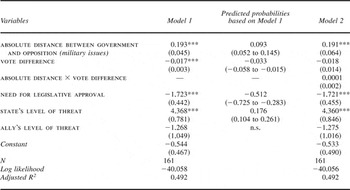
Given the binary dependent variable, the analysis technique is probit. Because of potential nonindependence of observations pertaining to alliances concluded by the same country, I use robust standard errors clustered on the country.Footnote 44 Results are displayed in Table 1, column (1) (Model 1).
Probit analysis of the choice between defense and consultation pacts by democratic members of bilateral alliances

Notes: Estimated coefficients with associated standard errors clustered on the state are presented. Significance tests are two-tailed.
*** p < .01;
** p < .05;
* p < .10.
Table shows the change in the probability of a defense pact associated with a one standard deviation increase in the variable when other variables are held constant at their means or modes. Predicted probabilities and 90 percent confidence intervals (in parentheses) were calculated using Clarify (King, Tomz, and Wittenberg Reference King, Tomz and Wittenberg2000).
n.s. = not significant.
The empirical results are generally supportive of the theoretical expectations. As proposed by H1, democratic governments appear to be more likely to conclude defense pacts, and thus try to precommit future administrations, if the government's preferences on military issues diverge from those of the strongest opposition party. The absolute difference between the government's and opposition's positions on military issues is a statistically significant predictor of alliance choice. The greater the preference divergence on fundamental matters of defense policy, and the more likely they are to disagree on particular alliances and allies as a result of this general disagreement, the more likely a defense pact is put in place. A one standard deviation increase in preference divergence from its mean increases the probability of a defense pact by 9 percent. This statistic is somewhat misleading as some countries experience much greater shifts over time. For example, France (a not atypical case) went from a value of 8.57 on the preference divergence measure in 1947 to a value of 0.37 in 1956. The corresponding drop in probability of defense pact is 37 percent; and indeed France concluded a defense pact in 1947 but not in 1956.
As suggested by H2, governments whose hold on power is tenuous are more likely to try to lock in potential successors through the conclusion of defense pacts. Vote difference is statistically significant and negative, indicating that greater vote differences are associated with a decreased likelihood of a defense pact. The greater the vote difference, the more likely the government will be able to hold on to power at least in the short run, and the less of a need for a firm defense pact. Note, however, that the substantive effect of this variable is quite small: a one standard deviation increase in vote difference decreases the probability of a defense pact by merely 3 percent. The small effect may be due to the limitations of this measure: vote difference is only one of the factors that inform government expectations about tenure. Alternatively, it may be the case that governments do not base their decisions regarding precommitment on only their expectations about whether turnover is likely in the near future but also worry about the possibility that their policies may be overturned in the longer run.
As stipulated by H3, the existence of hurdles for precommitment, in the form of legislative approval requirements for international agreements, make precommitment through defense pacts less likely. When legislative approval is required, the probability of a defense pact decreases by 51 percent. Under these conditions precommitment is often too costly to be feasible.
The empirical results also suggest that the government considers its international environment when choosing alliance commitments. Countries that face greater international threat, because they either have more or more powerful potential adversaries, are significantly more likely to conclude defense pacts. A one standard deviation increase in threat level leads to an 18 percent increase in the probability of a defense pact. This suggests that defense pacts are chosen to accomplish both precommitment of the leader's successors and precommitment of the ally. In fact, it appears that these goals are often pursued in tandem. When the threat level is very high (90th percentile), a one standard deviation increase in preference divergence leads to a 19 percent increase in the probability of a defense pact. When the threat level is low (10th percentile), the corresponding increase is only 3 percent. Domestic political considerations regarding the precommitment of successors do not lose their significance when threat levels are high. Instead, they seem to matter particularly at high threat levels. When the stakes are high, the government may be particularly inclined to precommit successors who do not agree with it as to the best way to protect the country.Footnote 45
The results do not indicate that the ally's threat level affects the choice of alliance type. The variable is not statistically significant at conventional levels. This suggests that leaders neither take concerns about entanglement into account, nor are they inclined to help the ally deter potential adversaries by sending a strong signal through a defense pact.
Model 1 includes preference divergence on military issues and the government's expectations about its time horizon in office as separate variables. I expect that a government facing an opposition with different preferences might want to choose a defense pact to ensure the state's continued cooperation with the ally independently of how long it expects to stay in power. Even if a government does not expect to lose office anytime soon, it may still be concerned about whether governments years down the road will continue to support the ally.Footnote 46 Yet, it is possible that the effect of preference divergence on the choice of alliance commitment is conditioned by the government's expectations regarding tenure. A government may be most likely to opt for a defense pact to bind its successors when there is both significant preference divergence and it expects not to be in power much longer. To test for this possibility, I add an interaction between these two variables. The results are displayed in Table 1, column (3) (Model 2).
In nonlinear models the coefficients and standard errors on interaction terms are difficult to interpret.Footnote 47 The best way to assess the marginal effect of preference divergence at different levels of vote difference is through graphical representation.Footnote 48
The solid line in Figure 1 represents the marginal effect of a one standard deviation increase in preference divergence on the probability of a defense pact at different levels of the conditioning variable, vote difference.Footnote 49 The dashed lines demarcate a 90 percent confidence interval. Figure 1 confirms the findings from the noninteractive model. Preference divergence on military issues has a statistically significant positive effect on the probability of a defense pact at all levels of the conditioning variable. This lends support to the idea that even if the government party has a significant majority and is unlikely to lose office any time soon, it prefers to bind likely successors whose preferences diverge. Yet, the positive effect of preference divergence decreases slightly as vote difference increases, suggesting that governments who confront potential successors with divergent preferences are more likely to choose a defense pact when they also expect that they may not be in office much longer.
Marginal effect of preference divergence as vote difference changes

Finally, I conduct two additional robustness checks. First, I use an alternative operationalization of the preference divergence concept. Research by Narizny shows that right-leaning governments tend to favor organizing the country's security through military alliances, which avoids raising taxes on the wealthy, while leftist governments prefer to increase military spending because this allows them to institute progressive tax reforms.Footnote 50 This suggests that a right-wing government may worry that if a left opposition party is not bound by a firm defense alliance it will minimize cooperation with the ally once it comes to power and instead increase the country's own defenses. Thus, one may observe precommitment through a defense pact if the government is further to the right than the opposition. Using the CMP variable on the left-right positioning of parties, I create a measure that subtracts the opposition's position on the left-right scale from the government's. Note that here the choice of a directional measure is warranted given the finding that right-wing governments prefer alliances compared to left-wingers.Footnote 51 The results regarding the precommitment variables are robust using this alternative measure. Interestingly, the measure capturing the ally's (B's) threat level is negative and statistically significant at the .1 level, indicating some support for the notion that entanglement concerns may also motivate states to choose more flexible consultation pacts over firm defense pacts.
Second, I test the hypotheses on a sample that contains both democratic members of bilateral alliances and of multilateral ones. The results are again robust.Footnote 52
Conclusion
Given frequent leadership turnover and the need of leaders to appeal to voters, democracies should face difficulties in maintaining their alliance commitments. Yet, the empirical evidence predominantly shows that democracies make reliable allies. This research note draws attention to the choice of alliance commitment as an important tool that democratic leaders use to increase reliability. Leaders who worry about the prospects for long-term military cooperation with an ally can choose a firm defense pact to precommit potential successors to continue to work closely with the ally and provide support in case of conflict. If there is no reason to worry about the relationship with the ally, either because potential successors agree on the value of continued military cooperation or because the leader expects to remain in power, or if precommitment through a defense pact is too costly, leaders will opt for more flexible consultation pacts.
The empirical results lend support to the argument that the choice of defense versus consultation pact is in part the result of government incentives to precommit successor administrations. At the same time, the results also suggest that defense pacts are formed not only as a way to bind oneself but to bind the ally. When the level of threat facing the country is high, it is more likely that the alliance agreement will take the form of a defense pact. However, the level of threat confronting the ally does not appear to exert a consistent effect on commitment choice.
The choice of alliance commitment is an understudied area of alliance politics and this research note presents a first cut at the question of why states sometimes conclude defense pacts and other times consultation pacts. The choice between these two alliance types is particularly interesting in the light of Fearon's puzzle. Why would states ever conclude half-hearted commitments rather than whole-hearted ones? Sometimes whole-hearted commitments are simply not necessary or not feasible. When it is clear to the leader, the ally, and potential adversaries, that the state supports the ally and will continue to do so in the future, a firm defense pact is not necessary. Other times the conclusion of a defense alliance may not be feasible domestically. Domestic political considerations play an important role in the choice of alliance type and can help explain why one sometimes observe weak commitments rather than strong ones, despite the fact that weak commitments lack the advantages of signaling and coordination that firm alliances possess.
Future research should continue exploring the paradox of weak alliance commitments. In particular, the inconsistent findings regarding the effect of the ally's threat level on the choice of defense versus consultation pact suggest the possibility that under some circumstances entanglement concerns may also play a role in the choice of alliance commitment. An investigation of this question might benefit from expanding the sample of cases to include autocracies alongside democracies. This would also help uncover whether precommitment incentives like the ones I have examined here motivate autocratic alliance choices. Recent research has pointed to similarities between democracies and some types of autocracies and these similarities may also be reflected in a common propensity to try to bind future leaders.
An additional avenue for future research is whether domestic precommitment considerations play a role in other aspects of alliance design such as the length of alliance contracts, the creation of formal military organizations, or the establishment of bases. The study of precommitment incentives and the mechanisms employed by leaders to bind their successors is valuable because it provides a better understanding of how democracies are able to pursue consistent foreign policies and make reliable international partners despite frequent leadership turnover. It is important to move beyond unconditional claims that democracies are more or less reliable to studying the mechanisms that democracies use in their quest for reliability. This research note provides important insights into this question but more research on precommitment in the realm of military alliances and other areas of international cooperation is certainly called for.