1. Introduction
Accretionary orogens form at plate convergent margins, above the subducted oceanic lithosphere (Cawood et al. Reference Cawood, Kröner, Collins, Kusky, Mooney and Windley2009). They involve a combination of contractional deformation and extension, different types of magmatism, metamorphism under variable P/T conditions, accretionary prism, development of sedimentary basins (back-arc and fore-arc basins) and, eventually, accretion of continental or oceanic terranes. Periods of protracted accretionary orogenic activity along the plate margin are punctuated by periods of relative quiescence. Discrete orogenic belts form parallel to the active margin, generally being younger towards the ocean.
The oldest rocks so far found in the Sierras Pampeanas formed during the Grenvillian orogeny (1.0–1.3 Ga; Fig. 1a) and outcrop in the westernmost ranges close to the present Andean orogenic front (McDonough et al. Reference McDonough, Ramos, Isachsen, Bowring and Vujovich1993; Porcher et al. Reference Porcher, Fernandes, Vujovich and Chernicoff2004; Casquet et al. Reference Casquet, Rapela, Pankhurst, Fanning, Baldo, González-Casado, Galindo and Dahlquist2006; Rapela et al. Reference Rapela, Pankhurst, Casquet, Baldo, Galindo, Fanning and Dahlquist2010). These rocks remained accreted to the SW Gondwana margin in the early Cambrian, after Rodinia break-up and the consequent opening of the Iapetus Ocean. The final amalgamation of SW Gondwana occurred at 545–520 Ma through the collisional Pampean orogeny, one of the youngest Neoproterozoic – Early Cambrian Brasiliano – Panafrican orogenies (e.g. Rapela et al. Reference Rapela, Pankhurst, Casquet, Baldo, Saavedra, Galindo, Fanning, Pankhurst and Rapela1998; Siegesmund et al. Reference Siegesmund, Steenken, Martino, Wemmer, López de Luchi, Frei, Presnyakov and Guereschi2010; Casquet et al. Reference Casquet, Rapela, Pankhurst, Baldo, Galindo, Fanning, Dahlquist and Saavedra2012, Tohver et al. Reference Tohver, Cawood, Rossello and Jourdan2012).
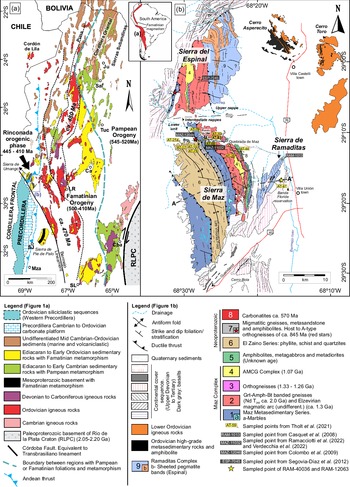
Regional and local geological maps. (a) Sierras Pampeanas and Northwestern Argentina (after Rapela et al. Reference Rapela, Pankhurst, Casquet, Dahlquist, Fanning, Baldo, Galindo, Alasino, Ramacciotti, Verdecchia, Murra and Basei2018). Town localities: Jujuy (Ju), Salta (Sal), Tucumán (Tuc), Catamarca (Ca), La Rioja (LR), San Juan (SJ), Córdoba (Cba), Mendoza (Mza), San Luis (SL). (b) Sierras of Espinal, Maz, Ramaditas, Cerro Asperecito and Cerro Toro (modified from Alasino et al. Reference Alasino, Casquet, Pankhurst, Rapela, Dahlquist, Galindo, Larrovere, Recio, Paterson, Colombo and Baldo2016; Ramacciotti et al. Reference Ramacciotti, Casquet, Baldo, Pankhurst, Verdecchia, Fanning and Murra2022). AMCG: anorthosite–mangerite–charnockite–granite suite. Samples referred to in the text: in grey are from Casquet et al. (Reference Casquet, Pankhurst, Rapela, Galindo, Fanning, Chiaradia, Baldo, González-Casado and Dahlquist2008), Colombo et al. (Reference Colombo, Baldo, Casquet, Pankhurst, Galindo, Rapela, Dahlquist and Fanning2009), Segovia-Díaz et al. (Reference Segovia-Díaz, Casquet Martin, Baldo and Galindo2012), Verdecchia et al. (Reference Verdecchia, Ramacciotti, Casquet, Baldo, Murra and Pankhurst2022) and this work. Samples in yellow are from Tholt et al. (Reference Tholt, Mulcahy, McClelland, Roeske, Meira, Webber, Houlihan, Coble and Vervoort2021). Star: location of samples RAM-40036 and RAM-12063.

Subduction initiated soon after the supercontinent amalgamation in the early Cambrian (e.g. Casquet et al. Reference Casquet, Rapela, Pankhurst, Baldo, Galindo, Fanning, Dahlquist and Saavedra2012 and references therein) and has continued up to the present (Pankhurst & Rapela, Reference Pankhurst, Rapela, Pankhurst and Rapela1998; Ramos, Reference Ramos2009). Therefore, this plate margin is the best example of long-lasting subduction processes and related orogenies. During the Palaeozoic, the continuous ∼18 000 km long Terra Australis orogen fringed the southern and western margin of Gondwana from South America to East Australia until c. 300–230 Ma (Cawood, Reference Cawood2005). Continuous subduction at the SW continental margin of Gondwana, firstly of the Iapetus Ocean and later of the proto-Pacific Ocean, was marked by periods of extension and contraction (tectonic switching; Lister & Forster, Reference Lister and Forster2009), mainly resulting from changes in the subducting slab velocity and/or angle (slab roll-back or flat-slab subduction; e.g. Ramos et al. Reference Ramos, Cristallini and Pérez2002; Rapela et al. Reference Rapela, Pankhurst, Casquet, Dahlquist, Fanning, Baldo, Galindo, Alasino, Ramacciotti, Verdecchia, Murra and Basei2018). Other processes, such as the accretion of exotic continental and oceanic terranes, have also been invoked. This is the case of the well-known Precordillera (Cuyania) terrane (e.g. Ramos, Reference Ramos1988, Reference Ramos2004; Astini et al. Reference Astini, Benedetto and Vaccari1995, Thomas & Astini, Reference Thomas and Astini1996) or Chilenia (Willner et al. Reference Willner, Gerdes, Massone, Schmidt, Sudo, Thomson and Vujovich2011).
The Famatinian orogeny occurred along the SW Gondwana margin between the late Cambrian and the early Devonian. The term Famatinian orogeny was coined by Aceñolaza & Toselli (Reference Aceñolaza and Toselli1976) and is retained here because it is rooted in the geological literature (e.g. Astini & Dávila, Reference Astini and Dávila2004; Ramos, Reference Ramos, Folguera, Contreras-Reyes, Heredia, Encinas, Iannelli, Oliveros, Dávila, Collo, Giambiagi, Maksymowicz, Iglesia Llanos, Turienzo, Naipauer, Orts, Litvak, Alvarez and Arrigada2018; Rapela et al. Reference Rapela, Pankhurst, Casquet, Dahlquist, Fanning, Baldo, Galindo, Alasino, Ramacciotti, Verdecchia, Murra and Basei2018; Weinberg et al. Reference Weinberg, Becchio, Farias, Suzaño and Sola2018; Otamendi et al. Reference Otamendi, Cristofolini, Morosini, Armas and Tibaldi2020; Dahlquist et al. Reference Dahlquist, Morales Cámera, Alasino, Pankhurst, Basei, Rapela, Galindo, Moreno and Baldo2021; Alasino et al. Reference Alasino, Paterson, Kirsch and Larrovere2022). However, the timespan of the Famatinian orogeny has been progressively restricted (e.g. Ramos, Reference Ramos, Folguera, Contreras-Reyes, Heredia, Encinas, Iannelli, Oliveros, Dávila, Collo, Giambiagi, Maksymowicz, Iglesia Llanos, Turienzo, Naipauer, Orts, Litvak, Alvarez and Arrigada2018) and the consensus today is that it embraced the late Cambrian and the Ordovician. In fact, an Ordovician orogenic belt is continuous between Venezuela and Argentina (e.g. Ramos, Reference Ramos, Folguera, Contreras-Reyes, Heredia, Encinas, Iannelli, Oliveros, Dávila, Collo, Giambiagi, Maksymowicz, Iglesia Llanos, Turienzo, Naipauer, Orts, Litvak, Alvarez and Arrigada2018). A protracted and continuous orogeny has been advocated (e.g. Weinberg et al. Reference Weinberg, Becchio, Farias, Suzaño and Sola2018), but evidence is growing that it was rather a succession of tectonothermal episodes (e.g. Rapela et al. Reference Rapela, Pankhurst, Casquet, Dahlquist, Fanning, Baldo, Galindo, Alasino, Ramacciotti, Verdecchia, Murra and Basei2018; Casquet et al. Reference Casquet, Ramacciotti, Larrovere, Verdecchia, Murra, Baldo, Pankhurst and Rapela2021 b). Marine basins developed contemporaneously with arc magmatism and crustal deformation, marking the episodic tectonic history in the form of regional unconformities (Moya, Reference Moya2015).
The previously unrecognized Rinconada orogenic phase of mainly Silurian age was proposed as a late tectonic phase of the Famatinian orogeny (Casquet et al. Reference Casquet, Ramacciotti, Larrovere, Verdecchia, Murra, Baldo, Pankhurst and Rapela2021 b). Outcrops of the orogenic belt consisting of metamorphic rocks are well exposed in the westernmost Sierras Pampeanas, and particularly in the Sierra de Ramaditas and the neighbouring sierras of Maz and Espinal (Fig. 1a, b), close to the present Andean orogenic front (Casquet et al. Reference Casquet, Ramacciotti, Larrovere, Verdecchia, Murra, Baldo, Pankhurst and Rapela2021 b). One interest of this belt lies in that it underwent an inverted Barrovian-type intermediate P/T metamorphism (garnet–staurolite–kyanite–sillimanite) that ranged upward from low- to high-grade conditions during nappe stacking and crustal thickening (e.g. Porcher et al. Reference Porcher, Fernandes, Vujovich and Chernicoff2004; Casquet et al. Reference Casquet, Rapela, Pankhurst, Fanning, Baldo, González-Casado, Galindo and Dahlquist2006; Lucassen et al. Reference Lucassen, Becchio and Franz2011; Tholt, Reference Tholt2018; Tholt et al. Reference Tholt, Mulcahy, McClelland, Roeske, Meira, Webber, Houlihan, Coble and Vervoort2021; Ramacciotti et al. Reference Ramacciotti, Casquet, Baldo, Pankhurst, Verdecchia, Fanning and Murra2022; Verdecchia et al. Reference Verdecchia, Ramacciotti, Casquet, Baldo, Murra and Pankhurst2022). Heating was fast and the temperature peaked early at 445 ± 1.9 Ma; Casquet et al. Reference Casquet, Ramacciotti, Larrovere, Verdecchia, Murra, Baldo, Pankhurst and Rapela2021 b). However, no evidence of significant Silurian magmatism exists in the ranges dealt with here. We explore the possible geodynamic scenario in the context of subduction and propose a conceptual model based on geological evidence to explain the inverted Barrovian-type metamorphism. We focus here on the Sierra de Ramaditas and the neighbouring sierras of Maz and Espinal (Fig. 1a, b). We have obtained accurate P/T estimates from phase equilibrium modelling of two significant rocks from Sierra de Ramaditas. This, together with other evidence (regional mapping, structures) and data already published by our research group (Casquet et al. Reference Casquet, Rapela, Pankhurst, Fanning, Baldo, González-Casado, Galindo and Dahlquist2006, Reference Casquet, Pankhurst, Rapela, Galindo, Fanning, Chiaradia, Baldo, González-Casado and Dahlquist2008; Colombo et al. Reference Colombo, Baldo, Casquet, Pankhurst, Galindo, Rapela, Dahlquist and Fanning2009; Segovia-Díaz et al. Reference Segovia-Díaz, Casquet Martin, Baldo and Galindo2012; Ramacciotti et al. Reference Ramacciotti, Casquet, Baldo, Pankhurst, Verdecchia, Fanning and Murra2022; Verdecchia et al. Reference Verdecchia, Ramacciotti, Casquet, Baldo, Murra and Pankhurst2022) and other authors (Tholt et al. Reference Tholt, Mulcahy, McClelland, Roeske, Meira, Webber, Houlihan, Coble and Vervoort2021), leads us to argue for a ‘hot iron’ type mechanism, i.e. heating from the top down. In this paper we explore the possible sources of heat and load.
2. Geological setting
In Western and NW Argentina respectively (Fig. 1a), the Sierras Pampeanas and the nearby Puna (which reaches a height of ∼4000 m) constitute uplifted crystalline basement of the Andean foreland, resulting from reverse faulting during the Neogene Andean orogeny (see Ramos et al. Reference Ramos, Cristallini and Pérez2002).
The Sierra de Ramaditas is one of the westernmost ranges of the Sierras Pampeanas (Fig. 1a, b) and consists of a large outcrop of metamorphic basement and a few small ones that are isolated from each other by Quaternary alluvial sediments (Fig. 1b). The basement is unconformably overlain by a late Devonian to Triassic cover of mainly continental sedimentary rocks (Fauqué et al. Reference Fauqué, Limarino, Vujovich, Fernandes, Cegarra and Ecosteguy2004 and references therein). The Sierra de Ramaditas is separated from the neighbouring sierras of Maz and Espinal by brittle faults and a strip of folded sedimentary cover rocks (Fig. 1b). In the latter ranges, three main lithotectonic domains separated by ductile shear zones and showing inverted metamorphism of Silurian age were firstly recognized by Casquet et al. (Reference Casquet, Pankhurst, Rapela, Galindo, Fanning, Chiaradia, Baldo, González-Casado and Dahlquist2008). Detailed mapping carried out since (Fig. 1b) has made it possible to precisely determine the structural relationships between the three domains and confirms the metamorphic inversion (Ramacciotti et al. Reference Ramacciotti, Casquet, Baldo, Pankhurst, Verdecchia, Fanning and Murra2022; Verdecchia et al. Reference Verdecchia, Ramacciotti, Casquet, Baldo, Murra and Pankhurst2022). The overall structure is well exposed in the Sierra de Maz, which is an antiformally folded thrust stack (nappes; defined according to Dennis et al. Reference Dennis, Price, Sales, Hatcher, Bally, Perry, Laubscher, Williams, Elliott, Norris, Hutron and Emmett1981) of metamorphic rocks. The antiform (named here the Las Víboras fold) is an upright, wide, open fold striking NNW–SSE in the central part of the range (Fig. 1b). The eastern flank of the antiform shows a complete sequence of thrust sheets. We distinguish the structurally lowest unit in the core of the Las Víboras antiform, the intermediate group of nappes, and the upper high-grade nappes that crop out in the eastern Sierra de Espinal and in the Sierra de Ramaditas (Fig. 1b). Metasedimentary rocks of Neoproterozoic to early Palaeozoic age with Nd model ages (T DM) peaking at c. 1.3 Ga occur in both the lower unit and in the upper nappes, respectively named as the Zaino Serie (after Kilmurray & Dalla Salda, Reference Kilmurray and Dalla Salda1971) and Ramaditas Complex (after Tholt et al. Reference Tholt, Mulcahy, McClelland, Roeske, Meira, Webber, Houlihan, Coble and Vervoort2021). The intermediate nappes record a complex Mesoproterozoic history of sedimentation, magmatism, metamorphism and deformation (Grenvillian orogeny s.l.). This complex was called the Maz Group by Kilmurray and Dalla Salda (Reference Kilmurray and Dalla Salda1971), the Maz Complex by Porcher et al. (Reference Porcher, Fernandes, Vujovich and Chernicoff2004) and the Maz suspect terrane by Casquet et al. (Reference Casquet, Pankhurst, Rapela, Galindo, Fanning, Chiaradia, Baldo, González-Casado and Dahlquist2008). Hereafter we call it the Maz Complex. The Maz Complex consists of at least two nappes. The lower one is formed by the mainly medium-grade Maz Metasedimentary Series, with Nd model ages (TDM) of c. 2.0 Ga. The series comprises garnet ± staurolite ± kyanite/sillimanite schists, white quartzites, calc-silicate rocks and marbles. Amphibolites, metagabbros, metadiorites, transposed felsic dykes, rare anthophyllite–garnet gneisses, and granitic orthogneisses are also found within the Maz Complex (e.g. Porcher et al. Reference Porcher, Fernandes, Vujovich and Chernicoff2004; Casquet et al. Reference Casquet, Rapela, Pankhurst, Fanning, Baldo, González-Casado, Galindo and Dahlquist2006, Reference Casquet, Pankhurst, Rapela, Galindo, Fanning, Chiaradia, Baldo, González-Casado and Dahlquist2008; Colombo et al. Reference Colombo, Baldo, Casquet, Pankhurst, Galindo, Rapela, Dahlquist and Fanning2009; Segovia-Díaz et al. Reference Segovia-Díaz, Casquet Martin, Baldo and Galindo2012; Tholt et al. Reference Tholt, Mulcahy, McClelland, Roeske, Meira, Webber, Houlihan, Coble and Vervoort2021; Ramacciotti et al. Reference Ramacciotti, Casquet, Baldo, Pankhurst, Verdecchia, Fanning and Murra2022; Verdecchia et al. Reference Verdecchia, Ramacciotti, Casquet, Baldo, Murra and Pankhurst2022). The upper nappe of the Maz Complex includes banded garnet–amphibole–biotite gneisses and a metamorphosed juvenile Andean-type magmatic arc of 1.26–1.33 Ga ranging from gabbro to granite, and an AMCG (anorthosite–mangerite–charnockite–granite) complex of c. 1.07 Ga (Porcher et al. Reference Porcher, Fernandes, Vujovich and Chernicoff2004; Casquet et al. Reference Casquet, Rapela, Pankhurst, Galindo, Dahlquist, Baldo, Saavedra, Gonzalez Casado and Fanning2005; Rapela et al. Reference Rapela, Pankhurst, Casquet, Baldo, Galindo, Fanning and Dahlquist2010).
Regional metamorphism is inverted ranging from high-grade in the upper nappes (Sierra de Ramaditas and western Sierra de Espinal) to low-grade in the core of the Las Víboras antiform (the Zaino Series). Most structures in outcrop (foliation and folding), as well as the thrusts, resulted mainly from Silurian orogenic reworking synchronous with metamorphism. Moreover, evidence for relict high-grade metamorphism and deformation of Grenvillian age is also recognized (Lucassen & Becchio, Reference Lucassen and Becchio2003; Porcher et al. Reference Porcher, Fernandes, Vujovich and Chernicoff2004; Casquet et al. Reference Casquet, Rapela, Pankhurst, Fanning, Baldo, González-Casado, Galindo and Dahlquist2006, Reference Casquet, Pankhurst, Rapela, Galindo, Fanning, Chiaradia, Baldo, González-Casado and Dahlquist2008; Tholt, Reference Tholt2018; Martin et al. Reference Martin, Collins and Spencer2019; Tholt et al. Reference Tholt, Mulcahy, McClelland, Roeske, Meira, Webber, Houlihan, Coble and Vervoort2021; Verdecchia et al. Reference Verdecchia, Ramacciotti, Casquet, Baldo, Murra and Pankhurst2022).
The Ramaditas Complex consists of metasedimentary migmatitic garnet (±cordierite) – sillimanite gneisses, meta-psammites, marbles, calc-silicate rocks, amphibolites and ultramafic bodies of meta-peridotite (Porcher et al. Reference Porcher, Fernandes, Vujovich and Chernicoff2004; Vujovich et al. Reference Vujovich, Porcher, Chernicofff, Fernández, Pérez, Dahlquist, Baldo and Alasino2005; Tholt et al. Reference Tholt, Mulcahy, McClelland, Roeske, Meira, Webber, Houlihan, Coble and Vervoort2021). This lithological association was first described by Kilmurray and Dalla Salda (Reference Kilmurray and Dalla Salda1971) who coined the name El Taco Series and presented a very schematic geological map. The metamorphism of the Ramaditas Complex was precisely dated at 442 ± 3 Ma by sensitive high-resolution microprobe (SHRIMP) analysis of zircon overgrowths from a calc-silicate rock (sample RAM-1013; Casquet et al. Reference Casquet, Pankhurst, Rapela, Galindo, Fanning, Chiaradia, Baldo, González-Casado and Dahlquist2008). Recently Webber (Reference Webber2018), Martin et al. (Reference Martin, Collins and Spencer2019) and Tholt et al. (Reference Tholt, Mulcahy, McClelland, Roeske, Meira, Webber, Houlihan, Coble and Vervoort2021) have added new U–Pb and Lu–Hf ages of metamorphism including metamorphism-related leucosomes and pegmatites from the Sierra de Ramaditas and Sierra de Maz. In the Sierra de Ramaditas, these ages range from 418 ± 4 to 455 ± 3 Ma (n = 9), coincident with ages from the Sierra de Maz between 410 ± 10 and 447 ± 3 Ma (n = 12). Two U–Pb titanite ages (thermal ionization mass spectrometry) of 428 ± 6 and 443 ± 3 Ma are also available from the Sierra de Maz (Lucassen & Becchio, Reference Lucassen and Becchio2003). The coincident range of ages strengthens the interpretation that the Ramaditas Complex and the Sierras of Maz and Espinal rocks were involved in the same tectono-metamorphic event between c. 455 and 410 Ma, corresponding to the Rinconada orogenic phase of the Famatinian orogeny (Casquet et al. Reference Casquet, Ramacciotti, Larrovere, Verdecchia, Murra, Baldo, Pankhurst and Rapela2021 b). Exceptions to the above ages are: 461 ± 11 Ma from a Lu–Hf isochron that included garnet cores and the rock matrix, with a MSWD of 3.4, and a weighted mean U–Pb age of 462 ± 4 Ma from monazite included in garnet and from cores of matrix monazite grains (Tholt et al. Reference Tholt, Mulcahy, McClelland, Roeske, Meira, Webber, Houlihan, Coble and Vervoort2021). However, matrix monazite rims from the same sample yielded 426 ± 11 Ma. The Lu–Hf isochron age is of low precision because of the large MSWD. Moreover, monazite inclusions in garnet and cores of monazites in matrix could be detrital. Therefore, the existence of a metamorphic event older than the Rinconada orogenic phase in the Ramaditas Complex cannot be confirmed.
3. Sampling and analytical methods
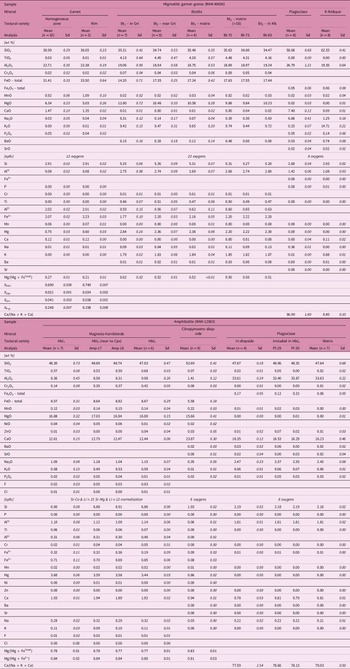
Two samples were chosen for P–T calculations, an amphibolite (RAM-12063; 29° 17′ 01.2″ S, 68° 15′ 48.8″ W) and a migmatitic garnet gneiss (RAM-40036; 29° 16′ 56.9″ S, 68°15′, 43.3″ W). Mineral analyses were carried out in two electron microprobes: a JEOL Superprobe JXA-8900M at the Universidad Complutense de Madrid (Spain) and a JEOL JXA 8230 and FE-SEM Σigma at the LAMARX (Universidad Nacional de Córdoba, Argentina). Averages (plus 1-sigma standard deviation, SD) are given in Table 1 because of essential chemical homogeneity. Full data are shown in Supplementary Table S1 in the Supplementary Material available online at https://doi.org/10.1017/S0016756823000080. The microprobes were operated at 15 kV accelerating potential, with a 10 nA beam current in hydrated minerals (phyllosilicate and amphiboles) and 20 nA in anhydrous minerals (garnet, plagioclase and K-feldspar, pyroxene, olivine, spinel) on carbon-coated polished thin-sections. The beam diameter was between 2 and 10 μm based on the size of the mineral of interest, with counting time of 10 s on the peak, and 5 s at each background position. In order to decrease the diffusion effect, Na2O and K2O were first analysed during 5 s on the peak and 2.5 s on the background. Natural mineral and synthetic compounds were used as internal standards. Amphibole structural formulae were calculated using the spreadsheet proposed by Locock (Reference Locock2014), where mineral classification and estimation of Fe3+ followed Hawthorne et al. (Reference Hawthorne, Oberti, Harlow, Maresch, Martin, Schumacher and Welch2012). Chemical formula and oxygen normalization in pyroxene (6 O), biotite (22 O), garnet (12 O), olivine (4 O), spinel–magnetite (32 O), K-feldspar and plagioclase (8 O) were calculated after Deer et al. (Reference Deer, Howie and Zussman2013) recommendations. Mineral abbreviations are after Whitney & Evans (Reference Whitney and Evans2010).
Summary of chemical analyses of minerals from the Ramaditas Complex

Note: Fe3+ content in amphibole and pyroxene was calculated for stoichiometry. In Cpx, Fe3+ was calculated following the methodology proposed by Droop (Reference Droop1987). Total Fe is expressed as Fe2O3 in plagioclase.
For phase equilibrium modelling, major elements in the amphibolite (RAM-12063) were analysed by inductively coupled plasma (ICP) atomic emission spectroscopy in Activation Laboratories Ltd (ACTLABS, Ontario, Canada), following the 4E-Litho-research routine. The garnet gneiss (RAM-40036) was analysed by conventional X-ray fluorescence spectrometry (Rigaku FX2000 spectrometer, Instituto de Geología y Minería of the Universidad Nacional de Jujuy, Argentina).
4. Results
4.a. Field relations of Ramaditas Complex
Foliation in the gneisses and amphibolites shows a predominant northerly trend (340° to 20°) and a mainly westerly to southwesterly dip (60° to subvertical). A stromatic foliation S1 is seen in the gneisses. Moreover, local tight folds with stromatic foliation are wrapped around by S1. Fold hinges plunge northward (e.g. 335°/28°, 340°/18°). We propose that the folds are mainly intrafolial and do not involve an older foliation event, although this issue deserves further research. Mineral lineation is shown by sillimanite nodules (see below) elongated parallel to the fold hinges. Locally, an older lineation of sillimanite is recognized at an angle to the former. The strike and dips of the main foliation and the fold hinges are more variable around competent ultramafic bodies. The S1 foliation evolves along-strike from zones with well-preserved stromatic banding to zones of higher strain where leucosomes are stretched (pinch-and-swell) and eventually dismembered, giving the rock a mylonitic appearance. Late mylonitic shear zones (Smyl) are also found slightly oblique to S1. These are north-striking (5° to 10°) with steep easterly dips (75° to sub-vertical) and a shallow plunging lineation (Lmyl ∼10°/8°, 30°/10°), with right-lateral kinematics. Late shear zones probably formed at temperatures that were still high during nappe stacking, as suggested by apparently syn-tectonic pegmatite intrusions. Large pegmatite veins discordant to S1 and trending variably from 40° to 90° are common across the range.
Migmatitic gneisses consist of alternating mafic and felsic bands, interpreted as residuum and leucosome domains respectively, that define a stromatic structure. Leucosomes represent a high volume of melt (20 to 30 %) and are of the in situ to in-source type (Sawyer, Reference Sawyer2008). Ultramafic bodies form a cluster in one small outcrop in the northeastern Sierra de Ramaditas. They consist of medium to coarse-grained amphibolitized peridotite. These bodies were folded and dismembered during S1 deformation. The main regional S1 foliation wraps around the ultramafic bodies and partially penetrates them. Locally, a faint primary layering is preserved. Field evidence suggests that ultramafic bodies are dismembered parts of a larger pre-tectonic (pre-S1 foliation) ultramafic body. Amphibolites are abundant in the Sierra de Ramaditas as elongated bodies concordant to the regional foliation. They probably represent former mafic dikes that intruded the ultramafic body and the host metasedimentary rocks. Garnet amphibolites have also been described in northern Sierra de Ramaditas, associated with marble and calc-silicate rocks (Vujovich & Kay, Reference Vujovich and Kay1996); however, they are probably not igneous in origin (para-amphibolites) and will not be dealt with here.
4.b. Petrography and mineral chemistry
4.b.1. Migmatitic garnet gneiss (RAM-40036)
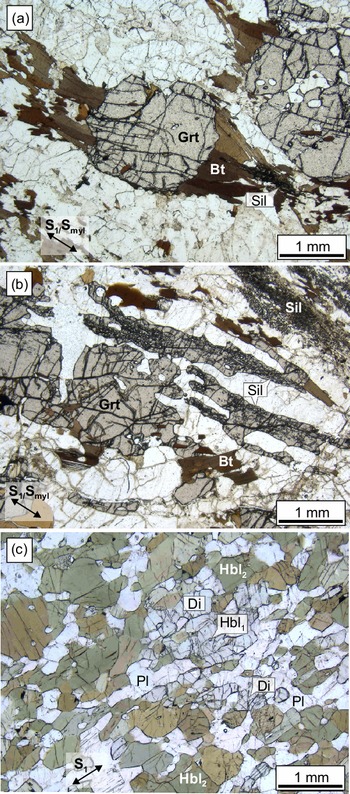
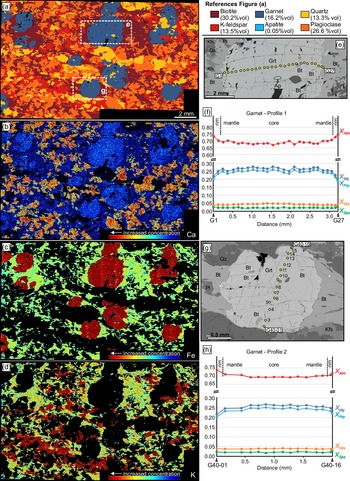
This rock consists mainly of garnet, biotite, plagioclase, K-feldspar and quartz. Sillimanite as prisms and as fibrolite is scarce (Fig. 2a, b). Foliation (S1) is defined by orientated biotite and the alternating bands of quartz–plagioclase–K-feldspar leucosomes and biotite–garnet residuum (Figs 2a and 3a–d). Garnet is subhedral to anhedral up to 5 mm in size and shows scarce inclusions of biotite, quartz and rare sillimanite. However, in other sillimanite-rich gneisses nearby, anhedral garnet crystals preserve trails of sillimanite inclusions parallel to the external foliation (Fig. 2b). In felsic layers, sillimanite inclusion in K-feldspar, quartz and garnet is recognized, in addition to quartz ± K-feldspar ± plagioclase small aggregates (<0.5 mm) with cuspate shapes and thin film shape around grain boundaries of quartz–feldspar aggregates. These textures are compatible with pseudomorphs after melt. From field evidence, the main melting event was coeval with S1 foliation, and leucosomes underwent variable stretching during progressive deformation. A late mid-temperature ductile deformation produced undulose extinction (biotite, quartz), subgrains in quartz, plagioclase and K-feldspar and deformation twins in plagioclase.
Microphotographs of migmatitic gneiss and amphibolite units. (a, b) Migmatitic garnet–gneiss (RAM 40036) with little (a) and abundant (b) sillimanite (in the matrix and included in garnet). (c) Amphibolite (RAM-12063) showing Mg-hornblende and diopside intergrowths. Two textural varieties of hornblende are identified: inside of diopside (Hbl1) and outside, in the matrix (Hbl2).

RAM-40036. X-ray compositional maps of garnet and chemical profiles. X-ray maps were processed with the XMapTools program (Lanari et al. Reference Lanari, Vidal, De Andrade, Dubacq, Lewin, Grosch and Schwartz2014). (a) Computer X-ray composition mask (top) and calculated modal composition (bottom). (b–d) X-ray maps of Ca (b), Fe (c) and K (d). (e, f, g, h) Backscattered electron images (BSE) of two garnet grains with point analysis and profiles of X Alm, X Grs, X Prp, X Sps and X Mg ratios.

Garnet is compositionally homogeneous except for an increase of X Alm and a corresponding decrease of X Prp near the rim (see Fig. 3f–h). The mean composition (except to rim) (n = 32) is: X Alm 0.690 ± 0.008 (hereinafter the mineral composition is given as the mean of several analyses ± 1-sigma standard deviation), X Grs 0.041 ± 0.003, X Sps 0.021 ± 0.001, X Prp 0.248 ± 0.007 (Table 1; Supplementary Table S1). The mean composition of rims (n = 3) is X Alm 0.740 ± 0.007, X Grs 0.038 ± 0.001, X Sps 0.024 ± 0.002 and X Prp 0.198 ± 0.008. Biotite included in garnet (n = 7) has 4.13 ± 0.64 wt % TiO2 and a Mg/(Mg + FeTotal) ratio of 0.62 ± 0.02. Biotite in contact with garnet (n = 9) has 4.45 ± 0.47 wt % TiO2 and a Mg/(Mg + FeTotal) ratio of 0.52 ± 0.01 whereas away from the garnet, biotite (n = 7) has 4.25 ± 0.42 wt % TiO2 and a Mg/(Mg + FeTotal) ratio of 0.51 ± 0.01. Plagioclase and K-feldspar are almost homogeneous. The first is andesine with Ca/(Ca + K + Na) * 100 = 37 ± 2 (n = 8), whereas K-feldspar is orthoclase, with K/(Ca + K + Na) * 100 = 88 ± 2 (n = 8), and contains an average of 0.74 ± 0.08 wt % of BaO.
4.b.2. Amphibolite (RAM-12063)
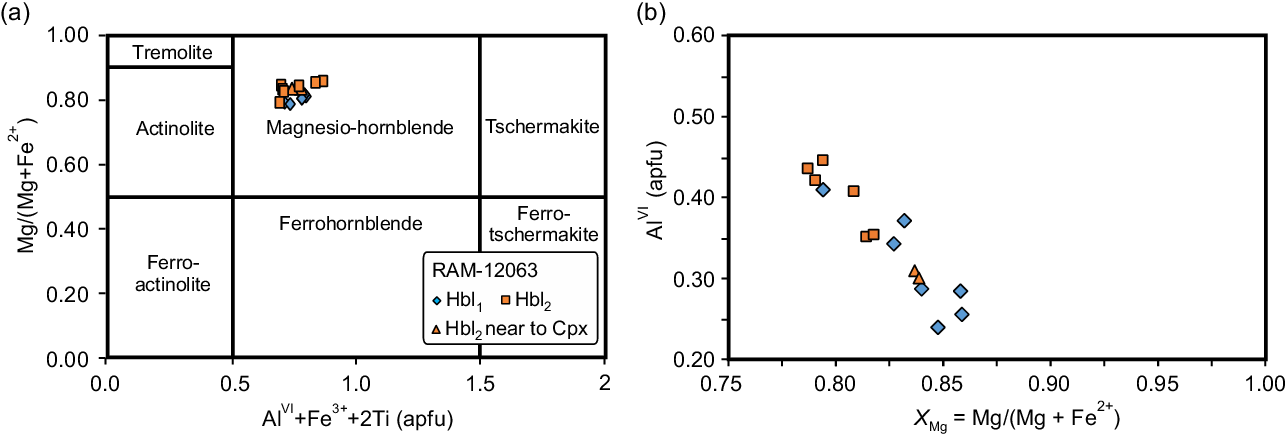
This rock consists of amphibole, clinopyroxene, plagioclase, subordinate quartz and rarely apatite, titanite and sulphides. This is a fine-grained rock (∼0.5–1 mm) with S1 foliation defined by orientated hornblende and pyroxene crystals (Fig. 2c). Greenish hornblende is found as inclusions in diopside (Hbl1) and in the matrix (Hbl2). Both are Mg-hornblende (see Fig. 4a), but the AlIV and Mg/(Mg + Fe2+) values are different from each other (Fig. 4b). The Hbl1 (n = 7; Table 1; Supplementary Table S1) yielded Mg/(Mg + Fe2+) values of 0.84 ± 0.02, Fe3+ (stoichiometrically calculated) = 0.32 ± 0.11 apfu, AlVI = 0.31 ± 0.06 apfu and Na = 0.29 ± 0.02 apfu. The Hbl2 (n = 6) yielded Mg/(Mg + Fe2+) values of 0.80 ± 0.01, Fe3+ = 0.19–0.09 apfu, AlVI = 0.40 ± 0.04 apfu and Na = 0.32 ± 0.02 apfu. Diopside (n = 9; Table 2; Supplementary Table S1) has 0.06 ± 0.01 apfu of AlIV and a Mg/(Mg + FeTotal) ratio of 0.83 ± 0.01 whereas plagioclase (n = 13; Table 2; Supplementary Table S1) has the same composition either as inclusion in diopside and hornblende or in the matrix, with a high anorthite content, Ca/(Ca + Na + K) of 78 ± 1 % (n = 13).
Amphibole composition in amphibolite RAM-12063. (a) Ca-amphibole classification after Hawthorne et al. (Reference Hawthorne, Oberti, Harlow, Maresch, Martin, Schumacher and Welch2012). (b) Relation between X Mg = Mg/(Mg + Fe2+) and AlVI.

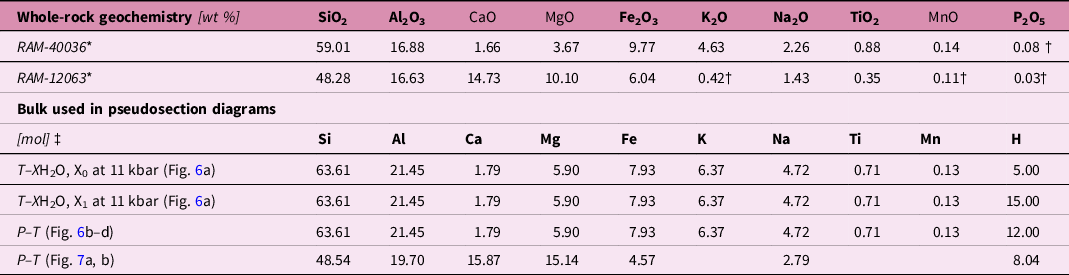
Bulk compositions for phase equilibrium modelling. Bulk compositions are expressed as moles of elements, in the same way that they are entered in the Theriak-Domino

* Loss on ignition (LOI) is 1.02 % in RAM-40036 and 1.14 % in RAM-12063. Fe total is expressed as Fe2O3.
† Elements not considered in the phase equilibria modelling.
‡ Oxygen was set up as O(?) for automatic estimation by Theriak-Domino. In order to avoid inconsistency in the solution models that can include Fe3+, a very low value of O (0.001) has been included for calculation of P–T pseudosection of migmatitic garnet–gneiss RAM-40036.
4.c. Metamorphic P–T conditions from phase equilibria analysis
4.c.1. Migmatitic garnet gneiss (sample RAM-40036)
The phase equilibrium modelling in migmatites is always a challenge when the protolith is not preserved (see Johnson et al. Reference Johnson, Yakymchuk and Brown2021 and references therein). In the Sierra de Ramaditas, these stromatitic migmatites evidence high percentages of leucosomes, of c. 20–30 vol. %. This suggests that the melt was probably mobilized but without clear evidence of melt loss since the rock is not a residuum. The absence of mafic selvage rims suggests equilibrium between melt and residuum. For modelling of the anatexis process, we have selected a rock characterized by homogeneous gneissic banding, avoiding the presence of local melt accumulations or leucocratic veins that overestimate the volume of melt in the selected sample. From this sample, 10 kg have been collected and processed from which the whole-rock major geochemistry was obtained.
The T–XH2O diagram and P–T pseudosections were performed in the MnNCKFMASHT system (MnO–Na2O–CaO–K2O–FeO–MgO–Al2O3–SiO2–H2O–TiO2) using Theriak-Domino software (de Capitani & Brown, Reference de Capitani and Brown1987; de Capitani & Petrakakis, Reference de Capitani and Petrakakis2010). The selected internally consistent thermodynamic datasets of mineral end-member properties are the ds55 from Holland & Powell (Reference Holland and Powell1998, update in 2003). Fe3+ was not considered a significant component, but a very low amount was added to avoid inconsistencies with the solid solution models. Due the absence of activity-composition models with phosphorus, an amount of Ca equivalent to 3.33 mol of P2O5 was subtracted from the whole-rock composition (X-ray fluorescence method; Table 2) to account for the presence of apatite. The activity-composition solid solution models used here were those in the tcdb55c2d.txt file in the Theriak-Domino software package: plagioclase (C1), K-feldspar (Holland & Powell, Reference Holland and Powell2003), ilmenite, spinel, melt (White et al. Reference White, Powell and Holland2007), biotite (Tajčmanová et al. Reference Tajčmanová, Connolly and Cesare2009), garnet (White et al. Reference White, Pomroy and Powell2005), orthopyroxene (White et al. Reference White, Powell and Clarke2002), chloritoid (White et al. Reference White, Powell, Holland and Worley2000), chlorite (Holland et al. Reference Holland, Baker and Powell1998), muscovite–paragonite (Coggon & Holland, Reference Coggon and Holland2002), staurolite and cordierite (Holland & Powell, Reference Holland and Powell1998). Sillimanite, kyanite, andalusite, quartz and H2O were included as pure phases. Bulk compositions for pseudosection calculation are shown in Table 2.
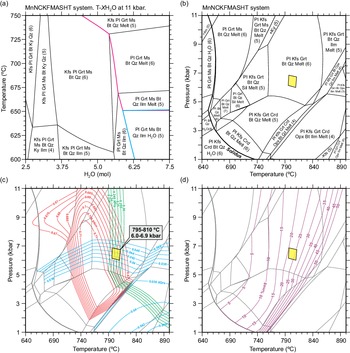
For the calculation of the P–T pseudosection, an H2O content of 6 mol was estimated from the T–XH2O diagram (Fig. 5a), so that the melt is H2O-saturated at 11 kbar immediately above the solidus and minimized the presence of H2O-free only just to the solidus curve along the whole pressure range modelled (cf. Johnson et al. Reference Johnson, Gibson, Brown, Buick and Cartwright2003; White et al. Reference White, Pomroy and Powell2005). The sample chosen has plagioclase, K-feldspar, garnet, biotite, quartz and very little sillimanite (∼0.14 vol. % obtained from compositional X-ray maps) in contrast with other rocks where the latter mineral is more abundant (see Figs 2a, b and 4a). The P–T pseudosection (Fig. 5b) shows that garnet is stable over most of the P–T range, whereas cordierite is stable at lower pressures (<5.5 kbar). A stability field with plagioclase, K-feldspar, garnet, biotite, quartz and melt is predicted at >4.7 kbar and 760–860 °C. In this field, the average composition of garnet (including deviation) is constrained to 6.0–6.9 kbar and 795–810 °C (± 1 kbar and ± 50 °C; general uncertainty after Powell & Holland, Reference Powell and Holland2008) from isopleth contouring of X Grs, X Alm and X Prp (Fig. 5c). These P–T conditions are those of the peak of metamorphism and anatexis. Under these P–T conditions, 20–25 vol. % of melt is predicted (Fig. 5d), which is consistent with field observation.
Pseudosection diagrams calculated in the MnNCKFMASHT system and suprasolidus conditions for migmatitic garnet–gneiss sample (RAM-40036). Utilized bulk compositions are listed in Table 2. (a) T–XH2O diagram at 11 kbar. Pink line is melt-in and light blue line is H2O-in. (b–d) P–T pseudosection diagrams calculated with 6 mol of H2O. (b) P–T diagram showing equilibrium mineral fields. Yellow box signals the P–T condition constrained for mineral assemblage (see (c)). (c) P–T diagram showing the X Grs (light blue lines), X Alm (red lines) and X Prp (green lines) ratio isopleths. The garnet composition allows us to constrain the P–T conditions from isopleth composition convergence at near to 795–810 °C and 6.0–6.9 kbar (yellow box). Uncertainties are ±50 °C and ±1.0 kbar. (d) P–T pseudosection diagram with modal amount isopleth of melt. Here and elsewhere, variance is given by values in brackets in front of each assemblage. See text for details.

4.2.2. Amphibolite (sample RAM-12063)
A P–T pseudosection was performed in the simplified NCFMASH system (Na2O–CaO–FeO–MgO–Al2O3–SiO2–H2O) using Theriak-Domino software and the internally consistent thermodynamic datasets ds55. The Fe3+, Mn and K were not considered as significant components. The activity–composition solid solution models used here were those in the compilation tcds55_p07.txt file from D. Tinkham (website: https://dtinkham.net/peq.html): plagioclase (I1) (Holland & Powell, Reference Holland and Powell2003), garnet, (White et al. Reference White, Powell and Holland2007), spinel, orthopyroxene (White et al. Reference White, Powell and Clarke2002), amphibole, clinopyroxene (Diener et al. Reference Diener, Powell, White and Holland2007; Diener & Powell, Reference Diener and Powell2012; Green et al. Reference Green, Holland and Powell2007), chloritoid (White et al. Reference White, Powell, Holland and Worley2000) and chlorite (Holland et al. Reference Holland, Baker and Powell1998). Kyanite, clinozoisite, albite, quartz and H2O were included as pure phases. The bulk composition for pseudosection calculation in sample RAM-12063 is shown in Table 2. The H2O content was set to 4.02 mol (H = 8.04 mol) using the H2O measured from loss on ignition (Table 2).
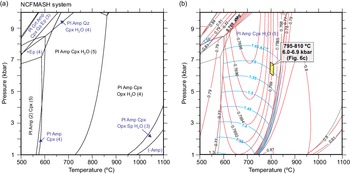
Sample RAM-12063 has plagioclase, amphibole and clinopyroxene (Fig. 2c). The P–T pseudosection (Fig. 6a) shows that amphibole and clinopyroxene are stable over most of the P–T field. Compositional isopleths of AlTotal (apfu) and X Mg = Mg/(Mg + FeTotal) values from amphibole are shown in Figure 6b to constrain the equilibrium P–T values. Compositional values of Hbl2 are: AlTotal = 1.55 ± 0.05 apfu (FeTotal as FeO; range of 1.48–1.60 apfu) and X Mg = 0.767 ± 0.005 (0.761–0.774). This composition is mostly constrained inside the stability field of plagioclase, amphibole, clinopyroxene and H2O, in a widely P–T range of ∼4–7 kbar and ∼600–850 °C. In this equilibrium field, AlTotal isopleths in the range 1.50–1.60 apfu (1.55 ± 0.05 apfu) are projected between ∼5 and ∼8 kbar and 590 and 840 °C, whereas X Mg is mostly homogeneous with values of 0.768–0.770 along all fields (Fig. 6b). However, at the P–T conditions calculated in the migmatite (6.0–6.9 kbar and 795–810 °C; Fig. 5b–d; yellow box in Fig. 6b), the predicted composition of amphibole is ∼1.59–1.62 apfu of AlTotal and ∼0.769 of X Mg. This composition is very near to the measured chemical composition of Hbl2. The small differences in the chemical composition of the predicted and measured amphibole could be associated with the non-inclusion of elements such as Fe3+ and Ti as part of the system used in the calculation of pseudosections. However, the results obtained show that the mineral assemblage of the amphibolite is compatible with the P–T conditions of the metamorphic peak obtained in the migmatite (sample RAM-40036).
Pseudosection diagrams calculated in the NCFMASH system for amphibolite sample (RAM-12063). The bulk composition is listed in Table 2. (a) P–T pseudosection diagram showing equilibrium mineral fields. (b) P–T diagram showing the AlTotal (apfu) (light blue lines) and X Mg ratio (red lines) isopleths. Yellow box signals the P–T condition constrained for mineral assemblage in migmatitic gneiss sample (RAM-40036; see Fig. 7). Uncertainties are ±50 °C and ±1.0 kbar. See text for details.

5. Discussion
5.a. Significance of the Rinconada orogenic phase metamorphism
The P–T conditions of peak metamorphism in the Ramaditas Complex calculated here at 6.0–6.9 ± 1 kbar and 795–810 ± 50 °C are consistent with those of Tholt et al. (Reference Tholt, Mulcahy, McClelland, Roeske, Meira, Webber, Houlihan, Coble and Vervoort2021; sample AT-47; 5.5 ± 1.5 kbar and 850 ± 70 °C). This metamorphic event was dated as mainly Silurian (Casquet et al. Reference Casquet, Pankhurst, Rapela, Galindo, Fanning, Chiaradia, Baldo, González-Casado and Dahlquist2008; Tholt et al. Reference Tholt, Mulcahy, McClelland, Roeske, Meira, Webber, Houlihan, Coble and Vervoort2021) and took place during the Rinconada orogenic phase of the Famatinian Orogeny (Casquet et al. Reference Casquet, Ramacciotti, Larrovere, Verdecchia, Murra, Baldo, Pankhurst and Rapela2021 b). Silurian metamorphism was also identified in the nearby Sierra de Maz (e.g. Lucassen & Becchio, Reference Lucassen and Becchio2003; Casquet et al. Reference Casquet, Rapela, Pankhurst, Galindo, Dahlquist, Baldo, Saavedra, Gonzalez Casado and Fanning2005; Colombo et al. Reference Colombo, Baldo, Casquet, Pankhurst, Galindo, Rapela, Dahlquist and Fanning2009; Tholt et al. Reference Tholt, Mulcahy, McClelland, Roeske, Meira, Webber, Houlihan, Coble and Vervoort2021; Verdecchia et al. Reference Verdecchia, Ramacciotti, Casquet, Baldo, Murra and Pankhurst2022). In the Sierra de Maz, detailed P–T conditions were recently determined on a garnet–staurolite (±kyanite, ±sillimanite) schist from the pre-Grevillian Maz Metasedimentary Series in the Maz Complex (Ramacciotti et al. Reference Ramacciotti, Casquet, Baldo, Pankhurst, Verdecchia, Fanning and Murra2022). This rock underwent a first Grenvillian metamorphism but was almost fully overprinted by a Silurian metamorphism that peaked at ∼625 ± 50 °C and ∼9.0 ± 1 kbar, coeval with foliation development and nappe stacking (Verdecchia et al. Reference Verdecchia, Ramacciotti, Casquet, Baldo, Murra and Pankhurst2022). Moreover, extension along late ductile shear zones (mylonites) in the Maz Metasedimentary Series drove the P–T path down through P–T conditions of ∼6.8 kbar and ∼600 °C (Verdecchia et al. Reference Verdecchia, Ramacciotti, Casquet, Baldo, Murra and Pankhurst2022).
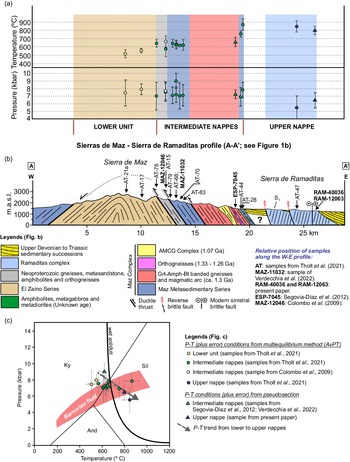
An amount of P–T values for the metamorphic peak in the sierras of Ramaditas, Maz and Espinal is available from different authors (Colombo et al. Reference Colombo, Baldo, Casquet, Pankhurst, Galindo, Rapela, Dahlquist and Fanning2009; Segovia-Díaz et al. Reference Segovia-Díaz, Casquet Martin, Baldo and Galindo2012; Tholt et al. Reference Tholt, Mulcahy, McClelland, Roeske, Meira, Webber, Houlihan, Coble and Vervoort2021; Verdecchia et al. Reference Verdecchia, Ramacciotti, Casquet, Baldo, Murra and Pankhurst2022; this work). These are shown in Figure 7 (Fig. 1b shows the sample locations). However, because of the different methods of calculation the resulting values, although similar, are not the same. These methods are the reverse modelling multiequilibrium AvPT (Powell & Holland, Reference Powell and Holland1994) and the forward modelling phase equilibrium analysis (pseudosections) (Powell & Holland, Reference Powell and Holland2008). An example of this difference is given by sample MAZ-11032, a garnet–staurolite schist from the Maz Metasedimentary Series. The P–T calculation yields 625 ± 50 °C and 9 ± 1 kbar by the forward phase equilibrium analysis (pseudosection) method (Verdecchia et al. Reference Verdecchia, Ramacciotti, Casquet, Baldo, Murra and Pankhurst2022), while sample AT-68 collected nearby by Tholt et al. (Reference Tholt, Mulcahy, McClelland, Roeske, Meira, Webber, Houlihan, Coble and Vervoort2021) yields at 632 ± 45 °C and 7.2 ± 1 kbar. While temperature is similar in both samples, pressure values differ, those of Tholt et al. (Reference Tholt, Mulcahy, McClelland, Roeske, Meira, Webber, Houlihan, Coble and Vervoort2021) being significantly lower although still within error.
Geological west–east profile along Sierra de Maz and Sierra de Ramaditas (b), with indication of relative position of samples from Colombo et al. (Reference Colombo, Baldo, Casquet, Pankhurst, Galindo, Rapela, Dahlquist and Fanning2009), Segovia-Díaz et al. (Reference Segovia-Díaz, Casquet Martin, Baldo and Galindo2012), Tholt et al. (Reference Tholt, Mulcahy, McClelland, Roeske, Meira, Webber, Houlihan, Coble and Vervoort2021), Verdecchia et al. (Reference Verdecchia, Ramacciotti, Casquet, Baldo, Murra and Pankhurst2022) and present work. The projected samples were utilized for thermobarometric constraints related to the metamorphic peak. Colombo et al. (Reference Colombo, Baldo, Casquet, Pankhurst, Galindo, Rapela, Dahlquist and Fanning2009) and Tholt et al. (Reference Tholt, Mulcahy, McClelland, Roeske, Meira, Webber, Houlihan, Coble and Vervoort2021) applied multiequilibrium thermobarometric method, whereas the phase equilibrium method was used by Segovia-Díaz et al. (Reference Segovia-Díaz, Casquet Martin, Baldo and Galindo2012), Verdecchia et al. (Reference Verdecchia, Ramacciotti, Casquet, Baldo, Murra and Pankhurst2022) and in the present work. (a) Temperatures and pressures along W–E profile (b). (c) P–T diagram projecting the results of P–T conditions previously published and from present work. In (a) and (c) the uncertainty is signalled as error bars. Typical Barrovian field is shown in (c).

From results of the two thermobarometric methods, peak P–T values from the Sierra Ramaditas and the Sierra de Maz, when projected on a cross section (T and P vs field distance; Fig. 7a) and on a P–T diagram (Fig. 7c), clearly show that metamorphism is inverted with T decreasing and P increasing downward across the nappe pile (Fig. 7a, c). This was expected from field evidence alone inasmuch as metamorphic rocks change from migmatites in the Ramaditas Complex, through schists in the Maz Metasedimentary Series (Maz Complex) down to phyllites in the lower unit (El Zaino Series). The T range is between ∼800 and 500 °C. The range of P between the Maz Metasedimentary Series and the Ramaditas Complex calculated by the AvPT method ranges from ∼8 to 5.5 kbar, while that obtained from pseudosections is from ∼9 to 6 kbar.
Barrovian-type metamorphism is typical of continent–continent collisional orogens that involved significant crustal thickening by nappe stacking but is also recognized in accretional orogenies (e.g. Casquet et al. Reference Casquet, Hervé, Pankhurst, Baldo, Calderón, Fanning, Rapela and Dahlquist2014; Van der Lelij et al. Reference Van der Lelij, Spikings, Ulianov, Chiaradia and Mora2016; Calderón et al. Reference Calderón, Massonne, Hervé and Theye2017). Metamorphic inversion also seems to be a common feature of Barrovian metamorphism, along with a short duration of few million years (e.g. Dewey, Reference Dewey2005). The first issue posed here is the heat source during the Rinconada orogenic phase, the second is load, as discussed below. The orogeny involved the progressive westward thrusting of the El Zaino Series and the Maz Complex under the Ramaditas sedimentary succession, coeval with development of a penetrative foliation, tight folding and heating (Fig. 8). The Maz Complex and the El Zaino Series would have been located seaward relative to the Ramaditas basin, as implied by kinematic markers that always suggest top-to-the-northwest sense of movement (e.g. Webber, Reference Webber2018). Remarkably, the highest temperatures were attained in the upper nappe (Fig. 7a, c).
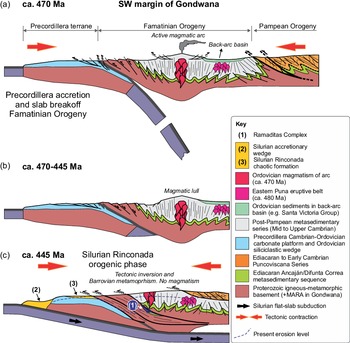
Geodynamic evolution of the SW Gondwana margin across the Precordillera – Sierras Pampeanas section in the middle Ordovician to Silurian. See text for explanation.

The Rinconada orogenic phase metamorphism peaked at 445 ± 1.9 Ma (Casquet et al. Reference Casquet, Ramacciotti, Larrovere, Verdecchia, Murra, Baldo, Pankhurst and Rapela2021 b), probably after the Hirnantian (late Ordovician) worldwide glaciogenic event, and was coeval with westward thrusting. The metamorphic peak in the Ramaditas Complex was attained at 442 ± 3 Ma (Casquet et al. Reference Casquet, Pankhurst, Rapela, Galindo, Fanning, Chiaradia, Baldo, González-Casado and Dahlquist2008) coincident within error with the value above. The temperature peak was followed by slow cooling throughout until c. 410 Ma (Casquet et al. Reference Casquet, Ramacciotti, Larrovere, Verdecchia, Murra, Baldo, Pankhurst and Rapela2021 b). In consequence, nappe stacking and heating were fast processes because of the short time between glaciogenic sedimentation and the peak metamorphism.
5.b. Source of heat and load
On the basis of geological evidence, four main heat sources can be invoked: (1) advective heat from a magmatic arc coeval with the Rinconada orogenic phase; (2) mafic magmatism recorded as amphibolites in the Ramaditas Complex; (3) strong radiogenic heating; (4) a preserved hot root of the 470 Ma magmatic arc thrusted upon the fore-arc at c. 445 Ma.
Magmatism is a source of regional heat, as has been demonstrated for the case of the Cordilleran-type Famatinian arc of 468–472 Ma at the Sierra de Valle Fértil, and the Western Puna Magmatic Belt east of the Sierra de Ramaditas (Alasino et al. Reference Alasino, Casquet, Pankhurst, Rapela, Dahlquist, Galindo, Larrovere, Recio, Paterson, Colombo and Baldo2016; Ducea et al. Reference Ducea, Bergantz, Crowley and Otamendi2017; Rapela et al. Reference Rapela, Pankhurst, Casquet, Dahlquist, Fanning, Baldo, Galindo, Alasino, Ramacciotti, Verdecchia, Murra and Basei2018; Otamendi et al. Reference Otamendi, Cristofolini, Morosini, Armas and Tibaldi2020; Casquet et al. Reference Casquet, Alasino, Galindo, Pankhurst, Dahlquist, Baldo, Ramacciott, Verdecchia, Larrovere, Rapela and Recio2021 a). However, no evidence exists of a magmatic mantle- or lower crust-derived arc of c. 445 Ma across the La Rinconada orogenic belt.
Mafic magmatism (swarm of former dikes or sills), if younger than the Famatinian arc magmatism at c. 470 Ma, could have played a role in heating the crust underlying the Ramaditas metasedimentary complex before thrusting at c. 445 Ma. This is similar to the proposal by Johnson and Strachan (Reference Johnson and Strachan2006) to explain inverted metamorphism in the Caledonian of NW Scotland. However, the age of the diking event is unknown but must be older than the Rinconada orogenic phase metamorphism that converted dikes into amphibolites. On the other hand, chemically similar gabbro bodies and mafic dikes emplaced between 490 and 470 Ma have been recognized in the Sierra de Pie de Palo (Ramacciotti et al. Reference Ramacciotti, Casquet, Baldo, Alasino, Galindo and Dahlquist2020) and the nearby Sierra de Asperecitos (Fig. 1a) (Alasino et al. Reference Alasino, Casquet, Larrovere, Pankhurst, Galindo, Dahlquist, Baldo and Rapela2014, Reference Alasino, Casquet, Pankhurst, Rapela, Dahlquist, Galindo, Larrovere, Recio, Paterson, Colombo and Baldo2016). In consequence, the role of the Ramaditas mafic magmatism remains conjectural.
A third source of heat could be a strong radiogenic source underlying the Ramaditas Complex, such as a high-heat producing plutonic complex. This is similar to the proposal by McLaren et al. (Reference McLaren, Sandiford and Hand1999) to explain the Mount Isa (Australia) high T/P metamorphism. Calculations show that buried high-heat production granitoids of c. 1660 Ma produced heat enough to heat the overlying Isa sedimentary basin to temperatures of ∼600 °C at 3–4 kbar almost 100 Myr later, during the Isan Orogeny at c. 1530 Ma. However, no evidence of high-heat producing granitoids exists in our case. In fact, no significant plutonism existed between c. 470 Ma, i.e. the age of the Famatinian Cordilleran-type magmatic arc, and the Rinconada orogenic phase (c. 445 Ma).
However, the heat sources mentioned above do not explain by themselves the overburden of 6–7 kbar (21–24 km) implied by geobarometry of the upper nappe.
A likely source of load and heat in the absence of a coeval magmatic arc can be found in the older Ordovician Cordilleran-type magmatic arc of 468–472 Ma (Ducea et al. Reference Ducea, Bergantz, Crowley and Otamendi2017), if thrusted upon the Ramaditas Complex when still hot. This process was called the ‘hot iron’ mechanism by Le Fort (Reference Le Fort1975) to explain the inverted intermediate P/T metamorphism in the Himalayas. The magmatic arc is a neighbouring block to the sierras of Maz and Ramaditas, separated by Andean faults (Fig. 1b). No other blocks of basement are recognized in between, which strengthens the hypothesis that the Ordovician magmatic arc played a role during the Rinconada orogenic phase metamorphism.
The ‘hot iron’ mechanism has been modelled by Dewey & Ryan (Reference Dewey and Ryan2016). In this model, a slab with a sole in excess of 945 °C could produce Barrovian metamorphism in only 2–3 Myr in the footwall. The model predicts temperatures between ∼800 °C at 3 km and 500 °C at 20 km in the footwall after ∼5 Myr of thrusting at a rate of c. 30 mm yr−1. This model is conceptually compatible with the inverted relationship between P and T found here and with the time relationships between nappe stacking and the peak of metamorphism. The case here would be a variant of the ‘thrusting of a magmatic arc over a passive margin’, one of the several geodynamic possibilities proposed by Ryan and Dewey (Reference Ryan and Dewey2019). The model requires that temperature be high enough at the root of the palaeo-magmatic arc some 25 Myr after cessation of magmatism. This issue is dealt with below.
5.b.1. The P–T–time evolution of the Ordovician (c. 470 Ma) magmatic arc
The Famatinian Cordilleran-type magmatic arc resulted from a magmatic flare-up with a peak of Ordovician ages between 473 and 468 Ma (Ducea et al. Reference Ducea, Bergantz, Crowley and Otamendi2017; Rapela et al. Reference Rapela, Pankhurst, Casquet, Dahlquist, Fanning, Baldo, Galindo, Alasino, Ramacciotti, Verdecchia, Murra and Basei2018), i.e. late Floian to Dapingian. The deepest part of the arc is exposed at the Sierra de Valle Fértil and its northern prolongation Cerro Toro (Otamendi et al. Reference Otamendi, Ducea, Tibaldi, Bergantz, de la Rosa and Vujovich2009; Tibaldi et al. Reference Tibaldi, Otamendi, Cristofolini, Baliani, Walker and Bergantz2013). Magmatism started with gabbros followed by voluminous tonalite, granodiorite and granite. Gabbros underwent subsolidus granulitization (coronitic metagabbros) previous to the intermediate to felsic magmatism (Castro et al. Reference Castro, Díaz-Alvarado and Fernández2014). Host rocks to the magmatic arc consist of mainly siliciclastic metasedimentary rocks with early Cambrian detrital zircon that were converted to migmatites coeval with magmatism (Castro et al. Reference Castro, Díaz-Alvarado and Fernández2014; Cristofolini et al. Reference Cristofolini, Otamendi, Walker, Tibaldi, Armas, Bergantz and Martino2014).
Metamorphic peak P–T conditions have been rated by different authors with different thermobarometer methods: 850 °C and 7–7.5 kbar (Castro de Machuca et al. Reference Castro de Machuca, Arancibia, Morata, Belmar, Previley and Pontoriero2008); 800–850 °C and <5 kbar (Delpino et al. Reference Delpino, Bjerg, Mogessie, Schneider, Gallien, Castro de Machuca, Previley, Meissl, Pontoriero and Kostadinoff2008); 720–790 °C and 6.5–7 kbar (Galindo et al. Reference Galindo, Murra, Baldo, Casquet, Rapela, Pankhurst and Dahlquist2004); 750–860 °C and 6.5 kbar (Gallien et al. Reference Gallien, Mogessie, Bjerg, Delpino and Castro de Machuca2009); 770 – 840 °C and 5.2–7.1 kbar (Otamendi et al. Reference Otamendi, Tibaldi, Vujovich and Viñao2008, Reference Otamendi, Ducea, Tibaldi, Bergantz, de la Rosa and Vujovich2009); >800 °C and 5.5 kbar (Tibaldi et al. (Reference Tibaldi, Otamendi, Cristofolini, Vujovich and Martino2009); >800 °C (Castro de Machuca et al. Reference Castro de Machuca, Delpino, Previley, Mogessie and Bjerg2012); 850 °C up to 1075 °C and 7 kbar (Castro et al. Reference Castro, Díaz-Alvarado and Fernández2014); 5–6.5 kbar and <900 °C (Gallien et al. Reference Gallien, Mogessie, Hauzenberger, Bjerg, Delpino and Castro De Machuca2012). Most determinations are compatible with granulite facies conditions well above 800 °C (up to 1075 °C) and pressure between 5 and 7 kbar. Lower crust is not exposed in the Famatinian magmatic arc. However, temperatures at the arc root where mantle-sourced magmas ponded and differentiated (e.g. Castro et al. Reference Castro, Díaz-Alvarado and Fernández2014, Rapela et al. Reference Rapela, Pankhurst, Casquet, Dahlquist, Fanning, Baldo, Galindo, Alasino, Ramacciotti, Verdecchia, Murra and Basei2018) had to be higher, probably close to the highest T determination of 1000–1075 °C by rim-to-rim amphibole–plagioclase thermometry in metagabbro (Castro et al. Reference Castro, Díaz-Alvarado and Fernández2014).
The magmatic arc underwent post-magmatic ductile shearing and thrusting. Anastomosed shear zones consisting of mylonites with reverse (top-to-the-west kinematics) are widespread across the Sierra de Valle Fértil, with thickness variable from a few metres to hundreds of metres (Castro de Machuca et al. Reference Castro de Machuca, Arancibia, Morata, Belmar, Previley and Pontoriero2008, Reference Castro de Machuca, Delpino, Previley, Mogessie and Bjerg2012; Cristofolini et al. Reference Cristofolini, Otamendi, Walker, Tibaldi, Armas, Bergantz and Martino2014). The 49Ar/39Ar dating for the mylonitic episode has yielded ages of c. 442 ± 2 Ma, 439 ± 2 Ma, 432 ± 4 Ma (amphibole porphyroclasts; Castro de Machuca et al. Reference Castro de Machuca, Arancibia, Morata, Belmar, Previley and Pontoriero2008, Reference Castro de Machuca, Delpino, Previley, Mogessie and Bjerg2012) and 409 ± 12 Ma (biotite; Cristofolini et al. Reference Cristofolini, Otamendi, Walker, Tibaldi, Armas, Bergantz and Martino2014). These ages are evidence that the former Famatinian magmatic arc (c. 470 Ma) was involved in westward thrusting during the Rinconada orogenic phase (Casquet et al. Reference Casquet, Ramacciotti, Larrovere, Verdecchia, Murra, Baldo, Pankhurst and Rapela2021 b). Moreover, Gallien et al. (Reference Gallien, Mogessie, Bjerg, Delpino, Castro de Machuca, Thöni and Klötzli2010) obtained whole-rock – garnet Sm–Nd isotope ages from migmatite gneisses of Valle Fértil that host the magmatic arc away from the shear zones. Three whole-rock – garnet fractions from one sample yielded two-point regression ages of 443.9 ± 5.7 Ma, 446.6 ± 6.1 Ma and 449.4 ± 4.7 Ma, which are coincident within error with thermal peak of the Rinconada orogenic phase. These ages imply homogenization of garnet. In consequence, temperature away from the shear zones had to be above the closure (diffusion) of Sm–Nd in garnet, i.e. above ∼700 °C (Ganguly et al. Reference Ganguly, Tirone and Hervig1998) at c. 445 Ma. Moreover, P–T values of up to 6–7 kbar and 500–700 °C were obtained from one shear zone (c. 440 Ma) by Castro de Machuca et al. (Reference Castro de Machuca, Delpino, Previley, Mogessie and Bjerg2012) in Sierra de La Huerta, to the southeast of Sierra de Valle Fértil. Therefore, exhumation of the Famatinian magmatic between c. 470 Ma and c. 445 Ma was small, i.e. 5–7.5 kbar and 6–7 kbar respectively, and temperature was still high in the middle crust, >700 °C when the Rinconada tectonic phase begun.
The thermal history of the Famatinian magmatic arc between c. 470 and c. 445 Ma is elusive. Cristofolini et al. (Reference Cristofolini, Otamendi, Walker, Tibaldi, Armas, Bergantz and Martino2014), based on the available ages (U–Pb zircon and 40Ar/39Ar), argue that temperature at the time of shearing in the early Silurian (500–700 °C) was the result of continuous cooling from the peak of metamorphism at c. 470 Ma. Few evidences exist of magmatic processes between the arc magmatism and thrusting. One comes from pegmatites. The latter are abundant in the Sierra de Valle Fértil as thick-sheeted bodies mainly emplaced within the metasedimentary rocks and the metagabbros. They are clearly discordant to the main syn-plutonic foliation (468–473 Ma) (Galindo et al. Reference Galindo, Pankhurst, Casquet, Baldo, Rapela and Saavedra1996; Casquet et al. Reference Casquet, Galindo, Rapela, Pankhurst, Baldo, Saavedra and Dahlquist2003). Pegmatites are of the muscovite type and contain garnet, beryl and columbite (Galindo et al. Reference Galindo, Pankhurst, Casquet, Baldo, Rapela and Saavedra1996). Garnet, K-feldspar and muscovite from one pegmatite yield a reliable Rb–Sr isochron age of 455 ± 3 Ma (MSWD = 1.9). 40K–40Ar ages of muscovite and K-feldspar range between 458 ± 11 Ma (muscovite) and 311 ± 10 Ma (K-feldspar) (Galindo et al. Reference Galindo, Pankhurst, Casquet, Baldo, Rapela and Saavedra1996). Recently, Galliski et al. (Reference Galliski, von Quadt and Márquez-Zavalía2021) obtained two laser ablation – ICP – mass spectrometry (LA-ICP-MS) U–Pb columbite ages of c. 461 ± 4 Ma and 474 ± 6 Ma. Excepting the latter age, an event of peraluminous pegmatite magmatism apparently took place in the Famatinian magmatic arc between c. 455 and 461 Ma, implying that at that time thermal conditions prevailed at depth for melting of metasedimentary rocks.
If exhumation and the average cooling rates between c. 470 Ma and 445 Ma were small, temperatures at the deep root of the arc may have remained high enough for the ‘hot iron’ mechanism to be plausible and produce the inverted metamorphism during the Rinconada orogenic phase. This possibility could be favoured by contribution from some radiogenic heating of the former magmatic arc resulting from U and Th decay from the igneous rocks. Petrologic models of the Famatinian magmatic arc show a gross stratification with metasedimentary septas increasingly abundant upwards in the middle and the upper crust, and mafic igneous rocks increasingly downwards (e.g. Rapela et al. Reference Rapela, Pankhurst, Casquet, Dahlquist, Fanning, Baldo, Galindo, Alasino, Ramacciotti, Verdecchia, Murra and Basei2018; Otamendi et al. Reference Otamendi, Cristofolini, Morosini, Armas and Tibaldi2020). Metasedimentary rocks would thus be an insulator because of the much lower thermal conductivities. However, the igneous rocks have very low U and Th contents because they are mainly I-type (U = 0.1 ppm; Th = 0.4–7.7; table 1 in Pankhurst et al. Reference Pankhurst, Rapela and Fanning2000), therefore radiogenic heating probably was of very minor importance.
On the other hand, that the Famatinian magmatic arc underwent a new significant heating event at c. 445 Ma remains an alternative possibility. Nevertheless, no mantle- or lower-crust-related magmatism coeval with the Rinconada orogenic phase has been recognized. In fact, no mafic diking is visible in the large discordant pegmatite bodies that cross-cut the deeper exposed section of the magmatic arc. In consequence, temperature had to be between the peak temperature of metamorphism recorded in the Ramaditas Complex (upper nappe) and the solidus of igneous rocks largely forming the root of the arc. The latter consist for the most part of gabbros, mafic cumulates and tonalites (Pankhurst et al. Reference Pankhurst, Rapela and Fanning2000; Dahlquist et al. Reference Dahlquist, Galindo, Pankhurst, Rapela, Alasino, Saavedra and Fanning2007, Reference Dahlquist, Pankhurst, Rapela, Galindo, Alasino, Fanning, Saavedra and Baldo2008, Reference Dahlquist, Pankhurst, Gaschnig, Rapela, Casquet, Alasino, Galindo and Baldo2013; Otamendi et al. Reference Otamendi, Ducea, Tibaldi, Bergantz, de la Rosa and Vujovich2009, Reference Otamendi, Ducea and Bergantz2012; Ducea et al. Reference Ducea, Otamendi, Bergantz, Jianu, Petrescu, DeCelles, Ducea, Carrapa and Kapp2015; Rapela et al. Reference Rapela, Pankhurst, Casquet, Dahlquist, Fanning, Baldo, Galindo, Alasino, Ramacciotti, Verdecchia, Murra and Basei2018). The tonalite solidus in the absence of water vapour at 6–7 kbar is between 850 and 900 °C (Vielzeuf & Schmidt, Reference Vielzeuf and Schmidt2001; Patiño Douce, Reference Patiño Douce2005). Therefore, temperature had to be between 800 and ∼900 °C.
Cooling of the residual deep root of the older magmatic arc had to be slow. Modern studies show that thermal diffusivity is temperature-dependent, meaning that cooling is slower at higher temperatures (Whittington et al. Reference Whittington, Hofmeister and Nabelek2009). We can thus expect that in the absence of fast unroofing, the middle and lower sections of the older magmatic arc underwent almost isobaric slow cooling. A similar case is posed by high-pressure granulites formed at high temperature at the bottom of the crust in collisional settings. Thus, Möller et al. (Reference Möller, Mezger and Schenk2000) conclude that Pan-African high-pressure granulites in Tanzania cooled at rates of 2–5 °C Myr −1. Similarly, Ashwal et al. (Reference Ashwal, Tucker and Zinner1999) show that granulite facies massif-type anorthosites from the Ankafotia body of southwest Madagascar cooled at very slow rates of 1.2 °C Myr−1 or less. Evidence for unroofing and thermal evolution from other magmatic arcs is scarce. A well-known case is the Fiordland magmatic arc (New Zealand) of c. 110 Ma, whose deep root is exposed (Flowers et al. Reference Flowers, Bowring, Tulloch and Klepeis2005). After a short period of magmatism, arc thickening and high-grade metamorphism, unroofing of the central deep crust granulites took 40–45 Myr. However, granulites remained deep in the thickened arc crust for 15 20 Myr during almost isobaric cooling down to ∼600 °C, with subsequent major unroofing recorded by rutile cooling to c. 450 °C by c. 70 Ma. This case shows that contrary to the building of the magmatic arc, exhumation rate can be small on average. Apparently, no reheating took place during the arc root exhumation. Therefore, in cases of isobaric cooling, i.e. with little exhumation, the cooling rates of the deep crust can be small probably because of the low diffusivities of rocks at high temperatures. This scenario, if equated to the root of the c. 470 Ma Famatinian Cordilleran magmatic arc, can explain that temperatures over 800 °C persisted for c. 25 Myr in the root and that the latter was the heat source during thrusting.
We can also invoke complementary frictional heating in ductile shear zones asraising temperature at the sole of the magmatic arc during thrusting. Platt (Reference Platt2015) has shown that narrow shear zones just below the Moho in which both stress and strain rate are high may experience temperature increases of up to 120 °C in a period of 5 Myr (see table 4 in Platt, Reference Platt2015). Because of conductive heat transfer the thermal anomaly extends ∼20 km on either side of the shear zone but the thermal gradients are small. In consequence, under given extreme conditions this mechanism could raise the temperature at the sole of the root of the arc. However, the high temperature attained throughout the Ramaditas Complex implies that shear heating of the footwall of thrust, if any, contributed only a minor part of the total heating. On the other hand, because of the amount of mafic rocks in the exposed section of the arc, mafic intrusions younger than the main arc magmatism could have been overlooked.
We conclude that, although no direct evidence has been found of the temperature at the root of the magmatic arc of c. 470 Ma at the age of the Rinconada orogenic phase thrusting (c. 445 Ma), all the above is compatible with a ‘hot iron’ model for the inverted Barrovian metamorphism shown exposed in the Sierra de Ramaditas. Besides, the time coincidence between thrusting and the peak of metamorphism is a strong argument in favour of the ‘hot iron’ mechanism.
5.3. The geodynamic model
The geodynamic evolution of the SW Gondwana continental margin between c. 470 and 445 Ma, at the evaluated latitudes, is summarized in Figure 8. We have included in the scheme the Precordillera terrane in the easternmost Andes (Fig. 1a). This terrane is a large block (∼600 km of extension) of a marine carbonate platform of early Cambrian to early Ordovician age, overlain by a middle Ordovician to Silurian continental clastic wedge (see Astini et al. Reference Astini, Benedetto and Vaccari1995). This block is notorious worldwide because of its interpretation as an exotic terrane to Gondwana that allegedly drifted away from the Ouachita embayment of eastern Laurentia and then collided with the SW Gondwana margin (e.g. Ramos, Reference Ramos1988, Reference Ramos2004; Benedetto, Reference Benedetto1993; Astini et al. Reference Astini, Benedetto and Vaccari1995; Thomas & Astini, Reference Thomas and Astini1996). We assume here the more widely accepted view that collision with mainland Gondwana took place in the middle Ordovician, at c. 470 Ma (Astini et al. Reference Astini, Benedetto and Vaccari1995; Thomas & Astini, Reference Thomas and Astini2003; Astini & Dávila, Reference Astini and Dávila2004; Otamendi et al. Reference Otamendi, Cristofolini, Morosini, Armas and Tibaldi2020).
Three stages are shown in Figure 8: (a) Collision of the Precordillera terrane led to slab break-off and voluminous metaluminous magmatism that built up the 468–472 Ma Famatinian Cordilleran-type magmatic arc (Ducea et al. Reference Ducea, Bergantz, Crowley and Otamendi2017 and references therein; Rapela et al. Reference Rapela, Pankhurst, Casquet, Dahlquist, Fanning, Baldo, Galindo, Alasino, Ramacciotti, Verdecchia, Murra and Basei2018). This stage was preceded by a still poorly known long period punctuated by extensional processes (not represented in Figure 8). The latter are recorded as coeval bimodal 485–480 Ma mafic–felsic volcanic and plutonic peraluminous magmatism in the Puna, i.e. the Eastern Puna Eruptive Belt in Figure 8a, and mafic diking (490–470 Ma) in the westernmost Eastern Sierras Pampeanas (Dahlquist et al. Reference Dahlquist, Pankhurst, Rapela, Galindo, Alasino, Fanning, Saavedra and Baldo2008; Alasino et al. Reference Alasino, Casquet, Pankhurst, Rapela, Dahlquist, Galindo, Larrovere, Recio, Paterson, Colombo and Baldo2016; Casquet et al. Reference Casquet, Alasino, Galindo, Pankhurst, Dahlquist, Baldo, Ramacciott, Verdecchia, Larrovere, Rapela and Recio2021 a). Sedimentary back-arc basin formation during stage (a) is represented in the scheme (Astini, Reference Astini1998). (b) Between c. 470 and 445 Ma there was a lull of Cordilleran-type magmatism (Bahlburg, Reference Bahlburg2022). (c) The Rinconada orogenic phase in the Silurian probably resulted from shifting of the active margin to the west of the Precordillera. An absence of related magmatism and formation of a syn-metamorphic thrust stack probably resulted from flat-slab subduction. Flat-slab subduction is compatible with the absence of a Cordilleran-type magmatism (Bahlburg, Reference Bahlburg2022) because of the retreat of the mantle wedge. Moreover, this type of orogeny that involves significant plate coupling must be short-lived, as in the case dealt with here (Cawood et al. Reference Cawood, Kröner, Collins, Kusky, Mooney and Windley2009). The Ramaditas Complex was thrust under the older magmatic arc, whose root was still hot at this moment, resulting in inverted Barrovian-type metamorphism (‘hot iron’ mechanism). Coeval westward thrusting also took place in the eastern hinterland (Larrovere et al. Reference Larrovere, de los Hoyos, Willner, Verdecchia, Baldo, Casquet, Basei, Hollanda, Roche, Alasino and Moreno2020). Uplift and cooling took place afterwards between c. 445 and 410 Ma. After uplift and cooling through c. 410 Ma the region remained relatively stable until c. 390 Ma, when voluminous magmatism resumed in the Devonian (Dahlquist et al. Reference Dahlquist, Morales Cámera, Alasino, Pankhurst, Basei, Rapela, Galindo, Moreno and Baldo2021).
The Rinconada orogenic phase, so well exposed in the sierras of Maz, Espinal and Ramaditas, is difficult to recognize in the Precordillera. Here, the Rinconada Formation in the Eastern Precordillera is a chaotic formation on top of the Ordovician clastic wedge, that includes large blocks (olistoliths) of the Cambrian to early Ordovician carbonate platform and of a crystalline basement (Voldman et al. Reference Voldman, Alonso, Fernández, Ortega, Albanesi, Banchig and Cardó2018) that might correlate with the metamorphic rocks in the nearby Sierras Pampeanas (see fig. 11c in Otamendi et al. Reference Otamendi, Cristofolini, Morosini, Armas and Tibaldi2020). This formation was assigned a Silurian age (Astini et al. Reference Astini, Benedetto and Vaccari1995; Keller & Lehnert, Reference Keller and Lehnert1998) and would have been deposited in front of an orogenic wedge of pre-Silurian basement that was thrust westwards during a contractional tectonic phase, probably in the early Silurian (Voldman et al. Reference Voldman, Alonso, Fernández, Ortega, Albanesi, Banchig and Cardó2018). Accordingly, Casquet et al. (Reference Casquet, Ramacciotti, Larrovere, Verdecchia, Murra, Baldo, Pankhurst and Rapela2021 b) gave the name Rinconada to the Silurian contractional orogeny. In a recent contribution by Arnol et al. (Reference Arnol, Uriz, Cingolani, Abre and Basei2022), detrital zircon ages from the Central Precordillera middle to late Silurian marine Tambolar Formation yield, among others, Ordovician ages (c. 469 Ma; 2.6 %) and also Silurian ages (c. 440 Ma; 2.6 %). The latter shows that in the Silurian the Precordillera foreland was already open to sedimentary sources in the east (Famatinian basement). Moreover, Silurian zircons show metamorphic textures (Arnol et al. Reference Arnol, Uriz, Cingolani, Abre and Basei2022), compatible with the absence of Silurian magmatism and the incipient exhumation of the metamorphic core of the Rinconada orogenic belt.
6. Conclusions
The Rinconada orogenic belt evolved near the continental margin of SW Gondwana, probably after accretion of the Precordillera terrane at c. 470 Ma.
Deformation and metamorphism of the Ramaditas Complex took place between c. 445 and 410 Ma, mainly in the Silurian, during the Rinconada phase of the Famatinian orogeny. The Ramaditas Complex forms the uppermost nappe of a thrust stack. Nappe formation took place along with development of a S1 foliation coeval with thrusting and metamorphism.
Metamorphism attained P–T conditions of 795–810 °C and 6.0–6.9 kbar in the Ramaditas Complex. The metamorphic field gradient across the nappe pile (preserved in the sierras of Maz, Espinal and Ramaditas) corresponds to an inverted Barrovian-type metamorphism.
After the accretion of the Precordillera terrane in the early to middle Ordovician (c. 470 Ma), the active margin of Gondwana resumed as a flat-slab subduction in the early Silurian provoking formation of a thrust stack of the Ramaditas Complex, and other seaward Grenvillian and Neoproterozoic terranes, under the still hot root (between 800 and 900 °C) of the c. 470 Ma Famatinian Cordilleran-type magmatic arc.
Thrusting of the nappe pile under the still hot magmatic arc led to heating from above (the ‘hot iron’ mechanism) and to an overload of ∼21 to 24 km, which could explain the inverted Barrovian-type metamorphic field gradient across the nappe pile.
Supplementary material
To view supplementary material for this article, please visit https://doi.org/10.1017/S0016756823000080
Acknowledgements
Funding was provided by Argentine public grants PUE 2016-CONICET-CICTERRA, CONICET PIP 11220150100901CO, FONCYT PICT 2017–0619 and SECyT 2018–2022, and CGL 2016-76439-P of former Ministry of Economy MINECO (Spain). The authors acknowledge John Dewey and Scott Paterson for their helpful comments during the writing of the manuscript.
Declaration of competing interest
The authors declare that they have no known competing financial interests or personal relationships that could have appeared to influence the work reported in this paper.