Introduction
Most phytophagous insects only exploit a small fraction of available plants, resulting in host ranges restricted to one or a few species. Host specialization is thus a common phenomenon that is associated with increased efficiency in host use and may explain the extraordinary diversity of insects (Ehrlich & Raven, Reference Ehrlich and Raven1964; Jaenike, Reference Jaenike1990). Host specialization has evolved in response to the heterogeneous nature of host plants that differ in traits such as nutritional quality, quantity and types of secondary metabolites, and morphological and physiological characteristics (Bernays & Graham, Reference Bernays and Graham1988; Bernays & Chapman, Reference Bernays and Chapman1994).
Phytophagous scale insects have traits that promote a high degree of host specialization, the most important being their sedentary adult stage, low dispersal ability and association with long-lived hosts (Gullan & Kosztarab, Reference Gullan and Kozstarab1997). Low mobility leads to isolated populations, which, together with the inbreeding that results, allows the accumulation of genetic characteristics that adapt them to particular host plants or species (Edmunds & Alstad, Reference Edmunds and Alstad1978; Hanks & Denno, Reference Hanks and Denno1994; Mopper, Reference Mopper1996; Glynn & Herms, Reference Glynn and Herms2004). Indeed, many scale insects are host-specific (Gullan, Reference Gullan1984; Cook & Rowell, Reference Cook and Rowell2007). Variation in host specificity between populations may result in the evolution of host-adapted biotypes, i.e. clades that are morphologically indistinguishable but that can interbreed and can only be recognized by their distinct host preferences for feeding or oviposition or by their survival and development on different host species (Diehl & Bush, Reference Diehl and Bush1984; Drès & Mallet, Reference Drès and Mallet2002).
The current study investigated interactions between the cochineal scale insect, Dactylopius tomentosus, and its cactus hosts, Cylindropuntia spp. The biology of D. tomentosus has recently been described by Mathenge et al. (Reference Mathenge, Holford, Hoffmann, Spooner-Hart, Beattie and Zimmermann2009a); and, in common with other scale insects, the insect is sedentary, has low mobility and limited dispersal ability. The genus Dactylopius is composed of nine species that all feed on species in the subfamily Opuntioideae (Guerra & Kosztarab, Reference Guerra and Kosztarab1992; Ben-Dov, Reference Ben-Dov2006) with D. tomentosus being associated with several species of cholla-like cacti belonging to the genus Cylindropuntia (Zimmermann & Granata, Reference Zimmermann, Granata and Nobel2002). Such an affinity for a particular group of related species can result in the formation of host-adapted biotypes. Cylindropuntia spp. have developed extraordinary adaptations to their semi-arid and desert habitats (Anderson, Reference Anderson2001; Rebman & Pinkava, Reference Rebman and Pinkava2001; Nobel, Reference Nobel2002) to which cactophagous insects have had to adapt (Moran, Reference Moran1980). The combination of these insect- and host-related characteristics again fosters a high likelihood of local adaptation and evolution of host specialization. Indeed, in a recent search for a biological control agent against Cylindropuntia fulgida var. fulgida (Cff), Mathenge et al. (Reference Mathenge, Holford, Hoffmann, Spooner-Hart, Beattie and Zimmermann2009b) reported that D. tomentosus provenances exhibited differential host specificity reminiscent of host-adapted biotypes.
Cff and a closely related species, C. imbricata, were introduced into South Africa for ornamental purposes, and both have become weeds of economic significance (Moran & Zimmermann, Reference Moran and Zimmermann1991; Henderson, Reference Henderson1995, Reference Henderson2001). Both species were believed to be of North American origin, where four other closely-related species, C. rosea, C. tunicata, C. f. var. mamillata and C. cholla, are found (Bravo-Hollis, Reference Bravo-Hollis1978). The taxonomy of the Cactaceae has recently been revised (Wallace & Gibson, Reference Wallace, Gibson and Nobel2002) and is now composed of 15 genera placed into four subfamilies – and within the subfamily Opuntioideae is Cylindropuntia. This genus is composed of 33 species and, as for other cacti, unravelling the taxonomic identity and relationships among these species remains a challenge. Although the six species listed above have been recognised, the status of each is uncertain, and there may be synonyms, hybrids or additional cryptic species (Anderson, Reference Anderson2001). The uncertainty surrounding the taxonomic identity of Cylindropuntia spp. continues to be a serious challenge to biological control efforts against these weeds. For example, in South Africa, Cff was known, until recently as C. rosea (Henderson & Zimmermann, Reference Henderson and Zimmermann2003), leading to erroneous sourcing of ineffective biocontrol agents. Therefore, methods that can help resolve the taxonomic relatedness of the genera in the Opuntioideae, and specifically the identity of Cylindropuntia spp., would be valuable. If host-specific biotypes of Dactylopius species exist, their host use patterns may provide insights into the identity and taxonomic relationships of their hosts. Therefore, the specific objectives of this study were to: (i) to confirm the existence of host-affiliated biotypes that could be used in biological weed control; and (ii) to establish whether host use patterns of different provenances may aid taxonomic studies of Cylindropuntia spp.
Materials and methods
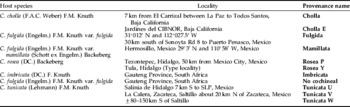
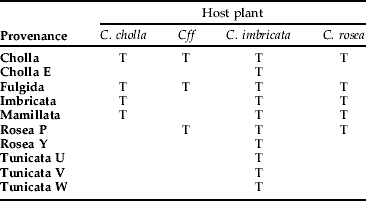
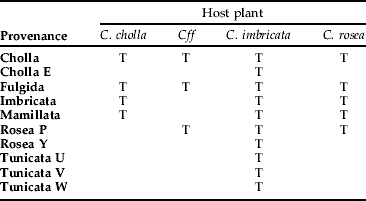
The identification of plant and insect accessions and the procedures for preparation of materials and insect culture are detailed in Mathenge et al. (Reference Mathenge, Holford, Hoffmann, Spooner-Hart, Beattie and Zimmermann2009b). For this study, 30 less than 24-h-old crawlers from each of ten provenances of D. tomentosus (Lamarck) (table 1) were seeded onto single cladodes from each of four plant species: C. cholla (F.A.C. Weber) F.M. Knuth; Cylindropuntia fulgida (Engelmann) F.M. Knuth var. fulgida (Engelmann) F.M. Knuth (Cff); C. imbricata (Haw.) F.M. Knuth and C. rosea De Candolle. The combinations of insect provenance and host plant tested are presented in table 2, and each combination was replicated three to five times. Insect development was then monitored as described below. Data from the provenance Imbricata on C. imbricata (Mathenge et al., Reference Mathenge, Holford, Hoffmann, Spooner-Hart, Beattie and Zimmermann2009b) have been included for comparison of this provenance on its original host with the rest of the provenances.
Host plant species and locations of collection of the provenances of D tomentosus and host plants used in this study.

Combinations of provenances of Dactylopius tomentosus and hosts plants tested (T).
Crawler development
The time taken by the nymphs to undergo their first moult and the number of first-instar larvae moulting were recorded to determine developmental time and survival of the nymphal stages. Differences in the proportions of crawlers moulting over time, that is the ‘developmental profile’, were expressed for each provenance-host combination using the Kaplan-Meier method (Kaplan & Meier, Reference Kaplan and Meier1958), and differences among provenances on each host plant were assessed using Mantel-Cox Log-Rank tests (Mantel, Reference Mantel1966; Cox, Reference Cox1972). If significant differences were found, then further Mantel-Cox Log-Rank tests were conducted to assess pair-wise differences in development between provenances on each host plant.
Fecundity, female weight and developmental time
Females were removed individually from cladodes when they began to oviposit. On removal, the females were dewaxed and weighed and the date of removal was recorded. Female developmental time was taken as the period from hatching to the start of oviposition. The cumulative number of progeny produced at the end of oviposition was recorded. Differences in the above parameters were determined using two-way factorial ANOVA with the factors ‘provenance’ and ‘host’ treated as fixed factors. If an interaction was found between provenances and hosts for any of the parameters, subsequent ANOVA was performed separately for each host species and repeated for each provenance. Means of homoscedastic data were separated using Duncan's Multiple Range tests, whereas heteroscedastic data were separated using Games-Howell tests.
Fitness indices
An index was formulated that could be used as a measure of fitness of any one provenance on a particular host plant species as follows:

where FI is the population growth index, S is the proportion of individuals surviving to second instar, P is fecundity (the mean number of progeny per female) and T is mean developmental time from hatching to maturity of females.
A second index was developed to estimate crawler fitness:

where CDI is the crawler development index, M is the mean number of first instar crawlers (out of an initial 30) that moulted and T is developmental time from hatching to the first moult.
Statistical analysis
All data were analysed using either Statistica (version 7, StatSoft, Inc.) or SPSS 14 for Windows (SPSS Inc.). Data were first tested for normality and homogeneity of variances using Levine's test. Data sets that were found not to be normally distributed or lacking homogeneity of variance were log transformed. Pearson Product-Moment Correlation was used to determine the relationships between female weight, and progeny numbers and female developmental time for the all provenances on each host plant species. In addition, the relationship between female weight and number of progeny was assessed for each provenance on each host species.
Results
Comparisons between localities
No differences were found in crawler and adult development between the two accessions from C. cholla, the two accessions from C. rosea and the three accessions from C. tunicata, when these accessions were tested on C. imbricata. Therefore, only data from Cholla, Rosea P and Tunicata V are presented.
Crawler development to second instar
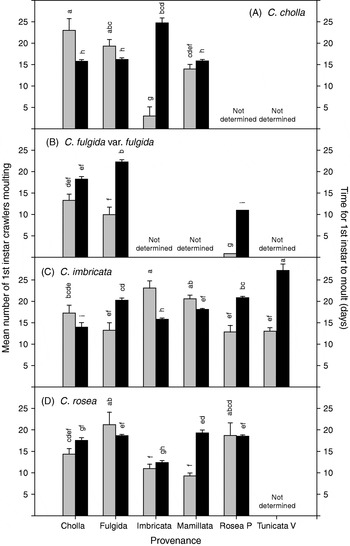
There was significant variation in the mean number of first instar crawlers that moulted on the different host plants (viz. reached second instar) (F=10.31; df=17, 51; P<0.05), including a significant interaction term (F=14.85; df=47; P=0.05) (fig. 1). For example, on C. cholla, the numbers of crawlers from the provenances Cholla and Fulgida that moulted were significantly greater than from Rosea P, which was in turn greater than Imbricata. Similar differences were found among the provenances reared on the other host species. When provenances were compared among host species, many crawlers of Cholla moulted on each host plant; whereas for Imbricata, the numbers moulting varied considerably with few moulting on C. cholla and many on C. imbricata. Of the various combinations tested, Cholla on C. cholla and Imbricata on C. imbricata had the highest number of crawlers moulting. These combinations contrasted with Imbricata on C. cholla where few crawlers moulted and Rosea P on Cff where only one crawler moulted.
Mean number and developmental time of first instar crawlers of D. tomentosus provenances reared on four Cylindropuntia spp. Bars bearing the same letter are not significantly different at P=0.05 according to Duncan's Multiple Range test ( , number moulting; ▪, time to moult).

There were also significant interactions in the time taken by crawlers to moult between provenances and hosts (F=18.34; df=8, 94; P<0.05) (fig. 1). For example, on C. cholla, Imbricata crawlers took significantly longer to moult than the other provenances. Tunicata V crawlers on C. imbricata took the longest time to moult of all provenances. Developmental times of Imbricata crawlers on C. rosea and the one Rosea crawler surviving on Cff were the shortest.
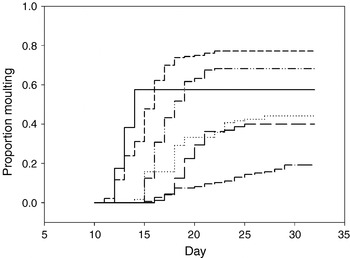
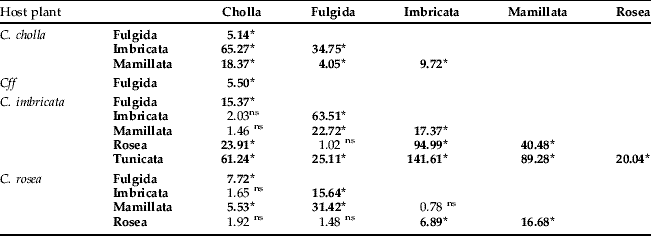
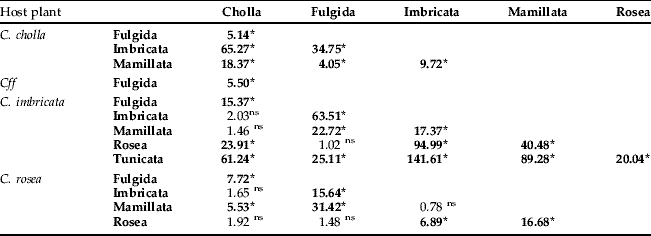
Crawler development data, expressed using the Kaplan-Meier method, is shown in fig. 2 for the provenances reared on C. imbricata only. In this figure, the horizontal axis shows the time until a moulting event occurred and the vertical axis represents the proportion of moulting crawlers at each event. Mantel-Cox analysis showed that these developmental profiles differed from each other (χ2=213.96; df=5; P<0.05), as did the profiles for the provenances reared on the other three host plants (data not shown). The statistical significance of the differences between the developmental profiles for pair-wise combinations of host and provenance determined using Mantel-Cox analysis is presented in table 3. For the accessions reared on C. cholla and Cff, all the profiles differed significantly from each other. For C. imbricata, 12 out of 15 combinations differed; whilst, for C. rosea, six out of ten combinations differed.
Developmental profiles showing the time to first moult of first instar crawlers of D. tomentosus provenances on C. imbricata depicted using the Kaplan-Meier method (——, Cholla;.........., Fulgida; – - – - – -, Imbricata; -··-··-··, Mamillata; – – –, Rosea; –·–·–·–, Tunicata).

Chi square values of pair-wise comparisons of developmental profiles of first instar crawlers between provenances. The comparisons were made within each host plant species using Mantel-Cox Log Rank tests. Asterisks denote significant differences between profiles at P=0.05 and ns denotes no significant difference.
Fecundity, female weight and developmental time
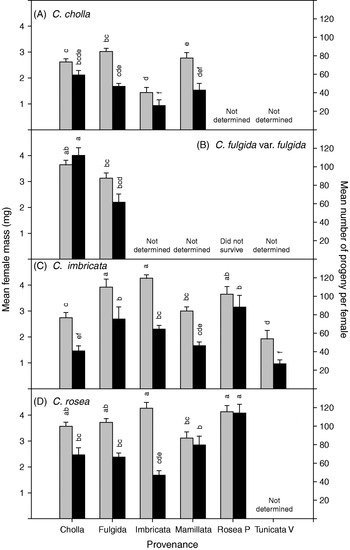
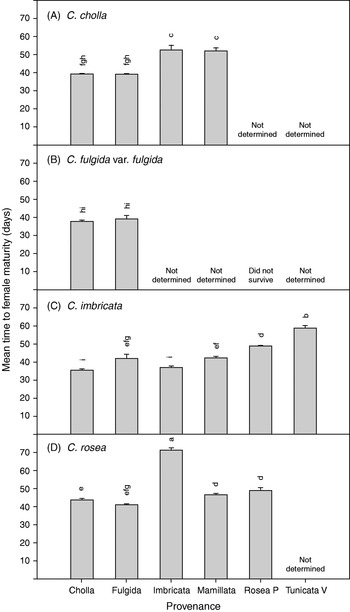
There were significant interactions between provenance and host plant species in mean number of progeny (F=6.25; df=8, 62; P⩽0.05), mean female weight (F=86.49; df=8, 62; P<0.05) (fig. 3) and mean female developmental time (F=86.49; df=8, 62 P<0.05) (figs 3 and 4). For example, the mean weights of females of Cholla on Cff and C. rosea were similar and higher than on C. cholla and C. imbricata. Similarly, the time to maturity of Imbricata was highest on C. cholla and C. rosea, but lowest on C. imbricata. Within a plant species, significant variation was also apparent. For the provenances on C. imbricata, there was a three-fold difference between the provenances producing the highest and lowest number of progeny, a two-fold difference in female weight and ~1.5-fold difference in time to maturity.
Mean number of progeny and female weight of D. tomentosus provenances reared on four Cylindropuntia spp. Bars bearing the same letter are not significantly different at P=0.05 according to Duncan's Multiple Range test (, female mass; ▪, number of progeny).

Mean developmental time to maturity of adult females of D. tomentosus provenances reared on four Cylindropuntia spp. Bars bearing the same letter are not significantly different at P=0.05 according to Duncan's Multiple Range test.

Relationship between adult life history traits
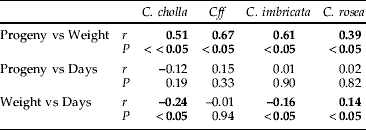
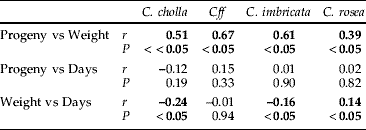
There was a significant, positive correlation between the number of progeny and female weight for the provenances reared on each host species (table 4). In contrast, the relationships between female weight and female developmental time were weak and negative, with these relationships not being significant for the provenances cultured on Cff. Thus, in general, prolonged developmental times were associated with low female weights. No correlation was found between female developmental time and the number of progeny produced. In addition, for each provenance reared on the different hosts, the relationships between the number of progeny and female weight per provenance were positive and significant for most provenances (table 5). In particular, relationships were the strongest for Fulgida and Imbricata on C. imbricata and Cholla on Cff. The relationship between time to maturity and female weight was either weak or moderate, being mostly negative, but significant only for Imbricata on C. rosea.
Pearson Product Correlation analysis showing the relationships between numbers of progeny, mean female weight and mean developmental time per host species.
Correlation coefficients (r) from Pearson Product Correlation analysis describing the relationships between the number of progeny and female weight for provenances of D. tomentosus reared on different host species. Asterisks denote significant and ns non-significant relationships at P=0.05.

Fitness indices
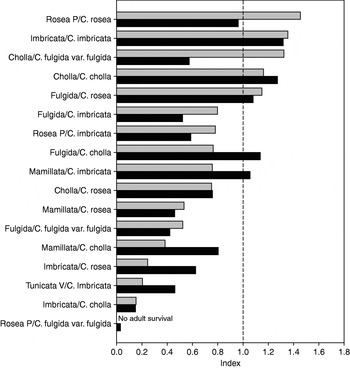
Based on their FI and CDI, the biotypes varied widely in their fitness on any host species (fig. 5 and table 6). In terms of their FI, Rosea P and Imbricata had their highest fitness on their original host species, whereas the other provenances had their highest fitness on novel host species. Amongst the plants, C. imbricata and C. rosea tended to be the best host species; however, Cholla did not perform well on either of these two species. In contrast, C. cholla and Cff tended to be poor hosts, but the latter species were the best host for Cholla. Amongst the provenances, Cholla tended to have a higher level of fitness on the range of host used; whereas, in general, Tunicata, Rosea P and Imbricata had the lowest levels of fitness. However, the fitness of the latter two provenances on their host of origin was high. There appears to be no relationship between the two indices, as the CDI exceeded FI for some provenance/host combinations whilst for others it was lower. The suitability of Cylindropuntia spp. as hosts for the different provenances of D. tomentosus split these species into two groups, with C. imbricata and C. rosea in one group and Cff and C. cholla in the other (table 6). This can be seen from the host use patterns of Fulgida, Imbricata, Mamillata, Rosea P and, perhaps, Tunicata that had better biological performance on C. imbricata and C. rosea compared to Cholla that had better biological performance on Cff and C. cholla.
Crawler development and adult fitness indices of combinations of D. tomentosus provenances reared on Cylindropuntia spp. Insects with a fitness index of ⩾1 were deemed to thrive on their host, those with an index of >0<1 were deemed to have survived and those with an index of 0 had died (▪, crawler development; , fitness).

The suitability of Cylindropuntia spp. as hosts for different provenances of D. tomentosus. The host plants were ranked based on their fitness index and ranking is in decreasing order from high to low suitability. Species on which provenances did not survive are indicated with an asterisk.

Discussion
Host specificity
Intraspecific variation in the use of particular host species is a widespread phenomenon in herbivorous insects (Diehl & Bush, Reference Diehl and Bush1984; Futuyma & Peterson, Reference Futuyma and Peterson1985; Jaenike, Reference Jaenike1990; Via, Reference Via1991) and has been demonstrated here for D. tomentosus on its Cylindropuntia hosts. The affiliations of the provenances with their hosts can be categorized into two types: (i) strong host specificity characterized by a large difference in fitness of a provenance between hosts; and (ii) weak host specificity characterized by small differences in fitness of a provenance between hosts. As a consequence, therefore, when reared on a particular host, the insects may thrive, survive or die (see Mathenge et al., Reference Mathenge, Holford, Hoffmann, Spooner-Hart, Beattie and Zimmermann2009b). In this study, provenances Rosea P and Imbricata had strong host affiliations, as the former thrived on C. rosea but died on Cff whilst the latter thrived on C. imbricata but barely survived on C. cholla. The provenances Cholla, Fulgida and Mamillata were less host-specific. These provenances either thrived or survived on the plants. The differential host specificity found in this study confirms the suggestion by Mathenge et al. (Reference Mathenge, Holford, Hoffmann, Spooner-Hart, Beattie and Zimmermann2009b) that the provenances should be considered as biotypes.
Host interactions
Some biotypes performed better on their host of origin than on alternative hosts, e.g. Imbricata and Rosea P, which is suggestive of host adaptation. Host adaptation is a widespread phenomenon among coccoids (Edmunds & Alstad, Reference Edmunds and Alstad1978; Hanks & Denno, Reference Hanks and Denno1994; Glynn & Herms, Reference Glynn and Herms2004), and the sedentary life style of the cochineal insects is likely to result in local adaptation in this group (Hanks & Denno, Reference Hanks, Denno, Mopper and Strauss1998). Perhaps the prolonged association of certain D. tomentosus biotypes with their hosts has reduced any adverse effects of plant defence compounds and induced subsequent adaptation to the nutritional, chemical and physical characteristics of their natal hosts (Mopper, Reference Mopper1996). The poor performance of other biotypes (e.g. Cholla and Fulgida) on their hosts of origin implies they may have a loose association with these plant species, or they are maladapted, as has been seen for other scale insects (Wainhouse & Howell, Reference Wainhouse and Howell1983; Spitzer, Reference Spitzer2006). There may be several factors behind poor performance on hosts of origin compared to novel hosts. Firstly, it may be because the hosts of origin are suboptimal in terms of suitability when compared with novel hosts (Berlocher & Feder, Reference Berlocher and Feder2002); hence, insects may perform below their physiological potential on their natal hosts (Arendt, Reference Arendt1997). Secondly, there may be genetic pre-adaptation of a biotype to the novel host plant, such that there may be some gene that is normally neutral when an insect is on its natal host but which becomes advantageous when it is on a novel host (Strauss & Karban, Reference Strauss, Karban, Mopper and Strauss1998). Lastly, it may be due to resource availability, whereby oligophagous insects sometimes use a more abundant host species that is more frequently encountered even though this is not necessarily the most suitable host (Singer, Reference Singer1983; Singer et al., Reference Singer, Thomas, Billington and Parmesan1989).
The suitability of Cff as a host for the Cholla biotype could also be a ‘new association’ effect, whereby a host plant is poorly adapted to repel a species of herbivore that it has never previously encountered (Hokkanen & Pimental, Reference Hokkanen and Pimentel1984). D. tomentosus may have diverged as distinct biotypes on two of its hosts because there is no overlap in the geographic distributions of C. cholla, which is restricted to Baja California Sur, and Cff, which occurs in the Sonora desert further north. Thus, the relatively poor performance of Cholla on its natural host, C. cholla, seen in the current study supports the hypothesis advanced by Mathenge et al. (Reference Mathenge, Holford, Hoffmann, Spooner-Hart, Beattie and Zimmermann2009b) that Cholla on Cff could represent a new association. This phenomenon has been exploited in biological weed control and has resulted in some highly successful control programs (Moran & Zimmermann, Reference Moran and Zimmermann1984). Uniting the Cholla biotype with Cff resembles the biological control programs in Australia and South Africa where D. austrinus has been used to great effect for the biological control of Opuntia aurantiaca, even though this cactus species is never a natural host for D. austrinus in its Argentinean home range (Moran & Annecke, Reference Moran and Annecke1979). Therefore, the Cholla biotype could result in the successful biological control of Cff in South Africa, and the Rosea P biotype could provide better control of C. rosea in New South Wales, Australia.
Variation between life history strategies
The differential performance between crawler and adult developmental stages of D. tomentosus biotypes found in this study may be a reflection of intraspecific variation in life history strategies, a common feature in many insect species (Danks, Reference Danks and Danks1994). For example, among other scale insects, life history patterns and voltinism may vary widely within a particular species (Beardsley & Gonzalez, Reference Beardsley and Gonzalez1975; Gerson, Reference Gerson and Rosen1990; McClure, Reference McClure and Rosen1990; Danzig, Reference Danzig, Ben-Dov and Hodgson1997). In D. tomentosus, the variation was exhibited in two ways: (i) either as high survival and faster development of crawlers but with females reaching maturity earlier, at a smaller size and with lower fecundity (e.g. Cholla on C. cholla), or (ii) with poor performance at the crawler stage but enhanced performance of surviving adults (e.g. Cholla on Cff and Mamillata on C. rosea). This variation can be explained as a trade-off between life stages that enhances overall fitness of an insect population (Nylin & Gotthard, Reference Nylin and Gotthard1998). Where the adult stage is favoured, this may also be explained as a compensatory response for poor juvenile fitness (Arendt, Reference Arendt1997) or to the first encounter phenomenon. In this phenomenon, when a new host is encountered, the crawlers take time to assess, settle, feed and assimilate the new food resource; but, if the host is accepted, it enhances overall fitness at the adult stage (Singer, Reference Singer1983). In the current study, the different life history strategies may be related to either genetic differences between the biotypes or to the effect of different nutritional, chemical or physical characteristics of each host species optimising the development of different life stages (Danks, Reference Danks and Danks1994; Awmack & Leather, Reference Awmack and Leather2002). Difference in life history strategies have been used to differentiate subspecies and species of scale insects (Gerson, Reference Gerson and Rosen1990; Danzig, Reference Danzig, Ben-Dov and Hodgson1997), and the differences in history strategies found in the current study are further evidence for the presence of biotypes of D. tomentosus.
Relationships between life history traits
It is generally acknowledged that particular reproductive traits of insects are related (Fox & Czesak, Reference Fox and Czesak2000), as revealed here for female weight and number of progeny. This would be expected because gravid cochineal females contain developing eggs. Similar relationships have been observed among other cochineal insects (Moran & Cobby, Reference Moran and Cobby1979; Volchansky et al., Reference Volchansky, Hoffmann and Zimmermann1999), as well as other insect groups (Honek, Reference Honek1993). However, the relationships for the D. tomentosus biotypes on their natal hosts (r2<0.30) were not as strong as those of other Dactylopius species: the coefficients of determination for two biotypes of D. opuntiae were 0.56 and 0.45 (Volchansky et al., Reference Volchansky, Hoffmann and Zimmermann1999) and for D. austrinus De Lotto was 0.74 (Moran & Cobby, Reference Moran and Cobby1979). This implies that the weaker relationship may be a unique feature of D. tomentosus, as size and fecundity can be influenced by genetic factors (Honek, Reference Honek1993). Alternatively, the difference may be due to food and host quality differences between the host species of each cochineal species, as these are known to influence relationships between female weight and fecundity in insects (Awmack & Leather, Reference Awmack and Leather2002). Lack of significant relationships between female weight and fecundity in Imbricata on C. cholla and Fulgida on C. fulgida may have been due to the low number of females that matured. In addition, there was little relationship between female developmental time and the female weight and no relationship between female developmental time and the number of progeny for D. tomentosus as was found in Mathenge et al. (Reference Mathenge, Holford, Hoffmann, Spooner-Hart, Beattie and Zimmermann2009b). This outcome may be because, as mentioned above, female weight is affected by both host nutrition and intrinsic growth rate, factors that are experimentally difficult to separate.
Host use patterns and host taxonomy
According to the taxonomic conservatism theory (Ehrlich & Raven, Reference Ehrlich and Raven1964), related insects utilize host species that are taxonomically related. Consequently, host use patterns of specialized insects have been used to offer insight into and, in some cases, resolve the taxonomy of their hosts (Eastop, Reference Eastop1979). Among the scale insects, the host use patterns of genetically closely related lineages of the maritime pine blast scale were congruent to particular groups of phylogenetically closely related maritime pines (Burban et al., Reference Burban, Petit, Carcreff and Jactel1999). Likewise, the host relations of subspecies of a gall-inducing scale insect corresponded to the phylogeny of their eucalyptus hosts (Cook & Rowell, Reference Cook and Rowell2007). Insects can discriminate between hosts based on host traits such as their nutritional, chemical or physical characteristics (Bernays & Chapman, Reference Bernays and Chapman1994). The quantity and composition of nutritional and chemical compounds vary between cactus species (Meyer et al., Reference Meyer, Mohammed and Mclaughlin1980; Kircher, Reference Kircher, Barker and Starmer1982). For example, cactus species vary in the amount of carbohydrates they contain (Kircher & Al-Azawi, Reference Kircher and Al-Azawi1985), and cactus subfamilies and genera have been differentiated on the basis of variation in chemicals (Wallace & Gibson, Reference Wallace, Gibson and Nobel2002). The influence of chemicals in cacti on insect-host interactions has been documented, e.g. alkaloids are toxic to certain species of Drosophila and not others, leading to host specialization among the Drosophila species (Fogleman et al., Reference Fogleman, Heed and Kircher1982; Danielson et al., Reference Danielson, Letman and Fogleman1995). Perhaps the cochineal insects are able to discriminate between Cylindropuntia species based on differences in nutritional, chemical, as well as physical, characteristics resulting in the observed host use patterns. It is possible that Cylindropuntia species eliciting similar levels of performance of D. tomentosus biotypes may share, amongst other traits, similar chemical characteristics and, therefore, may be taxonomically related.
The two Cholla biotypes (Cholla and Cholla E), the two Rosea biotypes (P and Y) and the three Tunicata biotypes (U, V and W) from different localities did not demonstrate any significant differences in development, either on C. imbricata (this study) or on Cff (Mathenge et al., Reference Mathenge, Holford, Hoffmann, Spooner-Hart, Beattie and Zimmermann2009b). In these two studies, two different accessions of Cff were used. In the study by Mathenge et al. (Reference Mathenge, Holford, Hoffmann, Spooner-Hart, Beattie and Zimmermann2009b), the accession of Cff used came from South Africa; whilst, in this current study, the accession came from Mexico. The development of Fulgida, Cholla and Rosea P were similar on these hosts between the two studies. Host specificity, therefore, is not related to the geographic locality from which either the hosts or biotypes were sourced. This suggests that the nutritional, chemical, morphological or phenological characteristics of the host species may be sufficiently different to induce the formation of biotypes. However, any differences occurring within a host species must be small, such that they cannot be discerned by accessions of a particular biotype; therefore, different accessions of a particular cactus species seem to be equally good hosts. This lack of differential performance suggests that host use patterns of the biotypes can be used to help determine the taxonomic relatedness of their hosts.
Based on host use patterns of D. tomentosus biotypes, we can advance the following hypothesis concerning the taxonomic relatedness of the Cylindropuntia spp. used in this study. The suitability of Cylindropuntia spp. as hosts for the different biotypes of D. tomentosus split these species into two groups, with C. imbricata and C. rosea in one group and Cff and C. cholla in the other. This grouping of the four hosts is consistent with the phylogenetic closeness between Cff and C. cholla reported by Rebman (Reference Rebman1995) and Aguilar et al. (Reference Aguilar, Devender and Felger2000). The grouping of C. imbricata and C. rosea together also supports the suggestion of Bravo-Hollis (Reference Bravo-Hollis1978) that C. imbricata may be a hybrid between C. rosea and C. tunicata. Thus, host use of the biotypes mirrors the known taxonomic relationships of the hosts.
In conclusion, this is the first detailed study of the host interactions between D. tomentosus and their host plants, Cylindropuntia spp., and provides further evidence for the existence of biotypes of D. tomentosus as suggested by Mathenge et al. (Reference Mathenge, Holford, Hoffmann, Spooner-Hart, Beattie and Zimmermann2009b). The host range of D. tomentosus may be wider than reported in the current study; hence, more biotypes may exist with varying degrees of host specialization. This variation in host use can aid in resolving the identity and taxonomic relatedness of the hosts of the insects. Ongoing molecular work to determine the genetic differentiation and relationships amongst the D. tomentosus biotypes may confirm the existence of biotypes and whether these relationships correspond to host use patterns and to the phylogenetic relationships among the hosts. Practically, it is important to take into account the existence of biotypes when selecting insects for biological control, as the selection of a biotype that does not thrive on a particular weed species may lead to its failure in the field.
Acknowledgements
We are grateful to the Weeds Research Division of the Plant Protection Research Institute, Agricultural Research Council, Pretoria, South Africa for provision of facilities during this research. We would like to thank their staff for help with this work and the South African Department of Agriculture, the National Research Foundation and the University of Cape Town for financial assistance. We are grateful to the Centre for Plants and the Environment, University of Western Sydney, Australia for financial support and provision of facilities enabling the preparation of this manuscript. We would also like to thank Alfie Meats for his suggestions for the development of the fitness index and Paul Milham for his help with preparing this manuscript.