


Introduction
Self-criticism is a self-evaluative process where individuals judge themselves harshly (Shahar et al., Reference Shahar, Szsepsenwol, Zilcha‐Mano, Haim, Zamir, Levi‐Yeshuvi and Levit‐Binnun2015a). Self-criticism is associated with lower self-esteem (Thompson and Zuroff, Reference Thompson and Zuroff2004). In a cognitive behavioural therapy (CBT) model of self-esteem, self-criticism is thought to maintain low self-esteem (Fennell, Reference Fennell1998). Self-criticism is associated with judgemental attitudes towards one's experience of negative emotions (James et al., Reference James, Verplanken and Rimes2015). Self-criticism is also closely related to self-critical perfectionism (Dunkley and Kyparissis, Reference Dunkley and Kyparissis2008). Self-criticism has been found to be a significant predictor of clinical symptoms over and above other aspects of perfectionism, suggesting that it is a key component associated with clinical problems (Dunkley et al., Reference Dunkley, Zuroff and Blankstein2006).
Self-criticism has been described as a transdiagnostic process as high levels are associated with a range of problems including depression (Luyten et al., Reference Luyten, Sabbe, Blatt, Meganck, Jansen, De Grave, Maes and Corveleyn2007), social anxiety (Shahar et al., Reference Shahar, Doron and Szepsenwol2015b) and eating disorders (Fennig et al., Reference Fennig, Hadas, Itzhaky, Roe, Apter and Shahar2008).
Gilbert (Reference Gilbert2009, Reference Gilbert2010a,Reference Gilbertb) has developed compassion-focused therapy (CFT) for individuals experiencing high levels of self-criticism and shame. CFT uses a ‘threat/safety strategy’ formulation (Gilbert, Reference Gilbert2010a) which focuses on the development of self-criticism within the context of three emotion regulation systems. Self-critical individuals are thought to have over-active threat-protection and drive-motivation systems, and an under-active contentment-soothing-safeness system (Gilbert, Reference Gilbert2009). CFT therefore aims to develop the contentment-soothing-safeness system using a range of self-compassion techniques.
There is a growing evidence base for CFT for a range of clinical difficulties including severe and enduring mental health problems (Gilbert and Procter, Reference Gilbert and Procter2006; Judge et al., Reference Judge, Cleghorn, McEwan and Gilbert2012), personality disorders (Lucre and Corten, Reference Lucre and Corten2013), psychotic symptoms (Braehler et al., Reference Braehler, Gumley, Harper, Wallace, Norrie and Gilbert2013; Mayhew and Gilbert, Reference Mayhew and Gilbert2008) and eating disorders (Gale et al., Reference Gale, Gilbert, Read and Goss2014). However, the authors are not aware of this approach having been investigated for individuals presenting specifically with high levels of self-criticism that has caused significant functional impairment. This study developed an intervention based on CFT and general cognitive behavioural methods to reduce self-criticism in university students reporting high levels of self-criticism associated with clinically significant levels of impairment.
Aims and hypotheses
This uncontrolled pilot study investigated a six-session intervention for students with impairing levels of self-criticism, with two main aims:
(1) To assess the acceptability and feasibility of the intervention and the assessment methods used to investigate the impact of this intervention.
(2) To investigate whether the intervention was associated with improvements in self-criticism, mood and other related constructs, comparing pre-treatment scores with those at post-treatment and 2-month follow-up.
Method
Design
This was an uncontrolled pilot study of a new intervention. A mixed qualitative and quantitative design was utilized to assess acceptability through participant feedback. Standardized measures were completed at screening, prior to each weekly session and at the 2-month telephone follow-up appointment.
Participants
To participate, individuals had to be enrolled at the local university and have high levels of self-criticism that were causing significant functioning impairment as indicated by a score of 10 or above on the Work and Social Adjustment Scale (Mundt et al., Reference Mundt, Marks, Shear and Greist2002). Individuals had to have sufficient English language proficiency and, if taking anti-depressants, be on a stable dose for at least 3 months. Individuals were excluded if they were receiving another psychological intervention, if their current risk levels required formal input from mental health services, or if they met DSM-IV criteria for a psychotic disorder, substance dependence or anorexia nervosa, indicating that a more specialist intervention would be more clinically appropriate. In line with recommendations about sample sizes for pilot studies assessing intervention efficacy in a single group of participants (Hertzog, Reference Hertzog2008), the target sample size was 16–25 participants.
Measures
Questionnaires were completed online. The full questionnaire set was completed at sessions 1, 3, 6 and follow-up (primary outcome measures were also collected before each session). All the questionnaires that were used have been shown to be reliable and valid, and Cronbach's alpha reported below were calculated for the present study.
Primary outcome measures
The Habitual Index of Negative Thinking (HINT; Verplanken et al., Reference Verplanken, Friborg, Wang, Trafimow and Woolf2007)
For this 12-item scale of habitual negative self-thinking, participants indicated agreement on a 5-point Likert scale; higher scores represented higher levels of negative self-thinking (Cronbach's alpha = 0.88).
Self-Critical Rumination Scale (SCRS; Smart et al., Reference Smart, Peters and Baer2015)
For this 10-item scale of self-critical rumination, participants indicated agreement on a 5-point Likert scale; higher scores represented higher levels of self-critical rumination (Cronbach's alpha = 0.75).
Work and Social Adjustment Scale (WASAS; Mundt et al., Reference Mundt, Marks, Shear and Greist2002)
This 5-item scale was used to measure the impact of self-criticism on different areas of an individual's life. Participants indicated agreement on a 9-point Likert scale; higher scores represented more impaired levels of functioning (Cronbach's alpha = 0.80). Scores of 10 and above indicate significant functional impairment (Mundt et al., Reference Mundt, Marks, Shear and Greist2002).
Secondary outcome measures
Patient Health Questionnaire (PHQ-9; Kroenke et al., Reference Kroenke, Spitzer and Williams2001)
The PHQ-9 has nine items measuring depressive symptoms over the last 2 weeks. Participants indicated agreement on a 4-point Likert scale; higher scores represented more severe depression (Cronbach's alpha = 0.83).
Generalized Anxiety Disorder (GAD-7; Spitzer et al., Reference Spitzer, Kroenke, Williams and Löwe2006)
The GAD-7 has seven items measuring anxiety over the last 2 weeks. Participants indicated agreement on a 4-point Likert scale; higher scores represented more severe anxiety (Cronbach's alpha = 0.90).
Rosenberg's Self-Esteem Scale (Rosenberg, Reference Rosenberg1965)
For this 10-item scale of global self-esteem, participants indicated agreement on a 4-point Likert scale; higher scores represented higher self-esteem (Cronbach's alpha = 0.81).
The Multi-Dimensional Perfectionism Scale (MDPS; Frost et al., Reference Frost, Marten, Lahart and Rosenblate1990)
For this 35-item scale of perfectionism, participants indicated agreement on a 5-point Likert scale; higher scores represented higher levels of perfectionism. There are six subscales: ‘concern over mistakes’ (CM), ‘personal standards’ (PS), ‘parental expectations’ (PE), ‘parental criticism’ (PC), ‘doubts about actions’ (DA) and ‘organization’ (O). For this study, the CM, DA, PE and PC subscales were totalled to measure ‘maladaptive’ perfectionism (Stumpf and Parker, Reference Stumpf and Parker2000) (subscales Cronbach's alpha ranged from 0.67 to 0.90).
Self-Compassion Scale (SCS; Neff, Reference Neff2003)
For this 26-item scale of self-compassion, participants indicated agreement on a 5-point Likert scale; higher scores represented higher levels of self-compassion (Cronbach's alpha = 0.88).
Beliefs about Emotions scale (BES; Rimes and Chalder, Reference Rimes and Chalder2010)
This 12-item scale measures the unacceptability of experiencing or expressing negative emotions. Participants indicated agreement on a 7-point Likert scale; higher scores represented stronger beliefs about the unacceptability of negative emotions. (Cronbach's alpha = 0.83).
Participant feedback
Online feedback was collected post-intervention and contained both quantitative rating scales and open-ended questions devised for this study.
Procedure
Two recruitment drives were completed and, for each, the study was advertised twice through an email inviting volunteers for university research projects. Interested individuals were sent further information and an online link. Individuals who appeared to meet the inclusion criteria were offered a telephone screening to assess eligibility. Past and current mental health problems were assessed using the latest version of the Mini International Neuropsychiatric Interview (M.I.N.I.; English version 6.0.0), a structured interview that assesses DSM-IV and ICD-10 psychiatric disorders (Sheehan et al., Reference Sheehan, Lecrubier, Sheehan, Amorim, Janavs, Weiller, Hergueta, Baker and Dunbar1998). The average time between screening and session 1 was 13 weeks (SD = 7.62).
Intervention
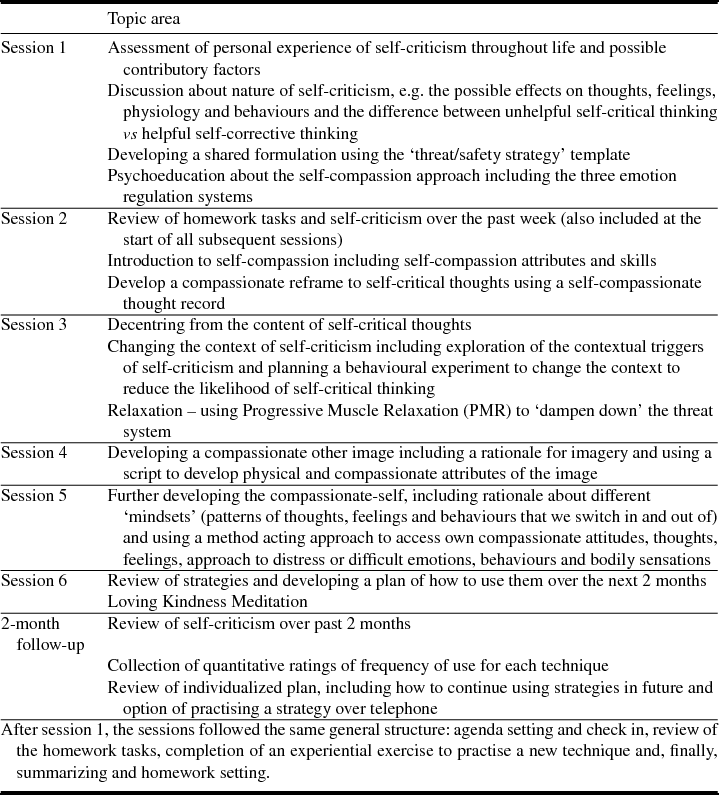
Two trainee clinical psychologists delivered the intervention supervised by a clinical psychologist. The therapists delivered the intervention during their second and third year of training and learnt the intervention techniques through their course training, reading about the Compassionate Mind approach and specific training and supervision sessions with their supervisor. The intervention consisted of six 1-hour individual sessions delivered approximately weekly, with written booklets to enhance learning (see Table 1 for a summary of intervention content). The treatment protocol and booklets were designed by the therapists and their supervisor, drawing heavily on CFT and general cognitive behavioural therapy principles. Every session was audio-recorded and listened to by the therapists’ supervisor to ensure fidelity to the protocol and for supervision purposes.
Content of intervention

Feasibility and acceptability objectives
Feasibility was assessed in terms of recruitment and retention. For acceptability, participants provided feedback about the assessment methods and intervention content.
Data analysis
Assessing acceptability
Written responses to open-ended feedback questions were analysed using brief content analysis by the first author (Mayring, Reference Mayring2000). Inductive category development was utilized whereby responses were read through and preliminary categories were defined. These were then refined further after reading through approximately 50% of the text for each question.
Changes in self-criticism and other outcomes
As there were only 11 missing items across the dataset, for these, mean item scores were calculated (Fox‐Wasylyshyn and El‐Masri, Reference Fox‐Wasylyshyn and El‐Masri2005). As multiple tests were used, a more conservative cut-off p-value ≤ 0.01 was used to indicate statistical significance; p-values between 0.01 and 0.05 were considered a ‘non-significant trend’.
Therapist effects
Independent t-tests were completed to determine whether there were differences in outcomes between therapists at each time point, but none was found.
Comparison between pre- and post-intervention
To examine the effect of the intervention on the study measures, repeated measures ANOVAs were conducted for each measure with time as the repeated measure factor. The time points were screening (if completed), pre-intervention, mid-treatment (session 3), post-intervention and follow-up. When a significant effect of time was found, planned pairwise comparisons were completed to determine whether there were significant differences between measures at post-intervention and follow-up compared with pre-intervention and whether gains were maintained between post-intervention and follow-up. Contrasts between screening and pre-intervention were completed to determine whether there were any significant changes during the baseline period prior to treatment.
Effect sizes for post-intervention and follow-up were calculated by dividing the mean differences between post- and pre-intervention and follow-up and pre-intervention by the mean standard deviations at pre-intervention. Pre-treatment changes were also calculated in a similar way to see how participants changed over time without treatment. Effect sizes were calculated using Cohen's d and interpreted using the following cut-offs: ‘negligible’ effect < 0.2; small effect ≥ 0.2, medium effect ≥ 0.5, large effect ≥ 0.8 (Cohen, Reference Cohen1988).
Although a number of time-points for the PHQ-9 and GAD-7 violated the assumption of normality, as repeated measures ANOVA are considered ‘robust’ to deviations from normality (Laerd Statistics, Reference Statistics2017), the ANOVAs are presented.
For outcome measures that were completed at both screening and pre-intervention, paired t-tests were also completed to determine whether there were statistically significant differences between the mean change in scores between screening and pre-intervention and between pre-intervention and post-intervention.
Finally, for all primary outcome measures, the Reliable Change Index (RCI) was calculated to test whether the change in scores from pre- to post-intervention, and from pre-intervention to follow-up, was greater than that expected from random variation. If the change in scores was larger than the RCI, participants were described as making ‘clinically significant improvements’ (Jacobson and Truax, Reference Jacobson and Truax1991). The overall number of participants who made clinically significant improvements was calculated. The proportion of those with and without a clinical diagnosis at baseline who showed clinically significant improvements were also calculated to gain preliminary information about whether those with clinical disorder benefited more from the intervention.
Results
Participant demographics
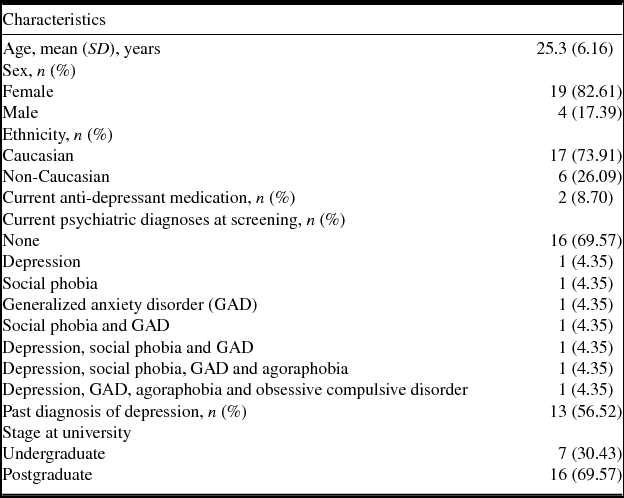
Table 2 summarizes baseline demographic information.
Participant baseline demographic information

Feasibility
Recruitment and retention
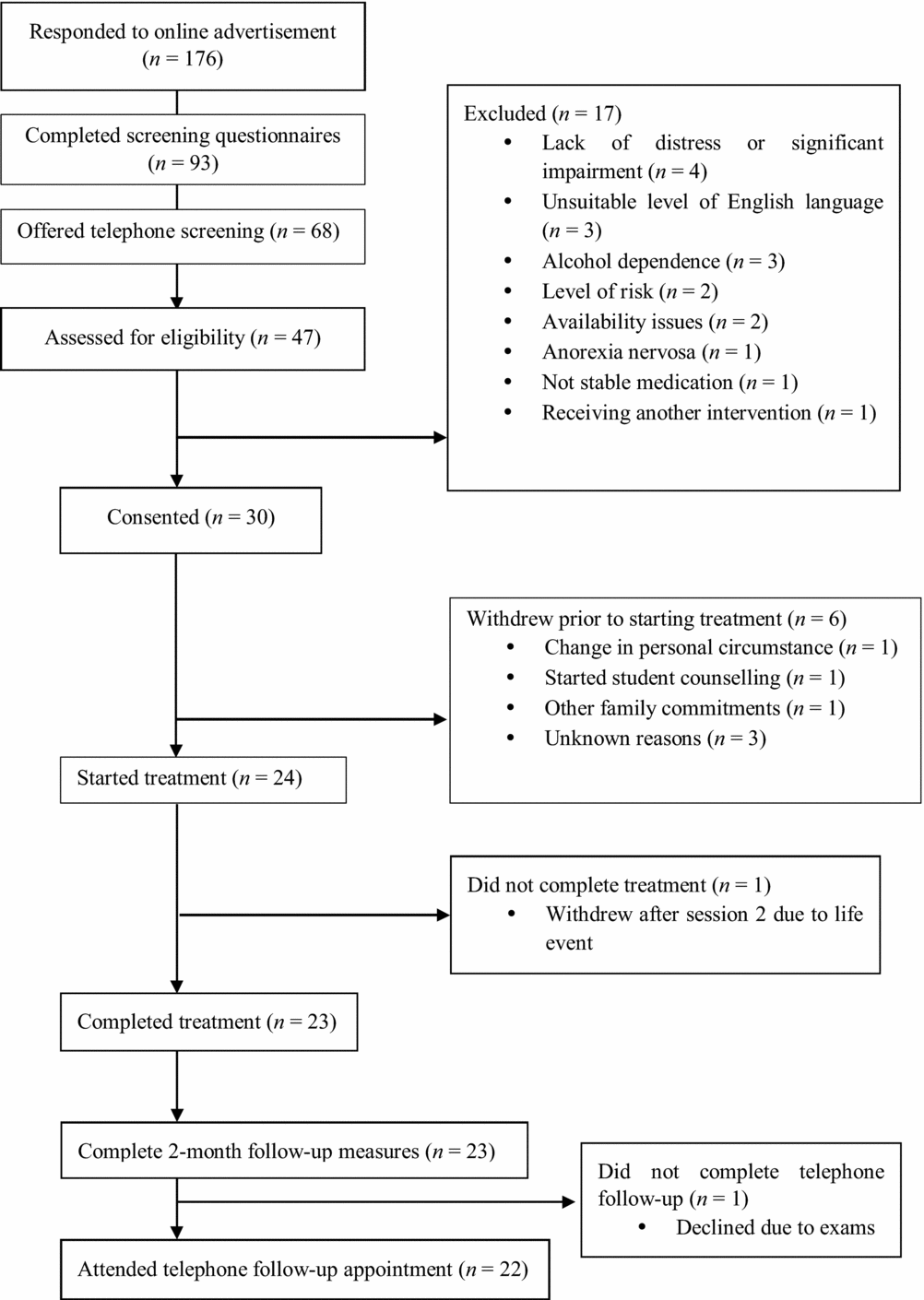
Figure 1 shows the recruitment and retention numbers. A sufficient number of eligible participants were recruited and subsequently completed the intervention. The inclusion/exclusion criteria appeared to result in a group of participants with significant impairment associated with self-criticism that could complete the intervention.
Study flow diagram showing recruitment process

Acceptability
Twenty-one of the 24 participants completed the feedback questionnaire.
The assessment methods
All participants completed the study measures at each time point; however, a common theme identified by the researcher from the written feedback was that the questionnaire pack was too long.
The intervention
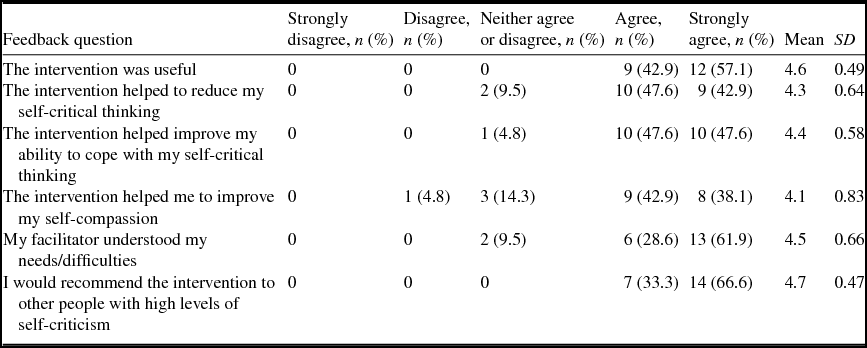
Participants post-intervention ratings about how useful they found the intervention are given in Table 3.
Post-intervention ratings of how useful participants found the intervention

Participants rated their agreement on a 5-point Likert scale: strongly disagree = 1; disagree =2; neither agree or disagree = 3; agree = 4; strongly agree = 5. SD, standard deviation.
The mean percentage of the weekly booklets read by participants was 79.5% (SD = 27.5. The mean time spent practising techniques each week was 140.8 min (SD = 155.58). ‘Decentring’ and ‘compassionate reframes’ received the greatest proportion of the two highest usefulness ratings (both 76%, n =16). At follow-up, 15 participants (68%) had been using ‘decentring’ and 13 participants (59.3%) had been using ‘compassionate reframes’, at least ‘once a week’ and the therapists noted that, for majority of these participants, the ‘compassionate reframe’ appeared to have become fairly automatic rather than a deliberate process each time.
Changes in self-criticism and other outcomes
Comparison between pre- and post-intervention
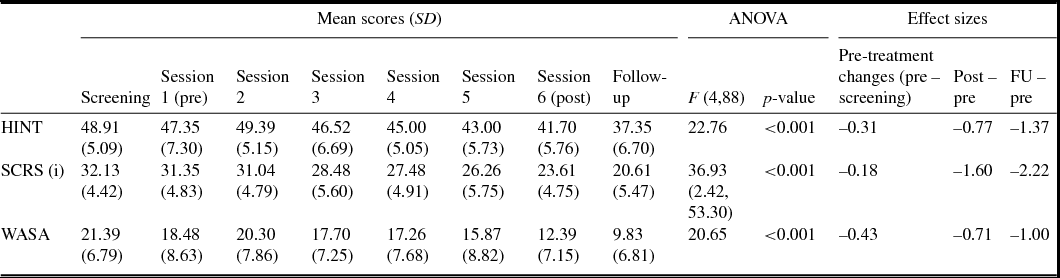
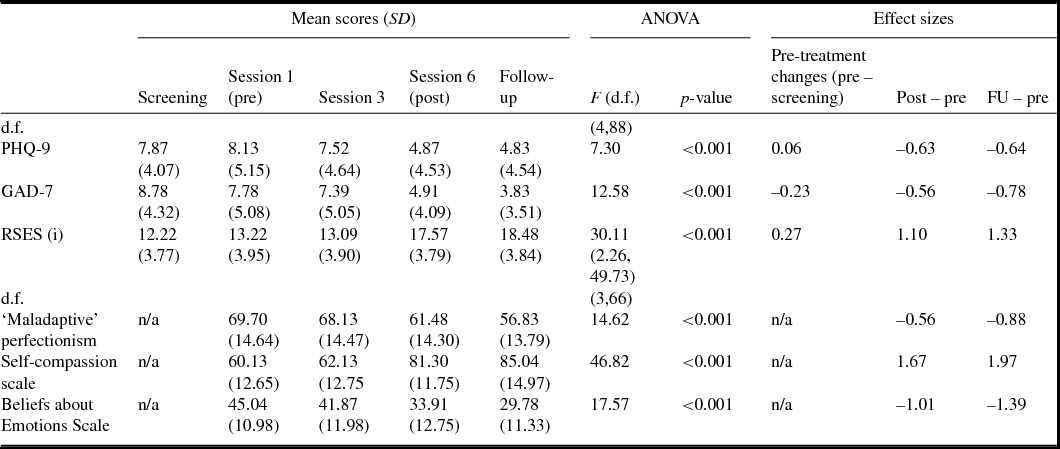
The results of one-way repeated ANOVAs for primary and secondary measures are given in Tables 4 and 5, respectively. Results of the subsequent planned pairwise comparisons are summarized below.
Primary outcome measures: results of one-way ANOVAs, means and standard deviations and effect sizes

HINT, the Habitual Index of Negative Thinking; SCRS, Self-Critical Rumination Scale; WASAS, Work and Social Adjustment Scale; FU, follow-up; SD, standard deviation. (i) The Mauchly's test of sphericity indicated that the assumption of sphericity had been violated, therefore the Greenhouse-Geisser correction was applied and the degrees of freedom are listed in the table. Scores for session 2, 4 and 5 are included for information and were not included in any of the analyses.
Secondary outcome measures: results of one-way ANOVAs, means and standard deviations and effect sizes

PHQ-9, Patient Health Questionnaire; GAD-7, Generalized Anxiety Disorder; RSES, Rosenberg Self-Esteem Scale; d.f., degrees of freedom; FU, follow-up; SD, standard deviation. (i) Greenhouse-Geisser correction was applied and degrees of freedom are listed in the table.
Primary outcome measures
Planned comparisons showed that there were significant reductions between pre- and post-intervention and between pre-intervention and follow-up for all primary outcome measures (p-values ≤ 0.002). There were also significant reductions between post-intervention and follow-up (p-values ≤ 0.009). The Cohen's d indicated that the intervention had a large effect size for self-criticism at both post-intervention and follow-up, compared with a small effect size for changes over the pre-treatment period. For impaired functioning, there was a small effect size for the pre-treatment period, medium effect size from pre-treatment to post-intervention, and a large effect size from pre-treatment to follow-up. No significant changes in the primary outcome measures were found over the baseline period between screening and pre-intervention (p-values >0.08). Comparing change during the baseline period with the treatment period directly, paired t-tests indicated significantly larger reductions in pre- to post-treatment mean scores than screening to pre-treatment changes for the HINT [t (22) = –6.23, p < 0.001], the SCRS [t (22) = –8.24, p < 0.001], and the WASAS [t (22) = –5.07, p < 0.001].
At post-intervention, 8/23 (35%) of participants’ impaired functioning related to self-criticism reduced to below sub-clinical cut-off (Mundt et al., Reference Mundt, Marks, Shear and Greist2002). At follow-up, this had increased to 14/23 (61%) of participants.
Finally, the RCI for the HINT was 4.89; overall, at post-intervention, 14/23 (60.9%) of participants showed clinically significant improvements. Five out of seven (71.4%) of the participants who had a clinical diagnosis at baseline showed clinically significant improvement compared with 9/16 (56.3%) of the participants with no clinical diagnosis at baseline. At follow-up, 18/23 (78.3%) of participants showed clinically significant improvements on the HINT. Of those who had a clinical diagnosis at baseline, 6/7 (85.7%) of these participants showed clinically significant improvement compared with 12/16 (75%) of the participants who had not had a clinical diagnosis.
The RCI for the SCRS was 6.13; overall, at post-intervention, 17/23 (73.9%) of participants showed clinically significant improvements. Six out of seven (85.7%) of the participants who had a clinical diagnosis at baseline showed clinically significant improvement compared with 11/16 (68.8%) of the participants with no clinical diagnosis at baseline. At follow-up, 18/23 (78.3%) of participants showed clinically significant improvements on the SCRS. Of those with a clinical diagnosis at baseline, 5/7 (71.4%) of these participants showed clinically significant improvement compared with 13/16 (81.3%) of participants who had not had a clinical diagnosis.
The RCI for the WASAS was 8.42; at post-intervention, 12/23 (52.2%) of participants showed clinically significant improvements. Five out of seven (71.4%) of the participants who had a clinical diagnosis at baseline showed clinically significant improvement compared to 7/16 (43.8%) of the participants with no clinical diagnosis at baseline. At follow-up, 14/23 (60.9%) of participants showed clinically significant improvements on the WASAS. Of those with a clinical diagnosis at baseline, 6/7 (85.7%) of these participants showed clinically significant improvement compared with 8/16 (50%) of participants who had not had a clinical diagnosis.
Secondary outcome measures
Planned comparisons showed that there were significant differences between pre- and post-intervention and between pre-intervention and follow-up for the secondary outcome measures (p-values ≤0.005). Cohen's d indicated that the intervention had a medium effect size for depression at both post-intervention and follow-up, compared with a ‘negligible’ effect size for change over the pre-treatment period. For anxiety, there was a small effect size for change over the pre-treatment period, medium effect size at post-intervention, and a large effect size at follow-up. For self-esteem, there was a small effect size for change over the pre-treatment period and a large effect size at both post-intervention and follow-up. The effect sizes for ‘maladaptive’ perfectionism was medium at post-intervention and large at follow-up. For self-compassion and negative beliefs about emotions there were large effect sizes at both post-intervention and follow-up.
No significant differences were found for depression, anxiety and self-esteem between screening and pre-intervention (p-values > 0.24). Indeed, additional paired t-tests indicated significantly larger changes in scores between pre-intervention to post-intervention than over the baseline period for the PHQ-9 [t (22) = –3.61, p = 0.002], the GAD-7 [t (22) = –4.14, p < 0.001], and the RSES [t (22) = 6.38, p < 0.001].
Discussion
The results indicate that a six-session intervention based on CFT was feasible to deliver and overall the participants appeared to find the intervention acceptable. Significant improvements were found between pre- and post-intervention on all outcome measures, with medium to large effect sizes. Gains made post-treatment were either maintained or increased at follow-up. On the Self-Critical Rumination Scale, 74% of participants showed clinically significant improvements at post-intervention and this number increased to 78% at follow-up.
Changes in self-criticism and other outcomes
The results provide a preliminary indication that the intervention may be an efficacious treatment for self-criticism. A possible limitation could be that the measures were collected prior to each session, which may account for the fact that most of the changes seemed to occur during the later sessions of the intervention. Nonetheless, this study tentatively adds to the body of evidence indicating that compassion-focused interventions may be helpful for a range of presentations. Two previous studies found significant reductions on self-report measures of self-criticism in clinical populations; however, they were longer group-based interventions for patients in secondary mental health care (Judge et al., Reference Judge, Cleghorn, McEwan and Gilbert2012; Lucre and Corten, Reference Lucre and Corten2013). This is the first study that appears to show that a brief individual compassion-focused approach may be beneficial in reducing self-criticism in a university student sample with impairing levels of self-criticism.
In the present study, the proportions of participants with a clinical diagnosis at baseline who showed clinically significant improvements were higher than the proportions of ‘non-clinical’ participants (e.g. 71 versus 56%) but the numbers in each group were too small to compare these groups statistically. The issue of whether the intervention is more beneficial for those with a clinical diagnosis could be investigated in future research.
Due to the uncontrolled nature of the study, however, other explanations for these results cannot be ruled out. Self-criticism may have reduced naturally over time. This explanation is less likely, however, given that the average time between screening and pre-intervention was 13 weeks (i.e. longer than the time taken to complete treatment) and the changes between screening and pre-intervention for all measures were non-significant, with ‘negligible’ to small effect sizes, compared with medium to large effect sizes across the treatment phase. It is also possible that participants may have improved through some other non-specific factor rather than related to the intervention content. Further research using controlled study designs would be needed to confirm these findings.
As self-criticism is possibly a cognitive vulnerability for clinical problems (Dunkley et al., Reference Dunkley, Sanislow, Grilo and McGlashan2009), a similar intervention focused on targeting self-criticism could be explored as an ‘early intervention’ approach. Although university maybe a promising setting for the early intervention of psychological problems (Hunt and Eisenberg, Reference Hunt and Eisenberg2010), the majority of participants in this study were postgraduate students, and over 50% had experienced depression in the past. Participants in this study were seeking help for self-criticism which results in a ‘mixed’ sample of those with and without clinical diagnoses, thus the intervention as an ‘early intervention’ was not formally explored. However, given the sample characteristics noted, it may be helpful to intervene even earlier; future research could examine the prevalence of self-criticism in the secondary school/college population and assess the feasibility and acceptability of a similar intervention for this age group.
Changes in secondary outcome measures
The results indicate that the intervention may have had a broader impact than simply reducing self-criticism, consistent with conceptualizations of self-criticism as a transdiagnostic process (Shahar et al., Reference Shahar, Szsepsenwol, Zilcha‐Mano, Haim, Zamir, Levi‐Yeshuvi and Levit‐Binnun2015a).
At pre-treatment, the mean level of self-esteem was lower than in previous research using the RSES (Sinclair et al., Reference Sinclair, Blais, Gansler, Sandberg, Bistis and LoCicero2010). It is therefore encouraging that participants’ scores increased post-intervention to a level almost the same as other general population samples (Sinclair et al., Reference Sinclair, Blais, Gansler, Sandberg, Bistis and LoCicero2010). The ‘threat/safety strategy formulation’ (Gilbert, Reference Gilbert2010a) aimed to help participants to identify their ‘key internal fears’, often corresponding to global, self-devaluative ‘core’ beliefs such as ‘I am not good enough’. The intervention may have helped participants re-evaluate and update these with a more compassionate view of themselves.
Treatment methods and mediators
There was a significant increase in self-compassion from pre- to post-intervention, which is consistent with the aim of the intervention. However, it should be noted that the Self Compassion Scale used in this study has been criticized as confirmatory factor analyses have not supported its 6-factor hierarchical structure (Williams et al., Reference Williams, Dalgleish, Karl and Kuyken2014). This scale can also be criticized for including reverse-scored items that assess self-criticism. Future research should assess self-compassion as a possible treatment mediator but using a measure that does not include self-criticism items. ‘Decentring’ received the highest proportion of the top usefulness ratings and this could also be investigated as a possible treatment mediator.
The ‘compassionate reframe’ (Gilbert, Reference Gilbert2005), was the second most popular technique. At follow-up, the therapists noted that a number of participants explained that they were completing these ‘in their head’ rather than in written format. Thus, it appeared important for self-critical individuals to change their self-to-self relating (i.e. their internal dialogue with themselves) to a more compassionate stance (Gilbert, Reference Gilbert2009).
This technique highlights one of the key differences between CFT and other CBT protocols that focus on reducing self-criticism. CBT protocols (e.g. Fennell, Reference Fennell2013) suggest targeting self-critical thoughts through thought challenging and behavioural interventions. However, Gilbert suggests it is important to support individuals to activate their contentment-soothing-safeness system, thus a compassionate reframe is less focused on finding ‘evidence’ for and against a thought, and more on helping individuals generate statements associated with warmth, kindness and self-compassion, taking account of the specific context of a given situation.
Limitations
As discussed above, this was an uncontrolled pilot study. The study sample also consisted of a small group of mainly White self-selecting female student participants at one university. It is therefore unknown to what extent these findings are generalizable to students with other characteristics or to a clinical population. The written participant feedback was analysed by one of the therapist, thus, a possible risk of bias should be noted.
Conclusions
The intervention appeared to be feasible and acceptable, and intervention effect sizes ranged from medium to large at post-intervention and two-month follow-up. Overall, these findings suggest that a six-session compassion-focused intervention is a promising treatment approach for self-critical students. The intervention now requires investigation using a RCT.
Acknowledgements
The researchers would like to thank the students who participated in the study for their time and for sharing their experiences.
Ethical statement: The authors assert that all procedures contributing to this work comply with the ethical standards of the relevant national and institutional committees on human experimentation and with the Helsinki Declaration of 1975, and its most recent revision. Ethical approval was gained from the King's College London (KCL) Psychiatry, Nursing and Midwifery Research Ethics Subcommittee (PNM/14/15-33 Self-criticism: Development of a new intervention).
Conflicts of interest: Alexandra Rose, Ruth McIntyre and Katharine Rimes have no conflicts of interest with respect to this publication.
Financial support: This research received no specific grant from any funding agency, commercial or not-for-profit sectors.



Comments
No Comments have been published for this article.