INTRODUCTION
Informal caregivers comprising family and friends play an essential role in the complex coordination of care for patients during the final phases of life. This includes physical, emotional, and social support; advocacy; and facilitating important patient choices, such as advanced directives and place of death (Payne & Grande, Reference Payne and Grande2013). Caregivers make a critical contribution to the Australian economy (Carers Australia, 2010; Productivity Commission, 2011); however, recent reports project large reductions in the availability of caregivers over the coming decades and a concomitant rise in demand (Australian Institute of Health and Welfare, 2013; National Council for Palliative Care, 2013; Redfoot et al., Reference Redfoot, Feinberg and Houser2013). Thus, the public health imperative to understand how best to support caregivers of palliative care patients is great (Harding et al., Reference Harding, List and Epiphaniou2012; Lynn, Reference Lynn2005; Payne & Grande, Reference Payne and Grande2013; Williams & McCorkle, Reference Williams and McCorkle2011).
Undertaking a caregiving role can have enduring psychological consequences for caregivers and interfere with functioning, to the extent that their needs may exceed those of the patient (Higginson et al., Reference Higginson, Wade and McCarthy1990). A significant proportion of caregivers experience severe psychological distress, depression being the most commonly diagnosed mental health disorder, with a prevalence ranging between 18 and 25% (Hudson et al., Reference Hudson, Remedios and Zordan2012; Mockford et al., Reference Mockford, Jenkinson and Fitzpatrick2006). Grief is a normal and inevitable response for caregivers, and, while painful and disorientating, it does not necessitate psychotherapeutic intervention. However, it has been shown that between 15 and 40% of caregivers experience debilitating persistent grief reactions post-death (Guldin et al., Reference Guldin, Vedsted and Zachariae2012; Lichtenthal et al., Reference Lichtenthal, Nilsson and Kissane2011; Schulz et al., Reference Schulz, Boerner and Shear2006), whereas the bereaved in the general population have rates between 10 and 20% (Prigerson et al., Reference Prigerson, Horowitz and Jacobs2009; Reference Prigerson, Maciejewski and Reynolds1995). These persistent grief reactions have been variably referred to as prolonged, complicated, or traumatic grief. We will use the term “prolonged grief disorder.” PGD is associated with several mental and physical health problems, including depression and anxiety disorders and reduced quality of life (Boelen & Prigerson, Reference Boelen and Prigerson2007; Chiambretto et al., Reference Chiambretto, Moroni and Guarnerio2010; Lichtenthal et al., Reference Lichtenthal, Nilsson and Kissane2011; Prigerson et al., Reference Prigerson, Horowitz and Jacobs2009; Rodriguez Villar et al., Reference Rodriguez Villar, Sanchez Casado and Prigerson2012).
Numerous studies have investigated a variety of factors associated with caregiver psychosocial outcomes. These commonly include sociodemographics, illness, and loss characteristics; coping styles; and psychological comorbidity (for reviews, see Boston et al., Reference Boston, Bruce and Schreiber2011; Chan et al., Reference Chan, Livingston and Jones2013; Ettema et al., Reference Ettema, Derksen and Leeuwen2010; Hagedoorn et al., Reference Hagedoorn, Sanderman and Bolks2008; Li et al., Reference Li, Cooper and Bradley2012; Melin-Johansson et al., Reference Melin-Johansson, Henoch and Strang2012; Wittouck et al., Reference Wittouck, van Autreve and De Jaegere2011). However, such studies have been largely descriptive and have rarely investigated interactions between factors. In addition, comparatively less research has identified sources of resilience and resourcefulness (Henriksson et al., Reference Henriksson, Carlander and Årestedt2013; Milberg & Strang, Reference Milberg and Strang2011; Neimeyer, Reference Neimeyer2006). Consequently, little is known about the relative impact of different factors on caregiver outcomes, and our understanding of the complex interpersonal and intrapersonal caregiving environment is constrained. This in turn limits the type and comprehensiveness of support we can offer caregivers to help sustain them in their role and promote optimal psychological well-being (Henriksson et al., Reference Henriksson, Carlander and Årestedt2013).
A recent review of the state of caregiver research in palliative care concluded that it is currently at a descriptive level, with few interventions tested or found superior to usual care or control conditions (McGuire et al., Reference McGuire, Grant and Park2012). Similarly, other reviews have concluded that there is inconsistent evidence on the benefit of psychotherapeutic intervention for caregiver psychological suffering (Candy et al., Reference Candy, Jones and Drake2011; Gauthier & Gagliese, Reference Gauthier and Gagliese2012; Harding & Higginson, Reference Harding and Higginson2003; Harding et al., Reference Harding, List and Epiphaniou2012; LeMay & Wilson, Reference LeMay and Wilson2008). This is largely attributable to the heterogeneity of the interventions applied and whether they are directed at all caregivers or targeted only to those at high risk or clinically diagnosed. Other factors affecting the quality of studies include poor control of known influential variables and poor operationalization of constructs. Thus, there is currently a lack of evidence upon which to base practice related to caregivers of palliative care patients (McGuire et al., Reference McGuire, Grant and Park2012). There is a critical need for the use and development of theories in this area of research to guide practice.
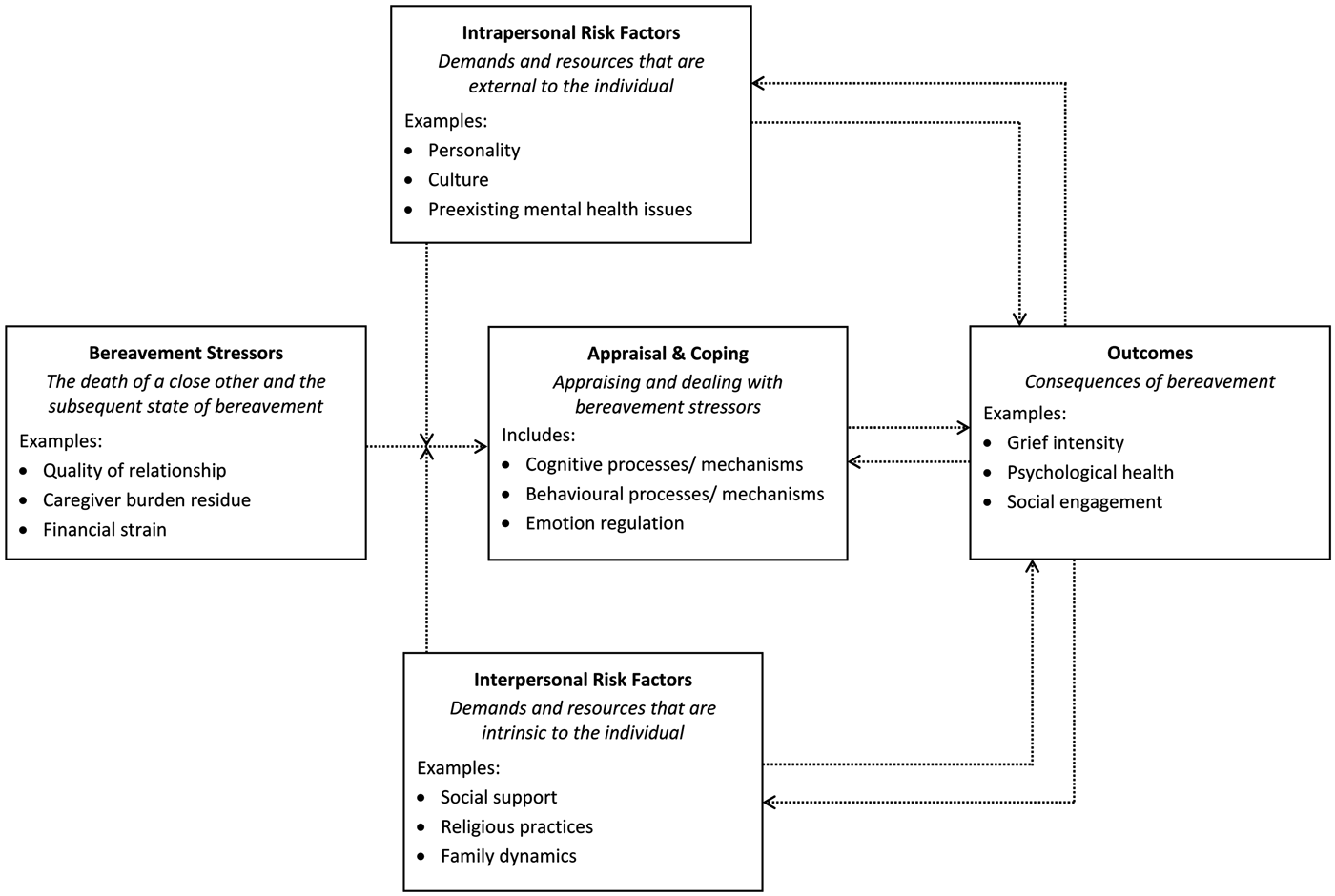
Stroebe and colleagues (Reference Stroebe, Folkman and Hansson2006, p. 1) developed an “integrative risk factor framework” to “enhance understanding of individual differences in adjustment to bereavement and to encourage more systematic analysis of factors contributing to bereavement outcome” (see Figure 1). This framework incorporates an analysis of bereavement stressors, intrapersonal and interpersonal risk and protective factors, and appraisal and coping processes that are postulated to impact outcome. Thus, the framework is intended to guide empirical research toward systematically examining pathways in the adjustment process, including the interactions and relative importance of factors known to influence the adjustment process. The framework is also intended to provide a basis for testing and refining bereavement theories and to improve their predictive potential with respect to bereavement outcomes.
The integrative risk factor framework (Stroebe et al., Reference Stroebe, Folkman and Hansson2006) for prediction of bereavement outcome.

Guided by the integrative risk factor framework, the purpose of this article is to propose a process model of global factors influencing the psychological distress and grief of individuals confronted by death and dying (i.e., those caregiving for a seriously ill loved one or dealing with bereavement). This model is believed to be broad enough to apply to individuals within the general population; however, the focus in this article is on caregivers of palliative care patients. Specifically, we present psychological distress and grief as functions of death attitudes and communication about death and dying, mediated by acceptance and valued living from an acceptance and commitment therapy (ACT) perspective. The model provides a comprehensive and explicitly strengths-based understanding of caregiver coping with issues of death and dying that we believe will be of considerable utility for both research and practice. It primarily expands on the “appraisal and coping” component in the integrative risk factor framework, as acceptance and valued living are theorized to directly impact psychological well-being as well as play a critical mediating role by influencing an individual's perception of a situation and/or their ability to cope with it (Hayes et al., Reference Hayes, Luoma and Bond2006). Hence, we are elaborating on these processes with a view to recommending acceptance- and values- (ACT) based interventions to facilitate both appraisal and coping in caregivers.
The proposed model is designed as a theoretical starting point based on the rationale and research reviewed in this article. It is not assumed that the variables contained in the model are exhaustive, and it is possible that there is variation in the causal directions of the variables in the model. These issues can only be clarified by future research. We provide below an outline of the empirical and theoretical underpinnings for each component of the model and a discussion on the research and clinical implications.
ACCEPTANCE AND COMMITMENT THERAPY (ACT)
Acceptance and valued living are key components of acceptance and commitment therapy (ACT), a form of psychotherapy that encourages individuals to accept unwanted private events (e.g., thoughts, feelings, memories) and engage in values-guided action that gives meaning to their lives (Harris, Reference Harris2006). A common issue for caregivers in the adjustment process is acceptance of a loved one's illness or death and a life without that person. Helping to identify values and pursue goals that are important can assist caregivers in staying engaged and moving forward in life, even when experiencing emotional turmoil. Both acceptance and valued living are therefore likely, at least in theory, to aid someone who is caring for a terminally ill loved one or who has lost a loved one to illness.
ACT proposes that psychological suffering is a normal experience and is rooted in human language and cognition (Hayes, Reference Hayes2004). Human language is a complex system of words, images, sounds, and physical expressions that are employed for a range of cognitive processes—like analyzing, planning, visualizing, remembering, and so on (Harris, Reference Harris2006). One key way in which human language creates psychological suffering is facilitating a struggle with unwanted private events (e.g., thoughts, images, feelings, sensations, urges, and memories) through a process known as experiential avoidance (this is the negative counterpart to our use of “acceptance”) (Harris, Reference Harris2006). Generally, humans successfully solve problems in the external world through strategies to avoid or get rid of a problem—for example, avoiding stormy weather by going inside and getting rid of a headache by taking pain medication. But when this same avoidance-oriented problem-solving approach is applied to the inner world of thoughts and feelings, it is usually less successful and creates further suffering. For example, a caregiver withdrawing from an ill loved one to avoid uncomfortable thoughts and feelings might have an internal dialogue like “I can't help them,” “I'll say the wrong things,” “I can't bear seeing them like this,” accompanied by associated feelings of helplessness, sadness, and anxiety. Although withdrawing briefly from an ill loved one for restorative time alone is not likely to be harmful, if it continues for an extended period the individual may begin to suffer feelings of guilt and self-depreciation. Attempts to control, avoid, or get rid of painful thoughts and feelings can take considerable attention and energy and move us away from what is important and meaningful in our lives.
The aim of ACT is to transform the relationship between thoughts and feelings so that they are no longer perceived as “symptoms” to be avoided, changed, or eradicated, but rather as harmless transient psychological events. By being willing to experience unwanted thoughts and feelings rather than investing time and energy in avoiding them, an individual has a greater capacity to engage in meaningful and fulfilling activities. When combined, acceptance and valued living produce what is referred to as psychological flexibility and contribute positively to well-being (Hayes, Reference Hayes2004). Psychological flexibility is argued to be a fundamental aspect of psychological health (Kashdan & Rottenberg, Reference Kashdan and Rottenberg2010), with its presence contributing positively to well-being and its absence implicated in the development of a variety of psychopathologies. ACT has more than 50 randomized controlled trials supporting its efficacy among a variety of conditions, including depression and anxiety disorders, psychosis, and chronic pain (Hayes et al., Reference Hayes, Luoma and Bond2006; Ruiz, Reference Ruiz2010).
There has been limited research on the application of ACT in grief, death attitudes, and mortality communication among palliative care caregivers. Yet ACT is ideally suited to this area for two key reasons. First, the large acceptance component makes it particularly useful in contexts that involve unchangeable circumstances (Feros et al., Reference Feros, Lane and Ciarrochi2011; Gregg et al., Reference Gregg, Callaghan and Hayes2007; Wicksell et al., Reference Wicksell, Melin and Lekander2009), while the values component provides the motivation to engage in activities that enrich one's life despite such circumstances (Bahraini et al., Reference Bahraini, Devore and Monteith2013; Branstetter-Rost et al., Reference Branstetter-Rost, Cushing and Douleh2009; Harris, Reference Harris2006). Second, ACT is transdiagnostic and has demonstrated benefits to individuals both with and without psychopathology (Kashdan & Rottenberg, Reference Kashdan and Rottenberg2010). Thus, while caregivers are under much stress, it is not necessary that they have any particular diagnosis for the therapy to improve their well-being. Therefore, ACT appears to be a strong approach with which to understand how to support caregivers struggling with issues related to death and dying.
GRIEF
Grief is a normal but often difficult psychological process that occurs in response to a significant loss (Chan et al., Reference Chan, Livingston and Jones2013). The manifestations of grief vary, though emotions such as yearning, sadness, anger, shock, anxiety, and numbness are common (Bruce, Reference Bruce2002; Rando, Reference Rando2000). Acceptance is proposed as an essential component of adjustment to the death of a loved one (Shear, Reference Shear2010) and is implicated in PGD (Kramer et al., Reference Kramer, Kavanaugh and Trentham-Dietz2010a; Prigerson et al., Reference Prigerson, Horowitz and Jacobs2009; Prigerson & Maciejewski, Reference Prigerson and Maciejewski2008; Prigerson et al., Reference Prigerson, Vanderwerker, Maciejewski and Stroebe2008). Among a sample of caregivers of advanced cancer patients, difficulty in accepting an illness was the strongest predictor of PGD symptoms after controlling for patient and caregiver sociodemographics, quality of care, and family conflict (Kramer et al., Reference Kramer, Kavanaugh and Trentham-Dietz2010a). A few studies have explicitly investigated the relationship between experiential avoidance and grief, and have demonstrated that experiential avoidance is a significant predictor of PGD and depressive symptom severity among the general population (Boelen et al., Reference Boelen, van den Bout and van den Hout2010; Morina, Reference Morina2011) and caregivers (Spira et al., Reference Spira, Beaudreau and Jimenez2007).
Communication is also proposed as an important factor in the grief-resolution process. Families that promote open communication about emotional reactions to death and loss report less intense grief over time (Schoka Traylor et al., Reference Schoka Traylor, Hayslip and Kaminski2003). The “grief to personal growth theory” (Hogan & Schmidt, Reference Hogan and Schmidt2002) implicates both experiential avoidance and communication as major components in the coping process of the bereaved. It is proposed that an early part of the coping process of the bereaved is to avoid feelings, images, and thoughts about the deceased. The next step is openly communicate about their thoughts and feelings with others, which facilitates progression from avoidance to personal growth. In this respect, while valued living may be low in the avoidant stage, grief may subsequently encourage valued living by acting as a values clarification process, such that it leads individuals to reconsider and invest in what is essential in their life.
Acceptance and valued living can also be understood within the dual process model of coping with bereavement (Stroebe & Schut, Reference Stroebe and Schut1999), which suggests that bereaved individuals move back and forth between such loss-oriented coping processes as grief work and such restoration-orientated activities as creating a new identity. Both processes are said to be important for working through grief. This is similar to ACT, which facilitates loss- and restoration-oriented coping processes through simultaneous encouragement of acceptance of private events, including the reality of the loss and painful emotions of grief, and engagement in valued activities to create a rich and meaningful life (Romanoff, Reference Romanoff and Neimeyer2012).
Interestingly, grief has not been examined in relation to death attitudes, and it is likely that a caregiver with greater fear of death may experience a greater sense of loss both before and after a loved one's death. On the other hand, a caregiver with greater acceptance of death may view it as a natural part of life that is integral to their worldview, and may therefore be better able to adjust to impending or actual death. This is consistent with meaning-reconstruction theories of grief, which propose that grief can shatter the central organizing beliefs about the self and world that give structure and meaning to life (Fleming & Robinson, Reference Fleming, Robinson and Stroebe2001; Janoff-Bulman, Reference Janoff-Bulman1992). The adjustment process involves modifying core beliefs and schemas in order to accommodate the loss (Fleming & Robinson, Reference Fleming, Robinson and Stroebe2001). Therefore, attempts to reduce fear of death and increase acceptance of death may partially abate caregiver grief, and the impact of death attitudes on grief is an avenue that merits further exploration.
In sum, ACT is a highly befitting approach to expanding our understanding of caregiver grief and the underlying mechanisms responsible for divergent psychosocial outcomes. While acceptance (or experiential avoidance) and communication have already been demonstrated as important contributors to grief, the role of valued living is yet to be empirically examined. Further, neither grief nor ACT has been examined in relation to death attitudes. The implications of death attitudes for caregivers of palliative care patients are outlined next.
DEATH ATTITUDES
An individual's attitudes or orientation toward death represents a factor that is thought to determine their reactions toward issues of death and dying (Neimeyer & Dingemans, Reference Neimeyer and Dingemans1980). Death attitudes are varied: from avoidance of death, motivated by fear, to acceptance of death as a natural and inevitable part of life. Death avoidance is considered a defense mechanism that keeps death away from one's consciousness, whereas death acceptance has been broadly defined as psychological preparedness for the end of life (Wong et al., Reference Wong, Reker, Gesser and Neimeyer1994). Higher levels of death distress (i.e., fear of death, avoidance of death, death anxiety) have been associated with practical issues such as lower likelihood of registering as an organ donor (Knight et al., Reference Knight, Elfenbein and Capozzi2000; Wu, Reference Wu2008) and of discussing advanced care directives with care providers and writing a living will (Dobbs et al., Reference Dobbs, Emmett and Hammarth2012), as well as psychological issues such as caregiver burden (Wang et al., Reference Wang, Chen and Chang2011), poorer caregiver quality of life (Sherman et al., Reference Sherman, Norman and McSherry2010), existential distress and anxiety, and depressive disorders (Neimeyer et al., Reference Neimeyer, Moser and Wittkowski2003; Reference Neimeyer, Wittkowski and Moser2004). Although argued to be unipolar constructs (Neimeyer et al., Reference Neimeyer, Moser and Wittkowski2003), death acceptance generally shows a medium negative association with death distress (Harville et al., Reference Harville, Stokes and Templer2003; Neimeyer et al., Reference Neimeyer, Wittkowski and Moser2004) as well as a positive association with psychological well-being and resilience in the face of loss (Bonanno et al., Reference Bonanno, Wortman and Lehman2002; Thompson et al., Reference Thompson, Chochinov and Wilson2009; Vehling et al., Reference Vehling, Lehmann and Oechsle2011).
Fear of death is thought to be common to the human condition, and thoughts and feelings about loved ones' and one's own mortality may be especially salient at the end of life (Bachner et al., Reference Bachner, O'Rourke and Carmel2011). Nonetheless, research exploring caregiver death attitudes and their impact on outcomes lags behind that for patients, bereaved community members, professional caregivers, and the elderly. Research with patients suggests that the degree of death distress triggered by deteriorating health is a function of interpersonal factors (e.g., family communication, social support) and personal resources (e.g., coping styles, religious beliefs) rather than the illness per se (Neimeyer et al., Reference Neimeyer, Wittkowski and Moser2004). Bachner and colleagues (Reference Bachner, O'Rourke and Carmel2011) found evidence complementary to this for caregivers. Their study revealed that, though both fear of death and mortality communication are direct predictors of psychological distress for nonreligious caregivers, the effect of mortality communication on psychological distress for Jewish caregivers was mediated by fear of death. Similarly, an experimental study among college students found that individuals who are characteristically more accepting of their thoughts and feelings do not produce the typical defensive responses when presented with reminders of death (Niemiec et al., Reference Niemiec, Brown and Kashdan2010). Thus, caregivers are likely to have a variety of interpersonal and intrapersonal factors that interact to affect the degree of death distress they experience.
The nuances of death acceptance are especially limited since research in this area has been much more focused on death distress. Nevertheless, preliminary research suggests positive relationships between death acceptance and existential well-being. For instance, studies show, on the one hand, a positive association between death distress and a lack of meaning or purpose in life and, on the other, a positive association among death acceptance, life satisfaction, and self-worth (Ardelt, Reference Ardelt and Tomer2008; Harville et al., Reference Harville, Stokes and Templer2003; Routledge & Juhl, Reference Routledge and Juhl2010; Tomer & Eliason, Reference Tomer and Eliason2005; van Hiel & Vansteenkiste, Reference van Hiel and Vansteenkiste2009). Existential theorists suggest that fear of death causes people to paradoxically both ruminate and avoid thinking about death, which in turn prevents them from living a full and authentic life (Wong, Reference Wong and Tomer2008; Yalom, Reference Yalom2008). At the same time, having a sense of meaning in life is thought to defend against fear of death because individuals are not so much afraid of death as of incompleteness or lack of self-fulfillment in their lives (Routledge & Juhl, Reference Routledge and Juhl2010; van Hiel & Vansteenkiste, Reference van Hiel and Vansteenkiste2009; Wink, Reference Wink2006). Consistent with this is research suggesting that individuals need to possess a positive attitude toward both life and death in order to reduce fear of death and move toward acceptance (Wong, Reference Wong2009).
Therefore, it would be of considerable interest to formally assess the impact of experiential avoidance and valued living on an individual's acceptance and fear of death. Promoting openness to one's thoughts and feelings and engagement in valued activities might be an effective means to promote accepting attitudes toward death while also reducing fearful attitudes.
COMMUNICATION
Communication between patients and caregivers is a core component of the end-of-life environment and represents both a practical and a psychological concern. The end of life is a time when many important decisions must be made, such as treatment, place of care, and advanced directives, as well as a time for affirming meaningful relationships and saying final goodbyes. However, many caregivers experience difficulties in communicating with patients about their illness, death, and dying, despite an expressed need to do so (Fried et al., Reference Fried, Bradley and O'Leary2005; Kilpatrick et al., Reference Kilpatrick, Kristjanson and Tataryn1998). In a qualitative study involving advanced cancer patients and their caregivers from 26 families, avoidant communication problems was experienced by 65% of families (Zhang & Siminoff, Reference Zhang and Siminoff2003). Discussion became increasingly difficult as death approached, with only 23% of families discussing end-of-life issues. Hospice volunteers, based on their experience and observations, have reported denial as the most common communication issue among patients and their families, followed by dealing with negative feelings (Planalp & Trost, Reference Planalp and Trost2008).
Psychological distress (Zhang & Siminoff, Reference Zhang and Siminoff2003) and family conflict (Kramer et al., Reference Kramer, Kavanaugh and Trentham-Dietz2010b) can mount when communication breaks down. Low levels of disclosure and high levels of holding back between patients and spouses are associated with poorer-functioning relationships (Porter et al., Reference Porter, Keefe and Hurwitz2005), and caregivers who express a desire for more communication have significantly higher caregiver burden scores than caregivers who do not express this desire (Fried et al., Reference Fried, Bradley and O'Leary2005). In a small qualitative study, families characterized by openness versus difficulties with talking about death were found to follow distinct trajectories as the patient's illness progressed (Wallerstedt et al., Reference Wallerstedt, Andershed and Benzein2013). Open communication within the family facilitated communication with health professionals and promoted advanced care planning, which together increased the level of preparation for death. These caregivers described dying and death as a calm and dignified event, and expressed satisfaction with the process and what they were able to achieve for the patient. Where communication was difficult, caregivers relied on assumptions of what the patient wanted rather than preparation with the patient and health professionals. These caregiving situations more often involved experiences of loneliness, vulnerability, anger, and uncertainty (Wallerstedt et al., Reference Wallerstedt, Andershed and Benzein2013).
Breakdown of communication between patients and caregivers also leads to a number of adverse consequences that reduce the quality of caregiver-delivered support. Caregivers often misunderstand the patient's condition and fail to recognize and appreciate the severity of a patient's pain and symptomatology (Glajchen et al., Reference Glajchen, Fitzmartin and Blum1995; Mystakidou et al., Reference Mystakidou, Tsilika and Parpa2006). Unrealistic expectations of the patient's abilities may result, along with further deterioration in the quality of care (Higginson & Costantini, Reference Higginson and Costantini2002). Unsurprisingly, then, poor communication between patients and caregivers can result in the patient being less likely to die at home (Higginson & Costantini, Reference Higginson and Costantini2002), the most preferred place of death (Office for National Statistics, 2013), perhaps because caregivers are not as involved in and able to provide care (Higginson & Costantini, Reference Higginson and Costantini2002).
Research examining the psychological processes involved in patient–caregiver communication difficulties is still in its infancy and primarily qualitative (Harris et al., Reference Harris, Bowen and Badr2009). As mentioned above, Bachner and colleagues (Reference Bachner, O'Rourke and Carmel2011) found that fear of death contributes to greater avoidance of communication about a patient's illness and impending death among Jewish caregivers. Zhang and Siminoff (Reference Zhang and Siminoff2003) found that avoidance of psychological distress and a desire for mutual protection were key drivers of nondisclosure. Participants reported attempts to block out their illness-related thoughts and feelings to prevent emotional distress and so did not want to think about it, let alone talk about it. Participants also reported concealing how they felt from one another and refraining from talking about the illness to prevent upsetting each other. However, as indicated above, the greater the breakdown in communication, the more distress reported by caregivers (Bachner et al., Reference Bachner, O'Rourke and Carmel2011; Higginson & Costantini, Reference Higginson and Costantini2002).
Thus, research related to caregiver–patient communication about end-of-life issues seems to be consistent with an ACT perspective, as avoidance of psychological distress is a typically ineffective coping strategy that perpetuates communication difficulties and paradoxically increases psychological distress. For this reason, it would be valuable to formally examine the impact of experiential avoidance on mortality communication among caregivers of palliative care patients. Further, considering the frequency of communication difficulties and the distress they cause, engaging in open and honest communication may in fact be chosen by caregivers as a target for valued action.
TOWARD AN ACT-BASED MODEL
Caring for a loved one at the end of life is a stressful life event, and each caregiver may respond in a unique way. ACT is an encompassing framework within which to understand and address this range of psychological suffering. Increasing acceptance, or reducing experiential avoidance, has a strong potential to alleviate unnecessary suffering caused from unwanted thoughts and feelings related to grief, fearful attitudes toward death, and communication difficulties. Helping caregivers stay engaged in life by undertaking action that is personally meaningful and fulfilling has a strong potential to help caregivers adjust to their situation and enhance their psychological well-being.
The field of caregiver psychosocial research has been criticized for underutilization of theory and being largely descriptive (McGuire et al., Reference McGuire, Grant and Park2012). With this comes a lack of explanatory and intervention research that is directly transferable to practice (McGuire et al., Reference McGuire, Grant and Park2012). For these reasons, we propose an ACT-based conceptualization situated within the integrative risk factor framework that partially explains caregiver coping with psychological distress and grief. The model enables an appropriately complex and coherent view of factors impacting caregiver coping, taking into account interactions between factors and identifying sources of both vulnerability and resilience. Further, the model enables generation of therapeutic interventions with a clear rationale. The research and clinical implications of this model are described in the following section.
EVALUATION AND APPLICATION OF THE MODEL
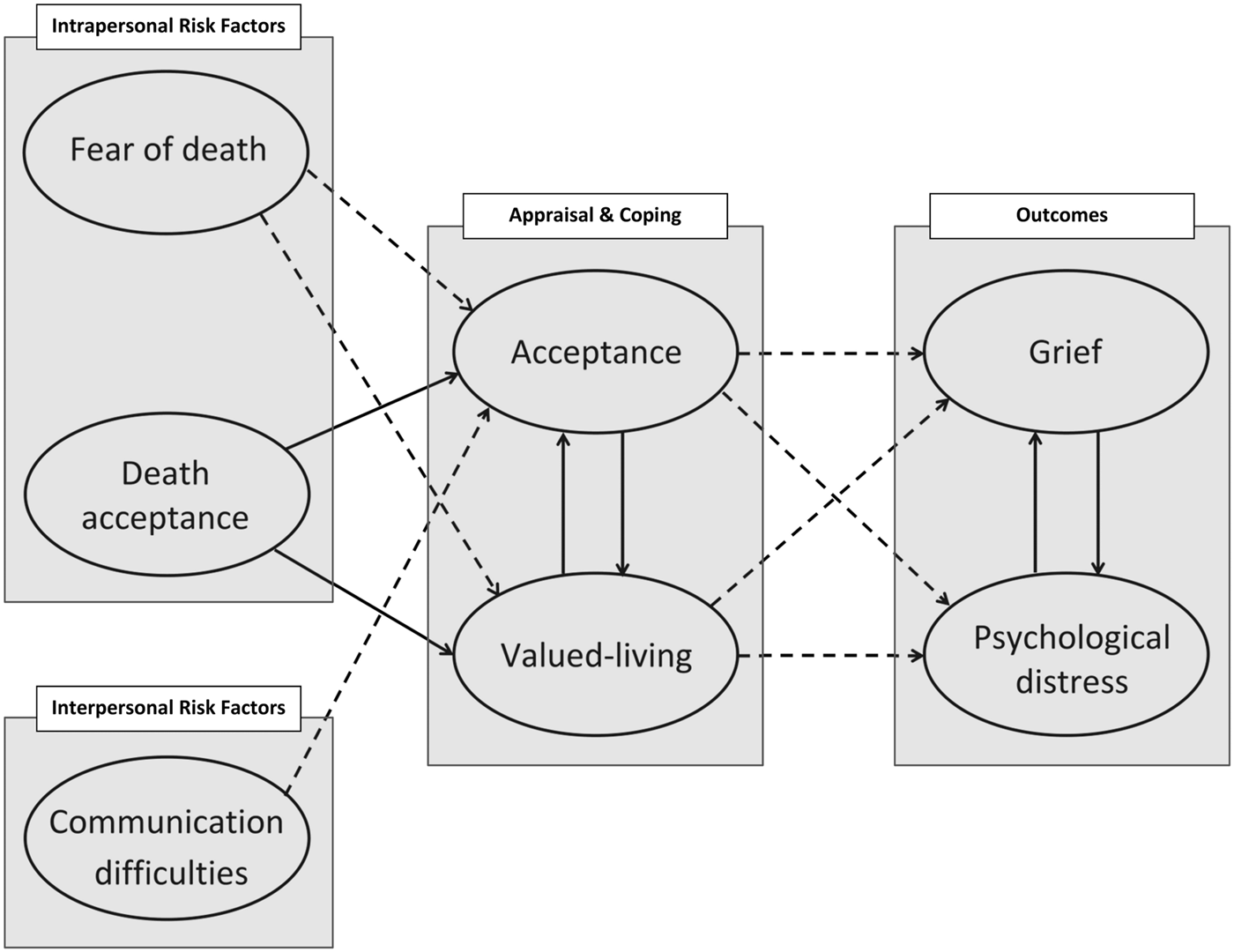
The proposed model and how it is situated within the integrative risk factor framework is illustrated in Figure 2. One advantage to conducting research that is model driven is that it promotes examination of the interactions between key variables in the adjustment process. We suggest that fear of death, death acceptance, and communication are covariates. Acceptance and valued living (partially) mediate the relationship of death attitudes and communication with psychological distress and grief. Further, acceptance and valued living as well as psychological distress and grief share reciprocal relationships such that they contribute positively to each other. To illustrate, consider a caregiver for whom the experience of seeing their loved one dying has elicited their fears of death. We would predict that they experience higher levels of communication difficulties, psychological distress, and grief as a result. However, should the caregiver also have high levels of acceptance or valued living, we would predict that their communication difficulties, grief, and psychological distress resulting from fear of death would be lower.
ACT-based model predicting caregiver grief and psychological distress from death attitudes and communication about death and dying. A positive relationship is represented by a full line and a negative relationship by a dashed line.
Another advantage of model-driven research is that it promotes examination of the relative importance of the factors in the adjustment process. For example, it is unclear how prominent the role of death attitudes is in an individual's grief and the extent to which mortality communication impacts death attitudes and grief. Also, considering the strong relationship between death acceptance and fear of death, it is possible that death acceptance does not predict additional variance over and above that of fear of death. Further, when pre-loss and post-loss grief are compared, there may be different strengths and causal directions of relationships among variables. It is possible that fear of death and valued living play a stronger role in pre-loss grief, as the impending death strongly elicits fears of death and provides an impetus to value the time left. By comparison, death acceptance and general acceptance may take precedence in post-loss grief, as indicated by the literature on the critical role of acceptance in adjustment to loss. Model testing will allow clarification of these complex interactions between caregiver vulnerabilities and resilience.
The model also has implications for clinical practice. Identifying and understanding the key relationships between variables will point to specific interventions to target key processes when coping with end-of-life issues. These include not only development of strategies to deal successfully with fear of death and psychological distress (including avoidance), but also to encourage a more accepting attitude toward death and engagement and fulfillment in life despite suffering or the nearness of the end of life (Tomer, Reference Tomer and Wong2012). For example, if communication difficulties are experienced, clinicians can investigate experiential avoidance as a root cause. They can explore the thoughts, feelings, and avoidance strategies behind the caregiver's communication difficulties and help them come to accept their experiences. If it is found that the caregiver has high levels of fear of death, the clinician may also encourage openness to death-related thoughts and feelings, and engagement in valued activities so as to encourage greater death acceptance.
CONCLUSIONS
We have argued for greater conceptual work and explanatory research in order to develop a more comprehensive understanding of the factors influencing psychosocial caregiver outcomes and ultimately to inform practice. We have presented our theoretically and empirically driven model as a step forward in addressing this need. It is part of a reflexive and cumulative model-building process, one that is open to revision secondary to empirical tests. Application of the model in research will further our understanding of the complex interpersonal and intrapersonal caregiving environments, and eventually inform and expand the type and comprehensiveness of support we can offer to caregivers.