INTRODUCTION
Very recently, Williamson (Reference Williamson2021) posited that innovation suffers from de-globalization, i.e., ‘the process of weakening interdependence among nations’ (Witt, Reference Witt2019a), as the increasing nationalistic and protectionist policies such as America First (Evenett, Reference Evenett2019) stifle firms’ capability to identify, access, and integrate specialist knowledge scattered across the globe (Doz, Santos, & Williamson, Reference Doz, Santos and Williamson2001). This is a challenge for emerging market multinational enterprises (EMNEs), as they utilize internationalization as a springboard to accelerate their acquisition of resources, integration of knowledge, and advancement of ‘compositional innovation’ (Li, Prashantham, Zhou, & Zhou, Reference Li, Prashantham, Zhou and Zhou2021; Xie & Li, Reference Xie and Li2018). Chinese enterprises, in particular, are most likely to suffer (Witt, Reference Witt2019b), as they are also the target victims of decoupling, i.e., ‘the deliberate dismantling – and eventual re-creation elsewhere – of some of the sprawling cross-border supply chains that have defined globalization and especially the US-China relationship in recent decades’ (Johnson & Gramer, Reference Johnson and Gramer2020).
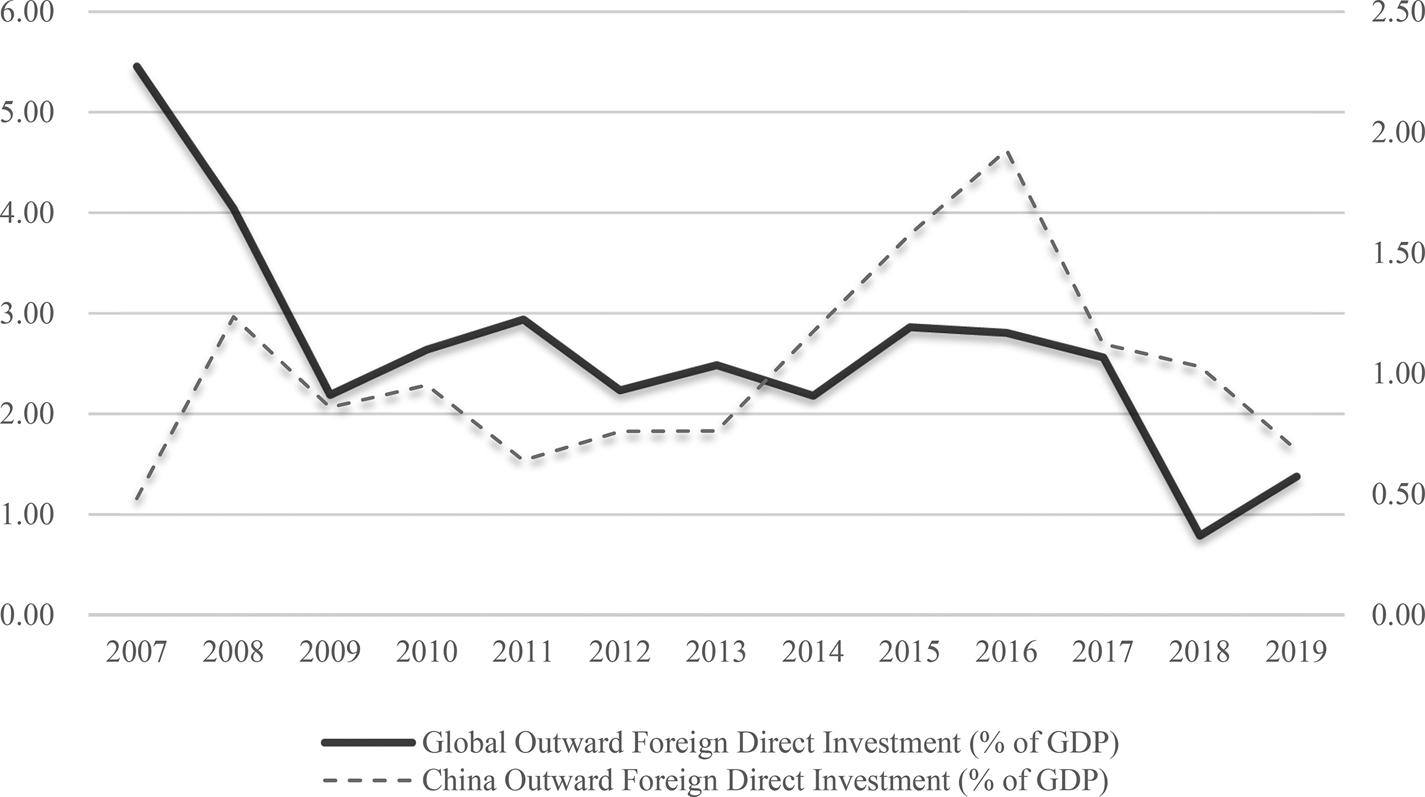
It has been posited that de-globalization has been in progress for several years, starting around 2008 after the financial crisis in the United States (James, Reference James2018; Kobrin, Reference Kobrin2017; Witt, Reference Witt2019a). Accordingly, global outward foreign direct investment (OFDI) as a percentage of GDP declined steadily since 2007 (see Figure 1). In contrast, Chinese OFDI has actually accelerated in the same period, indicating the continuous global expansion of Chinese enterprises against de-globalization, at least in its early years. The inauguration of the Trump administration in 2017, however, symbolized the start of an era when the notion of decoupling between the US and China was written into actual policies in the US (Hu, Tian, Wu, & Yang, Reference Hu, Tian, Wu and Yang2021), followed by other countries such as India (Li, Lewin, Witt, & Välikangas, Reference Li, Lewin, Witt and Välikangas2021) and possibly Western-style democracies more broadly (Witt, Li, Välikangas, & Lewin, Reference Witt, Li, Välikangas and Lewin2021). Coincidently, Chinese OFDI dropped sharply after 2016.
Global and Chinese OFDI from 2010–2019
Source: World Bank Database.

Our analysis of publicly listed firms in China (2010–2019) reveals that the degree of a Chinese enterprise's internationalization was positively related to its innovation performance before 2016. After 2016, this impact weakened and ceased to exist in conjunction with the Trump presidency in the US. While more research is needed to determine the causal relationship, these results seem to suggest that there might have been a tipping point between 2016 and 2017 when internationalization ceased to be an effective strategy for Chinese enterprises to boost innovation amidst decoupling and attendant de-globalization.
DECOUPLING AND DE-GLOBALIZATION UNDERMINE COMPOSITIONAL INNOVATION
Decoupling and de-globalization undermine strategies involving innovation through internationalization. As documented in previous studies (e.g., Hsu, Lien, & Chen, Reference Hsu, Lien and Chen2015; Khan, Rao-Nicholson, & Tarba, Reference Khan, Rao-Nicholson and Tarba2016), internationalization can be an essential way for EMNEs to increase innovation (Li et al., Reference Li, Lewin, Witt and Välikangas2021; Luo & Tung, Reference Luo and Tung2007, Reference Luo and Tung2018), but this strategy assumes a pro-globalization context (i.e., a free flow of knowledge, labour, and capital across national borders). Through internationalization, EMNEs can leverage diverse knowledge, information, and resources scattered across global markets; increase their organizational knowledge by learning from leading global companies; hire skilled talent; and engage in a wide range of international cooperation. In an era of decoupling and de-globalization, i.e., when a pro-globalization context ceases to continue, the above assumption no longer holds.
First, firms are less capable of obtaining the diverse specialized knowledge and technology available in different ‘centres of excellence’ around the globe. The Huawei ban in the US market, as well as the limited access to chip supply, is just an example (Hosain, Reference Hosain2019). Backlashes against globalization make countries more sensitive and cautious in terms of protecting their intellectual property from spilling over to other competitors in the name of national security. For example, the Committee on Foreign Investment in the United States (CFIUS) has imposed stringent controls on and inspections of foreign investments involving key technology and data-sensitive industries; additionally, similar regulations have been enacted in other countries, including the United Kingdom, France, and Germany. Consequently, firms have fewer opportunities to access foreign advanced technology, and these regulations are ultimately detrimental to firm innovation.
Second, decoupling and de-globalization may lead to a constraint on the free flow of skilled scientific and technological labour across countries. American, British, and Australian governments have curbed offshoring and immigration (e.g., H-1B visas in the US) and limited firms’ ability to hire internationally. Such restrictions result in the skilled talent of supply countries (e.g., India and China) tending to be retained in their home countries instead of migrating overseas (Farndale, Thite, Budhwar, & Kwon, Reference Farndale, Thite, Budhwar and Kwon2020), and this reduced labour mobility hinders the transfer and exchange of innovative ideas and knowledge. Overall, with the disruption of global networks resulting from ongoing de-globalization movements, firms’ ability to use internationalization as a pathway to enhance their innovation is at risk of declining.
IMPACT OF INTERNATIONALIZATION ON INNOVATION FOR CHINESE FIRMS BEFORE AND AFTER 2016
China became the second largest investor in the world in terms of outward investment for the first time in 2016. However, Chinese companies face a range of novel challenges because of de-globalization and superpower rivalry (Witt, Reference Witt2019b), such as the US-China trade wars and other countries’ restrictions on Chinese firms’ exports and technology acquisition. As shown in Figure 1, China's OFDI declined for the first time in 2017, after a steady increase since 2010.
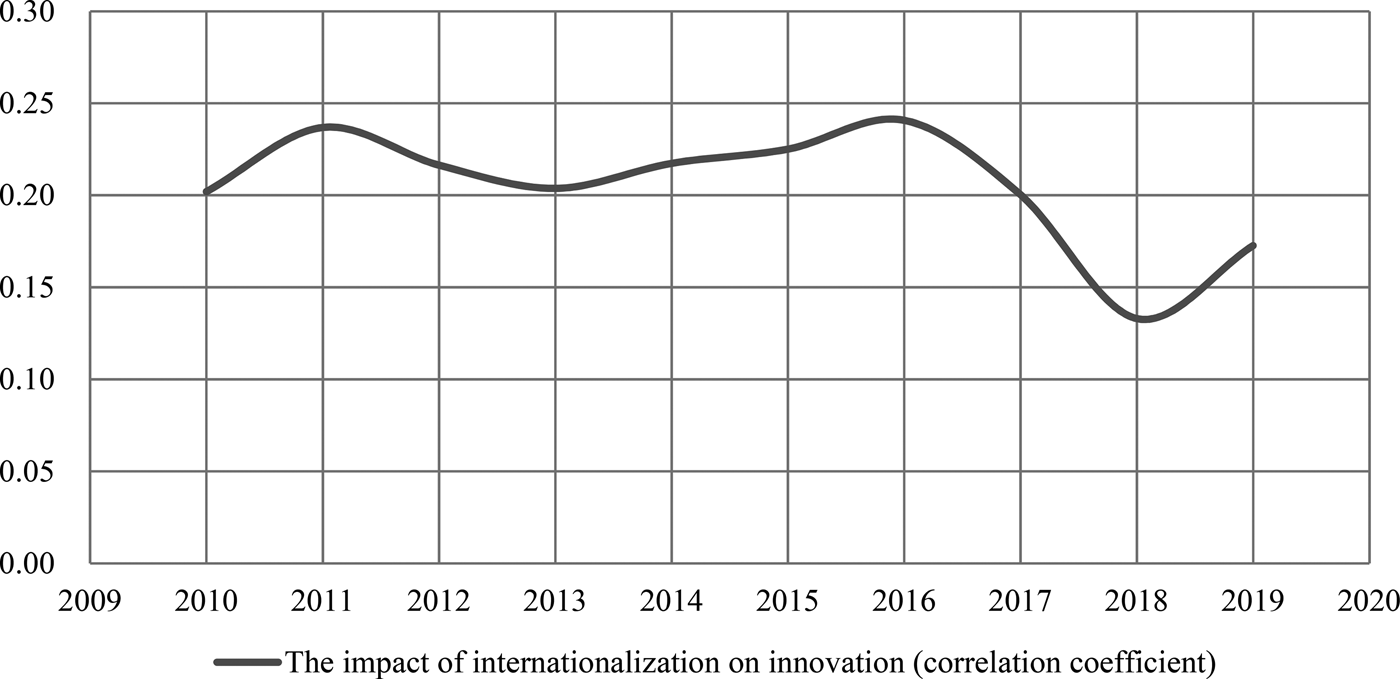
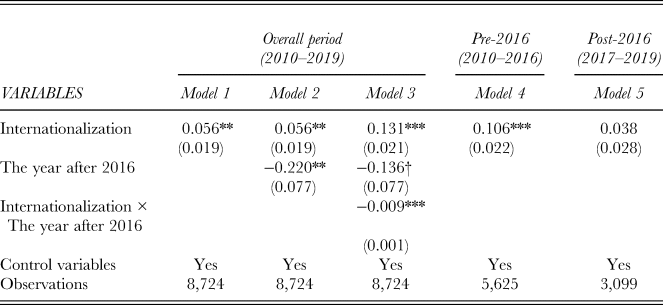
We split the sample of Chinese listed companies into two periods and statistically examined how internationalization had affected innovation before and after 2016. A firm's degree of internationalization (i.e., the ratio of foreign sales over total sales) was positively related to its innovation performance (i.e., the log-transformed number of patents applications) before 2016, but this relationship was weakened after 2016 (see Figure 2). The dummy variable of years after 2016 negatively moderated the relationship (see Table 1). After splitting the data, we found that the relationship before 2016 was stronger than that corresponding to the overall period. Before 2016, innovation performance increased by 0.106 (i.e., approximately 11% more patent applications) for every 1% increase in a firm's degree of internationalization; after 2016, however, internationalization had no effect on innovation performance.
The correlation coefficient between the examined Chinese listed firms’ internationalization and innovation
Source: The innovation data (number of firm patent applications) come from the State Intellectual Property Office of China; the internationalization data (ratio of foreign sales to total sales) come from the WIND database.

Generalized estimating equation (GEE) regression analysis of innovation performance among publicly listed firms in China (2010–2019)

Notes: Standard errors are in parentheses. † p<0.1, *** p<0.001, ** p<0.01, and * p<0.05. Internationalization is measured as the ratio of foreign sales over total sales; innovation performance was measured as the log-transformed number of patents applications; control variables include firm size, debt-to-asset ratio, free cash flow, firm age, CEO duality, provincial marketization, and year and industry fixed effects. All variables were winsorized at the 1st and 99th percentiles to reduce the potential influence of outliers; the explanatory variables were lagged by one year and standardized.
DISCUSSION
Exploring the impact of decoupling and attendant de-globalization on innovation (Williamson, Reference Williamson2021), our study provides some initial empirical evidence showing that the internationalization-innovation relationship weakened among Chinese enterprises after 2016. While this evidence alone is likely insufficient to prove the causal relationship, it demonstrates the likelihood that the compositional springboard strategy (Li et al., Reference Li, Lewin, Witt and Välikangas2021; Luo & Tung, Reference Luo and Tung2007, Reference Luo and Tung2018) might have become less effective for Chinese enterprises to catch up to firm innovation as a result of decoupling policies.
Considering the difficulties for EMNEs to execute springboard strategies due to decoupling and de-globalization (Luo & Witt, Reference Luo and Witt2021), how do EMNEs respond to this new reality and keep innovating? Luo and Witt (Reference Luo and Witt2021) proposed the double-loop springboard strategy emphasizing inward internationalization along with OFDI. Interestingly, the Chinese government recently unveiled the ‘dual circulation’ strategy – which places a greater focus on the domestic market (internal circulation) that is supplemented by the international market (external circulation) – to adapt to an increasingly unstable and hostile world. According to the World Intellectual Property Organization (WIPO), China surpassed the US in 2019 as the top source of international patent applications filed with WIPO, indicating the possibility that Chinese enterprises have managed to innovate since 2016. Does this mean that Chinese enterprises, and EMNEs more broadly, can still innovate in a world plagued by decoupling and de-globalization by relying more on innovation at home and/or inward internationalization? How effective are these strategies? Future research is needed to answer these questions.