Effective disinfection of contaminated environmental surfaces and equipment is essential to preventing transmission of Clostridium difficile spores in healthcare facilities.Reference Donskey 1 – Reference Dubberke, Carling and Carrico 3 In several quasi-experimental studies, substitution of sporicidal disinfectants for nonsporicidal agents has been associated with reductions in CDI.Reference Donskey 1 Therefore, sporicidal disinfectants are recommended for disinfection of surfaces in rooms of patients with C. difficile infection (CDI), particularly in outbreak and hyperendemic settings.Reference Dubberke, Carling and Carrico 3 However, even when sporicidal disinfectants are used, it is not uncommon for spore contamination to be detected on surfaces after completion of manual cleaning and disinfection.Reference Donskey 1 , Reference Sitzlar, Deshpande, Fertelli, Kundrapu, Sethi and Donskey 4 Such contamination has been attributed primarily to suboptimal application of disinfectants, a common problem in healthcare facilities.Reference Sitzlar, Deshpande, Fertelli, Kundrapu, Sethi and Donskey 4 – Reference Eckstein, Adams, Eckstein, Aron, Yadavalli and Donskey 7
In recent years, 2 strategies have been demonstrated to improve eradication of spores from surfaces in CDI rooms in settings where sporicidal disinfectants are used. First, monitoring of cleaning with feedback to environmental services (EVS) personnel has been effective in improving disinfection of spores.Reference Sitzlar, Deshpande, Fertelli, Kundrapu, Sethi and Donskey 4 , Reference Eckstein, Adams, Eckstein, Aron, Yadavalli and Donskey 7 For example, recovery of spores from surfaces in CDI rooms after cleaning was significantly reduced through an intervention that included feedback on the thoroughness of cleaning based on fluorescent marker removal and effectiveness of surface disinfection based on cultures.Reference Sitzlar, Deshpande, Fertelli, Kundrapu, Sethi and Donskey 4 Second, the use of automated room-disinfection devices (eg, hydrogen peroxide vapor, ultraviolet-C light) as an adjunct to standard cleaning has been shown to reduce levels of C. difficile spores and other pathogens on surfaces.Reference Boyce, Havill and Otter 8 , Reference Nerandzic, Cadnum, Pultz and Donskey 9
Although interventions have been shown to improve eradication of C. difficile spores, there remains an urgent need for high-quality evidence regarding whether such efforts are effective in reducing the incidence of healthcare-associated CDI. Reductions in CDI have been reported with adjunctive use of automated room disinfection devices.Reference Cooper, O’Leary, Yezli and Otter 10 – Reference Levin, Riley, Parrish, English and Ahn 13 However, confounding factors and regression to the mean cannot be excluded given the quasiexperimental design of the studies, and there is a potential for reporting bias because ineffective interventions may not be submitted for publication. Moreover, Valiquette et alReference Valiquette, Cossette, Garant, Diab and Pepin 14 reported that an intensive effort to improve environmental disinfection by EVS personnel was ineffective in controlling an outbreak of CDI. Here, we report findings of a multicenter, randomized trial to determine the effect of an environmental disinfection intervention on the incidence of healthcare-associated CDI. The intervention focused on improving environmental disinfection by monitoring EVS performance and providing feedback.
METHODS
Study Setting and Design
We conducted a multicenter, randomized trial in 16 northeastern Ohio hospitals to determine the effect of an environmental disinfection intervention on the incidence of healthcare facility–onset, healthcare facility–associated (HO-HCFA) CDI.Reference McDonald, Coignard, Dubberke, Song, Horan and Kutty 15 The intervention focused on improving environmental disinfection by monitoring EVS performance and providing feedback to EVS and infection control staff. Monitoring and feedback were performed using a fluorescent marker method to improve the thoroughness of daily and postdischarge cleaning of high-touch surfaces and using cultures of high-touch surfaces after patient discharge to assess the effectiveness of disinfection.Reference Sitzlar, Deshpande, Fertelli, Kundrapu, Sethi and Donskey 4 , Reference Carling, Briggs, Perkins and Highlander 5 Daily disinfection of high-touch surfaces in CDI rooms was emphasized given recent evidence that daily cleaning can be useful to reduce acquisition of spores on hands of personnel.Reference Kundrapu, Sunkesula, Jury, Sitzlar and Donskey 16
Of the 16 acute-care hospitals enrolled in the study, 8 were randomized to the intervention arm and 8 were randomized to the control arm. Each of the hospitals was stratified according to healthcare-associated CDI incidence into 4 groups. For each group of 4 hospitals, 2 hospitals were randomly assigned to the intervention group and 2 were assigned to the control group using software available at www.randomizer.org. A single intervention hospital dropped out prior to the start of the study. Thus, the study included 7 intervention and 8 control hospitals. The institutional review boards for each of the study facilities approved the study protocol. Informed consent was not obtained from patients or EVS personnel because the study procedures were deemed standard practice and no identifying information was collected.
Diagnostic testing and infection prevention strategies for CDI were similar for all facilities. All hospitals used nucleic acid amplification tests for diagnosis of CDI. All hospitals used commercially pre-prepared bleach wipes for daily and terminal disinfection of CDI rooms; 4 of 8 control hospitals (50%) and 2 of 7 intervention hospitals (29%) used bleach in all rooms after patient discharge. Also, 4 control hospitals and 4 intervention hospitals maintained CDI patients in contact precautions until discharge. Moreover, 6 control hospitals and 4 intervention hospitals stated that they conducted intermittent monitoring of cleaning using either fluorescent markers or adenosine triphosphate (ATP) testing, but none reported routine monitoring with regular feedback to EVS personnel. The policies of all hospitals included preemptive isolation of suspected CDI patients, but the timing of isolation was not monitored.
Intervention
A 12-month intervention was conducted in the 7 intervention hospitals. The start dates of the intervention were staggered for the different hospitals based on the preferences of the facilities and availability of study coordinators (ie, the initial months of the study required much more intensive education and training than later months). The first intervention began in February 2013 and the last began in November 2013; 5 of the interventions began between May and August 2013. During a 3-month period before the start of the intervention, postdischarge cultures of high-touch surfaces (ie, 5×10-cm areas of the bed rail and bedside table and entire surface area of the call button and telephone) for C. difficile were collected using premoistened BBL Culture Swabs (Becton Dickinson, Cockeysville, MD) from CDI and non-CDI rooms in control and intervention hospitals; the goal was to collect cultures from 10 CDI rooms if available and from 10 or more non-CDI rooms. In intervention hospitals, the fluorescent marker method was used to assess thoroughness of daily and postdischarge cleaning of high-touch surfaces in CDI rooms and of post-discharge cleaning of non-CDI rooms.Reference Sitzlar, Deshpande, Fertelli, Kundrapu, Sethi and Donskey 4 , Reference Carling, Briggs, Perkins and Highlander 5 Five surfaces were monitored for daily cleaning and 10 for postdischarge cleaning (the number of actual sites varied based on availability of the surfaces for marking).
For the 7 intervention hospitals, the intervention began with a meeting with infection control personnel, EVS supervisors, and hospital administrators. The study team presented an overview of the purpose of the study and a summary of the baseline marker removal and culture data for the facility. During a 1-month wash-in period, study staff worked with EVS supervisors to provide education to EVS personnel including demonstrations of how monitoring would be conducted and the sites that would be monitored. During the subsequent 12 months, study personnel provided aggregate feedback each month on fluorescent marker removal and culture results. Individual EVS staff members and their supervisors received feedback on daily and postdischarge cleaning based on fluorescent marker removal. For hospitals with limited improvement in cleaning or whose performance waned after initial improvement, additional meetings were held with infection control personnel, EVS supervisors, and hospital administrators, and additional education was provided to EVS personnel.
For the 8 control hospitals, no feedback or education were provided. In addition to the baseline cultures, postdischarge cultures from CDI and non-CDI rooms were collected during a 1-month period between 4 and 9 months after collection of the baseline cultures.
Outcomes
The primary outcome measure was the incidence of HO-HCFA CDI. Secondary outcomes included (1) thoroughness of postdischarge cleaning of high-touch surfaces in CDI and non-CDI rooms, (2) thoroughness of daily cleaning of high-touch surfaces in CDI rooms based on fluorescent marker removal, and (3) effectiveness of disinfection of CDI and non-CDI rooms based on postdischarge cultures of high-touch surfaces for C. difficile.
Microbiology
Clostridium difficile was cultured on selective media as previously described.Reference Sitzlar, Deshpande, Fertelli, Kundrapu, Sethi and Donskey 4 Clostridium difficile was confirmed on the basis of typical odor and appearance of colonies and by a positive reaction using C. difficile latex agglutination (Microgen Bioproducts, Camberly, UK).
Data Analysis
Based on HO-HCFA CDI incidence of ~6 per 10,000 patient days (1,068 cases and 1,683,928 patient days) in the study facilities in 2009, we estimated >95% power to detect a 25% reduction in the incidence of HO-HCFA CDI and 70% power to detect a 15% reduction. The incidence of HO-HCFA CDI for individual hospitals and on average for control versus intervention hospitals was graphed for the 1-year periods before, during, and after the intervention. For each of the control hospitals, May 1, 2013, was chosen as the start of the year for comparison to the intervention period. A linear mixed model was used to compare CDI rates in the intervention and postintervention periods for control and intervention hospitals, estimating the interaction effect of intervention versus no intervention and time with a random hospital effect. No other covariates were included in the linear mixed model because it was assumed that randomization would balance other covariates. Additional nonlinear mixed models were used to assess the effect of the intervention on fluorescent marker removal, looking at marker removal from postdischarge cleaning in CDI and non-CDI rooms and from daily cleaning in CDI rooms. Tests of proportions were used to assess reductions in the percentage of rooms with positive cultures in the intervention arm. Data were analyzed using R 3.2.2 with lme4 and lmtest packages.Reference Bates, Maechler, Bolker and Walker 17
RESULTS
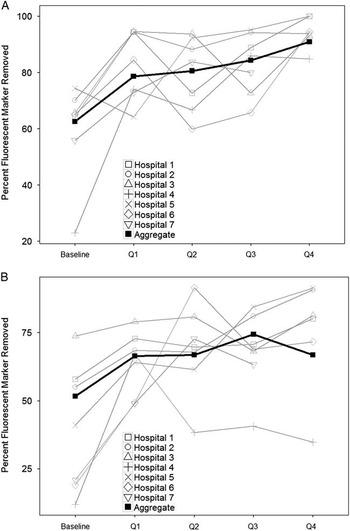
Figure 1 shows the percentage removal of fluorescent marker from high-touch surfaces for individual intervention hospitals and on average. The intervention resulted in a significant increase in fluorescent marker removal in CDI and non-CDI rooms that was sustained during the intervention year. For cleaning postdischarge in CDI and non-CDI rooms, the average percentage of marker removal increased from 63% (1,641 sites with marker removal of 2,624 total sites in 235 total rooms; range, 23% to 74% for individual hospitals) to 82% (4,407 sites with marker removed of 5,346 total sites in 650 total rooms; range, 64% to 100% for individual hospitals) during the study period (P<.001) (Figure 1A). For daily cleaning in CDI rooms, the average percent marker removal increased from 52% (1,534 sites with marker removal of 2,969 total sites in 435 total rooms; range, 12% to 74% for individual hospitals) to 69% (6,731 sites with marker removal of 9,704 total sites in 1,354 total rooms; range, 35% to 91% for individual hospitals) (P<.001) (Figure 1B).
Removal of fluorescent marker from surfaces after postdischarge cleaning of Clostridium difficile infection (CDI) and non-CDI rooms (A) and after daily cleaning of CDI rooms (B) from 7 intervention hospitals at baseline and during the intervention year. The thick line shows aggregate mean values for marker removal for all sites assessed and the thinner lines show mean values for the individual intervention hospitals. Abbreviation: Q, quarter of the study year.

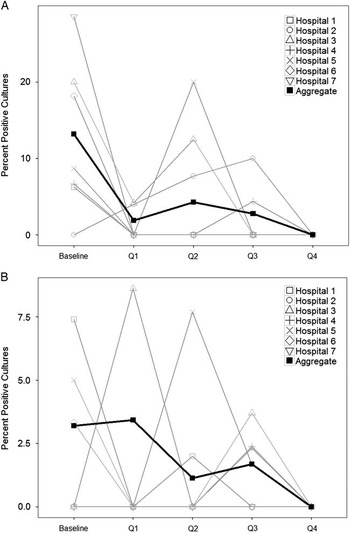
Figure 2 shows the percentages of rooms with positive cultures for C. difficile after postdischarge cleaning in CDI and non-CDI rooms for the intervention and control hospitals. No significant differences in the percentages of rooms with positive cultures for the control versus intervention hospitals in the baseline period. The intervention resulted in a significant reduction in the percentage of CDI rooms with positive cultures for C. difficile (from 13%, 19 of 144 rooms to 3%, 8 of 304 rooms; P<0.01) after postdischarge cleaning. The intervention also resulted in reductions in the percentage of non-CDI rooms with positive cultures for C. difficile (from 3% [4 of 125] to 2% [11 of 721]; P=.35).
Effect of the cleaning intervention on percentage of rooms with positive cultures for Clostridium difficile from high-touch surfaces after cleaning following patient discharge from C. difficile infection (CDI) (A) and non-CDI (B) rooms in the 7 intervention hospitals. Abbreviation: Q, quarter of the study year.

In the control hospitals, there were no significant reductions in the overall percentage of CDI rooms with positive cultures for C. difficile (19% [10 of 54] and 14%, 8 of 58; P=.23) after postdischarge cleaning. In addition, there was no reduction the percentage of non-CDI rooms with positive cultures for C. difficile (6% [6 of 95] and 5% [10 of 199]; P=.86) after postdischarge cleaning.
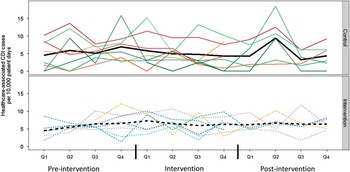
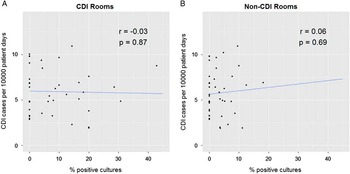
Figure 3 shows the incidence of HO-HCFA CDI for the control (top panel) versus intervention (bottom panel) hospitals during the preintervention, intervention, and postintervention 1-year periods. The incidence of HO-HCFA CDI was not significantly different for the control and intervention hospitals during the preintervention period: average CDI incidence: 5.6 per 10,000 patient days versus 5.8 per 10,000 patient days, respectively (P=.80). Based on a linear mixed model predicting monthly CDI cases per 10,000 patient days across the 3 years with a random hospital effect considering the effect of the intervention and time, no significant differences were observed in CDI rates in the intervention or postintervention periods across the 2 treatment periods. Moreover, there was no significant correlation between the percentage of positive cultures for C. difficile after cleaning of CDI or non-CDI rooms and the incidence of healthcare-associated CDI (Figure 4).
Incidence of healthcare-facility–onset, healthcare-facility–associated (HO-HCFA) Clostridium difficile infection (CDI) for 8 control (top panel) versus 7 intervention (bottom panel) hospitals during the preintervention, intervention, and postintervention periods. The thicker lines show mean values for control and intervention hospitals; the thinner lines show data for individual hospitals. For 2 control and 2 intervention hospitals, data was not available during the postintervention period. For 1 intervention hospital, data was not available for quarter 1 and quarter 2 of the preintervention period. Abbreviation: Q, quarter of the study year.

Correlation between positive cultures in Clostridium difficile infection (CDI) and non-CDI rooms after postdischarge cleaning and incidence of healthcare-facility–onset, healthcare-facility–associated (HO-HCFA) CDI for control and intervention hospitals.

DISCUSSION
We found that contamination of high-touch surfaces with C. difficile spores was common after completion of cleaning prior to the intervention, particularly in CDI rooms. The intervention resulted in improved thoroughness of cleaning based on significant increases in fluorescent marker removal from high-touch surfaces in CDI and non-CDI rooms. The effectiveness of disinfection also improved based on significant reductions in recovery of C. difficile from high-touch surfaces in CDI rooms. However, the intervention did not result in a reduction in the incidence of HO-HCFA CDI in the intervention hospitals during the intervention or post-intervention periods. Moreover, there was no correlation between the percentage of positive cultures after cleaning of CDI or non-CDI rooms and the incidence of healthcare-associated CDI.
There are several potential explanations for why the intervention failed to reduce the incidence of HO-HCFA CDI. First, the level of improvement in disinfection of high-touch surfaces may not have been sufficient to prevent transmission. Although disinfection was improved in the intervention hospitals, recovery of spores was not uncommon during the intervention. Moreover, the use of swabs for collection of cultures is relatively insensitive, and it is possible that small numbers of undetected spores persisted on surfaces.Reference Otter, Havill, Adams, Cooper, Tauman and Boyce 18 Second, the intervention focused on high-touch surfaces in patient rooms and may have missed other environmental sources of transmission. Such sources could include portable equipment, which may be infrequently cleaned, and floors that are typically cleaned with nonsporicidal products.Reference Donskey 1 , Reference Koganti, Alhmidi, Tomas, Cadnum, Jencson and Donskey 19 In a recent study, a benign virus placed on the floor in a patient room rapidly disseminated to high-touch surfaces, adjacent rooms, and personnel work areas.Reference Koganti, Alhmidi, Tomas, Cadnum, Jencson and Donskey 19
Third, the intervention may not have adequately addressed environmental shedding by asymptomatic carriers of toxigenic C. difficile, an important potential reservoir for transmission.Reference Donskey, Kundrapu and Deshpande 20 – Reference Longtin, Paquet-Bolduc and Gilca 22 Although efforts were made to improve cleaning in all rooms, CDI rooms were the major focus of the intervention. More intensive efforts to clean and disinfect non-CDI rooms might be required to reduce the risk for transmission by undetected carriers. Fourth, interventions that focus solely on environmental disinfection may be insufficient to prevent transmission of C. difficile. It is possible that interventions that include environmental disinfection as a bundle component may be more effective. Recent studies have suggested that antimicrobial stewardship focused on high-risk antibiotics such as fluoroquinolones should be emphasized for control of C. difficile.Reference Dingle, Didelot and Phuong Quan 23 , Reference Donskey 24
Finally, the intervention may have been unsuccessful because a significant proportion of CDI cases that are currently classified as healthcare-associated may not be acquired in hospitals. In a recent large study from the United Kingdom that used whole-genome sequencing to type C. difficile isolates, only a minority of CDI cases were linked to other cases in hospitals.Reference Eyre, Cule and Wilson 25 Other recent studies have reported that a significant proportion of patients diagnosed with healthcare-associated CDI are already colonized with the infecting strain at the time of admission.Reference Tschudin-Sutter, Carroll and Tamma 26 , Reference Kamboj, Sheahan and Sun 27 Environmental cleaning would not have an impact on cases where colonization is present on admission.
Our findings differ from recent reports suggesting that adjunctive use of automated room disinfection devices might be effective in reducing CDI rates.Reference Cooper, O’Leary, Yezli and Otter 10 – Reference Levin, Riley, Parrish, English and Ahn 13 It is possible that use of such devices may offer a benefit over interventions, such as ours, that focus on improving the performance of EVS personnel. However, in a large, cluster-randomized, multicenter, crossover study, adjunctive use of ultraviolet-C room disinfection devices was associated with reduced colonization or infection with multidrug-resistant organisms but not CDI.Reference Anderson, Chen and Weber 28 In that study, room disinfection with bleach was compared to bleach plus adjunctive ultraviolet-C room disinfection.
Our study has several strengths. We included monitoring to confirm the effectiveness of the intervention. One limitation of many previous studies is that monitoring has often not been adequate to confirm that interventions resulted in actual reductions in spore contamination. Second, we included multiple methods of monitoring, including assessments of both thoroughness of cleaning and effectiveness of surface disinfection. Third, the study was conducted as a randomized trial. Previous reports suggesting that cleaning interventions reduce CDI have been quasiexperimental in design.
Our study also has several limitations. First, the quality of the intervention varied among the different intervention hospitals. It involved efforts to improve cleaning by large numbers of EVS personnel with varying levels of support from EVS supervisors, infection control departments, and hospital administrations. In addition, there may have been variability in the ability of different study coordinators to effectively implement the intervention. Despite the potential for variation among facilities, we found evidence of improved cleaning in all intervention hospitals. Second, the study was not blinded. The nonintervention hospitals were aware of the study and coordinators were present to conduct monitoring during the baseline period and intermittently during the study. However, monitoring of the control hospitals was much less intensive than for the intervention facilities, and no feedback was provided. Third, as noted previously, the method used for culturing surfaces was relatively insensitive, and we cannot exclude the possibility that low-level contamination was present that might have contributed to transmission. Fourth, the study was conducted in a setting in which all hospitals were using sporicidal disinfectants in CDI rooms. The intervention may have had an impact on CDI rates in settings in which nonsporicidal disinfectants were used. Fifth, many of the study hospitals were conducting some form of intermittent monitoring of cleaning prior to the beginning of the study. However, none of the hospitals reported routine monitoring with regular feedback to EVS personnel. Sixth, we did not perform molecular typing to determine whether HO-HCFA CDI cases could be linked to other healthcare-associated cases. Finally, we only examined the impact of the intervention on CDI rates. Admission to a room previously occupied by a patient colonized or infected with healthcare-associated pathogens is associated with an increased risk of acquiring the same pathogen.Reference Mitchell, Dancer, Anderson and Dehn 29 In addition, environmental disinfection interventions have been associated with reductions in colonization or infection with pathogens other than C. difficile in some, but not all, studies.Reference Donskey 1 , Reference Datta, Platt, Yokoe and Huang 30 , Reference Wilson, Smyth and Moore 31 Further work is needed to determine whether the current intervention had an impact on the incidence of infections due to other organisms.
In conclusion, our results add to the growing body of evidence that environmental disinfection can be improved through interventions that include monitoring and feedback directed toward EVS personnel. Both thoroughness of cleaning and effectiveness of disinfection were significantly improved in the intervention facilities. However, the intervention did not result in a reduction in the incidence of healthcare-associated CDI. Additional studies are therefore needed to identify effective strategies to reduce the incidence of healthcare-associated CDI.
ACKNOWLEDGMENTS
Financial support: A grant from the Agency for Healthcare Research and Quality to C.J.D. (grant no. 1R1845020004-01A1) and a grant from the Department of Veterans Affairs supported this study.
Potential conflicts of interest: C.J.D. has received research funding from EcoLab, Clorox, GOJO and Altapure and serves on an advisory board for 3M. P.C.C. has served as a consultant for Ecolab and Steris and has licensed patents to Ecolab for a fluorescent marker product and process. All other authors report no conflicts of interest relevant to this article.