The Melody® transcatheter pulmonary valve system was developed for placement within right ventricle-to-pulmonary artery conduits in patients with CHD for treatment of stenosis or regurgitation, providing an alternative to open-heart surgery.Reference Ansari, Cardoso and Garcia 1 It includes a bare metal platinum–iridium stent with a sewn-in valve from a bovine jugular vein, and has been commercially available in the United States of America since 2010. It has since been used successfully in patients with a wide variety of congenital heart malformations.Reference McElhinney and Hennesen 2 Recent clinical trials have demonstrated favourable results for valve function and relief of obstruction up to 7 years from implant.Reference Asnes and Hellenbrand 3 Abnormal systemic venous connections altering the catheter course to the right ventricle-to-pulmonary artery conduit may present a challenge to Melody® valve implantation. We present two such cases, where the Melody® valve was successfully implanted in patients with congenitally corrected transposition of the great arteries after Senning atrial switch operation.
Case description
Case 1
A 15-year-old boy was referred to our cardiac catheterisation laboratory for transcatheter pulmonary valve replacement in the setting of progressively worsening right ventricle-to-pulmonary artery conduit obstruction. He was born with l-transposition of the great arteries, pulmonary atresia, and a large ventricular septal defect. He had mesocardiac heart position and orientation of his cardiac apex. He was initially palliated with a 4-mm, right, modified Blalock–Taussig shunt at 6 days of age to provide pulmonary blood flow. With growth, over the next several months, he became progressively cyanotic, and at 10 months of age he underwent placement of a 4-mm, left, modified Blalock–Taussig shunt to augment pulmonary blood flow. At 21 months of age, he returned to the operating room and underwent takedown of the bilateral Blalock–Taussig shunts, Senning atrial switch – baffling of the systemic venous return to the left-sided atrium and the pulmonary venous return to the right-sided atrium – and the Rastelli procedure including the morphological left ventricle-to-aorta tunnel, ventricular septal defect closure with Dacron patch, and placement of an 18-mm right ventricle-to-pulmonary artery conduit. By 5 years of age, he had developed left ventricle-to-aortic tunnel stenosis as well as moderate right ventricle-to-pulmonary artery conduit stenosis and insufficiency. He then underwent resection of the left ventricle-to-aorta tunnel obstruction with enlargement of the ventricular septal defect and replacement of his right ventricle-to-pulmonary artery homograft with a 20-mm pulmonary homograft. This procedure was complicated by the development of complete heart block, thus a dual-chamber epicardial pacemaker was placed.
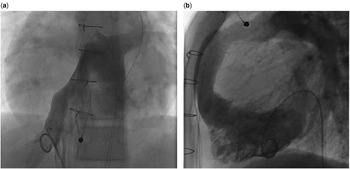
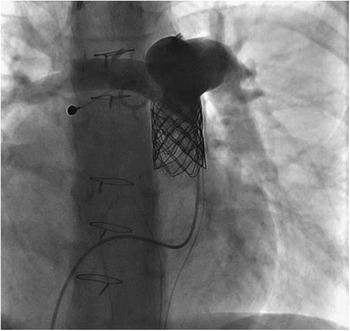
At 15 years of age, he developed worsening right ventricle-to-pulmonary artery conduit stenosis as well as mild–moderate aortic insufficiency. He had developed a peak instantaneous gradient of 68 mmHg (40 mmHg mean gradient) across the right ventricle-to-pulmonary artery conduit with moderate right ventricular hypertrophy per echocardiography. He was clinically asymptomatic. Considering these findings, we felt that placement of a transcatheter pulmonary valve would improve his right ventricle-to-pulmonary artery conduit obstruction and delay a return to the operating room, where he may eventually require surgical repair or replacement of his aortic valve should his aortic insufficiency progress. Initially, there was some concern that it would be difficult to navigate his intra-atrial Senning baffle and enter his right ventricle-to-pulmonary artery conduit. His previous angiograms were reviewed and demonstrated that his inferior caval vein-to-left atrium baffle was unobstructed and also showed that his right ventricle-to-pulmonary artery conduit was anteriorly placed on the right ventricular body. It was evident that a gentle right ventricle-to-pulmonary artery wire loop could be created over which the Melody® valve and delivery system could be expected to pass (Fig 1). His cardiac position was mesocardic, and his coronary artery anatomy had his left coronary arising from the right cusp and branching into an anterior descending coronary artery and circumflex coronary artery. The anterior descending coronary was quite remote from the right ventricle-to-pulmonary artery conduit and not a risk for compression. His right coronary artery arose from the left cusp and took a posterior course from the aortic root and gave rise to a dominant right coronary artery with a large posterior descending coronary artery. At cardiac catheterisation, his right ventricle-to-pulmonary artery conduit gradient was 35 mmHg. The conduit was balloon dilated up to 20 mm using an Atlas Gold 20-mm×4-cm balloon catheter (Bard Corp., Murray Hill, New Jersey, United States of America). With the 20-mm balloon fully inflated, ascending aortography was performed and revealed some indentation of the ascending aorta but no significant increase in aortic insufficiency and no compromise of the coronary arterial vasculature. Angiography of the right ventricle-to-pulmonary artery conduit revealed free pulmonary insufficiency and a small contained conduit disruption. A decision was made to address this injury with placement of a covered stent. Using a 0.035′, double-curve Lunderquist wire (Cook Medical, Bloomington, IN, United States of America), the right femoral venous sheath was upsized for an 18-Fr-long sheath, which was advanced to the main pulmonary artery. A 20-mm×4-cm Covered Cheatham-Platinum Stent (NuMed, Hopkinton, NY, United States of America) was advanced to the level of the conduit injury and deployed without difficulty with excellent positioning confirmed with angiography. An additional 3110 Palmaz XL Stent (Cordis, Hialeah, FL, United States of America) was deployed within the covered stent to reinforce the landing zone. An 18-mm Melody® valve was loaded onto a 20-mm Ensemble delivery system (Medtronic Corp., Minneapolis, Minnesota, United States of America), and the valve was implanted and expanded to 20 mm. Angiography revealed the stents and Melody® valve to be in excellent position within the homograft with no evidence of pulmonary insufficiency or homograft injury (Fig 2). Repeat ascending aortography revealed no evidence of worsened aortic insufficiency or coronary arterial compromise. There was a 5-mmHg gradient across the Melody® valve by pull back from the distal right ventricle-to-pulmonary artery homograft into the right ventricle. The procedure was concluded. At the 4-month follow-up, he remained clinically asymptomatic with echocardiography demonstrating mild right ventricle-to-pulmonary artery conduit stenosis with a 35-mmHg peak gradient (20 mmHg mean gradient) and no insufficiency.
( a ) A straight frontal projection of inferior caval vein venography demonstrates unobstructed flow into the inferior limb of the systemic venous baffle and into the left-sided atrium. ( b ) A straight lateral projection of right ventriculography demonstrates the anterior position of the right ventricle-to-pulmonary artery conduit.

A cranially angulated frontal projection of main pulmonary arteriography demonstrates a catheter advanced via the inferior caval vein through the inferior systemic venous baffle, left-sided morphological right ventricle, and into the right ventricle-to-pulmonary artery conduit. The stents and Melody® valve are positioned appropriately within the conduit. The injection revealed no evidence of pulmonary insufficiency and no evidence of further contrast extravasation.

Case 2
A 13-year-old girl was referred to our cardiac catheterisation laboratory for transcatheter pulmonary valve replacement in the setting of progressively worsening right ventricle-to-pulmonary artery conduit obstruction. She was born with l-transposition of the great arteries, pulmonary atresia, and a ventricular septal defect. She had dextrocardia with a rightward cardiac apex. She was initially palliated with bilateral Blalock–Taussig shunts, the first of which was placed in the neonatal period and the second 6 months later to further augment pulmonary blood flow. Subsequently, at 16 months of age, she underwent takedown of the bilateral Blalock–Taussig shunts, Senning atrial switch, and the Rastelli procedure, including the morphological left ventricle-to-aorta tunnel, ventricular septal defect closure with Dacron patch, and placement of a 14-mm right ventricle-to-pulmonary artery conduit with a 16-mm Gore-Tex tube graft extension from the right ventriculotomy to the right ventricle-to-pulmonary artery conduit. She developed progressive right ventricle-to-pulmonary artery conduit obstruction, and at 2 years of age she underwent right ventricle-to-pulmonary artery conduit replacement with an 18-mm Hancock porcine-valved conduit (Medtronic Corp., Minneapolis, Minnesota, United States of America).
At 13 years of age, she developed progressive right ventricle-to-pulmonary artery conduit stenosis with a peak gradient of 67 mmHg (mean gradient of 40 mmHg) across the valve per echocardiography. There was no significant pulmonary insufficiency and there was normal biventricular size and function. The patient complained of mild but worsening exercise intolerance. Considering these findings, we felt that placement of a transcatheter pulmonary valve would improve her right ventricle-to-pulmonary artery conduit obstruction and delay a return to the operating room for right ventricle-to-pulmonary artery conduit replacement. Her previous angiograms and her cardiac MRI were reviewed and demonstrated that her inferior caval vein-to-left atrium baffle was unobstructed, and that her right ventricle-to-pulmonary artery conduit was anteriorly placed on the right ventricular body. It was evident that a gentle right ventricle-to-pulmonary artery wire loop could be created over which the Melody® valve and delivery system could be expected to pass. Her cardiac position was dextroverted, and her coronary artery anatomy had her left coronary arising from the right cusp and branching into an anterior descending coronary artery and circumflex coronary artery. The anterior descending coronary was quite rightward and very remote from the right ventricle-to-pulmonary artery conduit and not a risk for compression. Her right coronary artery arose from the left cusp and took a leftward course from the aortic root and gave rise to a dominant right coronary artery with a large posterior descending coronary artery. At cardiac catheterisation, her right ventricle-to-pulmonary artery conduit gradient was 34 mmHg. As in case 1, serial balloon dilation was performed up to 18 mm with Atlas Gold balloon catheters. Coronary testing utilising aortography was performed and revealed the coronary arterial vasculature to be adequately distant from the conduit with no evidence of compromise of the anterior descending or right coronary artery. Once again, we utilised a double-curve, 0.035′, Lunderquist wire to deliver a 16-mm Melody® valve loaded on an 18-mm Ensemble delivery system. The Melody® valve was implanted in the appropriate position within the right ventricle-to-pulmonary artery conduit and post-dilated to 18 mm. Repeat angiography revealed the Melody® valve to be in excellent position with no evidence of pulmonary valve insufficiency or contrast extravasation. There was a residual 13-mmHg gradient by pullback from the distal main pulmonary artery into the right ventricle.
Discussion
This report describes successful transcatheter pulmonary valve replacement with a Melody® valve in two teenage patients with complex cardiac anatomy including a Senning atrial switch. Despite the abnormal catheter course, the right ventricle-to-pulmonary artery conduit was approachable via the right femoral vein allowing for deployment of the Melody® valve in the appropriate position. Although we were concerned that traversing a systemic venous baffle would make engagement of the right ventricular outflow tract more challenging, potentially requiring complex looping of the guidewire, this did not prove to be an issue. We postulate that in both the above-mentioned cases, the position of the proximal conduit in the mid portion of the anterior right ventricle wall allowed for enough anterior-to-posterior space to allow the wire to be positioned through the systemic venous baffle and then course anteriorly into the right ventricle-to-pulmonary artery conduit and then posteriorly into a branch pulmonary artery without any complex turns. This wire course may have proved more challenging to achieve if the conduit was posterior in a more anatomically correct position. Importantly, we took care to securely position an Amplatzer wire in a branch pulmonary artery to provide a stable rail for conduit preparation and subsequently exchanged it for a Lunderquist double-curve wire providing an excellent rail for Melody® valve implantation.
Despite the wire course, there was no evidence of heart block, although case 1 had an epicardial pacemaker in place. The anterior position of the right ventricle-to-pulmonary conduit may also be protective in this regard by keeping the wire more distant to the atrioventricular node. Transvenous pacemaker wires may provide an additional challenge to the wire course, and in such cases preparations should be made for possible lead replacement should lead dislodgment occur.
Our experience suggests that systemic vein-to-left atrium baffles are not prohibitive for Melody® valve implantation. This is an important finding considering the substantial population of ageing patients with CHD who have undergone atrial switch procedures. Both of our patients had similar anatomy with pulmonary atresia with a right ventricle-to-pulmonary artery conduit arising from the anterior wall of the right ventricle, allowing for a wire course that was easily maintained. In addition, the non-anatomic positioning of the right ventricle-to-pulmonary artery conduits remotely from the left and right coronary arteries in our patients made valve implantation very straightforward. These are important factors to consider when choosing appropriate patients for Melody® valve implantation.
Conclusion
Melody® valve implantation can be considered an appropriate option for treatment of right ventricle-to-pulmonary artery conduit dysfunction in patients with congenitally corrected transposition of the great vessels who have undergone atrial switch operations. In addition, case 1 exemplifies the use of a covered stent for containment of a conduit disruption, an anticipated complication when preparing right ventricle-to-pulmonary artery conduits for Melody® valve implantation.Reference Boudjemline, Malekzadeh-Milani and Patel 4 , Reference Armstrong, Balzer and Cabalka 5
Acknowledgements
None.
Financial Support
This research received no specific grant from any funding agency or from commercial or not-for-profit sectors.
Conflicts of Interest
None.
Ethical Standards
The authors assert that all procedures contributing to this work comply with ethical standards.