Introduction
Globally, more than 30% of crop production depends on animal pollination (Klein et al., Reference Klein, Vaissiere, Cane, Steffan-Dewenter, Cunningham, Kremen and Tscharntke2007). Apart from managed honey bees, wild pollinators also play a significant role in providing pollination for crops (Bommarco et al., Reference Bommarco, Marini and Vaissiere2012; Garibaldi et al., Reference Garibaldi, Steffan-Dewenter, Winfree, Aizen, Bommarco, Cunningham, Kremen, Carvalheiro, Harder, Afik, Bartomeus, Benjamin, Boreux, Cariveau, Chacoff, Dudenhoffer, Freitas, Ghazoul, Greenleaf, Hipolito, Holzschuh, Howlett, Isaacs, Javorek, Kennedy, Krewenka, Krishnan, Mandelik, Mayfield, Motzke, Munyuli, Nault, Otieno, Petersen, Pisanty, Potts, Rader, Ricketts, Rundlof, Seymour, Schuepp, Szentgyorgyi, Taki, Tscharntke, Vergara, Viana, Wanger, Westphal, Williams and Klein2013; Zou et al., Reference Zou, Xiao, Bianchi, Jauker, Luo and van der Werf2017a), and the decline of wild pollinators has been of considerable concern (Potts et al., Reference Potts, Imperatriz-Fonseca, Ngo, Aizen, Biesmeijer, Breeze, Dicks, Garibaldi, Hill, Settele and Vanbergen2016). It is important to understand local flower-visiting insect communities. Not only does this provide a basic understanding of different pollinator species that provide pollination services to specific crops (Howlett et al., Reference Howlett, Walker, Newstrom-Lloyd, Donovan and Teulon2009), but it also helps us to understand species distributions that are critical for biodiversity conservation.
There are a variety of methods that can be used to collect flower-visiting insects. To monitor pollinator communities at a large landscape scale or over a long-term period of time, those labor-intensive and difficult-to-standardize methods, such as sweep netting, may not be appropriate. Pan traps, a cost-effective method that can be deployed in the field over a relatively long period, are one of the most widely used methods that has been applied in monitoring the activity-density of local flower-visiting insects at a large landscape scale (Westphal et al., Reference Westphal, Bommarco, Carre, Lamborn, Morison, Petanidou, Potts, Roberts, Szentgyorgyi, Tscheulin, Vaissiere, Woyciechowski, Biesmeijer, Kunin, Settele and Steffan-Dewenter2008; Kovacs-Hostyanszki et al., Reference Kovacs-Hostyanszki, Batary and Baldi2011; Zou et al., Reference Zou, Bianchi, Jauker, Xiao, Chen, Cresswell, Luo, Huang, Deng, Hou and van der Werf2017b; McCravy, Reference McCravy2018). A pan trap usually consists of colored containers that attract flower-visiting insects (Cane et al., Reference Cane, Minckley and Kervin2000; Campbell and Hanula, Reference Campbell and Hanula2007; Westphal et al., Reference Westphal, Bommarco, Carre, Lamborn, Morison, Petanidou, Potts, Roberts, Szentgyorgyi, Tscheulin, Vaissiere, Woyciechowski, Biesmeijer, Kunin, Settele and Steffan-Dewenter2008). However, the sampling efficiency of the pan trap may be influenced by surrounding floral resources (Baum and Wallen, Reference Baum and Wallen2011) and biased toward a specific group of pollinators with similar physical features (Roulston et al., Reference Roulston, Smith and Brewster2007). Validation of the pan trap in relation to local pollinator diversity has been criticized, since it is an attractant-based sampling method (Cane et al., Reference Cane, Minckley and Kervin2000).
One of the non-attractant sampling methods that can be used in monitoring flight insect community is the window trap. Window trap is also called as the flight-intercept trap, which consists of a large pane of glass or fine mesh that is invisible to flying insects and is used as a physical barrier in the potential flight path (Howlett et al., Reference Howlett, Walker, Newstrom-Lloyd, Donovan and Teulon2009; Sverdrup-Thygeson and Birkemoe, Reference Sverdrup-Thygeson and Birkemoe2009; Zou et al., Reference Zou, Feng, Xue, Sang and Axmacher2012). As no attractant is involved, window traps may be less biased than pan traps in exploring the overall pollinator taxa, which is recommended in monitoring local bees and wasps in the forest habitat (Rubene et al., Reference Rubene, Schroeder and Ranius2015). Nonetheless, window trap has rarely been applied in the crop fields in monitoring flower-visiting insects.
In the agricultural pollination studies, pollinators' flower-visiting activity is an important index for measuring pollination services that are related to crop yield (Petersen and Nault, Reference Petersen and Nault2014; Bartholomee and Lavorel, Reference Bartholomee and Lavorel2019). Flower visitation of pollinators is usually conducted by direct observation, either by human observation or cameras (Banaszak-Cibicka et al., Reference Banaszak-Cibicka, Takacs, Kesy, Langowska, Blecharczyk, Sawinska, Sparks and Tryjanowski2019; Liu et al., Reference Liu, Chen, Luo, Xu, Xu, Shi and Zou2020). However, direct observation is usually time-consuming and can be affected by weather conditions and observation time, and therefore can hardly be standardized at a large spatial scale. Therefore, understanding whether and to what extent samples from traps reflect on-site insects' flower visitation activity is significant for agroecology (Liu et al., Reference Liu, Chen, Luo, Xu, Xu, Shi and Zou2020). While the comparison between pan traps and direct observation (usually transect walking) has been conducted in several studies (Westphal et al., Reference Westphal, Bommarco, Carre, Lamborn, Morison, Petanidou, Potts, Roberts, Szentgyorgyi, Tscheulin, Vaissiere, Woyciechowski, Biesmeijer, Kunin, Settele and Steffan-Dewenter2008; O'Connor et al., Reference O'Connor, Kunin, Garratt, Potts, Roy, Andrews, Jones, Peyton, Savage, Harvey, Morris, Roberts, Wright, Vanbergen and Carvell2019; Templ et al., Reference Templ, Mozes, Templ, Foldesi, Szirak, Baldi and Kovacs-Hostyanszki2019), no study has validated pollinator samples collected in window traps with the on-site flower-visiting activity.
In this study, we conducted a 2-year experiment in a field of oilseed rape (Brassica napus L.). Our study first aims to verify whether the relative abundance of each species collected in the window trap is positively correlated with the pan trap. We then tested whether we could replace the pan trap with the window trap by comparing the species richness (α-diversity) and species composition (β-diversity) of two methods. Finally, we aim to explore whether flower-visiting insects collected by the pan trap and window trap could reflect their flower-visiting activity. If not, we then aim to investigate which taxa are biased in both sampling methods.
Materials and methods
Study area
This study was conducted in a 2700 m2 (90 m × 30 m) field at the Jiangxi Agricultural University, Jiangxi Province, China (28°46.17′N, 115°49.99′E). The field was only used for rotation of oilseed rape (October to April) and rice (May to September) and no pesticide was applied since 2014. The experiment was conducted in 2018 and 2019 from the end of February to the end of April, which was the time of oilseed rape flowering. The field was divided into five ploughed plots (as five blocks) where the semi-winter cabbage type oilseed rape (single traditional bred cultivar “Yangguang-2009”) was grown.
Pan trap and window trap
A pan trap consists of three cups (8.3 cm diameter, 13.5 cm in height and a volume of 450 ml) painted with three ultraviolet (UV) colors (UV-blue, UV-yellow and UV-white) to minimize bias from a single-color pan trap (Westphal et al., Reference Westphal, Bommarco, Carre, Lamborn, Morison, Petanidou, Potts, Roberts, Szentgyorgyi, Tscheulin, Vaissiere, Woyciechowski, Biesmeijer, Kunin, Settele and Steffan-Dewenter2008). Traps were attached to a wooden stick. The height of the pan trap was 1.6 m, which was approximately the height of the oilseed rape flower in the field. Two 3 mm diameter holes were drilled in each cup at 2 cm from the edge of the cup to drain rainwater. We used saturated salt (NaCl) water with a mixture of several drops of detergent (to reduce water tension) as a killing agent for insects.
A window trap consists of a transparent acrylic plate (35 × 60 cm2 and 5 mm thick) as a barrier for intercepting flying insects. The plate was fixed on two wooden sticks, with its bottom containing two plastic trays filled with the same killing agent as the pan trap (Appendix 1). All window traps were fixed at a similar height as pan traps.
Because the surface area of a pan trap is much smaller than the barrier area of a window trap which can lead to the differences in sampling efficiency, we compared three pan traps and one window trap per field block to minimize this difference. In total, there were 15 pan traps and five window traps in the field (five blocks). All traps were set at least 2 m from edge of the field. Traps were set (end of February) and finished (end of April) on the same day, with emptying–refilling once a week and a total of 48 and 46 sampling days in 2018 and 2019, respectively. All specimens were pinned, sorted to morpho-species and identified by taxonomists. Overall, 93.1% of individuals were identified to the species level and 99% to the family level (Appendix 2).
Camera observation
To monitor the activity of flower-visiting insects, we used three surveillance cameras (DFD®, Shenzhen) with a resolution of 1280 × 720 pixels per inch. To have a clear view, cameras were positioned to focus on the main branch of one flowering oilseed rape plant at a distance of about 40 cm, with a visible area of 35 × 25 cm2. We regularly changed the focused plant once its flowering ended. Recordings started from 8:00 am to 5:00 pm in the same sampling period with pan traps and window traps. We did not record on rainy days because flower-visiting insects were not active.
Three cameras, one of which was put in the three middle blocks, were placed 5 m from the field margins. The location of the camera is shown in Appendix 3. In total, we obtained recordings of 228 h (131 h in 2018 and 97 h in 2019). We recorded all insects foraging on oilseed rape flowers. We managed to identify the insects that were recorded in the cameras into seven groups: Apis (Apis mellifera and Apis cerana), Andrenidae, Halictidae, other Hymenoptera, Syrphidae, non-Syrphidae Diptera, Lepidoptera and Coleoptera.
Data analysis
To explore how the relative abundance of each species collected in the window trap correlated with the pan trap, we applied a linear regression for the proportions of each species between two sampling methods. Data were square-root transformed to minimize the scale difference.
To compare the α-diversity between the pan trap and window trap, we used the individual-based rarefaction–extrapolation curve to investigate the extrapolated number of species between the two methods (Colwell et al., Reference Colwell, Chao, Gotelli, Lin, Mao, Chazdon and Longino2012). The extrapolation was based on the doubled number of individuals in a sampling method, of which we pooled the individuals collected in the same year and compared them separately for each year.
To compare the difference in species communities between pan traps and window traps, we used the chord-normalized expected species shared (CNESS) dissimilarity (Trueblood et al., Reference Trueblood, Gallagher and Gould1994). The CNESS index, which is not sensitive to the sample size, measures the probability of obtaining the same species when a given number of individuals (the value m) was randomly drawn from two communities (Zou and Axmacher, Reference Zou and Axmacher2020). We used the modified version of CNESS by Zou and Axmacher (Reference Zou and Axmacher2020) with its values between 0 and 1. We used a small sample size (m = 1) focusing on the difference of dominant species and a larger sample size (m = 20) focusing on the overall species assemblages. CNESS dissimilarity matrices were then visualized using non-metric multidimensional scaling (NMDS). To obtain a robust sample size, individuals from the same field block were pooled, while analysis was separated between two sampling years.
All statistical analyses were conducted in R Version 3.5.2 (R Development Core Team, Reference R Core Team2016). Package ‘vegan’ (Oksanen et al., Reference Oksanen, Blanchet, Friendly, Kindt, Legendre, McGlinn, Minchin, O'Hara, Simpson, Solymos, Stevens, Szoecs and Wagner2020) was used to calculate the rarefied species richness. Package ‘iNEXT’ (Hsieh et al., Reference Hsieh, Ma, Chao and McInerny2016) was used to calculate the rarefaction–extrapolation curve. Function ‘ESS()’ developed by Zou and Axmacher (Reference Zou and Axmacher2020) was used to calculate the CNESS value.
Results
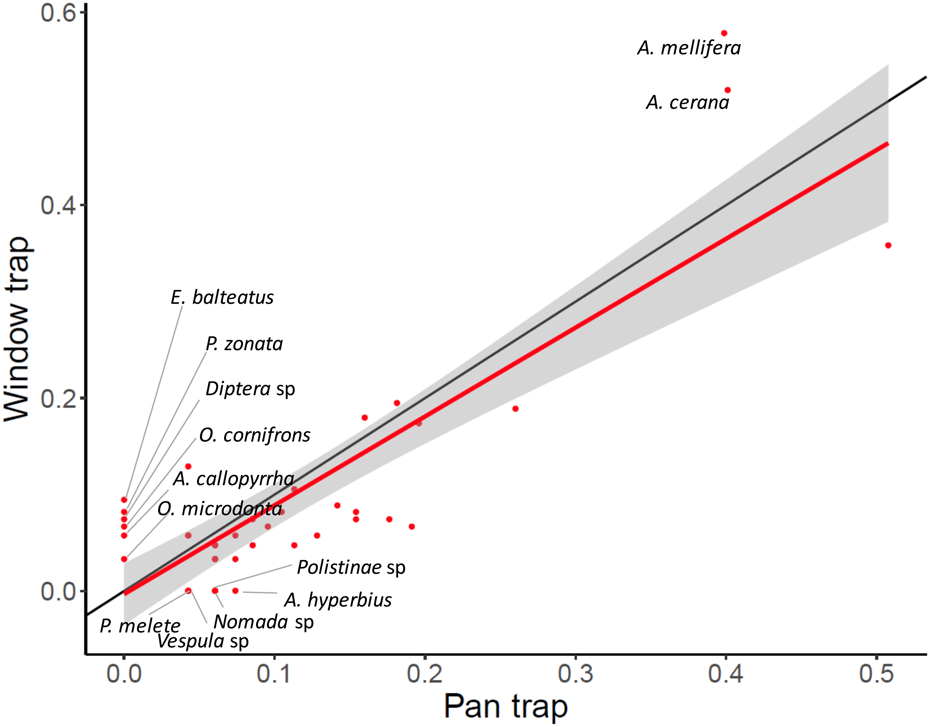
In total, we caught 1392 individuals with 37 insect species, of which pan traps caught 387 individuals (33 species) and window traps caught 1005 individuals (34 species). The average sampling efficiency was 0.27 and 2.14 per trap per day for the pan trap and window trap, respectively. Overall, the most abundant species were Apis mellifera (26.8%), followed by Apis cerana (22.8%), Pieris rapae (17.7%), Osmia excavata (4.7%), Osmia pedicornis (3.6%) and Lasioglossum proximatum (2.9%) (Appendix 2). There was a significant positive linear relationship between the proportion of species sampled in pan traps and window traps (β = 0.77 ± 0.08, R 2 = 0.70, P < 0.01, fig. 1). There was no significant difference between the linear model and the y = x line (as indicated by the 95% confidence interval (CI), fig. 1). Andrena callopyrrha, Osmia microdonta, Osmia cornifrons, Episyrphus balteatus, Phytomia zonata and a Diptera species were only caught in window traps, while species Argynnis hyperbius, Pieris melete and a species of Nomada, Polistinae and Vespula only in pan traps.
Relationship of proportion (square-root transformed) of each insect pollinator species that collected in pan traps and window traps. The red line represents the linear regression model and the black line represents y = x. The gray-shaded area represents the 95% CIs of the regression.

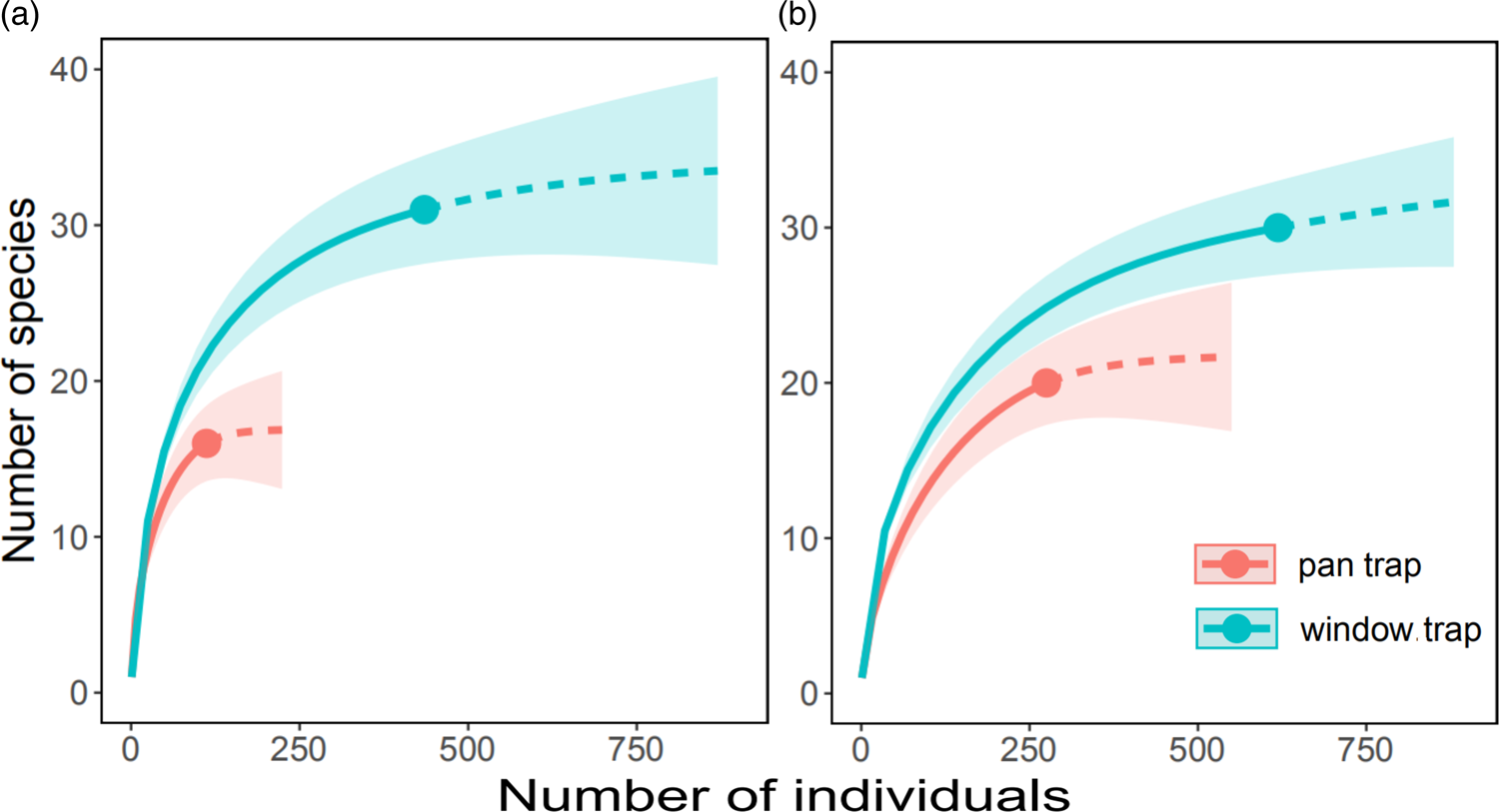
Species rarefaction curves showed that window traps collected more rarefied number of species than pan traps, and this pattern was consistent for both years (fig. 2). The extrapolation curves showed that the window trap (34.1 ± 3.7 and 34.2 ± 4.9 species in 2018 and 2019 respectively) would catch about 1.5 times more species than pan traps when both methods reaching their double sample size (16.9 ± 1.5 and 21.8 ± 2.2 species in 2018 and 2019).
Rarefaction and extrapolation curves for insect species collected in pan traps and window traps in 2018 (a) and 2019 (b). The solid lines represent interpolation and the dashed lines represent extrapolation predictions; shaded areas represent 95% CIs.

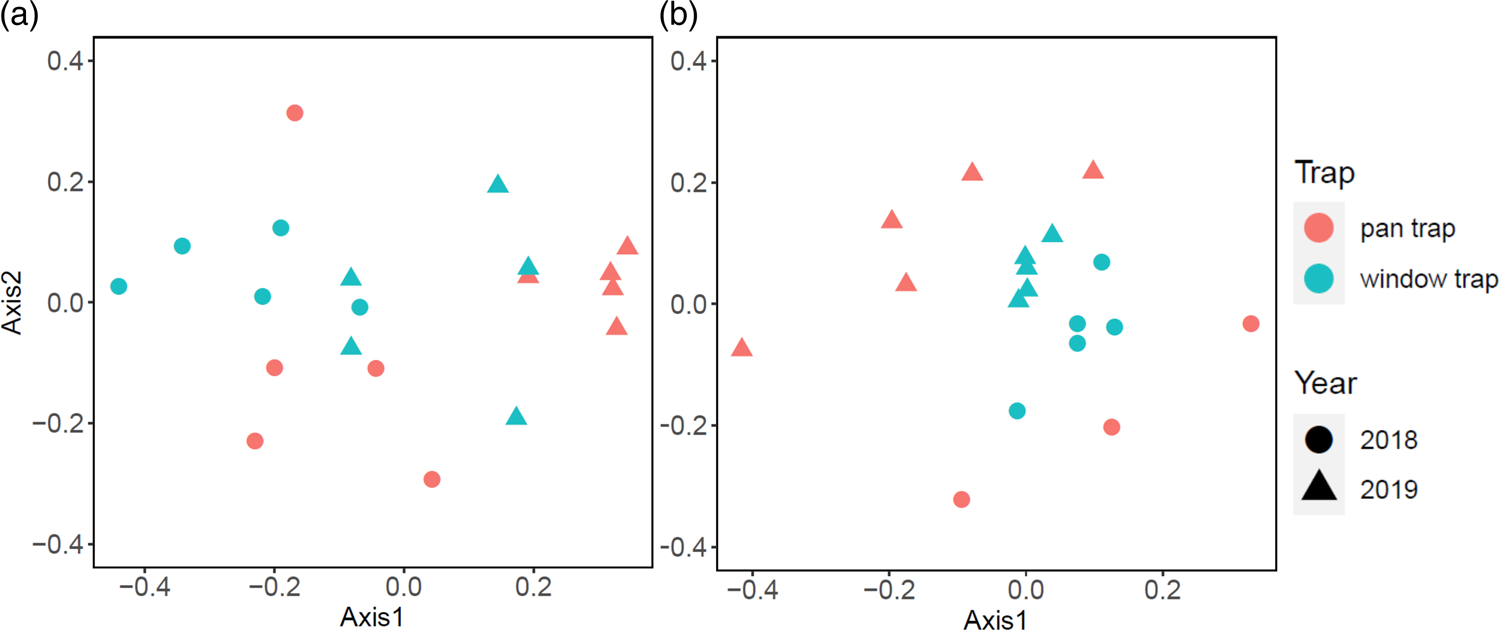
The species composition differed between pan trap and window trap. When looking at the between-sample difference, the NMDS distance between-sample was relatively large for both methods for dominant species (m = 1), but was larger in the pan trap than the window trap for the overall composition (m = 20, fig. 3). The overall species compositions (m = 20) in the two sampling years were also distinctive, particularly for pan traps (fig. 3).
NMDS plots based on CNESS dissimilarity for m = 1 (a, stress = 0.08) and m = 20 (b, stress = 0.16) for pan traps and window traps of two sampling years.

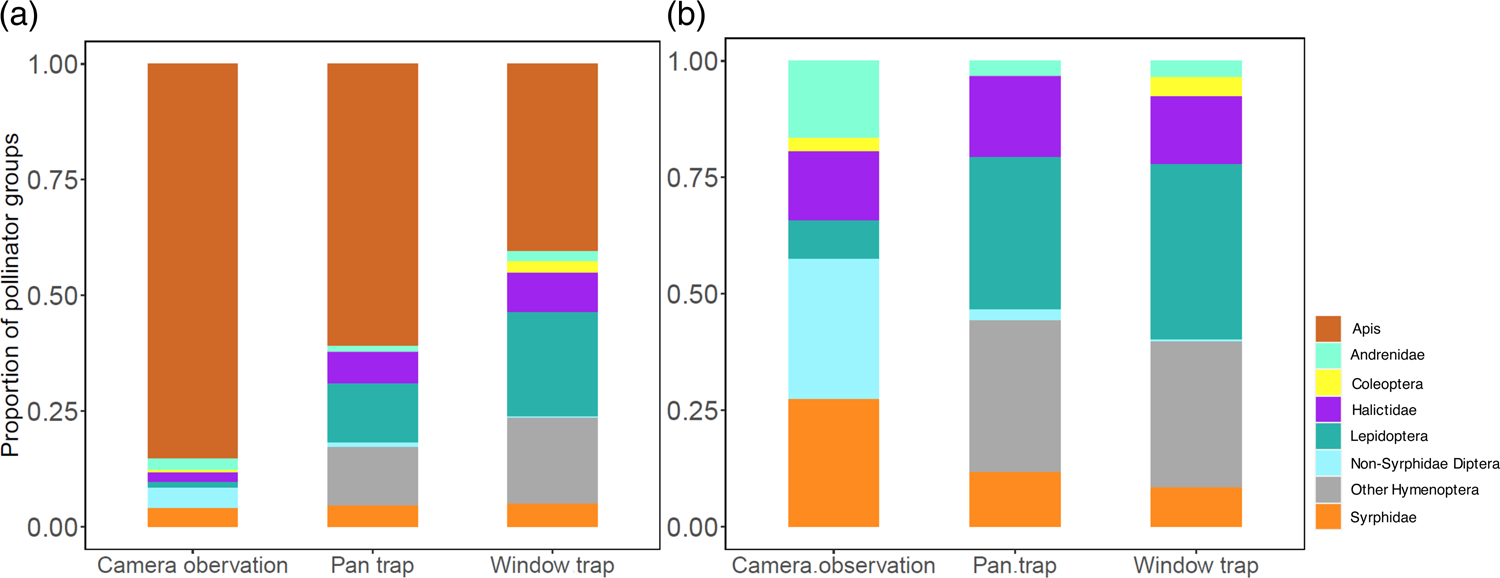
The camera observation recorded 375 visits in two years. Both the pan trap and the window trap underestimated the flower visitation of the honey bee (Apis) in two years (fig. 4a), while the proportion of the honey bee in pan traps was closer to the proportion in flower visitors (fig. 4a). The proportion of sweat bees (Halictidae) and butterflies (Lepidoptera) were overestimated in the pan trap and the window trap for their visitation to oilseed rape flowers (fig. 4a). Hoverflies (Syrphidae) and mining bees (Andrenidae) could be reflected from both traps as flower-visiting activity (fig. 4a). Excluding Apis, both the pan trap and the window trap showed a similar proportion of sweat bees to its proportion in flower visitors, while there was still an overestimation of butterflies and under-estimation of non-Syrphidae Diptera (fig. 4b). Relationships of the proportion of different groups between two traps and camera observation in 2015 and 2019 are shown in Appendix 4.
Proportion of each pollinator group recorded in camera observation, and specimens caught in pan traps and window traps for (a) all taxa and (b) the rest groups excluding Apis.

Discussion
While the window trap has been applied in forests (Wells and Decker, Reference Wells and Decker2006; Rubene et al., Reference Rubene, Schroeder and Ranius2015), it has rarely been used in sampling flower-visiting insects in agricultural fields. The window trap we used here was much more efficient than the pan trap in terms of the number of individuals per trapping day, and the number of rarefied species. As a cost-effective method, the window trap has a good potential to replace the pan trap in sampling pollinator insects in mass-flowering cropland.
Our results are consistent with Rubene et al. (Reference Rubene, Schroeder and Ranius2015), who found that the window trap performed better than the pan trap in sampling Hymenoptera in forest habitat, although results might depend on the difference in terrain conditions (Wells and Decker, Reference Wells and Decker2006; Rubene et al., Reference Rubene, Schroeder and Ranius2015). Sampling efficiency may be positively correlated with the area of the barriers (e.g. the glass panes in our study). Here we used a transparent acrylic plate with an area of about 0.2 m2, whose sampling efficiency (on average 335 individuals per trap) was more than ten times a pan trap (about 26 individuals per trap). While a large barrier area of the window trap means higher cost and more interruption to the flight path of insects, the trade-off between barrier size and sampling efficiency needs to be considered in designing window traps.
The high correlation of the proportion of species abundance between the two sampling methods indicates that the relative abundance of species sampled in window traps can be representative for those in pan traps, although some species were only found in the window trap. Nonetheless, when window traps are used to replace pan traps, species (e.g. A. hyperbius) that were only found in pan traps require particular attention from researchers aiming at pollinator monitoring, as these species might be overlooked in the former traps. Nonetheless, as these species were also rarely found in pan traps, we do not know whether these species were biased away from window traps, or just coincidentally missing from our sample.
While samples in window traps showed slightly different compositions for the overall species assemblages, the more homogeneous composition than pan traps means that window traps were able to catch a more comprehensive species assemblage, which mainly resulted from the limited individuals sampled from pan traps. We suspect that the main reason for the different composition between the two traps was the inherent attractant bias, as we were comparing an attractant-based method (pan trap) with a non-attractant-based one (window trap). The effect of surrounding floral resources on the two methods will be different (Baum and Wallen, Reference Baum and Wallen2011). In the oilseed rape flowering period, the insects' visitation to pan traps can be affected by the density of flower resources (Grindeland et al., Reference Grindeland, Sletvold and Ims2005; Popic et al., Reference Popic, Davila and Wardle2013; Prendergast et al., Reference Prendergast, Menz, Dixon and Bateman2020), while as the physical interceptions, window trap's sampling efficiency is less likely to be affected. Hence, considering its better performance in pollinator species and stable community composition, we recommend window traps if researchers are interested in understanding wild pollinator composition.
The insects collected in both traps cannot reflect flower-visiting activity for several taxa, but the proportion of hoverfly (Syrphidae) and mining bee (Andrenidae) was well represented. It is not surprising that specimens collected in sampling traps can be used effectively to monitor pollinator species’ biodiversity, but not flower-visiting activity for the targeted crops (Boyer et al., Reference Boyer, Fragoso, Dieterich Mabin and Brunet2020). Flower-visiting activity can be influenced by floral density (Grindeland et al., Reference Grindeland, Sletvold and Ims2005), while different pollinators may respond differently when the floral resource differs (Sih and Baltus, Reference Sih and Baltus1987). However, camera observations reflect a combination between the species density and their flower-visiting frequency, while individuals captured in traps only reflect activity density. This might be the reason why the camera slightly overestimates the true density for those with high flower-visiting frequency species such as Apis (Liu et al., Reference Liu, Chen, Luo, Xu, Xu, Shi and Zou2020). We have to admit that the number of overall recorded pollinator visits was not high in our study, and thus we encourage a more comprehensive study with more cameras.
Conclusions
In conclusion, we found that window traps had higher efficiency at sampling insects, could catch more diverse insect assemblage and were more homogeneous between samples than samples in pan traps. Our results suggest that window traps can be used as a replacement for pan traps in studying the diversity of flowering-visiting insects in agricultural fields. Although results are consistent over 2 years, our study was only conducted in one landscape and one crop type. We therefore recommend further studies to be conducted with a variety of crop types and in different landscape contexts to comprehensively evaluate the performance of using window traps as a replacement for pan traps. Furthermore, we highlight that we should be cautious about using the pan trap sample as a proxy of pollinator's flower-visiting activity.
Supplementary material
The supplementary material for this article can be found at https://doi.org/10.1017/S0007485322000104.
Acknowledgements
We thank Huanli Xu from China Agricultural University for identifying our pollinator samples. We thank Hainan Chong, Ting Jiang and Feiran Wang for their huge help in the fieldwork. We also thank Johannes Knops and Andrew McIntosh for providing comments and editing of the manuscript. This study was financially supported by the National Natural Science Foundation of P.R. China (31700363) and Jiangsu Science and Technology Department (BK20181191). Xiaoyu Shi is supported by Xi'an Jiaotong-Liverpool University research and development fund (RDF-17-01-07).
Author contributions
X. S., D. F., X. H. and Y. Z. designed the study; X. S., D. F. and X. H. performed the experiment; X. S., D. Y. and Y. Z. analyzed data and X. S. and Y. Z. wrote the paper. All authors provided comments on the paper.