Economic Transformation
South Africa's liberation, marked by the first democratic elections of 1994, ushered in an unprecedented expansion of large-scale redistributive arrangements. In the post-apartheid period, the collection of money into a central fund administered anonymously and bureaucratically has gained social and political importance, particularly for poor and lower-middle-class Africans. This is most evident in a rapid expansion of government social assistance—from 1997 to 2006 the number of beneficiaries of social grants increased from three to almost eleven million, and today at least a quarter of South African households receive welfare payments.Footnote 1 Social assistance “has been the fastest-growing category of government expenditure since 2001, and now amounts to R70 billion [almost US$7 billion in 2006] a year, about 3.4 percent of gross domestic product.”Footnote 2 The centrality of redistribution is clear in current debates over the establishment of a Basic Income Grant (BIG) for all South Africans.Footnote 3 Political liberation has also brought an increase in redistribution through development projects such as the National Reconstruction and Development Programme (RDP) and Black Economic Empowerment (BEE) grants.Footnote 4
The surge in redistributive arrangements is also notable in an increase in commercial insurance purchases by the mostly African poor and lower middle classes. In South Africa, expenditures on insurance, mostly by the predominantly White elite and upper-middle classes, are already very high, making up 14.5 percent of GDP, almost three times U.S. levels.Footnote 5 Driven by both commercial interests and government pressures, the insurance sector is exploring new markets among less affluent and predominantly African clients.Footnote 6 The rise of large-scale redistribution is also apparent in the popularity of prosperity churches,Footnote 7 which urge their congregations to donate large sums and preach that they will gain vast riches in return. They also discourage the maintenance of reciprocal obligations toward kin and neighbors. Though these churches are relatively small, they have grown rapidly since the second half of the 1990s.
Redistribution, then, has become central across the otherwise disparate realms of state support, the insurance market, and religion. We can identify three basic trends that have contributed to the rise of large-scale redistributive arrangements since political liberation. First, liberation has been accompanied by rising unemployment and continued poverty. Only a minority of Africans has escaped poverty, and many remain poor or have become poorer still. From 1995 to 2004, inequality rose by 6 percent.Footnote 8 From 2000–2005, the labor-participation rate of Africans dropped by nearly 20 percent. Though nearly all educated Africans are employed, large numbers of the uneducated have never had a job.Footnote 9 Cape Town, where I conducted most of my research, is no exception, and indeed it has the highest poverty rate of all South African cities, at 30 percent. The Eastern Cape, which includes the former Xhosa bantustans (native reserves) of Transkei and Ciskei, which so many have left to seek work in Cape Town, is the country's second-poorest province with a staggering poverty rate of 77 percent.Footnote 10 While political liberation legally and politically incorporated Africans into the economy, jobs actually became scarcer while entrepreneurial opportunities remained few. The continued exclusion of people from markets raises their hopes that they will find a prosperous future through large-scale redistributive arrangements.
Second, the South African government has tried to alleviate the inequalities of the past via redistribution through acts such as the 1994 Bill of Rights that guaranteed the extension of welfare to all South Africans irrespective of race. The government has also instituted policies that provide for land redistribution, expansion of social grants, and a myriad of development projects. Further, it has urged financial institutions such as insurance companies to offer their products and services to Africans and Coloureds on a much larger scale than they did during apartheid. For many South Africans, political liberation has become apparent through access to and inclusion within these redistributive arrangements.
The third trend is that, despite political liberation, pressures on reciprocal relations, particularly among kin and neighbors, have persisted and intensified, due to factors that include high levels of inequality, violence, and AIDS. These place great strain on kinship and neighborhood relations because they limit people's ability to care for others. It may be that redistributive arrangements are popular among the African poor and lower-middle classes because people expect them to provide not only wealth but also an escape from pressing reciprocal obligations. In this way, large-scale redistribution not only increases dependency on bureaucratic and impersonal external agents but also undermines cooperation among neighbors and kin.
The ongoing and lively academic debates concerning economic transformation are captured with concepts such as the neoliberal economy,Footnote 11 post-Fordism,Footnote 12 the millennial economy,Footnote 13 casino capitalism,Footnote 14 and the risk society.Footnote 15 Anthropological studies, in particular, have explored the sociality of changing markets and its relationship to non-market forms of exchange such as reciprocity and gift exchange, and various forms of solidarity.Footnote 16 In the heat of these debates, insufficient attention has been paid to large-scale redistribution as a distinct mode of exchange and its sociality.
The rise of redistribution raises fundamental questions about sociality and mutual dependencies. The breakdown of reciprocity and moral obligations cannot be, as Polanyi argued, attributed to markets alone.Footnote 17 When diverse institutions are infused by redistribution, it becomes difficult to distinguish redistribution from other forms of economic integration; the rise of commercial insurance (and one might provocatively add prosperity churches) blurs distinctions between the realm of the market and that of redistribution. Redistribution is not the separate form of economic integration that Polanyi took it to be: it is entangled with and a part of markets (commercial insurances), the state (social grants and development aid), and religious institutions (prosperity churches). This is an important complication of the redistribution concept generally. For many in South Africa and elsewhere, the market manifests itself through redistribution, with unexpected consequences for reciprocity and the accumulation of wealth. Even the redistribution of government social grants seems to reconfigure kinship and neighborhood relations, as well as violence within them.
The dependency on redistribution might revolutionize social relations as fundamentally as has the transformation of the colonial economy. The South African case offers us the opportunity to examine what I will call “redistributive economies”: economies in which people are connected to global markets through a variety of redistributive arrangements such as those of social grants, insurance companies, and prosperity churches. The constellation of these economic practices suggests that redistribution is not only a form of economic integration that is entangled with a wide range of economic practices, but also constitutes a field of economic contestations.Footnote 18
I collected my data between 1995 and 2006 during several research stints that ranged from a few weeks to a year in length, totaling about two and one-half years. Most fieldwork was carried out in Cape Town, which is particularly interesting due to the strong presence of the insurance industry: many South African insurance companies are headquartered there. Central to the present study is a comparison of the townships Indawo Yoxolo and Tembani. Almost all of the residents of both are Xhosa, who with the abolition of apartheid left the impoverished bantustans of Ciskei and Transkei to try to earn money in the city. In 1995, Indawo Yoxolo—situated between Philippi and Mitchell's Plain—was a small squatter camp. But over the years, with the aid of governmental development funds, most of it was turned into a township with electricity, sanitation, paved roads, schools, a clinic, and demarcated and privately owned residential plots.Footnote 19 Its residents are the poorest in Cape Town, and many live in shacks of corrugated iron sheets, wood, or other available and affordable building materials. During my fieldwork, unemployment was rampant and even “lucky” residents earned very little, as security guards, cleaners, or nannies. Violence was a major concern, and there were several murders. Notwithstanding the violence, and that most residents disliked living in Indawo Yoxolo, there were many social activities that connected neighbors, such as informal burial societies, credit groups, choirs, and small independent churches that held their services in people's living rooms.
Tembani is part of Cape Town's largest African township of Khayelitsha. Its residents are much wealthier than those of Indawo Yoxolo. Many work as teachers, nurses, or civil servants, some are entrepreneurs, and most live in privately owned, two- or three-bedroom brick houses. Some even own a car. Violence was not nearly so rampant in Tembani, but it was difficult to conduct fieldwork there nonetheless, in the sense of being part of the community, because neighbors interacted only sporadically, mostly to chase away potential criminals. In addition to interviews, participant observation, and other standard ethnographic research methods, I carried out a survey among residents of both townships. In 2005 and 2006, my research assistant Edith Moyikwa conducted a survey of 110 residents, about half of them from each area, which included questions about social security, insurance, financial services, livelihood strategies, and social relations.Footnote 20
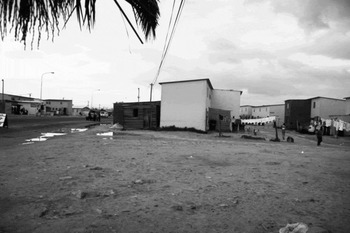
Developed section of Indawo Yoxolo.

Financial Mutuals and Reciprocity
In order to understand the nexus of large-scale redistributions and social interdependencies, it is vital to examine the reciprocal obligations within financial mutuals such as informal savings and credit organizations and burial societies. They reveal how mutual obligations among kin and neighbors changed as a result of apartheid, and then with its collapse during the 1990s.Footnote 21 In South Africa, financial mutuals must be understood within the context of colonial and apartheid legislation. Colonial and apartheid policies forced Africans to live in native reserves, or bantustans, which marginalized Africans politically and economically and led to the destruction of land and cattle.Footnote 22 As a result, fundamental kinship obligations of land inheritance and bridewealth or lobola (cattle) were weakened, and wage-labor became increasingly important. Due to the discriminatory apartheid labor laws, commonly referred to as “pass-laws,” it was mostly men who left the impoverished bantustans to earn money in cities such as Cape Town.Footnote 23
Tembani, Khayelitsha.

In Cape Town, apartheid legislation forced men from particular districts in the former bantustans to live together in designated barracks called “hostels.” For example, all migrant men from Umtata, the capital of the Transkei Bantustan, had to share the same overcrowded hostel room.Footnote 24 Given that the fellow migrants from one district—in Xhosa, abakhaya, or “those of one home”—lived in each other's vicinity, they could pool money to buy groceries, and cook and eat together. This social integration was fundamental to the establishment of a variety of financial mutuals.Footnote 25 Neighboring abakhaya would place a fixed amount of money into a common fund, and in December divide it among themselves. They could use their share to purchase a bus or train ticket home or to financially support dependent relatives in the bantustans. Burial societies guaranteed a decent burial back home instead of an embarrassing pauper's grave in Cape Town.
With the end of the apartheid state, more people left the former bantustans of Ciskei and Transkei for Cape Town. These migrants were no longer forced to live together in barracks, and neighbors were rarely abakhaya anymore. As the social proximity that determined social control among abakhaya waned, so did the financial mutuals they had organized.Footnote 26 Another consequence of apartheid's breakdown was that women, whose employment opportunities had been more restricted, began to leave for the city.Footnote 27 While financial mutuals among abakhaya men declined, female neighbors now started up their own. In Indawo Yoxolo in 1997, women commonly joined as many as three, in which they circulated up to one-third of their monthly incomes. Members often lived on the same street, which allowed the social control necessary for balanced reciprocal obligations.
Women's financial mutuals must be understood vis-à-vis kinship relations, in a way different from those of abakhaya men during apartheid. Women felt burdened by the financial pressures of kin relationships, particularly those from in-laws but also from husbands, boyfriends, and male siblings. Neighboring women joined financial mutuals to ensure that the money they invested was out of their hands. The social constraints within financial mutuals both forced women to make regular contributions and ensured that relatives could not get their hands on their money. Women were often secretive about their participation in financial mutuals; even when a boyfriend or husband was aware that they were taking part, they rarely knew how much money was pooled or when it was divided. Balanced reciprocal relations and social control helped female neighbors to withstand some kinship obligations. Once the money was divided, they often spent it on food, household items, and clothing, but also to help their mothers and children.
To summarize, generalized reciprocity among kin diminished as a result of the destruction of land and cattle that were so vital to the social reproduction of kinship,Footnote 28 as well as the brutal and discriminatory apartheid labor laws that isolated wage-earning men from their wives, children, and other kin. The money that was earned within the margins of an expanding capitalist economy was pooled in neighborhood-based financial mutuals that functioned according to the principle of balanced reciprocity. During apartheid these neighbors, in Cape Town at least, were predominantly men “from the same home” who used financial mutuals, at least ideally, to support dependent kin. After apartheid, it was mostly female neighbors who established financial mutuals, and they did so to withstand kinship obligations, particularly those to in-laws, husbands, and boyfriends. In short, balanced reciprocity among non-kin neighbors surfaced as generalized reciprocity among kin diminished.
Redistribution in the Post-Fordist Economy
According to the 2004 Labour Force Survey of Statistics South Africa, unemployment in the Western Cape was at 19 percent, far below the national average of 27 percent. Moreover, from 2003 to 2004 the Western Cape had the country's highest growth rate at 5.3 percent, well above the national average of 4.5 percent. This all indicated a fairly good job market overall, but if one considers racial discrepancies, Africans were almost ten times as likely to be unemployed as were Whites, and twice as likely as Coloureds.Footnote 29 Due to the continued dearth of jobs, more and more men and women have stopped looking for work altogether, and government policy has become “the explicit rejection of formal employment as the ‘normal’ frame of reference for social policy.”Footnote 30 Even if one does find a job, it will likely be as a poorly paid security guard, cleaner, nanny, or casual laborer in the construction sector. Although labor remains for many Africans a vital source of income,Footnote 31 as does the produce from land and cattle,Footnote 32 prolonged unemployment points toward a post-Fordist economy. As hopes of gaining wealth through the world of work have declined, so too have the financial mutuals that were historically part of the wage-labor scene. In their absence, redistribution becomes ever more crucial both as an economic reality and as a source of imagined riches.
Redistribution by development projects and social grants is at the heart of post-apartheid government policy.Footnote 33 The expansions of Black Economic Empowerment policies, and even more so of social security and development projects, are having fundamental socio-economic consequences. State redistribution appears to be part of an emerging neo-patrimonialism. Niehaus has revealed how in the northeast of South Africa people are pressured to vote for the ANC in return for the welfare they receive.Footnote 34 In Cape Town the situation is somewhat different since the ANC has a much less control over the provincial government there, while a fairly weak coalition headed by the Democratic Alliance (DA) controls the Cape Town municipality. Toward the end of 2008, the Congress of the People (COPE) became another contender for votes. The relatively weak position of political parties in Cape Town makes redistribution ever more important and a source of violent conflicts, which I have analyzed elsewhere.Footnote 35 Let us take a closer look at three different realms of redistribution—social grants provided by the state, the expansion of insurance by commercial companies, and the changing religious landscape—and how they relate to mutual obligations and reciprocity among kin and neighbors.
Social Grants
Social grants have existed in South Africa since the beginning of the twentieth century, but Africans rarely had access to them. South Africa's first social assistance grants, under the Children's Protection Act of 1913, were not available to Africans living in rural areas, and Africans in urban areas rarely received them.Footnote 36 The Old Age Pensions Act of 1928 only became available to Africans in 1944, and even then the maximum pension for Whites was five times higher than theirs.Footnote 37 As a consequence of democratization, all South Africans became eligible for social grants, of which there were also more types,Footnote 38 and the number of beneficiaries almost tripled between 1997 and 2007. This expansion is particularly striking if one compares it with labor statistics: the number of grant beneficiaries is 50 percent higher than the number of people paying income taxes.Footnote 39
These grants include monthly payments of food relief (R300), child support (R230), foster care (R650), and care-dependency (R960), and a monthly old age pension of R960.Footnote 40 During my Cape Town fieldwork it became clear that social workers encouraged people to apply for grants, even if they were employed. I was told that some social workers emphasized job insecurity and carefully hinted at the increasing incidence of HIV—the future was uncertain, and it remained to be seen how much longer the government would continue to provide social grants. Even people with well-paying jobs were sometimes urged to apply for disability grants, just to be sure.Footnote 41
Social grants particularly affect parental authority since most beneficiaries are parents or grandparents. A closer look at grant types and their distribution clarifies this. From 1997 to 2006, social grants to foster parents grew by 42 percent annually. During the same period, the number of parents receiving a child support grant grew by 37 percent annually. Of the total number of social grants that the state distributed in 2006, almost 90 percent were for pensioners (old age grants) and parents (child support grants).Footnote 42 These grants do not focus on work, as would be the case with, for example, bursaries that enable young people to further their education, grants to the unemployed, grants that make up losses of income during illness, or others related to the world of work. Instead, and in sharp contrast to the welfare of Western Europe and the United States,Footnote 43 social grants in South Africa are directed mostly at the aged and those raising children. Grants are relatively small and their real value has decreased over the years.Footnote 44 Nonetheless, for many African young men and women it is more feasible to live with parents or grandparents who are receiving them than to seek jobs that do not exist. One consequence of the shrinking labor market for the uneducated is that young and able men and women increasingly depend on their parents' or grandparents' social grants.Footnote 45
In the Eastern Cape town of Queenstown I interviewed a woman who was well into her eighties. When I first met her in 1997, she and her husband lived together alone, although she occasionally provided meals to visiting grandchildren who lived nearby with their mother. By 2006, her husband had died, her sole income was the state's old age pension, and she had five teenagers living with her. The latter stayed for months, even several years, without being able to make any financial contributions. Their parents occasionally sent the woman some money, but it was very little to survive on. She complained about having to feed all of these young people with her pension, although she enjoyed their company when they were quiet and listened to her. Nevertheless, having little education, the teenagers remained dependent upon her.
Paradoxically, then, in many households it is the disabled, sick, and elderly who generate income, not the young men and women in the prime of life. Although social grants are relatively small, their impact on social dynamics, particularly among parents and children, is substantial. For example, I met one woman in the Eastern Cape town, Fort Beaufort, who lived together with her adult son. She received an old age pension, at the time just over R700, while her son earned a meager R200 per month as a full-time construction worker. When a pensioner's government grant is more than three times the salary of a young man, kinship relations are inevitably affected.
During conversations in Indawo Yoxolo and Tembani, a growing concern became apparent that the provision of social grants would result in moral degeneration. Many men and women saw unemployment as a result of individual behavior and fail to acknowledge the apparent structural conditions of the job market.Footnote 46 Despite ample indications that jobs were extremely hard to find, parents complained frequently that their children, particularly the young men, were lazy and found it all-too-comfortable to live off of their grant-receiving parents or grandparents. Sometimes, these accusations would escalate. While I interviewed a woman in Tembani, the conversation turned to the members of her household, and I remarked that at an earlier meeting a young man was living in their house but I did not see him anymore. She said that he had AIDS and had gone to stay with relatives in the Eastern Cape and to die. She went on to explain to me how lazy he was. Angrily, she said that he was too lazy to get out of bed, to do any chores, and to even look for a job. When I suggested that perhaps he was too sick, she denied this vehemently: he was lazy and used AIDS as an excuse for not working.
When it came to girls, women in particular were worried that they would get pregnant in order to be eligible for a child-maintenance grant. During several interviews, they expressed their concerns about increasing teenage pregnancies, the risks of unprotected sex, and the girls' ignorance about child rearing and the costs of living. One woman told me about an argument she had had with her daughter of fourteen, who already had a child. During the argument, her daughter threatened her mother by saying that she was going to have more children, and could then leave her parental home and live on the state's child-maintenance grants. Irrespective of how justified these parental concerns are, whether teenage pregnancies are increasing, and if so whether this is a result of child-maintenance grants, social grants do affect kinship relations. Instead of young men and women earning money, they are seen to be dependent on their parents' grants. Inevitably, this contributes to inter-generational tensions.
Let me give one example of exactly how state redistribution by grants can generate social tensions among kin. Sipho and his brother grew up with their parents in the Eastern Cape. When Sipho was still young, not yet a teenager, his father died. The brothers stayed with their mother, but before long she too became ill, from AIDS, and her health deteriorated rapidly. The siblings took care of her as best they could, helped out by their grandmother who lived a few streets away. The brothers spent a lot of time with their grandmother and usually she cooked dinner for them, and they moved in with her when their mother died. Their father's brother, who lived in the same town, sold their parental home and took the proceeds. He officially adopted the two brothers and consequently became the beneficiary of the child maintenance grant. The grandmother continued to care for the two brothers, though she received no financial compensation.
When relatives became aware of this situation, many became angry. They thought it unjust that the uncle had adopted the orphans yet refused to take care of them, and that he had adopted them only to get the grant. Soon after, the grandmother also became ill and died of AIDS. Sipho and his brother moved into their uncle's home, which was a horrible experience for them. The uncle was aggressive and abusive and treated his own children much better. Sipho recalled the humiliation at dinner: with his brother he had to stand and watch the family eat while they received nothing, and they often went without food for days. Moreover, their uncle would beat them severely and Sipho told me that he felt treated as a slave. When a relative from his mother's side came to visit kin in the Eastern Cape, she had heard about the horrible situation and decided to take Sipho with her to Cape Town. This fuelled gossip within the family, mainly about the child-support grant, and some suspected that she had taken him in order to cash in on it. She was infuriated by these rumors, and assured me that she received no grant and that the uncle was still the legal foster parent. She liked having Sipho in the house; he was pleasant company and helped with chores. Sipho was also very happy to have left his abusive uncle. Unfortunately, things took a turn for the worse; while his aunt was hospitalized he accidentally wrecked two cars, one belonging to the family and one to a family friend, and out of embarrassment but also fear of repercussions he immediately left the house. Irrespective of Sipho's whereabouts, his uncle remained his legal guardian and received the grant.
Instead of fighting over land and cattle, kinship ties are now dominated by rumor and gossip concerning government grants. In the absence of wealth gained through land, cattle, and income from work, redistribution is the economic game of a liberated South Africa. Comaroff and ComaroffFootnote 47 have argued that the reconfiguration of violence is a result of expanding global neoliberal markets, but the dependency on government grants in the absence of jobs suggests otherwise. This reveals not only a plurality of economic regimes, which is also found elsewhere in Africa,Footnote 48 but also that contestations over mutual obligations and the reconfiguration of violence are results of government redistribution.
Commercial Insurance
Because commercial insurance is part of the realm of the market, it is not generally understood as a redistributive regime, even though risk mitigation does take place by a pooling of money and its redistribution to those confronted with specific adversities. Insurance reveals that redistribution is not confined to non-market spaces, as Polanyi understood it.Footnote 49 Redistribution has become part of financial markets, particularly as Africans experience it.
During apartheid, insurance companies rarely served Africans or Coloureds, not necessarily due to explicit racial policies but rather to marketing strategies that excluded them. For example, insurers stipulated that clients had to have completed a secondary education. Also, many policies were part of employment packages that were offered only to workers with permanent contracts. Given the apartheid-era labor migration policies, this meant that few Africans had insurance. During the past few years, insurance companies have expanded their business to the lower end of the market. Our survey in Indawo Yoxolo and Tembani found that fewer than 25 percent of the residents had no insurance, while some had as many as nine policies. Of the respondents, 63 percent had at least one funeral insurance policy, more than belonged to burial societies. Unemployment insurance (UIF) was held by 44 percent, 27 percent had medical aid, 26 percent a pension fund; and 24 percent a mortgage that included an insurance policy.Footnote 50 Respondent income was one of the strongest determinants for having a policy.Footnote 51 Almost all (96 percent) of those who earned more than R4000 per month had at least one or were covered by a partner's policy. Even the poor respondents, most of whom lived in Indawo Yoxolo, often had policies: 41 percent of those with incomes under R1000—about US$100 and considerably less than a cleaner's wage—had at least one.Footnote 52
David Porteous, founder and director of Bankable Frontier Associates, a U.S. consultancy firm focused on expanding financial services to the poor, envisions a tremendous insurance market, even for the poorest quintile of society. He identifies a market potential of over six million South African households, which is almost ten times the current market.Footnote 53 All major South African companies have established specific units that target what insurers call the “lower end of the market.” They have set up offices in the African and Coloured townships and have started hiring more African and Coloured brokers. The brokers visit people at their homes, and give presentations at local schools, police stations, and medical centers; not even the military bases escape their attentions. At a place of work, he (I encountered no female brokers) typically sets up his overhead projector or posters in the staff room and explains his products to the employees. Such presentations are now common; schoolteachers told me that a few years ago no brokers visited their schools, but now they come to give their sales pitches about once a month. In addition to brokers, insurance companies have also started to liaise with a myriad of intermediary organizations. Furniture stores, for example, sell insurance policies as part of the credit with which customers buy their furniture. Supermarkets and other stores also sell policies that have nothing to do with their core business, such as funeral policies, or travel insurance that only covers accidents that may occur while traveling from Cape Town to the Eastern Cape.
Part of the attraction of insurance policies is that they seem to offer an escape from burdensome reciprocal relations, particularly among kin and neighbors.Footnote 54 Many are eager to avoid such social entanglements. In Tembani I interviewed a woman who lived together with her children and worked as a nurse in the nearby hospital. She told me that she wanted nothing to do with her neighbors. She explained that as soon as she moved into the house she decided to build a wall around her plot, and that it had to be so high that passersby would be unable to look inside, even if they jumped. She said she already had too many worries and did not want to be bothered by other people's problems. The wall led to a dispute with her next-door neighbors when they had laid out their washing on the wall to dry in the sun. This angered her, so she told them: “This is my wall, I built it on my plot and so the outside of the wall is also mine! I do not want you to use it for your laundry!” Others had similar concerns. High walls surrounded many other plots in Tembani, ensuring disengagement from neighbors. Further, children rarely played on the street, and some parents reprimanded their children when they played with neighboring children in their neighbor's front yard. They explained to them that they should not invade their neighbor's privacy.
In Tembani, people spoke of some people as “friends.” This seemed to be a new form of identification, which I had not encountered in Indawo Yoxolo. There, people were neighbors, kin, members of the same church, colleagues and so on, but were never referred to as friends. In Tembani, friendship appeared to have emerged as a distinct form of identification. Friends would live elsewhere and visit by car, have tea, or talk about their concerns. Mutual obligations among friends appeared to be fewer than among neighbors, because friendship offered fewer opportunities for social control.
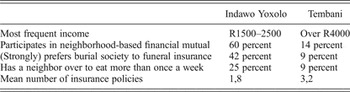
The survey data confirms that people with insurance policies are involved in fewer reciprocal obligations with neighbors (see table 1). To gain insight into generalized reciprocity, respondents were asked how often they have a neighbor over to eat a meal. In Indawo Yoxolo, about 25 percent of respondents said that this happened more than once a week, whereas in Tembani only 9 percent did. A closer look at financial mutuals provides greater insight into balanced reciprocity among neighbors. In Indawo Yoxolo, 60 percent of the respondents participated with neighbors in a financial mutual, but in Tembani only 14 percent did. Moreover, in Indawo Yoxolo, 42 percent (strongly) preferred burial societies based on balanced reciprocity to funeral insurance, while in Tembani only 9 percent said this.
Neighborhood relations and insurance in Indawo Yoxolo and Tembani (n = 110).

Questions were also asked about social capital. Social capital was measured as a compound variable of answers to: (a) How often do you have a neighbor over to eat? (b) How often does a neighbor ask you for money? and (c) How many financial mutuals do you participate in? The data suggests that people that spend more on insurance tend to have less social capital.Footnote 55 It appears that insurance offers an escape from the financial pressures that are part of social relationships.
But insurance is not just an escape; it can lead to disputes among kin and neighbors, and a configuration of violence within intimate relations. For example, my research assistant Edith Moyikwa was involved in organizing the funeral of a relative when she noticed that a fairly distant relative contributed the huge sum of R1000 toward the funeral costs. The relative requested in return only a copy of the death certificate. She had been equally generous at other funerals, which raised people's suspicions. Edith, partly as a consequence of her involvement in this study, suggested that this relative might well be taking out funeral policies on others. They confronted the woman with this and she admitted that this was what she was doing. Whenever a relative or neighbor was ill, she would take out a R10,000 funeral policy on that person's life. After the person died, she donated R1000 in return for the death certificate, which she needed to make her claim to the insurer. She would then keep the remaining R9000. The woman's relatives were furious and accused her of witchcraft: she was killing people to make money. The woman defended her practice by saying that she was trying to help people and that she had meant no harm. I encountered a widespread concern that someone will gain financially by one's death. Many hide their policies from others, and even spouses and siblings would not tell each other about them. Many were worried that insurance policies gave the policyholder an interest in the death of a family member.
Commercial insurance might be considered as the pinnacle of global financial capital. At first glance, it does seem that conflicts over mutual obligations are a result of neoliberalism or millennial capitalism. However, the intensified marketization of insurance is simultaneously an expansion of a redistributive economy. Acknowledging that insurances are also redistributive regimes reveals that people are caught up in economies that imply solidarities, entitlements, and obligations that are quite different and at times contradictory.
Religious Riches
Redistribution has also become part of South Africa's religious landscape. One way this is apparent is in the cooperation between insurance companies and churches. In 1989, the insurance company African Life and the leadership of the Zion Christian Church (ZCC) launched a funeral policy for ZCC members only. This policy grew most quickly in the mid-1990s. It was administered largely by ZCC members who collect the premiums and register payments. They also helped with the administration of claims, clarified potential misunderstandings about the legitimacy of claims, and dealt with other insurance-related issues, including conflicts among relatives over the allocation of benefits. For insurers, cooperation with the church had many advantages, most obviously that the ZCC offered up to four million clients with low administration costs.
Another example is the recent cooperation between the insurer Safrican and the prosperity church Assemblies of God. Safrican is largely owned by the Black Economic Empowerment company called Thebe Investment Company, and since 2007 it has been the underwriter of the funeral services for the Assemblies of God of Southern Africa. Safrican taught a group of Assemblies of God members about its policies, no doubt to ensure that they could then sell them to other congregation members.Footnote 56 Cooperation between insurance companies and churches is indicative of a post-Fordist economy in South Africa. For insurance companies, it no longer suffices to sell via intermediaries like employers and unions. Churches have become a new intermediary in an economy where large-scale redistribution appears to be replacing labor as a source of wealth, both real and imagined.Footnote 57
The growth of prosperity churches in post-apartheid South Africa suggests that large-scale redistribution has a stronger appeal than does mutual support among church members. Although increasing numbers of people are not affiliated with a church—in the survey 40 percent were not affiliated with any religion—prosperity churches such as the Universal Church of the Kingdom of God (UCKG), Apostolic Faith Mission, and the Assemblies of God have become more prominent. Some 18 percent of the respondents that did belong to a church belonged to one of these.Footnote 58 These churches are hierarchically organized and maintain a strong focus on financial donations.Footnote 59 They aggressively urge their congregations to donate large sums of money and promise them vast riches in return. The South African website of the Assemblies of God is particularly revealing.Footnote 60 It gives an initial impression of being the homepage of a lifestyle magazine. One sees a highly stylized living room with a leather chair, a large flat-screen television in the bookcase, and an iPod on a side table. These consumer items offer links that provide brief information about the church, such as an address or photographs. Only two links provide details: one takes visitors to a website on donating money, and the other takes them to a website on social development entitled, “Over the Wall: Access to Resources.” The only substantial links that Assemblies of God offers are about large-scale redistribution: donating money to the church, and access to resources.
The emphasis of redistribution is even more prominent in the fast-growing Universal Church of the Kingdom of God. In 1997, The UCKG had only one church in Cape Town, which held its services in an abandoned factory hall in Woodstock. Ten years later, there were thirty branches. This church of Brazilian origin and with Brazilian priests promised its members great wealth and prosperity.Footnote 61 Priests preached that tremendous wealth awaited the congregation: a big house, or a luxury car, mostly BMWs. They explained that this wealth had to be “unblocked” through fierce and intensive prayer and large donations to the church. Poor men and women, some earning less than R1000 a month, donated hundreds of rand at prayer services, which spurred congregations into competing with donations. Members gave as much as they possibly could, particularly during the Campaign of Israel. In this campaign, the priests preached that individual members had to write down their prayers, which would be taken to Israel. To make sure that God listened to the prayers, members had to donate as much money as they could. I spoke with one woman living in Khayelitsha who told me with some embarrassment that she had sold everything but the clothes on her own back and given all the money to the church just to make sure that her prayers would go through. Her sister, who had an affair with the priest, had done exactly the same. No riches appeared, and both were upset and eventually left the church. The woman was also angry with her sister for having secretly kept one set of clothing for herself: “Why did you not tell me that you did not sell everything? Then I would have also kept an extra set of clothing for myself.” She felt cheated by both her sister and the church. When I interviewed her, she had found employment as a cleaner, while her sister—the priest had left South Africa without telling anyone—had found a job picking grapes.
Though the histories of these three prosperity churches are very different, today they are all concerned with large-scale redistribution through hierarchical relations. In sharp contrast to the Zion churches, there are hardly any reciprocal relations among congregation members. Assistance among UCKG members was limited to prayers given, and other forms of mutual support, either financial or by helping people to find a job or run their household, were strongly discouraged. The churches also discourage kinship relations, since the congregation has to renounce ritual ties to their ancestors. The ancestors are fundamental to mutual kinship obligations such as funerals, slaughtering of cattle for ancestors, and the initiation of boys into manhood. When people stop taking part in these events then kinship obligations are diluted. Indeed, this may well be one of the attractions of these churches. Mutual obligations, after all, offer no prosperity, while the idea of religious riches through large-scale redistribution offers hope.
The hope for wealth in a liberated South Africa, then, is also apparent in the religious landscape, both in insurance offered in conjunction with churches and the growing popularity of prosperity churches that discourage mutual obligations and preach an ontology of large-scale redistribution. The dynamics of the country's changing religious landscape vis-à-vis insurance and redistribution require closer analysis. Redistribution through prosperity churches is particularly salient since it most strongly reveals the discrepancy between ideology and practice—the ideology is one of redistribution from God, while the practice is that church leaders enrich themselves at the expense of their congregations and their dependents. Yet merely pointing out the exploitative character of such practices cannot explain the attraction of these churches. To paraphrase Weber, prosperity churches seem to indicate a “spirit of redistributive economies,” with an almost millenarian but also quite fleeting trust in the power of redistribution.
Conclusions and Implications
Redistributive economies are central to the reconfiguration of sociality and violence. In South Africa, political liberation was followed by a surge in large-scale redistributive institutions through the state, markets, and churches. Many South Africans try to understand why some people have benefited from political liberation while so many others are worse off than before. Unemployment among the poor and uneducated has only worsened since 1994, while redistributions of social grants, development aid, insurance benefits, and the promise of religious riches have increased dramatically. Increasing numbers of people have had to rely on redistribution, as mutual obligations among kin and neighbors have become increasingly fragile, largely due to HIV, poverty, and violence. Redistribution has become the major source of real and imagined wealth, and is therefore pivotal to the reconfiguration of sociality.
This study reveals redistribution's impact on mutual dependencies and how it can lead to conflicts between kin and neighbors. The poor, without jobs or businesses, are especially caught up in a plurality of redistributive economic practices that lead to tensions over obligations and entitlements.Footnote 62 Social grants generate concerns about the moral degeneration of youth, and increase their dependency on parents or grandparents; insurance policies help policyholders and their dependents to overcome adversities, but also lead to conflicts over mutual obligations. Today, the poor take out policies on the lives of others and are treated with suspicion due to the interest they have in other people's adversities. Prosperity churches urge people to break off reciprocal relations and then disappoint congregations when priests suddenly leave and religious riches fail to materialize. Residents of Tembani develop a new social category, friendships, without financial obligations. These patterns display how the rapidly expanding redistributive economy can be conducive but also detrimental to reciprocal relations, and how it offers opportunities for both mutual support and exploitation. Redistributive economies can bring about conflicts over wealth and broad reconfigurations of sociality and violence.
Comaroff and Comaroff attribute violence to the opacity of wealth in neoliberal economies.Footnote 63 I argue that the amalgamation of a wide range of redistributive economic regimes causes the reconfiguration of sociality and violence. This process does not exclude the neoliberal market but is certainly not limited to it. The conflicts that Comaroff and Comaroff examine are also at the heart of government grants, development projects, black economic empowerment requirements, and the wealth that prosperity churches promise. Ferguson has recently argued that neoliberal policies offer ideological support for welfare provisions.Footnote 64 His fascinating study supports the idea that neoliberal policies support welfare, most notably through the state's healthy tax base but also due to processes of identification. Yet, do not forget that many influential South African politicians frequently denounce neoliberalism, and this cannot be put aside as mere political rhetoric. The centrality of a wide variety of redistributive regimes in South Africa offers us another perspective on the reconfiguration of sociality and violence that does not exclude the market but is not limited to it.
At a time when many of the poor now care little about the market, and pin their hopes instead on redistribution, it seems beside the point to belabor redistribution's social embeddedness. However, this rests on the problematic distinction between market and non-market exchange that locates redistribution squarely in the realm of the latter.Footnote 65 Commercial insurance is a form of redistribution: money is collected into a fund from which it is redistributed to assist in times of adversity. Whether prosperity churches are part of the market is open to scholarly debate, but I argue that its promises of wealth follow the logics of large-scale redistribution. Congregations ostentatiously pool money in church funds and expect that God will return vast riches to them.
Rather than dwelling on distinct economic spheres, it is more fruitful, as Guyer among others has noted, to study “the historical constitution of conversions and wealth creation, under turbulent conditions.”Footnote 66 The present study has shown that redistribution is part of the market (insurance policies) but also more than the market (social grants, development aid, religious riches). Scrutinizing the sociality of these redistributive regimes more fully captures the post-apartheid economy than does a study that takes the primacy of the market at its point of departure. We need to explore how redistributive economies are entangled with processes of democratization; how they can generate new feudalisms and neopatrimonialisms; how they engender new ontologies of wealth; and how the resulting reconfigurations of sociality, particularly in the intimate realm, cause new socio-economic formations.