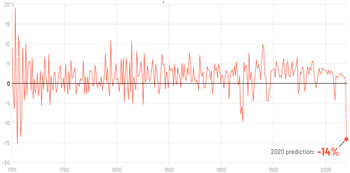
Severe crises reshape the world, mentally and politically as well as economically. They occur with some frequency, and should not really be considered as ‘black swans’. This article examines how far the character of the reshaping may follow from the differing nature of the challenge in each case. There is an urgency to this examination. The Covid-19 crisis has produced a uniquely sharp and severe worldwide economic downturn. Looking for precedents involves going back centuries. A recent presentation by the Bank of England spoke of the most severe downturn for over three hundred years, since the Great Frost of 1709 (see Figure 1).Footnote 1 The crises of the early 1700s were set against a background of bad weather, harvest failures and the very costly War of the Spanish Succession. Wheat prices in 1709 were five times the level of 1704 (Appleby Reference Appleby1979). These economic collapses were in essence (in this case weather-induced) supply shocks, a feature that makes them more obviously comparable to the 2020 situation than do the economic failures of the last century, which were (as with the Great Depression) more often, and more simply, demand shocks.
Annual change in UK GDP (percentage)

The current economic crisis is in addition widely interpreted as a crisis of globalization. The New York Times commentator Thomas Friedman explained that ‘Greed and globalization set us up for disaster.’Footnote 2 Peter Navarro, President Trump's Director of Trade and Manufacturing Policy, opined: ‘We wouldn't be having this problem if we had the domestic production of essential medicines, medical supplies like masks and medical equipment like ventilators . . . If we made it here, we wouldn't be faced with this. That was the original sin.’Footnote 3 It was the most globally connected centers of population that suffered first from the disease, but they are also hit uniquely harshly by the shutdown: Lombardy in Italy, London, Brussels, New York, São Paulo. It is easy to demonstrate the links between an early experience of the pandemic crisis and international travel.
As the crisis developed, it also became clear that it was not just the very globalized and the hyper-mobile who were affected. This crisis is more like a universal global crisis than any previous crisis. Most pre-modern weather catastrophes, like 1709, or 1706 in Britain, were quite localized, certainly in continental terms. While in the Great Depression, some farmers all over the world engaged in commodity production for export – coffee, rubber, tin – suffered enormous hardship, in general in previous economic disasters, the informal sector was protected against contagious economic fallout. Now the evidence is that it is precisely the informal sectors – in mature societies, the gig economy, in poorer economies, a vast part of economic activity – that are affected most.
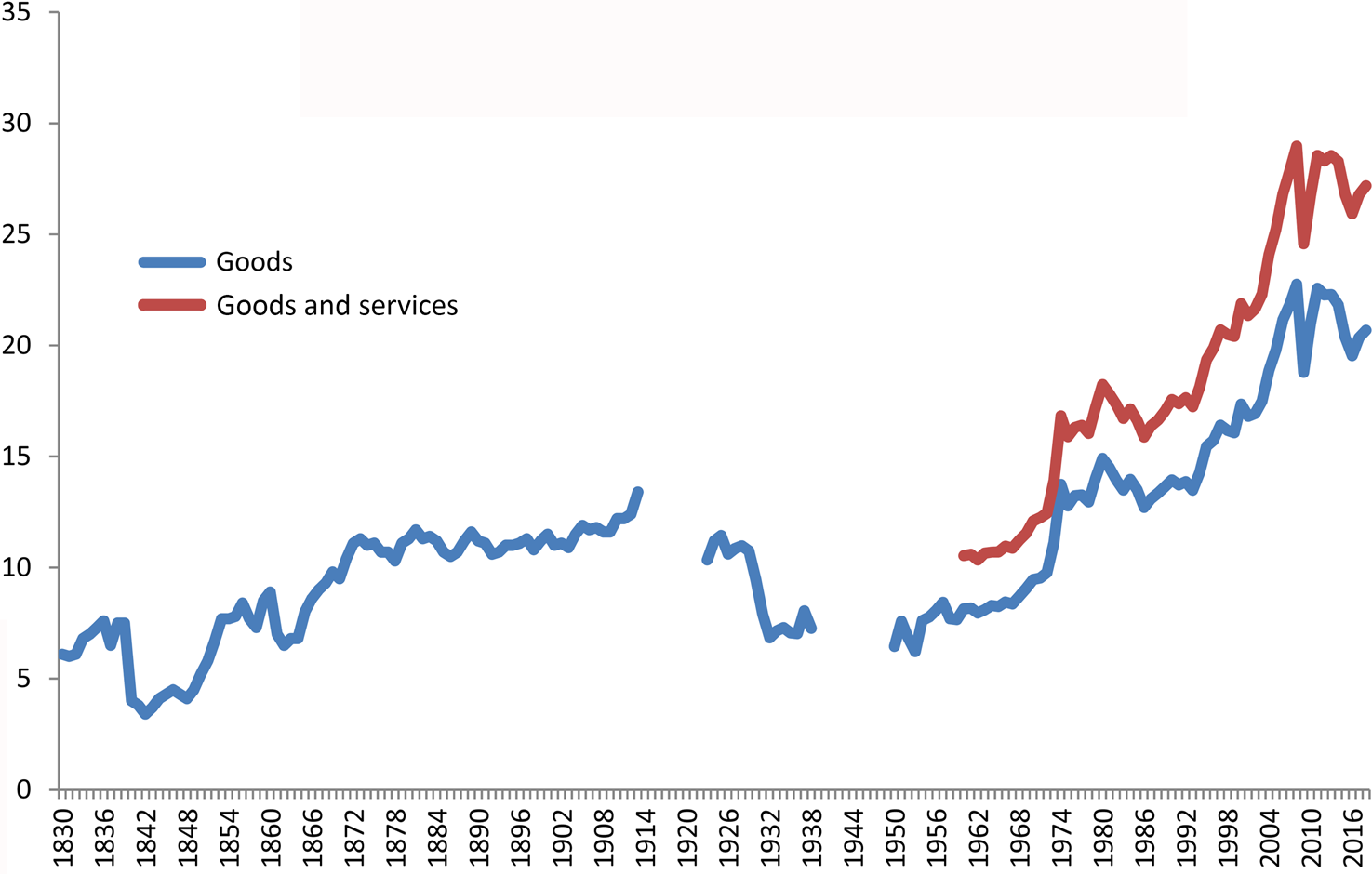
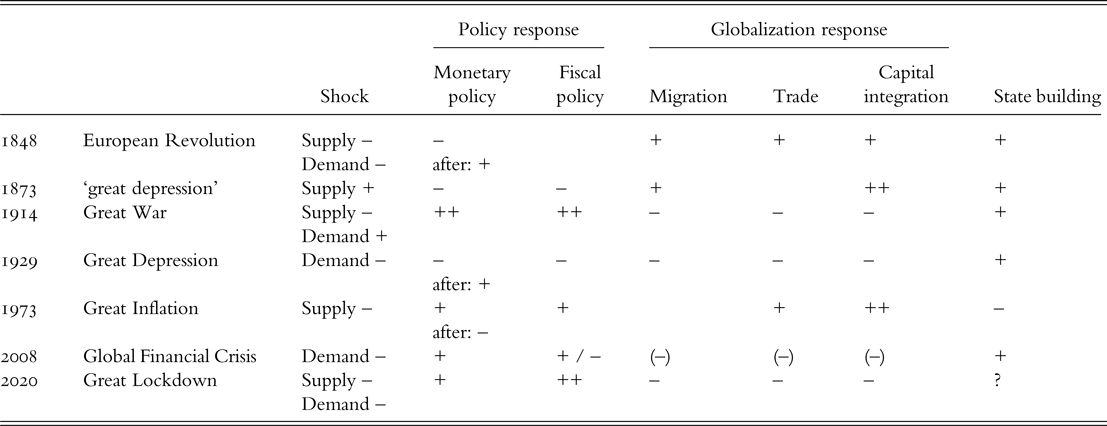
This article examines seven landmark disturbances that changed the course of international economic development, in large part because they led to a reshaping of the institutions that supervised or regulated development (see Table 1). In each case, a series of questions are posed: what were the origins of the crisis, what were the monetary and fiscal policy responses, how did the crisis affect the drivers of globalization, trade and migration? And how did these different challenges affect governance and views of politics? Effective state structures and legal frameworks are central in connecting with the outside world. Previous supply shocks generally pushed further globalization, but in an altered form, and led to new expectations of how governments should manage the shocks. All these crises affected the trajectory of globalization, some pushing further integration, others leading to disintegration. The characteristic U-shape of globalization was molded by the shocks: see Figure 2 (Catão and Obstfeld Reference Catão, Obstfeld, Catão and Obstfeld2019).
Ratio of global exports to GDP

Seven crises of globalization: an overview of history

THE EUROPEAN REVOLUTIONS (1848)
The 1840s are – like 1706 or 1709 – an instance of a powerful negative supply shock. The middle of the decade looked like both a classical hunger or subsistence crisis of the ancien régime, as well as a modern business cycle downturn coupled with a financial and banking crisis. It was in a sense then an eighteenth-century crisis, but also a twentieth-century crisis. Jonathan Sperber considers it in consequence a ‘crisis of transition’ (Sperber Reference Sperber2005; Spoerer and Berger Reference Spoerer and Berger2001). The food crisis followed from bad weather and poor harvests, with the weather leading additionally to crop diseases, most famously the potato blight. Most people were spending from two-thirds to three-quarters of their income on food. From 1845 to 1847 prices, especially in central Europe and France, ran up. In Ireland, some 80 percent of the 1846 potato crop was destroyed by phytophthora infestans. There was thus a quite generalized supply shock. The financial crisis came as speculators bet on continually rising prices in 1847, and were then surprised both by the actual harvest (which was abundant) and by grain imports.
Policy measures augmented the severity of the shock, and the crisis is a powerful illustration of Amartya Sen's (Reference Sen1983) proposition that famines are man- (or policy-)made. The most stunning example was in Ireland, where the historical consensus explains that British doctrinaire laissez-faire liberalism led to the disaster (O'Grada Reference O'Grada1995). The Whig ‘ideologue’ (Cormac O'Grada's term), Chancellor of the Exchequer Charles Wood, thought that ‘Providence and foresight’ ought to have been exercised by all classes in Ireland including ‘those who have to suffer the most’. But in the view of the British officials, the greatest evil of all was the neglect of the destitute by ‘those who in their several neighbourhoods’ had a duty to ‘alleviate the sufferings of the poor’ (Haines Reference Haines2004, p. 240). A new twist to that story was recently given by Charles Read, who showed that the fiscal stance of the British government, with higher taxes on small and medium farmers and above all traders, gave the final push: driven into bankruptcy, these entrepreneurs emigrated, and the supply chain broke down (Read Reference Read2016). An Irish patriot who emigrated to the US concluded: ‘No sack of Madgeburg, or ravage of the Palatinate, ever approached in horror and desolation to the slaughters done in Ireland by mere official red tape and stationery, and the principles of political economy’ (Mitchel Reference Mitchel and Maume2005, p. 218; Gillissen Reference Gillissen2014).
The economic and social breakdown led to a political flashpoint, in 1848, with contagious revolutionary movements spreading from Paris and Palermo all over central Europe: after the worst effects of the food crisis were already past. The combination of the economic crisis and the failure of the political reform movement generated a new wave of emigration from Europe (which also helped to raise living standards in Europe). German-speaking central Europe saw especially high rates of migration. Those poor areas such as Scandinavia with high levels of emigration saw living standards rise more quickly than poor areas with little emigration: O'Rourke and Williamson (Reference O'Rourke and Williamson1999) contrast Sweden with Portugal.
The crisis was also followed by a wave of monetary expansion, pushed to some extent by the discovery of gold (the Californian gold rush of 1849) and in part by financial innovation, as France and central Europe experimented with new banks on the model of the French crédit mobilier. In consequence, very quickly, Europe looked much less likely to experience a repeat of the simultaneous move to political revolution.
Trade liberalization, which was given a model in the form of the 1860 Anglo-French agreement (the Cobden–Chevalier pact), international capital movements and migration all took off after the political revolutions, although there was already a substantial growth of trade before 1860 (Accominotti and Flandreau Reference Accominotti and Flandreau2008).
The events of the 1840s laid the foundation for a wave of productive institutional adaptation, designed to remedy coordination problems raised by a multiplicity of small states with limited powers to deal with mobility: the creation of nation-states in Europe, with new constitutions, notably in Germany and in Italy, the administrative reform of the Habsburg empire culminating in the Ausgleich of 1867 and the establishment of the Dual Monarchy (Austria–Hungary). The US Civil War and the opening of Japan with the Meiji restoration can also be seen in this context of nation-building. Indeed there are linkages with the European crisis. In 1854 emigration from Germany surged to a peak (250,000) in precisely the year that Kansas had been declared open to free settlement. The surge of German and Scandinavian immigration into Kansas ensured that Kansas would become a free and not a slave-owning state and in this way undid the careful constitutional compromise of the Kansas–Nebraska Act, and helped to set the switches for Civil War.
Friedrich Engels in his 1895 Introduction to Marx's Class Struggles in France wrote how it had become clear to Marx in 1850 that: ‘the world trade crisis of 1847 had been the true mother of the February and March revolutions, and that the industrial prosperity which had been returning gradually since the middle of 1848 and attained full bloom in 1849 and 1850 was the revitalising force of a restrengthened European reaction’ (Marx Reference Marx1895). It's not clear that reaction is really the best way of describing the new and quite revolutionary form of governance that emerged in the 1850s and 1860s. The original reactionaries faded, like Radowitz, the garderobier of King Friedrich Wilhelm IV's ‘medieval fantasies’ (Petersdorff Reference Petersdorff1900, p. 11). They were replaced by ambiguous figures like Louis Napoleon (Napoleon III) or Otto von Bismarck: modernizers who built a world in conformity with a new logic. One leading commentator, the liberal journalist who coined the term Realpolitik, August Ludwig von Rochau (Reference Rochau1869), concluded that nation-state was ‘nothing more or less than a simple business transaction’.
THE ‘GREAT DEPRESSION’ (1873)
The ‘great depression’ of the 1870s followed from a positive supply shock: the opening of the world economy in the 1860s, with the steamship reducing the cost of transoceanic transportation, and the railroad opening up continents to transporting export crops. The excitement about new frontiers, coupled with legal changes that made it much easier to establish corporations in many European countries, generated a wave of company formation and speculation (Gründerzeit).
The euphoria ended with major and nearly simultaneous stock market crashes in North America and central Europe in 1873. It started with a collapse in Vienna on 5 May and 9 May, with stock of banks and some speculative railroad companies particularly badly affected (Schäffle Reference Schäffle1874). The US crash came after the failure of a major railroad constructor, Jay Cooke, on 18 September 1873. The Berlin market only crashed in October. In all cases the panic seemed unexpected and wildly contagious. As a contemporary US commentator put it:
A Wall Street panic comes suddenly like thunder from a clear sky. No shrewdness can foresee and no talent avert it. A combination without a moment's warning can be formed that will sweep away the fortunes of merchants in an hour, shipwreck speculators, ruin widows and orphans, make farmers grow pale, and harm every industrial and mechanical interest in the land. (Smith Reference Smith1874, p. 28)
The aftermath of the crashes, and the extent to which financial panics produce long-term damage, is often driven by the character of monetary policy. In this case, the major policy shock came from the US resumption of gold payments after the Civil War, the ‘crime of ’73’, and the deflationary consequences; in the same year, 1873, Germany had also moved onto a gold basis.
The combination of the weakness of grain prices and a severe industrial downturn as building and railroad construction ground to a halt pushed many European governments into a more protectionist, conservative, and at times pro-agrarian and anti-industrial course. Tariff levels increased, but they did not curtail continued trade expansion, which continued but at much lower rates of growth than in the surge of the 1850s and 1860s (see Figure 2). In German history the outcome became known as the pact of ‘iron and rye’, and was the subject of classic studies by Alexander Gerschenkron (Reference Gerschenkron1943) and Hans Rosenberg (Reference Rosenberg1943). The downturn in Europe also pushed higher levels of migration (Thomas Reference Thomas1954), and as railroads and shipping opened up eastern Europe, the Mediterranean and South Asia, emigration from those areas also surged.
Above all the collapse prompted a rethinking of the state. European countries turned to formal empire, and scrambled to divide Africa, and by the end of the century looked forward to partitioning China. Domestic politics changed also. There was a heavy dose of anti-Semitism in the criticism of the ‘National Liberal’ era. The historian Constantin Frantz (Reference Frantz1874) produced a denunciation of National Liberalism and of the kleindeutsch solution to German unification as Judenherrschaft, in a book whose major thesis was that Jews had seized control of Berlin. It is quite hard to see long-lived traces of the events of the 1870s in output data, and recently historians have concluded that the broadly deflationary era of the late nineteenth century constituted a benign deflation, driven by technology and productivity gains (Bordo, Landon-Lane and Redish Reference Bordo, Landon-Lane and Redish2004). The major legacies of the Gründerkrach in central Europe were more to do with intellectual and political than with economic outcomes: it set off a much more managed form of imperialistic globalization, that was potentially highly conflictual.
THE GREAT WAR
World War I constituted a massive negative supply shock, as well as a positive demand shock because of vast government expenditure. Shipping was immediately targeted in a new kind of economic warfare, and was immediately disrupted. Cotton prices fell dramatically as European producers no longer imported cotton fiber. Food on the other hand became scarce, as did raw materials required for military production.
John Maynard Keynes told his fellow Bloomsburyite David Garnett:
he was quite certain that the war could not last much more than a year and that the belligerent countries could not be ruined by it. The world, he explained, was enormously rich, but its wealth was, fortunately, of a kind which could not be rapidly realised for war purposes: it was in the form of capital equipment for making things which were useless for waging war. When all the available wealth had been used up – which, he thought would take about a year – the Powers would have to make peace. We could not use the cotton factories in Lancashire to help our navy blockade Germany; Germany could not use its toymakers’ factories to equip her armies. (Garnett Reference Garnett1954, p. 271; see also Ferguson Reference Ferguson2006, p. 89)
Governments spent large amounts on economically unproductive activities (creating and using weapons). Most of that effort could not be financed out of taxation, but was instead raised initially by long-term borrowing, mostly on the domestic market. In order to create incentives for the public to display its patriotic inclination and buy war bonds, the monetary authorities (usually central banks) lent on the security of these bonds. There was an effective monetization of government debt, and the resulting regime is the most obvious exemplar of the phenomenon of ‘fiscal dominance’.
The immediate learning experience of the Great War was that collective organization made sense and brought substantial efficiency gains. The initial strategy adopted quickly by Germany in 1914 of managing raw material supply to construct an effective war planning system was adopted by most of the belligerents, with a high degree of efficiency in France and Britain, but with chaotic consequences in Russia. The inadequacies of both food and housing supply were a major contribution to the revolutionary breakdown that started in Russia and then spread over central Europe.
The price effects of the large-scale monetization became apparent, but not immediately. In order to maintain social harmony, wartime governments quickly imposed price controls. Many in addition wanted to ensure fair access to limited resources, and complemented the price controls with rationing. The result led some analysts to conclude that in some countries, notably the UK, average health improved in wartime (Winter Reference Winter, Wall and Winter2005).
The full effects of wartime monetary management became evident only after the end of the conflict. In the US and the UK, governments increased tax rates and cut expenditure sharply, producing a sharp postwar recession (1920-1) (see Sargent and Hall Reference Sargent, Hall and Dabla-Norris2019). That course was only followed by a very few other states: Czechoslovakia almost alone imitated the budgetary austerity. Most of central Europe did not, because the elites were unwilling to accept a higher tax regime (Bresciani-Turroni Reference Bresciani-Turroni and Sayers1937; Ferguson Reference Ferguson1995). The result was an inflation driven by fiscal looseness and debt monetization. In inflationary settings, there are advantages to collective mobilization to press for wage and other gains, and the inflation pushed a high degree of unionization and other social organization (Hirsch and Goldthorpe Reference Hirsch and Goldthorpe1979).
The aftermath of the war produced a reversal of both the trade and the migration integration that had largely characterized the prewar world. On the other hand, policy was driven by a concern with a rapid ‘return to normalcy’, and often by a nostalgia for the apparent certainties and security of the prewar world, although that looked almost irrecoverable. One hope was that the normalcy could be achieved by capital flows, from the private sector, to allow reconstruction and recovery. At the same time, the legacy of inter-allied debt and the reparations system created alternative claims, that would make the structure of international credit uncertain (Ritschl Reference Ritschl1998). The result of the quest for normalcy was a set of expectations that was impossible to fulfill, and an overstraining of vulnerable democratic and parliamentary institutions: that result became fully clear after a demand shock that is causally deeply connected with the legacy of the war.
THE GREAT DEPRESSION
The origins of the Great Depression lie in a demand and investment shock. If there was a supply shock, it was a positive one, following from the extension of cultivation across the world in and after World War I, which generated price declines for many foodstuffs and commodities after the mid 1920s. Throughout the crisis, the decline in food and raw material prices was sharper than that of manufactured goods, and the terms of trade remained in favor of manufacturing for the whole of the 1930s. It was easy to deduce from that observation a long-term falling tendency of raw material prices. The demand shock was augmented by poor fiscal and monetary policy choices, that turned what otherwise would have been a business cycle downturn or the collapse of a speculative bubble into the Great Depression.
That analysis became basic conventional wisdom in the second half of the twentieth century, and drove both Keynesian and Friedmanite policy prescriptions. There was another aspect of Keynes's interpretation in the 1936 General Theory that is harder to investigate, or to use as a basis for policy prescription. Keynes spoke of:
the instability due to the characteristic of human nature that a large proportion of our positive activities depend on spontaneous optimism rather than mathematical expectations, whether moral or hedonistic or economic. Most, probably, of our decisions to do something positive, the full consequences of which will be drawn out over many days to come, can only be taken as the result of animal spirits – a spontaneous urge to action rather than inaction, and not as the outcome of a weighted average of quantitative benefits multiplied by quantitative probabilities. (Keynes Reference Keynes1936, pp. 161–2)
Animal spirits seem to hark back to psychological theories of business cycles that relied on the idea of confidence. Recent econometric research shows there is some substance to this belief: thus the mood of optimism for the mid 1920s was fed in the US by ‘good news’ about European stabilization, even though the actual impact on the US economy was slight, because of the relatively closed nature of the US economy (Kabiri et al. Reference Kabiri, James, Landon-Lane, Tuckett and Nyman2020).
Monetary policy was constrained by the revived international gold standard. In large part that mechanism had been restored as a confidence- and credibility-building mechanism in the aftermath of wartime finance and fiscal dominance. Its architects saw it as the basis for security on which international credits could be built, allowing reconstruction of devastated Europe and development elsewhere. Any expansive monetary policy would lead to financial panic and an outflow of currency. Modern economic historians have largely concurred that the gold regime was the fatal flaw of the interwar system, and argued that countries that threw off ‘golden fetters’ earlier derived the most benefits from a new policy regime and recovered more quickly (Eichengreen and Sachs Reference Eichengreen and Sachs1985; Bernanke and James Reference Bernanke, James and Hubbard1991; Eichengreen Reference Eichengreen1992).
Fiscal policy was constrained in many countries, notably the debtor countries, which were caught in a trap. They owned a substantial foreign currency debt. A currency devaluation would increase the size of that debt, and wreck corporate and bank balance sheets (with assets in domestic currency and liabilities in foreign exchange). It made sense as an option only with some sort of default on foreign debt. Countries that defaulted experienced an immediate shock – but in a longer run made their way back to growth.
Countries seem also to have regarded each other as models. The US and France, which should not be thought of as fiscally constrained because of their substantial creditor position, responded to the events of 1931 in central Europe and Britain by pushing fiscal austerity. Until September 1931, Herbert Hoover liked to push fiscal stimulus measures; after the UK crisis of September 1931, and widespread commentary about how the US might also be vulnerable to credit instability, he changed course completely and cancelled previously discussed measures (James Reference James2001). The State of the Union message of 8 December 1931 had as its central point the restoration of confidence through fiscal austerity. The Federal Reserve System – with a similar motivation – turned against open market purchases of securities, which would have counteracted the monetary deflation.
The initial answer to the multiple policy failures was to cast off internationalism, and the connections, spillovers and policy constraints that it brought. Keynes in 1933 prepared an essay that was enthusiastically received in the US, but also in Germany, where it quickly appeared in translation, ‘National Self-Sufficiency’: ‘Ideas, knowledge, science, hospitality, travel – these are the things which should of their nature be international. But let goods be homespun whenever it is reasonably and conveniently possible, and, above all, let finance be primarily national.’ But Keynes urged caution: ‘Yet, at the same time, those who seek to disembarrass a country of its entanglements should be very slow and wary. It should not be a matter of tearing up roots but of slowly training a plant to grow in a different direction.’ He ended with some perplexity:
The decadent international but individualistic capitalism, in the hands of which we found ourselves after the war, is not a success. It is not intelligent, it is not beautiful, it is not just, it is not virtuous – and it doesn't deliver the goods. In short, we dislike it, and we are beginning to despise it. But when we wonder what to put in its place, we are extremely perplexed. Each year it becomes more obvious that the world is embarking on a variety of politico-economic experiments, and that different types of experiment appeal to different national temperaments and historical environments. (Keynes Reference Keynes1933, pp. 758, 760–1)
Already before the depression, governments had restricted migration (most dramatically in the United States), but with the onset of economic crisis, immigration looked even more threatening, as a source of labor competition which was also interpreted as a political challenge. States reacted to financial crisis by imposing much more restrictive trade regimes, no longer depending on tariffs but applying quantitative restrictions (quotas) (Eichengreen and Irwin Reference Eichengreen and Irwin2010).
When Keynes wrote in 1933, it was not clear quite how destructive the new experiments would be. In the concluding section of the 1936 General Theory, he then added a warning:
The authoritarian state systems of today seem to solve the problem of unemployment at the expense of efficiency and of freedom. It is certain that the world will not much longer tolerate the unemployment which, apart from brief intervals of excitement, is associated – and, in my opinion, inevitably associated – with present-day capitalistic individualism. But it may be possible by a right analysis of the problem to cure the disease whilst preserving efficiency and freedom. (Keynes Reference Keynes1936, p. 381)
The German text of the preface, which was based on a version prepared by Keynes but may have been altered in the course of translation and publication, gives a rather different view of the potential of authoritarianism:
Nevertheless the theory of output as a whole, which is what the following book purports to provide, is much more easily adapted to the conditions of a totalitarian state [the German text carries the official expression: Totaler Staat], than is the theory of the production and distribution of a given output produced under conditions of free competition and a large measure of laissez-faire. This is one of the reasons which justify my calling my theory a General theory. Since it is based on less narrow assumptions than the orthodox theory, it is also more easily adapted to a large area of different circumstances. Although I have thus worked it out having the conditions in the Anglo-Saxon countries in view – where a great deal of laissez-faire still prevails – it yet remains applicable to situations in which national leadership [staatliche Führung] is more pronounced. (Schefold Reference Schefold1980, p. 175)
Keynes, and others, thought of a primary lesson on the Great Depression as the end of laissez-faire. In developing his response in the course of World War II, he emphasized freedom much more, but also (in the lead-up to the Bretton Woods negotiations) the desirability of an international or global settlement.
THE GREAT INFLATION
The trigger of the 1970s Great Inflation was a negative supply shock, emanating from (mostly Middle Eastern) oil-producing countries. It occurred against a background of currency disorder: the par value system collapsed in August 1971, and the attempt to restore it in December at the Smithsonian conference was unconvincing. Since petroleum prices were conventionally quoted in dollars, oil producers at first wanted to protect the real value of their exports, and then – by 1973 – realized that increasing oil prices could be an economic and also a political weapon. There was thus a new ‘oil nationalism’. In 1974, OPEC's oil revenues tripled to $108 billion, accounting for an eighth of all world exports. All the major industrial countries were heavily dependent on oil imports. The higher price might be regarded as the imposition of a new (wealth- and income-reducing) tax; the industrial countries mostly decided not to adjust immediately. The immediate response in most countries was to accommodate the shock. That accommodation pushed inflation, which rose to 11.0 percent in the US in 1974 (and then, after a second oil shock, to 12.0 percent in 1980), and to higher levels in some other countries: in the UK CPI inflation in 1975 was 24.2 percent, and in 1980 18.0.
The outcome altered the attitudes of governments toward capital mobility, which had been seen with distrust in the postwar settlement (that was a legacy of the 1930s). In fact, the international financial system was the key to the strategy designed by Henry Kissinger to contain the oil producers: if they might be encouraged to deposit their surpluses through international banks, they would be brought into the system. That argument was made explicitly at the first international summit of what was then the G5 in Rambouillet in 1975 (James Reference James1997).
The outcome of the 1970s also altered the stance of major governments toward traditional Keynesianism and interventionism. It appeared that the traditional Keynesian framework of the Phillips curve was wrong, and that higher levels of inflation (if anticipated or expected) would simply produce price increases but no output gains or reductions in unemployment. The first to move in this direction were center-left governments, the UK Labour government of James Callaghan, Jimmy Carter's Democratic administration, and – first of these – Helmut Schmidt's SPD–liberal coalition in Germany. The legacy was inherited – and considerably expanded – by center-right governments, above all those of Reagan and Thatcher. James Callaghan's 1976 Labour Party conference speech was subsequently described as the ‘words which effectively buried Keynes’ (Jenkins Reference Jenkins1987, p. 18). He set out a radically new doctrine, in words which had in fact largely been penned by his son-in-law, the Times journalist Peter Jay, and which Jay himself then wrote of as ‘the most breathtakingly frank public pronouncement since St Paul's First Epistle to the Corinthians’ (Roberts Reference Roberts2017, p. 12).
Britain has lived for too long on borrowed time, borrowed money, borrowed ideas . . . We used to think that you could spend your way out of a recession, and increase employment by cutting taxes and boosting Government spending. I tell you in all candour that that option no longer exists, and that in so far as it ever did exist, it only worked on each occasion since the war by injecting a bigger dose of inflation into the economy, followed by a higher level of unemployment as the next step.Footnote 4
That was the story of stagflation. The British retreat marked a recognition that the state was not in a good position to decide the relative merits of the pay claims of various competing groups (teachers versus nurses versus policemen).
The late 1970s constitutes the hinge of the twentieth century, the moment when the world moved decisively into a new phase of globalization. In China, Deng Xiaoping began a series of reforms that introduced the principles of the market. 1979 was the year of the Iranian Revolution, when the Shah was overthrown and fled Teheran on 16 January. In March 1979, some members of the European Community (without the participation of the UK) launched the European Monetary System, a stepping stone on what would be the road to the most problematical aspect of European integration, the creation of a monetary union. On 6 October 1979, the Chairman of the US Federal Reserve Board, Paul Volcker, announced a dramatic interest rate hike in a bid to kill inflation. On 3 May, in the UK, in a general election the Conservatives won a 43-seat majority, ousted the Labour government of James Callaghan and installed Margaret Thatcher as Prime Minister.
The supply shock of the 1970s thus gave a dramatic fillip to the notion of global opening, or globalization, and to a challenging of state capacity (but not to any substantive rollback in the size of the state as measured by the public sector's share of National Income). International migration increased, trade expanded with the formation of complex supply chains, and financial intermediation exploded (Baldwin Reference Baldwin2016).
THE GLOBAL FINANCIAL CRISIS
Like the Great Depression, the Global Financial Crisis was fundamentally a demand shock, produced by a breakdown of the financial system. The origins were indeed even more clearly financial than in the case of the Great Depression.
The policy response was fiscal stimulus, coupled with measures designed to prevent full-scale financial collapse. British Prime Minister Gordon Brown was keen to emphasize the fiscal stimulus as the centerpiece of international coordination. At the press conference, he explained that the $5,000 billion global fiscal stimulus was the largest ‘the world has ever seen’, and announced a new $1,100 billion ‘programme of support to restore credit, growth and jobs in the world economy’. One obvious criticism was that this was an exercise in producing big headline numbers that might not reflect a real policy commitment.Footnote 5 The headline figure combined discretionary spending with the automatic fiscal stabilizers that were the built-in response to the economic shock in every major country (but especially in continental Europe). The amount was meant to impress markets, and, perhaps more, voters. The April 2010 G20 London Summit counts as one of the high-water points of international economic cooperation, alongside the Bretton Woods conference, and a stark contrast with the failure in the Great Depression of the World Economic Conference, that was also incidentally held in London (but on the other side of town, in the Kensington Geological Museum). The political scientist Dan Drezner (Reference Drezner2014) makes the thesis that ‘the system worked’ the center of his argument, and indeed the title of his book analyzing response to the crisis. The London communiqué self-consciously adopted the language of Bretton Woods: ‘the belief that prosperity is indivisible; that growth, to be sustained, has to be shared.’ Brown saw it as creating a ‘new world order’. As he put it: ‘This is the day the world came together to fight recession not with words but with a plan for economic recovery and reform.’ European Commission president José Manuel Barroso commented: ‘What we have achieved in economic history is incomparable. We said what we would do, and now we will do what we say.’ French President Nicolas Sarkozy gave the interpretation an anti-American twist: ‘Since Bretton Woods, the world has been living on a financial model, the Anglo-Saxon model – it's not my place to criticise it – clearly, today, a page has been turned.’ Germany's Angela Merkel spoke about an opportunity to create a new ‘capitalism with a conscience’. Footnote 6 There was a major rehabilitation of the insights of Keynes (Skidelsky Reference Skidelsky2009).
The fiscal stimulus was broken off in 2010, in part because of the eruption of a European debt crisis, and in part because of political change in the two countries that had pushed the coordinated fiscal stimulus in 2008–9, the US and the UK. The mid-term elections in the US and the general election of 2010 in the UK produced Republican control of Congress (the ‘shellacking’ of Barack Obama) and a narrow Conservative victory in the UK (but with no overall majority, with the consequence that a Conservative–Liberal coalition was installed).
On the other hand, monetary policy did more and more of the heavy lifting. Dollar swap lines had been a central part of the initial response to the drying-up of the interbank market (Shin Reference Shin2011; Tooze Reference Tooze2018). The balance sheets of the major central banks expanded as they embarked on asset purchases, or unconventional monetary policy measures. Central bank balance sheets reached 25.1 percent of GDP in the US in November 2014. In the Eurozone an initial highpoint came in July 2012 (31.6 percent of GDP): that ratio then fell, but surged again to 36.9 percent in March 2018, when that of the UK was also 28.7 percent of GDP. The central bankers were uncomfortable with their new position, and Mario Draghi in particular at the European Central Bank repeatedly called for fiscal policy to take a greater share of policy. Critics thought that the use of asset purchases as a major policy tool brought the central banks into the domain of fiscal policy: choosing which assets, in the case of the Eurozone which government central banks, and which private sector assets to purchase was concerned with the ‘transmission of monetary policy’, but it also involved distributive choices.
There was a half-hearted push less to deglobalize than to make globalization safer or more sustainable in each of the classic areas of integration. Despite repeated G20 pledges not to adopt protectionism, there were increasingly restrictive trade measures. Governments attempted to limit migration. There was less international enthusiasm for capital flows, and more awareness of the dangers posed by the spillovers from monetary policies in other countries (loose US monetary policy set off surges into emerging markets, that then threatened to reverse if there was monetary tightening and created a substantial vulnerability). The IMF in 2012 adopted a new approach, termed the Institutional View, which introduced the notion of capital flow management measures (CFMs), and argued that in certain circumstances (mostly concerned with large inflows to emerging economies), CFMs ‘can be useful to support macroeconomic adjustment and safeguard financial stability’ (International Monetary Fund 2018). Rich countries became much more skeptical about immigration, with the inflow of Syrians fleeing from civil war into Europe in 2015 providing a focal point for a general critique. There was an incipient deglobalization, or ‘slowbalization’, rather than a complete disintegration or dismantling of international interconnectedness (James Reference James2018).
THE GREAT LOCKDOWN
The 2020 economic collapse was deliberately induced by governments trying to stem the ravages of a virus and prevent the overstraining of hospitals. It was thus simultaneously a severe demand shock and a supply shock. The idea was that normal economic activity would produce such a peak of infection that medical and health facilities would be overwhelmed, and consequently death rates needlessly high. Early projections showed that with a 2 percent case fatality rate baseline for overwhelmed health systems, and half of the world population infected, 1 percent of the world population, or 76 million people, would die. There were dramatic pictures of coffins stacked up in northern Italy, the first major site of infection after China, and there was a widespread belief that ‘flattening the curve’ of infection was the only way of avoiding Italian conditions. However, in the short run, flattening the infection curve inevitably steepens the macroeconomic recession curve. Pierre-Olivier Gourinchas (Reference Gourinchas2020) spoke eloquently about how the virus mutates and infects our economic system.
The only conceivable policy answer shows up the ambiguity of dealing through conventional measures with both a demand and a supply shock. Fed chair Jay Powell immediately responded to Covid-19 with considerable confidence: ‘When it comes to lending, we are not going to run out of ammunition.’Footnote 7 The conventional measures, learned from the Global Financial Crisis, involved both fiscal and monetary stimulus on a large scale, but were ill-equipped for dealing with a profound 1848-like social crisis.
Many of the measures are designed as short-term stimuli, but face a problem analogous to that of Great War policy-makers: what happens if the conflict is much longer than expected? Guarantees given as confidence-enhancing measures that were not expected to be called on then become fiscal liabilities. Some large-scale employers (notably in tourism, hospitality and transport) will take a very long time to recover. The crisis is a profound shock to education and medical provision, and it is likely that the choices of a post-crisis world are very different to those of the pre-2020 environment.
Globalization in the sense of the movement of physical factors of production is likely to be severely curtailed. Travel restrictions are supplemented by limiting or prohibiting visa rules, and legal migration will be severely reduced. Concern with supply of essential goods will lead at least in larger countries to a relocalization of production and the elimination of complex supply chains in essential goods – and lobbying efforts will lead to more and more goods being classified as essential. But immaterial (intangible) goods and services will be likely to continue to be traded. In some areas – remote education or telemedicine – there may even be more internationalization. The deglobalization move will further be affected by the financial responses to Covid-19.
The consequence of the pandemic has been a simultaneous shock to demand and output, as governments imposed lockdowns. Governments responded with stimulus measures, as well as targeted spending on health equipment and research, at a time when the reduction in economic activity drastically cut tax revenue. The result has been the sharpest ever increase in fiscal deficits outside wartime. Monetary authorities all over the world, including the European Central Bank (ECB), responded with accommodative measures. A European peculiarity has been the extent of the support given through loans and guarantees to businesses hit by the lockdowns.
European countries spent additional resources in countercyclical measures, but above all they provided guarantees and loans: in Germany such support amounted to some 23 percent of GDP and in Italy the package of bank loan guarantees and credit reinsurance schemes was close to 14 percent of GDP.Footnote 8 In addition, the European Commission announced its own €750 billion program, with €500 billion to be awarded as grants to recovery from the Covid damage. The UK has adopted a similar path of large-scale guarantees.
There are two major uncertainties. The first concerns the timing and speed of recovery. Even if there is a successful combination of vaccination and antiviral treatment, it is unlikely that some areas of activity will recover for a long time. Some of the crisis-era shifts are likely to be longer term: for instance, the move to remote office working, and internet conferencing. Cruise ships, tourism, restaurants and hospitality, trade fair and conference business are all likely to take a longer-term hit. Fashion and clothing may suffer with fewer opportunities either to socialize or meet in offices. Universities and hospitals have seen their business model shaken. If the longer-term alterations materialize, it is likely that a very large proportion of the loans will never be repaid, leaving a substantial fiscal burden. High levels of unemployment are also likely to remain, with pressure for more permanent support mechanisms once the very widespread (and successful) short-term support (Kurzarbeit) expires. The substantial provision of guarantees as a response to the Covid crisis holds a potential threat. Guarantees in some European countries might be called on, leading to a fiscal cost, while in other countries the purpose of the guarantee in simply providing a safety net that avoids a bad equilibrium succeeds and there is no fiscal cost. The question then arises as to how the cost is allocated between these countries. This is a scenario that looks back to the Euro debt crisis in the eventuality that northern Europe experiences a rapid rebound (a V-shaped recovery) while southern Europe is plunged into a renewed structural crisis (an L-shape trajectory).
The second uncertainty concerns the monetary consequences of the new environment, with major central banks launching a wide range of extraordinary programs. On 23 March 2020, the Fed launched simultaneously the Term Asset-Backed Securities Loan Facility (TALF), Primary Market Corporate Credit Facility (PMCCF) and a Secondary Market Corporate Credit Facility (SMCCF). The amounts were later expanded to $750 billion, and the program widened to include issuers that were rated as investment grade but were later downgraded (‘fallen angels’). On 9 April, a Main Street Lending Program (MSLP) was established for companies employing up to 10,000 workers. The ECB followed a similar trajectory, expanded asset purchases until end-2020 under the existing program (APP), and agreed on temporary additional auctions of the full-allotment, fixed rate temporary liquidity facility at the deposit facility rate and more favorable terms on existing targeted longer-term refinancing operations (TLTRO-III) between June 2020 and June 2021. Recently, the ECB introduced a new liquidity facility (Pandemic Emergency Longer-Term Refinancing Operations, PELTRO), at an interest rate that is 25 basis points below the average MRO rate prevailing over the life of the operation; and an additional €750 billion asset purchase program of private and public sector securities (Pandemic Emergency Purchase Program, PEPP) until end-2020. It also announced a broad package of collateral easing measures for Eurosystem credit operations in early April.
Monetary aggregates are rising in Europe (as in the UK and the US). The year 2020 will see the highest annual percentage increase in the broadly defined quantity of money in the US in peacetime, with the peak figure above 20 percent and possibly even above 25 percent.Footnote 9 Measuring the effects in terms of inflationary/deflationary impact is extremely hard at the outset (Blanchard Reference Blanchard2020). The collapse of demand has unsurprisingly led to major price falls for a range of consumer goods, including textiles and automobiles. Petroleum prices fell by record amounts (with negative prices for forward contracts because of the shortage of storage facilities). On the other hand, the collapse of supply chains and a politically driven reversal of globalization is likely to make many goods more expensive, including many food products. There is likely to be a rapid increase in ‘felt inflation’, in that trips to the supermarket are already becoming much more expensive. Asset prices already look as if they are being driven by a monetary overhang, as the initial post-Covid losses were reversed. Influential commentators such as Martin Wolf in the Financial Times considered the possibility of a recurrence of 1970s run-away inflation.Footnote 10 For at least a few months, or even a very few years, however, the tug of war between inflation and deflation may be unresolved, and policy uncertainty will prevail.
If and when the inflationary scenario materializes, there will be a rapid move away from fixed yield instruments, and government financing will become much more expensive. That outcome would see a return to the Euro debt crisis of the early 2010s. The environment surrounding the EU is likely also to be more unstable, as a return to inflation fears is likely to occur earlier and faster there.
If this scenario is realistic, it changes the policy incentives, and creates in particular a great attraction in funding as much debt as possible quickly, including very long-term maturities, or even as suggested by Giovazzi and Tabellini (Reference Giavazzi and Tabellini2020) non-maturing permanent debt, modeled on the very successful British ‘consols’ launched in the eighteenth century. Such instruments can, however, only be issued by very secure borrowers; if there is any doubt as to the credibility they would not be likely to find much of a market. The ECB without an adequate long-term fiscal arrangement would simply look like a version of the post-World War I German Reichsbank. Small European countries, or emerging markets, will not be able to access this type of instrument. The proposal thus depends on a very radical move to debt mutualization in Europe, a move for which there is perhaps not much or not sufficient political appetite. The European Commission €750 billion fund requires support from new fiscal revenue (perhaps a business tax, perhaps an environmental tax).
OUTLOOK
The combination of demand and supply shocks sends mixed and confusing policy messages. States will find it hard to meet all the expectations that arise when dealing with a demand shock, short of a continuation of benign monetary conditions. That was what made the response to the first of the seven crises of globalization so successful: the world opened up and trade and prosperity expanded. But in the 1850s countries did not suffer from the large debt overhang that is a legacy of previous more or less successful attempts to deal with other globalization crises, and especially the Global Financial Crisis (demand shocks).
Previous supply shocks produced a strong incentive to overcome limitations on supply by drawing on more international resources – globalizing more. The first crisis examined, the 1840s, led to a surge of global movement of goods and capital, and of labor mobility. After World War I, there was an initial attempt to restore the old interconnected world. The push to globalize was clearest and most urgent after the oil shocks of the 1970s.
Like other globalization crises, especially the 1840s, the Great War and the Great Depression, the Great Lockdown is likely to produce social tensions that are costly to defuse or contain. The 1840s and the Great War produced civil-war-like circumstances, with a polarization of violent change and weaponized reaction. The Alt-right rallies against lockdown confront groups protesting against the social and racial inequalities revealed by the virus. The clashes replicate the movements of armed peasants in 1840s Europe who moved to confront urban revolutionaries, or the Freikorps or other paramilitaries that fought communist revolutionaries at the end of World War I. Supply shocks are superficially easy for elites to manage through inflationary mechanisms, but those mechanisms in the past frequently eventually led to greater polarization and to social breakdown.
The difference between the twentieth-century supply shocks – Great War and Great Inflation – and the 1840s was that the financing was much more inflationary, and pushed a build-up of debt. As a consequence of the debt binge, powerful groups started to articulate competing claims about the priority of their claims.
Is history helpful as a guide? The outcome of the corona crisis may look much more like the response to the supply shock of World War I, when expectations about what institutions and governments can do turn into a bitter disappointment. The supply shock of the 1970s ended not with the strengthening of public institutions, but with their dismantling. There will be a desperate search for new models of governance as governments – including the most conspicuously populist governments (Trump, Bolsanaro, Johnson, Modi) – falter. The crisis sheds a harsh light not just on populist governments but also on the conditions – inequality, cramped housing, poor access to water and food – that also helped in the first place to produce populism and the challenge to globalization.