On 10 September 2004, senior Chinese Communist Party (CCP) advisor Zheng Bijian 郑必坚 appeared for a rare interview on Shanghai Oriental Television. Zheng had been working assiduously for the previous two years trying to explain to elite foreign groups the concept of the People's Republic of China's (PRC's) “peaceful rise” and (later) its “peaceful development.”Footnote 1 His message was consistent: there is nothing to fear from China's rise because the only way the country can develop is through economic interdependence and political co-operation. For China to embark upon an internationally-destructive course similar to the paths taken by Japan and Germany prior to the Second World War would be unthinkable. Nor could it succeed by emulating the former Soviet Union and disruptively contesting the United States for world hegemony. China's peaceful development through interdependence and co-operation actually began as early as 1978, when Deng Xiaoping introduced reform and opening. “We have reaped enormous advantages from taking this road,” Zheng said in Washington in December 2002. “Why would we want to change now?”Footnote 2
But two years later, in the Shanghai television interview, Zheng briefly let his guard down and invited his Chinese audience to appreciate the strategic dimensions of insisting that China's rise would be peaceful – an aspect he never mentioned in any of his published remarks to foreigners. To his Chinese audience, Zheng explained that asserting the peacefulness of China's rise helps the state to increase its “discourse power” (huayuquan 话语权) in the complex contests of international relations. “Working in this way has its advantages – in obtaining greater understanding, sympathy and support, in winning discourse power on the question of China's development path, in winning discourse power in the international sphere … It is all extremely advantageous, and there is absolutely no downside.”Footnote 3 In his speeches to foreign groups, Zheng always claimed that the CCP uses “peaceful rise” or “peaceful development” simply because the terms are accurate. But on Shanghai television, while still claiming accuracy, he also acknowledged that it was frankly useful for CCP leaders to speak of China's inherent peacefulness as a tactic in competing with other states for soft power.Footnote 4
Zheng's confession raises the question of just how significantly Chinese thinking on the future of international relations has changed in recent years, as opposed to being repackaged to help facilitate the country's rise. In the 1990s, the consensus in English-language academic writing was that Chinese foreign policy is rooted in a fundamentally Realist world view.Footnote 5 One of the most important books making this argument was Alastair Iain Johnston's 1995 Cultural Realism: Strategic Culture and Grand Strategy in Chinese History.Footnote 6 Johnston found Chinese foreign and security policy making – at least from the Ming until the Maoist period – to be structured by a parabellum strategic cultural outlook, which “assumes that conflict is a constant feature of human affairs, that it is due largely to the rapacious or threatening nature of the adversary, and that in this zero-sum context, the application of violence is highly efficacious for dealing with the enemy.”Footnote 7 In a 1998 China Quarterly article, Johnston systematically tested some of his findings on PRC foreign policies in the Mao and Deng periods (until 1992). He concluded, inter alia, that despite some significant changes related to joining international regimes and participating more extensively in the world economy, “hyper-sovereignty values are still a central driver of Chinese foreign policy” and that “a realpolitik strategic culture still colours the world-view of many of China's senior security policy decision makers, a world view in which military force is a potentially useful tool … in a competitive and relatively dangerous world.”Footnote 8
Johnston's views were echoed by numerous other influential scholars. Michael Swaine concluded a 1995 RAND study by predicting the continued “predominance of the conventional realpolitik, cooperative/competitive approach to China's future security in intellectual, specialist circles.”Footnote 9 Andrew J. Nathan and Robert S. Ross wrote in 1997 that “we understand China's [international] behaviour as a search for security under what international relations theorists call ‘conditions of anarchy’.”Footnote 10 Wu Xinbo found in a 1998 study that although “Chinese security thinking has changed substantially” since the early 1980s, it had not yet “become liberal and internationalist.” Instead, “the hard realpolitik of the early Cold War period has [only] moderated.”Footnote 11 Michael Pillsbury surveyed the writings of over 200 Chinese authors from the 1990s and found that elite forecasts of the security environment in 2010–30 assumed it would be like “the Warring States era in Chinese history … when a multistate competition to become ‘hegemon’ featured stratagems, small wars, interstate conferences, treaties, and what Western scholars of international relations would label ‘anarchy’.”Footnote 12 Avery Goldstein argued in the December 2001 China Quarterly that a new Chinese grand strategy had emerged around 1996 but remained essentially Realist. The strategy's principal objective was “to engineer the country's rise to the status of a true great power that shapes, rather than simply responds to, the international system.”Footnote 13
In the early 2000s, the tone of Western literature changed. Prominent scholars began arguing that China was increasingly behaving as a cooperation-seeking international actor displaying most of the desirable attributes prescribed by the Neoliberal school of American international relations theory.Footnote 14 One of the most compelling articles making this case was Johnston's “Is China a status quo power?”Footnote 15 While not renouncing or even explicitly addressing his rich and influential earlier work on China's parabellum strategic culture, Johnston asserted in this 2003 essay that:
The PRC has become more integrated into and more cooperative within international institutions than ever before. Moreover, the evidence that China's leaders are actively trying to balance against US power to undermine an American-dominated unipolar system and replace it with a multipolar system [as Realism would predict] is murky … It does not appear at the moment that China is balancing very vigorously against American military power or US interests.”Footnote 16
Coming from the author of Cultural Realism, this was an especially powerful argument.
But Johnston was far from alone in discovering a major shift in the basic Chinese orientation toward international relations. David C. Kang, also in 2003, wrote that “China perceives the international environment of the past decade as less hostile, and even benign … The evidence so far suggests that although China has outstanding territorial disputes with a number of countries, it has neither revisionist nor imperial aims.”Footnote 17 Evan S. Medeiros and M. Taylor Fravel argued somewhat more circumspectly that “China's approach to bilateral relations, multilateral organizations, and security issues reflects a new flexibility and sophistication. The changes represent an attempt by China's recent leaders to break out of their post-Tiananmen isolation, rebuild their image, protect and promote Chinese economic interests, and enhance their security.”Footnote 18 David Shambaugh noted in 2004 that “in a relatively short period, China moved from passivity and suspicion to proactive engagement in [such] regional regimes and institutions” as the Association of Southeast Asian Nations (ASEAN).Footnote 19 And Bates Gill concluded in 2007 that “China is pursuing positions on regional and global security matters that are far more consistent with broad international norms than in the past, … a pattern that looks likely to continue for years to come.”Footnote 20
Nevertheless, there were some dissenting voices. Susan L. Shirk agreed with the general shift but warned that a highly-nationalistic and activated public could mobilize in a way that would tip the balance of power within the elite towards those who would take risky, irresponsible actions. “Particularly when emotionally incendiary issues [such as Japan and Taiwan] are involved, public sentiment demands tough stands, not accommodation.”Footnote 21 To Shirk, the central challenge and opportunity facing the United States, Japan, Taiwan and other relevant actors is how to support the moderates and reinforce the responsible, co-operative tendencies in Chinese foreign and security policy, avoiding provocation:
The way America approaches China's rise can either reinforce its responsible personality or inflame its emotional one. If the responsible China succeeds, then we can expect that China will put its growing power and influence behind our common efforts to preserve peace, fight terrorism, maintain global economic stability and openness, reduce poverty, and slow global warming. Some optimistic Chinese even believe that someday the relationship between the United States and China could become as close as the alliance between the United States and Great Britain.Footnote 22
Using “English School” Tools to Map Chinese Changes
Thomas J. Christensen, Alastair Iain Johnston and Robert S. Ross call in the concluding section of their 2006 edited volume on New Directions in the Study of China's Foreign Policy for scholars and policy makers to try harder “to see China and the world the way that influential Chinese see China and the world.”Footnote 23 Inquiring into how Chinese political and academic elites view the future of international relations is precisely the purpose of this article. It seeks to answer a series of questions that the literature reviewed above does not typically address.Footnote 24
First, how far and in what directions has Chinese thinking on the international future actually moved since the mid-1990s? The answer is not immediately apparent from the English-language literature. With some exceptions, this literature relies on a rather crude dichotomy portraying China as having moved from dangerously Realist and potentially threatening to the US-dominated world order (a “power-transition” logic) in the 1990s to well-integrated, co-operative, firmly enmeshed in networks and regimes, and generally Neoliberal in world view in the 2000s: an easy glide along a two-dimensional scale from prickly and potentially disruptive to friendly and firmly supportive of the status quo.Footnote 25 This is just the image Zheng Bijian sought to cultivate with his “peaceful rise” and then “peaceful development” slogans. But when Chinese elites think ahead to the day the PRC's material power is much greater than it is now, does their Realism remain repressed? Or does it suddenly reappear? And to the extent it does reappear, specifically what kind of Realism is it: dangerous and threatening to the global order, or moderate and defensive? Similarly, to the extent CCP elites genuinely imagine a co-operative international future, even as PRC material power increases, exactly how far in the direction of co-operation are they willing to go? Shirk reports optimistic Chinese who envisage Sino-US relations becoming as close as UK–US relations. But just how common or uncommon are such views and what are the implications for the actual evolution of Chinese foreign policy?
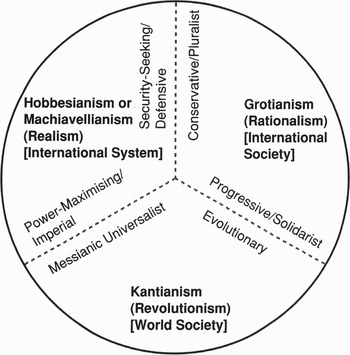
This article addresses these questions by moving beyond the Realist-versus-Neoliberal approach and using some of the potentially more nuanced “English school” tools of analysis.Footnote 26 English school international relations theory focuses on exploring the inter-relationships among three longstanding traditions in the history of Western thinking on the subject: Realism, Rationalism and Revolutionism. English school Realism is not so different from American (classical) Realism (see note 6), except that English school writers emphasize the obstacles a Realist world view poses to forging workable institutions within the international society of states. “The more a thinker emphasizes sovereignty and the authority, dignity, and coherence of the state … the more he will tend to discount a suggestion that the state is [even] a member of a wider society of states.”Footnote 27
English school Rationalism is rooted squarely in the concept and possibilities of international society. Although on the surface similar in key respects to American Neoliberal international relations theory – in particular, the belief that states prefer co-operation and absolute gains to conflict and relative gains – Rationalism focuses on how diplomacy helps to achieve “the institutionalization of shared interest and identity amongst states, … the creation and maintenance of shared norms, rules, and institutions.”Footnote 28
The third tradition, Revolutionism (sometimes “cosmopolitanism” or “Kantianism”), suspends the assumption that states are, or should be, the core actors in world politics and that the institution of sovereignty is unchallengeable (hence the label “revolutionary”). Revolutionism asserts “individuals, non-state organizations, and ultimately the global population as a whole as the focus of global societal identities and arrangements.”Footnote 29 It proclaims “a world society of individuals, which overrides nations or states, diminishing or dismissing this middle link.”Footnote 30 Thinking in this tradition has ranged from Kantian and Leninist formulations to the contemporary theorizing of global civil society (GCS) advocates.
Rather than viewing Realism, Rationalism and Revolutionism as completely discrete categories, English school theorists portray them as overlapping within a closed circular continuum (Figure 1). Rationalism thus ranges from a solidarist variant that shades into Revolutionism to a pluralist variant that shades into Realism. The solidarist–pluralist debate within Rationalism – essential to assessing the progress of Chinese thinking since the 1990s – hinges on the question of
the type and extent of norms, rules, and institutions that an international society can form without departing from the foundational rules of sovereignty and non-intervention that define it as a system of states. Pluralists think that the sovereignty/non-intervention principles restrict international society to fairly minimal rules of coexistence. Solidarists think that international society can develop quite wide-ranging norms, rules, and institutions, covering both coexistence issues and cooperation in pursuit of shared interests, including some scope for collective enforcement.Footnote 31
The Classical “Three Traditions” Model of English School Theory

The blurriness of the boundaries marking off the three traditions is also crucial. As explained below, most Chinese writers who assess the international future oscillate between shades of Realism and pluralist Rationalism. Many writers assert Rationalism but belie or devolve into Realism. They are not necessarily being disingenuous (although some appear to be so); they simply seem unable to extricate themselves from a deeply-engrained Realist world view. Even the apparently sincere Rationalists who assert the doctrine and stick to it carefully defend the boundary line between pluralism and solidarism. They reject the notion of a solidarist world taking root in future decades because to them, solidarism implies all states becoming institutionally and culturally alike through Westernization. For related reasons, no Chinese writer articulates a purely Revolutionist vision of the future (although two or three come close). Some Chinese analysts address Revolutionist concepts, such as the growing importance of global civil society, but ultimately reject them as impractical or illegitimate. Chinese analysts are generally not comfortable with the idea of the global. They prefer to see the world as constituted by essentially-unlike nation-state units. The only question then becomes how much friction there will be among the states.
Realism as the Ti, Rationalism as the Yong?
The dean of Peking University's School of International Studies, Wang Jisi 王缉思 – long a leading America specialist – promotes Rationalism with a palpable sincerity in the preface to his 2006 compendium of recent articles and book chapters. Wang writes that decades of experience and research have taught him that the major purpose of Chinese foreign policy should be to establish the conditions under which the Chinese people's security and welfare can be consolidated and improved. This purpose rules out the adventurous foreign policies associated with power-maximizing Realism but not necessarily the still somewhat risky policies associated with moderate Realism. Yet Wang goes further and contends that advanced forms of international co-operation are necessary in order to improve and consolidate Chinese welfare and security. “If today's world is truly a ‘new Spring and Autumn Warring States period,’ will our country still be able to proceed stably along the path of reform and opening?”Footnote 32 Here, he is evidently challenging those who assert that conflict between China and the United States is inevitable. Wang acknowledges the possibility of China and the US becoming enemies – more specifically, of the US making an enemy out of China and China then having no choice but to respond. But he notes that there are many Americans who want friendly relations with China and that working with them to consolidate a harmonious relationship is possible. His conscience tells him this is the wiser path to take.Footnote 33 The same logic applies to China's relations with the other great powers. Wang asks: “Can we not, through rationally reflecting on international politics, find a way to reduce the sources of friction among countries and resolve some of the disasters facing humankind?”Footnote 34
Not only is the answer “yes,” according to many Chinese writers, but just as importantly, the PRC is uniquely well-qualified to lead the world to a future state of harmony because its strategic culture is inherently Rationalist. (The goal of establishing a “harmonious world” was first articulated by Hu Jintao in April 2005.) “Strategic culture” refers – in Johnston's words – to “consistent and persistent historical patterns in the way particular states (or state elites) think about the use of force for political ends.”Footnote 35 Johnston found China's strategic culture to be Realist (at least from the 1360s to the 1990s). But some Chinese writers and interview subjects insist that it has always been, for thousands of years, Rationalist. The problem is that this insistence itself often seems to reflect a strategic rationale – raison d’État may now require defining China as an inherently harmony-seeking state.
Men Honghua 门洪华, a professor at the Central Party School's International Strategy Institute, argued in 2005 that “China's strategic culture is built upon such traditional fundamental concepts as benevolence (ren 仁), propriety (li 礼), morality (de 德) and harmony (he 和).”Footnote 36 Prior to the 19th century, Men claims, China fully implemented this culture in its interactions with neighbouring countries through the tributary system. “Chinese people emphasized that ‘harmony is precious’ (he wei gui 和为贵) … [but only] harmony in diversity (he er bu tong 和而不同),” a vision in which essentially distinct entities enter into interdependent relationships “to ameliorate each other's shortcomings and share each other's strengths, thereby forming a harmonious world in which all within the boundaries of the four seas are brothers.” Men acknowledges that the pre-modern Chinese state occasionally resorted to violence: “China could not have abandoned the military option [in its foreign policy], but in the realm of beliefs it certainly was vastly different from the West … [because] China opposed the blind use of force and regulated war with morality.”Footnote 37 Force was a necessary adjunct to a state policy that, in essence, sought peace.
Unfortunately, this ideal state of affairs was shattered by Western and Japanese imperialism. During the 19th and 20th centuries, “the harmony-is-precious orientation of China's strategic culture, which had persisted for many thousands of years, changed to a conflict-oriented culture … that sought to use armed struggle to realize national independence and unification.” But crucially, “the deepest infrastructural levels of Chinese strategic culture – based on an embrace of universal human society (tianxia 天下) and moral rationality – have not been completely destroyed.”Footnote 38 The essential China, with 5,000 years of history, has always valued harmony, peace and interdependence. Only the situational factors associated with Western and Japanese imperialism could have temporarily diverted China onto a Realist path. Today, with China rising, the Chinese people can rediscover their Rationalist roots and contribute centrally to the construction of a harmonious world.
Wang Yiwei 王义桅 of Fudan University elaborates this vision by outlining three dimensions to the harmonious world soon to come. The first is institutional harmony (zhixu hexie 秩序和谐). The regional institution-building celebrated in Neoliberal international relations theory and among diplomatic practitioners in Europe and ASEAN, among other places, can be important for achieving peace through papering over differences, but cannot achieve genuine harmony and stability. Regional institution-building fails to address – and even locks in – regional inequalities, both within countries and across national borders. Scholars and practitioners must develop an “integrated world view” (shijie zhengtiguan 世界整体观) that comprehends how regions interrelate in this way and how the world's component parts all fit together. Then they will understand how some regions exploit others, and on the basis of this new insight, learn to craft policies that will eventually reduce world inequality and ensure long-term stability.Footnote 39
The second dimension is power harmony (liliang hexie 力量和谐). Harmony among nation-states requires moving beyond the Western Realist goal of achieving (mere) peace through maintaining a balance of power. A balance of power may give the world's leading states an enhanced sense of security, however illusory. But it fails completely to enhance the security of smaller or weaker countries, many of whose interests will be sacrificed in pursuit of the desired balance. In order to achieve genuine world harmony, states must develop a deeper commitment to co-operation and to achieving all-sides-win outcomes. They must internalize this orientation and meet its requirements with earnestness and sincerity.Footnote 40
The final dimension is values harmony (jiazhi hexie 价值和谐). Here, Wang reiterates that “harmony is precious” but only “harmony in diversity.” The problem is that achieving this dimension of harmony “faces the challenge of [a certain party] promoting democracy to consolidate its current hegemony.”Footnote 41 While states must continue in future years to promote openness and be willing to learn from each other, they should also respect the diversity of civilizations, religions and values, and particularly the sovereign right of each country to choose its own social system and developmental model.Footnote 42
Wang Yiwei seems generally to be a pluralist Rationalist, but he also enjoys speculating on how pursuing the harmonious world as a foreign policy objective could help China to increase its soft power relative to that of the West. “The harmonious world view [of China] surpasses the narrow ‘democratic peace’ and biased ‘clash of civilizations’ [of the West], showing the way for an international relations of the 21st century.”Footnote 43 If the concept works – if Chinese diplomacy succeeds in making it work – then China will become a cultural and ideological world leader, having drawn upon its rich heritage to produce a new model for solving international problems superior to the models offered by the West.
Notably optimistic about this particular prospect is Li Jidong 李继东, a lecturer at the International Politics Research Centre of the PLA's Foreign Languages Institute. Li's point of departure is “how to make Confucianism's inherent intelligence and attractiveness serve our country's development strategy and national interests.”Footnote 44 The challenge is “how to contest the West's, especially America's, ‘discourse hegemony’ … The ‘Realism’ that they promote … now constitutes the mainstream of international political culture. Under the circumstances of this kind of ‘power politics’ culture, would it be possible for China's ‘benevolent culture’ to ascend and become international political culture's mainstream?”Footnote 45
Li is optimistic for three reasons. First, “when a country's national [material] power increases, its culture naturally becomes an object of imitation.”Footnote 46 This would suggest that if China's economy continues to grow rapidly, its soft power will automatically increase. Second, even during the Cold War, when China's material power was negligible, “the Five Principles of Peaceful Coexistence, reflecting the intelligence of the Chinese people, already obtained widespread acclamation from international society.”Footnote 47 Third, “Confucian culture has broad influence in a number of countries and regions, especially places where ethnically-Chinese people are concentrated. We can further expand the propagation of Confucianism on the basis of these already-existing resources.”Footnote 48
Some Chinese writers completely ignore the harmonious world discourse and assert their Realism straightforwardly and unabashedly.Footnote 49 In a widely-reprinted essay first published in 2006, Peking University's Pan Wei discusses seven categories of core values present in all modern societies – seven categories that systematically interrelate in a concentric-circle pattern. At the centre is morality governing relations among individuals; at the outer edge is morality (or its absence) governing relations among nation-states. (There is no possibility of transboundary relations among non-state entities; all individuals and corporate groups are contained by nation-states.) The basic reality of the international realm is not “mutual interdependence” but instead an anarchy in which “the strong eat the meat of the weak.” When a nation-state is being oppressed by more powerful nation-states, its people must clearly recognize this fact and act accordingly or else the entire seven-layered structure of values will collapse.Footnote 50
This is precisely the crisis China is currently facing. Elites are not united in patriotism against American hegemony. Some blame China for problems in the US–China relationship and a few even go so far as to excoriate healthy Chinese patriotism as extreme nationalism. Because the seven categories of values are interlinked in a system, the incompleteness of elite patriotism has already had negative effects on Chinese political values. Some elites are championing the so-called “universal values” promoted by the United States – especially democracy. But these values are not truly universal; they are only designed cynically by the hegemon to advance its geopolitical interests.Footnote 51 If this corrosive process is allowed to continue, the eventual result will inevitably be China's collapse (in the same way as the former Soviet Union). The entire chain of logic is brutally straightforward:
China's having lost its core values began from changes in conceptions of the international realm, starting from the assessment [in the 1980s] that a new world war could not break out and eventually developing into today's “doctrine of integration” [the notion that China can integrate into a benign, US-centred international society]. If we seek to rebuild core social values, one effective method would be to start from conceptions of the international and reassess our country's strategic direction, … gradually adjusting it into the direction of balancing against hegemonism.Footnote 52
Other scholars take a similarly Realist approach but write with less of a sense of crisis and with less truculence. Qinghua University's Yan Xuetong 阎学通 gently chides the Rationalists by arguing that relative gains are, and will continue to be, more important for the Chinese people in their international dealings than absolute gains:
Obviously, to advance ourselves but still steadily fall behind other countries is inconsistent with the Chinese people's interests … The people cannot be satisfied with [merely] advancing themselves, but instead are demanding that we hasten to close the gap with other countries. Therefore, we seek to surpass Japan [by 2020] … The interest in surpassing and the interest in expanding (tuozhan 拓展) are the interests of a rising country.Footnote 53
Unlike the deeply worried and therefore hostile Pan Wei, Yan is optimistic. He forecasts that China's comprehensive national power may come to equal that of the United States by 2040. He does not foresee the US even being in a position to choke off China's rise or to destroy its value system.Footnote 54
Some authors develop forecasts of the future that begin by sounding like pluralist Rationalism but then morph into Realism. For example, PLA scholars Luo Shou 罗授 and Wang Guifang 王桂芳, of the Military Sciences Institute Strategy Research Division, envisage three stages to China's rise. In the first stage (the present), China will “construct a secure surrounding environment” as shown partly “by the integrity of state sovereignty and the national territory not becoming even more split.”Footnote 55 Constructing a secure surrounding environment requires maintaining or developing strategic partnerships with neighbouring countries, especially Russia, India and even Japan, and playing an active (sometimes leading) role in such regional organizations as ASEAN and the Shanghai Co-operation Organization. China must vigorously guard against Tibetan and Uyghur independence in this stage, and “especially try to stabilize cross-Strait relations within the ‘one China framework,’ absolutely not permitting Taiwan to split apart from the fatherland.”Footnote 56 The ultimate goal in this stage is “to construct a surrounding environment that guarantees the sustainability of China's economic growth, secures its social stability, and affirms that its international political position will continually rise.”Footnote 57
The second stage requires moving beyond the Asian region in order to “mould” (suzao 塑造) a global security environment more beneficial to China's interests. “This is a kind of active, initiative-taking posture, chiefly exemplified by expanding our international space and realizing the unification of our fatherland.” This stage will demand significantly greater efforts from China diplomatically. “China will no longer be just a regional great power, but will have marched into the ranks of the world's great powers. This will require that China shoulder more responsibilities and make more contributions.” The Luo–Wang vision clearly combines elements of Rationalism (China contributing to a global community) with Realism (Chinese power relative to that of other states increasing). “China's interests will no longer be limited to the Asia-Pacific region but will have expanded to the world”; therefore, China must “play a suitable functional role in the world's most important strategic regions and in all important international affairs … and have a stronger voice in what transpires.”Footnote 58
With consolidation of the second stage, strategic relations between China and the United States will stabilize as the US, however reluctantly, acknowledges the reality of Chinese power. China's relations with Europe will expand from being mostly economic in nature to jointly defending the integrity and stability of the Eurasian continent, including through military co-operation. Territorial disputes with India, South China Sea island claimants and Japan will have been resolved through compromise. Taiwan will have been unified “peacefully” – but here is where Luo and Wang most visibly trade Rationalism for Realism: “To uphold core national interests and guarantee national sovereignty and territorial integrity, the peaceful rise does not rule out using military methods as an unavoidable last resort … Making the commitment to peace does not equate to abandoning the use of military force to maintain peace, to create peace.”Footnote 59
When China enters the third stage – towards the middle of the century – it will have joined the ranks of the world's supreme powers. Its primary task will then be to “plan and operate (jinglue 经略) a new international political and economic order that can universally be accepted by international society.”
The “plan and operate” stage will be the highest level of the peaceful rise. China's national interest will have fundamentally completed the process of fusing with the global interest; that is, China will comprehensively blend into international society while the situation and developments in other parts of the world directly impact upon China's own interests. This will require China to take a global perspective in deliberating and planning its policy toward the outside, putting into place a clearly global strategy and carrying out strategic arrangements and deployments of a global nature.Footnote 60
China will, in the third stage, work actively to create “an international order of peaceful coexistence that the vast majority of countries – including in the Third World – can identify with.” It will “profoundly lead and guide the international situation's direction of development, working hard to uphold the international strategic balance” and guaranteeing international stability. “Especially important is that China will develop its discourse power within international politics, and through the dissemination of China's unique cultural values, will influence the world's discourse environment – cultivating influence over the world's direction of development within the realm of culture and values and, as a result, obtaining universal world respect.”Footnote 61
(Mere) Flirtations with Solidarist Rationalism and Revolutionism
In his September 2004 Shanghai television interview, Zheng Bijian flatly rejected images of an international future in which borders dissolve, nations lose their essential distinctiveness, and/or states yield their political dominance to international organizations, multinational corporations and the NGOs of global civil society:
I believe that in the present and for a very, very long time into the future, the human world will only be able to take [distinct] nation-states as the basic form of organization. Even though we have all manner of international organizations; even though we have economic globalization and regional integration; and despite the fact nations can unite together in this way and that, even yielding a portion of their sovereignty, the nation-state – this fundamental thing – will not change. Speaking with regard to China's own national conditions, it is even less likely to change.Footnote 62
Such a logic undergirds the “harmonious but distinct” formulation, whose proponents contend it would be impossible – or at least exceedingly undesirable – for all nation-states to start becoming alike institutionally and culturally or for other types of organization to begin assuming their functions.
In the December 2002 Contemporary International Relations, Cai Tuo 蔡拓 (then of Nankai University) and Liu Zhenye 刘贞晔 (Tianjin University of Commerce) distil six “influences on international relations” predicted by foreign specialists on global civil society in part one of a two-part article. The authors discuss, in turn, Revolutionist predictions that GCS will, first, push international relations on to a development path leading to coherent integrationFootnote 63; second, create conditions for units other than states to become significant actorsFootnote 64; third, “smash the inside-the-state/outside-the-state political boundary” while “dissolving state rights and powers”Footnote 65; fourth, democratize the international realm through increasing the participation of new actors in global policy makingFootnote 66; fifth, “undermine the international realm's special characteristic of anarchy” by “pushing international politics onto a developmental path of rule-by-law-ization”Footnote 67; and finally, as a result of all of the foregoing, usher international relations into a new post-Machiavellian era in which “world politics will march in the direction of good politics (shan de zhengzhi 善的政治) and ethical values will start to return to world politics.”Footnote 68
So rich and detailed is the literature review that at the end of part one, the reader is convinced Cai and Liu are Revolutionists highly sympathetic to the GCS agenda and its vision of a cosmopolitan world future. But this conclusion is called sharply into question by the approach the authors take in part two, which appears in the January 2003 Contemporary International Relations. Here, Cai and Liu concentrate on explaining four key deficiencies in GCS that will prevent it from playing the expansive and transformative roles predicted by foreign scholars and activists.
First, GCS organizations can only become influential in issue-areas ignored by states. Once states decide to focus on an issue-area, they quickly and easily brush GCS organizations aside.Footnote 69 Second, NGOs suffer from a legitimacy deficit in the world outside the West – something which cannot (generally) be said of states. (Many states are legitimated effectively through nationalism.) After NGOs become large and institutionalized, they often appear indistinguishable from any other organization pursuing interests and advantages. This undercuts their claim to being uniquely altruistic.Footnote 70 Third, GCS activities are distributed unevenly, with most of the powerful NGOs locating their headquarters in the West. Already “quite a few NGOs even go so far as to expend great energy to promote the interests of Western countries,” especially in the realms of human rights and environmental politics.Footnote 71 This also undermines their claim to neutrality and altruism. Finally, while GCS is in many ways a positive philanthropic force, it also includes among its ranks “anti-social elements that go against the tide,” such as (ironically) anti-globalization activists, but also terrorists, national extremists, criminal syndicates and cults.Footnote 72 Restricting the activities of such groups – which have become “the chief sickness of GCS” – is the responsibility of states. GCS organizations cannot police themselves as they lack the capacity. More broadly, the legal frameworks states provide are necessary for even the positive philanthropic NGOs to flourish, since only states can guarantee contracts and uphold legal order.Footnote 73 In short, GCS must remain superseded and even caged by the international society of states. A cosmopolitan or Revolutionist future in which an increasingly number of state functions and powers is assumed by NGOs would be impossible to achieve and dangerous to attempt.Footnote 74
One of the government think-tank scholars interviewed in December 2006 did allow for the possibility of radical changes to the international order of the future – but primarily the distant future.Footnote 75 The scholar – who had evidently given the matter serious thought – began by discussing how Hu Jintao's harmonious world will emerge from the successful establishment of “harmonious societies” in each of the individual key leading states. Between now and approximately 2050, states that have built harmonious societies internally will begin coming together to form harmonious regions. “Some countries in Northern Europe have already built harmonious societies,” particularly Sweden. Therefore, Northern Europe will soon emerge as the world's first harmonious region. Asia is still rather distant from the goal. Among Asian countries, Singapore has made good progress, “but still isn't democratic enough.” Japan has also achieved much that is praiseworthy, but “there's still too much conformity and cultural repression in Japan for it to be considered a harmonious society. With dissent stifled, it can't even be considered truly democratic.”Footnote 76
China, he believes, will make significant progress towards building a harmonious society by 2025 but is unlikely to complete the process until 2040–50. Once China does succeed, it can begin co-operating with neighbouring states to construct a harmonious Asian region. Here is where the scholar begins departing from the orthodox Chinese position that solidarist Rationalism and Revolutionism are unworkable and normatively undesirable. He finds that China already shares with the United States, Britain, Japan and other democratic states the core value that governance should be “people-based” (minben 民本), stressing peace, democracy, development and a concern for others. He even argues that people-based governance is becoming a universal (pushi de 普世的) value. It has not always been a universal value; in fact, it has only become a genuine Chinese value in recent years. (Ancient Confucians used the term but Imperial Chinese society was in practice emperor-based.) As globalization deepens and states intensify their interactions, people-based governance will emerge as a universal value, establishing the cultural preconditions for building a harmonious world.
At some point after 2050, the scholar predicts, the world will move in the direction of “integration into a single unit” (yitihua 一体化). This is clearly a solidarist or even Revolutionist vision and was surprising to hear from a leading Chinese government-connected analyst, since the orthodox viewpoint is that states can interact harmoniously but will never fuse together or become identical. Yet the think-tank scholar believes that the global economic integration already under way will inevitably “spill over” into politics. The trend is, moreover, “unavoidable and irreversible,” although it will take a very long time to complete. Economic integration is likely to require 100 years. Political integration may take 300 or 400 years, and socio-cultural integration a little less. But eventually they will all occur.
Even though the process of political integration is expected to take a very long time, it is significant that the think-tank scholar believes the world is already developing in the direction of integration, already embarked upon a process whose end goal is predetermined. Still, he expects that sovereign, autonomous states will continue to be the overwhelmingly dominant actors in the decades leading up to 2050. They will not yet have merged together nor ceded their leading roles to NGOs or other GCS actors. And that is a good thing, the scholar contends, because states – though born as war-fighting machines – have evolved in recent decades into highly-effective problem-solving organizations providing indispensable management services. NGOs can assist states in the decades leading up to 2050, but states will, and should, continue to play the leading roles.Footnote 77
Implications
By taking an English school approach to analysing Chinese thinking on the future of international relations, we find that the “Rationalist turn” in PRC foreign policy detailed by Western scholars in the early and mid-2000s may have weak cognitive foundations. Realist categories emphasizing increases in China's material and ideational power relative to that of foreign countries remain at the core of most Chinese thinking on the future. This Realism is not always moderate or defensive, particularly when the scholar is articulating scenarios for more than about two decades ahead. Meanwhile, Chinese Rationalist accounts not only frequently devolve back into Realism, but almost universally defend pluralism against solidarism. Few scholars articulate Revolutionist visions. All of this suggests the limits to how far CCP elites would be willing to go in co-operating with foreign states even in best-case scenarios – limits difficult to map without the aid of English school analytical techniques. The notion that China could one day become as close to the United States as Britain – as some of her interlocutors told Susan Shirk – seems highly questionable in the light of most foreign policy elites’ consistent rejection of solidarism in their writings and interviews.
Of course, there is no straight line from what elites say and write to what China will actually do in the years and decades ahead. International realities may constrain the CCP from acting on its intellectual and political elites’ Realist instincts. Zheng Bijian may be right when he contends that the only possible rise for China is one rooted in economic interdependence and political co-operation. If this is so, then anticipating that any challenge to regional or world order would meet with opposition, Chinese strategists could learn to suppress their Realist impulses. Over time, the impulses might even fade away. Such a trend would be reinforced by Chinese elites coming to identify with an image of their country's strategic culture as having always been Rationalist and seeking harmony.
But there are at least three problems with this scenario. First, crises will unavoidably develop that require China's leaders to make snap decisions under immense political pressure and with incomplete information. In periods of crisis, it will surely matter a great deal that Chinese analytical categories and impulses remain Realist or at best pluralist Rationalist. PRC leaders will already feel a degree of alienation from foreign states, especially the West and its democratic Asian allies. (This alienation will probably be a part of the reason the crisis develops.) They will tend to distrust the foreign states and worry that these states’ long-term global ambitions and objectives are distinctly different from those of China.
Alienation and mistrust will in this way inevitably complicate crisis-management. They will keep the various parties involved on edge and always questioning at some level whether a long-term stable relationship between China and the democracies is really possible. This doubt may fuel further alienation and a sense that the relationship(s) will always be troubled. In contrast, resolving crises would become significantly easier if China and the democracies were to start viewing each other as partners in a common global mission. But that would be solidarism.
Second, it is easy to imagine that 20 or 30 years into the future, China's relations with Asian and other countries will be marked not by true interdependence but instead by one-sided dependence. While the United States, much of Europe and probably Japan will still enjoy varying degrees of economic autonomy, many other countries will probably become completely dependent upon China for their economic well-being. As a result, the fact that Realism seems to remain firmly at the core of Chinese strategic thinking could mean that PRC leaders will be tempted to push their advantage and try to establish clear domination over Asia. They may also decide to compete vigorously with the United States for influence in other world regions. The popular nationalism that Shirk and others document suggests that such a forward foreign policy would meet with strong public approval in China, or even alacrity.
Finally, rejecting solidarism and GCS's importance (as suggested by Revolutionism) could become a practical foreign policy Achilles’ heel for the CCP. Democratic governance is firmly consolidated in Japan, South Korea and Taiwan. In South and South-East Asia the picture is cloudier, but middle classes in Thailand, the Philippines, Indonesia, India and probably Malaysia evidently derive strong psychic benefits from identifying with their country as democratic or moving in that direction. It will be difficult for the middle classes in these countries to accept Chinese regional hegemony should the PRC decide to become more pugnaciously Realist. The political-ideological differences within the region would suddenly start to loom as significantly more meaningful than previously imagined.
There is also no denying the increasing importance of NGOs in world politics as autonomous actors not necessarily serving the interests of Western states. Perhaps the roles NGOs play will always be limited, but Chinese leaders surely underestimated their potential in the spring of 2008 when NGOs demonstrated they were fully capable of causing China serious loss of face and vexing political difficulties in managing issues ranging from the Olympics torch relay to Tibet to Zimbabwean arms sales. A more supple view of international relations that relaxed the assumption of eternal state centrality would at least allow PRC leaders to recognize real change in the world's political ecology when it occurs and to start taking steps to adapt more effectively. Without a more supple view, they seem certain to be challenged in the years and decades ahead in ways they will be unable even to comprehend.