





Introduction
A central prediction in heritage language research is that contact-induced change is selective, affecting some variables while leaving closely related ones intact—yet fine-grained variationist evidence for this remains limited. Most existing work compares heritage speakers across languages, dominant-language pairings, or proficiency levels. This cross-population design is valuable for identifying general tendencies, but it introduces a fundamental confound: When two variables behave differently across studies, it is difficult to determine whether the asymmetry reflects genuine selectivity in how the grammar responds to contact, or merely differences in the communities, corpora, and speakers being compared. Without holding these factors constant, the claim that heritage language change targets particular variables cannot be fully established.
The present study addresses this gap by examining object expression in Canberra Vietnamese. Subject expression in this community has already been documented: Nguyen and Sim (Reference Nguyen and Sim2026:253–255) showed, drawing on the same corpus and a largely overlapping speaker sample, that subject expression had undergone broad generational restructuring. What remains unknown is whether that shift extends to object expression, or whether the two argument positions follow different trajectories. The comparison is particularly revealing because Vietnamese licenses null arguments in both positions, making it a radical pro-drop language (Biberauer et al., Reference Biberauer, Holmberg, Roberts and Sheehan2010:8). Subject and object expression are thus closely related: Both involve an alternation between null and overt pronominal reference licensed by discourse recoverability, and both have been argued to be vulnerable under contact because they depend on the integration of syntactic and discourse-pragmatic constraints (Polinsky & Gregory, Reference Polinsky and Gregory2020:11). They are nonetheless distinct variables, and there is no a priori reason to assume they change in tandem. Comparing their trajectories within a single community therefore makes it possible to ask whether change under contact proceeds in parallel even between near neighbors in the grammar, or whether it is selective at this finer grain. It is precisely this kind of within-system comparison that theories of differential vulnerability require—and that has rarely been carried out.
It is important to note that while measuring generational change in this work, we do not treat “generation” merely as a demographic label (e.g., first- vs. second-generation based on birthplace or parentage), but as a proxy for differences in acquisition history, input conditions, and language dominance. This contrasts with age-related change across the lifespan, or patterns of social embedding which reflect speakers’ ongoing language use. While these factors may be related, they capture distinct aspects of heritage speakers’ linguistic experience.
Against this backdrop, we probe the following research questions:
1. What are the patterns of variable object expression across generations of Canberra Vietnamese heritage speakers?
2. What linguistic and social factors condition object expression in this community, and do these factors remain stable across generations?
3. Do generational patterns in object expression parallel the restructuring previously observed for subject expression, or do they diverge from it?
Together, these questions allow us to assess not only how object expression behaves in this community, but also whether its trajectory under contact mirrors or diverges from that of subject expression—and what that (a)symmetry reveals about the nature of heritage grammar change.
Object expression in Vietnamese
Vietnamese was previously classified as a radical null subject language, that is, a language that permits the omission of pronominal forms without verbal agreement of any kind (Nguyen, Reference Nguyen1997:210–213; Thompson, Reference Thompson1965:219–220). Other languages that also display this behavior include Chinese, Japanese, Korean, and Thai, as well as some others concentrated in Asia and Africa (Biberauer et al., Reference Biberauer, Holmberg, Roberts and Sheehan2010:8). The key trait that distinguishes Vietnamese from other radical pro-drop languages is that anaphoric reference in Vietnamese can be established not only by reduced pronominal forms but also by kinship terms and personal names.Footnote 1 Just like subjects, object pronominal forms in Vietnamese can be expressed or unexpressed across all grammatical persons (Phan & Lander, Reference Phan and Lander2015:400–401). Examples (1)–(2) demonstrate.


(Brunelle’s data, 2020, glosses and translations ours)Footnote 2
It should be noted that while object omission is restricted to certain verb types in languages like English (Allerton, Reference Allerton1975:224–225, Reference Allerton1982:114–138; Goldberg, Reference Goldberg2001:505–518), this phenomenon is considerably more radical in discourse pro-drop languages like Vietnamese (Nguyen, Reference Nguyen1997:210–214). In fact, any transitive verb may occur with or without an object, as long as it can be recovered from discourse. Analyses of radical pro-drop languages therefore often consider sentences such as (1b), (1c) and (2b) to have a null direct object, whose reference is identified by a topic operator (e.g., Huang, Reference Huang1984 for Chinese, Nakamura, Reference Nakamura1991 for Japanese, Kim, Reference Kim1989 for Korean).
That object omission is discourse-governed rather than verb-governed finds empirical support in Ngo (Reference Ngo2019), the only experimental study to date on null versus overt object expression in Vietnamese. Drawing on narrative production and offline sentence completion tasks with homeland speakers, Ngo shows that the division of labor between null and overt pronominal forms is not straightforward. Nevertheless, topicality emerges as a key conditioning factor: Speakers predominantly use null pronouns when referring back to topicalized referents, while overt pronouns are favored for less topical referents. This suggests that object expression in Vietnamese is already strongly shaped by discourse factors in the homeland grammar—a baseline against which contact-induced change can be assessed. A further notable finding is that Vietnamese speakers show a strong tendency to assign pronouns to object antecedents, challenging the cross-linguistic subject bias widely reported for English and other languages (Chafe, Reference Chafe1976:43–49; Simpson et al., Reference Simpson, Zoe and Yan2016:14–17; Ueno & Kehler, Reference Ueno and Kehler2016:1168).
Beyond their differing discourse conditioning, subject and object expression in Vietnamese also diverge in their sensitivity to social factors. Specifically, while both can be omitted across a wide range of contexts, subject expression encodes social hierarchy far more strongly than object expression. Second-person subjects in particular are typically not omissible when a younger speaker addresses an older interlocutor (Nguyen & Sim, Reference Nguyen and Sim2026:245). Object pronouns, by contrast, appear less bound by constraints on omissibility, though this asymmetry has not, to our knowledge, been systematically documented for Vietnamese. Constraints on the choice among overt forms are a separate matter: the deferential force of kin terms derives from the forms themselves and the relational categories they encode (Nguyen, Reference Nguyen2018:449–450, 461–462), and there is no evident reason for that force to be confined to subject position. Whether these properties—the discourse conditioning of omission, and the pragmatic norms governing the choice of overt forms—persist under the conditions of cross-generational transmission and language contact remains an open empirical question, one that has attracted considerable attention cross-linguistically.
Object expression in contact settings
Research on null arguments in bilingual contexts has focused primarily on second-generation heritage speakers, typically in comparison with monolinguals. A recurrent claim in this literature is that null arguments constitute a vulnerable domain, as their use requires the integration of syntactic and discourse-pragmatic constraints (e.g., Polinsky & Gregory, Reference Polinsky and Gregory2020:11). For subjects, many studies report increased rates of overt forms among bilingual speakers (e.g., Ivanova-Sullivan, Reference Ivanova-Sullivan2014:95–96; Montrul, Reference Montrul2002:52–63; Polinsky, Reference Polinsky2018:253–255; Quesada, Reference Quesada2015:253–258; Rothman, Reference Rothman, Baauw, Drijkoningen, Meroni and Pinto2007:314), though other works point to relative stability under contact (e.g., Torres Cacoullos & Travis, Reference Torres Cacoullos and Travis2018:127). As noted by Nagy (Reference Nagy2024:21–28), these differences may partly reflect methodological contrasts across studies, including the use of experimental versus naturalistic data. Overall, null argument behaviors in bilingual contexts are not uniformly vulnerable, but vary across contexts.
Central to the present study is Nguyen and Sim (Reference Nguyen and Sim2026), who examined subject expression in the Canberra Vietnamese community using the Canberra Vietnamese-English corpus (CanVEC). Analyzing subject expression in heritage Vietnamese, they found that although the overall rate of null subjects remains stable across generations, the hierarchy of person-based constraints changes: Gen1 speakers are least likely to omit second-person subjects, whereas Gen2 speakers are least likely to omit first-person subjects. Further analysis of second-person subjects also revealed a redistribution of overt forms, with Gen2 speakers showing more kin terms and fewer personal names than Gen1 speakers. Together, these patterns indicate a reorganization of how referential and pragmatic distinctions are encoded, rather than a simple increase or decrease in subject expression. Nguyen and Sim interpret this as evidence of pragmatic reorganization under cross-generational transmission in a diasporic context (cf. Clyne, Reference Clyne2003:1–19; Sharma, Reference Sharma2011:485). Taking these findings as a point of departure, the present study considers whether object expression exhibits a comparable pattern of restructuring across generations in the same community.
In general, evidence for cross-generational restructuring in object expression under contact remains mixed. Some studies point to age-related effects: Rinke et al. (Reference Rinke, Flores and Pilar2018:125–127) showed that null object use in European Portuguese patterns more strongly with age than with bilingualism, although heritage speakers extend null objects to a wider range of contexts. Others highlight input-related developmental differences: Sopata et al. (Reference Sopata, Rinke and Flores2024:91–94) found that Polish heritage speakers initially show target-like constraints but later overgeneralize null objects, which they attribute to reduced input. Findings from differential object marking (DOM) further complicate the picture. Although not directly comparable, work on Spanish and Portuguese shows that object realization is shaped by factors such as animacy and specificity (Schwenter, Reference Schwenter, Amaral and Carvalho2014:251). In heritage Spanish, Montrul and Sánchez-Walker (Reference Montrul and Sánchez-Walker2013:120–127) reported elevated omission rates for DOM relative to monolinguals, but patterns vary across groups and cannot be attributed straightforwardly to age or bilingualism alone. Taken together, these findings suggest that object expression reflects interacting effects of age, input, and bilingual experience, rather than a uniform process of cross-generational change. The question then becomes: How is Vietnamese object expression—with its distinct discourse conditioning—reshaped by these same factors under contact?
Data and method
Community and data collection
The present study addresses this question through a variationist analysis of the Vietnamese migrant community in Canberra, Australia. Following the distinction between late and early bilinguals in heritage language research, Gen1 speakers are those who completed their primary socialization in Vietnamese before migrating—that is, they arrived in Australia in late adolescence, having acquired Vietnamese as their dominant language in a Vietnamese-speaking environment. Gen2 speakers are early bilinguals raised in Canberra: born in Australia or arriving before age five (cf. Hoffman & Walker, Reference Hoffman and Walker2010:44), and exposed to an English-dominant environment from early childhood. As a result, Gen2 speakers acquired Vietnamese under reduced and more variable input conditions relative to Gen1.
The community in which these two generations are embedded has a distinct sociolinguistic profile: Canberra is predominantly English-speaking (71.3% of residents speak only English at home), but Vietnamese is the third most commonly spoken heritage language (n = 4082), following Mandarin Chinese (n = 12,149) and Nepali (n = 5689). Unlike communities in Sydney or Melbourne, Vietnamese speakers in Canberra are not geographically concentrated and are largely employed in education or the public sector (Australian Bureau of Statistics, 2022). Community members maintain dense social networks through regularly shared activities (e.g., charity stalls, weekly choir practices, karaoke nights, variety shows, and traditional ceremonies), which support ongoing language use (see e.g., Milroy, Reference Milroy1987:109–138; Wenger, Reference Wenger1998:72–73).
The data come from the Canberra Vietnamese-English Corpus (CanVEC; Nguyen & Bryant, Reference Nguyen and Bryant2020), comprising naturalistic speech from 45 bilingual Vietnamese-English speakers (21 men, 24 women) across the two generations. Gen1 speakers include both refugees from the Vietnam War and more recent economic migrants; Gen2 speakers are the children of Gen1 migrants. Data collection followed a vernacular speech approach (Labov, Reference Labov, Baugh and Sherzer1984:29). Participants used mobile phones to self-record either one 30-minute conversation or two 15-minute conversations with members of their existing Vietnamese-English bilingual social networks. No instructions were provided regarding language choice. The corpus comprises 23 recordings, most of which are intergenerational (70%), with both Gen1 and Gen2 speakers represented in the majority of recordings. Participants also completed a questionnaire on language proficiency, social network, and language attitudes.
Recordings were then manually transcribed, anonymized, and semi-automatically annotated for language identification and part-of-speech tagging (Nguyen & Bryant, Reference Nguyen and Bryant2020:4122–4125). The corpus contains monolingual Vietnamese, monolingual English, and code-switched segments. The present study focuses exclusively on the monolingual Vietnamese subset (n = 7508 clauses).
Extracting and coding for object expression in Vietnamese
To analyze object expression, we first identify the variable context as clauses containing verbs that can take a direct object. Clauses with clearly intransitive verbs (e.g., ngủ “sleep,” ngồi “sit,” etc.) were therefore excluded (n = 201, 13%), based on classification in the Vietnamese Dictionary Vdict.Footnote 3
The status of “optionally transitive” verbs in Vietnamese is less clearly defined, as objects are freely omissible for most lexical verbs (Nguyen, Reference Nguyen1997:110–112). Accordingly, only strictly intransitive verbs were excluded, while all other lexical verbs are included in the envelope of variation.
As the present study focuses on pronominal direct objects, lexical NP are excluded (n = 60, 3.9%). Following previous work (Ngo, Reference Ngo2019:13; Nguyen & Sim, Reference Nguyen and Sim2026:241–246), pronominal objects are taken to include personal pronouns, kinship terms, and personal names. Although not canonical pronouns, kin terms and personal names function pronominally in Vietnamese, indexing discourse participants and social relations (e.g., gender, relative age), and are therefore treated as part of the same functional class in the alternation between null and overt object expression. This treatment finds distributional support in the corpus: As Table 1 shows, personal pronouns, kin terms, and personal names pattern alike with respect to Coreferentiality, while all three differ sharply from null objects. The three overt forms thus behave as a single class in the null/overt alternation, differing in social indexicality rather than discourse distribution.
Distribution of Coreferentiality (no/yes) by object type (top) and pairwise comparisons of object type predicting Coreferentiality (bottom)

Table 1 Long description
Coreferentiality is reported by object type with columns for n, coreferential percent, and non coreferential percent. Null has n 139, coreferential 79.1 percent, and non coreferential 20.9 percent. Kin has n 462, coreferential 32.0 percent, and non coreferential 68.0 percent. Name has n 53, coreferential 24.5 percent, and non coreferential 75.5 percent. Pronoun has n 110, coreferential 30.9 percent, and non coreferential 69.1 percent. Pairwise comparisons list contrast, odds ratio, standard error, z, and p: null versus name has odds ratio 0.08, standard error 0.03, z minus 6.35, p less than 0.0001; null versus kin has odds ratio 0.12, standard error 0.03, z minus 8.58, p less than 0.0001; null versus pronouns has odds ratio 0.12, standard error 0.04, z minus 6.89, p less than 0.0001. Comparisons among name, kin, and pronouns are name versus kin odds ratio 1.47, standard error 0.50, z 1.14, p 0.67; name versus pronouns odds ratio 1.46, standard error 0.57, z 0.97, p 0.77; kin versus pronouns odds ratio 0.99, standard error 0.24, z minus 0.04, p 1.00.
Note. Pairwise contrasts among the three overt types all n.s.; each overt type vs. null, p < 0.0001.
Verbs that optionally subcategorize for locative complements (e.g., về “return”) are also excluded. Tokens were coded as objects only when occurring in canonical object position and selected by the verb, excluding vocative or parenthetical uses. Constructions with muốn “want” and cần “need” were similarly set aside (n = 9, 0.6%), as their complements are structurally ambiguous when omitted.
In CanVEC, Vietnamese pronominal objects are also categorically null when the referent is inanimate (n = 111, 7.3%), a pattern also reported for Chinese (Yuan, Reference Yuan1997:475). By contrast, animate 3SG objects, such as in example (3), are variable and therefore admitted into the envelope of variation. From here onwards, every CanVEC example presented features a transcript name (e.g., Billy.Tyler.Ellie.0807) and a timestamp; the subscript indicates generation (1 = Gen1, 2 = Gen2). English is given in regular font, while Vietnamese morphemes are in italics.

Tokens in which the object is topicalized within the same clause were excluded (n = 122, 8.1%), as these are obligatorily null in post-verbal position (see example [4]). Cases with unintelligible or unreliable cues were also excluded (n = 2, 0.1%). Set phrases were removed only where they were fully lexicalized and invariant in the corpus (n = 7, 0.5%) (e.g., để xem, cảm ơn).

After applying these criteria, a total of n = 523 tokens were discounted, yielding a dataset of N = 992. Table 2 presents the overall distribution of expressed objects across generations prior to modeling.
Cross-generational distribution of Vietnamese expressed objects

Table 2 Long description
Columns are Gen, Total, Expressed, and Percentage. Two generations are listed, One and Two. For Gen, One, Total is 608 and Expressed is 463, with Percentage 76.2%. For Gen, Two, Total is 384 and Expressed is 332, with Percentage 86.5%. Total counts are higher for Gen, One than Gen, Two. Expressed counts are higher for Gen, One than Gen, Two. Percentage is higher for Gen, Two than Gen, One.
As Table 2 shows, overt objects are highly frequent in both generations (76–87%), with higher rates among Gen2 speakers. This difference is statistically significant (χ2 = 15.7, p < 0.01). However, aggregate differences do not in themselves reveal the structure of variation, as frequency effects may reflect extra-linguistic factors rather than systematic conditioning (Nagy, Reference Nagy2015:315–316, Reference Nagy2024:22–27; Nguyen & Sim, Reference Nguyen and Sim2026:248–249). Table 2 therefore serves as a descriptive baseline motivating the multivariate analyses that follow. We now turn to the linguistic and social factors included in the analysis.
Coding linguistic factors
Common predictors of object expression such as animacy and specificity/definiteness (Choi, Reference Choi2000:534–535; Landa, Reference Landa1995:160–162; Lecanda & Schwenter, Reference Lecanda, Schwenter, Bellamy, Child, González, Muntendam and Del Carmen Parafita Couto2017:99; Meyerhoff, Reference Meyerhoff2009:310; Schwenter, Reference Schwenter, Face and Klee2006:25; Schwenter, Reference Schwenter, Amaral and Carvalho2014:251; Yuan, Reference Yuan1997:475) are not included, as they are not reliably operationalized in Vietnamese. Third-person singular inanimate objects are categorically null and fall outside the envelope of variation, while specificity and definiteness lack consistent overt marking and arise from multiple interacting nominal features (Lê & Schmitt, Reference Lê and Schmitt2016:162–171; Phan & Lander, Reference Phan and Lander2015:393–395; Simpson & Ngo, Reference Simpson and Ngo2018:223–230).
One consequence of setting specificity aside as a predictor is that referential properties are instead controlled in delimiting the variable context. Following the protocol established for subjects (Nguyen & Sim, Reference Nguyen and Sim2026:247–248), non-referential and non-specific tokens were excluded from the envelope of variation at this coding stage. In particular, second-person mình may express either non-specific, generic reference—comparable to English general “you” (n = 3)—or specific first-person plural reference including speaker and interlocutor; only the latter cases were included. Generic reference therefore does not enter the analyzed data.Footnote 4
Object expression in Vietnamese instead varies in environments parallel to subjects, across person, number, and clause types. These features are also coded following the scheme established for subjects (Nguyen & Sim, Reference Nguyen and Sim2026:247–248). However, the remaining linguistic predictor, Coreferentiality, requires an object-specific operationalization.
Specifically, Coreferentiality serves as a proxy for the discourse accessibility of the object referent: whether the object shares its referent with a constituent in the immediately preceding clause. Previous work has shown that argument realization is sensitive to discourse-level properties such as referent prominence and topicality (e.g., Schnell & Barth, Reference Schnell and Barth2018:58–59). As these gradient factors are not straightforward to operationalize in conversational data of this kind, a binary coreference measure provides a tractable proxy for accessibility. Coded this way, the factor represents a dichotomized version of Givón’s (Reference Givón, Geeslin and Diaz-Campos1983:13) Referential distance: Shared reference corresponds to recent mention (RD = 1 clause), indexing high accessibility, and reference switch to greater distance (RD > 1), indexing low accessibility.
The object-level factor is deliberately operationalized more broadly than its subject-level counterpart. In particular, Vietnamese subject coreferentiality is standardly operationalized as structural continuity—whether the subject of the current clause shares its referent with the subject of the preceding clause (Ngo, Reference Ngo2019:2; Nguyen & Sim, Reference Nguyen and Sim2026:249). This reflects a tendency, rather than a strict constraint, for subjects to maintain continuity across clauses. For objects, however, such an operationalization is insufficient. Object coreference is not restricted to a preceding object, but may target referents introduced in a range of grammatical roles. This reflects the fact that objects are not consistently tracked through a single structural position, and are instead more directly tied to discourse-level relations.
This asymmetry is consistent with Huang’s (Reference Huang1984:538–543) analysis of discourse pro-drop languages, where null objects are shown to be more tightly constrained by local discourse structure than null subjects. Accordingly, object coreferentiality is defined broadly to include referents realized as subjects, objects, or topicalized constituents in the immediately preceding clause, as well as referents introduced by an interlocutor.
Coreferentiality is then coded as binary: shared reference (✓✓) versus reference switch (✗✗), with the antecedent identified in the preceding discourse. Example 5 provides an illustration. The target object appears in line (b), and its antecedent in line (a), both emphasized with bold text.


Note that while a topicalized object in the same clause is not included in the variable context, it is still relevant for determining Coreferentiality with the object of the following clause, as it establishes the topic. In example (7), for instance, the null object in Billy’s utterance is not treated as a dependent variable, whereas the null object in Tyler’s utterance is. Tyler’s null object is further marked as Coreferential with the topicalized object chị nớ (“she”) in Billy’s preceding clause, even though chị nớ lies outside the variable context.
Coding extra-linguistic factors
Data on extra-linguistic factors were extracted from the questionnaire responses, which included speakers’ information on age, gender, the primary language of their social network, self-assessed proficiency in each language, attitudes toward each language, and ethnic orientation—all of which have been shown to influence language variation (e.g., Kiesling, Reference Kiesling, Di Paolo and Yaeger-Dror2009:171–179; Labov, Reference Labov1972:109, Reference Labov, Baugh and Sherzer1984:32; Milroy & Milroy, Reference Milroy and Milroy1992:1).
Of the 45 speakers recorded, 40 contributed qualifying tokens to the present analysis. Age was included as a continuous predictor, alongside Generation, which captures cohort-based differences in speakers’ linguistic experience. Although the two variables are related, they index distinct dimensions: the generations differ in mean age (Gen1: M = 37.00, SD = 16.25; Gen2: M = 22.57, SD = 7.07; Welch’s t(36.9) = 3.90, p < 0.001, computed at the speaker level), but their distributions overlap substantially, and a Gen2 speaker may be older than a Gen1 speaker. Age and Generation were therefore entered simultaneously in the models, together with their interaction.
Statistical modeling
We conducted generalized linear mixed-effects modeling (GLMM) using the lme4 package (Bates et al., Reference Bates, Mächler, Bolker and Walker2015) in R (version 4.5.0; R Core Team, 2025). Object expression was coded as a binary response variable (null = 0 and expressed = 1). The random effects structure included maximal random intercepts for Speaker, as supported by the data. Categorical predictors were weighted using effect coding to account for unequal sample sizes (Darlington & Hayes, Reference Darlington and Hayes2017:298–300; Te Grotenhuis et al., Reference Te Grotenhuis, Pelzer, Eisinga, Nieuwenhuis, Schmidt-Catran and König2017:163–166), and the sole continuous predictor, speaker age, was standardized (z-scored).
To identify significant predictors and simplify the model, likelihood ratio tests compared the maximal model that included all predictors with reduced models, each omitting one predictor at a time. Only those predictors whose removal significantly worsened model fit were retained in the final, best-fitting model. Interactions were further explored using the emmeans package (Lenth, Reference Lenth2018). Details of the fixed and random effects included are provided in the following section.
Multicollinearity was assessed via cross-tabulations, adjusted Generalized Variance Inflation Factors (GVIF), and inspection of regression diagnostics. Because of high collinearity between some factors, attitudinal measures and self-assessed proficiency for Vietnamese and English, as well as ethnic orientation, were excluded from the modeling.
Although the dataset includes four clause types (interrogatives, imperatives, subordinate clauses, and main clauses), only main clauses were analyzed (n = 764, 77% of tokens). Non-main clause types are individually infrequent and, when subdivided by Person and Generation, yield extremely sparse cells, creating problems of non-orthogonality. The analyses below therefore focus on main clauses.Footnote 5
Findings
Regression analysis was performed to ascertain whether there are generational differences in object expression, while controlling for various linguistic and social factors. The list of fixed effects in the maximal model can be found in Table 3. The optimal random effects structure for the maximal and best-fitting models included a random intercept for Speaker.
Fixed effects included in the maximal generalized linear mixed-effect model, including number of observations per level of each categorical variable, contrast weights, and the justifications for the interaction terms

Table 3 Long description
Fixed effects are grouped into linguistic factors and extra linguistic factors, with columns for levels with counts and contrast weights. Person has First with 165, Second with 123, and Third with 476; contrast weights are given for Second relative to First and for Third relative to First. Number has Singular with 709 and Plural with 55, with contrast weights for Singular relative to Plural. Coreferentiality in the previous clause has No with 459 and Yes with 305, with contrast weights for No relative to Yes. Generation has Gen1 with 464 and Gen2 with 300, and Gender has Male with 286 and Female with 478, each with contrast weights for the first level relative to the second. Age in years is summarized as a mean of 28.25 with a standard deviation of 11.19. Primary language of social network has English with 77, Vietnamese with 221, and Both with 466; contrast weights are given for English relative to Vietnamese and for Both relative to Vietnamese. Interaction terms listed are Generation with Person, Number, Coreferentiality, Age, and Primary language of social network, each paired with a written justification.
In the best-fitting GLMM model (n = 764, marginal R 2 = 0.46, conditional R 2 = 0.90), the main effects Coreferentiality (χ2(1) = 91.0, p < 0.0001), Social network language (χ2(2) = 137.9, p < 0.0001), and the two-way interaction between Generation and Person (χ2(2) = 9.3, p < 0.01) significantly improved model fit. No other predictor significantly improved model fit: the main effects of Gender, Number, and Age, and the interactions of Generation with Number, Coreferentiality, Age, and Social network language, were therefore not retained.Footnote 6 The adjusted GVIF values for all fixed effects in the final model were below 1.1.
As Table 4 illustrates, the main effects of Coreferentiality and Primary language of Social network, and the two-way interaction between Generation and Person, were significant predictors. With respect to Coreferentiality, objects were significantly more likely to be expressed in non-coreferential contexts than in coreferential contexts, relative to the weighted grand mean.
Summary of fixed effects from the best-fitting generalized linear mixed model with Object expression as response (0 = null, 1 = expressed) and random intercept for Speaker

Table 4 Long description
Fixed effects are reported for a model with Object expression as the response, with columns for Contrasts, percent null, Odds Ratio, 95% CI, and p. The intercept has an odds ratio of 152.92, 95% CI 24.51 to 954.12, with p less than 0.001. For Gen, One has 21.8 percent null, odds ratio 1.77, 95% CI 0.58 to 5.34, p 0.31; Two has 12.7 percent null with no odds ratio, confidence interval, or p shown. For Coreferentiality in the previous clause, No has 6.32 percent null, odds ratio 3.11, 95% CI 2.36 to 4.10, p less than 0.001; Yes has 36.1 percent null with no odds ratio, confidence interval, or p shown. For Primary language of social network, English has 7.80 percent null, odds ratio 8.96, 95% CI 0.88 to 91.64, p 0.07; Both has 10.3 percent null, odds ratio 10.44, 95% CI 4.71 to 23.14, p less than 0.001; Viet has 38.5 percent null with no odds ratio, confidence interval, or p shown. For Person, Second has 13.8 percent null, odds ratio 1.22, 95% CI 0.54 to 2.74, p 0.63; Third has 22.1 percent null, odds ratio 0.92, 95% CI 0.69 to 1.23, p 0.58; First has 10.3 percent null with no odds ratio, confidence interval, or p shown. For Generation times Person, Gen1 times Second has 13.2 percent null, odds ratio 2.59, 95% CI 1.36 to 4.92, p 0.004; Gen1 times Third has 26.9 percent null, odds ratio 0.89, 95% CI 0.70 to 1.12, p 0.31; Gen1 times First has 11.6 percent null with no odds ratio, confidence interval, or p shown.
Note: Syntax of best-fitting model: glmer(Object ∼ Coreferentiality + Social network language + Generation × Person + (1|Speaker)). The intercept reflects the estimated log-odds at the weighted grand mean of all predictors under weighted effects coding and is not substantively interpretable.
Social network language significantly predicted object expression. Model estimates indicated that both English-dominant and mixed Vietnamese–English networks were associated with higher odds of object expression compared to Vietnamese-dominant networks, with the effect reaching significance for the mixed-network group. A direct comparison between English-dominant and mixed-network speakers showed no significant difference (OR = 0.86, p = 0.99). Taken together, these results suggest that the effect of social network language is driven by markedly lower rates of object expression among Vietnamese-dominant speakers.
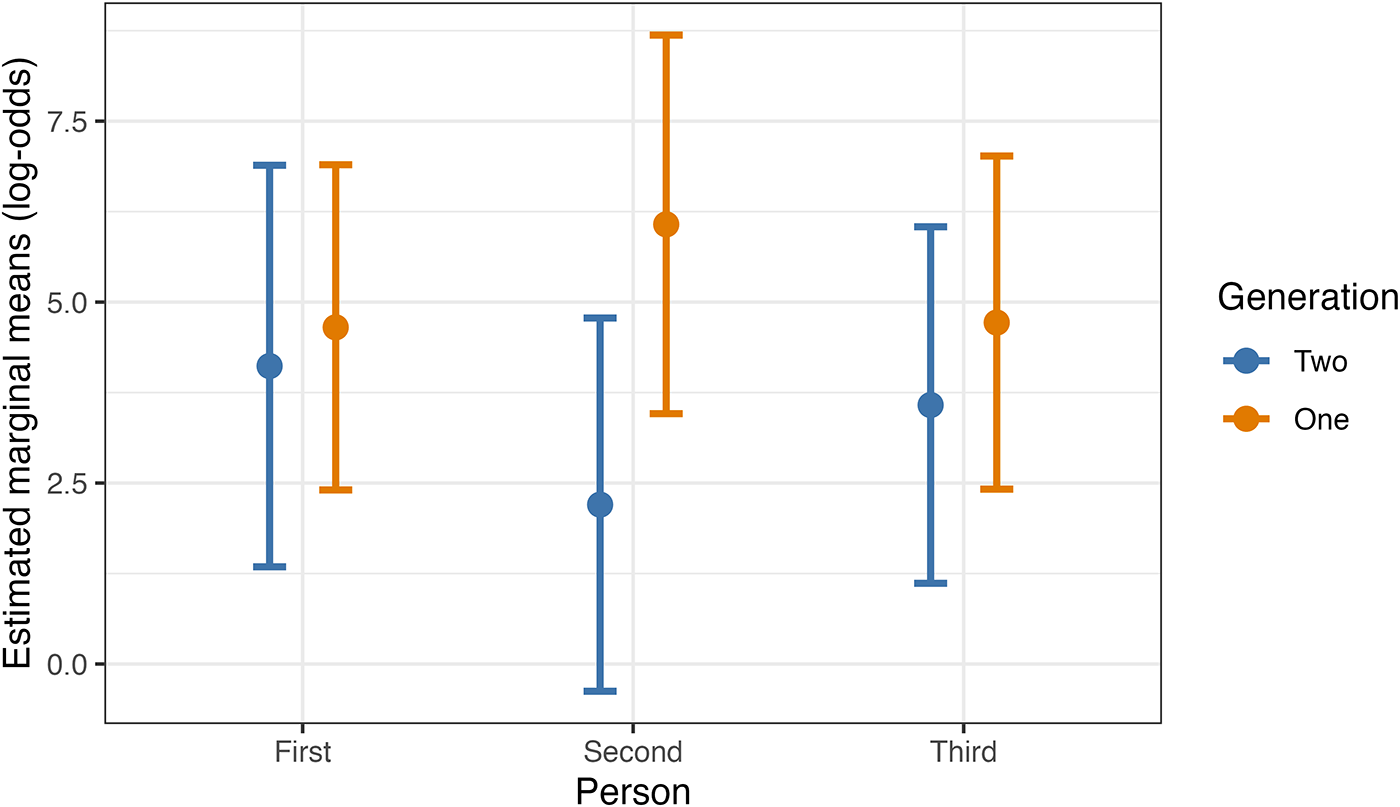
The interaction between Generation and Person was further examined using pairwise comparisons. Within each generation, grammatical person did not significantly affect the rate of object expression. However, between generations, Gen2 speakers were significantly less likely to express second-person objects than Gen1 speakers (OR = 0.02, z = −2.29, p = 0.02). This pattern is visualized in Figure 1, which highlights the cross-generational contrast for second-person objects. No other between-generation differences by person reached significance.
Marginal means of the interaction between Generation and Person for object expression, with error bars representing 95% confidence intervals.

In short, despite a significant cross-generational difference in overall rates of object expression (Table 2), the multivariate analysis showed that broadly similar linguistic and social factors conditioned object expression across generations, albeit with some generation-specific differences in the effect of Person. Thus, while the two generations differ in the overall frequency with which objects are expressed, the grammar of object expression remains largely stable.
Discussion: object expression in heritage Vietnamese
The findings of this study suggest that heritage Vietnamese maintains its core grammatical resources, with change occurring in a selective manner, potentially reflecting differences in speakers’ bilingual experience. The following discussion examines these effects in detail, considering the roles of discourse accessibility, social experience, and localized generational shifts.
Coreferentiality and discourse accessibility
We begin with the strongest linguistic constraint on object expression, Coreferentiality. Null objects were strongly favored where the object’s referent had been mentioned in the immediately preceding clause—that is, where it was highly accessible. Example (9) illustrates a typical case in which the object referring to the addressee is omitted in a coreferential context.


In this example, the object me “2SG.kin” in (9b) is dropped following mention of the same referent in the preceding clause (9a). While Coreferentiality does not fully subsume topicality, it serves here as an operationalizable proxy for discourse accessibility. The strong effect observed indicates that object expression in heritage Vietnamese remains highly sensitive to discourse structure, which is consistent with descriptions of Vietnamese as a discourse-oriented language in which referential recoverability licenses argument omission. Although we have no homeland data to confirm or refute contact effects, the persistence of this constraint suggests continuity and supports the view that discourse-conditioned variation is robust in heritage grammars despite language contact and reduced input.
It is worth highlighting how this result relates to subject expression in the same speech community (Nguyen & Sim, Reference Nguyen and Sim2026:257–258), where Coreferentiality—there operationalized as subject continuity across adjacent clauses—did not emerge as a significant predictor. Although the two factors share a label, they are related but not identical measures: the subject factor indexes structural and topic continuity through a single grammatical position, whereas the object factor indexes recency of mention regardless of the antecedent’s grammatical role. The contrast should therefore be interpreted with care: it does not show that the same factor conditions one argument position but not the other, but rather that object realization is tightly governed by local accessibility in a way that subject realization, tracked through structural continuity, is not. This is nonetheless consistent with the asymmetry noted in the literature, whereby null objects are more closely linked to discourse-level null topics than null subjects (Huang, Reference Huang1984:546–553; Li & Thompson, Reference Li, Thompson and Givón1979:317–320). Experimental evidence from Ngo (Reference Ngo2019:25–57) further supports this distinction in Vietnamese: Speakers favor object antecedents in pronoun resolution, challenging the widely observed subject preference bias (Chafe, Reference Chafe1976:43–49).
Returning to the present data, closer inspection confirms that the effect of Coreferentiality is consistent across grammatical persons: Expressed objects are near-categorical (93–96%) in non-coreferential contexts, while null objects are favored in coreferential contexts for all persons—including first- and second-person referents, which are typically assumed to be highly accessible in discourse. The conditioning effect of accessibility thus extends beyond third-person reference and operates uniformly across participant roles. As shown in Table 3, the effect of Coreferentiality is moreover uniform across overt object types: pronouns, kin terms, and names pattern alike, indicating that the constraint operates as a general discourse-pragmatic one rather than being tied to any particular form.
Taken together, these patterns reinforce the conclusion that object expression in heritage Vietnamese remains firmly anchored in discourse-pragmatic structure. Furthermore, object expression appears most variable in coreferential contexts (36% null vs. 64% expressed, cf. Table 4). This suggests that while Coreferentiality captures an important dimension of discourse accessibility, it does not represent a single, uniform level of accessibility, but rather a range of discourse configurations. Variation within this domain is therefore expected. Factors such as topic continuity or thematic prominence may influence the likelihood of object realization (see e.g., Givón, Reference Givón, Geeslin and Diaz-Campos1983:1–41; Schnell & Barth, Reference Schnell and Barth2018:58–59). This is consistent with broader theories of referential choice (e.g., Ariel, Reference Ariel1990; Givón, Reference Givón, Geeslin and Diaz-Campos1983), which relate reduced forms to high accessibility, but also recognize that accessibility is gradient rather than categorical.
Importantly, this residual variation does not weaken the role of Coreferentiality as a primary conditioning factor, but instead reflects the role of coreferential contexts as the variable environment in which additional constraints may operate. Further work is needed to investigate the contribution of finer-grained discourse-level factors.
Social network language and interactional experience
Alongside these discourse-pragmatic patterns, object expression is also shaped by speakers’ social environments, highlighting the interaction between linguistic structure and social experience. The significant effect of social network language (SNL) shows that speakers whose primary social networks were Vietnamese-dominant produced lower rates of overt object expression than those embedded in English-dominant or bilingual networks. This pattern suggests that sustained engagement with Vietnamese reinforces norms favoring object omission, whereas increased use of English correlates with higher rates of overt realization.
Importantly, this effect reflects differential weighting of an existing variable option rather than categorical modification. This is consistent with Sopata et al. (Reference Sopata, Rinke and Flores2024:91–94), who demonstrated that input influences object realization in Polish–German bilingual children, and with broader evidence that cumulative exposure shapes heritage language grammatical outcomes over time (Schmid, Reference Schmid2009:239–240; Unsworth, Reference Unsworth, Silva-Corvalán and Treffers-Daller2015:172).
Furthermore, the fact that social network language significantly conditions object expression but not subject expression in heritage Vietnamese is particularly revealing. This asymmetry suggests that similar linguistic variables may not be equally sensitive to environmental factors under contact.Footnote 7
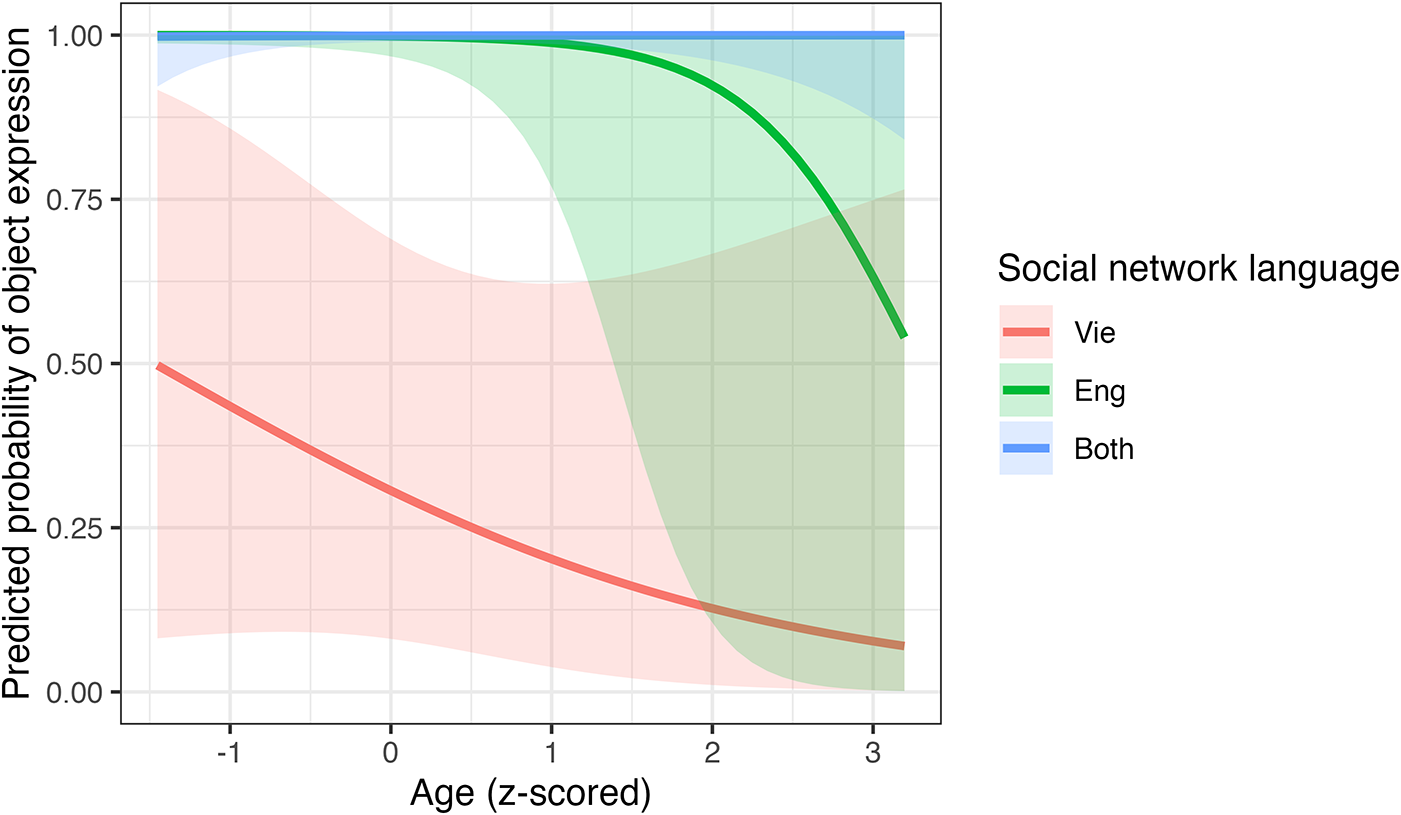
To assess whether the effect of SNL is uniform across the lifespan, we added a two-way interaction between Age and SNL to the best-fitting model. The interaction did not significantly improve model fit (χ2(3) = 6.07, p = 0.11), a result consistent with the considerable variation and uncertainty visible in Figure 2, which presents the model-predicted marginal probabilities. The figure nevertheless suggests a possible age-related trend within the English-SNL group: younger English-SNL speakers pattern with speakers whose networks include both Vietnamese and English, whereas among older speakers the English-SNL curve diverges from the ceiling-level behavior of mixed-network speakers, trending in the direction of—though not reaching—Vietnamese-dominant rates. Given that speakers are predominantly tertiary-educated, with high self-assessed English proficiency across age groups (see “Object expression in contact settings”), this trend is unlikely to reflect differences in linguistic competence. Adding an interaction between Generation and SNL likewise did not improve model fit (χ2(2) = 2.27, p = 0.32), indicating that the SNL effect does not differ across generations and is therefore unlikely to be driven by age of acquisition. One possibility, which we offer speculatively, is that English-dominant networks index different language histories at different life stages—a later-life reorientation toward English for older speakers, early and sustained bilingual practice for younger ones (cf. Sharma & Sankaran, Reference Sharma and Sankaran2011:422–424)—but the present data cannot adjudicate this.
Model-predicted probabilities of object expression by Age (z-scored) and Social network language, from the best-fitting model augmented with the (non-significant) Age × SNL interaction. Shaded regions are 95% confidence intervals.

It is nevertheless worth keeping in mind that interaction effects of this kind are often difficult to detect in sociolinguistic data, given the gradient and heterogeneous nature of bilingual experience. Future work with larger-scale datasets would therefore be valuable in assessing the robustness of the observed age–SNL trend and its generalizability beyond the present study.
The independence of generation from age
Before turning to the generational effect itself, it is worth establishing what it is not. Age was tested both as a main effect and in interaction with Generation during model selection, and neither improved model fit. Object expression in this community shows no detectable lifespan effect—a finding that contrasts with European Portuguese, where null objects increase among younger speakers across both bilingual and monolingual groups (Rinke et al., Reference Rinke, Flores and Pilar2018:116–117). Together, this underscores how age-related patterns in object expression are language- and community-specific rather than uniform across heritage settings.
This null result is analytically consequential. Because the two generations differ in age composition, any generational effect could in principle be a cohort-age artifact. The absence of an age effect, together with the non-significance of the Generation × Age interaction, rules this out: Whatever distinguishes the generations in this community is not carried by chronological age. Generation, operationalized through migration history, evidently captures a dimension of speakers’ linguistic experience—the circumstances of acquisition and the balance of input across the lifespan—that age alone does not. It is against this backdrop that the one genuine site of generational differentiation, to which we now turn, stands out.
Localized generational reconfiguration in second-person contexts
The significant Generation × Person interaction (Fig. 1) locates this differentiation precisely: within each generation, grammatical person did not condition object expression, but between generations a contrast emerged for second-person objects, with Gen2 speakers showing significantly lower model-estimated probabilities of expression than Gen1 speakers. Given our previous discussion on the independence of generation from age, this contrast cannot be attributed to the generations’ differing age profiles, and the absence of a significant Generation × Social network language interaction indicates that it is likewise not moderated by network language in the present data. The pattern parallels, at a thematic level, the person-based restructuring found for subject expression in the same community (Nguyen & Sim, Reference Nguyen and Sim2026:253–254), yet it is striking in its own right: Person-based pragmatic constraints bear less on the omissibility of objects than of subjects, so second person is the last place one would expect generational differentiation to surface for objects—and yet that is where it appears. As shown in Table 5, Gen2 speakers exhibit a sharp reduction in the use of kin terms for second-person objects (51% vs. 72% in Gen1), accompanied by a substantial increase in pronoun use (27% vs. 7%) and a modest increase in null objects.
To assess these patterns statistically, we conducted additional analyses restricted to second-person contexts. A logistic regression comparing kin-term and pronominal objects shows that Generation significantly predicts object type (β = 0.65, z = 2.92, p = 0.004), with Gen1 speakers more likely to use kin terms for second-person objects than Gen2 speakers. In contrast, a model comparing null and overt objects did not reveal a significant effect of Generation (β = −0.04, z = −0.21, p = 0.83), indicating that rates of omission do not differ across generations. This asymmetry indicates that the key pragmatic shift lies in a redistribution of overt object forms in second-person reference, with reduced use of kin-term objectsFootnote 8 and increased use of pronominal forms, rather than in a change in object omission.
The pattern found in Table 5 is rather unexpected, given that object position in Vietnamese is generally less constrained in its omission by person-based pragmatic norms than subject position. As shown in Nguyen and Sim (Reference Nguyen and Sim2026:253–255), subject expression in this community undergoes broad restructuring across generations, with shifts in person-based constraints despite stable overall rates. Here, the emergence of a Generation × Person effect for objects—albeit highly localized—therefore suggests that person-sensitive pragmatic pressures in Canberra Vietnamese are not confined to subjects, but may extend to object reference under certain interactional conditions.
Distribution of object expression by Object Type, Person, and Generation

Table 5 Long description
Percent distributions are given for object expression types, Null, Kin, Pron., and Name, by Person and by generation, Gen1 and Gen2. For First person, Gen1 percentages are Null 11.6, Kin 67.4, Pron. 11.6, and Name 9.5, with n 95; Gen2 percentages are Null 8.6, Kin 70.0, Pron. 18.6, and Name 2.9, with n 70. For Second person, Gen1 percentages are Null 13.2, Kin 72.1, Pron. 7.4, and Name 7.4, with n 68; Gen2 percentages are Null 14.5, Kin 50.9, Pron. 27.3, and Name 7.3, with n 55. For Third person, Gen1 percentages are Null 27.0, Kin 54.8, Pron. 10.6, and Name 7.6, with n 301; Gen2 percentages are Null 13.7, Kin 61.1, Pron. 19.4, and Name 5.7, with n 175. Null ranges from 11.6 to 27.0 in Gen1 and from 8.6 to 14.5 in Gen2, while Name ranges from 7.4 to 9.5 in Gen1 and from 2.9 to 7.3 in Gen2.
One possible interpretation—as anticipated in our discussion on object expression in Vietnamese—is that kin terms retain their indexical and relational force when realized as objects. For Gen2 speakers, referring to the addressee via a kin term entails asserting a hierarchical relationship on every mention—a stance they may not fully inhabit—so kin-term reference may be perceived as pragmatically marked or interactionally restrictive within their bilingual repertoire, prompting the use of pronominal forms instead. That kin terms are readily retained across other persons (Table 5) further suggests that what is avoided is the stance rather than the kin-term system itself. This parallels the interpretation advanced for second-person subject drop in the same community (Nguyen & Sim, Reference Nguyen and Sim2026:254–257).
Alternative explanations find little support. While increased pronoun use is widely reported in contact settings and is compatible with influence from English (where pronominal objects are categorically expressed for Gen2 speakers in this corpus), the restriction of the observed effect to second-person objects here argues against wholesale transfer. More generally, the shift is not attributable to reduced linguistic competence; overall rates of object omission do not differ across generations once discourse and network factors are controlled (the raw difference in Table 2 is not attributable to generation per se). Nor is the generational contrast attributable to age or social network language: Network conditions object expression overall, but neither factor moderates the group difference (Generation × Age and Generation × SNL both n.s.).
One factor, however, cannot be ruled out in the same way: Gen2 speakers’ second-person objects were produced almost exclusively with older interlocutors, and Gen1 speakers’ predominantly with younger ones, so the generational contrast cannot be fully separated from addressee configuration (cf. Nguyen & Sim, Reference Nguyen and Sim2026:255, for the same limitation with subjects). The norm set out in our description of object expression in Vietnamese is that kin terms are preferred over pronouns in reference to older interlocutors. Against that expectation, Gen2 speakers’ elevated use of pronominal second-person objects reads as a departure from the norm, not as its context-appropriate application. The observed change is thus best understood as a localized pragmatic reconfiguration of second-person reference within a largely stable grammatical system. Testing this against the alternative—that speakers apply different norms in different interactional configurations—would require Gen2 speakers recorded with younger addressees, which we leave to future work. Meanwhile, Table 5 supports this localized picture: Kin terms remain frequent for object reference in other persons—and indeed remain the majority overt choice even in Gen2 second-person reference—while overall rates of object expression remain high across generations.
Direct comparison with subject expression in the same corpus underscores that the two variables, though related, do not behave as a unified domain. Animacy is categorical for objects (inanimate third-person objects are invariantly null) but not for subjects; object realization is strongly conditioned by recency of mention whereas subject realization is not conditioned by subject continuity; social network language conditions objects but not subjects; and person-based constraints restructure across generations for subjects while remaining inert within generations for objects. It is precisely these differences that motivate treating subject and object expression as related but distinct variables rather than as instances of a single “null argument” domain.
More broadly, these findings can be situated within cross-linguistic work on pro-drop variation in heritage languages, which shows that subject pronoun expression is often remarkably stable across generations, despite sustained contact with non-pro-drop languages (see Nagy, Reference Nagy2024:113–140 for a helpful overview). Canberra Vietnamese departs from this pattern for subjects (Nguyen & Sim, Reference Nguyen and Sim2026:253), yet the stability that generalization predicts turns up here in the object domain. Whatever protects discourse-conditioned variation under contact, then, is not fixed to a particular argument position.
Conclusion
This study has shown that object expression in Canberra Vietnamese is systematically variable but largely stable across generations. Coreferentiality strongly conditions it: Objects are more likely to be expressed in non-coreferential contexts, consistent with discourse-based accounts of referential accessibility. Social embedding matters as well, with speakers in primarily Vietnamese-speaking networks expressing objects at lower rates than those in English or mixed networks. Age did not significantly predict object expression, either independently or in interaction with Generation, indicating that the patterns reported here are not artifacts of cohort age composition.
Generational effects, by contrast, were limited. Generation was not a main effect, and Person did not condition object expression within generations. Only one contrast reached significance: Gen2 speakers were less likely than Gen1 speakers to express second-person objects once other factors were controlled. Rather than signaling a reorganization of the object domain, this single interaction marks a narrow locus of change, one plausibly tied to interactional routines in second-person kin-term contexts rather than to any general shift in object expression strategies.
Set against the broad generational restructuring of subject expression in this community, the picture that emerges is of selective change: Even closely related variables differ in their sensitivity to contact. What looks like a generalized “Gen2 effect” when a single variable is examined turns out to be far more circumscribed when two variables are considered—which is an argument for studying multiple related variables within one speech community. Ultimately, this study adds to growing evidence that heritage grammars are shaped by selective pressures, resulting in uneven but systematic patterns of variation over time.
Acknowledgements
We thank the editors and the anonymous reviewers for their thoughtful and constructive feedback, which greatly improved the article.
Competing interests
The authors declare none.




 Open access

