How to map women's poetry at the end of the nineteenth century was a question already posed by Vita Sackville-West in 1929, in her essay, “The Women Poets of the 'Seventies.”1
Sackville-West's essay was published in 1929 for the Fellows of the Royal Society of Literature. The occasion of my essay was a lecture for the 2002 conference on “Women's Poetry and the Fin de Siècle (1875–1914)” sponsored by the Institute for English Studies at the University of London and Birkbeck College in 2002. I enjoyed talking about female philhellenism with numerous colleagues at the conference; I am grateful to Marion Thain and Ana Vadillo for organizing this stimulating event and encouraging me to revise my lecture for publication, sooner rather than later. I also thank the Guggenheim Foundation for supporting my archival research on Robinson and Symonds; a special thanks to Elizabeth Wingrove for good company in the Paris archives, and to the rest of my writing group in Ann Arbor for helpful suggestions on drafts. For conversations about Robinson, I wish to express my appreciation to Martha Vicinus and Emily Harrington as well.
The woman of the future! she'll be deeply read, that's certain,
With all the education gained at Newnham or at Girton;
Or if she turns to classic tomes, a literary roamer,
She'll give you bits of Horace or sonorous lines from Homer.
Oh pedants of these later days, who go on undiscerning
To overload a woman's brains and cram our girls with learning,
You'll make a woman half a man, the souls of parents vexing,
To find that all the gentle sex this process is unsexing.
As quoted by Sackville-West in her essay (114), this parody is an equivocal tribute to the generation of women just before her own. Although (in her estimation) the women poets of the seventies produced “nothing of any remarkable value,” nevertheless she admired their intellectual ambition: “a general sense of women scribbling, scribbling” was the “most encouraging sign of all” that the woman of the future was about to come into being, as an idea to be fulfilled by the New Woman of the fin de siècle (131).
But for Punch the very idea of a classically educated woman was the source of new anxieties and ambiguities. Not only might she prove that “a woman's brains” could think like a man, but there was also the implication that this intellectual “unsexing” could lead to sexual transgression. The entry of the “gentle sex” into Greek studies was especially “vexing”: much as Greek eros came to define a homoerotic discourse between men toward the end of the nineteenth century, the desire to learn ancient Greek defined various kinds of communities and relations among women as well. Without making a claim to professional philology, such women were amateurs whose love of ancient Greek authorized their work to circulate in the margins of academia, around women's circles in London, and throughout fin-de-siècle culture in its invention of boundary-crossing aesthetic forms. Identified with Greek letters as proof of their cultural literacy, these new women of letters became an important medium for classical transmission, mediating between the professionalization of classical scholarship and the popularization of “Classics.” In this respect they exemplified the “high amateurism” associated with women's writing at the end of the century, and described by Bonnie Smith in The Gender of History: “Amateurs articulated liminality that worked to mark out the boundaries, spaces, and locations of femininity” (165) and “expanded cognition to include aesthetic, emotional, and kinetic registers, constructing these within a historical knowledge that was – and remains – beyond the horizons of the professional” (171–72). Thus, as Punch predicted, “the woman of the future” seemed to roam promiscuously through “classic tomes,” using her passionate reading of classical literature to define new forms of feminine desire.
The sexual politics of British Hellenism have been explored by various critics,2
but the place of women within these Hellenizing discourses is open to further consideration, raising important questions like the ones posed by Ann Ardis in “New Women and the New Hellenism.” Pondering how the Platonic doctrine of eros was cultivated by male intellectuals of the 1890s, Ardis asks: “Does the New Hellenism enable or discredit female intellectuality? Does turn-of-the-century Platonic discourse carve out a cultural space for female homorelationality?” (108). Ardis draws a negative conclusion from the writing of New Women such as Olive Schreiner and Ethel Arnold, who critiqued the exclusion of women from the homoerotic world of Oxford Hellenism. However the emergence of Hellenism and feminism in Victorian Cambridge suggests there were other places where women were able to use Greek to carve out a cultural space for female homorelationality. The first generation of women to study Greek at Newnham College included Michael Field and Jane Harrison, who drew on the influence of Oxford aesthetes such as Walter Pater to turn his vision of Greek eros into their own.3On Hellenism and feminism in Victorian Cambridge, see Prins. On Jane Harrison in particular, see Peacock, Beard, Robinson (2002), Fiske.
For a Victorian satire on “South Kensington Hellenism,” including “the Hellenic enthusiasm of young and pretty women” see Traill 113–14. For further discussion of women performing Greek theatricals in London of the 1880s, see Beard 37–53. On other Victorian women and Classics, see also Hurst.
While the last of these names is perhaps less familiar to us now than others, Mary Robinson was a central figure in literary London, coming of age as a young poetess in the late 1870s. She was among the first generation of women to be officially admitted to lectures at University College London in 1878, where she studied ancient Greek and dedicated herself to reading Homer, Plato, and the Greek tragedians. During this time she engaged in an elaborate literary correspondence with John Addington Symonds, the poet and classical scholar who had recently published Studies of the Greek Poets (First Series 1873; Second Series 1877). His interpretation of Euripidean tragedy influenced her translation of Hippolytus, which she published in her second volume of lyric poetry in 1881: The Crowned Hippolytus, Translated from Euripides with New Poems by A. Mary F. Robinson, dedicated “To My Friend, J. A. Symonds.” By looking at Robinson's letters to Symonds alongside her translation of Euripides, we can glimpse the formation of her own literary character and also trace the emergence of a particular form of female authorship mediated by translation. Like Elizabeth Barrett Browning, Robinson translated ancient Greek in order to authorize herself as one of the most promising poetesses of her day, using translation to mediate between the passive imprinting and more active invention of herself as a writer. She chose Euripides because of the tragedian's reputation for “feminine” lyricism, allowing Robinson to discover through his poetry a highly musical language of desire for her own poetry. Her translation proved to be a poetic tour de force, as we shall see: a metrical performance, inventing new measures for new women poets who were eager for stylistic as well as sexual innovation. Even if Robinson did not boast of an “education gained at Newnham or at Girton,” she was a woman of the future as predicted by Punch, and “deeply read, that's certain.”
A second Mrs. Browning?
Early in her long literary career Agnes Mary Frances Robinson (1857–1944) was considered one of the poetesses most likely to inherit the laurels of Elizabeth Barrett Browning. In “Some London Poets” (1882), the American critic and poet E. C. Stedman described his visits to her father's house on Gower Street, known for “literary and musical receptions,” a library “curiously rich with rare and antique volumes,” and a lovely daughter basking “in the friendly encouragement of the London literary world, by many of whose members, and most certainly by myself, she is thought to be possessed of that priceless faculty – a true gift of song” (886).5
On Robinson's place in the salon culture of literary London, see Vadillo (1999).
Even Robert Browning himself took an interest in the young Miss Robinson. He too visited her father's literary salon in London on various occasions and years later, when she was hosting her own literary salon in Paris, first as Mme Darmesteter and then as Mme Duclaux, she recalled: “When I knew Browning he was more than sixty years old, and I was eighteen.…If he had affection for me it was, I think, because that fragile young girl who wrote verses and read Greek poems reminded him – ever so remotely – of the shadow of his dear Elizabeth, long dead.”6
Translated from a letter written in French to Maurice Barrès in 1922: “Lorsque j'ai connu Browning il avait plus de soixante ans, et j'en avais dix-huit.…S'il avait de l'amitié pour moi c'était, je crois, parce que cette frêle jeune fille qui faisait des vers et lisait des poèmes grecs lui rappelait – de bien loin – l'ombre de sa chère Elisabeth, depuis longtemps morte” (Halévy 74).
Corréspondance de Mary Robinson, Bibliothèque Nationale de France, Fonds Anglais 248, folio 31. Letters quoted from Fonds Anglais 248 will be cited in main text, with folio numbers.
Robinson's identification with Elizabeth Barrett Browning was more than personal, however. She identified with the woman of (Greek) letters as a literary type that embodied the imprinting of a woman's poetic character through classical education. One classic scene for the emergence of this self-classicizing figure is in Elizabeth Barrett Browning's novel-poem, Aurora Leigh. In Book II, at the dawn of her poetic career, Aurora is just crowning herself Poetess with an ivy-wreath when she is discovered in the garden by her cousin Romney. Mocking her in the pose of a petrified yet blushing caryatid, he returns the book of poems that Aurora has begun to write: “No name writ on it – poems by the form; / Some Greek upon the margin, / – Lady's Greek, without the accents” (II: 74–77). Even without Aurora's authorial signature, Romney recognizes the writing in her book because of the Greek she has marked, or rather left unmarked, in the margins. His gentle mockery of “Lady's Greek, without the accents” suggests either that she writes Greek improperly, without correct diacritical marks, or that she does not know how to scan the quantities of Greek verse for proper pronunciation. Any English schoolboy would have better training in Greek prose composition or classical prosody than Aurora, who lacks formal education: while she is no philologist, she has learned to love the “trick of Greek” from her father, in the books from his private library, at home. Yet this love of Greek has left its mark, if not literally on the page then figuratively on her poetic soul, compared by Aurora to a palimpsest where “we may discern, perhaps / Some fair fine trace of what was written once, / Some upstroke of an alpha and omega / Expressing the old scripture” (I: 829–32). Inscribed with Greek letters, her soul is a script that is difficult to decipher but may be understood, perhaps, in translation; the fictional character of Aurora, like the literary character of Elizabeth Barrett Browning, made itself legible by translating from ancient Greek.
Mediated by “Lady's Greek,” Elizabeth Barrett Browning's claim to female authorship was exemplary for women poets of the fin de siècle. In her Preface to Casa Guidi Windows, Robinson recorded a tribute engraved on the Italian home of the famous Poetess, “who reconciled in her woman's heart the scholar's knowledge and the poet's mind” (vi). A knowledge of classical languages made Elizabeth Barrett Browning seem exceptional as a poet who was also a scholar. Yet her example was not exceptional but generic; or rather, this exemplarity was generic in being figured as exceptional. The imprinting of Greek letters in the heart, mind, and soul of woman typified the literary character of many ladies learning Greek by the end of the century: not one Lady's Greek, in the singular, but Ladies' Greek in the plural. Like other women of her generation, Robinson was eager to convert “Lady's Greek, without the accents” into a thorough knowledge of ancient Greek. She learned Classical languages at an early age, and the anecdotes of Robinson's linguistic talents and literary ambitions are reminiscent of the young Elizabeth Barrett who was 15 when she wrote, in “Glimpses into My Own Life and Literary Character”: “To comprehend even the Greek alphabet was delight inexpressible.…To be a good linguist is the height of my ambition & I do not believe I can ever cease desiring to attain this!!”8
Barrett Browning (1984) 1: 350, 355. On EBB's Greek studies see Meredith, Fowler, Falk (1988, 1991), Loeffelholz, Wallace, Hurst.
Robinson gives us a similar glimpse into her own life and literary character, marked by intense desire for Greek, in her poem “Two Sisters.” Published in The Crowned Hippolytus, this ballad recalls tomboy games she played with her sister Mabel, who acted like “an Amazon of eight,” while Mary took the part of Greek tragic heroines with a “taste for violent tragedy” that “would make me plot / Revenge.”
9Robinson, The Crowned Hippolytus 184. Poems from CH will hereafter be cited in main text by page number.

” (CH 183). The Greek phrase gunaikos androboulon ker (literally, “a woman's heart with the will of a man”) is untranslated and untransliterated in the poem, yet cleverly manipulated by Robinson to fit the rhyme and rhythm of her English verse. “So prevails audacious / The man's-way-planning hoping heart of woman” had been Robert Browning's translation of the phrase a few years earlier in his Agamemnon (3). The unusual Aeschylean epithet describes the androgynous character of Clytemnestra, who appropriates masculine authority in the house of Agamemnon and plots revenge against her husband. Within the context of Robinson's poem, the reference to this character from Greek drama (and more literally, the appearance of these Greek letters) serves to dramatize the inscription of young Mary's literary character, audaciously incorporating “the man's way” of reading ancient Greek into “the hoping heart of woman.” Clytemnestra's audacity prevails, inscribed in Greek on Mary's heart like the palimpsest of Aurora's soul.
So Robinson took to heart the example of Elizabeth Barrett Browning, using Greek to incorporate the scholar's knowledge and the poet's mind into her own poetry. But while the young Elizabeth Barrett learned Greek from private tutors and personal mentors, Robinson found additional support for her scholarly ambitions at college, making the transition from informal schooling of girls at home to more formal higher education. The coeducation of University College London, close to her house on Gower Street, enabled Robinson to pursue Greek studies alongside the men.10
In his chapter on “The Admission of Women,” Bellot notes that UCL had a longer history of supporting the higher education of women: as early as 1833 “some were excited to tears” by “the admission of Ladies” to a class in Natural Philosophy, and in 1849 UCL gave assistance to the funding of the Ladies' College at Bedford Square, but it was not until the decade between 1868 and 1878 that “the college, by granting admission to women, effected the most revolutionary change which has so far occurred in the course of its history” (367–68). In 1878, all lectures were officially opened to both sexes and the college began to award degrees to women. See also Broderick 10–16; Harte 126–34.
Marandon notes Mabel's description of Mary at University College: “Sa soeur reconte qu'au début, les jeunes gens et les jeunes filles avaient encore des cours séparés, mais la fusion commençait à s'opérer. Un jour, on annonça que le cours supérieur de grec pour jeunes filles allait être incorporé à celui des jeunes gens: on vit alors Mary, toute menue, s'avancer seule pour représenter la catégorie féminine” (22).
According to Chambers this tribute was penned by “the most brilliant of all Goodwin's pupils, Mrs. Craigie,” and is quoted in his centenary address on “Philologists at University College” (39).
Quoted from a description of “Mr. Goodwin's influence in the College,” fondly recalled by a former student and colleague in Faculty, Notes and Materials for the History of UCL (19–22). Goodwin was appointed to the Chair of Latin in 1876 and undertook teaching of Greek in 1879; he became Chair of Greek in 1880 (Bellot 387).
Through the force of his character, Professor Goodwin also influenced the formation of Robinson's literary character: he firmly “believed that a literary education was the best form of education and that a competent knowledge of Greek and Latin – especially Greek – was a necessary part of a literary education” (22). Robinson attended his lectures and was singled out for special attention, as she reported in a letter from November 1879: “The other day there was an exam in Plato's Republic &, to my surprise, I and two young men came out bracketed first. Since then Professor Goodwin has been most good to me, tells me what books to read, argues my ‘modernisms’ of thought away as much as he can” (248 f.90). He insisted on a philological approach that would make Robinson less “modern” and more scholarly in her reading of Greek texts: “Mr. Goodwin says I am a great deal too modern & only approach Plato on the sensuous & poetic side, & ought to read unlimited Greek books,” Robinson wrote (248 f.92). Under his tutelage, she applied herself to a rigorous regime of reading Greek – “I ought to be preparing my Plato for Mr. Goodwin's Class at 12” was her daily refrain (248 f.49).
Robinson was an active student at University College for several years, excelling in exams, publishing in the University Magazine, and participating in the Women's Debating Society. She had some misgivings about her future in academia, however:
The Women's Debating Society at University College have [sic] elected me one of the Committee. I feel dreadfully out of place, a frivolous poet, among all the learned ladies in checked Ulsters. I suppose they elected me for the sake of the Greek. So when they asked me to choose a subject of Debate I chose the difference between Classic & Modern Ideals in Literature and Arts. I am to open the Debate with a Speech…(248 f.40).
Debating both sides of “Classic & Modern Ideals,” Robinson succeeded academically but ultimately did not pursue a university degree: the “modernisms of thought” that Professor Goodwin had identified in Robinson made her more of a modern poet than a Classical scholar. For developing the more poetical side of her literary character, Robinson turned to “My Friend, J. A. Symonds,” to whom she dedicated her translation of Hippolytus: a modern man of letters who shared her love of ancient Greek letters.
“Dear Miss Robinson” and “My Dear Mr. Symonds”: A wordy correspondence
In 1878 John Addington Symonds initiated “a brisk interchange of letters with Miss Robinson,” as he confessed to his friend Edmund Gosse: “I felt so much interest in her poems that I wrote to her about them; & her answer to that letter drew me into wordy correspondence” (Symonds, Letters 2: 583). While most of the letters from Symonds to Robinson are lost, many of Robinson's early letters to him survive, albeit unpublished.
14Letters from Robinson to Symonds are collected in the papers of A. Mary F. Robinson in Paris, along with one letter from Symonds to Robinson dated 1884 (Fonds Anglais 248 f.152–54). A few additional letters from Symonds to Robinson are at Bristol University, and have been edited by Schueller and Peters.

[pros akron muelon psuches, “at the inner corner of the soul”] with people I can see,” she wrote (248 f.37), leaving something inscribed in ancient Greek at the inner corner of her own soul, for Symonds to translate.
15I quote Greek phrases exactly as they appear in Robinson's correspondence, with the accents as she marked them. The transliterations and translations set off in brackets are my own.
Addressing her letters to “My dear Mr. Symonds,” she appealed to him for expertise in Greek and English poetry. In December 1878, for example, she wrote for help with Classical meters:
Can you tell me where I can get help about Metre by Quantity. I can find nothing better than Smith's Classical Dictionary, which gave me my Hendecasyllabics wrong. I used to think it was being a girl made me [sic] so ignorant but now I learn Greek with the other students at University College where I do not get on any better. We never read anything but Hexameter or Trimeter Iambic because we either leave the Choruses out or read them so slowly they are no use. Of course I read them to myself at home but probably all wrong. (248 f.14)
The lyric meters of Greek choruses were of special interest to Robinson. She was eager to learn the fine points of Classical prosody from Symonds, as she was experimenting with various metrical forms in her own poetry. Copying out some of her poems in a fair hand, she sent them to Symonds for critique and he responded in turn by sending his poems to her as well. As their literary relationship developed, the letters from Robinson to Symonds (a man twice her age) became increasingly intimate. After Robert Browning's memorable visit to her study, Robinson felt free to confide in Symonds: “how nice it would be if you could come & sit in my little study & read Greek choruses to me” (248 f.50).
But it was several years before Robinson met Symonds in person. Although they exchanged photographs now and then, their literary friendship depended on the exchange of letters, in English and in Greek. “Shall I meet with my friend anywhere?” Robinson once asked him, “If I did, it would seem too strange – because (

notwithstanding) I cannot imagine you a real solid human person” (248 f.32). The playful spelling out of photographs in Greek graphically emphasizes how each created an image of the other through (Greek) letters, in an ongoing literary dialogue. Symonds asked Robinson for advice on poems and essays he was preparing for publication, and on occasion she also did literary research for him in London. At the British Library she was frequently seen as visitor to the Reading-Room, as she wrote to Symonds: “I am well-acquainted with the ways of the

” [phrontisterion,“a place for thinking”], humorously recalling what Aristophanes called the school of Socrates (248 f. 15).
16Indeed a cartoon in Punch from 28 March 1885, entitled “Valuable Collection in the Reading-Room British Museum,” depicted Robinson in the midst of many books and readers at the British Library. Surrounded by eminent men of letters, she is the only woman of letters, holding in her hand her collection of poems, A Handful of Honeysuckle. The cartoon is reproduced in Hoberman 499, and I am grateful to Martha Vicinus for calling it to my attention.

. [eros adunaton k. t. l.,“unconquerable eros etc.”] is an old favourite of mine – but after all, I think I first found it in one of your books” (248 f.26).
The proverb to which Robinson alludes – about the overpowering force of eros – hints how desire for Greek was erotically charged for both poets, albeit in different ways. Robinson understood that for Symonds the love of Greek might signify another kind of desire, “an indefinable

[pothos, “desire”] that is almost despair, that, right or wrong, I have come to consider a characteristic of your poetry” (248 f.13), as she wrote to him. In the Greek-inspired poems that Symonds sent for her to read, Robinson recognized the homoerotic overtones of Platonic pothos, the yearning or desire for ideal beauty that Symonds later described more openly in his memoir, in response to Greek sculpture: “The Greek in me awoke to that simple, and yet so splendid, vision of young manhood…all my dim forebodings of the charm of males were here idealized. The overpowering magic of masculine adolescence drew my tears forth.”
17Symonds (1984) 73–74, quoted and analyzed by Blanshard 104.
The notorious treatise by Symonds on the social benefits of love between men was composed in 1866–68 and rewritten in 1873–74, then printed privately in a pamphlet of ten copies in 1883 and published posthumously in 1897, as an appendix to Havelock Ellis, Studies in the Psychology of Sex. Vol. 1. Sexual Inversion. London: Wilson & Macmillan, 1897. For further discussion on Symonds and the model of ancient Greece, see Holliday; see also Dellamora (1990) 160–62, Dowling 77–81, Pemble 11–14, Davis (1999). Davis (2000) points out that “Symonds's homoerotic aesthetics understood as a whole form of life cannot be reduced to either pole, homoerotic or aesthetic,” but rather must be approached as a reciprocal “relation between homoerotic and aesthetic impressions” (77).
Robinson understood the multiple associations of Platonic love, as she wrote in a letter to Symonds about her first encounter with Plato in Greek:
Just now I read Plato's Republic, for the first time in Greek. I am again the only woman but we have a new professor who is very kind and treats me just like a boy so I do not feel so shy. How I should [love?] to read it with you! It seems so alive after all these years.…I remember when I was at school, I used to read it all the playhours& knew many passages by heart.…Talk to me about Plato, whom I know you love, like you did about Whitman. (248 f.76)
Imagining herself for a moment “just like a boy” in her Greek studies, Robinson seemed to be asking for an initiation into the homoeroetic Hellenism of Symonds. She knowingly associated his love of Plato with his love of Whitman, and was eager to learn more about the imaginative possibilities of these homoerotic projections and sympathetic identifications. Adopting a familiar metaphor from Plato, she described her “Platonic” friendship with Symonds as a way for her soul to grow wings: “You in helping me are raising me nearer your own level – you are making a friend that will comprehend you at last. Then I will never fail you. My soul is new-born & feeble, it is only half-fledged & if you go there will be no one to teach it to fly” (248 f.16).
Early in her correspondence with Symonds, Robinson often expressed a need for a sympathetic mentor who would teach her soul to fly beyond its bounds. Despite the success of Robinson's first volume of poems, A Handful of Honeysuckle (1878), she doubted her poetic abilities. Feeling awkward about “the unmerited sympathy & attention that I have received from so many poets,” she worried: “Surely people must soon tire of the tinkling of a lyre with so few strings. I cannot write what I do not feel and I feel so little. I would put up with all the misfortunes of Cassandra and Electra if I could change my cold nature for theirs” (248 f.10). But if Robinson seemed to fall short of those Greek heroines whose tragic passions created great poetry, she also believed that Greek tragedy could serve as an ideal form for developing intensity of feeling. Like Symonds, she read Greek literature to discover her own desires, transforming her “cold nature” – through sympathetic identification and the vicarious experience of pathos – into a soul filled with Greek pothos. As she wrote to him, “I would rather you thought of me as an earnest, thoughtful little soul…longing, longing to do right & so grateful to you for showing her how” (248 f.20).
Much as Symonds shared his love of Greek with Robinson, her letters to him were written with the understanding that Greek eros could define relations between women as well. Despite confessing doubts and professing modesty, Robinson also admitted to a “fierce rebelliousness” when it came to the cause of women, and she used Greek to proclaim her feminism. “To be quite naturally a failure because one is a woman – Horrible thought.

[ou pleton oude rheton, “intolerable and unspeakable”]…No, I will never believe it,” she wrote to Symonds, invoking “shades of Sappho, Erinna, Myrtilla” as well as Georges Sand, Elizabeth Barrett Browning, Hippolyta, Joan of Arc, and various other female icons to “shelter me with the Aegis of your ways!” (248 f.104). No doubt Symonds recognized the implications of this litany of women who defied gender conventions, beginning with the notorious Sappho: in Studies of the Greek Poets, Symonds had written quite openly about the lesbian passions of Sappho's circle on the island of Lesbos, and his translations of Sappho made it clear that her love poems were addressed to women.
19Wharton's 1885 edition of the Sapphic fragments incorporated long passages by Symonds on Sappho quoted from Studies of the Greek Poets, and featured several translations by Symonds. This edition was notable for identifying the addressee of Sappho's love poetry with feminine pronouns.
The Platonic friendship between Symonds and Robinson can be understood as period of “queer” tutelage, with his passionate response to Greek literature serving as a model for Robinson to discover the passion of her own literary projections and erotic identifications. Their correspondence coincided with the time when Robinson was developing an intimate friendship with Vernon Lee (the pen name of Violet Paget). After meeting Lee in 1879, Robinson traveled to see her in Italy in 1880, as she recalled her first visit to Casa Paget: “People came, attracted by the brilliance of the daughter of the house, Vernon Lee.”
20Robinson (1907) 936. On the relationship between Robinson and Vernon Lee, see Vicinus (2004, 2004), Colby, Zorn. On the literary exchange between Robinson and Lee, see Harrington.
See Colby 50–51, and Grosskurth.

[koina ta ton philon, “friends hold things in common”] (1968, 2: 931). He made a point of not translating the Greek phrase precisely because they all understood how much, and how intimately, knowing Greek allowed friends to hold things in common.
Hippolytus as (fe)male aesthete
In addition to learning much from her correspondence with Symonds, Robinson was an avid reader of his Studies of the Greek Poets, a book that had more than scholarly appeal for many readers. “Of course I have read Studies in the Greek Poets [sic], many a time & oft,” she wrote to him, “– It is one of my favorite books” (248 f.26). Especially instructive in the chapter on “Greek Tragedy and Euripides” were his comments on Hippolytus. Although readers of this Euripidean tragedy have traditionally focused on the pathos of Phaedra (whose incestuous love for her stepson, Hippolytus, leads to her suicide), Symonds was especially interested in the “chaste” love of Hippolytus (who withholds himself from intercourse with all women and worships only Artemis). In a rhapsodic description of the Greek hero, Symonds wrote:
I do not want to dwell upon the pining sickness of Phaedra, which Euripides has wrought with exquisitely painful details, but rather to call attention to Hippolytus. Side by side with the fever of Phaedra is the pure fresh health of the hunter-hero. The scent of forest-glades, where he pursues the deer with Artemis, surrounds him; the sea-breeze from the sands, where he trains his horses, moves his curls. His piety is as untainted as his purity; it is the maiden-service of a maiden-saint. (233–34)
Phaedra's painful performance of femininity was less interesting to Symonds than the pious Hippolytus, whose chaste beauty lends itself to various identifications across gender: as the son of Hippolyta, the Amazon queen, he embodies a feminized masculinity born from a masculinized femininity. He is a male Amazon, recoiling from the heterosexual eros of Aphrodite and dedicating himself in “the maiden-service of a maiden-saint” to the virginal Artemis. According to Symonds, his “pure fresh health” is exercised in nature where he keeps company with the goddess, entering her sacred precincts without violating her; thus his “piety is as untainted as his purity.”
Hippolytus increasingly looks and sounds like an ideal male aesthete, as Symonds imagines “the pure fresh health of the hunter-hero” with his wind-blown curls. Symonds admires how “Hippolytus first comes upon the stage with a garland of wild flowers for Artemis” (234), and his first speech is quoted in translation:
Lady, for thee this garland I have woven
Of wilding flowers plucked from an unshorn meadow,
Where neither shepherd dares to feed his flock,
Nor ever scythe has swept, but through the mead
Unshorn in spring the bee pursues her labours,
And maiden modesty with running rills
Waters the garden. Sweet queen, take my crown
To deck thy golden hair: my hand is holy.
To me alone of men belongs this honour,
To be with thee and answer when thou speakest;
Yes, for I hear thy voice but do not see thee.
So may I end my life as I began. (234)
Translated by Symonds, the poetry of this lyric prayer paints a scene in nature that seems increasingly supernatural: an “unshorn meadow” untouched by man, a pastoral place without shepherds or sheep, a utopian space outside of time. Here, watering the garden with “running rills” that never seem to run out, “maiden modesty” presides: an allegorical personification of the Greek word aidos, meaning both “modesty” and “shame.” This virginal meadow is a projection and spatialization of desire for Hippolytus, an adolescent boy (parthenos) who wants to remain forever a virgin. As Froma Zeitlin points out in a recent reading of the play, “Hippolytus sacralizes virginity, and the manner of his exclusive worship of the goddess suggests the cultural values often embedded in the idea of maidenhood,” but his identification with the maiden modesty of Artemis also runs the risk of “transcending the laws of nature and even of gender.”22
Zeitlin 235. Zeitlin summarizes various scholars on the ambiguities of the untouched meadow, and points out it is “the spatial analogue of Hippolytus, who in identifying himself with the meadow and its immortal mistress defines himself as an unworked territory” (232–33).
Hippolytus is ultimately punished by Aphrodite for this transgression, but in the “queer” reading of the play proposed by Symonds, it is not a transgression of human nature for a young man to identify with Artemis; rather, it is naturalized as a projection of a different kind of desire. The imaginary place that Hippolytus seeks to enter is the space of homoerotic aestheticism, or so Symonds seems to imply in the commentary on his own translation:
Even in this bald translation some of the fresh morning feeling, as of cool fields and living waters, and pure companionship and a heart at peace, transpires. Throughout the play, this impression is maintained, in spite of the usual Euripidean blemishes of smart logic-chopping and pragmatical sententiousness. Hippolytus moves through it with the athletic charm that belongs to such statues as that of Meleager and his dog in the Vatican. (234)
According to Symonds the “pure companionship” of Hippolytus and Artemis is a purification of heterosexual desire, liberating his young hero from “the usual Euripidean blemishes” of plot. Removed from other human attachments, Hippolytus “moves through” the play with an “athletic charm,” yet remains essentially unmoved with “a heart at peace,” like the Classical statue of Meleager: he incarnates the boyish ideal that Symonds admired in Greek statuary, a familiar figure for homoerotic identification.
Indeed Hippolytus seems to become like the statue of Artemis that he worships, as Symonds asks his readers to imagine that “the scent of the forest coolness has been blown upon him” and “his death will now be calm” (235). Symonds translates his final dialogue with the goddess, where she promises Hippolytus that he too will be worshipped:
Unwedded maids before their bridals
Shall rear their locks for thee, and thou for ever
Shalt reap the harvest of unnumbered tears.
Yea, and for aye, with lyre and song the virgins
Shall keep thy memory. (235)
Artemis predicts that young girls will pray to the image of Hippolytus as they pray to her, when they prepare to leave the uncut meadow of their virginity: they will cut their long locks in honor of Hippolytus, and he will harvest their tears while they lament his memory “with lyre and song.” In songs performed by “unwedded maids before their bridals” the tragedy of Hippolytus will be remembered: as his name suggests, it is the story of a boy dragged to death by his horses, destroyed by unbridled heterosexual eros.
The two passages from Hippolytus that Symonds chose to translate and interpret in his Studies of the Greek Poets were influential for Robinson's translation of the play, as her own celebration of “maiden-service to a maiden-saint.” By translating the play from Greek into English verse, she aligned herself with those young maidens keeping the memory of Hippolytus “with lyre and song.” The title of her translation, The Crowned Hippolytus, emphasizes that the hero who brings a garland to crown Artemis is himself crowned in flowers, a figure for the flowers of speech he bestows upon the goddess. The prayer so lyrically translated by Symonds is even more lyrical in Robinson's translation, turning this wreath of language into a veritable anthology of poetic tropes:
I bring for thee a plaited wreath of flowers
From meadow lands untrodden and unmown.
There never shepherd dares to feed his flocks,
Nor iron comes therein; only the bee
Through that unsullied meadow in the spring
Flies on and leaves it pure, and Reverence
Freshens with rivers' dew the tended flowers.
And only they whose virtue is untaught,
They that inherit purity, may pluck
Their bloom and gather it – no baser man.
Yet, O dear mistress, from this pious hand
Take thou a garland for thy golden hair.
For I, of all men, only am thy friend
To share thy converse and companionship.
Hearing thy voice, whose eyes I never see –
And thus may I live until I reach the goal! (CH 6)
In its musical manipulation of alliteration and assonance, Robinson's translation is a more flowing and flowery description of the meadow, where “Reverence / Freshens with rivers' dew the tended flowers.” Even more than Symonds, Robinson emphasizes the “purity” of the meadow: while Symonds simply repeats the adjective “unshorn,” in Robinson's translation the “unsullied meadow” is “untrodden and unmown,” defined by a series of negations (“never shepherd dares…nor iron comes…no baser man”) that make it a truly utopian space in the etymological sense of the word (ou topos in Greek: no place). Following Symonds, Robinson thus introduces Hippolytus as a highly lyricized, aestheticized, homoeroticized figure, unsullied by conventional masculinity and like “no baser man.”
Furthermore, the idealized relation between Hippolytus and Artemis – what Symonds called their “pure companionship” – is directly assimilated into the language of Robinson's translation, when Hippolytus prays to Artemis to be “thy friend” and “share thy converse and companionship.” This phrase is also quoted (in Greek) by Robinson in one of her early letters to Symonds:
It is very good of you to write to me and to take an interest in my life, which is a nice little life enough but very narrow – it is such a delight for me to know you,

[soi kai ksuneimi kai logois ameibomai, kluon men auden, omma d' ouk oron to son]. Hippolytus again, oh dear! I am reading it now every morning at University College & it runs in my head all day. (248 f.19)
Here the Euripidean text translated by Symonds in Studies of the Greek Poets (“to be with thee and answer when thou speakest; / Yea, for I hear thy voice but do not see thee,” 234) is un-translated in Robinson's letter to him, and later re-translated by Robinson in The Crowned Hippolytus (“to share thy converse and companionship / Hearing thy voice, whose eyes I never see,” 6). In this interplay of translations Robinson sought a form of intimate “converse and companionship” with Symonds, as if each could “hear thy voice” without actually seeing the other in person. The ideal of a friendship, simultaneously intimate and remote, was played out not only in Robinson's correspondence with Symonds but in the act of translating Hippolytus as well.
Through the figure of Hippolytus, Robinson therefore came to articulate a language of “pure companionship” that she shared first with Symonds, and then with Vernon Lee. Indeed, Hippolytus would seem to be one of those adolescent boys that female aesthetes could appropriate from male aestheticism and turn into a trope for desire between women: the male Amazon as Lesbian boy.23
On the figure of the lesbian boy in fin-de-siècle women's writing, see Vicinus in Dellamora (1999) 83–106.
Phaedra in the meadow
Alongside Robinson's cross-identification with Hippolytus as male (or female) aesthete, there was also the possibility, and the problem, of identifying with Phaedra.24
On the complex appeal of Phaedra to women poets, see Fox.
I am the only girl-student in the Senior Class and out of politeness to us the Professor makes the unfortunate youths translate Euripides' diatribe against women all wrong. For instance that passage in the Epode of the first chorus, about the evil unhappy helplessness of the wayward disposition of women, he made them translate ‘the complex nature of females is prone to daydreams.’ At which compliment not all the dignity of my newly-acquired womanhood could save me from laughing aloud. In the evenings I try translating it into English verse, but what I have done sounds so odd & funny that I think I shall have to give it up. (248 f.19)
While Robinson responded with humor to the mistranslation of womanly character (Phaedra's as well as her own), in doing her own translation of the play, she found it difficult to strike a balance between the lyrical and more polemical passages. Her first resolution to “try translating it into English verse” came in January of 1879, but often she was close to giving up, as she wrote to Symonds in February: “I don't think I can go on translating Euripides. It is too exasperating to feel a beauty summoning one that one is quite unable to express” (248 f.26). By March she promised to “send some Hippolytus” to him but warned that “only fragments, unconnected & incomplete, are in existence,” and then went on to suggest that he take over the project: “I wish you would translate Hippolytus” (248 f.40). Symonds insisted that she finish the project she had begun, however, and later that spring she resolved to try again: “Since you like my Hippolytus, I will finish it in the Holiday” (248 f.60).
During July 1879, when Robinson was visiting a country house in Warwick, she wrote a series of letters to Symonds about what she did during her summer vacation: she was busy translating Hippolytus. Her description of the English countryside (“the hay is still standing and has grown very long, it is full of flowers and the seeds in the grass give a faint rosy bloom to the meadow”) echoed the famous meadow passage from the Hippolytus of Euripides, and she reported that her sister Mabel was out of doors painting a hayfield that looked like “the virginal meadow in Hippolytus” (248 f.63). Recalling the lyric prayer of Hippolytus to Artemis, she found in nature a scene for imaginary identification, projecting her desires simultaneously into and out of the Greek text. She entertained “pastoral visions of translating that play out of doors,” as if she might inhabit the highly poetic descriptions of nature in the play, although she was quick to admit that her vision of the play was more textual than natural: “I spend more time than I ought in the library” (248 f.63).
In fact the translation did not come naturally at all, as Robinson struggled daily with the Greek text. In particular the character of Phaedra seemed to be growing out of proportion, deflowering the beauty of the play:
I am getting into great despair about Hippolytus. Every morning I leave off on the verge of tears. All the faults of the original, the out-of-place philosophy, the sudden change in Phaedra's character seem to shoot up the Jack's beanstalk, & the beauty, the tear-wringing pathos, & wisdom vanish, or rather they are quite left out in my translation like the fragrance in the painted copy of a rose. Then, as to style, it sounds so untidy & wild – not in the least

[kompseuripikos, “in the pretty Euripidean style”]. (248 f.66)
Here the “tear-wringing pathos” of Euripidean tragedy is transferred to Robinson herself, the long-suffering translator who is “on the verge of tears” in her attempt to recreate the lyricism of the play. Her translation seemed to her like the “painted copy of a rose,” imitating the Greek text in a florid style “not in the least kompseuripikos,” without the flourish of Euripides. By amplifying the “faults of the original” (what Symonds called “the usual Euripidean blemishes”), she worried that she was writing in a style “untidy & wild,” shooting up like a beanstalk. Phaedra was troubling the translation, linking a transgression of style to sexual transgression, as if female sexuality might be growing out of control, and beyond the boundaries of the play.
Robinson therefore left the translation to wither until November, when she reported to Symonds that one of his friends had offered help:
I have seen something of your friend Mr. Fred Myers lately, for twice he has been to help me in correcting my half-done Hippolytus. He says it is pretty accurate, but does not quite fall in with my artistic views, which I fear I must modify. At all hazards I wanted to make it an English poem, written in a style natural to English readers, to call Demeter corn, Eros Love, & (sometimes) Zeus, God, to produce if possible the same natural impression on modern readers as the original did on Greek hearers, to make it quite literal but not a crib – that was my never-realized Ideal. But Mr. Myers says this is over-strained, unscholarly, in some respects false; and I am beginning to think it a fit of youthful enthusiasm. (248 f.83)
While Robinson wanted the translation that she had started in the English fields to be “written in a style natural to English readers” and “to produce if possible the same natural impression” as the original Greek, she was told her style seemed artificial: “overstrained” and “unscholarly” and perhaps even “false.” The ideal beauty of the play, as presented by Symonds, seemed a “never-realized Ideal” that she could not attain in a translation.
But in circulating her “half-done Hippolytus” among friends Robinson must have made some impression on modern readers, as she was invited to publish an excerpt by University College London in their magazine. In a renewed fit of youthful enthusiasm, she wrote to Symonds in late November:
Next month a scene out of the Hippolytus is coming out in the University Magazine as a sort of specimen. Please tell me quite frankly what you think of it.…Of course I feel a little excited to know what you will think (in fact very excited) but I am getting disgusted with the thing myself, so don't be afraid of saying you are disappointed. – And if you think there is any merit or faithfulness or freshness in it, shall I finish it & bring it out next year? Please tell me what you really think. (248 f.91–92)
Despite her doubts, she hoped this excerpt – “a sort of specimen,” like a flower cut from the meadow of her Hippolytus translation – would have some of the “freshness in it” of the original text, or at least the scene she had imagined for its recreation, in her “pastoral vision of translating that play out of doors” in the English meadows around Warwick.
The scene she chose for publication was not Hippolytus praying to Artemis, however, but one of the lyrical speeches delivered by Phaedra pining away with desire for Hippolytus. “The specimen is called The Sickness of Phaedra,” Robinson wrote to Symonds; “I did not choose it as being best, but as the only part that would detach itself” (248 f.92). But there was more at stake in this passage, as Robinson had sufficiently detached herself from Symonds to develop a different reading of the play, more focused on Phaedra. In her delirium, Phaedra echoes the description of the pure meadow, as a space where she would either be purified of her yearning for Hippolytus or find a way of being together with him. “Ah me!” cries Phaedra in Robinson's translation,
Fain would I draw me a draught of clear water
Out of the little, springing well!
Where in the grass of the meadow the poplar
Grows, would I like and take my rest!
The place worshipped by Hippolytus where “Reverence freshens with rivers' dew the tended flowers” is here refigured as a meadow with spring water running through the grasses: a mimesis of his prayer that also works as erotic sublimation for Phaedra, a place to fulfill her desires and “take my rest.” Phaedra also yearns for escape into the mountains, as another Artemisian space where the hunting with (or of) Hippolytus can be refigured as sexual pursuit:
Oh, send me away to the mountains. I go
To the wood where the dogs, the hunters,
Tread in the shade of the pines,
Chasing the dappled deer.
In these passages Robinson turns the figure of Phaedra to her own poetic purposes. By translating “the pure fresh health of the hunter-hero” (as imagined by Symonds) into the lyrical delirium of Phaedra, she also was transposing the language of masculine desire into other languages of feminine desire that might be associated (perhaps transgressively) with female aestheticism. Transforming Phaedra's desire to be with Hippolytus into her own desire to translate Hippolytus, Robinson thus found a way of entering a new poetic domain.
Metrical (de)cadence
In translating the lyrical prayer of Hippolytus to Artemis, and the lyricized landscapes of Phaedra's delirium, Robinson was eager to demonstrate her virtuosity as a lyric poet. The lyrical qualities of Euripidean drama had been praised by Symonds in Studies of the Greek Poets: “It has been well said, that the ear and not the eye was the chosen vehicle of pathos to the Greeks,” Symonds wrote, adding: “This remark is fully justified by the narrative passages in the plays of Euripides – passages of poetry unsurpassed for radiance, swiftness, strength, pictorial effect” (218). Euripides came after Aeschylus and Sophocles to represent a third generation of artists who were, according to Symonds, “obliged to go afield for striking situations, to focus sentiment and pathos, to subordinate the harmony of the whole to the melody of the parts” (220). Euripides found inspiration for lyric poetry by going “afield” into elaborate pictorial descriptions with even more elaborate musical effects: “The lyrics of Euripides are among the choicest treasures of Greek poetry: they flow like mountain rivulets, flashing with sunbeams, eddying in cool shady places, rustling through leaves of mint, forget-me-not, marsh-marigold and dock” (223). It is easy to see how such a description would appeal to women poets like Robinson: she was drawn to the “feminine” lyricism of Euripides, whose poetic cadences are figured by Symonds as the natural flow of rivulets, “flashing” and “eddying” and “rustling.”
Throughout the nineteenth century Euripides had often been dismissed as an “effeminate” and “decadent” poet who marked the decline of Greek tragedy.25
In contrast to Nietzche's 1872 attack on Euripides in The Birth of Tragedy, the 1870s were a turning point in England for the revaluation of Euripides, influenced in part by publication of two translations by Robert Browning, as Symonds notes in his chapter, “Greek Tragedy and Euripides” (243). Symonds sought to defend Euripides from German critics in particular: “It would be a delightful task to attempt to do him justice in the teeth of a malevolent generation of critics, led by Schlegel and Müller, who do not understand him” (223). On the nineteenth-century damnatio of Euripides see Behler, Henrichs, Michelini.
It is hard, while still beneath the overshadowing presence of so great a master as Euripides, to have patience with the critics and scholars who scorn him – critics who cannot comprehend him, scholars who have not read him since they were at school. Decadence! is their cry. Yet what would they have?…Why will they not be satisfied with beauty as luminous as that of a Greek statue or a Greek landscape, with feeling as profound as humanity itself, and with wisdom ‘musical as is Apollo's lute.’” (242)
Symonds turned the charge of “Decadence!” against Euripides into a defense of decadent aesthetics, resounding in poetry with greater variety of musical cadences. According to Symonds, “in the decadence of Greece it was not Aeschylus and Aristophanes, but Euripides” who was “learned and read and quoted” as the modern poet of his day (243), with the implication that Euripides might be learned and read and quoted again by modern-day readers during another period of decadence, in late Victorian England. Symonds concluded his chapter with a special appeal to modern poets: “It seems a strange neglect of good gifts to shut our ears to his pathetic melodies and ringing eloquence” (244).
Robinson was one of those modern poets who kept her ears open to the melodies of Euripidean style, recognizing that both the ear and the eye were the “chosen vehicle of pathos” for Greek tragedy. In translating Hippolytus, she tried to recreate the cadences of his poetry in the metrical modulations of her own poetic lines. With her first volume of poetry, A Handful of Honeysuckle, Robinson had already achieved a reputation for melodious versification. The Academy discovered in these early poems “lines, full of melody and sentiment,” and “abundance of music,” and “the most touching lyrical cadence” (Rev. of A Handful of Honeysuckle 53). The Spectator also praised “the skill with which a somewhat difficult metre is handled,” lending to her lyrics a “sweet pathos, and sometimes a certain weird power” (Rev. of A Handful of Honeysuckle 1343). Even the Saturday Review (despite complaining that “when a lady introduces Greek names into verse she should be careful of her quantities”) found “in Miss Robinson's book an unusual command of metrical language, much sense of the music of words, a power of making a scene visible, with plenty of colour and light on it” (Rev. of A Handful of Honeysuckle 21). These words of praise, reminiscent of Symonds praising Euripides, made Robinson seem uniquely qualified to do a metrical translation of Euripidean tragedy, demonstrating how “Lady's Greek” might look and sound with the accents.
Without trying to match the patterns of Classical quantitative verse exactly, Robinson used her reading of Classical meters to expand the possibilities for writing English accentual verse. Her ear was carefully tuned to the rhythms of English poetry and often she worked out a metrical scheme before starting a poem, “writing lines in stress marks only, the words to be filled in later,” like composing a melody before the words (Van Zuyle 27). When she was translating Hippolytus, she wrote to Symonds that she had decided she would “turn the lyric speeches into unrhymed metre” (248 f.109), and in another letter she asked his advice about the metrical scheme she was trying to work out for the chorus:
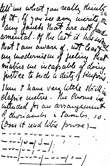
Tell me what you really think of it, if you see any merits or any faults that are not fundamental. Of the last it has several that I am aware of, not least my modernism of feeling that makes me incapable of doing justice to such a deity of Kupris. Then I have very little skill in classic meters. The Chorus is intended for an arrangement of Choriambs & Iambs, so. (Does it read like prose). (248 f.96)
While conceding that her “modernism of feeling” might make her translation seem anachronistic, and her versification out of step with “classic meters,” she sketched out the metrical feet as she imagined them in English (see Figure 15): a pattern of choriambs (four syllables, long-short-short-long) and iambs (two syllables, short-long). The marks she used for scansion indicated length rather than accentuation of syllables, but in her English translation she made the two forms of stress equivalent. She was trying to stretch English verse into longer lines on the model of Classical meters, and although she worried that the passage might “read like prose,” she was eager to see if it could be made to work as a new kind of prosody.

A. Mary F. Robinson, page from a letter to John Addington Symonds, 3 Dec. 1879. Reproduced from Corréspondance de Mary Robinson (Fonds Anglais 248, folio 96). Courtesy of the Bibliothèque Nationale de France.
The passage that scans most closely according to the pattern in Robinson's letter is her translation of the parodos, when the “Chorus of Troezenian Ladies” first enters the stage:
Strophe A
There is a rock dripping with springs out of the very sea,
Sending adown from the tall cliff's crown
Fountains that flow, so that therein dipped may the pitchers be.
I have a friend; thither she went carrying purple gear,
Drenching it through in the rivers' dew,
Out on the rocks, sunny and broad, letting it dry and clear. (CH 9)
This choral passage marked the beginning of “The Sickness of Phaedra,” the excerpt from Robinson's translation published in the University Magazine: simultaneously a vivid pictorial description and a virtuosic metrical performance. The chorus begins with an evocation of a pastoral scene, a flowing fountain where women come to dip their pitchers for water, in language that is also flowing. The first line “There is a rock dripping with springs out of the very sea” is composed of three choriambs and an iamb (as diagrammed in Robinson's letter), creating a syncopated melody more complex than the more straightforward movement of dactyls that we might expect in English verse. In the third line is another metrical syncopation: the first choriamb (“Fountains that flow”) pauses briefly after “flow,” literally and figuratively stopping the flow of the verse before continuing with the second choriamb (“so that therein”), while the third choriamb leads without interruption directly into the final iamb (“dipped may the pitchers be”).
Following the rules of choral responsion, the antistrophe matches the metrical pattern of the strophe, echoing its melody while also introducing a marked contrast thematically. This stanza moves from the description of a sunny scene out in nature to a description of Phaedra hidden from the sun, suffering indoors with a veil shrouding her head and her mouth parched with drought:
Antistrophe A
First from my friend heard I the news how on a fevered bed,
Wasted with pain, hath Phaedra lain
Sick in the house, under a veil shrouding her golden head.
This is to-day third of the days since she persists to close
Foodless, in drouth, her ambrosial mouth;
Death is her choice, on to that goal urged by her secret woes. (CH 9–10)
In contrast to the syncopated flow of the strophe, the syntax of the antistrophe works with the alternation of choriambs and iambs to create a more halting effect, marking the time of Phaedra's suffering in carefully measured phrases: “This is to-day” (choriamb) followed by “third of the days” (choriamb) and “since she persists” (choriamb), and ending with “to close” (iamb). These measures are so well established by the final line (“Death is her choice, on to that goal urged by her secret woes”) that the predetermination of her death seems metrically overdetermined as well, urging Phaedra to the end of her life, and the end of the poetic line, as her “goal.”
By creating her own metrical effects, Robinson struck a balance between literal and free translation, adapting Greek melody to English meter and English melody to Greek meter. The choral odes allowed Robinson to play out different metrical systems, aestheticizing and sometimes even thematizing this interplay of meters. For example, the famous choral ode addressed to Eros is a self-conscious performance of metrical (de)cadence:
O Love! O Love! From the eyes of thee
Droppeth desire, and into the soul
That thou conquerest leadest thou sweetness and charm;
Come not to me bringing sorrow or harm,
And come not in dole,
Nor with measureless passion o'ermaster thou me! (CH 30)
The chorus, praying that it will never fall under the influence of eros, tries to find the right measures for the articulation of this “measureless passion.” The alternation of iambs and anapests in this passage suggests the descending cadences of desire as it drops into the soul, causing erotic turmoil. The tension between these different rhythms corresponds to the paradox of desire bringing both “sweetness” and “sorrow,” and gives metrical form to this internal conflict. Symonds later commented in a letter to Robinson on a general tendency in her verse to displace iambs more familiar to the English ear. “I doubt whether your anapaestic lines in the iambic stanzas are always successful,” he wrote. “They seem to me sometimes to have driven the iambic rhythm so far away, that it becomes intrusive on our ear” (1968, 2:910). The denaturalization of iambic rhythm may sound strange in other poems by Robinson, but in her translation of this choral passage, it is a deliberate intrusion on the ear as a metrical performance of the disordering effects of eros.
A more harmonious anapestic meter is used by Robinson in another choral passage, one of the famous Euripidean “escape odes” in which the chorus wishes to fly away like a bird from the human suffering of the tragedy:
O, I would that I were in the smooth hollow places of rocks!
Were I set by a god as a bird in the light-winged flocks
I am eager to wander on wings and to soar
Over-seas to the far Hadriatic shore. (CH 41)
Here anapests take over to create greater momentum in the ode, and with this metrical acceleration the chorus enacts how it is “eager to wander on wings and to soar” like “a bird in the light-winged flocks”: a trope for lyric poetry, moving beyond earth-bound tragic meters into the air-borne melodies of birds. Thus the chorus articulates its wish to cross over to a distant shore, where human language is transformed into birdsong, and meter could become a purely musical performance.
This flight into the realm of the unreal could perhaps be understood in terms of an “immaterial poetics” that came to characterize Robinson's lyrics in general. Ana Parejo Vadillo has argued that Robinson's lyric impulse was a movement toward disembodied abstraction that Vernon Lee once described as a “quality of voice rare, aetherial, singing in an altogether higher stratum of atmosphere, coming out of what seems an immaterial throat.”26
Quoted by Vadillo in “Immaterial Poetics,” from a personal letter addressed by Lee to Robinson in 1886.
Louder, louder, louder sing
Robinson often wrote to Symonds about her passion for music – one of the first poems she sent for his perusal was “A Passion of Music” (248 f.9) – and she described to him “the intense pleasure, beyond reason, one gets from combinations of harmony in music” (248 f.75). She thanked Symonds for noting her interest in music and expressed surprise that other critics “took no note of my passion for it. Sometimes I think it is the one real thing in life. All the same I have not much music ‘in my hands’ and I think few people who heard me sing would guess how dearly I love it” (248 f.74). Although Robinson did not sing or play a musical instrument, she perceived meter musically, and music was a recurring theme in many of the new poems collected in The Crowned Hippolytus. For example, in “During Music” she wrote: “Hark! What rapturous vital air of music, / What strong harmony utters things unuttered.” Hearing music, like reading Greek or writing poetry, was a way for Robinson to utter things unuttered, articulating a “real thing” in metrical form. Indeed we might think of the melodic manipulation of meters in her translation of Euripides as a prelude to melody of her own poems. Recalling from Symonds that “the ear and not the eye was the chosen vehicle of pathos for the Greeks,” she learned to tune the musical instrument of her verse by translating ancient Greek.
Such an appeal to the ear, mediated by Greek translation and modulated in a metrical performance, is amplified in Robinson's poem, “An Address to the Nightingale.” Translated from The Birds of Aristophanes and published along with other new poems in The Crowned Hippolytus, this exquisite lyric can be read as Robinson's palinode to the escape odes of Euripidean tragedy. Instead of flying away with the birds to a distant shore, as the chorus imagines in Hippolytus, Robinson invites the nightingale to come near:
O dear one, with tawny wings
Dearest of singing things,
Whose hymns my company have been
Thou art come, thou art come, thou art seen!
Bid, with the music of thy voice,
Sweet-sounding rustler, the heart rejoice;
Ah! louder, louder, louder sing,
Flute out the language of the spring;
Nay, let those low notes rest,
Oh! my nightingale, nightingale, trill out thy anapaest! (CH 187)
The poem performs the song of the nightingale in the very act of addressing it: the music is made visible by marking and naming anapests that are “seen” in the song of the bird: “thou art come, thou art come, thou art seen!” Through this repetition of anapests the trilling sounds of the nightingale are figured as a revelation of lyric song, and the very word “nightingale” is transfigured into anapests in the syncopated final line: “Oh! my nightingale, nightingale, trill out thy anapaest!” To heighten the lyrical effect of these anapestic lines, other rhythms are introduced as well, such as iambs in “Ah! louder, louder, louder sing,” and spondees in “Nay, let those low notes rest.” But instead of creating metrical tension, as in the conflict of iambs and anapests in the apostrophe to Eros from Euripides, the meters here are harmonized into a melodious musical cadence, rising upward rather than falling downward: not dissolving into the abstraction of immaterial poetics, but amplifying the musicality of the poem as a “real thing,” reified and reiterated in the invocation to the nightingale as “dearest of singing things.”
When Robinson sent a draft of this Aristophanic translation to Symonds, she wondered “Is the repetition too Euripidesque?” (248 f.56). Perhaps she was referring not only to the repetition of words and phrases in this poem but also more generally to the assimilation of Euripidean lyricism into her own poetry: was it original or too much of a repetition? Did her poetry sound and look too much like Euripides, or did Euripides sound and look too much like her poetry? She debated back and forth about publishing the translation of Hippolytus with or without her own poems, unsure of what kind of poetic claim to make as a translator. On the one hand, she felt she would be taken more seriously as a poet if she published her own poetry along with her translation: “I don't know whether to add a few of my later poems. If I did a great many more people would read Hippolytus, friends of mine who don't take much interest in Euripides, and I should rather like to publish something more serious than my Honeysuckle” (248 f.112–13). On the other hand, her publisher felt that the translation should be independent from her poetry. “I can not make up my mind about my book. Everyone wants me to publish poems with the play, but Mr. Paul agrees with me that Hippolytus is best alone” (248 f.122).
Robinson's decision, finally, to publish her version of Hippolytus as a prelude to her own verse suggests that each should be read in relation to the other, as a reversible relation. By presenting the translation first in the volume, followed by her poems, she invited readers to read her poetry through the lens of Euripides and Euripides through the lens of her poetry. A review in the Athenaeum noted that she had “produced a careful and extremely pleasing version of the ‘Hippolytus’ of Euripides,” distinguished not by literal accuracy but by Robinson's ability to turn it into an English poem that she herself might have written:
Here, as in her other verses, Miss Robinson displays that felicity of language, that real, even if occasionally misled, sense of style, which she, almost alone among contemporaries of her own sex, undeniably possesses. Her ‘Hippolytus’ is an English poem and may be accepted as such by the English reader. This is itself a success. As to the merits of the play as a translation, they are considerable, and we do not know that we are quite justified in demanding a more literal accuracy. If Miss Robinson errs, it is in the direction of raffinirung, of prettifying her original. (Rev. of The Crowned Hippolytus 8–9)
The “prettification” of the original was a measure of Robinson's decadent style, which the Athenaeum reviewer alternately admired (as in “fine passages, like the first speech of Hippolytus”) and criticized (“Miss Robinson's not infrequent failure to cast her choruses in a harmonious form of English verse”). Nevertheless the review concluded that “Miss Robinson's version will satisfy the English reader and bring the student back to his Greek.”
Of course the point of Robinson's translation was that it could bring the student back to her Greek, as well. With The Crowned Hippolytus, Robinson demonstrated (like Elizabeth Barrett Browning) how to reconcile “in her woman's heart the scholar's knowledge and the poet's mind.” Although she was criticized for an overly florid feminine style – “prettifying her original” – her metrical translation of Euripides introduced a new kind of musicality into women's verse. Many of her female contemporaries read these metrical experiments as an exemplary reinvention of lyric song; for example, Hannah Lynch (Robinson's ardent advocate) considered her “a singer of rare and precious art” and singled out The Crowned Hippolytus as “a singularly melodious rendering of Euripides into English verse” (261). Robinson's Greek translation also earned her a place in the 1894 Library of the World's Best Literature, Ancient and Modern, where she was praised for reviving an ancient tongue, no longer spoken, in the living melody of her verse:
Her polished and lovely verse indicates reading, and the absorption of the riches of the literary past of her own and other tongues.…But her talent is independent: her note is distinct enough to justify all her contact with the great spirits of literature; and the chastened classic quality of some of her song in no wise detracts from the modernness of her mind. For a certain refined melancholy she is thoroughly a modern. (Warner 12315)
Even while Robinson's poetry “indicates reading” (both her own and ours), it is figured as music that appeals with “her note” and “her song” to the ear of the reader: a new musical form, simultaneously “classic” and “modern.”27
On Robinson as a Victorian poet on the verge of “modernity,” see Demoor, Ely, Groth, Vadillo (2005).
Thus Robinson drew on the Victorian legacy of ladies' Greek to create new meters for a new generation of new women poets. Among the “scribbling, scribbling” women described by Vita Sackville-West, Robinson proved a serious student of Greek, and a writer who understood her female authorship to be a function of metrical translation: not a claim to authorial voice, exactly, but reclaiming the possibility for women like herself to sing “louder, louder, louder” by trilling out their anapests. During her classical studies at University College London, Robinson learned from Professor Goodwin that her approach to Greek might be “too modern” and perhaps too much “on the sensuous and poetic side” (248 f.49), but in her youthful correspondence with Symonds, who also leaned toward “the sensuous and poetic side” of classical literature, she found a way to play out her desire for Greek as a language of desire. Reading the Hippolytus of Euripides, Robinson became especially interested in Hippolytus as a figure for homoerotic aestheticism, and in Phaedra as a figure for transgressive feminine desire. Her own translations of these passages from the play, alongside the lyrical flights of fancy in the Euripidean choral odes, show the literary influence of Studies of the Greek Poets by Symonds, whose chapter on Euripides described and defended a decadence of Euripidean style that became the model for Robinson's poetic cadences. Although some of her contemporaries found the translation “unscholarly” and “overstrained,” Symonds encouraged Robinson to publish it in The Crowned Hippolytus: a virtuosic metrical performance illustrating the musicality of her language and also her “modernism of feeling,” as she noted in her letter to Symonds (Figure 15). Robinson's poetry accentuated the emergence of a decadent style at the turn of the century, with a wider range of erotic undertones and overtones. Looking back to the lyric strains of the nineteenth century, and looking forward to the strenuous reinvention of lyricism in the twentieth century, Robinson made her mark on the map of fin de siècle women's verse by writing “Lady's Greek,” with the accents.