Introduction
The genus Myristica, belonging to the family Myristicaceae, represents a taxonomically diverse group of evergreen trees, encompassing an estimated 120–150 species distributed across tropical ecosystems worldwide (Megawati et al. Reference Megawati, Darmawan and Hudiyono2024). This genus holds significant economic value, primarily due to the production of aromatic compounds and medicinal substances from several of its constituent species. Notably, Myristica fragrans Houtt. (nutmeg), M. argentea (Papua nutmeg) and M. malabarica (Bombay nutmeg) contribute substantially to regional and international trade, underscoring the genus’s importance in both traditional and contemporary applications.
Among these, M. fragrans Houtt., commonly known as nutmeg, is a major tropical tree spice crop of global importance (Abeyrathne et al. Reference Abeyrathne, Kariyawasam, Perera, Madola, Perera, Suriyagoda, Karunaratne, Dissanayake, Wanigarathna and Jayatilake2025), ranking alongside other economically significant spices such as clove, cassia and cinnamon. This species uniquely produces two distinct products – the seed (nutmeg) and the aril (mace) – both widely utilized in culinary, medicinal and cosmetic industries, thereby driving its global cultivation and trade (Abourashed and El-Alfy Reference Abourashed and El-Alfy2016). In traditional Oriental medicine, nutmeg and mace have long been employed to treat digestive ailments, induce sleep and act as aphrodisiacs (Chaudhari et al. Reference Chaudhari, Dhole, More, Kushwaha and Takarkhede2021). Native to the Moluccas Islands of Indonesia (Ashokkumar et al. Reference Ashokkumar, Simal-Gandara, Murugan, Dhanya and Pandian2022), M. fragrans is now extensively cultivated across tropical regions including Indonesia, Grenada, India, Sri Lanka and Malaysia, highlighting its global agricultural and economic relevance (Francis et al. Reference Francis, James, Varughese and Nair2019).
The dioecious reproductive system of M. fragrans poses a major challenge for cultivation, as it generates high heterozygosity among progenies. Consequently, seed-derived plants are not true-to-type and segregate into male and female plants in an approximate 1:1 ratio (Shibu et al. Reference Shibu, Ravishankar, Anand, Ganeshaiah and Shaanker2020). To address this, commercial propagation of elite genotypes depends largely on vegetative methods, which preserve desirable traits and maintain appropriate male–female ratios within plantations (Nissar et al. Reference Nissar, Sasikumar and Rema2019). Grafting and budding are the most widely adopted vegetative propagation methods, with in situ and nursery budding being common in commercial production (Miniraj et al. Reference Miniraj, Mathew and Nybe2012). Although M. fragrans itself is considered the ideal rootstock (Priyanka et al. Reference Priyanka, Miniraj and Vikram2023), its large-scale use is constrained by low bud intake due to phenolic interference (Beena and Kurian Reference Beena and Kurian1996), limited seed availability and the consequent high cost of planting material.
In India, commercial nurseries frequently employ wild Myristica species, particularly M. malabarica and M. beddomei, as alternative rootstocks (Farhana et al. Reference Farhana, Vikram, Anitha and Mini Raj2024). These species are abundant in the Western Ghats, a global biodiversity hotspot, and their seeds – lacking high commercial value – impose minimal opportunity cost. Moreover, they demonstrate superior bud compatibility and improved field performance, including enhanced drought tolerance and wind resistance, especially in the case of M. malabarica (Krishnamurthy et al. Reference Krishnamurthy, Rema, Mathew and Krishnamoorthy2008). However, the long-term graft compatibility of wild Myristica rootstocks remains a significant concern. Given the perennial nature of nutmeg – characterized by a long juvenile phase and an economic lifespan exceeding 50 years – stable graft performance is critical. Recent field observations have reported symptoms of late-phase graft incompatibility, including stunted growth and reduced yields, typically emerging 15 years post-grafting (Fig. 1). These issues pose severe economic risks to farmers and threaten the sustainability of nutmeg cultivation. Since nutmeg propagation is a highly skilled practice largely managed by private nurseries, growers are often unaware of rootstock origin and are left vulnerable to long-term losses. While nurseries may gain short-term benefits from using readily available wild rootstocks, the hidden costs of incompatibility highlight the urgent need for reliable rootstock authentication strategies.
Late-phase graft incompatibility observed in nutmeg trees grafted onto wild Myristica sp. rootstock in commercial plantations older than 15 years; (a–c) nutmeg trees exhibiting varying degrees of long-term graft incompatibility.

Figure 1 Long description
Image A shows the base of a nutmeg tree with visible swelling and rough texture, surrounded by fallen leaves. Image B depicts another tree with a distinct discoloration and rough surface at the graft union, with soil and leaves around it. Image C displays a larger nutmeg tree with multiple branches emerging from a swollen graft area, set in a forested environment with other trees in the background.
Current approaches for distinguishing M. fragrans rootstocks from wild species are inadequate. Morphological descriptors (Suseela et al. Reference Suseela, Jayarajan and Kandiannan2007; Priyanka and Miniraj Reference Priyanka and Miniraj2017; Agustina et al. Reference Agustina, Chasani, Daryono and Rifqi2024; Shaju et al. Reference Shaju, Payatatti, Vijayan, Kalathil, Gafoor, Jagadamma and Elampilay2024) are unreliable at the seedling stage (Supplementary Figure S1), while random DNA markers such as RAPD (Sheeja et al. Reference Sheeja, Sabeesh, Shabna, Shalini and Krishnamoorthy2013; Nikam et al. Reference Nikam, Ingale, Gokhale and Lajurkar2016; Krishnan et al. Reference Krishnan, John, Cyriac and Sible2017) and ISSR (Sheeja et al. Reference Sheeja, Sabeesh, Shabna, Shalini and Krishnamoorthy2013; Krishnan et al. Reference Krishnan, John and Varghese2019; Shaju et al. Reference Shaju, Payatatti, Vijayan, Kalathil, Gafoor, Jagadamma and Elampilay2024) exhibit poor reproducibility. While nuclear simple sequence repeats (SSRs) and transcriptome-based markers (Kusuma et al. Reference Kusuma, Scarcelli, Couderc, Mariac, Zekraoui and Duminil2020; Rostiana et al. Reference Rostiana, Heryanto, Arlianti, Ruhnayat, Priyatno and Hariri2025) are useful genomic resources for population genetics and marker-assisted selection, their diagnostic utility for rootstock authentication is confounded by the high heterozygosity and allelic segregation inherent in dioecious Myristica seedling populations; conversely, the non-recombinant, maternally inherited nature of the chloroplast genome offers highly conserved, species-specific signatures that remain stable across generations. Existing chloroplast DNA (cpDNA) barcoding methods often rely on high-quality DNA and next-generation sequencing (Swetha et al. Reference Swetha, Parvathy, Sheeja and Sasikumar2017, Reference Swetha, Sheeja and Sasikumar2019), restricting their utility for large-scale, field-based applications such as genotyping from bark tissues under resource-limited conditions. Universal barcoding regions (e.g., rbcL, matK) frequently lack sufficient sequence variation to discriminate closely related congeners, leading to low resolution in phylogenetic analyses (Wang et al. Reference Wang, Liu, Zhang, Chen, Qu and Fan2021; Guo et al. Reference Guo, Wang, Wang and Li2023). Furthermore, such loci may fail to capture key genetic differences across the chloroplast genome that could yield more precise species-specific signatures (Shaw et al. Reference Shaw, Lickey, Schilling and Small2007).
To address these limitations, the present study leverages complete chloroplast genome sequences of Myristica species (Mao et al. Reference Mao, Zhang, Yang, Li and Wu2019; de Oliveira et al. Reference de Oliveira, Duijm and Steege2020; Cai et al. Reference Cai, Ma, Ci, Conran and Li2021; Ariati et al. Reference Ariati, Priyadi, Hariri and Risna2023; Kusuma et al. Reference Kusuma, Couderc, Scarcelli and Duminil2023). Through comparative genomics, we identify highly variable regions (mutation hotspots) that serve as targets for PCR-based markers exploiting sequence length polymorphisms (SLPs), such as insertions/deletions (InDels) and SSRs (Santos and Pereira Reference Santos and Pereira2018). Unlike universal barcoding loci, these tailored markers provide greater resolution for species-level discrimination within Myristica. Importantly, they offer a rapid, low-cost and field-compatible solution that can be visualized on agarose gels, making them accessible to nurseries and field stations in India.
In this context, the present study aims to develop a robust molecular toolkit to enhance the sustainability of nutmeg production. Specifically, we:
(i) Develop and validate novel species-specific PCR markers based on chloroplast SLPs to accurately distinguish M. fragrans from wild rootstocks.
(ii) Apply these markers to authenticate rootstocks in commercial nurseries and established plantations.
(iii) Evaluate phylogenetic relationships among major Myristica accessions to better understand genetic diversity and evolutionary history.
These markers are tested across all major Indian M. fragrans cultivars – including released varieties, farmer selections and elite lines – ensuring broad applicability in commercial nurseries and germplasm conservation programs.
Materials and methods
Plant material for marker validation and phylogenetic studies
For initial marker validation and phylogenetic analyses, leaf and bark samples were collected from 33 Myristica accessions (Table 1). The accessions included: M. fragrans (22 accessions, encompassing all the released high yielding varieties and widely grown farmer-selected cultivars representing significant cultivated nutmeg germplasm in India), M. malabarica (6 accessions, including 2 with distinct early branching phenotypes), M. andamanica (2 accessions, exhibiting pubescent and glabrous leaf characteristics, respectively), M. magnifica (2 accessions) and M. beddomei (1 accession). The M. fragrans, M. andamanica, M. magnifica, M. beddomei and M. malabarica (Col. Nos. 1, 4, 5 and 6) accessions are maintained at the tree spice germplasm repository, ICAR-Indian Institute of Spices Research (ICAR-IISR), Kozhikode, Kerala, India, and are available for research purposes under the Standard Material Transfer Agreement (SMTA) by submitting a formal request to the Director, ICAR-IISR, Kozhikode, Kerala, India. Wild Myristica sp. accessions were collected from different regions of two Indian states viz., Kerala and Karnataka as detailed in Table 1.
Details of the nutmeg varieties, popular cultivars and wild Myristica sp. utilized in the study

Table 1 Long description
The table provides details on 33 nutmeg genotypes, focusing on Myristica fragrans varieties and wild Myristica species. It includes released high-yielding (HY) varieties like IISR-Viswasree and farmer selections such as Sindhusree. Monoecious varieties are noted, with Konkan Sanyukta and Konkan Sugandha being examples. Wild nutmeg species, including M. malabarica, M. andamanica, M. magnifica, and M. beddomei, are collected from various locations in India, such as the Western Ghats and Kozhikode. The table highlights the diversity in nutmeg genotypes and their geographical origins, emphasizing the importance of both cultivated and wild varieties in phylogenetic studies.
Rootstock authentication studies
To evaluate the utility of species-specific markers and investigate graft incompatibility in cultivation, a targeted survey was conducted in commercial nurseries and plantations across Kerala, India. Bark tissue from rootstocks was collected from 18 grafted trees, representing three categories:
• Commercial nursery grafts (RSB1–RSB6): Six samples were obtained from rootstocks of young grafts at the seedling stage from a commercial nursery in Kozhikode, Kerala, to assess species identity in current propagation practices.
• Mature, graft-compatible trees (RSB7–RSB14): Eight samples were collected from >20-year-old grafted trees without any symptoms of incompatibility. These included four samples from a commercial plantation in Thrissur (RSB7–RSB10) and four from Ponkunnam, Kottayam (RSB11–RSB14).
• Mature, graft-incompatible trees (RSB15–RSB18): Four samples were obtained from rootstocks of trees in the same Ponkunnam plantation, which exhibited late-phase incompatibility symptoms such as stunted growth and reduced yield (Fig. 1).
• Commercial Nursery Grafts (Maharashtra): To further strengthen marker validation across geographically distinct nutmeg-growing regions, an additional set of rootstock samples was collected from the Konkan region of Maharashtra, India. Twenty-four bark samples (RSB19–RSB42) were obtained from rootstocks of grafted nutmeg plants at the seedling stage from commercial nurseries located in Dapoli, Ratnagiri district, Maharashtra. This region represents one of the major nutmeg cultivation zones in western India, outside Kerala.
All collected samples were immediately frozen in liquid nitrogen and stored at −80°C to preserve DNA integrity for subsequent molecular analysis.
DNA extraction
The DNA was extracted using the CTAB method, first described by Murray and Thompson (Reference Murray and Thompson1980) and later updated by Doyle (Reference Doyle1990). The quality and quantity of the extracted DNA were assessed using a NanoDrop Spectrophotometer and agarose gel electrophoresis. For PCR, the DNA was diluted to a working concentration of 20 ng/μL.
Chloroplast genome alignment and identification of hypervariable regions
Complete chloroplast genome sequences of nine Myristica accessions (Supplementary Table S1) were retrieved from NCBI. Quality control included checks for completeness, length and absence of ambiguous bases. Multiple sequence alignment (MSA) was performed using MEGA X with the ClustalW algorithm (Kumar et al. Reference Kumar, Stecher, Li, Knyaz and Tamura2018). Genome annotation was carried out with CPGAVAS2 (Shi et al. Reference Shi, Chen, Jiang, Wang, Wu, Huang and Liu2019) to identify coding genes, rRNAs, tRNAs and intergenic regions. Comparative analyses were performed with mVISTA in Shuffle-LAGAN mode (Frazer et al. Reference Frazer, Pachter, Poliakov, Rubin and Dubchak2004), using M. fragrans (MN495963.1) as the reference, enabling identification of conserved and divergent regions. Hypervariable regions were defined as loci exhibiting InDels or a high density of SNPs.
InDel and SSR identification
InDels were identified from the alignment, with only those ≥5 bp retained for marker development to ensure clear resolution on agarose gels. SSRs were identified using SSRIT (Temnykh et al. Reference Temnykh, DeClerck, Lukashova, Lipovich, Cartinhour and McCouch2001) and validated with MISA, with repeat thresholds set following standard criteria (≥10 for mono-, ≥5 for di- and ≥3 for tri- to hexanucleotides).
Primer design and marker selection
Primers were designed for polymorphic loci using Primer3 (Kõressaar et al. Reference Kõressaar, Lepamets, Kaplinski, Raime, Andreson and Puurand2018), targeting amplicons of 100–350 bp. Although a large number of chloroplast SSRs were identified across the nine Myristica genomes (63–71 per accession; Supplementary Table S3), primers were designed only for loci that (i) showed clear interspecific length polymorphisms and (ii) had highly conserved flanking regions. SSRs with length variation <3 bp were deliberately excluded, as such differences cannot be reliably resolved on 3% agarose gels. Parameters such as annealing temperature (55 ± 2°C), GC content (40–60%) and primer length (≈20 bp) were optimized for efficient PCR amplification. Where feasible, primers were designed to capture multiple polymorphisms within a single amplicon. A total of 84 candidate markers (59 SSRs and 25 InDels) were initially designed from the identified polymorphic loci. From this pool, eight markers (MCP1–MCP8) were selected for synthesis based on high in silico polymorphism between M. fragrans and other Myristica species. These markers targeted hypervariable chloroplast regions, including five InDel loci and three combined InDel–SSR loci (Table 2).
List of markers developed based on the hypervariable sites in the chloroplast genome for PCR-based genotyping of Myristica accessions

Table 2 Long description
The table lists eight markers developed for PCR-based genotyping of Myristica accessions, focusing on hypervariable sites in the chloroplast genome. Each marker targets a specific region and exhibits either InDel or InDel/SSR polymorphism types. The expected amplicon sizes range from 150 to 274 base pairs, with MCP5 having the largest amplicon. The GC content varies significantly, from 39.13% in the reverse sequence of MCP1 to 61.11% in the forward sequence of MCP1, indicating differences in sequence stability. Melting temperatures are relatively consistent, ranging from 57.44°C to 59.27°C, suggesting similar primer binding efficiencies across markers. These markers provide a diverse set of tools for genotyping, with potential implications for understanding genetic variation in Myristica species.
PCR amplification and product analysis
PCR reactions (10 µL) were prepared using Emerald Green Master Mix (TaKaRa) and run under standard cycling conditions (94°C initial denaturation, followed by 40 cycles of denaturation–annealing–extension, with final extension at 72°C). Products were resolved on 3% agarose gels in 1 × TAE buffer, stained with ethidium bromide and visualized under UV (Bio-Rad ChemiDoc™). Fragment sizes were compared with a 100 bp ladder, and alleles were scored based on fragment length. A marker was deemed species-specific if it consistently distinguished M. fragrans from wild congeners.
Phylogenetic analysis
Genetic relationships among Myristica accessions were inferred from the allelic data of cpDNA-based markers. A binary matrix of allele presence/absence was generated and analyzed in DARwin v6.0.14 (Perrier and Jacquemoud-Collet Reference Perrier and Jacquemoud-Collet2013). Pairwise dissimilarities were calculated and subjected to principal coordinate analysis (PCoA) to visualize genetic distances in multidimensional space. Hierarchical clustering was performed using the UPGMA algorithm to construct a dendrogram depicting the phylogenetic structure. The combination of PCoA and UPGMA provided complementary insights, with PCoA highlighting the relative placement of accessions in a reduced-dimensional framework, while the dendrogram illustrated hierarchical clustering patterns, enabling identification of major genetic lineages within Myristica.
Results
InDels in the Myristica chloroplast genome
A comprehensive analysis of MSAs across 9 Myristica species revealed 25 InDel loci exhibiting length variations of 5 base pairs (bp) or greater (Supplementary Table S2). The size of these InDels ranged from 5 bp to 66 bp. Notably, the majority (23 loci, 92%) of these InDels were located within non-coding intergenic spacer (IGS) regions of the chloroplast genome. Two InDel loci were identified within coding regions, specifically within the accD and rpl22 genes. Furthermore, 11 of the 25 InDel-containing regions were found to harbour SSRs.
SSRs in the Myristica chloroplast genome
A total of 597 SSR loci were identified across the chloroplast genomes of the 9 Myristica species (Supplementary Table S3). The distribution of SSRs was predominantly skewed towards non-coding regions, with 76.19% of the total SSRs located in IGS regions, while 23.81% were found within coding sequences of the M. fragrans annotated chloroplast genome. Significant interspecific variation in SSR abundance was observed. The number of identified SSRs ranged from 63 to 71 across the analyzed accessions. M. fatua (OP866725.1) exhibited the highest SSR count (71), followed closely by M. yunnanensis (ON881528.1) with 68. M. yunnanensis (MK285565.1) and M. fragrans (OL628762.1) each presented 67 SSRs. M. yunnanensis (MN495964.1) and M. fragrans (MT062914.1) displayed 66 SSRs each. M. teysmannii (OQ476656.1) contained 65 SSRs, and M. argentea (OP866724.1) exhibited 64. Conversely, the lowest SSR count was observed in M. fragrans (MN495963.1) with 63 SSRs (Supplementary Table S3).
Marker development and validation
PCR amplification using the eight synthesized primers yielded clear, reproducible and distinct banding patterns across the Myristica accessions (Figs. 2a, 2b and 4). All eight markers successfully amplified the target regions, confirming the technical robustness of the primer set. However, their diagnostic utility differed: among the eight chloroplast SLP markers developed and tested, five markers (MCP1, MCP2, MCP3, MCP4 and MCP7) were informative, exhibiting clear length polymorphisms that enabled interspecific and/or intraspecific discrimination within Myristica, whereas three markers (MCP5, MCP6 and MCP8) were monomorphic across all 33 Indian Myristica accessions analyzed, showing no detectable length variation under the current sampling and resolution conditions.
a. Species-specific polymorphism among Myristica sp. at the ycf4_cemA intergenic spacer revealed by the MCP4 marker; Figure 2b. Representative gel profile showing allelic diversity at the trnR-ACG_rrn5S IGS among Myristica accessions as revealed by the InDel marker MCP7. M: 100 bp ladder; 1. IISR-Viswasree; 2. IISR-Keralashree; 3. Sindhusree; 4. Konkan Sanyuktha; 5. Konkan Sugandha; 6. 562; 7. 590; 8. Yellow mace; 9. Fab; 10. Golden; 11. KAU-Mundathanam, 12. KAU-Punnathanam; 13. KAU-Pullan; 14. KAU-Poothara; 15. Kinattukara; 16. Nova; 17. KAU-Kochukudi; 18. M. malabarica (Col.No.1); 19. M. malabarica (Col.No.2); 20. M. malabarica (Col.No.3); 21. M. malabarica (Col.No.4); 22. M. malabarica (Col.No.5); 23. M. malabarica (Col.No.6); 24. M. andamanica pubescent; 25. M. andamanica glabrous.

Figure 2 Long description
The image A shows a gel electrophoresis result with 25 lanes labeled 1 to 25 and two markers labeled M at both ends. The bands are visible across all lanes, with a 100 bp ladder on the left. The bands are positioned between 200 bp and 500 bp markers. The image B shows another gel electrophoresis result with similar labeling, featuring bands across all lanes. The bands are positioned between 200 bp and 500 bp markers, with a 100 bp ladder on the left. Both images display distinct banding patterns for each sample.
Allelic diversity and species discrimination
The 8 selected cpDNA markers, targeting regions containing InDel and SSR variations, exhibited high reproducibility, consistently generating a single, clear amplicon in each of the 33 Myristica accessions, confirming their reliability for downstream genotyping analyses (Table 3). The InDel marker MCP1, targeting the trnQ-UUG_psbK IGS, displayed three distinct alleles: a 150 bp amplicon specific to all M. fragrans accessions, a 155 bp amplicon in all M. malabarica accessions, both M. magnifica accessions and M. beddomei, and a 160 bp amplicon unique to M. andamanica accessions (Supplementary Figure S2). MCP2, targeting the rpoB_trnC-GCA IGS, revealed two alleles: a 189 bp allele present in 5 M. fragrans cultivars (IISR-Vishwasree, Konkan Sanyukta, Yellow mace, Konkan Shrimanti and KAU-Kochukudi) and a 184 bp allele in the remaining 28 accessions. MCP3, targeting the trnS-UGA_psbZ IGS, showed a similar pattern, with a 195 bp allele in the same 5 M. fragrans cultivars and a 189 bp allele in the other 28 accessions. MCP4, targeting the ycf4_cemA IGS, exhibited species-specific polymorphism: a 164 bp allele in all M. fragrans accessions, a 189 bp allele in both M. andamanica and M. magnifica accessions, M. beddomei and four M. malabarica accessions (Collection Nos. 1–4), and a 194 bp allele in two M. malabarica accessions (Collection Nos. 5 and 6), which displayed a distinct early branching phenotype (Fig. 2a).
Characteristics of eight validated cpDNA markers in Myristica accessions

Table 3 Long description
The table presents allele sizes in base pairs for eight cpDNA markers across five Myristica species, highlighting species specificity and potential for cultivar differentiation. MCP1 and MCP4 are species-specific, with MCP1 showing three different alleles across species. MCP2, MCP3, and MCP7 have potential for cultivar differentiation, each with two alleles observed. MCP5, MCP6, and MCP8 show no species specificity or differentiation potential, with only one allele size observed across all species. MCP1 and MCP4 have the highest number of alleles, indicating greater variability. The data suggest that certain markers may be more useful for identifying specific species or cultivars within the Myristica genus.
MCP7, targeting the trnR-ACG_rrn5S IGS, revealed a 236 bp allele in 17 M. fragrans cultivars and a 218 bp allele in the remaining 5 M. fragrans cultivars (IISR-Vishwasree, Konkan Sanyukta, Yellow mace, Konkan Shrimanti and KAU-Kochukudi), as well as in all M. malabarica, M. magnifica, M. beddomei and M. andamanica accessions (Fig. 2b). Conversely, markers MCP5 (rrn5S_ndhF InDel/SSR), MCP6 (trnN-GUU_trnR-ACG InDel) and MCP8 (atpB_rbcL InDel/SSR) were monomorphic across all accessions, indicating a lack of detectable polymorphism within the sampled populations.
Phylogenetic analysis
Phylogenetic analysis, employing cpDNA marker polymorphisms, delineated three distinct genetic clusters within the Myristica germplasm, elucidating evolutionary relationships and genetic diversity. Cluster A, the largest, encompassed 17 M. fragrans accessions, indicating a conserved cpDNA lineage. Conversely, Cluster B exclusively contained five M. fragrans cultivars (IISR-Vishwasree, Konkan Sanyukta, Yellow Mace, Konkan Shrimanti and KAU-Kochukudi), suggesting genetic differentiation potentially influenced by artificial selection or independent origins. Cluster C exhibited further substructure: M. andamanica accessions formed a well-supported, distinct clade, highlighting its evolutionary divergence. Within Cluster C, M. malabarica accessions resolved into two subclades; accessions with an early branching phenotype (Collection Nos. 5 and 6) formed a unique, well-defined clade, implying a distinct genetic lineage associated with this trait. The remaining M. malabarica accessions (Collection Nos. 1–4), alongside both M. magnifica accessions and M. beddomei, constituted another separate clade (Fig. 3).
Dendrogram depicting the phylogenetic relationship among Myristica accessions based on the allelic diversity at cpDNA-based InDel/SSR markers.

Figure 3 Long description
The dendrogram illustrates the phylogenetic relationships among various Myristica accessions based on genetic markers. It shows three distinct clusters. Cluster A includes M. fragrans cultivars such as Konkan Shrimanti, KAU-Kochukudi, Yellow Mace, Konkan Sanyukta and IISR-Vishwasree. Cluster B contains M. andamanica and M. malabarica accessions, with subclades for M. malabarica Collection Nos. 5 and 6 and another for Collection Nos. 1 to 4, M. magnifica and M. beddomei. Cluster C features M. fragrans cultivars like Goa Jayaphal, Konkan Swad, Nova, KAU-Poothara, KAU-Pullan, KAU-Punnathamam, KAU-Mandathamam, Golden, Fab, Accession 601, Accession 626, Konkan Sugandha, Sindhude and IISR-Keralashree.
Root stock species identification using validated markers
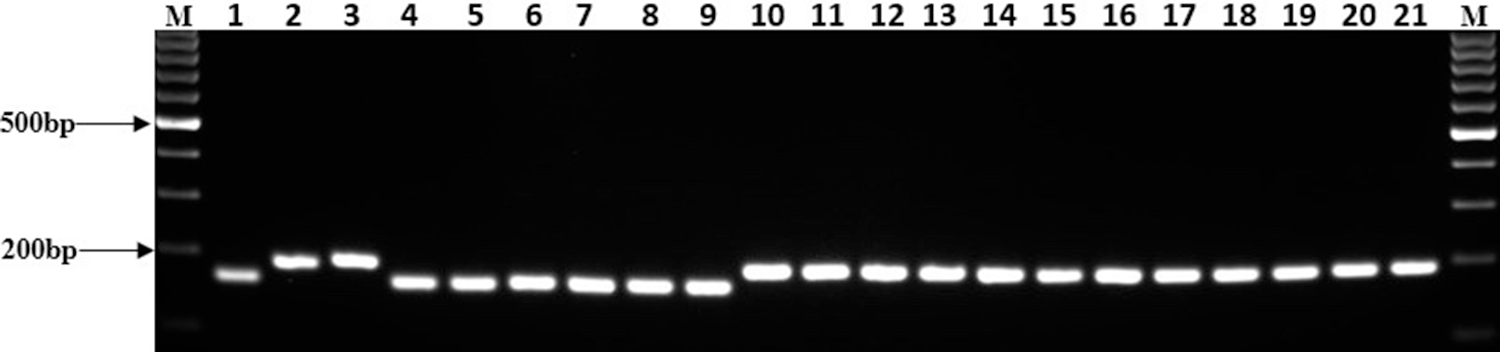
The validated species-specific markers, MCP4, was employed to authenticate true nutmeg (M. fragrans) rootstock from wild Myristica species used in commercial nutmeg grafts. Rootstock bark samples from six nutmeg grafts at the seedling stage (RSB1–RSB6), obtained from a commercial nursery in Kozhikode, Kerala, consistently exhibited a 164 bp amplicon with the MCP4 marker (Fig. 4). This amplicon size, characteristic of M. fragrans, confirms that M. fragrans was used as the rootstock in these grafts. Rootstock bark samples (RSB7–RSB18) from mature nutmeg trees (>20 years old) collected from commercial plantations in Thrissur and Ponkunnam, Kerala, consistently produced a 189 bp amplicon with the MCP4 marker. These amplicon sizes are diagnostic for wild Myristica sp., indicating that M. malabarica, considering its wide distribution and easy availability compared to other wild Myristica species, was used as the rootstock in all these mature grafts. All four mature grafts (RSB7–RSB10) from the Thrissur plantation, utilizing wild Myristica sp. rootstock, demonstrated long-term graft compatibility (Table 4). In the Ponkunnam plantation, four mature grafts (RSB11–RSB14) with wild Myristica sp. rootstock exhibited long-term graft compatibility, while four other mature grafts (RSB15-RSB18) with wild Myristica sp. rootstock displayed graft incompatibility. This observation indicates that while wild Myristica sp. is used as a rootstock, other factors, potentially including specific wild Myristica sp. genotypes or environmental conditions, may influence graft compatibility.
Rootstock authentication using cpDNA marker MCP 4; M: 100 bp ladder, 1. M. fragrans cultivar IISR Viswasree; 2. M. malabarica (Col. No. 1); 3. M. malabarica (Col. No. 6); 4. RSB 1; 5. RSB 2; 6. RSB 3; 7. RSB 4; 8: RSB 5; 9. RSB 6; 10. RSB 7; 11. RSB 8; 12. RSB 9; 13. RSB 10; 14. RSB 11; 15. RSB 12; 16. RSB 13; 17. RSB 14; 18. RSB 15; 19. RSB 16; 20. RSB 17; 21. RSB 18.

Figure 4 Long description
The image shows a gel electrophoresis result with 21 lanes labeled from 1 to 21, flanked by marker lanes labeled 'M' on both ends. The markers indicate bands at 500 base pairs and 200 base pairs. Each lane displays distinct DNA bands, with most samples showing bands near the 200 base pair marker. The bands are consistent across the lanes, suggesting similar DNA fragment sizes for the samples tested.
Results of the rootstock species identification and long-term graft compatibility analysis

Table 4 Long description
The table analyzes rootstock species identification and long-term graft compatibility. Samples RSB1 to RSB6 are identified as M. fragrans at the seedling stage with a diagnostic marker MCP4 of 164 bp. Samples RSB7 to RSB14 are compatible Wild Myristica sp. with a marker size of 189 bp. Samples RSB15 to RSB18 are incompatible Wild Myristica sp., also with a marker size of 189 bp. Samples RSB19 to RSB42 are at the seedling stage, identified as Wild Myristica sp., with a marker size of 189 bp. The data suggests that Wild Myristica sp. has varying compatibility, while M. fragrans is consistently at the seedling stage.
Validation of the MCP4 marker using an independent population of 24 rootstock samples (RSB19–RSB42) collected from commercial nurseries in Maharashtra yielded consistent and unambiguous results. All Maharashtra rootstock samples produced a single amplicon of 189 bp at the MCP4 locus (Table 4; Supplementary Figure S3). This allele corresponds to wild Myristica species and is clearly distinct from the 164 bp allele diagnostic of M. fragrans. Notably, none of the Maharashtra nursery samples exhibited the M. fragrans-specific 164 bp allele, indicating exclusive use of wild Myristica species as rootstocks in the surveyed nurseries.
Discussion
The sustainability of commercial nutmeg (M. fragrans) cultivation, particularly in India, is critically threatened by late-phase graft incompatibility – an issue rooted in the unreliable use of wild Myristica species as rootstocks. Addressing this critical economic risk requires definitive rootstock identification at the nursery stage. Our study provides a decisive solution by developing and validating a set of highly specific, cpDNA-based SLP markers. The central novelty of this work lies in creating a unique molecular signature for the entire cultivated Indian M. fragrans germplasm, enabling its unambiguous differentiation from common wild species such as M. malabarica, M. beddomei, M. magnifica and M. andamanica. Such a targeted authentication study has not been previously reported in the literature, which primarily focuses on general genetic diversity using less robust markers. Unlike previous genotyping efforts in Myristica that relied on non-reproducible random markers (RAPD, ISSR) (Sheeja et al. Reference Sheeja, Sabeesh, Shabna, Shalini and Krishnamoorthy2013; Nikam et al. Reference Nikam, Ingale, Gokhale and Lajurkar2016), or universal cpDNA barcodes lacking sufficient discriminatory power (Swetha et al. Reference Swetha, Parvathy, Sheeja and Sasikumar2017), our methodology represents a significant technical advance. We utilized comparative chloroplast genomics to pinpoint specific mutation hotspots, yielding markers (notably MCP4) that exhibit clear, diagnostic amplicon size differences that are easily resolved on an agarose gel. This targeted strategy provides a low-cost, rapid and field-compatible solution for distinguishing M. fragrans from all relevant congeners, even utilizing the low-quality DNA often extracted from bark tissue in practical field settings. This breakthrough elevates rootstock authentication from a morphological gamble to a reliable molecular certainty.
Our in silico analyses revealed 25 InDel loci, predominantly located in IGS regions, consistent with the relaxed selection pressures operating in non-coding cpDNA. Although less frequent, InDels were also detected in coding regions such as accD and rpl22, raising the possibility of functional relevance that merits further exploration. The co-occurrence of InDels with SSRs in 11 regions highlights the complex mutational dynamics shaping chloroplast genomes. While SSRs were abundant and diverse across Myristica species, the limited length variation (<3 bp) often constrains their resolution on agarose gels. This reinforces the practical value of InDel-based markers, or combined InDel–SSR assays, which offer clear, easily scorable alleles, for cost-effective genotyping in nursery and field contexts. Nevertheless, higher-resolution techniques such as capillary electrophoresis or fluorescence-labelled primer analysis could further exploit the cpSSR diversity revealed here, as reported by Huang et al. (Reference Huang, Sun, Jin, Gao, Hu, Gao, Yang, Zhu, El-Kassaby and Mao2018) in Cupressaceae species.
Eight cpDNA-based SLP markers designed from polymorphic regions were validated, of which MCP1 and MCP4 demonstrated the strongest discriminatory power. The MCP1 marker perfectly separated M. fragrans (150 bp) from M. malabarica (155 bp) and M. andamanica (160 bp), demonstrating its utility for the initial rapid screening of rootstock materials. The study identified a species-specific diagnostic allele for M. andamanica, an endemic and vulnerable species of the Andaman & Nicobar Islands (Waman and Bohra Reference Waman and Bohra2020). The availability of such a marker has immediate conservation relevance, allowing unambiguous identification in germplasm collections, restoration programs and ecological surveys where morphological traits alone are insufficient for accurate species delimitation. Such molecular diagnostics contribute directly to safeguarding this IUCN red-listed species and support evidence-based conservation strategies. The InDel marker MCP4, targeting the ycf4_cemA IGS region, demonstrated species-specific amplification for M. fragrans. All 22 M. fragrans accessions consistently produced a unique 164 bp amplicon, characterized by a distinct 25 bp deletion absent in all other Myristica species analyzed. This marker serves as a reliable molecular signature for Indian cultivated nutmeg. In addition to being a practical method for identifying rootstock species in grafted nutmeg plants, this specific molecular signature offers a robust tool for the authentication of cultivated nutmeg in commercial products, ensuring integrity and traceability, and enabling differentiation from morphologically similar species like M. magnifica, M. andamanica and M. beddomei (Fig. 5). This single-locus assay provides a simple, cost-effective method for rootstock authentication and cultivar integrity testing using standard PCR and agarose electrophoresis. Such markers also hold value in germplasm conservation and seed certification programs, ensuring that planting materials remain true-to-type and traceable. The consistent presence of distinct alleles across species in the trnQ-UUG_psbK (MCP1), ycf4_cemA (MCP4) and trnR-ACG_rrn5S (MCP7) IGSs underscore the evolutionary divergence within these regions. Although comparative in silico analysis of complete chloroplast genomes identified MCP5, MCP6 and MCP8 as hypervariable regions, these loci were monomorphic across all Indian Myristica accessions analyzed in the present study. The length polymorphisms defining these markers arise from insertions or deletions specific to non-Indian Myristica species, relative to M. fragrans, including M. yunnanensis, M. fatua and M. teysmannii. As these taxa are not employed as rootstocks in Indian nutmeg cultivation systems, MCP5, MCP6 and MCP8 lack practical utility for rootstock authentication within the current geographical and biological context. Nevertheless, these markers may prove valuable in future studies involving expanded taxonomic sampling across Southeast Asia and China, or for broader evolutionary investigations within the genus. For the targeted purpose of rootstock authentication in Indian nutmeg production, however, these markers are not recommended for inclusion in the diagnostic marker toolkit.
Authentication of commercial nutmeg (Myristica fragrans) using the species-specific InDel marker MCP4. (A) M. fragrans; (B) M. andamanica; (C) M. beddomei; (D) MCP4 gel profile revealing a diagnostic 25-bp deletion that clearly distinguishes M. fragrans from the wild Myristica species.

Figure 5 Long description
Image A shows a hand holding a nutmeg fruit cut in half, revealing the seed and surrounding aril. Image B displays another hand holding a nutmeg fruit with the seed and aril visible. Image C shows several nutmeg seeds with arils placed on a leaf. Image D presents a gel electrophoresis profile with bands labeled for M. andamanica, M. andamanica, M. beddomei and M. fragrans, indicating a 200 base pair marker.
Beyond species-level authentication, the developed markers revealed intraspecific variation within Indian M. fragrans cultivars. Three markers (MCP2, MCP3 and MCP7) partitioned cultivars into two genetic clusters, with elite lines such as IISR-Vishwasree, Konkan Sanyukta, Yellow Mace, Konkan Shrimanti and KAU-Kochukudi forming a distinct subgroup. This finding indicates substantial genetic diversity within M. fragrans, which is in agreement with previous studies based on morphological traits (Vikram and Raj Reference Vikram and Raj2025) or random DNA markers like RAPD and ISSR (Krishnan et al. Reference Krishnan, John, Cyriac and Sible2017, Reference Krishnan, John and Varghese2019). Additionally, this structuring implies the presence of multiple maternal lineages, possibly reflecting independent introductions of nutmeg into India via historical trade routes (Miniraj and Nybe Reference Miniraj and Nybe2019) or divergence under domestication. Recognition of such distinct genetic pools has practical significance: crossing between divergent lineages can enhance heterosis, broaden the genetic base and accelerate targeted breeding efforts.
The phylogenetic resolution achieved using cpDNA markers provides new insights into evolutionary relationships within the genus. M. fragrans accessions largely clustered into a conserved maternal lineage, with a subgroup of cultivars forming a separate clade, possibly reflecting independent domestication or strong selection for horticultural traits. Wild species exhibited deeper divergences, with M. andamanica forming a distinct lineage, consistent with its morphological and biogeographical distinctiveness. Interestingly, M. malabarica resolved into two subclades, one of which corresponded to accessions showing early branching phenotypes, suggesting a genetic basis for this trait. The close clustering of the three Western Ghats species – M. malabarica, M. magnifica and M. beddomei – supports their close evolutionary relationship and potential shared ancestry.
Field validation confirmed the practical utility of the developed markers. While nursery seedlings consistently showed M. fragrans as rootstock, mature plantations often revealed wild Myristica species, which explains the late-phase graft incompatibility reported by farmers. Interestingly, some wild Myristica rootstocks supported long-term compatibility, suggesting genetic heterogeneity within the species. This finding is consistent with our field survey, where a small proportion of plants (<25%) grafted on wild Myristica sp. shows complete graft-compatibility, but the remaining grafts show varying levels of incompatibility (Fig. 1). This small percentage of successful grafts is often deceiving for farmers, as they face replanting almost three-quarters (3/4th) of the plantation by 15 years after planting if wild Myristica sp. are used as rootstock. This underlines the urgent need for marker-assisted screening of rootstocks in nursery operations, ensuring growers receive compatible planting material and are protected from hidden long-term economic losses. This field application is novel, directly addressing the long-standing problem that growers are often unaware of the rootstock origin, a vulnerability previously highlighted by Farhana et al. (Reference Farhana, Vikram, Anitha and Mini Raj2024).
The inclusion of an additional 24 rootstock samples from Maharashtra substantially strengthens the diagnostic confidence and practical relevance of the MCP4 marker. The consistent detection of the 189 bp wild Myristica allele in all Maharashtra nursery samples demonstrates that MCP4 performs reliably across distinct agro-climatic regions and independent propagation systems. The absence of the M. fragrans-specific 164 bp allele in these samples indicates that, similar to older plantations in Kerala, wild Myristica species continue to be widely used as rootstocks in commercial nurseries outside the state. This finding highlights that the rootstock misidentification problem is not region-specific but widespread across Indian nutmeg cultivation systems.
In summary, this research delivers the first cpDNA-based SLP markers for Myristica, providing a reliable, low-cost system for rootstock authentication, cultivar differentiation and phylogenetic analysis. By addressing both the economic challenges of graft incompatibility and the ecological imperative of conserving wild congeners, this work makes a dual contribution to sustainable nutmeg cultivation and biodiversity management, particularly in resource-limited settings.
Supplementary material
The supplementary material for this article can be found at https://doi.org/10.1017/S1479262126100501.
Acknowledgements
Authors acknowledge the support given by The Director, ICAR-Indian Institute of Spices Research (ICAR-IISR), Kozhikode, Kerala, India.