INTRODUCTION
As one of the agricultural origination centers of the world (Vavilov Reference Vavilov1951; Diamond Reference Diamond2002), the first domesticated millet was found over 10,000 yr ago in northern China (Lu et al. Reference Lu, Zhang, Liu, Wu, Li, Zhou, Ye, Zhang, Zhang, Yang, Shen, Xu and Li2009; Yang et al. Reference Yang, Wan, Perry, Lu, Wang, Zhao, Li, Xie, Yu, Cui, Wang, Li and Ge2012) and a widespread millet agriculture developed in the following millennia (e.g. Bettinger et al. Reference Bettinger, Barton, Richerson, Boyd, Wang and Choi2007, Reference Bettinger, Barton and Morgan2010; Crawford Reference Crawford2009; Jones and Liu Reference Jones and Liu2009; Liu Reference Liu2015). Other than plants, livestock as well as other animals were another important aspect of the life of the ancient culture. Some animals were raised as meat and other byproducts, including pigs (Sus scrofa domestica), sheep (Ovis aries), goats (Capra aegagrus), and cattle (Bos taurus), while others were used for transportation (horse, Equus ferus) or for hunting (dog, Canis lupus, and cat, Felis catus) (Diamond Reference Diamond1999). It is likely that pig domestication occurred during the early Holocene independently in different parts of the world (Larson et al. Reference Larson, Dobney, Albarella, Fang, Matisoo-Smith, Robins, Lowden, Finlayson, Brand, Willerslev, Rowley-Conwy, Andersson and Cooper2005), with China as one of the centers (Yuan and Flad Reference Yuan and Flad2002; Flad et al. Reference Flad, Yuan and Li2007; Yuan Reference Yuan2010). However, cattle domestication in China can only be traced back to ~4500 years ago (Yuan Reference Yuan2010). Chinese scholars (Su and Yin Reference Su and Yin1981; Chang Reference Chang1986; Yan Reference Yan1992) agree that Neolithic north China consisted of several agricultural culture sequences that included the Hongshan culture (~6000–5000 cal yr BP) colonizing the Liao River, the Dawenkou culture (~6300–4500 cal yr BP) in the lower Yellow River, the Yangshao culture (~6800–4900 cal yr BP) in the middle Yellow River, and the Majiayao culture (~5200–4800 cal yr BP) in the upper reaches of the Yellow River, each with prominent achievements. The peak of the cultural sequence was reached during the Yangshao culture in the mid-Holocene in central China (Yan Reference Yan2009).
Previous studies have revealed that the Yangshao people were sedentary agriculturalists who lived in villages with specific structure patterns and had significant gender divisions of labor. Yangshao inhabitants grew millet and raised pigs as primary food sources, but also hunted game, fished, and gathered wild food as supplementary sources (Institute of Archaeology, Chinese Academy of Social Sciences 2010). Stable isotopic results verified that a large proportion of their diet came from cultivated plants, primarily millet (Wang Reference Wang2004; Pechenkina et al. Reference Pechenkina, Ambrose, Ma and Benfer2005; Barton et al. Reference Barton, Newsome, Chen, Wang, Guilderson and Bettinger2009; Fu et al. Reference Fu, Jin, Hu, Ma, Pan and Wang2010; Ling et al. Reference Ling, Chen, Xue and Zhao2010; Guo et al. Reference Guo, Hu, Gao, Wang and Richards2011; Hu et al. Reference Hu, Hu, Wang, Wu, Marshall, Chen, Hou and Wang2014).
The Majiayao culture was distributed throughout northwest China in the second half of the Holocene and later branched into several other cultures (Xie Reference Xie2002), the emergence of which overlapped the later phase of Yangshao culture. It is debatable whether the Majiayao culture originated independently in northwest China culturally parallel to the Yangshao culture in central China or developed as a western successor of the latter (Yan Reference Yan1989; An Reference An1999; Xie Reference Xie2002). What is explicit is that the Majiayao culture is primarily known by its exclusively marvelous and numerous painted red ceramics with figure patterns (An Reference An1999). Results from archaeobotanical studies (Jia et al. Reference Jia, Dong, Li, Brunson, Chen, Ma, Wang, An and Zhang2013) indicate that rain-fed millet agriculture was fully developed during the Majiayao culture period. Hu (Reference Hu2015) came to the same conclusion, based on a flotation extraction of seeds at the Majiayao cultural site of Shannashuzha, where millet seeds were found to be the largest proportion of crop remains. Combined with the agriculturally oriented stone tools found at this site, it is believed that the occupants of the Majiayao culture site practiced a millet-based agriculture (Hu Reference Hu2015). Dong et al. (Reference Dong, Wang, Cui, Elston and Chen2013) hypothesized that agriculture played different roles in different regions during the Majiayao period based on the types of tools found. Liu et al. (Reference Liu, Zhang, Feng, Hou, Zhou and Zhang2010) thought the Majiayao was a farming culture dependent on the mercy of a suitable climate. However, no research on Majiayao lifestyle has ever directly taken the use of animal sources into consideration. Did Majiayao people raise pigs and grow millet like their eastern neighboring Yangshao farmers (Wang Reference Wang2004; Guo et al. Reference Guo, Hu, Gao, Wang and Richards2011) or did they pasture animals such as sheep and goats as well as grow crops similar to their higher-elevated Tibetan Plateau shepherd neighbors (d’Alpoim Guedes et al. Reference d’Alpoim Guedes, Lu, Li, Spengler, Wu and Aldenderfer2014; Chen et al. Reference Chen, Dong, Zhang, Liu, Jia, An, Ma, Xie, Barton, Ren, Zhao, Wu and Jones2015)?
Stable carbon and nitrogen isotopes of bone collagen are indicative of animal diet (DeNiro and Epstein Reference DeNiro and Epstein1978, Reference DeNiro and Epstein1981) and this technology has been widely applied (e.g. Ambrose Reference Ambrose1990; Richards et al. Reference Richards, Pettitt, Trinkaus, Smith, Paunović and Karavanić2000). In addition, isotope information can also reveal social status due to different diet (e.g. White et al. Reference White, Healy and Schwarcz1993; Price et al. Reference Price, Burton, Sharer, Buikstra, Wright, Traxler and Miller2010), explore subsistence strategies (e.g. Wang Reference Wang2004; Bocherens et al. Reference Bocherens, Drucker, Billiou, Patou-Mathis and Vandermeersch2005), unveil migration patterns (e.g. White et al. Reference White, Nelson, Longstaffe, Grupe and Jung2009; Eggers et al. Reference Eggers, Parks, Grupe and Reinhard2011), or differentiate domesticated fauna from wild fauna (e.g. Fornander et al. Reference Fornander, Eriksson and Lidén2008; Hu et al. Reference Hu, Luan, Wang, Wang and Richards2009).
This study examines the faunal dietary distribution at the Majiayao culture site of Shannashuzha, in order to distinguish domesticated animals from wild animals and to analyze the role of animals and animal management practices in people’s lifeways at Shannashuzha using stable isotope analysis.
STUDY AREA
Archaeological Context
Majiayao is the last of the early to middle Neolithic cultures that were widely distributed in Gansu Province and eastern Qinghai Province (Ganqing region), which is geographically located in the valley of the upper Yellow River (Dong et al. Reference Dong, Wang, Cui, Elston and Chen2013). Chronologically, the Majiayao culture can be placed during 5200–4800 cal yr BP, relative to the Dadiwan culture (7800–7350 cal yr BP), the Yangshao culture (6800–4900 cal yr BP), the Qijia culture (4300–3500 cal yr BP), and the Xindian and Siwa cultures (3600–2500 cal yr BP) (Shui Reference Shui2001; Xie Reference Xie2002).
Geographical Setting
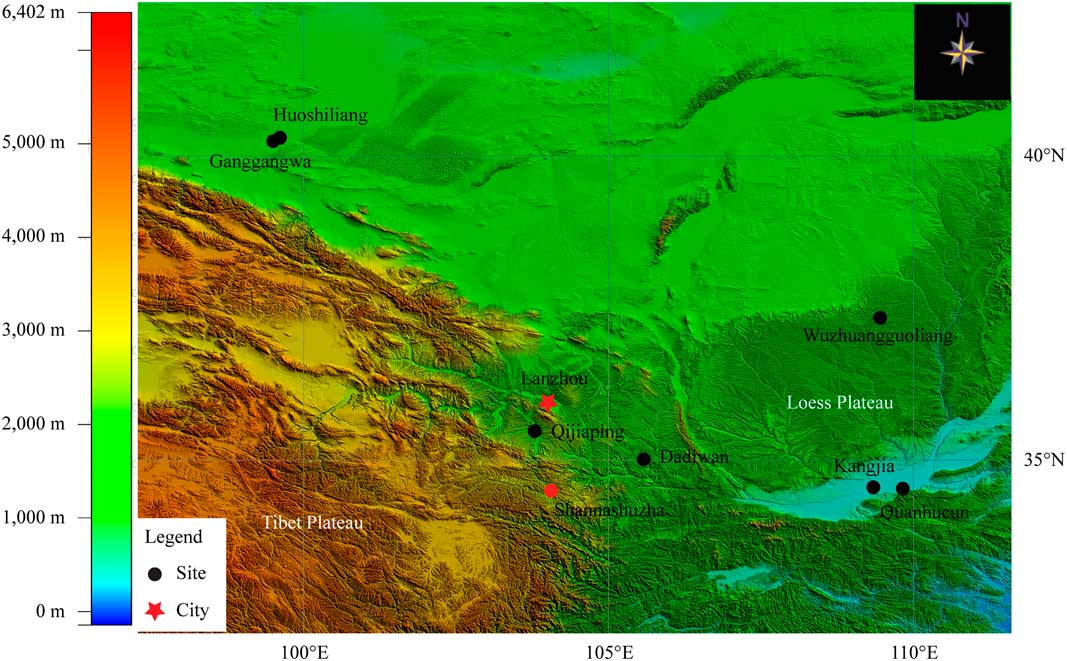
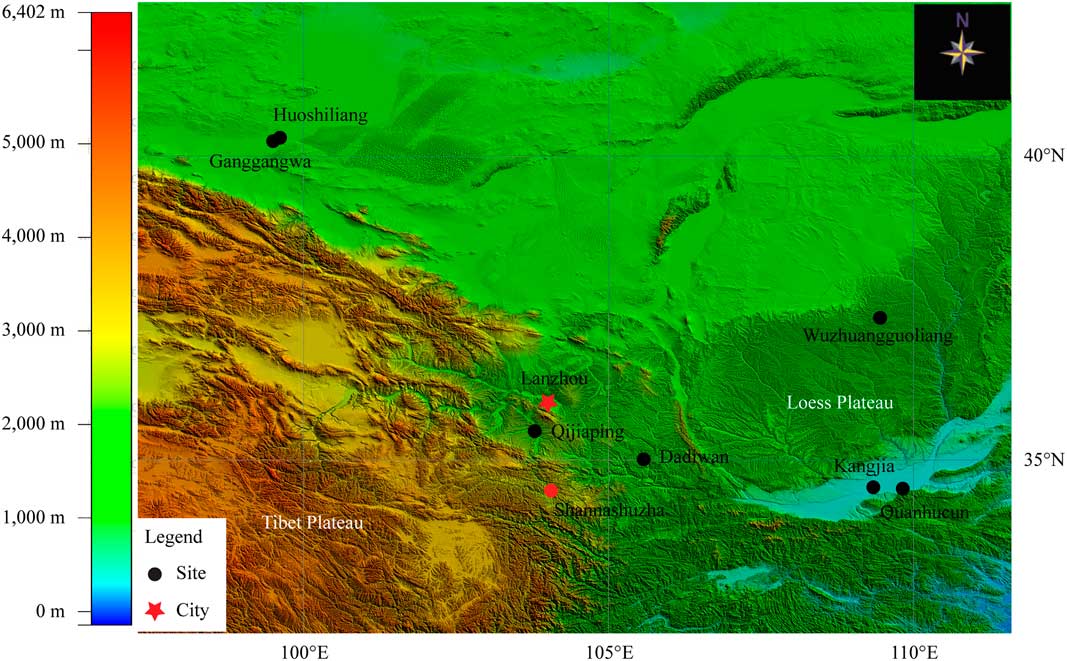
The material for this study derives from a residential site of Shannashuzha (34°29′34.06″N, 104°4′24.54″E), which is located on the margin of the Tibetan Plateau in Minxian County, Gansu Province (Figure 1). The site is close to the river bank of the Tao, which is a tributary of the Yellow River, and is surrounded by high mountains to the northeast and southwest, with an annual temperature of 5.7°C and annual precipitation of 597 mm. Because of the high altitude of 2323 m (asl), the site is mainly dominated by a moist and cold climate year-round.
Study area and sites studied. At Huoshiliang site, two pigs, six Cervidae, two cattle as well as two Caprinae samples were tested (Atahan et al. Reference Atahan, Dodson, Li, Zhou, Hu, Bertuch and Sun2011); at Ganggangwa site, two pigs, two Cervidae, four cattle and two Caprinae bones were tested (Atahan et al. Reference Atahan, Dodson, Li, Zhou, Hu, Bertuch and Sun2011); at Qijiaping site, nine pigs and six cattle samples were tested (Ma et al. Reference Ma, Dong, Liu, Lightfoot, Chen, Wang, Li and Jones2014); at Dadiwan site, 32 pigs, seven Cervidae and two cattle bones were tested (Barton et al. Reference Barton, Newsome, Chen, Wang, Guilderson and Bettinger2009); at Wuzhuangguoliang site, five pigs and three hares bones were tested (Guan et al. Reference Guan, Hu, Hu, Sun, Qin and Wang2008); at Kangjia site, three pigs, one Cervidae, two cattle and one Caprinae samples were tested (Pechenkina et al. Reference Pechenkina, Ambrose, Ma and Benfer2005); at Quanhucun site, 10 pigs, one hare and six cattle bones were tested (Hu et al. Reference Hu, Hu, Wang, Wu, Marshall, Chen, Hou and Wang2014).
Material
The main cultural type of this site is the Majiayao culture, with mid- to late Yangshao cultural relic units sporadically found. All the material here listed was collected from Majiayao cultural relic units. The Shannashuzha site is rich in faunal remains, including domesticated animals, which are mainly pigs and dogs, as well as many wild species including gazelles, monkeys, and bears. The faunal remains for this study were collected from pits and cultural strata during the excavation in 2012 (unpublished results).
Conifers and herbaceous plants compose the main natural vegetation coverage here. Based on the charcoal analysis results of this site, more humid-oriented plants such as bamboo were not unusual back to the Majiayao period. Generally, more diversified vegetation should be expected during the time of occupation (unpublished results).
METHODS
Sample Selection
Thirty animal bones in total were collected for carbon and nitrogen isotope analyses. Of these bones, 24 specimens were classified into 10 species that included rabbits (Lepus capensis), bamboo rats (Rhizomys pruinosus), Siberian roe deer (Capreolus pygargus), barking deer (Muntiacus muntjak), red deer (Cervus elaphus), sika deer (Cervus nippon), cattle (Bos taurus), badgers (Meles meles), pigs (Sus scrofa domestica), and Chinese goral (Naemorhedus goral). Four samples were identified as Cervidae, and two herbivore animal samples remained unidentified. Of the faunal samples analyzed, only badgers and pigs are omnivores, with the others all herbivores.
Extraction of Bone Collagen
Bone collagen extraction followed the procedure described herein. All the visible contaminants were mechanically removed from both inner and outer bone surfaces until only fresh surfaces were exposed using an electric Dremel® grinder. Approximately 2 g of dense bone was selected from cut sections and washed thoroughly with deionized water in an ultrasonic bath. Bone samples were then oven-dried to a constant weight at 70°C. After drying, the weights of the samples were recorded utilizing an EL204-IC analytical balance. Bone samples were subsequently demineralized by soaking them in a 0.5N solution of hydrochloric acid (HCl) at 4°C and refreshing the solution every 2 days for about 3 weeks, until the bone samples were soft and no bubbles were produced. After demineralization, the resulting sample material was washed repeatedly with deionized water to neutrality. The samples were then immersed in a 0.125N solution of sodium hydroxide (NaOH) at 4°C for 20 hr to remove remaining lipids and other acids. After lipid removal, samples were washed with deionized water to neutrality and dissolved in a 0.001N HCl solution at 70°C in the oven for 2 days to gelatinize. The samples were filtered with a filter paper and deionized water. The gelatinized collagen samples were lyophilized using a Labconco* FreeZone lypholizer at –50°C, weighed, and sealed in tin capsules for analysis.
Isotope Analysis
The stable carbon and nitrogen isotope analyses were performed using a continuous-flow isotope ratio mass spectrometer (IRMS), combined with a Conflo interface device, Thermo Finnigan DeltaPlus at the Key Laboratory of Western China’s Environmental Systems, Ministry of Education (MOE), Lanzhou University. An elemental analyzer (EA), vario EL Cube (State Key Laboratory of Applied Organic Chemistry, Lanzhou University) was used to determine the atomic C/N ratios. A C/N ratio between 2.9 and 3.6 indicates retention of in vivo isotopic signature of the collagen sample (Ambrose Reference Ambrose1990).
The isotopic results are expressed as delta (δ) values in parts per mil (‰) notation, δ13C=1000× [(Rsample/Rstandard) –1], where Rsample and Rstandard are the 13C/12C ratios of the sample and standard, respectively, and the same for δ15N. For carbon, the result is relative to the international VPDB (Vienna PeeDee Belemnite limestone) standard, while for nitrogen the standard is AIR. The long-term standard deviation of the machine is ±0.2‰ for both δ13C and δ15N. Reference standards used for δ13C and δ15N calibrations were GLY (δ13C=–33.3‰, δ15N=10‰), PUGE (δ13C=–12.6‰, δ15N=5.6‰), and collagen (δ13C=–9‰, δ15N=7.6‰).
AMS Dating
Two bamboo samples were selected for accelerators mass spectrometry (AMS) radiocarbon dating (Table 1) as bamboo has a relatively short lifetime. The pretreatment of the samples followed the procedure of Manning and Reid (Reference Manning and Reid1977) and Vogel et al. (Reference Vogel, Southon, Nelson and Brown1984) at the Key Laboratory of Western China’s Environmental Systems, Ministry of Education (MOE), Lanzhou University, and the 14C analysis was conducted at the Laboratory of Quaternary Geology and Archaeological Chronology of Peking University, Beijing. The data were calibrated using the program CALIB v 7.02 and the IntCal13 curve (Stuiver and Reimer Reference Stuiver and Reimer1993; Reimer et al. Reference Reimer, Bard, Bayliss, Beck, Blackwell, Bronk Ramsey, Buck, Cheng, Edwards, Friedrich, Grootes, Guilderson, Haflidason, Hajdas, Hatté, Heaton, Hoffmann, Hogg, Hughen, Kaiser, Kromer, Manning, Niu, Reimer, Richards, Scott, Southon, Staff, Turney and van der Plicht2013).
AMS dates of Shannashuzha.

RESULTS
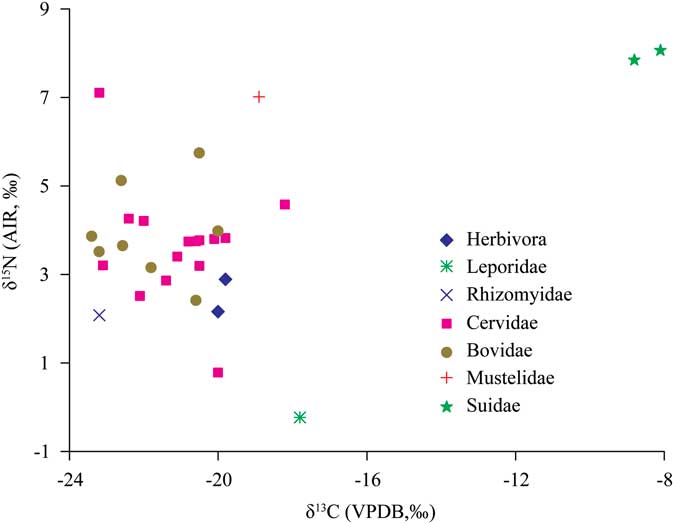
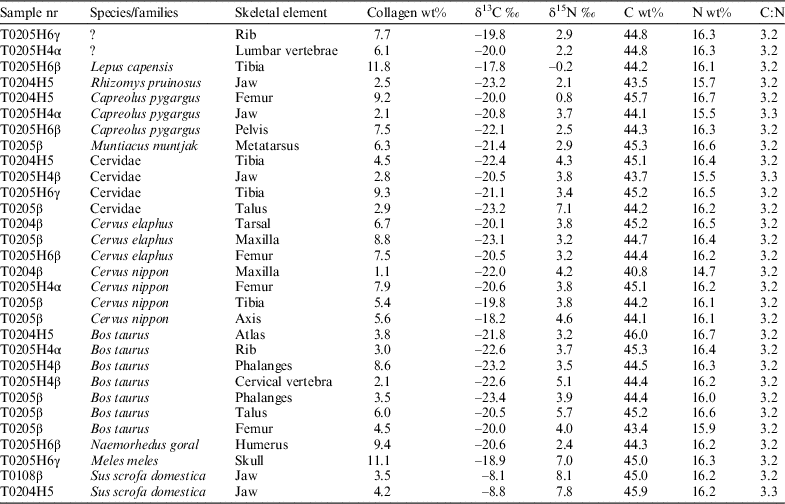
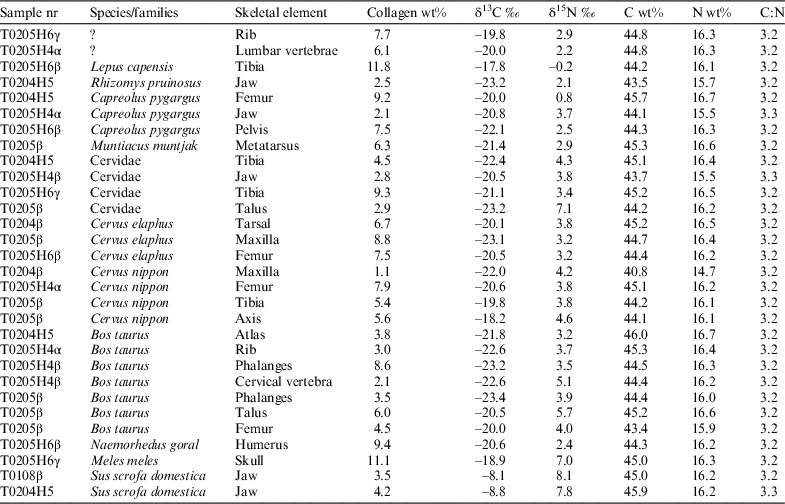
Isotopic results, collagen yields, C/N ratios, and other detailed information on the samples are shown in Table 2 and Figure 2. As can be seen in Table 2, the atomic C/N ratios of 30 collagen samples ranged from 3.2 to 3.3, with collagen yields ranging from 1.1% to 11.8%, indicating that all samples could be characterized as unaltered collagen (Ambrose Reference Ambrose1990). The mean δ13C value of the 27 herbivore samples was –21.2±0.3‰ with a range from –17.8 to –23.4‰, indicating a mainly C3-based diet; we discuss the 13C-enriched Lepus capensis sample later in the text. The mean δ15N value for herbivores was 3.5 ± 0.3‰, with a range of –0.2 to 7.1‰, suggesting a low protein diet. The omnivore samples were isotopically distinguished from the herbivore ones, having a mean δ15N value of 7.6±0.3‰ (n=3), ranging from 7 to 8.1‰, indicating some proportion of an enriched protein-food source intake. The δ13C values are distinct from the herbivores; the two pigs had δ13C values of –8.1‰ and –8.8‰, respectively, suggesting a diet with a C4 food source component. The one badger sample had a δ13C value of –18.9‰, suggesting a C3-based diet.
Isotopic results of faunal remains at Shannashuzha
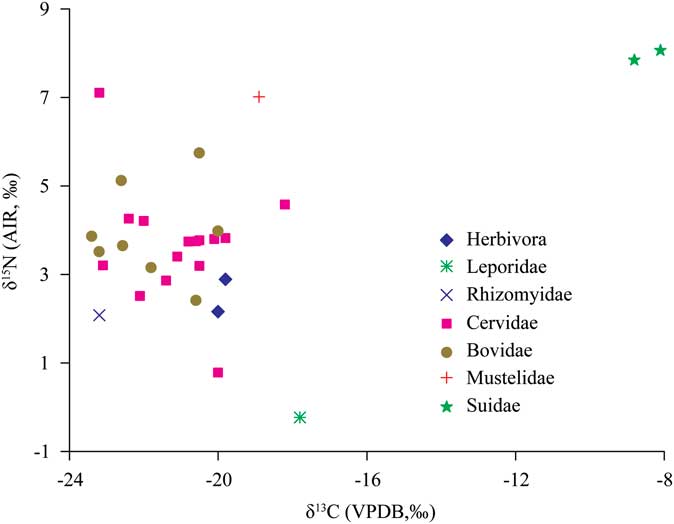
Bone collagen stable carbon and nitrogen isotopic results of Shannashuzha.
DISCUSSION
Herbivores
Cattle
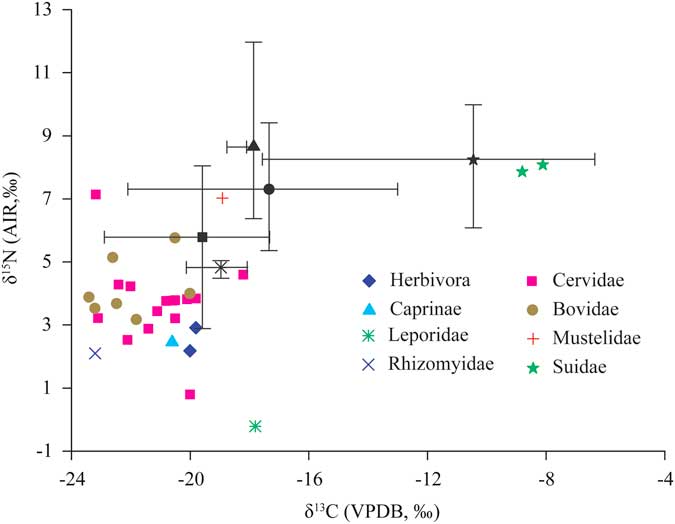
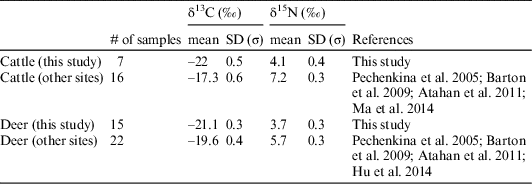
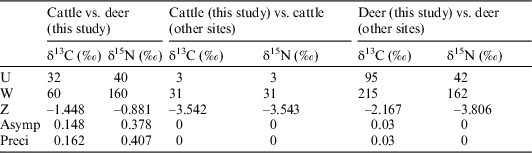
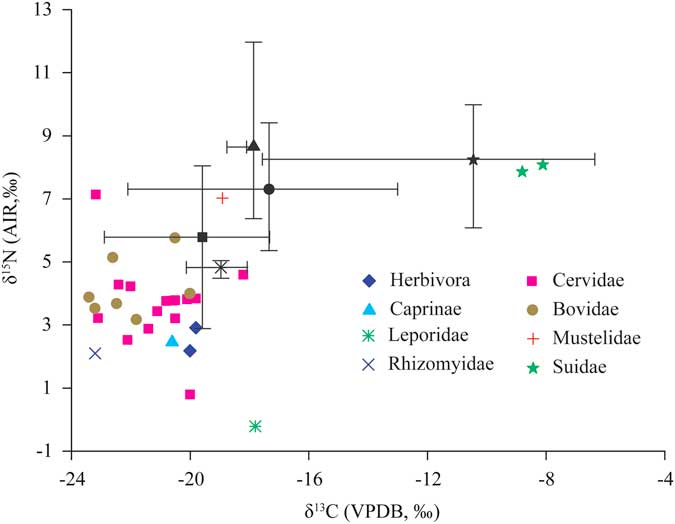
In our study, the cattle have a mean δ13C value of –22.0±0.5‰ (n=7), ranging from –23.4 to –20.0‰, slightly depleted compared to deer whose mean δ13C value is –21.1±0.3‰ (n=15). The cattle have mean δ15N value of 4.1±0.4‰ (n=7) with a range from 3.2 to 5.7‰. Deer have a mean δ15N value of 3.7±0.3‰ (n=15) ranging from 3.4 to 7.1‰, although these variations in δ15N are statistically insignificant (nonparametric Mann-Whitney U test, Tables 3, 4), making cattle indistinguishable from deer merely using isotope results. Compared to the older Bovidae samples from Kangjia (Yangshao culture) (Pechenkina et al. Reference Pechenkina, Ambrose, Ma and Benfer2005), Dadiwan (Dadiwan culture phase 2) (Barton et al. Reference Barton, Newsome, Chen, Wang, Guilderson and Bettinger2009) and later Huoshiliang, Ganggangwa (Bronze Age) (Atahan et al. Reference Atahan, Dodson, Li, Zhou, Hu, Bertuch and Sun2011), and Qijiaping (Qijia culture) (Ma et al. Reference Ma, Dong, Liu, Lightfoot, Chen, Wang, Li and Jones2014) sites from this large area, the cattle at Shannashuzha have mean δ13C and δ15N values that are depleted by 4.7‰ and 3.1‰, respectively (nonparametric Mann-Whitney U test, Figures 1, 3; Table 3, 4). Taking a closer look, two Kangjia samples represent the most 13C-enriched cattle (–15.1‰ and –14.2‰, respectively). At least one of them was identified to be Bubalus, which explained the enrichment of 13C signal (Pechenkina et al. Reference Pechenkina, Ambrose, Ma and Benfer2005). Of the remaining 14, only one from Qijiaping site was interpreted as a C3-C4-mixed source (Ma et al. Reference Ma, Dong, Liu, Lightfoot, Chen, Wang, Li and Jones2014). Further proof of grazing in natural pastures can be suggested since cattle from Shannashuzha have a both 13C- and 15N-depleted diet similar to the range of the Chinese goral’s (Table 2).
Comparison between the isotopic distribution of Shannashuzha and results from other nearby sites (Pechenkina et al. Reference Pechenkina, Ambrose, Ma and Benfer2005; Guan et al. Reference Guan, Hu, Hu, Sun, Qin and Wang2008; Barton et al. Reference Barton, Newsome, Chen, Wang, Guilderson and Bettinger2009; Atahan et al. Reference Atahan, Dodson, Li, Zhou, Hu, Bertuch and Sun2011; Hu et al. Reference Hu, Hu, Wang, Wu, Marshall, Chen, Hou and Wang2014; Ma et al. Reference Ma, Dong, Liu, Lightfoot, Chen, Wang, Li and Jones2014). Colored symbols represent the samples from Shannashuzha and corresponding black ones are the comparable results from other sites.
Statistical results of stable isotopes for cattle and deer from both Shannashuzha and the other sites.

Mann-Whitney U test results of different groups of the samples.

Cattle can provide meat, milk, and animal skins, as well as being used as transportation and cultivation tools in the agricultural societies. Unlike sheep and goats, cattle husbandry also requires that there is a plentiful water supply, and apparently, the Shannashuzha site is an ideal place for cattle to live. Unfortunately, manual intervention on the basis of isotopic results does not indicate if they are domesticated or not.
Deer
Different from cattle, deer are browsers with a tendency to choose food that is easy to digest, such as tender leaves and fresh grass. Three bone segments identified as Siberian roe deer, one barking deer, three red deer, four sika deer, and four samples only identified to be deer make Cervidae the largest family in the faunal assemblage at Shannashuzha.
Different variety of deer share similar isotopic compositions and have δ13C values ranging from –23.2‰ to –18.2‰, δ15N values distributed from 0.8‰ to 7.1‰, indicating a C3-based food consumption (Figure 2). Compared to other contemporary samples from spatially neighboring sites (Pechenkina et al. Reference Pechenkina, Ambrose, Ma and Benfer2005; Barton et al. Reference Barton, Newsome, Chen, Wang, Guilderson and Bettinger2009; Atahan et al. Reference Atahan, Dodson, Li, Zhou, Hu, Bertuch and Sun2011; Hu et al. Reference Hu, Hu, Wang, Wu, Marshall, Chen, Hou and Wang2014), deer from Shannashuzha have significantly lower δ13C and δ15N values (nonparametric Mann-Whitney U test, Tables 3, 4; Figure 3).
Rabbit and Bamboo Rat
The sample of Lepus capensis has an extremely depleted δ15N value of –0.2‰, much lower than the mean of its other herbivore counterparts [3.6±0.2‰ (1σ, n=26)], as well as that of Leporinae remains found at other contemporary neighboring sites (Guan et al. Reference Guan, Hu, Hu, Sun, Qin and Wang2008; Hu et al. Reference Hu, Hu, Wang, Wu, Marshall, Chen, Hou and Wang2014; Figure 3), even 2.3‰ lower than that of its rodent relative bamboo rat’s (Table 2, Figure 2), illustrating that 15N-depleted plants composed most of its food. The value of –17.8‰ represents the most enriched 13C signature of the herbivore samples, which have a mean δ13C value of –21.2±0.3‰ (1σ, n=27) that is significantly different from the –23.2‰ of bamboo rat. Millet was pervasively found among all the units of this site and believed to be the staple of this community (Hu Reference Hu2015); the C4 plant has a mean δ13C value of –10‰ (An et al. Reference An, Dong, Chen, Li, Shi, Wang, Zhang and Zhao2015). The isotopic composition suggests a high possibility that the Lepus capensis ate some millet related food, which provides a hint of the near-site activity of this hare/rabbit.
Omnivores
It is very likely that pigs were domesticated locally in China (Yuan and Flad Reference Yuan and Flad2002; Larson et al. Reference Larson, Dobney, Albarella, Fang, Matisoo-Smith, Robins, Lowden, Finlayson, Brand, Willerslev, Rowley-Conwy, Andersson and Cooper2005; Flad et al. Reference Flad, Yuan and Li2007). The presence of pigs at an archaeological site can indicate a sedentary society. The earliest occurrence of domesticated pigs appeared at the nearby Dadiwan site ~7000 yr ago, which indicated the emergence of settled agriculture in this region (Barton et al. Reference Barton, Newsome, Chen, Wang, Guilderson and Bettinger2009). Pigs are omnivores and have a very broad food spectrum, usually as cleansers eating leftovers of humans, making them isotopically similar to human beings, but pigs can also consume grass, insects, and other animals. Badgers are also omnivores that consume reptiles and insects, as well as plants.
Two pig samples in this site have similar isotopic compositions (Figure 2; Table 2), and exhibit an explicitly C4-plant based diet with a mean δ13C value of –8±0.1‰, which can be easily discriminated from the other C3-based-food consumers whose mean δ13C value is –21.1±0.3‰ (1σ, n=28). The pigs in this study also have enriched δ15N values (8.0±0.1‰) compared to the herbivores (3.5±0.3‰, 1σ, n=27) indicating consumption of animal protein, assuming a 3–6‰ “trophic effect” between the food source and consumer (Bocherens and Drucker Reference Bocherens and Drucker2003; Hedges and Reynard Reference Hedges and Reynard2007; O’Connell et al. Reference O’Connell, Kneale, Tasevska and Kuhnle2012). Since millet agriculture has long colonized this region by the Majiayao period (Barton et al. Reference Barton, Newsome, Chen, Wang, Guilderson and Bettinger2009; Jia et al. Reference Jia, Dong, Li, Brunson, Chen, Ma, Wang, An and Zhang2013), and millet was also the most common agricultural product at this site (Hu Reference Hu2015), assuming a stable carbon isotope value of –10‰ for millet (An et al. Reference An, Dong, Chen, Li, Shi, Wang, Zhang and Zhao2015), it is reasonable to think that pigs at Shannashuzha were fed human-related food such as leftovers and by-products of millet. The badger at the same site mainly consumed a C3-based diet.
CONCLUSIONS
Based on the stable isotope evidence presented in this study, animal husbandry of pigs was practiced among the Shannashuzha residents. The population at the Shannashuzha site was comprised of farmers, who developed diversified economic strategies, i.e. practiced agriculture with mainly millet as a staple, raised pigs in captivity and fed them mainly with a C4-based diet, likely including human food waste. Isotope values of the Lepus capensis sample suggest that it lived near the site. Residents at Shannashuzha site also captured cattle, deer, goral, badgers, and even bamboo rats as supplementary food sources. They appear to have had two meat sources, including pig domestication and wild animal hunting.
ACKNOWLEDGMENTS
We thank Lele Ren (Lanzhou University) and Dr Geoffrey Smith (MONREPOS Archaeological Research Center and Museum for Human Behavioral Evolution) for help identifying the faunal assemblage. The authors would also want to thank the three anonymous reviewers for their constructive comments. This work was supported by the National Natural Science Foundation of China (41071051) and the Fundamental Research Funds for the Central Universities (lzujbky-2014-256).