


The oceans mirror many of the environmental problems described in the planetary boundaries framework and reported widely in the media, such as overfishing and deep-sea mining (biosphere integrity), plastic islands or microplastics (novel entities), shipping (atmospheric aerosol loading), or dead zones lacking oxygen (biogeochemical flows). Less present in the media is the problem of ocean acidification addressed by the planetary boundary. Like the atmosphere, the oceans are sinks for CO2 produced by the burning of fossil fuels.
CO2 absorption changes the chemistry of the oceans, lowering their pH. The resulting acidification also leads to fewer of the calcium carbonate shells produced by numerous creatures sinking carbon to the ocean floor before they dissolve back into the water. The boundary’s control variable relates to this by describing the ‘carbonate ion concentration in surface seawater’ and, more specifically, the ‘average global surface ocean saturation state with respect to aragonite’ (Richardson et al. Reference Richardson, Steffen and Lucht2023). Aragonite is one of the most abundant forms of calcium carbonate. The boundary is at more than 80 per cent of the pre-industrial aragonite concentration, defined as 3.44. In 2023, the level was 81 per cent, meaning the ocean boundary was, at that time, still one of the few that had not been crossed. Thus, Pelejero et al. (Reference Pelejero, Calvo and Hoegh-Guldberg2010: 332) describe ocean acidification as the ‘“evil twin” of global warming’ – it is a moot question, though, as to which is of the two is more evil. This also means that reducing greenhouse gas emissions will reduce the pressure on ocean acidification.
Acidification of the oceans and declining concentrations of calcium carbonate are becoming a problem for marine life. Many creatures depend on the presence of these calcium compounds in the water to build their shells or skeletons. Lower pH not only erodes the existing structures of these creatures, but they also find less calcium to rebuild them. These include plankton, corals, crustaceans, and molluscs, which are vital to marine biodiversity, marine food chains, and, ultimately, human food security (Rockström et al. Reference Rockström, Steffen and Noone2009). So, the control variable of the ocean boundary is the global average saturation state of calcium carbonate in surface water. The framework sets the preindustrial Holocene base value at 3.44 and the boundary value at 2.75. Since 2009, the actual values have fluctuated between 2.8 and 2.9 (Richardson et al. Reference Richardson, Steffen and Lucht2023). In 2025, the ocean acidification boundary was first recognized as having been crossed (Findlay et al. Reference Findlay, Feely, Jiang, Pelletier and Bednaršek2025).
Both chapters on ocean acidification take the problem structure of the ocean acidification boundary as the starting point of their ethical reflections. Konrad Ott describes it as post-normal, that is, a situation when problem-solving has to cope with uncertain facts, disputed values, high-stakes, and urgent decisions (Funtowicz & Ravetz Reference Funtowicz and Ravetz1993). Ott explores the issue of ocean acidification from an environmental ethics perspective. He discusses different ways of justifying why ocean acidification is an ethical problem and what follows from this. In doing so, he aims to show how well the most common environmental ethical approaches can address the issue. They mostly differ in their scope of the moral community, that is, to whom we have direct moral obligations: to humans only, or also to individual animals, species, or ecosystems? Depending on the answer one gives, the reasons for protecting oceans will change. Ultimately, Ott intends to specify the normative building blocks of deep anthropocentrism as his preferred approach to the issue.
Rachel Haug Fossbakk, too, addresses the issue of decision-making relating to uncertainty and risk perception. She argues that the human response to ocean acidification is inadequate. This is despite the fact that there is already enough knowledge to act. Her hypothesis is that action requires an adequate perception of risk, which many people do not have when it comes to ocean acidification. She concludes by asking who has a responsibility to act, and on what ethical basis. Rachel Haug Fossbakk then advocates an ecocentric perspective by which she understands a situation ‘where humans are part of nature and need to live sustainably as part of it on the same term as other species’.
21.1 Introduction
Around the end of the eighteenth century, with the design of the steam engine by James Watt, the geological age of the Anthropocene started (Crutzen Reference Crutzen, Ehlers and Krafft2006). This has led to unprecedented changes in the natural environment, the most serious of which is climate change. We have tried to change our paths since then though. In fact, more than 50 years have now passed since the 1972 Stockholm Conference (Rockström et al. Reference Rockström, Gupta and Qin2021) – the United Nations Conference on the Human Environment. This was when global leaders for the first time made the environment and the triple planetary crisis of climate, nature, and pollution a focus issue. At that time, in 1972, they warned – and this still holds true today – that ‘Through ignorance or indifference we can do massive and irreversible harm to the earthly environment on which our life and well-being depend’ (United Nations 1973).
Since then, state leaders have created the United Nations Environment Programme (UNEP) entered into force both a climate and biodiversity agreement (United Nations Framework Convention on Climate Change (UNFCCC) and the Convention on Biological Diversity (CBD)) with many iterations; signed the UN 17 Sustainable Development Goals (SDGs) in 2015 with corresponding targets, as part of the realization of Agenda 2030; and in 2022 and 2023, state leaders also signed the Kunming-Montreal Global Biodiversity Framework (GBF) and the Agreement under the United Nations Convention on the Law of the Sea on the conservation and sustainable use of marine biological diversity in areas beyond national jurisdiction (BBNJ). Still, we have continued to saturate Earth’s capacity to support future generations (Intergovernmental Panel on Climate Change 2018). The planet is more polluted than earlier, there are fewer fish in the ocean, the temperature is increasing, methane levels are at their highest in 800,000 years, polar regions are melting, plastics are ubiquitous, and the ocean is more acidic than ever (Barnes & Kaiser Reference Barnes, Kaiser and Safran2009; Hönisch et al. Reference Hönisch, Ridgwell and Schmidt2012; Worm & Branch Reference Worm and Branch2012; MacLeod et al. Reference MacLeod, Arp, Tekman and Jahnke2021; Intergovernmental Panel on Climate Change 2022).
In fact, six of nine planetary boundaries that are needed for humans to be able to develop and thrive for generations to come have been breached already (Richardson et al. Reference Richardson, Steffen and Lucht2023). Then, in 2025, the ocean acidification boundary was crossed (Findlay et al. Reference Findlay, Feely, Jiang, Pelletier and Bednaršek2025). This is a boundary that is also specifically mentioned in the SDGs, with target 3 of SDG14 Life below water specifying the need to ‘Minimize and address the impacts of ocean acidification, including through enhanced scientific cooperation at all levels’. It was in fact the only by-product of climate change and greenhouse gas emission that was singled out to be included under this goal (United Nations Department of Economic and Social Affairs 2022). Still, there is a lack of concrete knowledge of how breaching this boundary will impact either non-human populations or the corresponding human population that depends on these (Buckley et al. Reference Buckley, Pinnegar and Painting2017).
In light of this, the current chapter considers ocean acidification within the planetary boundaries framework and assesses the lack of responses that led to, and may further exacerbate, the breaching of this boundary. We argue that this in part can be explained by the human-centric perspective of global environmental governance, where effective governance is linked to risk perception within a human context. In terms of ocean acidification, we argue that humans still have a low personal risk perception, coupled with a lack of knowledge (or interest) about it, which directly hinders its agenda setting and implementation of effective governance. We conclude with considering whether the increased saliency of biodiversity challenges, as brought to the surface with the signing of the GBF in 2022, can bring more attention to the role of stressors such as ocean acidification on sustainability and the consequences the breach of this planetary boundary can have on not only humans but also non-human populations.
21.2 Ocean Acidification and Planetary Boundaries
Planetary boundaries are related to critical Earth-system processes that jointly define the operating space within which what some call the Anthropocene can be maintained (or the Holocene as it is officially known as). However, findings demonstrate that the current level of resource use must be dramatically reduced if all people are to lead a good life for not only the current, but also for future generations. Still, since the start of multilateral negotiations towards managing humans’ exploitation of nature in Stockholm in 1972, and even within the planetary boundaries framework itself, there is a marked human well-being and growth perspective which effectively hinders its saliency. The SDGs, for example, demonstrate a distinctly human, and not planetary focus, with 12 of its 17 goals being social objectives, and only 4 having an environmental focus and the final one on the process of implementation. They therefore have a focus on pursuit of human development, a good, reserved for humans. However, this may in fact undermine Earth-system processes that frame the planetary boundaries themselves, by causing disturbances to Earth system components to a degree that risks changing global environmental conditions markedly (O’Neill et al. Reference O’Neill, Fanning, Lamb and Steinberger2018). Ocean acidification is driven by climate change and its corresponding pressure indicator of CO2 emissions, which has already breached said boundaries. This in turn is further driven by the land system change boundary, which, if properly managed, could bring global forest covers to high enough levels so that they better complement the ocean as substantial sinks of atmospheric CO2 and bring it back to safe operating space in terms of planetary boundaries.
The interlinkages between land system change, climate change, and ocean acidification demonstrate the interconnectedness of human interventions and resultant impacts on nature. These connections and the corresponding breach of ocean acidification and corresponding gravity and impact on nature and humans alike, however, lack recognition in society. Ocean acidification and its effects have been well documented the last decade, though, within the scientific community especially, with studies ranging from effects on plankton and larvae and economic activities, to the microbial food web and bacterial processes to name some (Burrell et al. Reference Burrell, Maas, Teesdale-Spittle and Law2016; Leo et al. Reference Leo, Kunz and Schmidt2017; Narita & Rehdanz Reference Narita and Rehdanz2017; Alvarez-Fernandez et al. Reference Alvarez-Fernandez, Bach and Taucher2018; Tiller et al. Reference Tiller, Arenas and Galdies2019; Galdies et al. Reference Galdies, Bellerby and Canu2020a, Reference Galdies, Tiller, Martinez Romera, Leal Filho, Azul, Brandli, Lange Salvia and Wall2020b). There has also been ample scientific knowledge reported, proving that the ocean pH is declining at an unprecedented rate compared to the last 300 million years of the Earth’s history (Pearson & Palmer Reference Pearson and Palmer2000; Hönisch et al. Reference Hönisch, Ridgwell and Schmidt2012; Intergovernmental Panel on Climate Change 2022; Richardson et al. Reference Richardson, Steffen and Lucht2023). We also know that this corresponds with the post-industrial revolution increase in anthropogenic CO2 emissions (Gattuso & Hansson Reference Gattuso and Hansson2011; Zeebe & Ridgwell Reference Zeebe, Ridgwell, Gattuso and Hansson2011).
This is because ocean acidification is caused by the uptake of about 30–40 per cent of all carbon dioxide from the atmosphere into the ocean (Doney et al. Reference Doney, Fabry, Feely and Kleypas2009), which, I concur, on its face sounds like a positive. In fact, about one million tonnes of CO2 will enter the ocean per hour today removing it from the atmosphere (Sabine et al. Reference Sabine, Feely and Gruber2004). However, with a continuous increase of CO2 in the atmosphere, this also means an increased amount of it in the ocean, altering ocean chemistry and causing potential disruptions to oceanic biodiversity through making the waters more acidic, 30 per cent more acidic in fact since the Industrial Revolution, and the rate of changes is faster than any time on record with no sign of slowing down (Gattuso & Hansson Reference Gattuso and Hansson2011; Zeebe & Ridgwell Reference Zeebe, Ridgwell, Gattuso and Hansson2011), after having remained constant for millions of years (Pearson & Palmer Reference Pearson and Palmer2000).
The impact of this on biological, biogeochemical, and ecological processes of the oceans, and the consequences of these impacts on not only nature itself, but also human needs, are only partially known, and poorly quantified. Though some organisms are more sensitive to lower pH, others are better able to adapt to it. Some again, even similar species, may compensate the effect of acidification through some internal mechanisms (Tiller et al. Reference Tiller, Arenas and Galdies2019; Galdies et al. Reference Galdies, Tiller, Martinez Romera, Leal Filho, Azul, Brandli, Lange Salvia and Wall2020b). The IPCC, in part B.4.2, also stated with high confidence that ‘The level of ocean acidification due to increasing CO2 concentrations associated with global warming of 1.5°C is projected to amplify the adverse effects of warming, and even further at 2°C, impacting the growth, development, calcification, survival, and thus abundance of a broad range of species, for example, from algae to fish’. In fact, the term ‘Ocean Acidification’ was mentioned 103 times in this report, demonstrating that it is a known and important effect of climate change, with several negative impacts on both nature and humans. And to be able to stop it, we need to see significant reductions in the atmospheric CO2 concentration within a very short time frame, as specified by among others the Monaco Declaration and the latest IPCC report (Monaco Declaration 2009; Intergovernmental Panel on Climate Change 2018).
21.3 Risk Perception
Despite the availability of this knowledge, more than 50 years after Stockholm, we are still to a large extent choosing to continue within the vein of business as usual, and ocean acidification still does not reach the consciousness of policymakers to the extent that other multilateral agreements do; those that may be more tangible in their implementation and goals like the Montreal protocol to tackle the hole in the ozone layer, or the forthcoming plastic treaty (Green Reference Green2009; Raubenheimer & McIlgorm Reference Raubenheimer and McIlgorm2017; Tiller et al. Reference Tiller, Arenas and Galdies2019, Reference Tiller, Booth and Cowan2022; Simon et al. Reference Simon, Raubenheimer and Urho2021). We, therefore, look to the risk perception literature to assess how the science–policy interface can be exploited to convey the importance of ocean acidification to the public, which in turn may ensure its rise to the agenda setting stage of public policy.
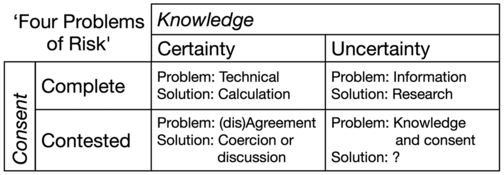
Our assessment starts with the premise that the concept of personal risk in given situations not only refers to the perceptions of a probability for an event happening, such as ocean acidification, affecting marine biodiversity negatively. It also concerns our perceptions of what the consequences of this will have on a personal level, including both objective and perceived risk. The former is based on knowledge about the issue, while the latter refers to the individual’s perception thereof; and there is an unbridged gap between these two groups. When there is a substantial amount of divergent scientific literature on an environmental topic and its effect on human health, this can lead to no consensus about whether or what mitigation measures need to be taken, such as in the case of ocean acidification being ‘just’ an impact of climate change. The latter could result in cultural constructions of risk events that can differ greatly within society and between sectors that depend or not on ocean resources (Adams Reference Adams1995). For the purposes of ocean acidification, we will assess it within the framework of the knowledge-consent vs. certainty-uncertainty figure (Figure 21.1).
Four Problems of Risk. Risk perception, problems, and solutions as products of knowledge and consent adapted from Wildavsky and Dake (Reference Wildavsky and Dake1990) ‘Four Problems of Risk’. The term ‘consent’ is used by the original authors. We understand it as having the meaning of ‘consensus’ or ‘agreement’. However, generally, we understand that ‘consent’ implies a lack of objection, whereas consensus’ is an active agreement to something.

The top-left box is when individuals in question have both complete certainty around the knowledge about a given topic, such as ocean acidification, and complete consent within the group that this is the complete amount of knowledge about the issue area. All the alternatives around the topic are known already, and the objectives as well. In a case like this, for a given environmental problem, the solution is centred on calculating the outcome that is most efficient to solve it. An example is the hole in the ozone layer resulting in the Montreal protocol. The ‘hole’ in the atmospheric ozone layer, from ozone depletion because of the use ozone-depleting substances such as chlorofluorocarbons (CFCs) (Molina & Rowland Reference Molina and Rowland1974), led to global public outrage. The reason for this was perception of personal risk, and a fear of millions of new skin cancer patients and other human health effects (for example, infectious diseases, suppression of the immune system and eye disorders). This risk led to the issue being taken seriously in public and political arenas (Morrisette Reference Morrisette1989). In this case, the challenge was technical, with a need for innovation in product development, and the solution was calculating how to solve it. The alternatives were known, and the objectives were agreed upon, and as such, finding a solution was a matter of calculating the most efficient outcome that would ensure that the problem was solved.
In the bottom-left box, there is also certainty about the environmental challenge and its importance in terms of scientific knowledge around it like in the case of the ozone hole. However, there is disagreement with regard to consent. There is also some contestation around the value of existing knowledge with respect to the cost-benefit of the consequences of it. The example here could be the COVID-19 pandemic, and the solution was differentiated responses in different countries, based, among others, on risk relative to number of cases. Individuals knew during this time period that there was a global pandemic and that it resulted in people losing their lives. However, there was disagreement regarding the extent of the problem in various regions or countries. Also, some people questioned whether economic security was more important in terms of how best to respond, for example if lockdowns should happen or not. Some countries therefore implemented economically strict and coerced shutdowns (for example Korea). Other countries, such as Sweden, on the other hand, implemented limited or partial shutdowns that led to higher rates of mortality in the shorter-term (Hale et al. Reference Hale, Angrist and Kira2020).
In turn, the top-right category is when there is complete consent in the public that there is an environmental challenge that needs to be solved. However, the knowledge about the risks of this environmental challenge is limited, and there is insufficient information for some to assess the risks. A solution in such a case is to default to more research being needed to address knowledge gaps. This is likely where the case of ocean acidification is currently located and why there is not yet an encompassing treaty for either and that the solution is further research to assess to what degree they represent a risk for human populations. The certainty around knowledge pertaining to risk is still not strong enough to drive the public to demand immediate action, as was the case of the Montreal Protocol.
Finally, the bottom-right category is one when there is neither enough knowledge in place nor consent on the cost-benefit of consequences. Different social relations groups fall into different groups in this table when it comes to perceptions of personal risk around environmental issues. An example of this is arguably the UNFCCC and solutions to climate change. Though there is no clear-cut solution to a challenge where there is insufficient consent or knowledge, one of the actions that the global community put in place was that of establishing the Intergovernmental Panel on Climate Change (IPCC). This was to prepare comprehensive scientific, technical, and socio-economic knowledge about climate change and its impacts that were accessible to the public as well. In Tiller et al. (Reference Tiller, Arenas and Galdies2019), the authors quote cast member of Weekend Update of Saturday Night Live TV show Michael Che saying, in response to the IPCC report on climate change that had just been released:
I keep asking myself ‘why don’t I care about this?’ Don’t get me wrong, I 100 percent believe in climate change, yet I’m willing to do absolutely nothing about it. I think it’s because they keep telling us we’re gonna lose everything, and nobody cares about everything. People only care about some things.
Though said in a comedy setting, the statement still rings true when it comes to public perceptions of climate change policy and global action in general, and risk perception of individuals.
Considering this, and though we have established that the human dimension of ocean acidification, through socio-economic impacts, could be substantial (Turley & Boot 2011), the risk perception is low for the issue area. This is despite the fact that, for fisheries and aquaculture, for example, the phyto- and zoo-plankton communities and resultant transfers to the whole trophic web could affect the potential for sustainable future fisheries (Blaustein Reference Blaustein2010; Doubleday et al. Reference Doubleday, Nagelkerken, Coutts, Goldenberg and Connell2019). Modification of the sea bottom because of ocean acidification, disappearance of corals, and reduction of rocky substrata for coastline protection against natural hazards could also be affected. It could affect climate regulation negatively as well, by altering the fluxes of sequestration of carbon into the deep ocean through the biological pump (Sarmiento & Gruber Reference Sarmiento and Gruber2002). And it could even affect human health, though this is a complex study linked to decline in high seas opportunities for exploiting biodiversity and genetic resources that could be used for new medicinal, pharmaceutical, industrial, and agricultural applications (Blaustein Reference Blaustein2010; Doubleday et al. Reference Doubleday, Nagelkerken, Coutts, Goldenberg and Connell2019). Combined though, these are dramatic risks – not just for nature but also for human activities and livelihoods. Yet, the feeling of risk on individuals is still arguably low, leaving ocean acidification to not have enough saliency for policymakers to put it on the agenda. This has been reflected in an EU study on the impacts of climate change, where results precisely reflected this, with respondents being least aware of ocean acidification (Buckley et al. Reference Buckley, Pinnegar and Painting2017).
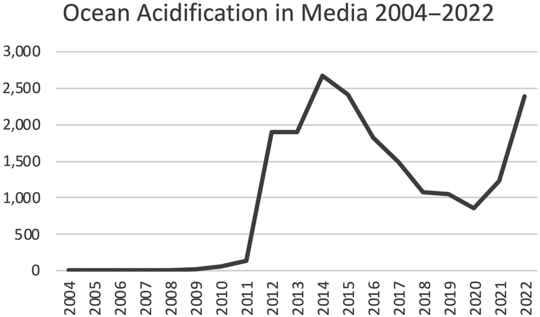
We can see this clearly when we do a media search on Retriever looking at the term ‘Ocean Acidification’ over time in all international media channels as well (Figure 21.2). We can see that after the SDGs in 2015, there was a sharp increase in media discussions about the issue area, perhaps because of it being explicitly mentioned in target 14.3 as mentioned. This is then followed by a sharp decline until 2020 when it begins to increase in saliency again. McCombs and Shaw (Reference McCombs and Shaw1972) discussed early how news media is able to influence the salience of topics on the public agenda, and thereby help set the agenda for policymaking. Also, increased media attention is believed to result in increased concern for a particular issue (Brown & Deegan Reference Brown and Deegan1998).
Ocean acidification in Media.
21.4 Responsibility
Who is responsible to stop ocean acidification, though, if humans don’t feel any personal risk with regard to it and governance actions have a limited human centric approach? And how should this be reflected in governance? Granted, we have tried to curb ocean acidification, directly and indirectly, at national, regional, and global levels (Tiller et al. Reference Tiller, Arenas and Galdies2019; Galdies et al. Reference Galdies, Bellerby and Canu2020a, Reference Galdies, Tiller, Martinez Romera, Leal Filho, Azul, Brandli, Lange Salvia and Wall2020b). However, we have only created agreements within the framework of planetary boundaries that protect humans from anthropogenically induced change that is affecting nature (and us in turn) – and not ensured that we protect nature itself from human use. To manage the expected negative impacts on humans, for example, would focus on biodiversity conservation and habitat restorations, as well as adaptation to changes to the Ocean (Falkenberg et al. Reference Falkenberg, Bellerby and Connell2020). Verma (Reference Verma2019) highlights five guiding principles that identify an anthropocentric world view, namely: (1) humans are at the centre, with the highest status; (2) humans are most capable of managing earth; (3) humans are the most important species on earth, in charge of the rest of nature on the planet; (4) unlimited resources on earth are for humans only, and healthy nature can only be accomplished through a healthy economy; and (5) if we humans are to succeed as a species on earth, we have to be managers of resource extraction and benefits deriving thereof.
In a similar fashion, Verma contradicts this world view with that of ecocentrism, where humans are part of nature and need to live sustainably as part of it on the same terms as other species. Prioritizing ecocentrism is also highlighted by Kotze and French (Reference Kotzé and French2018), for example, who emphasized that ‘a more ecocentric orientation … is urgently required to enable a more ecocentric rule of law to better mediate the human-environment interface in the Anthropocene’. In fact, risk as we have discussed it in this chapter has primarily referred to risk to humans – not nature itself – though that is where most negative effects will materialize first. This, in, turn will lead to, down the chain, humans also being affected, but we are not the primary and immediate recipients of the risks associated with ocean acidification. This is also likely the reason for the lack of focus at the global governance stage, despite its damaging threats. And we know, it’s not from a lack of knowledge, nor has it been since the creation of the Intergovernmental Panel on Climate Change (IPCC) in 1988 and the adoption of the UNFCCC in 1992 at least. However, with the signing of the Kunming-Montreal Global Biodiversity Framework, the global community took a sharp turn in that direction by including both sustainable use (human centric) and protection in and of itself. Target 8 specifically emphasizes that it will
[m]inimize the impact of climate change and ocean acidification on biodiversity and increase its resilience through mitigation, adaptation, and disaster risk reduction actions, including through nature-based solution and/or ecosystem-based approaches, while minimizing negative and fostering positive impacts of climate action on biodiversity.
This agreement is scheduled to reach its targets by 2030 and will work in tandem with the BBNJ agreement for areas that are outside national jurisdiction. By 2030, perhaps risk perception will have reached the consciousness of humans about this planetary boundary as well, and we can see reversals of the environmental damages, as we have done with the boundary for atmospheric aerosol loading after the implementation of the Montreal protocol. If we collectively decide that the future high is worth the temporary pain of making the required changes, that is.Footnote 1
22.1 Introduction
This chapter addresses ocean acidification (OA) from an environmental ethics perspective. Ocean acidification is seen as a paradigm case for post-normal science. At its core, the chapter adopts and substantiates several ethical building blocks from a discourse-pragmatic approach, as (a) common heritage of humankind, (b) strong sustainability, (c) Aldo Leopold’s principle, and (d) ecosystem services, with a special eye on cultural services. The idea to attribute inherent moral value to marine organisms and ecological systems is seen critically.
This chapter emerged from the research programme BIOACID (Biological Impacts of Ocean Acidification) being conducted at Kiel University. Within the final period of the BIOACID research programme, a work package on environmental ethics was included to address the underlying normative issues. This project resulted in a monograph: Frederike Böhm and Konrad Ott, Impacts of Ocean Acidification: An Analysis from an Environmental Ethics Perspective (Böhm & Ott, Reference Böhm and Ott2019).Footnote 1 The following chapter presents the essential lines of reasoning of this book and adds new thoughts. It is organized as follows: Section 22.2 gives a brief overview of the scientific dimension. Section 22.3 presents a post-normal-science framing of OA. Section 22.4 deals with interrelated sources of normativity which stem from environmental ethics. Section 22.5 addresses the problem of defining a planetary boundary for OA.
22.2 The Scientific Basis
Ocean Acidification refers to a reduction in the pH of the ocean over an extended period, typically decades or longer, which is caused primarily by uptake of carbon dioxide (CO2) from the atmosphere, but can also be caused by other chemical additions or subtractions from the ocean. Anthropogenic ocean acidification refers to the component of pH reduction that is caused by human activity.
Ocean acidification is one of several global stressors to the future ocean. It occurs alongside ocean warming and climate change, a complex of problems mainly resulting from continued carbon dioxide emissions. Closely related are issues of deoxygenation and eutrophication. In a marine ecosystem context, it is impossible to isolate the impacts of OA from those of co-occurring and interacting environmental pressures. Many studies and risk assessments therefore consider combined and synergistic effects (Hales et al. Reference Hales, Chan and Boehm2015). Thus, one has to distinguish OA and its impacts (a) in isolation and (b) in context with other pressures. A focus on (a) may underrate the problem.
OA, as climate change, is an unintended side effect of CO2 emissions. The basic chemistry is well known, CO2 entering the ocean changes seawater chemistry via several chemical reactions. The main net effects are an increase of H+ ions and consequently a decrease in pH and an increase in bicarbonate (HCO3) ions along with a decrease in carbonate saturation. In the last two centuries, global average surface seawater pH has decreased by about 0.1 units (pH 8.21 to pH 8.1) (Rhein et al. Reference Rhein, Rintoul and Aoki2013). This is equivalent to approximately 26 per cent increase in hydrogen ion concentration. An overall reduction of oceanic pH by 0.4 pH units (pH 8.21 to pH 7.8) seems possible in the worst case (IPCC 2014; Secretariat of the Convention on Biological Diversity 2014). Under the most optimistic IPCC scenario (‘RCP 2.6’), ocean acidification is still projected to increase globally until the end of the twenty-first century and may slowly recover after the mid twenty-second century (IPCC 2014).
OA is occurring extremely fast on geological time scales and irreversible on a historical scale (Knoll & Fischer Reference Knoll, Fischer, Gattuso and Hansson2011). Natural restoration of ocean chemistry to a state similar to pre-industrial levels would take tens of thousands of years (The Royal Society 2005). From a human perspective, OA is a creeping and long-term process with a time lag between cause and effect. While the process has already started, the full effect will occur in the future. While CO2 emissions represent the main driver of OA, there are also local factors which may cause or intensify it. Coastal drivers of OA can be pollutants, erosion of soils, sulphur dioxide precipitation, hypoxia, eutrophication as well as changes in circulation patterns, or biological processes as metabolism rates (Duarte et al. Reference Duarte, Hendriks and Moore2013). Thus, scales, context, and local variations matter.
At the species level, OA can affect physiological functions like formation of shells and skeletons by calcifying species, internal pH regulation, or photosynthesis. Besides such direct effects on organisms, many are also indirect (for example via food web or habitat change). OA lowers tolerance to ocean warming by coral and crustacean species, thereby enhancing the effect of OA. With high likeliness, calcifying organisms will be the most negatively impacted group of species (Kroeker et al. Reference Kroeker, Kordas and Crim2013).
Therefore, some authors suggest establishing thresholds for OA based on the aragonite saturation state of seawater (Rockström et al. Reference Rockström, Steffen and Noone2009). This proposal would define an additional ‘planetary boundary’. Such a planetary boundary is not a natural one but relies on normative presuppositions. Global thresholds can serve well for political purposes. If it has been prudent to determine such threshold in climate policy, it might be prudent to argue for an analogous threshold in the case of OA (Section 22.5). Without ethical grounding, any fixation of an OA threshold in terms of average pH, however, looks arbitrary because it can’t be derived from scientific data alone (Section 22.4).
22.3 The Framing: Wicked Problems and Post-Normal Science
From an epistemological perspective, OA can be conceived as a case of post-normal science. ‘Post-normal science’ is a term that refers to wicked real-world problems in which stakes are high, uncertainties large, values in dispute, and decisions hard and urgent (Funtowicz & Ravetz Reference Funtowicz, Ravetz and von Schomberg1993, Reference Funtowicz, Ravetz, Westra and Lemons1995). OA has characteristics of a wicked problem, ‘where time is running out, where decision makers lack agency, where incentives are in place that push us into a short-termist downward spiral, and where all actors in the system are ourselves part of the problem’ (Thomas Reference Thomas2014). The term ‘wicked’ refers to critical features that overburden the usual ‘modern’ ways of problem solving via law, incentives, pricing, policymaking, and technological fixes. Those features are marked in this section.
From a scientific perspective, assessing OA must distinguish between OA alone (‘as such’) and OA in the context of multiple ocean pressures, as ocean warming, pollution, overfishing, and so on. Even seen in isolation, uncertainties remain high. Contextualizing increases uncertainties about long-term interactions, non-linear effects, cascades of effects, positive and negative feedbacks, and so on (Section 22.2). Riebesell and Gattuso (Reference Riebesell and Gattuso2015) emphasize knowledge gaps in ecosystem level responses, the potential of long-term adaptation, and effects of multiple drivers in context. OA exceeds natural variability of seawater alkalinity and carbonate saturation; that is, the human driver is one that the marine ecosystems are not pre-adapted to. This makes predictions uncertain. OA and ocean warming may have cascading effects on marine life and ecological processes (Secretariat of the Convention on Biological Diversity 2014).
From a policy perspective, however, OA has been addressed by Sustainable Development Goal 14 (SDG 14) ‘Life below water’. Sustainable Development Goal 14 aims to ‘conserve and sustainably use the oceans, seas and marine resources’. Sub-target 14.3 specifically addresses OA in the aim to ‘Minimize and address the impacts of ocean acidification, including through enhanced scientific cooperation at all levels’ (United Nations Department of Economic and Social Affairs 2022). Sustainable Development Goal 14 and its sub-target 3 serve as a reference point in international governance for the objective of combatting OA. The wording of sub-target 14.3 refers to the impacts of OA, not to OA as such. To determine a threshold (Section 22.5) might suppose a different understanding of sub-target 14.3: ‘Minimize OA and address and minimize its impacts’.
From a temporal perspective, OA is an intergenerational problem. Whereas in climate change, the members of the human species feel many of the impacts more directly, for example through extreme weather events, heat waves, droughts, and sea level rise, OA foremost affects natural systems. Humans remain largely unaffected by OA. From an anthropological perspective, OA is a creeping and invisible problem that does not represent a direct hazard to human life and health. Since humans have evolved in terrestrial environments with specific threats, they are not ‘wired’ to perceive long-term risks within marine systems. From the moral point of view, however, OA does not appeal to our common moral sentiments, convictions, and imagination. OA doesn’t victimize individual persons, and it does not fall within the scope of problems that most people in general regard as moral ones. Thus, OA touches limits of moral perception and modes of moral attentiveness. OA falls outside the scope of usual moral problems. It is ‘wicked’ and ‘post-normal’ for ethics as well.
22.4 Environmental Ethics
22.4.1 Environmental Pragmatism
Ocean acidification falls into the field of environmental ethics. Environmental ethics is a discipline of applied practical philosophy, which investigates the moral and value-laden relationships of human beings (individuals and collectives) to natural environments (for overview see Krebs Reference Krebs1999 and Attfield Reference Attfield2014). Environmental ethics has mostly focussed on terrestrial and limnological systems. It has not been applied to the ocean very often (laudable exceptions are Norton Reference Norton and Dallmeyer2003; Wolf Reference Wolf and Dallmeyer2003). Dallmeyer (Reference Dallmeyer and Dallmeyer2003: p. 278) postulates a ‘second great awakening – this time for the ocean’. Roberts (Reference Roberts2013) also points in this direction. In recent years, there have been many pleas for ocean literacy, ocean stewardship, ocean sustainability, ocean recovery, ocean ethics, and ocean health (Auster et al. Reference Auster, Fujita and Kellert2009; Mengerink et al. Reference Mengerink, van Dover and Ardron2014; Visbeck et al. Reference Visbeck, Kronfeld-Goharani and Neumann2014; Blaustein Reference Blaustein2016; Franke et al. Reference Franke, Blenckner and Duarte2020).
My approach to environmental ethics is close to environmental pragmatism, which studies human–nature interactions and practices and wishes to modify them towards more sustainable and preservationist modes (‘wise use’) (Norton Reference Norton2005, Reference Norton2015). I also wish, however, to reconcile discourse ethics and environmental ethics (Hendlin & Ott Reference Hendlin and Ott2016). This discourse-pragmatic approach can select specific lines of reasoning out of the entire universe of environmental ethical discourse if such lines look appropriate for specific challenges and problems, as OA. Not all arguments fit all problems equally well. Humans may have different reasons to protect endangered species or wilderness areas, to choose a vegetarian diet, to perform organic gardening or to distribute scarce environmental resources fairly among humans. This section rests on hopes that appropriate reasons have been selected which fit the case of OA.
One may ask why one should bother morally about OA. Here comes an answer: If a moral person has been informed about OA (Section 22.2), she should have appropriate emotions and attitudes about it. OA and ocean warming imply the insight that not even the ocean remains unaffected and safe from anthropogenic climate change. Being terrestrial beings, ‘we’ humans must recognize that ‘we’ are responsible for the long-term fate of the ‘great otherness’ on planet Earth: the ocean. In ‘The Sea Around Us’, Rachel Carson wrote about ‘man’: ‘He cannot control or change the ocean as, in his brief tenancy of earth, he has subdued and plundered the continents’ (Reference Carson1951: 20). Retrospectively, this echoes a final illusion of planetary infinity und human limitations. Meanwhile, Carson has been proven wrong by the great and excessive acceleration since the 1950s. Yes, we can! – and this ‘is’ (or should be) awfully shocking. Such primordial moral awareness constitutes a generic sense of human responsibility (Ott Reference Ott, Sierra and Grisoni2017, following Hans Jonas) which requires to address OA from the environmental ethical perspective more closely.
22.4.2 Common Heritage of Humankind
Respect for the well-being of future generations is a primary normative vantage point, which is covered by the common heritage of [hu]mankind (CHM) principle as advocated by Arvid Pardo, Elisabeth Mann Borghese, and others following their lead (Taylor Reference Taylor, Bollier and Helfrich2012; van Doorn Reference van Doorn2021). The concept is anchored in both ethics and international law (Taylor Reference Taylor, Bollier and Helfrich2012). Implications of CHM in UNCLOS are outlined in Böhm and Ott (Reference Böhm and Ott2019). Via a CHM-approach, the former concept of ocean as res nullius is replaced by a res communis-approach (van Doorn Reference van Doorn2021).
Common heritage of [hu]mankind is not grounded in individual rights and entitlements. It would be strange to claim a right on a specific pH threshold of ocean waters. Obligations to future generations with respect to the ocean are twofold pro tanto (Ott et al. Reference Ott, Negenborn, Matz-Lück and Harris2022). On the one hand, the ocean is a planetary entity, while, on the other hand, the chain of generations has no definite end. In consequence, a collective entity called ‘humankind’ has a long-term responsibility against future members with respect to a huge global good called ‘ocean’ and its qualities, resources, and inhabitants. Such responsibilities can’t be reduced to obligations against individual members of future instances of humankind. In any case, the ocean will remain the ocean, but its features, amenities, and disadvantages may become different to future humans.
In principle, we can bequeath (‘pro tanto’) goods and bads to future generations. From OA research (Section 22.2) we assume that OA is not a change by which future generations will be benefitted. Therefore, OA should prima facie be regarded as change for the worse (‘bad’). A bad becomes a moral evil, if it is recognized but remains unaddressed.
22.4.3 Strong Sustainability
Common heritage of [hu]mankind refers to the idea, but not yet to a specific concept of sustainability. To some economists, natural resources and natural capital might be perfectly substitutable by other kinds of capital. According to optimistic assumptions about substitution, the depletion and degradation of natural capital would not be a catastrophe (Solow Reference Solow1974) if prudent investments in man-made capital, social infrastructure, and human capital were undertaken. This approach has been dubbed ‘weak sustainability’. OA might not be a big problem for weak sustainability, since a change in marine pH might be compensated by artificial ways to enjoy the ocean (by cruising ships, digital twins, improved diving and surfing equipment, etc.). Humans may well cope with OA and won’t miss former pH values. They shall conform to shifting marine species compositions.
The concept of strong sustainability denies belief in almost perfect substitutability (Daly Reference Daly1996; Ott & Döring Reference Ott and Döring2008: ch. 3, 4; Ott Reference Ott2014). Thus, natural capital should be held intact over time. The concept of natural capital refers to stocks and non-living and living funds whose different flows contribute to overall human welfare, including so-called eudemonic values (Ott Reference Ott2016; Ott & Reinmuth Reference Ott, Reinmuth and Beckmann2021). Eudemonic values strongly overlap with so-called ‘cultural services’ within the ‘ecosystem services approach’ (Section 22.4.5). If natural capitals have been depleted in the past, society should invest in natural capitals by ways of ecological restoration. Neumann et al. (Reference Neumann, Ott and Kenchington2017) argue that SDG 14 implicitly presupposes strong sustainability. From a strong sustainability perspective, the ocean water bodies are a huge non-living fund of natural capital. This non-living fund is a living condition to a huge diversity of marine organisms nested into complex food webs. A substantial fraction of such organisms may, actually or optionally, belong to living funds of natural capital. Thus, OA is likely to impair fractions of natural capital. If so, OA is not in accordance with the Constant Natural Capital Rule (CNCR) of strong sustainability. If OA violates, impairs, and compromises the CNCR, it should be minimized, as SDG 14 demands (Section 22.3). Following this line of reasoning, we see OA as an imminent encroaching long-term threat to ocean’s natural capitals and the supporting, provisioning, regulating, and cultural services (Ecosystem Services and Cultural Ecosystem Services) that stem from them. Such threat is pro tanto, and there is neither need nor possibility to prove it with respect to every group of marine species. According to the argument, CHM, SDG 14, and strong sustainability are coherent and fit together in a reflective equilibrium.
22.4.4 The Legacy of Aldo Leopold to the Ocean
Two sub-targets of SDG 14 refer to ‘ocean health’ but it remains unclear what ocean health should mean precisely. Literally, the concept of health, whatever its meaning within medicine, applies to organisms only. Therefore, the parlance of a ‘healthy’ ocean is to be interpreted as a metaphor. Metaphors are guiding images (‘visions’). They can inspire our common moral imagination (Weston Reference Weston2012) and may motivate people more strongly than sophisticated ethical arguments. Such metaphors are ‘boundary objects’ since they interconnect epistemic communities, but they can serve as boundary objects best, if they are translated into scientific concepts.
Bohnsack (Reference Bohnsack2003), Neumann et al. (Reference Neumann, Ott and Kenchington2017), and Franke et al. (Reference Franke, Blenckner and Duarte2020) propose to interpret this ‘ocean health’ metaphor in the spirit of Aldo Leopold’s ethical principle stating that actions should respect ‘stability, integrity, and beauty’ of biotic communities within land and sea (Leopold Reference Leopold1977). With respect to ‘ocean health’, this translates to (1) resilience (for ‘stability’), (2) productivity or fertility (for ‘integrity’), and (3) cultural richness (for ‘beauty’) of the biotic community. To Franke et al. (Reference Franke, Blenckner and Duarte2020: p. 559) the ocean is ‘healthy if and only if it is resilient, productive, and diverse’. OA may affect the ocean for worse on all three parameters.
22.4.5 Ecosystem Services
Parameters of ocean health can be specified and, at least in part, measured by the ecosystem service approach (ESA). While there are numerous definitions of what comprises an ecosystem service (see Haines-Young & Potschin Reference Haines-Young, Potschin, Raffaeli and Frid2010 for a detailed review), the general idea behind ESA is to bridge the gap between nature and human welfare. Contributions in Schubert and Müller (Reference Schubert and Müller2023) show how the ecosystem service approach can be applied to marine systems (as the Southern Baltic coast). Natural capital entails stocks and funds which enable beneficial flows. Such flows are dubbed ‘services’, although nature should not be interpreted as service delivering industry. Thus, ‘service’ is a technical term within a concept. The ecosystem service approach bridges the gap as follows: first, a distinction is drawn between nature as such and a concept of natural capital, defined as a broad source contributing to human welfare in many ways. Second, it is assumed that stocks (or funds) of natural capital provide a variety of flows which benefit human beings in different respects. Third, those respects are categorized as:
[Supporting services (e.g. ecosystem structures and functions)]
Provisional services (food, fibre, timber, fish, shellfish, etc.)
Regulating services (water, climate, soil, flood regulation, etc.)
Cultural services (aesthetics, recreation, spiritual, etc.).
The category of supporting services is contested because it consists of ecological functions and structures, which underlie the beneficial flows of the other three categories (Haines-Young & Potschin Reference Haines-Young, Potschin, Raffaeli and Frid2010). Their sustenance is necessary for ongoing beneficial flows, but a separate valuation of supporting services implies double counting (Boyd & Banzhaf Reference Boyd and Banzhaf2007). Thus, they have been put in brackets. There is conceptual connectivity between the Leopoldinian categories (fertility, resilience, beauty) and types of ecosystem services. Fertility refers to supporting and provisioning services that result in measurable yields (fisheries). Richness, diversity, and beauty refer to cultural ecosystem services. Flows can also have opposite effects, that is, cause harm or disadvantage. These are termed ‘disservices’. OA might not only impair services but may foster disservices. For instance, it has been highlighted that there will be winners (including, for example, jellyfish, epiphytic algae, and seagrasses) and losers among marine organisms in response to OA and ocean warming. Ocean acidification in combination with warming and other drivers of ocean change may cause in jellyfish blooms. This could locally interfere with the recreational value of bathing at the coast (Rodrigues et al. Reference Rodrigues, van den Bergh and Ghermandi2013). Algal blooms can be problematic for swimmers’ health. Disservices might impair our admiration and appreciation of the ocean.
22.4.6 Cultural Ecosystem Services
Let’s take a special look upon cultural services. Recreation and (eco)tourism are the most frequently considered cultural ecosystem services in economic studies, because they allow for contingent valuation. However, these services do not fully represent the category of cultural services. Neumann et al. (Reference Neumann, Ott and Kenchington2017) specify the cultural value category with coastal ecosystems in mind:
Aesthetics, beautiful sceneries
Sense of place, feeling at home
Leisure and recreation, health improvement
Inspiration for poetry, painting, and music
Transformative values, virtue enhancement
Spiritual encounters with nature
Cultural heritage
Specific (local, regional) cultural values.
All these cultural services (= eudemonic values) can be realized at sea and in coastal zones (Ott & Berg Reference Ott, Berg, Schubert and Müller2023). Cultural values (inclusive non-western ones) might be encapsulated in narratives, proverbs, songs, festivals, rituals, and so on. Narratives are highly important for the tradition of values, perhaps especially in oral cultures but are often overlooked from a scientific perspective. Cultural values are intrinsic to activities being undertaken for their own sake, such as sailing, swimming, or diving, even if performed by visitors and tourists. Living close to the sea is often a chosen way of life. By intuition, we regret a person who never saw the ocean.
Gains or losses in ecosystem services are often explored from an economic point of view which aims to place monetary values upon benefits derived from ecosystems. It is frequently pointed out that there are limitations to economic approaches and that especially many cultural services are intangible or difficult to quantify (Jax et al. Reference Jax, Barton and Chan2013). The meaning and significance of cultural services must be hermeneutically understood as it touches the background of belief systems (‘lifeworld’). Habermas (Reference Habermas1981) has warned against a presumptive ‘colonization of the lifeworld’. It might count as an instance for such colonization if aesthetics, place-making, spiritual, and transformative attitudes to the ocean are to be represented in an economic cost-benefit-scheme. How to represent awe in $?
In any case, future humankind has a ‘pro tanto’ entitlement to enjoy cultural ocean values even if it is unpredictable how and where such values may actualize. The conjunction of CHM, SDG 14, strong sustainability, and the ESA approach, including the full set of cultural values, constitutes a ‘deep anthropocentric’ ocean ethics within the paradigm of discursive pragmatism. If the primordial moral awareness (Environmental Pragmatism) becomes enriched by these normative building blocks, they may transform such awareness into attitudes and virtues which are reflected in environmental virtue ethics. Sense of responsibility and (biophilic) appreciation of ocean life may converge. Analysis of such transformation by which a terrestrial being can come ‘close’ to the ocean is beyond the scope of this article. The demarcation problem remains beforehand.
22.4.7 Inherent Moral Value of Nature
To attribute the category of inherent moral value (IMV) to a natural being (NB) means to respect this being for its own sake irrespectively of how valuable and beneficial it may be to humans. If such attribution is justified, direct moral obligations hold with respect to NB. The natural being, then, has become a ‘moral patient’. Moral patients are beings, which lack the capability to join moral discourse but are protected by moral rules which imply obligations to moral agents. Such obligations may be obligations not to kill, not to harm, not to violate, not to capture, not to hunt. The problem of how to attribute IMV is called the ‘demarcation problem’. Analysis is given in Ott (Reference Ott, Westra, Bosselmann and Westra2008). The non-anthropocentric (‘physiocentric’) solutions are:
Sentientism (all sentient beings are moral patients)
Zoocentrism (all prehensive animals are moral patients)
Biocentrism (all living beings are moral patients)
Ecocentrisms (all ecosystems as such are moral patients)
Holism (all natural beings are moral patients).
I have sympathies with sentientism, yet I see sophisticated problems in applying sentientism to marine life. Sentientism seems appropriate with respect to marine mammals, sea birds, and even turtles and sharks. If one adopts sentientism, the problem occurs that (most or all) fishes are sentient (Rey et al. Reference Rey, Huntingford and Boltaña2015) Egalitarian sentientism implies a moral ban on fisheries as a rigid conclusion, given the reliance of many coastal communities on artisan fisheries for nutrition. If one wishes to attribute IMV only to some sentient creatures, as marine mammals, turtles, sharks, and so on, one faces the accusation of arbitrariness. If environmental pragmatism conceives sentience as gradual, it is possible to circumvent a complete ban on fisheries. Gradual sentientism allows treating members of different sentient species differently according to other features and traits, as proliferation patterns. Therefore, according to gradual sentientism, a mackerel is morally less considerable than a dolphin, a sardine less than a whale. The impacts of OA to sentient marine life are hard to predict.
OA affects many non-vertebrates without sentience. Some non-vertebrates, however, seem to display kinds of awareness (Rozzi Reference Rozzi2019). It remains doubtful, however, whether minimal awareness is sufficient for membership in the moral community. One would have to adopt a biocentric position in order to respect moral entitlements of all organisms to be protected against the impacts of OA. If one adopts biocentrism, however, one faces the problem of how to overview and assess the impacts of all anthropogenic pressures on the myriads of non-sentient, often single-cell organisms living in the ocean. Ocean life in itself puts a question mark upon biocentric considerability. Reverence for life (Schweitzer Reference Schweitzer1926) is rather a basic attitude toward life than a proper solution of the demarcation problem.
Ecocentrism faces the problem to delineate marine ecosystems. In holism, one has to respect seafloors and ocean waters as such, and it might be mandatory to restrain any kind of human interference with the ocean to a minimum. Holism (Gorke Reference Gorke2003) will consider OA directly from the moral point of view. Holism implies a principle of least possible human interference with nature. It gives IMV to all existing entities. Ocean waters exist. If they are modified by anthropogenic impacts, this is morally wrong in holism. To holism, OA is not just bad, but it is a moral evil in itself. Holism, however, rests on a fallacious justification. Holism states that arbitrariness is not permitted on the moral point of view. Any exclusion of any entities from the moral community should be strictly non-arbitrary. To draw a line of moral considerability (distinguish, exclude) counts as arbitrary until proven otherwise. The burden of proof falls on the side of exclusion, and such burden is specified by a criterion of ontological parsimony (‘Occam’s razor’). Any statement ‘entities E-1 deserve IMV because of their morally relevant features F, while entities E-2 don’t deserve IMV because they lack any F’ is less parsimonious than ‘all entities have IMV’. Thus, holism always wins if one accepts the burden of proof.
On reflection, it becomes questionable whether biocentrism, ecocentrism, and holism are adequate ethical concepts with respect to the ocean and its lifeforms. How to follow the moral demands of some egalitarian sentientism to reduce suffering in nature (Horta Reference Horta2017) if big fish must eat small fish? How to consider all plankton and all marine microorganisms, as biocentrism demands? How to distinguish distinctive ecosystems, as ecocentrism requires, if marine life is in constant flux at the high sea? How to deal morally with the water bodies, sediments, and geological items, as holism demands? Facing the ocean, these ethical concepts are puzzling on ontological grounds. Within the arena of UNCLOS, no agreement on the demarcation problem is to be expected. One should not impose a specific solution on all coastal communities. Moreover, to apply different solutions to the demarcation problem to the impacts of OA to marine life will be highly speculative and conjectural. If there is a reason to keep environmental ethics simple, there is a reason to adopt deep anthropocentrism (Section 22.4.6) at least in the case of OA.
22.5 A New Planetary Boundary: Threshold Problem Revisited
In climate policy, article 2 of UNFCCC has been specified to the goal that GMT warming should be limited to ‘well below 2 °C’. We are now in a position to specify the normative building blocks of deep anthropocentrism (CHM, SDG 14, strong sustainability, ‘ocean health’, ESA) which implies aversion against OA-induced disservices to an analogous boundary. Such boundary might be adopted by UNCLOS, as ‘well below 2 °C’ has been adopted by the parties of UNFCCC. Such a boundary might make sense, even if OA has not yet crossed the planetary boundaries according to the diagrams of the Stockholm Resilience Centre. Such presumptive planetary OA-boundary has to be grounded in environmental ethics (Section 22.4) but must be also based on scientific knowledge (Section 22.2).
At current levels of atmospheric CO2, an overall risk of damaging effects to marine species resulting from the combination of OA and warming is very likely; some foraminifera and pteropods are already affected by decreased calcification. Changes in abundance of these organisms would be relevant for marine food webs. Considering OA in isolation, high-risk levels, by which 30–50 per cent of calcifying species across taxa including molluscs, corals, and echinoderms are affected, are predicted for atmospheric CO2 levels exceeding 500 ppm. Adding effects of ocean warming to the picture, the transition to the high-risk zone already starts above 400 ppm, that is, close to present CO2 levels. Right now, we are at the breach of the high-risk zone. The zone of very high risks is looming beyond. Two thresholds of very high risk to marine life (BIOACID 2017) are characterized by (1) increasing effects on vulnerable taxa, marginalization of warm-water reefs, and loss of fish habitat; and (2) negative effects on more than 50 per cent of molluscs and corals. If the combined effects of OA and warming are considered, two ‘very high risk’ thresholds to marine life overlap and are located at levels around 450 ppm. This indicates that pH 7.97 comes close to the very high-risk margin (Böhm & Ott Reference Böhm and Ott2019). If so, there is only 0.1 distance to the zone of very high risk.
The Stockholm Resilience Centre proposed a planetary boundary for OA based on average global surface ocean aragonite saturation as an indicator, following which aragonite saturation should be sustained at 80 per cent or more of the pre-industrial state, ± natural diel and seasonal variability (Rockström et al. Reference Rockström, Steffen and Noone2009). Personally, I support this planetary boundary for OA. With the legal framework of UNCLOS, there should be further debate on a precautious pH-threshold.

 Open access