The anonymous Trecento treatise, Capitulum de vocibus applicatis verbis,Footnote 1 offers a description of ‘caciae (sive incalci)’ which is at odds with most notated examples in Trecento manuscripts.Footnote 2 This discrepancy becomes all the more puzzling when the treatise's presumed dating (after 1332)Footnote 3 and provenance (northern Italy) are considered, since these point to a period and cultural ambit closely associated with the early flourishing of the written caccia repertoire (preserved in Reg and Rs).Footnote 4 In view of the possible temporal and geographical proximity, one might reasonably expect a certain similarity between the description of the caccia in the Capitulum and the earliest examples of the genre, such as Nella foresta, Chiama il bel papagallo, Mirando i pessi (all from Reg) and Or qua conpagna (Rs). Yet at first glance the definition does not appear to meet even these modest expectations:
Cacce, or incalci, are in all respects constituted similarly to motets, except that the verbal organization of cacce should be either all of seven or all of five syllables. Moreover, they are intended for as many [singers] as there are partes, and all [parts] should be constituted over the first pars, so that if the caccia were composed of five partes, all five singers would sing the first pars together.Footnote 5 There should be in the number of singers a similar order as was mentioned of the motets, namely, when one ascends the second descends, the third remains firm, the fourth pauses, and the fifth breaks (quintus rumpat). And thus, by alternating their roles, a decorative diversity is produced, which most often is found in consonances. Let some of them [i.e. singers] and all at the end, find themselves in consonance, some at the fifth, some at the octave, and beware of the tritone as was said of the motet.Footnote 6
The treatise's descriptions of two basic characteristics of the genre, namely its poetic structure and musical form, are particularly confusing. The Capitulum states that caccia verse comprises regular ‘quinari’ or ‘settenari’ lines, rather than irregular endecassilabi and settenari typical of the preserved repertory (though a few exceptions to the rule do exist).Footnote 7 The description of the caccia's musical structure is different too. The treatise suggests a simple, five-voice circular (‘round’) canon based on voice-exchange and repetition, rather than ‘continuous’ (that is, ‘through-composed’) canon employed in most notated examples.Footnote 8
The present article aims to shorten the distance between theory and practice, as well as between the ‘round’ and ‘continuous’ canonic forms, by examining certain archaic compositional strategies of the caccia's canonic texture – particularly noticeable in the earliest, northern layer of the repertoire – that elucidate the genre's historical genesis.Footnote 9 The focus will be on various repetition patterns ranging from concise melodic reiterations to large-scale melodic and/or harmonic ostinato procedures that function as important structural elements of the canonic techniquesFootnote 10 and reveal a tendency towards ‘periodicity’ in otherwise continuous melodic and harmonic writing.Footnote 11
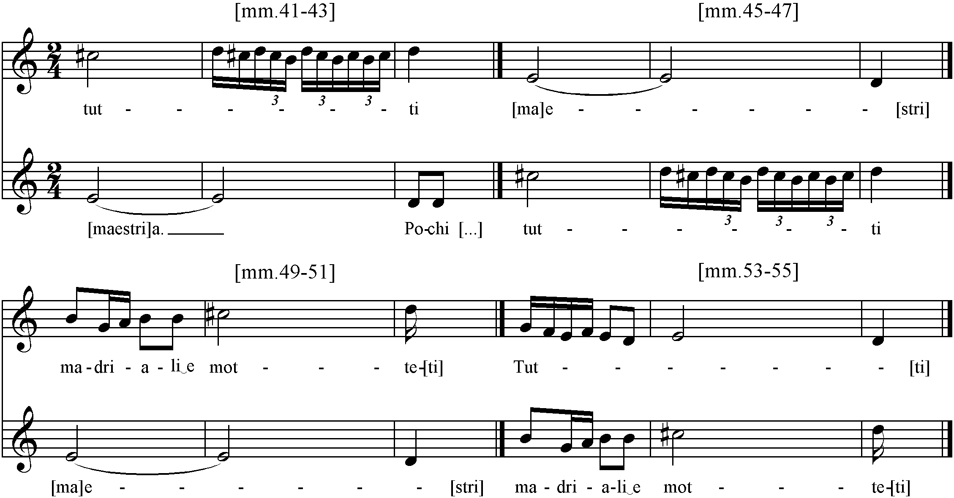
It is only natural that such regular repetition patterns would reveal themselves first and foremost in the cadential area, which is by nature more ‘formulaic’ than the surrounding music with respect to melodic, rhythmic and harmonic configurations. If repeated regularly, a single cadential gesture could easily grow into a brief harmonic pattern demarcating a certain segment of composition. For example, in Jacopo's Oselletto selvagio (for three voices)Footnote 12 and Per sparverare,Footnote 13 cadential patterns are similarly located and structured, appearing in the second halves of the strophe after a long rest in the upper voice, and reiterated regularly thereafter (every four or ten breves, respectively).Footnote 14 In both cacce, moreover, the approach to the cadential area is characterised by ritardando, with the rhythmic activity slowing down to a breve-and-long pace in the upper voices as well as the tenor. (In Oselletto selvagio, Jacopo embellishes the skeleton with triplets in cantus I, measure 42, and cantus II, measure 46, but the deceleration remains perceptible nonetheless. See Ex. 1.) Interestingly, cadential patterns occupy important positions in both cacce. In Per sparverare, the introduction of the pattern coincides with a climactic textual and musical passage (‘Guarda, guarda, guarda là!’). In Oselletto selvagio, the repetition of the cadential gesture appears to take on a rhetorical function: it begins when the text turns to a critique of contemporary art (‘et tutti si fan maestri’, mm. 40–7) suggesting an ironic subtext (as Elena Abramov-van Rijk has noted with regard to the unusual accentuation and prolongation of the word ‘tutti’).Footnote 15
Jacopo da Bologna, Oselletto selvagio, cantus I–II only, mm 41–55.

Another early caccia, Giovanni da Cascia's Per larghi prati, is a good example of the same ritardando procedure. A cadential figure consisting of two concords – E/c♯/g♯ and D/d/a – repeats more or less regularly through most of the strophe, either in full (three-voice) or reduced (two-voice, E/c♯ and D/d, or E/g♯ and D/a) form. Initially, the rhythmic accent falls on the second concord,Footnote 16 but it later shifts to the first.Footnote 17 Finally the pattern changes its harmonic configuration and loses its cadential force.Footnote 18 Nevertheless, as in both of Jacopo's cacce, the repetition is accentuated by considerable rhythmic deceleration, rendering it clearly audible.Footnote 19
The later caccia repertoire provides further examples. In Vincenzo da Rimini's In forma quasi, a somewhat extended cadential gesture built on two melodic phrases (one with a downward movement from a to d, the other with a ‘winding around’ figure, e–d–c♯-d) makes its first appearance in measures 52–6, after which it repeats regularly every thirteen measures.Footnote 20 (It should be noted, however, that both phrases had appeared earlier in the piece, but were initially separate from one other.)Footnote 21 As in Jacopo's cacce, the repetition pattern coincides with salient points of the text: the second phrase marks the beginning of a vivid description of a market scene (‘O della barca, premi e'n via’, mm. 31–4), while the cadential pattern starts with the emphatic ‘Chi vuol pesce?’ (mm. 52–6).
Taking the formulaic structure of the cadence into consideration, it is logical to assume that the kind of cadential periodicity described above is not confined to the caccia repertoire. Indeed, a considerable number of similar cadential patterns can be found among early Trecento madrigals and what Nino Pirrotta considered southern siciliane recast (in PR) into the northern ballata form.Footnote 22 The main differences involve the regularity of cadential repeats in the cacce and the specific rhythmic profile of the cadences, which as we have noted include written-out ritardando.
The former feature could be explained as a logical consequence of the canonic setting, but the latter hints at a peculiar aspect of performance practice. As Brooks Toliver has pointed out with respect to the madrigal repertoire transmitted in Rs, written-out deceleration and simultaneous rests may indicate points of communication between singers in the course of an improvisatory performance practice.Footnote 23 Cadential patterns, which have similar characteristics and serve the same compositional purpose regardless of genre – namely to demarcate the musico-poetic form – may offer a glimpse into a presumably unwritten aspect of canonic composition. Although the cadential figures considered above are too brief to allow broad generalisations, they give us an appropriate context to examine longer and more solid ostinato schemes.
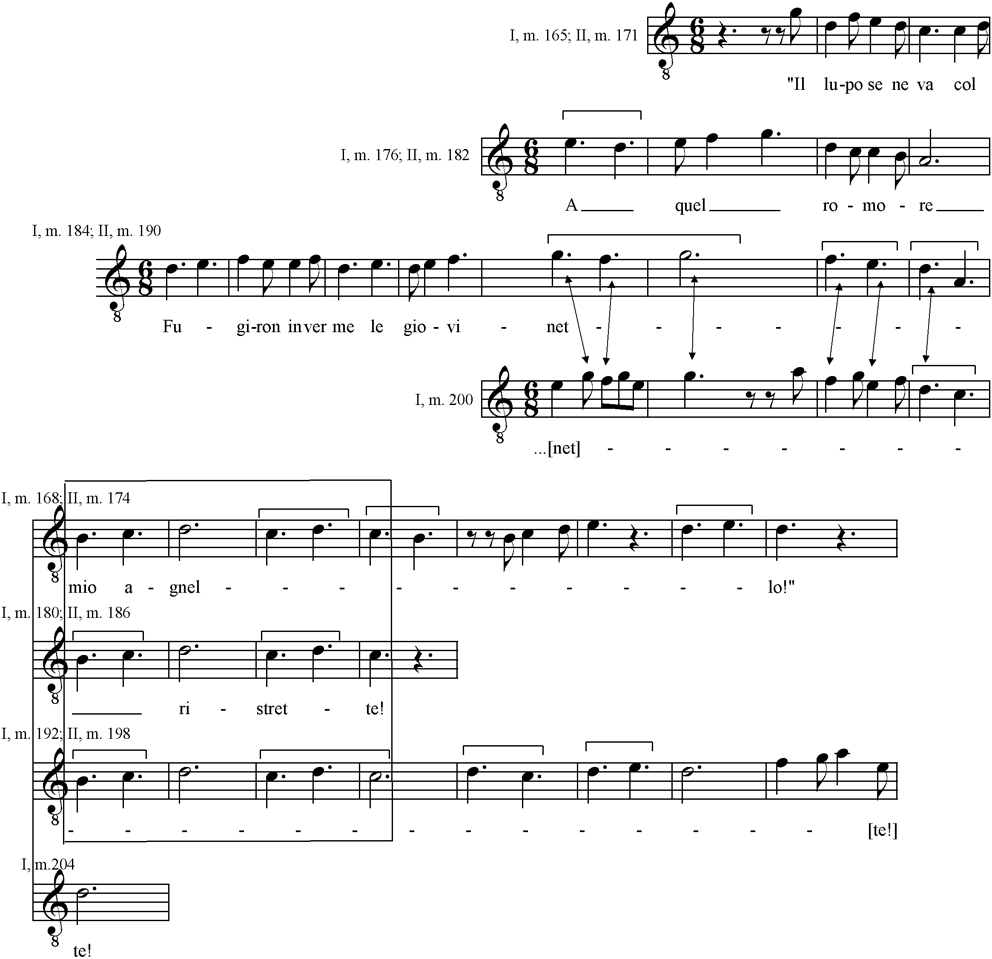
Most brief melodic repetitions are found in the cadential area (i.e., at the ends of musico-poetic periods), but in a few cases musical periodicity is not supported by the text, resulting in an overlap of musically regular and poetically irregular structures. Niccolò's caccia State su, donne, measures 165–204 (Ex. 2) illustrates this complex musico-textual relationship.Footnote 24
Niccolò da Perugia, State su, donne, mm. 165–204.
This excerpt includes three text lines of irregular length comprising eleven, seven and eleven syllables, and occupying ten, eight and fifteen measures, respectively (the third is twenty-one measures long in cantus I): ‘“Il lupo se ne va col mio agnello!” [11] / A quel romor' ristrette [7] / Fugiron inver me le giovinette! [11]’. Despite the musical and poetic irregularities, however, the passage includes a regularly repeated melodic figure (cantus I: mm. 168–71, 180–3, 192–5 and 198–201; cantus II: mm. 174–7, 186–9 and 198–201) occupying a different position in each musico-poetic period. In the first line, it is incorporated into the end of a syllabic section and the beginning of a melisma (‘mio agnel-[lo]’); it then appears at the end of the second line (‘[romo]-re ristrette’); in the last line it is buried in a richly embellished penultimate melisma (‘[giovi]-net-[te]’), which itself includes a slightly varied internal repetition (cantus I: mm. 188–91 and 200–4). The persistent repetition, and the voice-exchange procedure resulting from it (compare mm. 174–7 and 180–3, 186–9 and 192–5, 194–7 and 200–3),Footnote 25 create an effect of a circular motion akin to one produced by a ‘round’ canon.
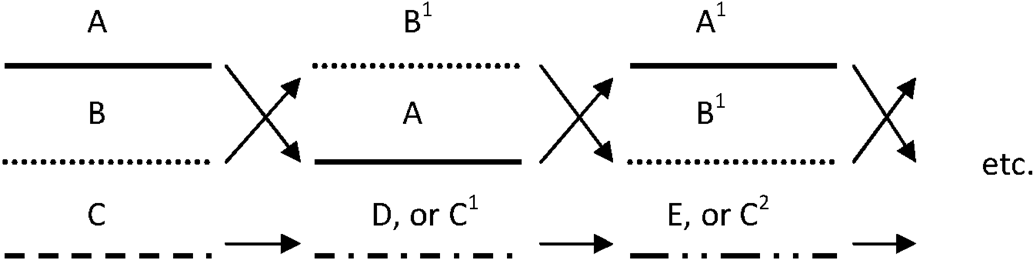
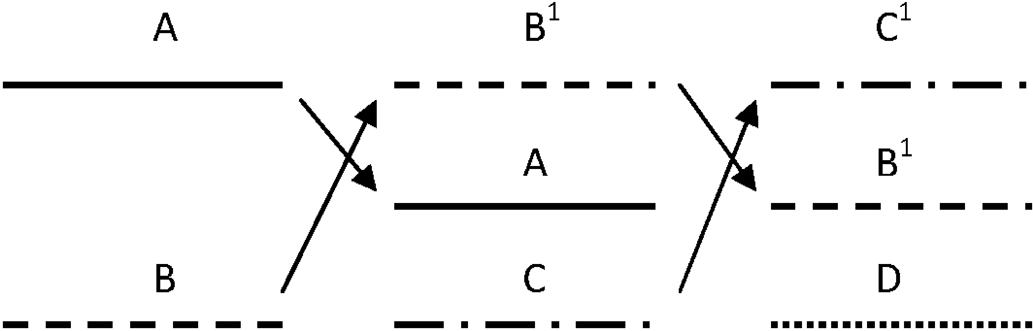
Now let us turn to large-scale repetition patterns – melodic and harmonic – in order to prove that such archaic compositional procedures as voice-exchange, ‘circular’ melodic motion and ostinato were incorporated into the caccia's texture early on, and constituted an essential element of the canonic technique. Melodic repetition is usually confined to the upper duo and proceeds according to the scheme represented in Figure 1: the two upper voices build an ostinato unit, a structural framework, while the tenor either moves freely or partly supports the ostinato with its own repetition scheme.
A scheme of the voice-exchange procedure in the two upper voices.
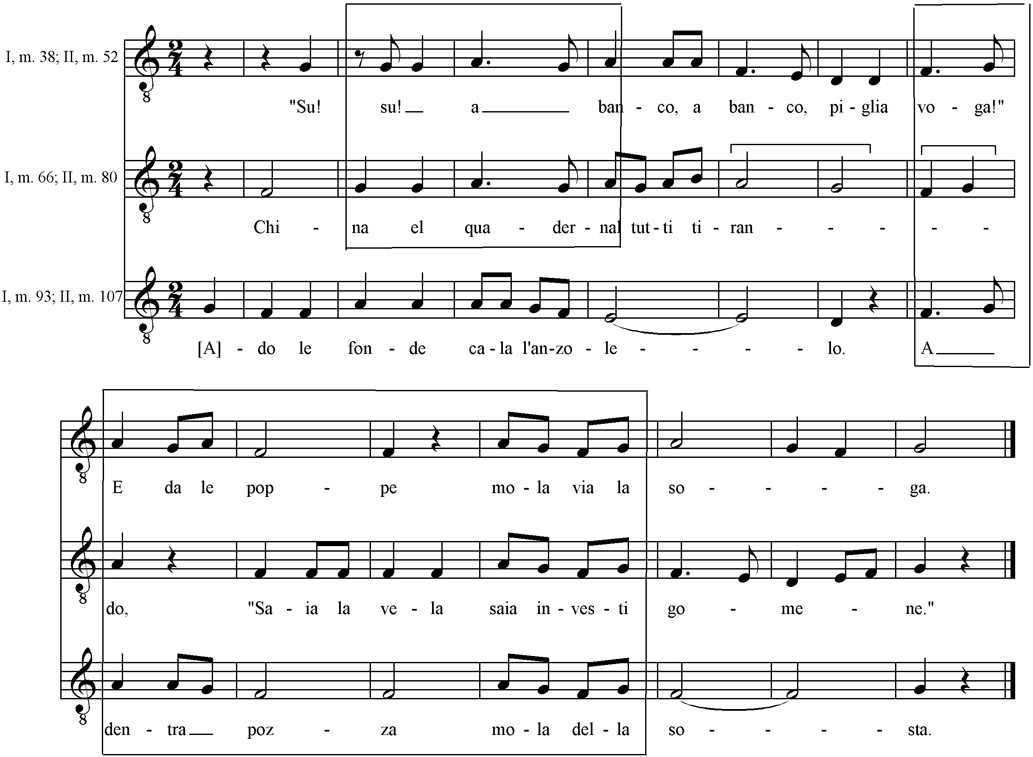
Piero's Con dolce brama is a good example of this. From measure 52 on, each fourteen-measure unit in the upper voices makes a variation on a melodic shape outlined in measures 38–51 (see Exx. 3–4). Each variation not only replicates the original framework, but also a considerable number of specific melodic turns and ornaments (see the framed segments in Examples 3–4), suggesting that the repetition pattern was wholly intentional.
Piero, Con dolce brama, mm. 24–107.
Piero, Con dolce brama, mm. 38–121.
The musical periodicity of Con dolce brama is reinforced by regular poetic form (equal hendecasyllables) and steady declamation, yet the musico-textual relationship is complex at the semantic level: the ostinato reveals itself at the very point where the poetic text introduces direct speech and shifts from description to action (‘Su! Su! A banco, a banco’). At first glance, this correlation may appear coincidental, but it has been noted in the examples cited above (Jacopo's Per sparverare, for instance) and will be further substantiated below.
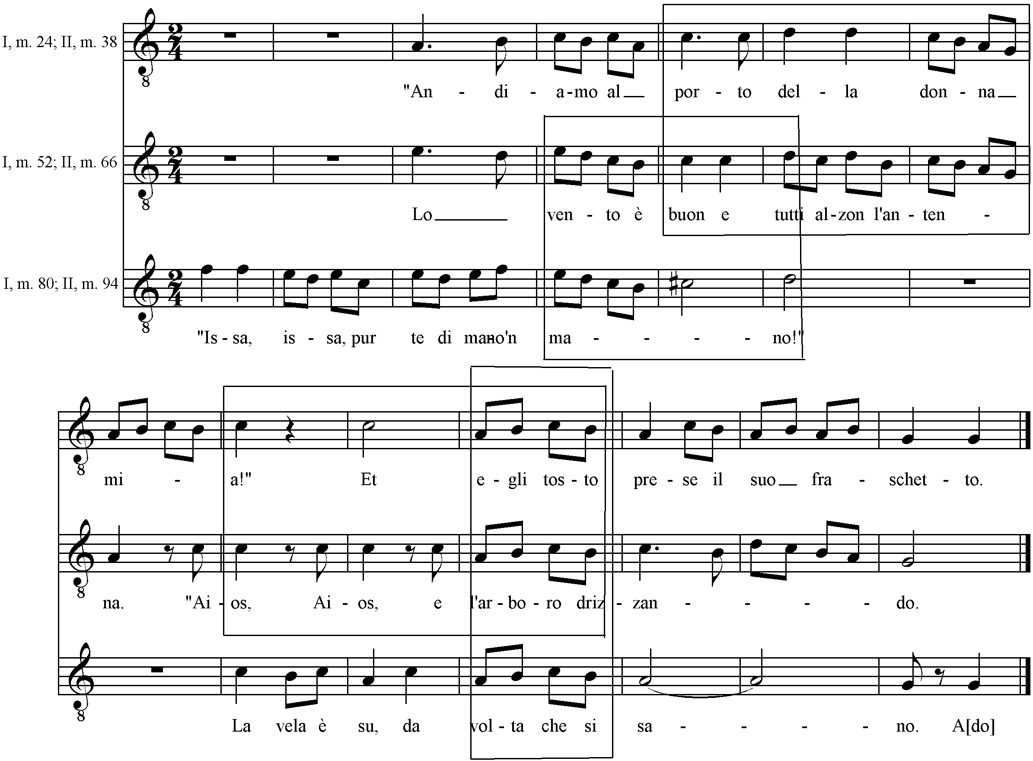
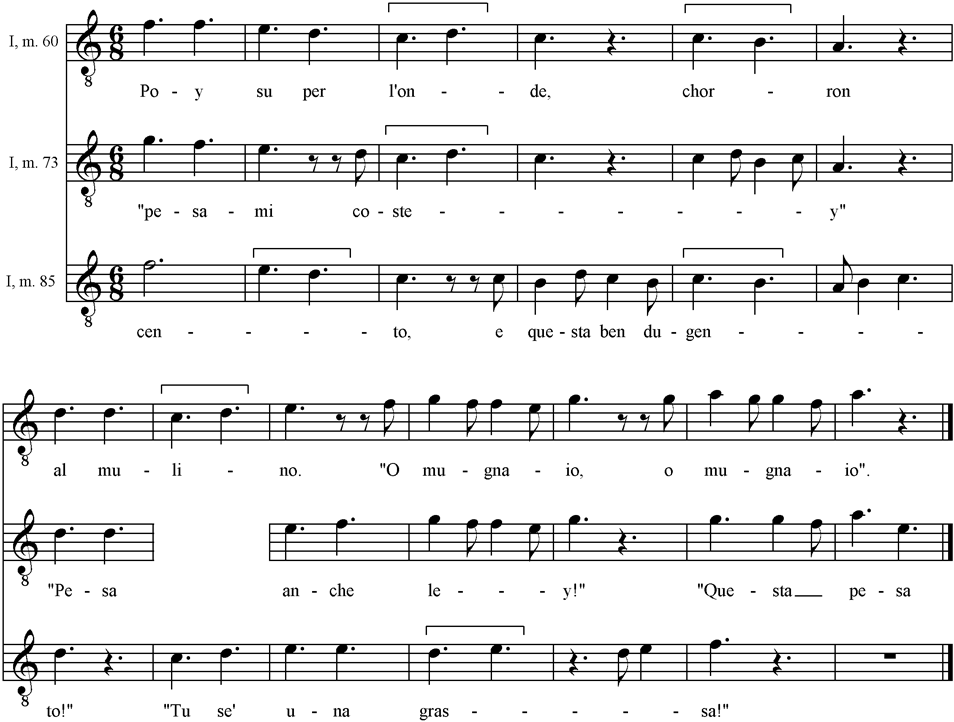
Niccolò's caccia, State su, donne (mm. 60–96), to which we now return, provides another example of melodic repetition (see Ex. 5). While the variation technique here closely resembles that of the preceding example, the relationship between music and text appears to be more intricate at the structural level: poetic lines of irregular length overlap with the repetition pattern, which is not periodic either – note the elision in the second statement of the original phrase, measures 73–84. The overlap is particularly noticeable in measures 83–7, where the short line ‘Questa pesa cento’ breaks into two syntagmas (‘Questa pesa’ and ‘cento’) in the course of repetition.
Niccolò, State su, donne, mm. 60–96.
Taken together, Examples 2 and 5 from Niccolò's caccia display a skilful equilibrium between regular and irregular patterns – in the poetic text, the music and, finally, in the coordination of music and text.Footnote 26
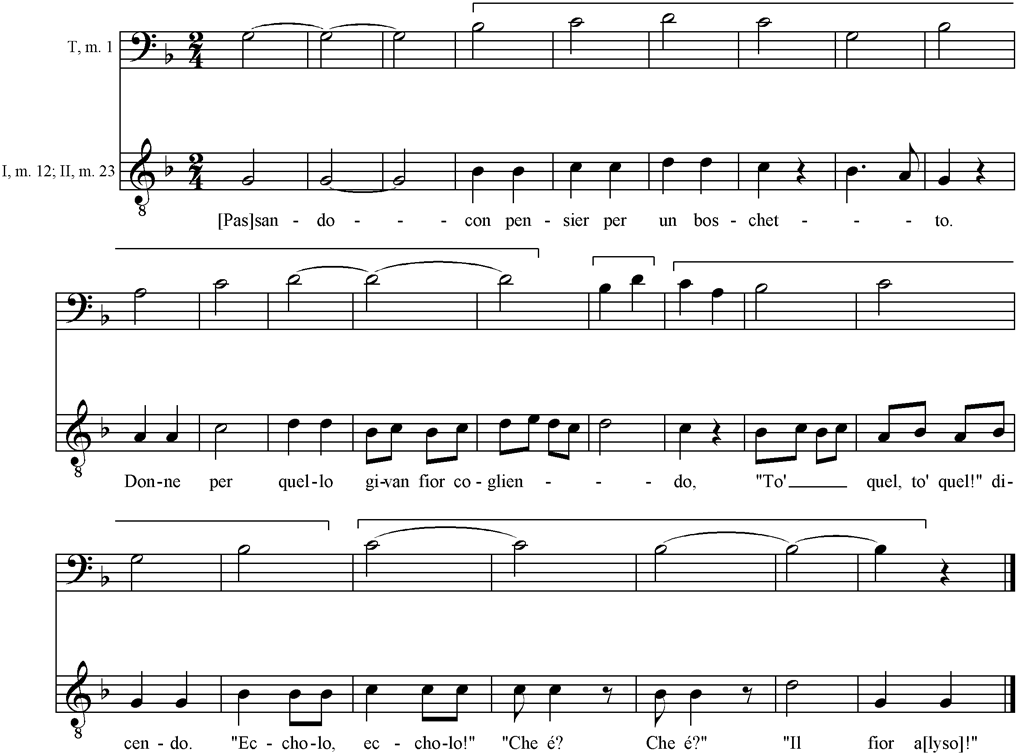
Examples drawn from the repertoire of early northern cacce (Piero's Con dolce brama and Jacopo's Per sparverare) and Niccolò's later pieces (Dappoi che ‘l sole and Passando con pensier) provide the bulk of evidence for a different scheme of melodic repetition, represented in Figure 2. Here, surprisingly, the upper duo interacts with the tenor by means of borrowing and elaborating an extended melodic fragment from its beginning.Footnote 27
A scheme of the voice-exchange procedure in all three voices.
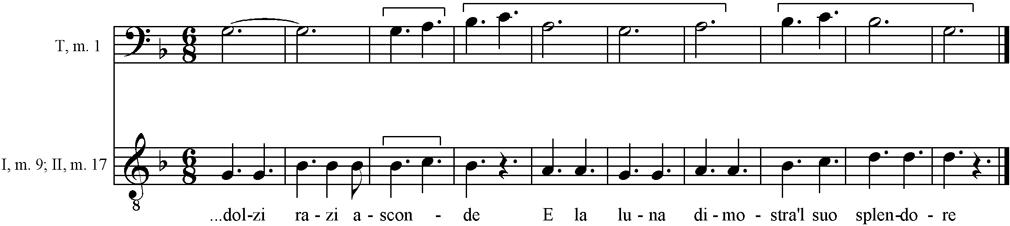
Both the scheme of voice-exchange procedures in general and the method of borrowing the tenor melody in the upper voices in particular are strikingly similar in all four pieces. In each case, the cantus ornaments the skeletal shape of the original tenor phrase by means of a simple diminution, breaking the tenor's long notes into shorter ones to accommodate the syllabic declamation of the text (see Exx. 6 and 7).
Niccolò, Dappoi che ‘l sole, mm. 1–26.
Niccolò, Passando con pensier, mm. 1–47.
To the examples already cited a considerable number of less extended tenor borrowings in other pieces could be added, such as the anonymous Or qua conpagni (tenor, mm. 22–7; cantus I, mm. 31–6; cantus II, mm. 40–5) and Piero's Con bracchi assai (tenor, mm. 49–51; cantus I, mm. 57–9; cantus II, mm. 65–7).Footnote 28 It is evident in these examples that the tenor is integrated into the canonic texture to such an extent that it cannot be regarded as an ‘additional’ part, or simply harmonic ‘filler’ attached to the upper duo. The three-part texture functions as one undivided unit rather than the sum of ‘two plus one’.Footnote 29
While the tenor's involvement in the repetition pattern permits us to reconsider its function in the texture, the diminution technique utilised in the cantus part may shed light on the passage in the Capitulum dealing with contrapuntal rules and voice disposition: ‘There should be in the number of singers a similar order as was mentioned of the motets, namely, when one ascends the second descends, the third remains firm, the fourth pauses, and the fifth breaks (quintus rumpat).’Footnote 30 These contrapuntal rules are too vague to allow any firm conclusions; they also appear in an earlier section of the treatise dealing with the motet.Footnote 31 Nevertheless, this passage seems to embrace at least some features of the caccia's texture, particularly the complementary upward and downward motion (quando unus ascendit, alter descendat) so characteristic of melodic writing in the caccia's upper voices. If the treatise's author (or authors) were referring to actual musical practice, moreover, the description of the fifth voice (‘quintus rumpat’) might allude to a diminution procedure akin to the one encountered in the early caccia repertoire, and not merely to any kind of embellishment or ornamentation.
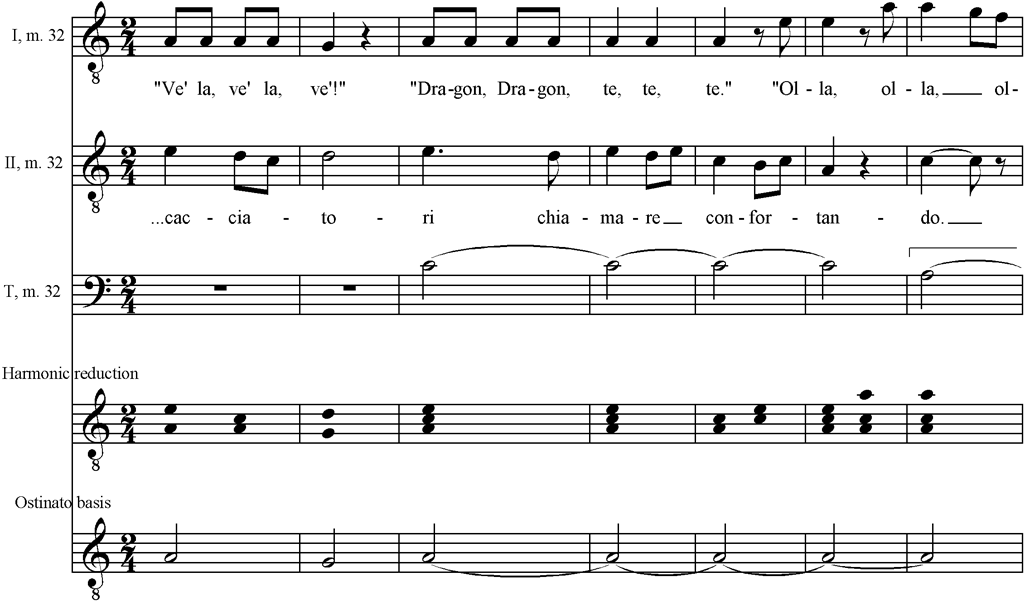
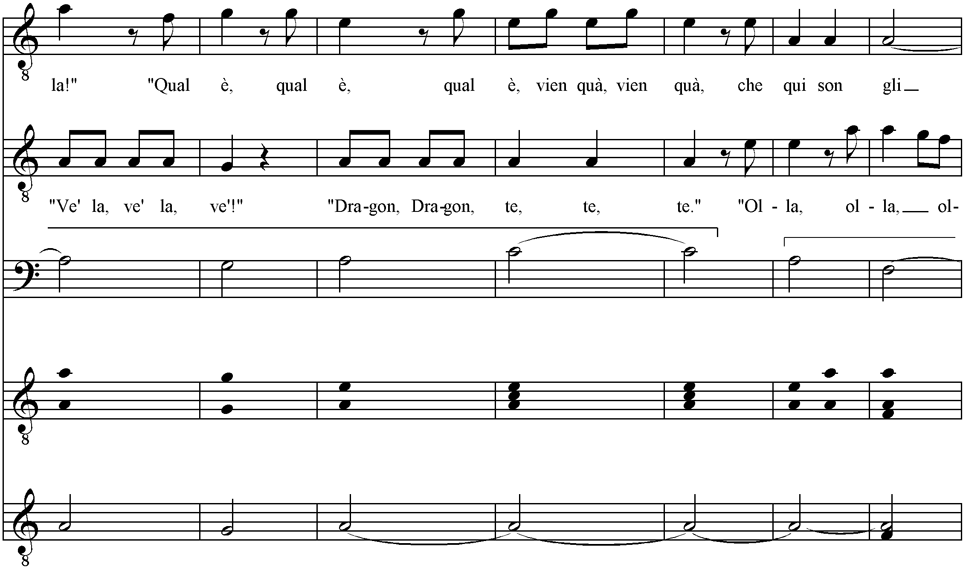
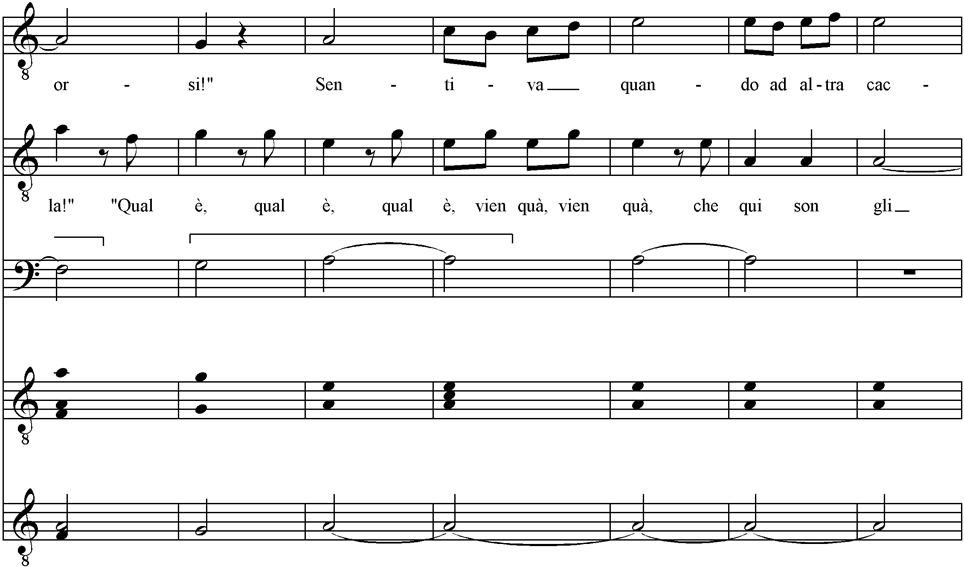
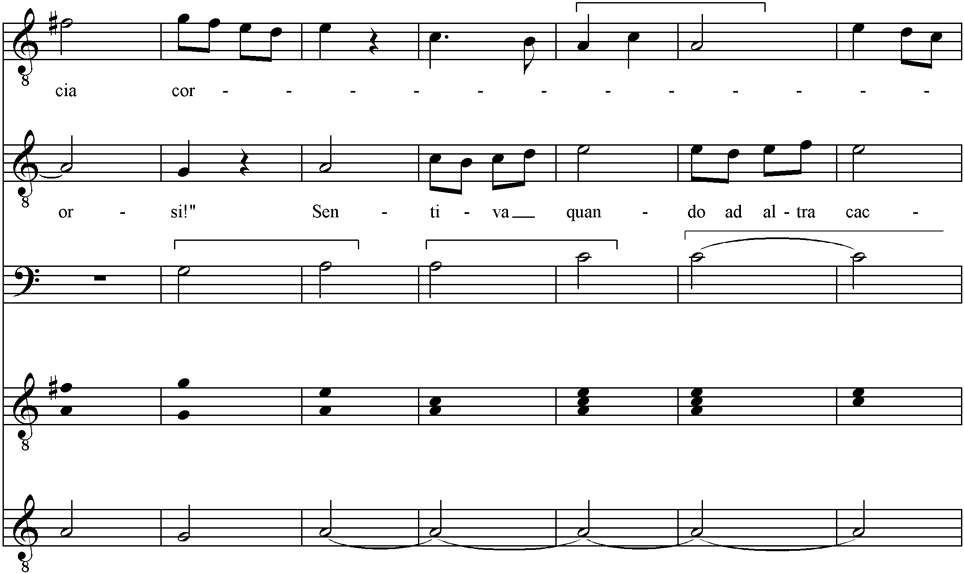
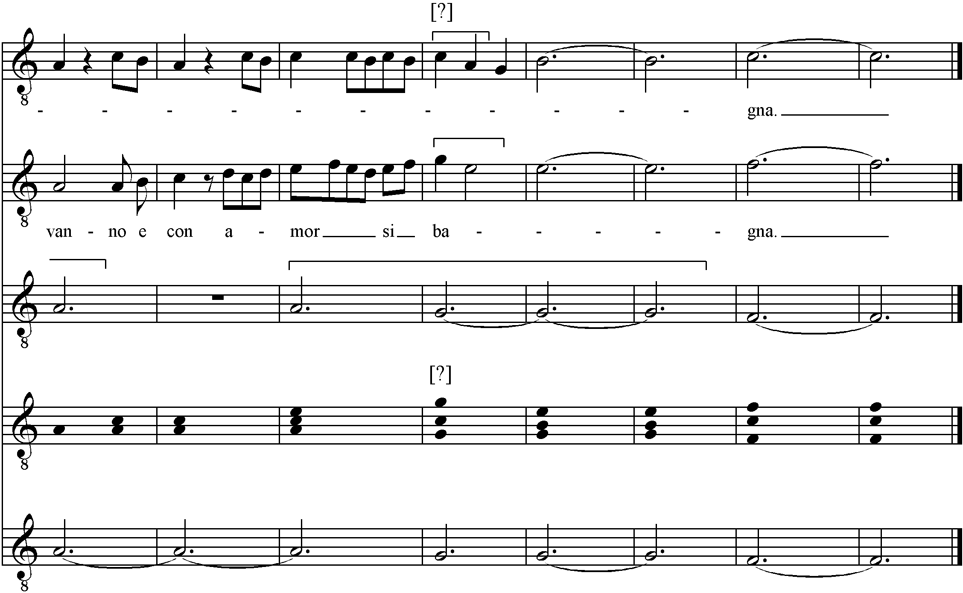
Let us now proceed to a different compositional strategy, namely the fixing of harmonic structure by means of a simple ostinato either implied by the harmonic context or presented explicitly.Footnote 32 We begin with three canonic pieces from the early Trecento that reveal an identical harmonic pattern in which A- and G-rooted concords alternate. The anonymous Segugi a corta (Ex. 8) is transmitted in two different metric versions or divisiones, quaternaria (FP, fol. 99r) and senaria imperfecta (Lo, fol. 77v), but with almost identical pitch contents.Footnote 33 In both versions, the second half of the strophe, which starts with direct speech and the hunter's commands (‘Ve' là, ve' là ve’, ‘Dragon Dragon, tè, tè, tè’, etc.), deserves particular attention. Although the text offers a vivid and picturesque description of the hunting characteristic of many cacce, the melodic writing here becomes surprisingly ‘formulaic’ and static, as if the composer were seeking to imitate natural speech or the hunter's shouts musically, rather than to compose a beautiful melody per se. The repetitious and static melodic writing, in turn, generates a clearly audible ostinato pattern with the alternation of A and G concords, resulting in an almost monochromatic-sounding segment with the predominant ‘A’ sonority occupying some twenty-five of thirty-two measures.
Segugi a corta, mm. 32–65.
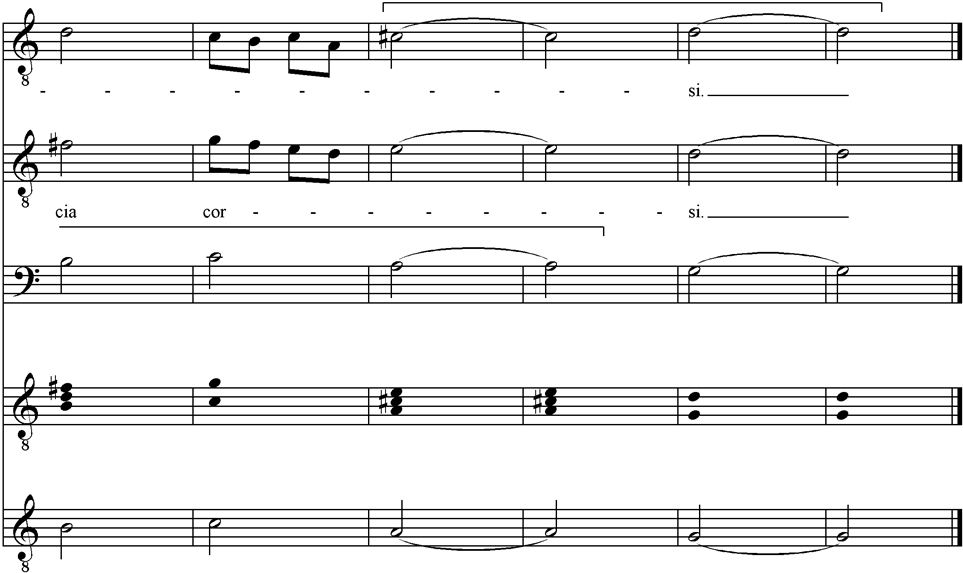
On one hand, the use of ostinato as musical counterbalance to the lively poetic description in Segugi a corta resembles Piero's Con dolce brama. The two cacce also appear closely related in their transmission (Piero's piece immediately precedes Segugi a corta in FP and exploits the same quaternaria division throughout the strophe), melodic writingFootnote 34 and compositional planning.Footnote 35 On the other hand, the harmonic pattern links Segugi a corta to two canonic ritornelli, one from Piero's madrigal Si com' al canto, the other from the anonymous caccia Chiama il bel papagallo (Ex. 9) from the Reg fragment, both of which are based on a concise A–A–A–G harmonic progression.
Chiama il bel papagallo, ritornello.
In Chiama il bel papagallo, the ostinato is easily perceptible from the very beginning of the ritornello, particularly in the explicitly repetitive tenor voice (cf. mm. 48–51, 52–5 and 56–9); in Piero's madrigal the pattern is buried in extensive ornamentations of both voices, revealing itself only through a series of reductions.
The two anonymous cacce and Piero's canonic madrigal form a single group at the compositional level, revealing the same ostinato foundation for the canonic procedure. For this reason it is tempting to suggest Piero's authorship of the two anonymous pieces, particularly Segugi a corta, but we should be very cautious in offering such an hypothesis based on these compositional similarities. It is well known that in the Trecento a small group of compositions may indicate a competition between different musicians belonging to the same milieu, rather than the products of individual creation.Footnote 36
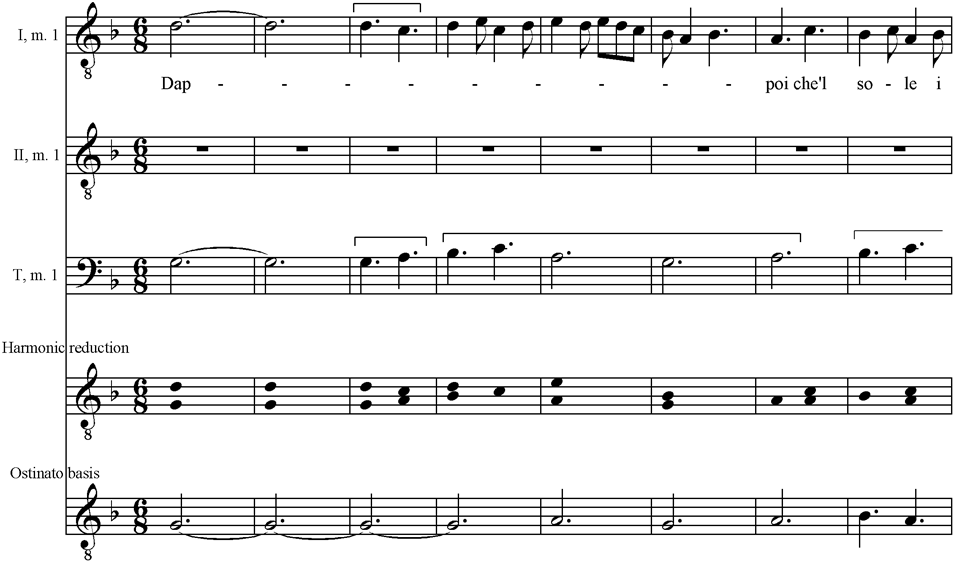
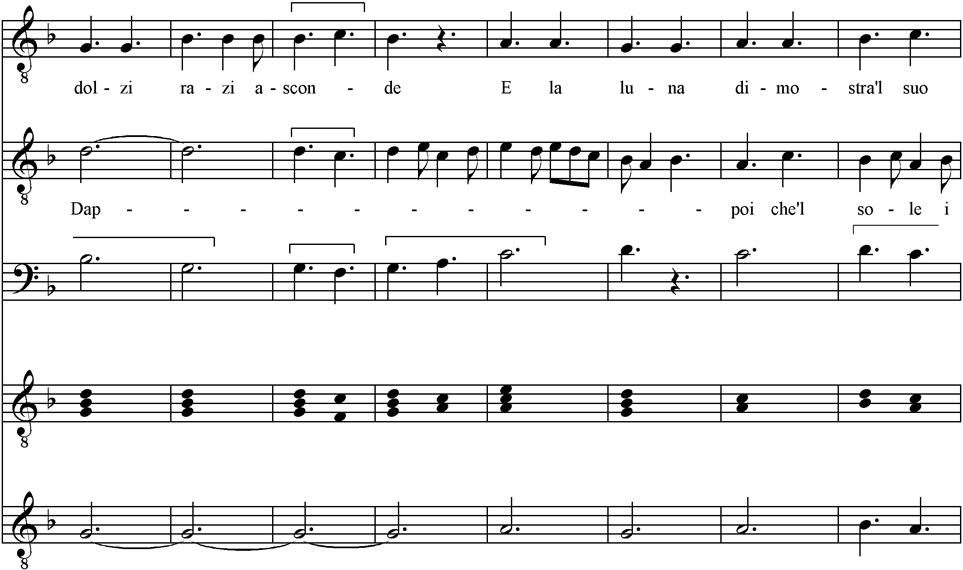
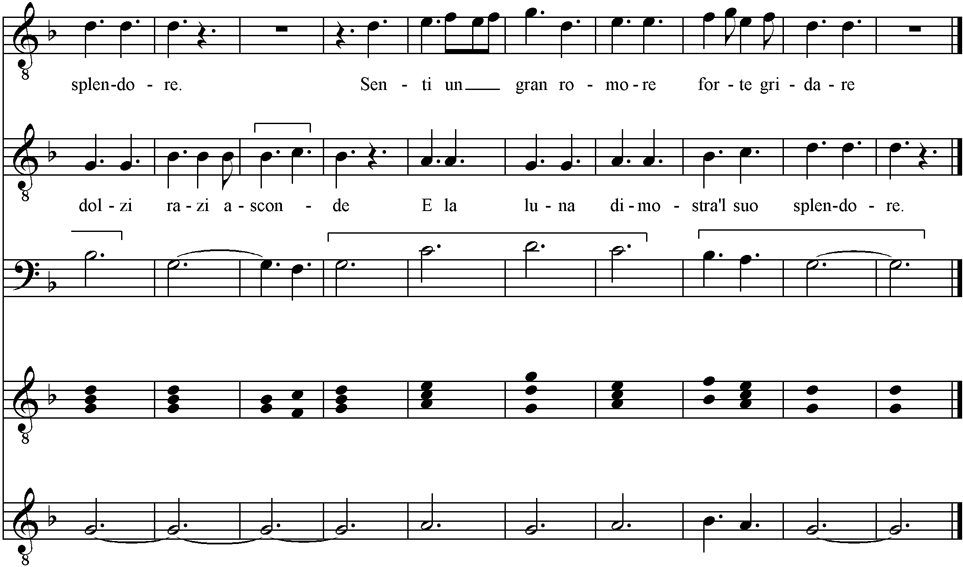
The later caccia repertoire presents us with a few examples of harmonic ostinato, though few repetition patterns turn out to be as concise and as easily memorised as the ‘A–G’ pattern considered above. The beginning of Niccolò's Dappoi che ‘l sole, for instance, combines melodic and harmonic repetition, the latter emerging almost as a by-product of the former (see Ex. 10). Indeed, the complex imitation scheme (cantus I borrows, at least partly, from the tenor; cantus II imitates cantus I) leaves virtually no opportunity for varying the harmonic progression, which again is narrowed down to the G and A concords (leaving aside a few auxiliary concords on F and one on B♭).
Niccolò da Perugia, Dappoi che ‘l sole, mm. 1–26.
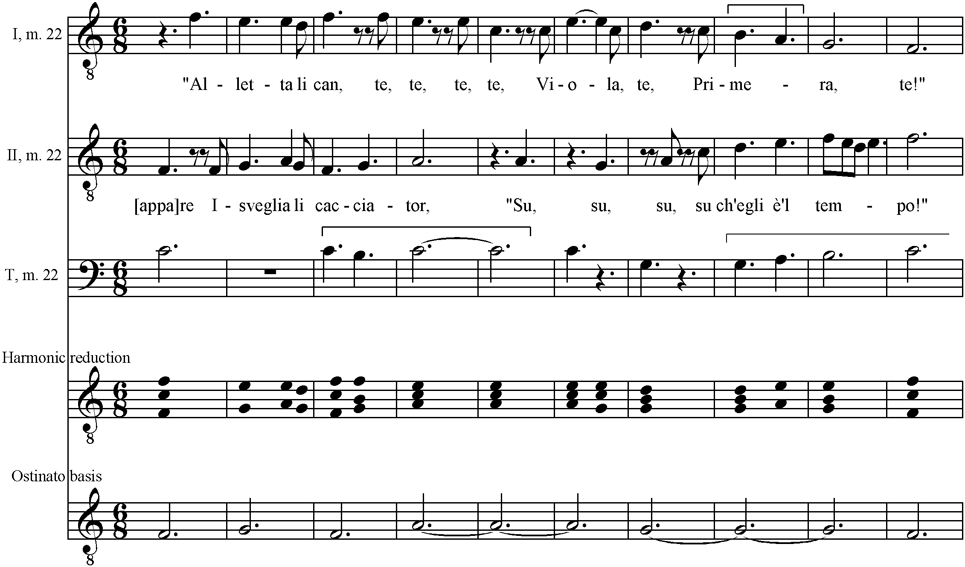
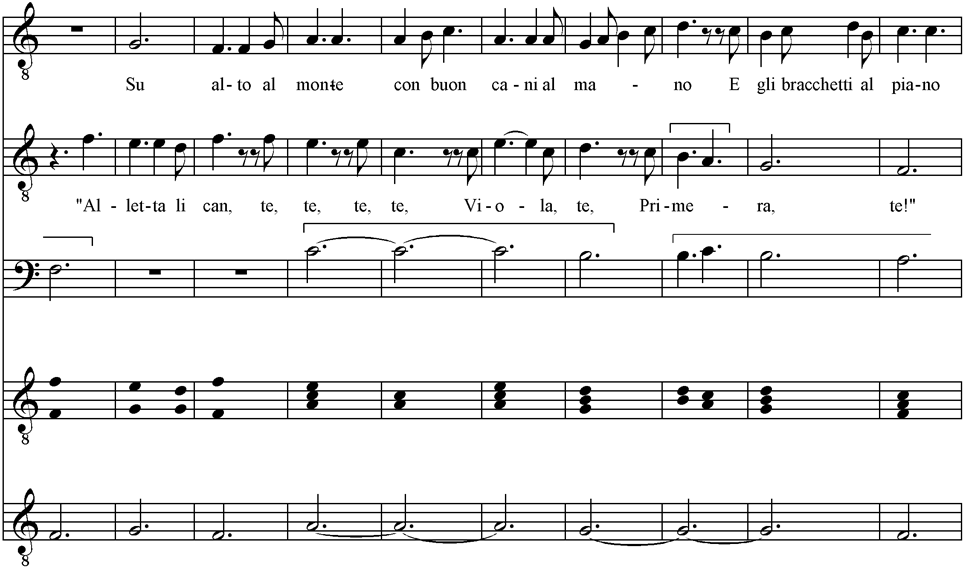
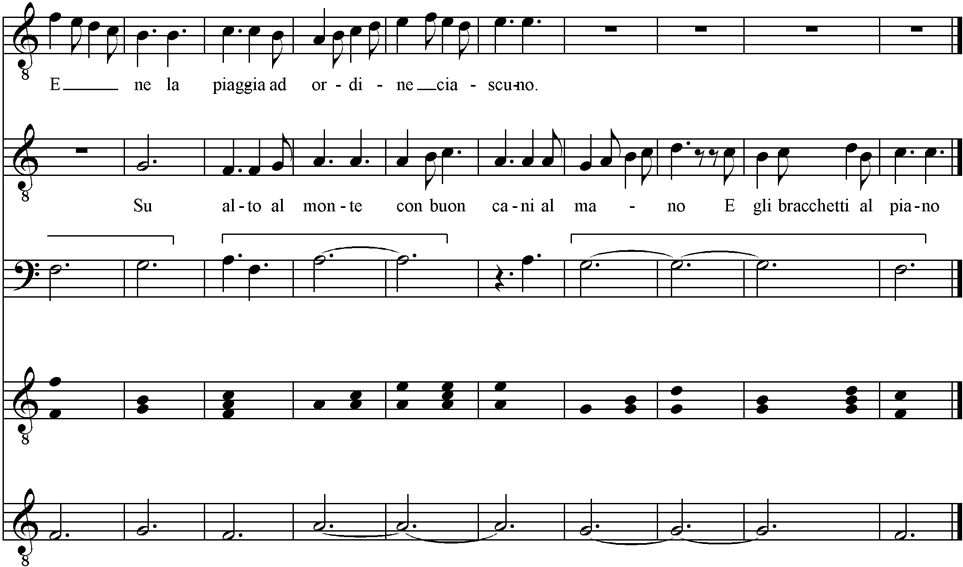
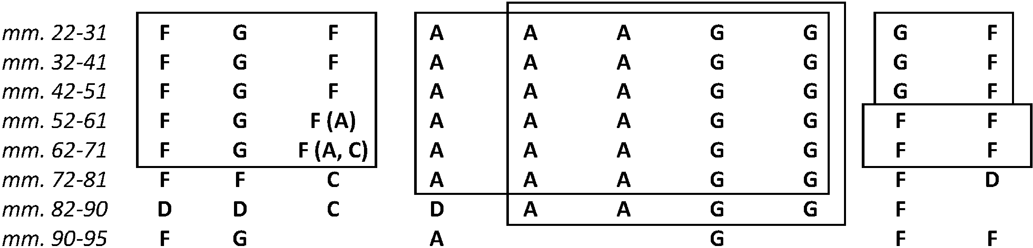
Another example is Gherardello's Tosto che l'alba, which includes a large ostinato fragment in the central section of the strophe (beginning at m. 22) comprising seven statements of a ‘mutable’ harmonic pattern.Footnote 37 (Ex. 11 gives only three of seven statements; all seven are represented in Fig. 3.)
Gherardello da Firenze, Tosto che l'alba, mm. 22–51.
An ostinato pattern from Gherardello's Tosto che l'alba, mm. 22–95.
The original progression consists of only three concords based on F, G and A (F–G–F–A–G–F); other sonorities (D and C) are introduced later. As is evident in Fig. 3, the pattern gradually changes in the course of repetition, particularly at the beginning and end (the last statement, which deviates sharply from the original, is the exception). No change, however, occurs in the core A–G progression (see the central framed section in Fig. 3) which produces a strong ostinato effect. Even the final cadence of the strophe (mm. 90–4) could be regarded as a concise and abbreviated variant of the original pattern (F–G–A–G–F). As in Piero's Con dolce brama, the musical periodicity of this portion of Tosto che l'alba is further reinforced by the text underlay, the main difference being the highly irregular poetic structure (compared with the regular hendecasyllables of Piero's piece).
It has by now become clear that sufficient evidence exists to argue that the repetition patterns considered above constitute an essential element of caccia's compositional planning and canonic writing; that these counterbalance the lively melodic writing and vivid poetic descriptions characteristic of the genre; and that structurally, ostinato procedure (particularly large-scale melodic and harmonic patterns) is an important link between ‘round’ and ‘continuous’ canonic forms. Let us conclude this examination by briefly considering other examples of ostinato-based compositions from adjacent repertoires in order to contextualise the procedure. I should also like to address the broader issue of caccia's genesis and historical development at the intersection of oral/aural and written traditions.
At first glance, ostinato technique seems to have little relevance to Trecento polyphony broadly considered, but a few examples stand out from the rest in their extensive use of repetition patterns. I refer to the presumably improvised Cividale repertoire of so-called ‘cantus planus binatim’ and related styles of ‘simple polyphony’,Footnote 38 including a substantial number of pieces based on voice-exchange technique.Footnote 39 Although these simple yet ingenuous pieces differ stylistically as well as functionally from the elaborate and refined caccia, they testify to the existence of an aural experience that could well have manifested itself in other repertoires.
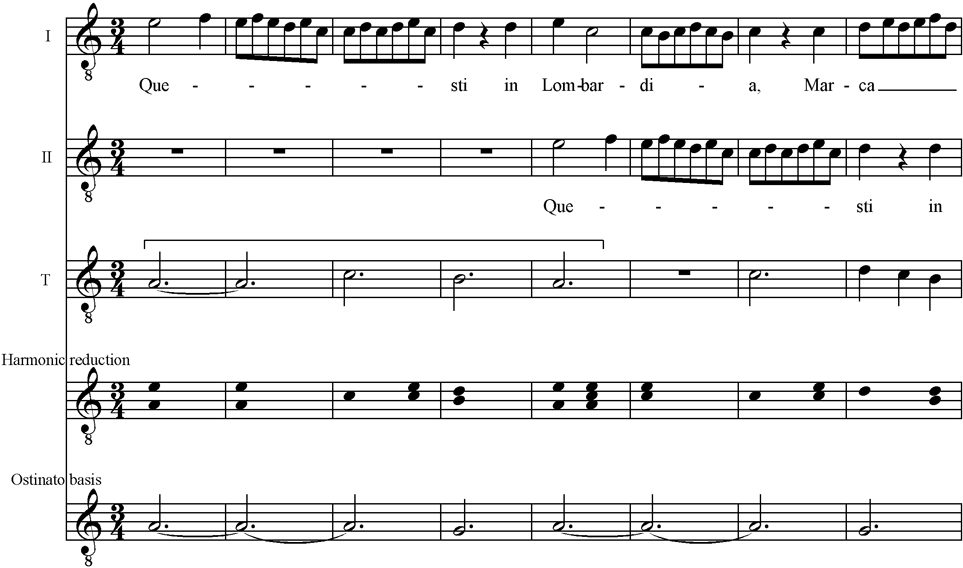
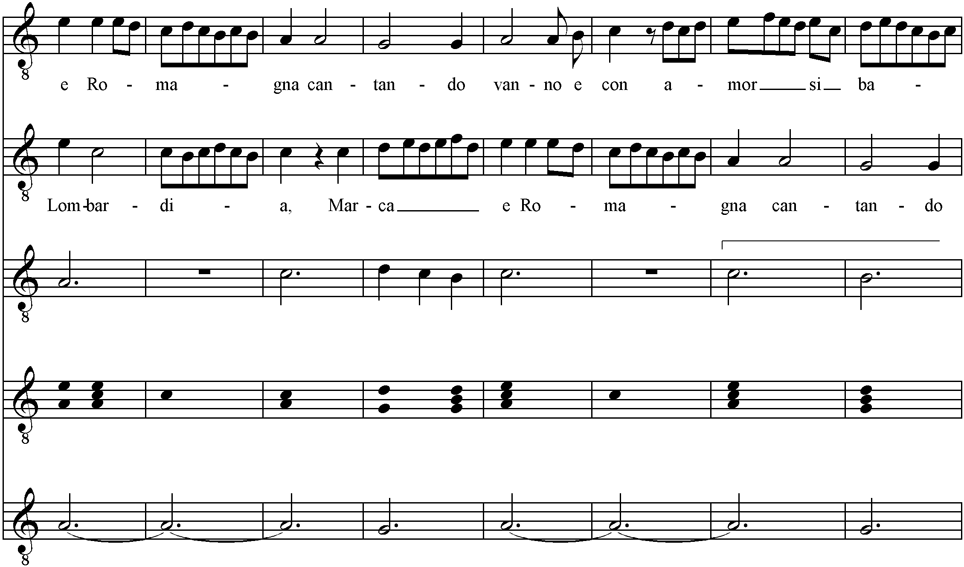
Another example is even more promising since it is a madrigal transmitted in an early northern Italian source (Rs) which belongs to the same cultural ambit as most early cacce. Thomas Marrocco was the first to draw attention to the anonymous madrigal E con chaval, the melodic structure of which reveals a double ostinato.Footnote 40 While the cantus melody includes many embellishments of, and deviations from, the original pattern, the tenor line consists of rigid repetitions of a simple progression (A–G–E–F–G–A–G) which is essentially built around the ‘A–G’ pattern discussed above in connection with some early cacce. Marrocco concludes: ‘we have before us a composition which may well be considered a landmark in Italian Trecento music. But it is curious that, despite the existence of this highly sophisticated and cleverly organized composition by a highly disciplined composer, the ostinato technique remains a unicum, for nowhere among the several hundred compositions of the Trecento repertoire it is again encountered’ (emphasis mine).Footnote 41 It is time finally to incorporate this madrigal into a more substantial body of ostinato-based Trecento compositions.Footnote 42
Although the pieces considered above clearly show that the ostinato effect was familiar to Trecento musicians, they do not prove its structural importance for canonic writing. Canonic repertoires of other countries might offer additional evidence for the connection between early forms of continuous canon and ostinato technique. Since this issue is beyond the scope of this article, I will restrict myself to a few notable examples from the English repertoire.
As Margaret Bent has pointed out, a certain number of canons from the Old Hall Manuscript require the support of a repeating ostinato.Footnote 43 In her detailed analysis of Pycard's five-voice canonic Gloria, she notes a certain periodicity and freely shifting repetition pattern, although she ultimately concludes that ‘the ostinato character was a by-product of the canon, not the canon of the ostinato’.Footnote 44 In a canonic Gloria by Dunstaple, however, the periodicity of harmonic changes and canonic structure leave little doubt that ‘the whole composition could have been built on a minimally simple harmonic ostinato’.Footnote 45 These examples suggest that ostinato patterns did not lose their compositional function with the decline of simpler ‘round’ and ‘rondellus’ forms of canon, which include repetition and periodicity as an integral part of their structure, but rather were assimilated into the new continuous (through-composed) canonic form.
It might be argued that repetition patterns in early Trecento cacce suggest a process of assimilating an older ostinato-based improvisatory tradition, which could have been similar to that described in the Capitulum de vocibus applicatis verbis. Ostinato procedure in notated examples would be an elusive trace of what may have been a characteristic feature of the earlier unwritten tradition. The function of ostinato had, however, been changing all along the way, such that in the surviving early corpus of Trecento polyphony repetition patterns were used more or less straightforwardly, often in coordination with poetic structures, while in later pieces (by Gherardello, Lorenzo and Niccolò) the irregularity and complex structural relationship between musical repetition patterns and texts reveal a new, skilful and ingenious approach, not a simple emulation of the earlier exemplars. Although the significance of ostinato technique evidently declined gradually in the course of caccia's historical development and structural transformation, attention to this phenomenon should be increased now as it might help illuminate a history that has thus far remained shrouded in mystery.
Appendix: sigla of manuscript cited
- FP
Florence, Biblioteca Nazionale Centrale, Panciatichi 26
- Lo
London, British Library, Add. 29987
- PR
Paris, Bibliothèque Nationale de France, n.a.fr. 6771
- Reg
Reggio Emilia, Archivio di Stato, Archivio Comune di Re[ggio], Appendice, Frammenti di codici musicali [Nr. 16]
- Rs
Rome, Biblioteca Apostolica Vaticana, Rossi 215 and Ostiglia, Biblioteca dell'Opera Pia Greggiati, mus. rari B 35
- Sq
Florence, Biblioteca Medicea Laurenziana, Mediceo-Palatino 87