Introduction
Brain-derived neurotrophic factor (BDNF) is a nerve growth factor which is abundant in the brain and periphery. BDNF is widely expressed throughout the brain and plays a major role in neuronal plasticity, survival and development (Reference Huang and Reichardt1). Much evidence suggests BDNF as a candidate molecule involved in the neurobiological and behavioural changes associated with major depressive disorder (MDD) (Reference Brunoni, Lopes and Fregni2). In animal models, forced swimming and chronic immobilisation stress decrease expression of BDNF mRNA (Reference Russo-Neustadt, Ha, Ramirez and Kesslak3,Reference Smith, Makino, Kvetnansky and Post4), which can lead to neuronal atrophy in the hippocampus and other brain structures (Reference Schmidt and Duman5). Several neuroimaging studies revealed that the hippocampus undergoes selective volume reduction in the MDD patients (Reference Koolschijn, van Haren, Lensvelt-Mulders, Hulshoff Pol and Kahn6). Infusion of BDNF itself into rat brain can produce an antidepressant-like effect by ameliorating learned helplessness (Reference Siuciak, Lewis, Wiegand and Lindsay7). In addition, antidepressant drug and chronic electroconvulsive treatments increase the expression of BDNF and neurogenesis in the adult rat brain (Reference Altar, Whitehead, Chen, Wörtwein and Madsen8). Consistent with animal studies, increased BDNF expression in hippocampal tissue was found in antidepressant-treated subjects compared with untreated subjects (Reference Chen, Dowlatshahi, MacQueen, Wang and Young9) and decreased levels of BDNF mRNA and protein were observed in hippocampus and frontal cortex of suicide victims, most of them diagnosed with MDD (Reference Dwivedi, Rizavi, Conley, Roberts, Tamminga and Pandey10). In addition, circulating levels of BDNF are reported to be lower in untreated depressed patients (Reference Karege, Bondolfi, Gervasoni, Schwald, Aubry and Bertschy11), while antidepressant medications appear to normalise this alteration (Reference Gonul, Akdeniz, Taneli, Donat, Eker and Vahip12). A meta-analysis found that serum BDNF levels are abnormally low in patients suffering from MDD and that the BDNF levels are elevated following a course of antidepressant treatment (Reference Sen, Duman and Sanacora13).
The BDNF gene val66met polymorphism has been associated with MDD, bipolar disorder and schizophrenia, but replication attempts have often provided inconclusive results (Reference Rybakowski14,Reference Schumacher, Jamra and Becker15). Although two recent studies found that the Val66met variant influences circulating levels of BDNF (Reference Lang, Hellweg, Sander and Gallinat16,Reference Ozan, Okur, Eker, Eker, Gönül and Akarsu17), the role of this genetic factor has been inconsistent. Indeed, several studies showed that the Val66met polymorphism was unrelated to the concentration of BDNF in serum, plasma or whole blood (Reference Jiang, Wang, Liu, Zhang and Chen18–Reference Tramontina, Frey, Andreazza, Zandona, Santin and Kapczinski20). The aim of this study was to further explore whether the Val66met polymorphism is correlated with the serum concentration of BDNF in MDD and whether serum BDNF concentrations are altered in drug-free patients with MDD compared to healthy control subjects.
Materials and methods
From the cohort of psychiatric inpatients admitted to the Department of Psychiatry of Yangzhou Wu Tai Shan Hospital in China between January 2006 and March 2007, 76 Chinese Han depressive patients between 20 and 65 years of age were recruited. Diagnosis of MDD was determined by the use of a structured clinical interview according to Diagnostic and Statistical Manual of Mental Disorder-IV (DSM-IV) criteria (21,Reference First, Spitzer, Gibbon and Williams22); they had no history of other psychiatric disorders or physical/neurological diseases. None of the patients had a history of a manic or hypomanic episodes or a first-degree relative with bipolar disorder. The diagnosis was reached independently by at least two senior psychiatrists. All patients scored 18 or higher on the 21-item Hamilton Depression Rating Scale (HDRS-21), which was used for assessment of symptom severity (Reference Hamilton23). They were either medication-naive or medication-free for at least 4 weeks. For these patients BDNF values were obtained from serum samples collected on the day before antidepressant initiation. Fifty healthy subjects (22 males and 28 females) were studied as control subjects. Control subjects were not on medication and had no history, or first-degree family history, of mental disorders, neurological diseases or drug abuse. Age, gender and education years were matched between the MDD patients and the normal controls. The study was approved by the local Institutional Ethics Committee. Written informed consent was obtained after a full written and verbal explanation of the study. None of the subjects were regular drinkers or smoker.
Following an overnight fast, serum samples from the patients and healthy controls were collected between 8:00 and 9:00 and stored at −80 °C until used for assay. The concentrations of BDNF were measured with the enzyme-linked immunosorbent assay (Emax Immunoassay System kit; Promega, Madison, WI, USA) according to the manufacturer's instructions. The samples were diluted 1:2 with block and sample 1× buffer. All samples were tested in triplicate and the mean was calculated. The intra- and inter-assay coefficients of variation were <4 and <5%, respectively. Genomic DNA was extracted from 300 µl ethylene diamine tetra acetic acid-anticoagulated venous blood using Puregene DNA Purification kit (Gentra, Minneapolis, MN, USA) according to the manufacturer's recommendation. Polymerase chain reaction was performed with the sense primer 5′-ACT CTG GAG AGC GTG AAT-3′ and the antisense primer 5′-ATA CTG TCA CAC ACG CTC-3′. The amplified DNA was digested with the NlaIII restriction enzyme (New England Biolabs, Beverly, MA, USA), which cuts at the 196A site and the product was electrophoresed in 2% agarose gels and stained with ethidium bromide. Restriction enzyme digestion results in a 243 bp product (66Val) or 168 and 75 bp products (66Met).
The chi-squared goodness-of-fit test was used to test the distribution of genotypes and allele frequencies for deviations from Hardy–Weinberg equilibrium in patients and normal control samples. Chi-squared or Fisher's exact test was performed on categorical data and study groups were compared for continuous variables by a two-tailed t-test or Mann–Whitney U test. Analysis of covariance was performed to compare BDNF serum concentrations between genotype groups, using age and gender as covariates. The relationship between the serum BDNF and clinical variables was examined using Pearson's correlation coefficient. Statistical significance is indicated by p values less than 0.05. All statistical analyses were performed using SPSS (version 10.0 for Microsoft Windows, SPSS Inc., Chicago, IL, USA).
Results
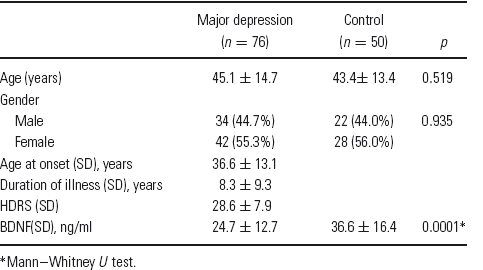
Table 1 shows the demographic and clinical characteristics of both the MDD and control groups. The concentrations of serum BDNF were significantly lower in the patients with MDD (mean = 24.7 ± 12.7 ng/ml, p < 0.001) compared with the control subjects (mean = 36.6 ± 16.4 ng/ml). No significant correlation was found between serum BDNF and age in MDD patients (r = 0.196, p = 0.089) or controls (r = 0.045, p = 0.756). Moreover, there was no significant difference in the serum BDNF levels between males and females (MDD patients: male = 34, 22.02 ± 11.7 ng/ml vs. female = 42, 26.9 ± 13.1 ng/ml, p = 0.098; control group: male = 22, 38.5 ± 17.9 ng/ml vs. female = 28, 35.1 ± 15.3 ng/ml, p = 0.48). Neither age at onset (r = 0.067, p = 0.576) nor duration of MDD (r = 0.168, p = 0.148) correlated significantly with serum BDNF in patients. No significant correlation was observed between BDNF and HDRS scores (r = −0.063, p = 0.586) in MDD patients. The HDRS has been shown to be multi-dimensional which has only some items to assess the severity of depression (Reference Bagby, Ryder, Schuller and MarshaIl24). Maier and Philipp (Reference Maier and Philipp25) have developed a subscale that assess the severity of depression includes items of depressed mood, guilt, work/interests, psychomotor retardation, anxiety and general somatic symptoms. There was no significant correlation between the serum BDNF and HDRS item 1 (depressed mood: r = 0.023, p = 0.842), item 2 (guilt: r = 0.058, p = 0.62), item 7 (work/interests: r = −0.152, p = 0.189), item 8 (psychomotor retardation: r = −0.116, p = 0.316), item 10 (anxiety: r = 0.102, p = 0.379) and items 13 (general somatic symptoms: r = −0.122, p = 0.293). The serum BDNF levels in patients with a family history of mood disorders (n = 15,25.6 ± 12.5 ng/ml) did not differ from those in patients without such a history (n = 61,24.5 ± 12.8 ng/ml; p = 0.761).
Demographic features, HDRS scores and BDNF serum concentrations of the groups
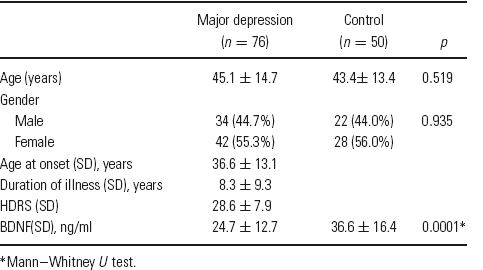
* Mann–Whitney U test.
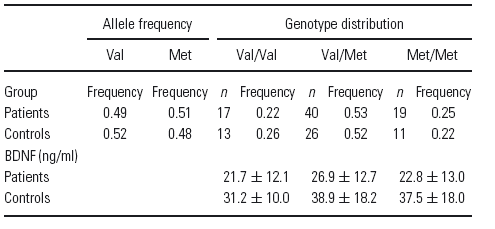
Allele frequencies and genotype distributions of the subjects for the Val66Met in the BDNF gene were shown in Table 2. The genotypic distributions in MDD ( X 2 = 0.227, df = 2, p = 0.893) and control groups ( X 2 = 0.084, df = 2, p = 0.959) were consistent with the Hardy–Weinberg equilibrium. There were no significant differences in the distribution of the allele frequencies and genotype between the MDD patients and controls ( X 2 = 0.265, df=1, p=0.607; X 2=0.283, df = 2, p = 0.868, respectively). The BDNF serum concentrations were not significantly different between the genotypes of Val66met polymorphism in MDD patients and controls.
The Val66met polymorphism and BDNF serum concentrations according to the genotype in MDD patients and controls
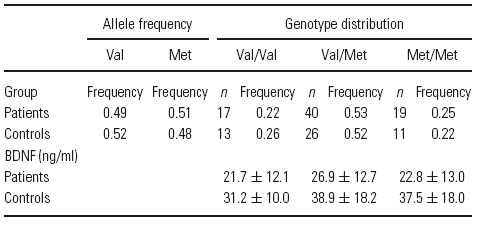
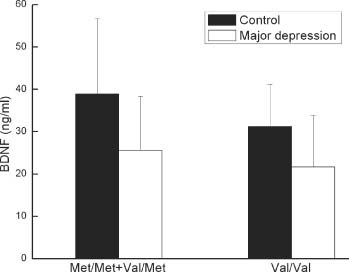
BDNF serum concentrations by genotypes in major depression disorder patients and control group were presented in Fig. 1. There were no significant differences in BDNF serum concentrations between the Met/Met + Val/Met and Val/Val genotype groups (MDD patients: p = 0.199; control group: p = 0.472). An analysis of covariance in all research subjects independent of the diagnostic status showed that the dependent variable BDNF serum concentrations were not significantly affected by the factor ‘genotype' (Met/Met + Val/Met vs. Val/Val: F = 2.172, df = 1, p = 0.143), the covariate ‘age' (F = 1.199, df = 1, p = 0.276) and ‘gender' (F = 0.189, df = 1, p = 0.665).
Val66Met polymorphism and BDNF serum concentrations in major depression disorder patients and control subjects.

Discussion
The main findings of this study were that serum BDNF were significantly lower in the patients with MDD compared with the control subjects. We found no significant differences either in allele or genotype in the Val66Met polymorphism between the MDD and control groups. Moreover, genotype did not significantly correlate with the BDNF serum levels in the MDD or control groups.
Previous studies reported that serum or platelet BDNF levels were reduced in depressed patients (Reference Brunoni, Lopes and Fregni2,Reference Karege, Bondolfi, Gervasoni, Schwald, Aubry and Bertschy11,Reference Lee and Kim26), while antidepressant treatment appears to normalise this alteration (Reference Gonul, Akdeniz, Taneli, Donat, Eker and Vahip12,Reference Sen, Duman and Sanacora13). Two meta-analyses study showed a reduction of both BDNF serum and plasma levels in MDD (Reference Sen, Duman and Sanacora13,Reference Bocchio-Chiavetto, Bagnardi and Zanardini27); our finding was consisted with their reports. In addition, some studies report that serum BDNF levels are negatively correlated with the severity of depression (Reference Gonul, Akdeniz, Taneli, Donat, Eker and Vahip12,Reference Shimizu, Hashimoto and Okamura28). However, Lee et al. (Reference Lee, Kim, Park and Kim29) reported that plasma BDNF levels had significant positive correlations with HDRS. Our findings show no significant correlation between HDRS score and serum BDNF. Moreover, we found no significant correlation between serum BDNF and HDRS items 1, 2, 7, 8, 10 and 13. Thus, we infer from our findings that serum BDNF levels are not significantly correlated with the severity of depression. We found no significant correlation between serum BDNF and age or gender. Neither age at onset nor duration of MDD correlated significantly with serum BDNF in patients. These results are consistent with other findings (Reference Sen, Duman and Sanacora13,Reference Lee and Kim26). A lot of determinants may affect the BDNF level. Bus et al. (Reference Bus, Molendijk and Penninx30) identified eight independent determinants of serum BDNF levels, i.e. time of blood withdrawal, time of storage, food intake before sampling, urbanicity, age, sex, smoking status and drinking behavior. Huang et al. (Reference Huang, Lee and Liu31) found that there are significantly low serum BDNF protein levels in depressive patients than healthy controls in women, but not in men. Moreover, there were significantly increased changes in serum BDNF protein levels in women patients taking antidepressants during a period of 4 weeks. For the responders in women, there were significantly increased changes in serum BDNF protein levels, but not in men.
We found that the allele frequency of the Val66Met polymorphism in BDNF was not different between MDD and control groups. This negative result is also consistent with previous studies involving Asian populations (Reference Hong, Huo, Yen, Tung, Pan and Tsai32,Reference Tsai, Cheng, Yu, Chen and Hong33). In contrast, an association has been reported between the BDNF Val66Met polymorphism and geriatric depression in a Chinese population (Reference Hwang, Tsai, Hong, Yang, Lirng and Yang34). Zou et al. (Reference Zou, Ye, Feng, Su, Pan and Liao35) detected a significant genetic association between the BDNF Val66Met polymorphism and treatment response in patients with MDD in their meta-analysis and Val/Met heterozygous patients have a better response rate in comparison with Val/Val homozygous patients, especially in the Asian population. Moreover, Kato and Serretti (Reference Kato and Serretti36) found that the Met allele carriers have a favourable response to antidepressant treatment. However, Domschke et al. (Reference Domschke, Lawford and Laje37) did not find an association between genetic variation in BDNF and antidepressant treatment response or remission. A recent meta-analysis of the association of the BDNF Val66Met polymorphism with MDD investigated 2812 patients and 10 843 controls from 14 case–control studies (Reference Verhagen, van der Meij, van Deurzen, Janzing, Arias-Vásquez, Buitelaar and Franke38), but did not detect any significant association. Verhagen et al. (Reference Verhagen, van der Meij, van Deurzen, Janzing, Arias-Vásquez, Buitelaar and Franke38) found that the BDNF Val66Met polymorphism is of greater importance in the development of MDD in men than in women. Our results indicate a possible trend towards an interaction between gender and serum BDNF in MDD patients. (male = 34, 22.02 ± 11.7 ng/ml vs. female = 42, 26.9 ± 13.1 ng/ml, p = 0.098). Our failure to show significant association supports the conclusion that BDNF gene Val66Met polymorphism may not play a major role in MDD pathogenesis for our Chinese sample population.
The Val66Met polymorphism lies within the pro-BDNF sequence, which is cleaved post-transcriptionally. Although this polymorphism does not affect mature BDNF protein function, it has been shown to affect activity-dependent secretion of BDNF in cultured cells (Reference Chen, Patel, Sant, Meng, Teng, Hempstead and Lee39). A study by Egan et al. (Reference Egan, Kojima and Callicott40) showed that the Val/Met polymorphism at codon 66 in the BDNF affects intracellular distribution, packaging and release of the BDNF protein in vitro. Although it has been hypothesised that BDNF Val66Met genotype is associated with circulating levels of BDNF (Reference Lang, Hellweg, Sander and Gallinat16,Reference Ozan, Okur, Eker, Eker, Gönül and Akarsu17), the contribution of this genetic factor remains unclear. Others suggest that the Val66Met polymorphism influences only local activity-dependent secretion from neurons, whereas the constitutive secretion and average BDNF concentrations in brain and blood are unaffected by the genotype (Reference Chen, Jing and Bath41). In addition, other work has reported that the Val66Met polymorphism is unrelated to whole blood BDNF concentration (Reference Trajkovska, Marcussen, Vinberg, Hartvig, Aznar and Knudsen19) and is also unrelated to plasma or serum concentrations of BDNF (Reference Jiang, Wang, Liu, Zhang and Chen18,Reference Tramontina, Frey, Andreazza, Zandona, Santin and Kapczinski20,Reference Terracciano, Martin and Ansari42). Our findings are consistent with the majority of these studies.
Some limitations of this study must be taken into consideration. First, the number of patients was small and it would therefore be unwise to generalise the results. We cannot rule out the association of other genetic polymorphisms in the BDNF gene with BDNF serum concentrations which would require further investigation and confirmation in larger samples and other ethnic populations.