The fabulous story of James Buchanan Duke, founder of the modern mass production industry, has been frequently told, but—it will be argued here—is fundamentally wrong.2
Chandler, Visible Hand, pp. 382–91; and McCraw, Prophets, pp. 72–73.
I shall follow my predecessors in treating cigarettes as a conventional economic “good,” eschewing the hindsight that the trillions of sticks sold killed millions of people. Despite this ending, the textbook fable has achieved iconic status because it so clearly illustrates the application of the innovative Bonsack machine to the development of an essentially new product that was branded and advertised to a standardized mass market of modern, urban consumers. This is, naturally, also a story of American leadership in the second industrial revolution, with the American Tobacco trust's majority-controlled foreign subsidiary, British American Tobacco (BAT), becoming “among the most impressive American firms abroad.”
3 Wilkins, Emergence, p. 91.
Duke's “visible hand” triumphed over Germany (which betrayed its usual limited entrepreneurial response in branded packaged products) and the United Kingdom (whose Imperial Tobacco trust compromised its initial brand skills by perpetuating family management, rather than creating the professional management hierarchy that this archetypal modern industry required).
4 Chandler, Scale, pp. 247–49, 430–32.
Key aspects of success were the economies of speed and forward vertical integration that Duke needed “to transform the high fixed costs that he had strategically incurred into low unit costs and sustained competitive advantage.”
5 Lazonick, Business Organization, p. 241.
Duke's peccadillo—no one is perfect—was his attempt to do the same in cigars, where brand proliferation and the absence of economies of scale prevented the replication of his “massive output” in cigarettes.
6 Chandler, Visible Hand, p. 390.
The power of this fable is underlined by its widespread acceptance by scholars who have a more nuanced picture of the diversity of American demand and the complexity of entrepreneurial responses to it. Scranton acknowledges Duke's achievement in meeting mass market demand in this quintessentially modern industry, before hastily moving on to products more congenial to his thesis.7
Scranton, Endless Novelty, pp. 4, 354.
A European critic of Chandlerian oversimplification notes that James Bonsack licensed his machine in Britain first, before excusing Britain's later falling behind on account of the larger U.S. market.
8 I cite these points, not to ridicule the story-tellers, but to excuse myself. I have grumbled that a few facts do not fit this story, but I have often retold it.
9 Hannah, “American Miracle”; and Hannah and Wada, Miezaru.
NATIONAL MARKETS AND TOBACCO TAXES
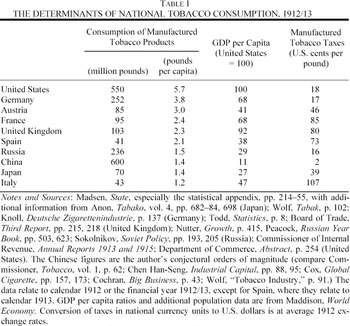
Tobacco was grown and used widely in Europe and Asia as well as on its native continent. Table 1 shows the impressive size of the largest markets (column 1) and the annual manufactured tobacco consumption per capita (column 2) in the major industrial and industrializing economies and the largest underdeveloped economy before World War I. Broadly, consumption varied with income levels and tobacco taxes (the last two columns).The notion of a tobacco “tax” is problematic where there was a state-operated tobacco monopoly (as in Austria, France, Italy, and Japan) or a privately franchised state monopoly (as in Spain): I have adopted A. W. Madsen's contemporary adjustments of reported state profits (for tax collection costs, capital charges and so on) to arrive at tax-equivalents. Except in China, where the state barely functioned, tobacco taxes often dwarfed other elements of cost and varied more than the other major cost, tobacco leaf. In the highest tax country, Italy, tobacco taxes were six times the American level and accounted for more than two-thirds of retail tobacco prices: this column is a proxy for international price differences. High prices explain the relatively low consumption levels in the United Kingdom, Italy, and France, whereas low prices in the United States, Germany, and China explain high sales, relative to incomes.
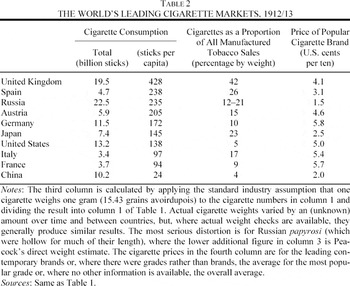
Traditional tobacco usages still dominated everywhere—the pipe in Japan, China, and Britain, chewing tobacco in the rural United States, the more recent innovation of cigars in urban America, Germany, and Italy—but cigarettes had been spreading rapidly. As Table 2 shows, Russia remained the major producer of cigarettes, as in the hand-rolling era, when the cigarette fashion spread westwards from the Tsarist and Ottoman Empires. However, Spain, Germany, Austria, and the United Kingdom were well ahead of the United States in cigarette consumption per capita (column 2), despite their lower incomes, while American consumption languished below Japanese levels. An alternative measure of cigarette development—the percentage of all tobacco use in the form of the cigarette (the penultimate column in Table 2)—shows all large European economies and Japan ahead, though the United States retained a slight lead on China.
Some of this U.S. “backwardness” is cultural: Americans chewed tobacco. Smoking tobacco sales did not exceed chewing sales by weight until around 1908.10
Robert, Story, p. 274; Commissioner, Tobacco, vol. 3, pp. 125, 135; and Nicholls, Price Policies, pp. 9–11.
It seems reasonable to suppose that conversion to cigarettes was a larger step for Americans than the shift by Europeans and Asians from pipes and cigars. Yet when Americans did take to smoking, it was to cigars rather than cigarettes that they usually moved. As late as 1912, cigars accounted for nearly six times as much leaf tobacco use as cigarettes in the United States and, by value, cigars accounted for more than all other tobacco sales combined. In Britain cigars were smoked on special occasions or by the elite (and were vastly outnumbered by cigarettes), but in the United States cigars dominated the smoking market. The
fin de siècle British press image of the plutocratic Yankee with an expensive, fat cigar was a misleading caricature, not because of the fat cigar, but because its smoker was not rich: merely an East Coast city-dweller enjoying an everyday pleasure.
One factor restraining American cigarette sales was the cigarette prohibition movement: 15 states prohibited the sale of cigarettes, while permitting other tobacco habits. However, these were states where cigarettes were already little used and the laws were, in any case, sometimes not enforced, so this is unlikely to have been a major factor.11
Tate, Cigarette Wars; Alston et al., “Social Reformers”; and Young, Story, pp. 271–76.
There are stronger clues to the differential progress of the cigarette in prices. The last column of
Table 2 shows the retail price of popular cigarette brands before the First World War. These prices were, of course, originally at small coin price points in the national currencies—such as the U.S. price of a nickel for a pack of ten shown—but have been converted to cents (at average exchange rates for 1912) for ease of comparison. Low prices were clearly a key to high consumption in poorer countries such as Russia, China, and Japan, but the U.S. price was, in a country used to cheap tobacco, a little higher than the West European average for cigarettes. Consumers everywhere were willing to pay for the taste, convenience, modernity, or higher level of finish of the cigarette, but the extra they had to pay varied. In the United Kingdom—the most rapid adopter in
Table 2—cigarettes were around 75 percent more expensive per ounce than the cut pipe tobaccos that were the main alternative preferred by British smokers.
12 Prest and Adams, Consumers' Expenditure, pp. 89–90.
In the United States, by contrast, cigarettes cost around four times as much as plug or smoking tobacco, weight for weight. In Japan, France, and Austria they were respectively two, three, and six times the price of the cut tobacco that was the main local alternative.
13 Commissioner, Tobacco, vol. 3, pp. 246, 267, 277, 284, 338; and Madsen, State, pp. 220, 243, 249.
It appears that state tobacco monopolies (directly in their pricing policies) and internal revenue authorities (through their tobacco tax policies) showed some bias against what later came to be seen as the modernization of tobacco taste. In Britain no tobacco leaf was grown domestically, so the most natural form of tobacco tax was a levy on leaf imports. This was, of course, inherently nondiscriminatory between final uses.
14 Germany also had a leaf tax (on both domestic production and imports), but supplemented it in 1906 with a cigarette consumption tax, so British tax neutrality cannot be considered completely accidental.
However, the general practice was to tax the final products, facilitating bureaucratic or political discretion. This was, judging from the evidence on price relativities, used to deter the innovation of the cigarette in the United States and elsewhere.
Yet nontax factors were clearly also at work. The United Kingdom had a price of just over four cents for ten Wills's Woodbines (actually one English penny for a pack of five). High taxes accounted for just under half of this U.K. cigarette price. U.S. cigarette taxes were much lower—exactly a quarter of the American retail price—so the ex-tax price of the trust's Sweet Caporal brand was three-quarters higher than that for Woodbines.15
Woodbine cost accounts for 1900, up-rated by the 1909 duty increase, with allowance for reduced tobacco content and productivity increase, see Alford, Wills, pp. 245, 483. U.K. taxes were also payable on leaf purchase not product sale, so interest charges need to be added in comparing with U.S. taxes.
The available cost accounts for these two brands are not directly comparable, but they are consistent with three explanations.
16 Ibid., pp. 244–45; and Commissioner, Tobacco, vol. 3, pp. 167–72, 334–39.
First, the British and Irish smoked smaller cigarettes, possibly containing a quarter less tobacco in the case of the brands in question.
17 The average Wills cigarette in 1912 weighed 14.30 grains (Alford, Wills, pp. 476, 478) and Woodbines would have been below this; for Sweet Caporal weights averaging 17.59 grains in a small 1899 New York sample, see Young, Story, p. 133.
Second, U.K. producers were further down the experience curve of large-scale manufacturing. By 1905 Woodbine—the mass market brand of
one branch of Imperial Tobacco—was selling more sticks than
all the U.S. brands of the American Tobacco Company collectively.
18 Alford, Wills, p. 478; and Commissioner, Tobacco, vol. 3, p. 168.
Because almost all Imperial's leaf was imported from America, Britain's raw material costs (including transport) were higher: if it had a cost advantage, it was in manufacturing or selling costs. Third, the American Tobacco trust may have more thoroughly exploited its monopoly by restricting output and raising prices than its British rival. There is evidence that all three factors played a role.
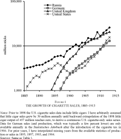
The timing of the United States's falling behind in total sales of cigarettes is shown in Figure 1. The top line in the chart shows the expected pattern of steady sales growth in Russia, a mature cigarette economy, with demand primarily driven by rising real incomes, population, and urbanization. As the cigarette fashion spread to America and Western Europe, sales might have been expected to grow faster than this, with growth tailing off to Russian levels as their markets matured. In the 1880s only France (not shown on the graph) and the United States were well embarked on this growth curve, with similar early sales levels, but the French state monopoly soon dropped out of the race in machine-made cigarettes and concentrated on what the French called scaferlati: cut tobacco for the consumer to hand-roll cigarettes. The latecomers in machine-made cigarettes, Britain and Germany, only reached 1880s French and American levels of production in the mid-1890s. Both the British and the German markets then showed the classic latecomer development pattern: growing much faster initially, but at similar rates as they matured. The United States also exhibited rapid growth in the 1880s, and was well ahead, but from 1896 cigarette sales stagnated, and were still below the 1896 level in 1905. U.S. aggregate cigarette sales were overtaken in the United Kingdom by 1898 and in Germany by 1901.
FIGURE 1 THE GROWTH OF CIGARETTE SALES, 1885–1913
The chronology of U.S. cigarette taxation correlates well with some of this. The tax of 0.05 cents per cigarette was raised to 0.1 cents in July 1897 and to a peak of 0.15 cents in June 1898, and the differential with plug and other tobaccos was also then at its highest, as the federal government struggled to fund the Spanish-American War. In July 1901, however, the tax was lowered to 0.108 cents per cigarette (0.054 cents on cheaper ones), and tax rates then remained stable until July 1910, when they were raised to a uniform 0.125 cents. Even before the 1897/98 tax increases, the trust, despite rapidly falling costs, abjured a policy of significantly lowering prices to expand demand.19
Between 1893 and 1899 manufacturing, selling, advertising, and freight costs halved, saving almost as much as the increased tax, see Commissioner, Tobacco, vol. 3, p. 155.
The recovery after the July 1901 tax reductions was slow, and mid-1890s sales levels were only exceeded when the trust's contacts in government circles were making it clear, from 1906 onwards, that it faced a serious federal antitrust threat.
20 Kolko, Triumph, pp. 125–26.
The market response to the large but short-lived tax rises of 1897/98 (a 36 percent fall in sales between 1896 and 1901) was very different from the response, postdissolution, to the smaller but permanent 1910 tax rise (a 106 percent rise in sales between 1910 and 1913).
21 Commissioner, Tobacco, vol. 3, pp. 7, 155, 324.
It is important, then, to examine the policies of the trust and the strategic context in which it formed them.
THE STRATEGIES OF THE TRUST
There is no good scholarly history of the leading companies in the tobacco trust.22
Anon., American Tobacco; and Anon., Lorillard, are slender volumes in more senses than one. Tilley, R. J Reynolds; and Cox, Global Cigarette, are excellent, but deal with subsidiaries that were quite independently managed. Durden, Dukes, is balanced, but concentrates on the family rather than the firm.
Consequently, our understanding of the firm's core strategy has to be based on revealed behavior. Duke's journalistic biographer's assertion that he “never entered a room where cigarettes were being smoked without a sniff of distaste” is, of course, unhistorical, but there is no reason to doubt its poetic truth.
23 Winkler, Tobacco Tycoon, p. 262.
Certainly Duke chewed plug in his early days and smoked cigars as he graduated to the society circles of New York and London.
24 That Duke ignored colleagues' advice in the mid-1890s and decisively shifted the American Tobacco Company's domestic focus from cigarettes to other tobacco products is clear.
25 Duke himself stated that one of his motivations was genuine doubt about the future of the cigarette, though some have been inclined to suspect the serial monopolizer of lying to cover his true intent.
26 Tate, Cigarette Wars, p. 32.
This is not entirely implausible—he had a record of telling considerably less than the whole truth and of attempting to bribe witnesses—but even confirmed liars sometimes tell the truth.
27 Moody, Long Road, pp. 156–59, 204; Industrial Commission, Report, pp. 317–28.
Whatever his motives, Duke restricted the sales of cigarettes, in the textbook monopolistic manner, generating the profits required to finance diversification within, and the monopolization of, the whole manufactured tobacco industry. This was a bold, not to say foolhardy, plan, for, on its foundation in 1890 as a merger of five companies, the American Tobacco Company sold 90 percent of cigarettes, but less than 5 percent of all U.S. tobacco products.28
Commissioner, Tobacco, vol. 1, p. 325, vol. 2, pp. 8, 242; Durden, Dukes, p. 58; and Department of Commerce, Abstract, p. 700.
In its first major predatory pricing campaign, in plug, the trust lost $4.1 million between 1895 and 1898, though it also needed tens of millions more to acquire established plug companies: the additional capital had to come not just from current profits but from capital issues to investors lured by the prospect of future monopoly profits in cigarettes and plug.
29 Burns, “Outside Intervention”; and Commissioner, Tobacco, vol. 2, pp. 71–76; vol. 3, pp. 51, 155.
Duke floated the trust's stock on the New York Stock Exchange in 1895 and then constrained domestic sales in an attempt to rack up profits. Between 1895 and 1904, independent manufacturers doubled their cigarette sales, while trust sales fell, reducing its market share from an initial 90 percent to around 75 percent. The trust also bought ten competing, independent manufacturers in the years around the turn of the century. If these independents had maintained their market share, the trust's share of the U.S. cigarette market would have declined to around 56 percent in 1906, implying a halving of the original trust's core sales in ten years.
30 Commissioner, Tobacco, vol. 1, pp. 228–31, 329–33, with allowances for pre-1898 little cigar output as in Figure 1.
Clearly the trust was the major force restricting output for the domestic market in this period. The average wholesale cigarette price charged by the trust rose almost every year for more than a decade after 1897.
31 Ibid., vol. 3, pp. 155, 327.
By 1900 the unexpected combination of the tax squeeze with the trust's own output restriction was devastating. Cigarette profits could no longer support Duke's expanding predatory pricing ambitions in snuff, cigars, and overseas markets. Fortunately his gamble in plug had paid off: in that year plug profits were rising rapidly, as the new monopoly was consolidated. Two years later they were nearly seven times domestic cigarette profits. Cigarettes were by then making even lower profits than the trust's newly organized snuff subsidiary, and snuff, not cigarettes, was the most rapidly growing tobacco product category between 1895 and 1910.32
Ibid., vol. 3, pp. 51, 138–39, 155. Contemporaries bracketed cigarettes and snuff together as the unimportant branches of the industry, see Ibid., vol. 1, p. 50.
It is conceivable that trust managers, despite their experience of the success of cheap cigarettes abroad, considered them as a niche, rather than mass market product at home.
Such a conjecture is compatible with the marked change in branding strategy for cigarettes at the end of the nineteenth century, when Sweet Caporal had 50 percent of the market. American Tobacco then muted the mass market strategy for which its fablers lauded it, and refocused on a policy of strong product differentiation and a move to the luxury end of the smoking market, promoting new brands such as Piedmont and Mecca at a variety of prices and higher manufacturing costs.33
Ibid., vol. 3, pp. 16, 162–63.
Duke attempted to increase appropriation of consumers' surplus by price discrimination, particularly in Turkish cigarettes, using substantial quantities of expensive, imported dark tobacco. These had previously been largely the preserve of immigrant hand-rolling workshops in New York, but partial mechanization increased his market share from 1 percent at the turn of the century to 60 percent by 1910. Directed at the cheaper end, the trust's cigarettes were known derisively as “imitation Turkish” in the trade, which attached some importance to hand-rolled quality. His factories were smaller than for mass-produced cigarettes, and some machinery could not be used: for example, Turkish cigarettes were usually oval rather than round, and packing had to be done by hand. The prize was higher prices and profits from selling a luxury rather than mass market product: Turkish cigarettes sold at a premium price of a dime to a quarter for ten, twice the price of mass market brands or more. The average price of the trust's cigarettes in 1901 was 1 percent above the basic price of Sweet Caporal; by 1910 the product differentiation strategy was so successful that the average trust cigarette price was 26 percent above this cheap brand. The trust's Turkish sales (1.7 billion sticks in 1910) were well below American-style cigarettes (5.2 billion), but its Turkish profit per stick was more than double that on an American cigarette. However, the smaller, independent, and also partly mechanized Turkish manufacturers, such as Philip Morris (a tiny, then British, firm that had set up a New York factory in 1902), had lower unit costs. There were few scale economies in Turkish cigarettes, but, with the trust's reduced sales and restrained advertising of mass market cigarettes, such product differentiation at the luxury end remained profitable for the trust and even more profitable for small-scale producers.
34 Winkler, Tobacco Tycoon, p. 258; Young, Story, pp. 57, 91; Kluger, Ashes, pp. 49–51; and Commissioner, Tobacco, vol. 1, pp. 173, 228, 332, 334, vol. 2, pp.172–3, vol. 3, pp.155, 168, 173–78, 331, 339–51, 439–50.
In this context, the trust's parallel move into cigars appears not as the unfortunate exception that proves the rule of the triumph of the mass-produced American cigarette, but as an integral part of Duke's strategy of moving toward more differentiated, higher priced, smoking products. It was also a direct and urgent response to a major competitive threat. Cigars were hardly a peripheral sideshow, for the U.S. cigar manufacturers had carried all before them, while the trust restricted cigarette sales. By 1901 big cigars (which five years earlier had sold in comparable numbers to cigarettes) outsold cigarettes by three to one. The cigarette's position in America might well have appeared hopeless: it apparently was difficult to sell as a luxury in competition with cigars costing a nickel or more: ten times the cigarette price per stick. Cigars had become the core of the U.S. market for convenience smoking and this part of the industry remained highly competitive. The trust at its peak had only 16 percent of U.S. production; there were more than 20,000 other U.S. cigar manufacturers; and their aggregate profits exceeded the trust's own profits from all tobacco products.35
The 1904 domestic tobacco profits of the trust were under $27 million (ibid., vol. 2, pp. 26, 30, 33).The Bureau of Corporations was coy about independent cigar makers' profits, perhaps because (unlike the other independents whose profits they did report) they did not fit the Bureau's preconceived theories, but we can deduce they were considerably higher, by deducting from the 1904 census figure for value added in cigars, the relevant taxes, wages, and the trust's cigar profits (ibid., vol. 1, pp. 149, 427–30, vol. 3, pp. 182, 192, 195, 197, 201; Commissioner of Internal Revenue, Annual Report 1910, p. 109; and Department of Commerce, Abstract, p. 470).
As with Turkish cigarettes, the triumph of the cigar was facilitated by the market distortions created by the trust. If there were significant price cross-elasticities between cigars and other tobacco products, the trust's monopoly pricing in the minority of the industry it controlled would increase cigar sales: that, indeed, seems to have happened.
The strategic challenge was to change this unfavorable and unfamiliar balance of competitive advantage by mechanizing the production of the differentiated products on which the trust increasingly focused. Duke succeeded in partially mechanizing the production of Turkish cigarettes and little cigars, building up market shares of, respectively, 60 percent and 75 percent in these sectors. His investment in his own in-house tobacco machinery manufacturing company under Rufus L. Patterson, a young engineer hired in 1898, is a good example of the long-term planning by the “visible hand,” seeking not merely to react to external developments, but actively to shape the industry's future. Bonsack's earlier experimentation cost a few thousand dollars, but Patterson spent an astounding $7–8 millions on the cigar machinery project over more than two decades, making it arguably the largest and longest sustained of U.S. R&D programs at that time.36
Before the Frascati rules, R&D expenditure comparisons are fraught with difficulty, but, taking the lower figure and averaging over 26 years, this is $270,000 per year, a sum not equaled by U.S. chemical and electrical firms before World War One, compare Mack, Cigar Manufacturing Industry, p. 52; and Anon, “Rufus Lenoir Patterson,” p. 56; with Hounshell and Smith, Science, p. 14; and Reich, Making, p. 80.
There were severe technical problems both in bunching the filling (already achieved for small cigars by molds) and in wrapping it in natural leaf (much harder to manipulate than uniform cigarette paper). Nonetheless, Patterson came up with a workable prototype for machinery by 1915 and, 15 years after that, machines were producing most American cigars.
37 Cox, Competition, pp. 50–54; Mack, Cigar Manufacturing Industry, pp. 55–56; Baer, Economic Development, pp. 197–201; and Commissioner, Tobacco, vol. 1, pp. 151, 289–90.
That was, of course, too late for the trust, which had also lost more than $4 million on fruitless predatory pricing in cigars in 1902–1903 alone, and never made profits in the cigar sector at the level of its monopoly businesses. But the trust appeared no more able than Microsoft today to contemplate the possibility that the contrast between its high core profits and its high losses in new areas (where others made large profits) might betoken past good luck (in cigarettes), rather than current wasted investment (in cigars). American Tobacco's commitment was serious and sustained, as it waited patiently for its research engineers to deliver. It continued to employ 37,000 people in cigar manufacturing and retailing, ten times its domestic mass-produced cigarette workforce, and invested more in cigar assets and brand building, where it showed every sign of seeing its future, using recovering cigarette profits after the 1901 tax cut as a “cash cow” to fund this core strategy.
38 Ibid., vol. 2, pp. 33, 272–78, 286–288, vol. 3, pp. 51, 87, 129, 139, 155, 182, 195, 198, 202, 230; and Anon., American Tobacco, p. 3.
The managerial strains on Duke's organization of the massive and rapid increase in corporate size, as he expanded beyond the small (and apparently declining) cigarette industry into the large, growing, and diverse plug, cigar, and snuff sectors, must have been considerable. In the early 1890s he had controlled a specialist cigarette and smoking tobacco organization of only a few thousand employees and several million dollars sales, but the tobacco trust he created in the early twentieth century employed 100,000 and had sales of $125 millions.39
Winkler, Tobacco Tycoon, p. 116; and Commissioner, Tobacco, vol. 2, pp. 139, 182, 242.
This both required a quite different order of management skills and shifted the management hierarchy's focus to the 95 percent of activities that now lay outside the domestic cigarette business, especially as plug and snuff manufacturing were more manager-intensive than were cigarettes.
40 Commissioner, Tobacco, vol. 1, p. 51, for their higher ratios of salaries to wages than the cigarette sector.
The suggestion that the 250 highly diverse companies in the group were efficiently centrally managed by the cigarette combine's head office at 111 Fifth Avenue (whereas the British Imperial group, with one-twentieth that number of organizational units and one-sixth its number of employees, was merely a loose federation) is fantasy.
41 Ibid., vol. 2, p. 248; Tennant, American Cigarette Industry, p. 6; and Chandler, Strategy, p. 40. For the contrary view, see Chandler, Scale, pp. 247–49.
Both groups hired professional managers and imposed central costing standards, but finance and advertising expenditures were more centrally controlled at Imperial.
42 Alford, Wills, pp. 309–10, 319; and Commissioner, Tobacco, vol. 2, p. 386.
Both allowed some separate selling organizations in subsidiaries, though the British appear more inefficiently indulgent in this respect.
43 Commissioner, Tobacco, vol. 3, p. 343.
Family heirs were also more apparent in British top management, unsurprisingly as Duke's employment of his family was restricted to his own generation because he
had no son or son-in-law (and he could not even stand the idea of women smoking, never mind managing). Significantly, he used many ex-family managers—the most obvious source of experienced tobacco professionals and sometimes a lever to gain agreement to merger terms—to administer his sprawling empire. Early on, names such as Ginter and Kinney had disappeared from the senior management ranks, but later, as management strains multiplied, family managers such as Alvarez, Drummond, Helme, Lorillard, Murai, and Ogden were necessarily retained. When the time came to move on, he chose the Hill dynasty, with its highly personal management style, to succeed him at American Tobacco and a son-in-law of the Wills family to succeed him at BAT. He certainly, as did Imperial, established a central leaf buying department, but, unlike Imperial, he allowed many branches and subsidiaries to do their own leaf purchasing.
44 Ibid., vol. 1, pp. 252, 255–56, vol. 2, pp. 277–78.
Whereas Imperial acquired all the assets of its constituents, dissolving their separate companies, Duke usually preserved the corporate form of subsidiaries and sometimes allowed the retained family managers to continue as minority stockholders (for example, the Reynolds family retained a third of R. J. Reynolds when it joined the trust) or, in the case of American Snuff, even as majority stockholders (ATC held only 43 percent of the shares). As his family biographer generously notes, it is possible that he was telling the truth when he testified that he wished he had run more subsidiaries this way.
45 Managers of such giant firms were doubtless tempted to leave alone subsidiaries that were not causing problems, while focusing on those where technical, legal, or market pressures required urgent attention. Several ATC subsidiaries were secretly controlled (to dupe competitors or unions), so management there had to be at arm's length. Despite Duke's public statements to the contrary, the complex, inter-related structures of the American, Continental, Consolidated, and Lorillard holding companies were, in some respects, centrally managed. Then the Northern Securities decision of 1904 induced a tightened organization, under a new holding company, American Tobacco. Thereafter the core subsidiaries that were treated by the Commissioner of Corporations as centrally managed accounted for a similar proportion of the trust's business as the dominant Wills branch of Imperial that was managed from its Bristol headquarters.46
Commissioner, Tobacco, vol. 2, pp. 234–35, 305, 308, vol. 3, p. 43; and Alford, Wills, pp. 262, 324.
In difficult and novel circumstances, both firms were feeling their way—experimentally, unseeingly, and with intermittent success—to a more efficient organization, but the British were initially making a better job of it, whether judged by business outcomes or by the degree of managerial integration. This was not necessarily because Britons were better managers: rather, perhaps, luckier strategists, who had not bitten off more than they could chew. Wills had driven its rapid growth internally by focusing clearly on cigarettes, and its consolidation of smaller competitors into Imperial in 1901/02 little more than doubled its own capital; whereas the American Tobacco acquisitions around the turn of the century involved seven-fold capital growth and were mainly in tobacco sectors unfamiliar to Duke.
47 Alford, Wills, pp. 263–64, 269; and Bunting, Statistical View, pp. 41–42.
It is frustrating that we have no reliable account of internal management decision-making while these managerial stresses of exceptionally rapid corporate growth were being absorbed by Duke's loose agglomeration of disparate companies, but it is plausible that strategic thinking suffered. The board had some Wall Street heavyweights, but they may have been focused on private enrichment from insider dealing at the expense of stockholders rather than strategy for cigarette development.48
Commissioner, Tobacco, vol. 2, for the accusations, and a complex (and debatable) attempt at unraveling their accounting.
The years around the turn of the century were years of corporate deal-making, financial restructurings, new capital issues, and overseas adventures that must have absorbed a considerable amount of the 12-hour days that Duke reputedly put into management. The enormous size of the commitment to cigars and its failure to yield results parallel to those in other tobacco sectors clearly preoccupied senior management. It is possible that the failure to promote mass market cigarettes in this period, especially after the 1901 tax reductions, was simply a case of managerial overload. Some of these problems were resolved by 1905 and Duke then passed on his international responsibilities for BAT to a colleague. On the other hand, his excruciating divorce that year, his personal nontobacco investments, and the antitrust threat added to his time management problems. Whether a desire to modify the trust's perceived monopolistic behavior, a resolution of the severe managerial strains of rapid diversification, learning through BAT from British experience in cigarettes, or some other unknown factor caused the trust from around 1907 to resume its role as the main contributor to cigarette sales growth in the United States, catching up by 1910 with aggregate German sales levels (see
Figure 1), is currently unknown.
Monopolists do, of course, have more managerial discretion than most businessmen. Whether Duke maximized profits is moot, because strategic plays such as cigars produced poor returns, but it would be a brave historian who second-guessed the choices made by a man who became immensely wealthy and was, with pardonable exaggeration, dubbed by a colleague “the greatest merchant in the world.”49
Winkler, Tobacco Tycoon, p. 149.
Duke's refusal to be drawn into selling cigarettes at under a nickel for ten, except selectively in the south and to deter entry, prevented most Americans having an option that many overseas smokers enjoyed, probably substantially boosting profits in the East Coast urban markets on which his product differentiation campaigns were focused.
50 Commissioner, Tobacco, vol. 1, pp. 229–30, vol. 3, pp. 168–69.
The common stockholders in the 1890 merger (mainly Duke and his associates: the public largely held preferred stock and bonds) had by 1908 enjoyed a monopolist's return, in income and capital gains, some three times that on the average manufacturing stock.
51 Burns, “Competitive Effects,” p. 719, n. 6; and Commissioner, Tobacco, vol. 1, pp. 118–23, vol. 2, pp. 64, 312.
It may be that no plausible strategy of exploiting consumers and passive investors (other than the impractical commandment “thou must always foresee everything perfectly”) would have been more personally profitable than the one Duke chose.
There is a possible defense, in broader terms, of his strategic shift to product differentiation: that, in what was one of the wealthiest economies of the time, mass production and marketing of cigarettes was inappropriate. Diversity of taste in tobacco—in plug, snuff, cigars or Turkish cigarettes—could be seen as one of the fruits of wealth: a symptom of the choices offered by American economic success, not a signal of failure. But two obvious counterfactuals suggest doubts about this. First, the United Kingdom offered an alternative vision of much more rapid conversion of tobacco users to the cigarette, combined with a more wholehearted pursuit of mechanized mass production and low prices, rather along the lines the fablers exaggeratedly credited to Duke. Wills pursued a less monopolistically exploitative and more cigarette-focused strategy. Its cigarette prices were lower than ATC's and this enabled it to maintain its U.K. cigarette market share around 53 percent between 1895 and 1901 by rapid internal growth (without mergers), while its market share in other manufactured tobacco declined to a mere 5 percent.52
Alford, Wills, pp. 460–61.
Its low-price, high-volume strategy produced a profit rate and absolute profits higher than the trust's in cigarettes alone, though (operating in a low-tax tobacco market five times the size of Britain's) ATC's total profits were more.
53 Ibid., pp. 324, 460, 470–71, 476, 478; compare Commissioner, Tobacco, vol. 3, p.155.
American consumers may not have liked the small, unflavored Woodbines that Wills successfully sold in the United Kingdom: British snobs also apologized for Virginia (“Sorry, it's only a Virgin”) when not offering an up-market Turkish cigarette. Yet the British-Virginia cigarette sold well, in larger sizes, in Australia.54
Walker, Under Fire, pp. 54–55.
The British threat to build cigarette factories in the United States was forestalled for a quarter century by Duke's offer of the 1902 BAT merger, but events after the 1911 break up of the trust reinforce the suggestion that a variant of the British mass market strategy might have worked earlier in the United States. In the next 15 years, free of Duke's control, U.S. cigarette sales grew nearly four times faster than in the previous 15 years. By the late 1920s the United States already matched British 1912 levels of cigarette consumption per capita.
55 Commissioner of Internal Revenue, Annual Report 1927, p. 98.
This transformation was initially driven by the Camel brand. Camels were launched in July 1913 by R. J. Reynolds, a medium-sized successor company explicitly excluded by Duke from cigarettes. Extraordinarily (it is rare for a new entrant's new brand to capture an established market so quickly), Camels were, within two years, selling more than any previous U.S. cigarette brand and, within four years, had nearly 40 percent of the already much larger U.S. cigarette market.
56 Tennant, American Cigarette Industry, pp. 75–78.
A significant feature of this success, besides a return to high Virginia tobacco content in the mass production of domestic blended cigarettes and a slightly lower price in real terms, was a massive increase in advertising. Duke had suppressed advertising of mass market cigarettes to modest levels after attaining a monopoly.
57 Commissioner, Tobacco, vol. 3, p. 164.
In this environment, the revealed preferences of consumers for heavily advertised and expensive cigars and Turkish cigarettes cannot be taken as unambiguous indicators of exogenous taste differences. We should be cautious in assuming it would have been more profitable for Duke to behave as the fablers thought he did (or as the British actually did), though more open to the possibility that American consumers might have preferred it. The verdict delivered by post-1911 U.S. smokers, when new entry and competition facilitated freer explorations of their consumption possibility frontier, lends some credence to that view.
MECHANIZATION AND PRODUCTIVITY
It is difficult to find words that adequately describe the richly varied panoply of American tobacco enthusiasms before World War I, but the adjective that is most frequently used in the historical literature on international productivity differences is “European.” In the United States, we are told, “(t)he extraordinary development of mass production … would hardly have been possible without its vast national market, its relatively egalitarian income distribution, and the unparalleled willingness of its immigrant consumers to accept standardized substitutes for traditional products.”58
Tolliday and Zeitlin, eds., Power, p. 286.
By contrast, textbook Europeans are supposed to have held stubbornly to archaic regional tastes (plug? snuff?) and reinforced class divisions in consumption (cigars? Turkish cigarettes?), rather than embracing the standardization of consumption (Camels?) of the melting pot. In tobacco, the American melting pot operated in these prewar years at a low temperature. The British and Irish brought their taste for Virginia (or what, in their newly adopted language, were called “bright tobacco”) cigarettes, southern Europeans liked dark tobacco, and Russians and Californian Asians preferred
papyrosi (cigarettes with a hollow cardboard mouthpiece where the filter tip now is, manufactured by the trust in San Francisco). Italians and Germans opted for cigars, whereas Swedes took snuff, and they all, together with Greeks and Turks, brought varied craft skills in tobacco as well as varied tastes. Whatever it was that Borden, Heinz, Kellogg, and their like did to the tastes of immigrants in food (and I suspect that is exaggerated, too), American Tobacco signally failed to do in tobacco. On top of that, many native-born Americans refused to pander to new-fangled, foreign tastes and stuck to navy-plug, flat-plug, or fine-cut. The result was a pattern of consumption that has been held in Europe to explain low productivity. It is worth considering whether that was also the outcome in U.S. tobacco manufacturing.
There are three relevant estimates of comparative productivity for the period before World War I. Stephen Broadberry's study of physical productivity differences (based on census data on tobacco manufactured) found U.S. tobacco productivity in 1909 8 percent higher than the United Kingdom's in 1907 and 1 percent below it (with a similar two-year lag) in 1914.59
Broadberry, Productivity Race, p. 196.
Eric Zitzewitz developed a time series for the same two countries' tobacco manufacturing, beginning in 1879, that showed British productivity, defined in terms of value-added, overtaking that of the United States in the early twentieth century.
60 Zitzewitz, “Competition.”
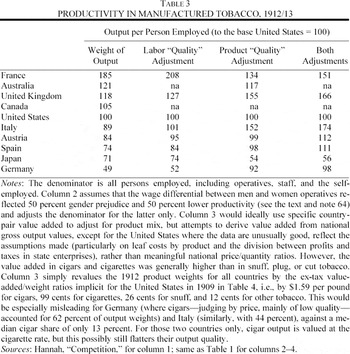
Finally, I have suggested a reworking of Madsen's data for 1912 to produce productivity estimates for a wider range of countries (
Table 3). The weight of tobacco manufactured per employee, normalized on the United States = 100 (the first column of the table), shows Germany significantly lagging, but otherwise little trace of the normally marked U.S. manufacturing leadership.
61 One reason for the difference in results is that the denominator in Table 3 includes all labor (including the self-employed and salaried staff), whereas Broadberry's denominator includes only operatives. The United States had an unusually large number of small family firms (thousands of whose, often hand-working, owner-managers are excluded by Broadberry), whereas in the United Kingdom and France tobacco output was more concentrated in large factories, so the difference matters.
These productivity calculations leave some room to debate the differences among the results, but the remarkable thing about them—and about all countries in Table 3—is the uniformity of outcomes. It should be recalled that at this time the typical American manufacturing worker produced about twice as much as the average British or German worker, three times as much as the average French worker, ranging up to nearly nine times in the case of the Japanese.62
Broadberry, Productivity Race, pp. 2, 48–57.
The output-per-person-year figures for tobacco, by contrast, are everywhere in the same ballpark: this was an industry in which, remarkably, the whole world was developed, or was as near to that outcome as we are likely to find.
63 Clark, “Why isn't the Whole World,” is a thought-provoking discussion of why this cannot happen.
(Perhaps more accurately, the whole world was
underdeveloped, because, even in the United States, most tobacco manufacturing was still done by handicraft—or modestly mechanized—processes and even standard cigarettes were still profitably hand-made in low income regions of Cuba, Saxony, or Iberia). The United States did not show its normal early-twentieth-century pattern of forging ahead. This is particularly surprising in that, in America, this was still (just, at 52 percent) largely men's work, whereas tobacco operatives in the rest of the world, as devotees of
Carmen know, were predominantly female (95 percent in Spain and Italy and 87 percent in France). Both the high productivity of Frenchwomen and the power of male-dominated unions in U.S. cigar manufacturing suggest caution in inferring, from men's wages everywhere being around twice those paid to women, that men were more productive. However, there is some evidence that women were less skilled, less experienced and produced less on piecework.
64 Brissenden, Earnings, p. 377; Oakeshott, “Women,” pp. 567–72; and Madsen, State, p. 43.
The second column makes an adjustment for possibly lower female productivity on the assumption that only half the wage differential was due to gender prejudice and shows the United States in uniformly poorer light. Nor does the further adjustment for product quality in the last two columns fundamentally change the United States's mediocre productivity ranking. If the whole world was developed, it seems reasonable to characterize this—as our earlier analysis also suggests—as a consequence of U.S. tobacco manufacturers behaving badly, not because the rest of the world did particularly well.
However, the country that forged ahead of the pack in Table 3—France—had a tobacco industry with characteristics that, in other contexts, have usually been described as American. France had the most standardized output of any country in the table: scaferlati (cut tobacco for pipes and roll-your-own cigarettes) and the cigarettes made from such tobacco accounted for 81 percent of production by weight and 76 percent by value.65
State-owned, it had one of the most professionally managed, long-established, and centralized management hierarchies in an industry that, in many countries, including the United States, was still in the hands of small, medium, and large family firms, only just beginning to experience bureaucratization and the divorce of ownership from control. The French
Régie had for long recruited on merit by competitive examination, and employed some of France's top
polytechniciens in senior management positions.
66 Eveno and Smith, Histoire.
The precocious performance of the Japanese state monopoly should also be noted: it had vastly reduced the normal nine-fold U.S. productivity advantage, long before that was approached by other Japanese manufacturers. As in France, demand was relatively standardized, though Japanese cut tobacco (77 percent of 1912 output by weight) was still mainly smoked in the traditional long-stemmed, small-bowled kiseru, and was more finely cut than the tobacco used in cigarettes.67
Anon., Tabako, vol. 4, pp. 682–84.
The Japanese tobacco manufacturing monopoly had been established as recently as 1904, by bureaucrats knowledgeable of French achievements, following the established Meiji-era habit of copying the best in the West (the local model provided by Duke's Japanese subsidiary was explicitly rejected). The Monopoly Bureau of the Ministry of Finance recruited well qualified engineering and law graduates from the top imperial universities: the head of the bureau in 1912, Osachi Hamaguchi, was a graduate of Todai and a future prime minister of Japan. Within several years, the bureau substantially raised prices and revenues, concentrated its consequently stagnant output on large factories, and nearly doubled the productivity level that had been achieved under private management. However, contemporary complaints that standardization of demand by state monopolies failed to match consumer preferences and the ambiguous impact of the imperfect product quality adjustments in
Table 3 suggest that more research would be advisable before inferring the general superiority of the socialist “visible hand.”
68 Madsen, State, pp. 45–46, 267–71.
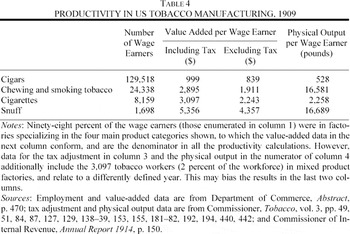
Countries such as Germany, whose capitalist producers specialized in cigars, found it difficult to match the productivity of countries such as Britain and France, which concentrated on cigarettes and smoking tobaccos. The U.S. failure to forge ahead can also be traced to the influence of the cigar. Table 4 disaggregates the U.S. tobacco industry's value-added and employment for 1909 into four specialist product sectors; disaggregated physical output data are also available for that census year. Cigar manufacturing accounted for over three-quarters of the wage-earners in U.S. tobacco manufacturing, and labor productivity in cigars (in terms of value-added or physical output) was markedly lower than in other sectors.
The U.S. cigar sector did no better in physical productivity terms than Germany's, though it did better in terms of value-added per worker, but it was U.S. performance in other sectors that enabled it to outpace Germany. Malcolm Burns has usefully drawn attention to the wide range of mechanization and productivity improvements in plug, smoking tobacco, and snuff.69
The data in
Table 4 confirm both the quantitative significance in the United States of these sectors' employment levels and their favorable productivity performance (higher in physical productivity terms and not much below cigarettes in value-added terms). Burns also lauds the trust for achieving economies of scale and production efficiencies by concentrating manufacturing into fewer, larger factories. However, the survivor-technique evidence that he uses cannot refute the alternative hypothesis that large bureaucracies such as American Tobacco preferred larger factories for their administrative tidiness, or, more charitably, as a way of neutralizing the managerial diseconomies of scale inherent in enormous enterprises.
Yet can we fairly credit the trust with the major contribution to productivity improvements in this sector? Productivity growth had been very rapid in the earlier period of vigorous competition between family-owned firms in chewing and smoking tobacco and snuff, when a wide range of new tobacco machinery was being adopted. As Burns candidly notes, “the independent manufacturers were rather highly concentrated in 1897”: that is before the trust bought most of them in the following five or so years, thus turning a series of specialty oligopolies into a diversified near-monopoly.70
We can measure productivity growth in this sector (manufactured tobacco other than cigars and cigarettes) in the period of family control in the nineteenth century (when efficient firms with large plants were gaining share largely by internal growth) and in the later period when the trust was digesting them (further concentrating output into fewer, even larger plants). Value-added per worker increased by an outstanding 119 percent in 1879–1889; by a still impressive 92 percent in 1889–1899; but by something nearer the average for U.S. manufacturing—28 percent—in 1899–1909.
71 U.S. Department of Commerce, Abstract, p. 700.
The initially high rate of productivity growth, driven by mechanical innovations induced by competition between its predecessors, fell, under trust control, to modest levels. Even this may have been illusory: the recorded increase in “value-added” in the decade of full trust control probably derived more from increased monopoly profits than from enhanced efficiency.
72 Compare the trust's 1899 and 1909 costs and profits in this sector in Commissioner, Tobacco, vol. 3, pp. 51, 87, 128, 139. For general skepticism on the benefits of the 1898–1902 merger wave, see Lamoreaux, Great Merger Movement; and O'Brien, “Factory Size.”
The fable leads us to believe that America led in cigarette productivity, but there, too, the picture was mixed. U.S. cigarette productivity (see Table 4) was, in physical output terms, lower than that of other sectors (except cigars), though cigarettes commanded a higher price, relative to weight, than many tobacco products, so their value-added per worker was slightly greater than for smoking and chewing tobaccos. The new cigarette technology palpably added value: Bonsacks were remarkable machines to watch and rarely failed to enthrall the economic tourists of their day.73
Provost, L'Industrie, p. 64.
In 1890 Duke had been willing to pay the Bonsack Machine Company one-twelfth of his initial cigarette profits for exclusive use of the machine, so he evidently rated it highly.
74 Winkler, Tobacco Tycoon, pp. 79, 82; Commissioner, Tobacco, vol. 3, p. 155; but compare the less extravagant payment a professional engineer could negotiate in Alford, Wills, pp. 144–57, 229.
It was also constantly being improved. Early best outputs were 200 cigarettes per minute, twice that of rival 1880s machines. By 1913 the standard output was 450 per minute. Yet cigarette machines were a case of multiple, simultaneous invention and were easily manufactured. Bonsacks were only securely monopolized by the trust (and in the domestic market only) between 1890 and 1895 and Bonsacks made in New York, Dresden, and Paris were widely available internationally. Many less efficient but serviceable rival machines were successfully produced worldwide and used profitably by other cigarette companies. The French state monopoly licensed Bonsacks before Duke, but found their upkeep expenses high, so also used slower Decouflé machines, which Duke also felt had sufficient promise to justify buying the U.S. rights to pre-empt competitive use.
75 Commissioner, Tobacco, p. 266; and Provost, L'Industrie, p. 307.
The Ikegai Ironworks, in Japan, had difficulty manufacturing western textile machinery to the required tolerances, but could turn out dozens of copied cigarette machines at ¥400 ($200) each by 1899/1900.
76 Hanabusa, Ikegai, p. 149.
The emphasis in the fable on the paper-wrapping part of the cigarette production process is also misleading. Speed was the impressive essence of that part, but cigarette manufacture was, in fact, one of the slowest of all contemporary manufacturing processes. It typically took one-and-a-half years to make a cigarette, from the initial factory curing of leaf to the final packaging and dispatch to jobbing wholesalers. The largest capital cost of a cigarette manufacturer was thus tobacco stocks and work in progress, rather than factories and machinery, and the prized “manufacturing” skill was leaf blending.77
Provost, L'Industrie, pp. 61–62; Tilley, Reynolds, p. 174; and Alford, Wills, pp. 179, 181.
Alexander Field's choice of American Tobacco as his prime manufacturing example of the capital-saving bias of the modern corporation is therefore particularly inapposite: the Bonsack's saving of capital was infinitesimal.
78 Field, “Modern Business Enterprise,” p. 477. If the “economies of speed” were between a very slow handworker taking, say, an hour to make a cigarette and the Bonsack a split second, the inventory cost saved out of, say, 500 days, would be under 0.001 percent; American Tobacco was a standard Hicksian labor-saving innovator.
Contemporary technical manuals emphasize the wide range of other mechanical contrivances for processes such as curing, drying, compressing, stemming, fermenting, ageing, conditioning, damping, stoving, cooling, and cutting leaf (processes common to other tobacco products), saucing, twisting, and shaping plug, pulverizing snuff, and the final packaging (which again was common to the whole range of branded tobacco goods, with a variety of different proprietary technologies for packing).
79 Balanced accounts of technical innovation in tobacco manufacturing include Alford, Wills, pp. 139–57, 161–63, 225–33; Provost, L'Industrie, pp. 50–447; and Tilley, Bright-Tobacco Industry, pp. 568–92.
In cigar-making there were also important productivity gains from reorganizing table-top work-flow in teams and ancillary equipment for handworkers.
80 Cooper, Once a Cigar Maker, pp. 18, 30, 170–76.
The importance of any innovation thus depends on three factors: the efficiency of the technique compared with alternatives, its application horizontally to other sectors of tobacco manufacture, and its proportionate importance vertically in the extended process of manufacturing.
The Bonsack performed well in the first, not at all in the second, and modestly in the third respect. We can measure its overall impact more precisely in 1889, when Duke discontinued hand-rolling. That still meant employing 350 girls on making and packing the cigarettes, in addition to the workers in the earlier stages of tobacco preparation, so the impact on total employment was less than the 48:1 ratio of the output of one machine to one skilled handworker would suggest. The early machines required a loader, an operator and a catcher, though this was eventually reduced to one, or, on faster machines, two attendants, with the help of a skilled development engineer. His annual commission, equivalent to the wages of 70 girls in 1889, negated some of the savings, but the local women and girls now employed were paid less than half as much as the skilled immigrant males that Duke had employed on hand-rolling. Duke's 24 Bonsacks of 1889, producing 834 million cigarettes, were replacing 1,080 hand-rolling jobs.81
On the assumption that they saved 45 jobs per machine: 48, less 3 operators (Tilley, Bright Tobacco, pp. 476, 572; Commissioner, Tobacco, vol. 3 p. 149; and Roberts and Knapp, “Paving”).
The industry-wide labor-saving impact in the 1880s of all sources of productivity change can be obtained by applying the labor productivity levels for tobacco manufacturing in the 1879 census to the tobacco output levels of the 1889 census and comparing the result with the actual 1889 employment levels. The total labor saving over the decade was 34,308 workers in cigars and cigarettes and 35,471 in other tobacco, so Duke's Bonsacks, saving the work of 1,080 hand-rollers, contributed 1.5 percent of the productivity improvement in U.S. tobacco manufacturing in the 1880s. If half the cigarettes made by the other members of the combination of 1890 were from Bonsacks operated as efficiently, these machines and Duke's accounted for 3.7 percent of the industry's labor productivity gains. This was less than their share of tobacco sales, so their productivity achievement, even with a generous allowance for other innovations they used, is unlikely to have been much above the industry average. This contribution could have increased in the following decades, with increased efficiency of the Bonsacks, or of the derivative Standard machines manufactured by the trust. However, as the invention was only one part of the production process of a product whose initially small share of domestic U.S. leaf tobacco use peaked at just over 6 percent in 1896 before declining to below 3 percent for several years after 1901 (when Duke sold fewer cigarettes in the United States than in 1890), not regaining its 1896 level until 1911, it is difficult to envisage the number becoming very large in the three decades following the 1881 patent.82
Commissioner of Internal Revenue, Annual Reports, various dates.
The prewar story of productivity growth in U.S. tobacco manufacturing can only accurately be told as one of widespread and pervasive advance on a broad front of mechanical contrivances.
Bonsacks were ten times more important for Britain, with twice as many machines installed in a tobacco market less than one-fifth the size. As we saw in Table 2, cigarettes—overwhelmingly made on American-designed Bonsacks and Standards—accounted in 1912 for 42 percent of U.K. tobacco sales. Several decades later, when cigarettes achieved that degree of market penetration in the United States, new inventions were eclipsing the pioneering American technology of the fable: Bonsacks were being replaced by Molins machines (with speeds in excess of 1,000 sticks per minute), using a technology developed by Cuban-American immigrants to Britain and financed by Imperial Tobacco.83
Cigarettes in their final—and curiously belated—triumph in the United States were largely manufactured by imported technology, just as their earlier, precocious triumph in Britain had been based on the American Bonsack.
American Tobacco may not have been able to outstrip the French monopoly's productivity in manufactured tobacco overall, or British productivity in cigarettes. The behavior that led to this, it has been noted, has, in other contexts, been seen as distinctively European. One major difference with European economies is nonetheless evident: these factors prevented America forging ahead, but they did not lead to falling far behind. If the United States got some things wrong in this industry, there was still something that kept its productivity nearer to that of the European leaders than they themselves were to higher American productivity in manufacturing generally. This appears to have owed only a modest amount to the technological prowess of Bonsack (who sold more machines abroad) or to the visible hand of Duke (whose mature actions were often negative). It can as plausibly be traced to productivity advances achieved earlier by the traditional family tobacco firms that the trust took over. Perhaps some is due also to the independents who still accounted for most tobacco manufacturing value added in the United States. We do not know what caused the collective economic performance of these many contributors: perhaps competition worked well in cigars and until the late 1890s elsewhere; perhaps this industry was infused with the go-getting business culture that made immigrants to New York more entrepreneurial than culturally identical immigrants to London; and perhaps high U.S. wages induced higher work effort in tobacco.84
Godley, Jewish Immigrant Entrepreneurship, introduces some of these issues.
There was, as Alfred Marshall put it in a different context, “something in the air” in America that drove even its mediocre performers like those in manufactured tobacco to levels that could still look Europe in the face.
THE WHIG MISINTERPRETATION
The story I have told diverges somewhat from the traditional fable of American Tobacco, and it is worth asking why such a misleading account has been current for so long. Much of this is due to the false dichotomies of the “robber baron” tradition and reactions to it that inhibit recognition that businessmen such as Duke had both negative and positive effects. Technical innovation, economies of scale, monopoly prices, overweening ambition, large failed strategic bets, greed, and predatory behavior soon become bedfellows. It is not easy to conclude where the balance of advantage to the public interest (or even to stockholders) lies, and any historian is strongly tempted to duck balanced judgment in favor of a clear central theme. The problem is certainly not systematic or deliberate falsehood, for the canon of the fable rests on a factual narrative that is eerily accurate in detail, but misleading in substance.
The fable can most obviously be faulted for sins of omission. Evidence selection favors the relentless assertion of American modernization and managerial integration, led by cigarettes. The fable tells us that Duke's 1880s marketing innovations were essential for transforming the industry using the Bonsack (which is true), but not that he later presided over a long stagnation of the cigarette industry, which compromised the extent of the machine's use. The fable tells us that Duke attained the massive sales total of five billion sticks in the United States (which he did), but not that the British, German, Japanese, and Russian cigarette industries (and the American cigar industry) had done so earlier, nor that this contrasts with a normally higher U.S. rank in mass market, consumer goods, and transforming, machine technologies. The fable tells us that top British managers were from old-established tobacco families (which they were), but not that this was the norm everywhere (except state monopolies), nor that the business performance of family firms, both in America and in Britain, was overwhelmingly positive. The fable tells us that German producers developed no really strong cigarette brand (which is true), but not that Duke's product differentiation strategy led to similarly low sales for the top American brand. Repeatedly, the fable misrepresents the historical contingencies faced by the actors, and the knowledge and constraints within which they operated, presenting historical outcomes as the linear product of the modernizing intentions of far-seeing professional businessmen, rather than of more complex and somewhat less unidirectional interactions and processes, in which old and new struggled in the uncharted strategic space of the messy present, to produce outcomes that were often unanticipated.
These biases mirror those analysed by critics of the Whig interpretation of history in the political sphere, with the heroic visible hand of corporate management taking the place of liberty and democracy in the Whig fable and driving a similar, grotesquely partisan, airbrushing of the evidence.85
Butterfield, Whig Interpretation. The problem extends far beyond the tobacco case, see Hannah, “Marshall's Trees”; and Lamoreaux, Raff, and Temin, “Against Whig History.”
The worlds in which both fables prospered were worlds in which a fundamental truth (whose triumph and desirability were being peddled) was so self-evident that it was easy to read back into the historical evidence things that simply were not there. Historical explanation becomes trivial if supposed heroes can, however capriciously and anachronistically, be labelled “professional” (“Whig”), while the imagined villains can be tagged “family” (“Tory”) with parallel arbitrariness. The criticism is not of the objects of the fablers' praise (there is nothing wrong with liberty, or with good management), but of misplaced zeal to propagate what are profoundly unhistorical, teleological myths about the origins of what happened later. The United States really was in the 1960s the world's leading manufacturer of cigarettes (and of very much else), and the job of the business historian was to demonstrate the inexorable path of virtuous progress to that end point promoted by America's vital few.
The factual errors that this imperative induced are the most revealing (because unconscious) indicators of bias, even among the most skilled business historians. For example, Alfred Chandler, in a rare slip, credits the postdissolution American Tobacco Company, rather than R. J. Reynolds, with the Camel revolution.86
This—of course, unwittingly—fits his thesis more comfortably than the truth: that the antitrust break-up of 1911 enabled a North Carolina family firm finally to turn around America Tobacco's dismal performance in cigarettes. The fablers instinctively depict that antitrust dissolution—for Reynolds, and U.S. consumers, a welcome liberation from the dead hand of the tobacco trust—as a regrettable brake on the development of a fine corporation.
87 Chandler and Hikino, “Historical Perspective,” pp. 228–29. Compare Daniels, Tar Heel Editor, p. 476.
Of course, all historical narratives require the selection of evidence and the reader might legitimately enquire why she should believe the present story rather than the traditional fable. The evidence base is hardly new: almost all the sources quarried here were published decades ago and were available to—indeed, widely cited by—the fablers. One advantage of the present version is that it rests on a reasonably firm statistical base, which is at least a discipline on authorial bias, albeit (of course) not a foolproof cure. By contrast, the fablers simply assumed an uncomfortably large amount of their story of American leadership must be true.88
For similar criticisms, in the context of other industries, see Broadberry and Crafts, “Britain's Productivity Gap,” pp. 534–35, 548–49, 553–55. For American Tobacco's international performance, see Hannah, “Strategic Games.”
On the whole, historians should favor accounts that explain what happened, over alternative narratives that, however compellingly, explain something that did not happen.
The stage was set by 1912 for one of the world's most interesting—but still largely unexplored—natural experiments in industrial economics. There was an unusually level playing field—in terms of initial productivity levels and technical potential—between all countries. The global tobacco industry as it actually existed after the antitrust break-up of 1911 provided a remarkable laboratory of industrial organization, prompting questions on the output, profitability, and productivity outcomes of state versus private ownership, of monopoly versus oligopoly, and of nationally owned versus multinational enterprises.89
For glimpses of the outcomes, see Zitzewitz, “Competition”; and Hannah, “American Miracle,” pp. 212–13.
If this article succeeds in refocusing attention on such questions of comparative industrial organization that really require analysis, it will have succeeded in its major purpose. We might then be able to construct a new business fable that serves the true purpose of the genre: to illuminate rather than obfuscate the issues.
Thanks for advice to participants in seminars in Canberra, Hirosaki, Madrid, Oxford, and Tokyo, to Bernard Alford, Howard Cox, Patrick Fridenson, Kazuo Wada, and Eric Zitzewitz, and to two anonymous referees.